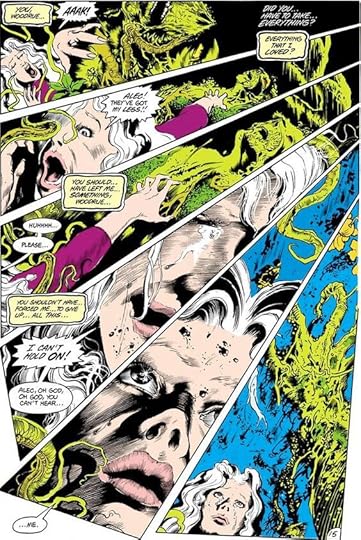
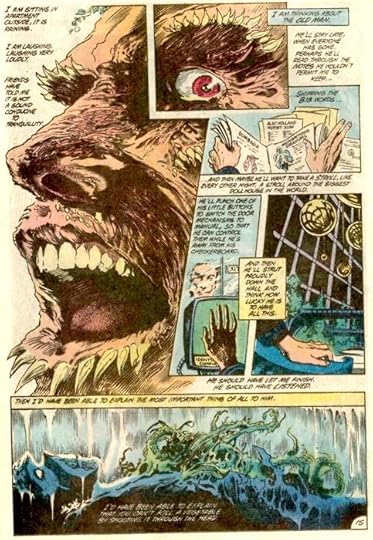
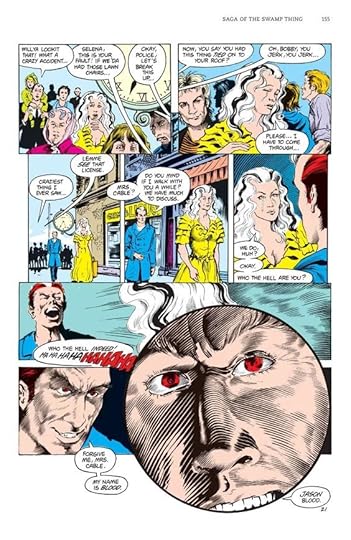
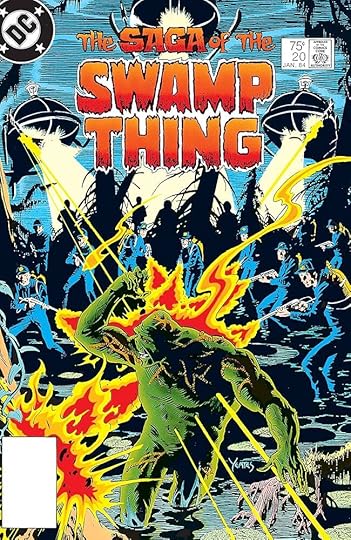
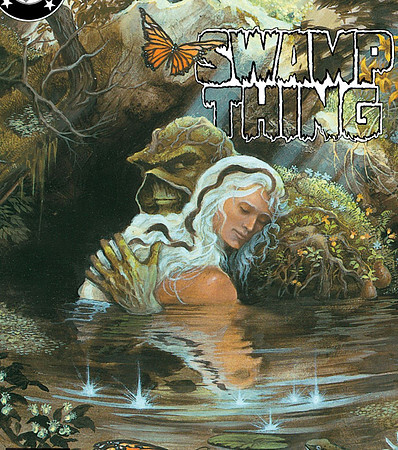
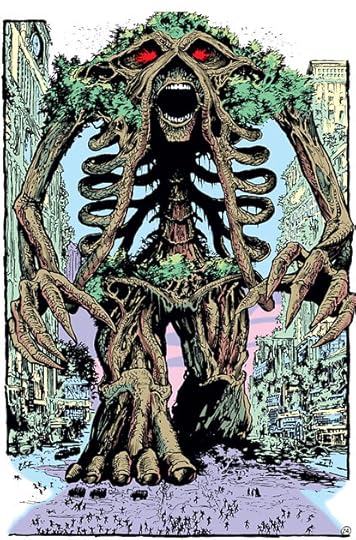
De 1983 a 1987, um jovem escritor britânico chamado Alan Moore revolucionou os quadrinhos dos Estados Unidos. Sua abordagem revolucionária na série do Monstro do Pântano, da DC Comics, definiu novos padrões para a narrativa gráfica e desencadeou uma revolução na nona arte que se reflete até os dias de hoje. Partindo das premissas de horror gótico do título e construindo um marcante e intuitivo estilo narrativo e uma profundidade de caracterização sem precedentes, a visão de Moore foi traduzida em assombrosamente belos desenhos de colaboradores como Stephen Bissette, John Totleben, Dan Day e Rich Veich. O resultado é uma das mais duradouras obras-primas dos quadrinhos.
Este volume reúne as edições 20 a 27 de The Saga of The Swamp Thing, reproduzindo com fidelidade os primeiros passos de Alan Moore no título e inclui também prólogo do famoso autor de horror Ramsey Campbell e nova introdução pelo cocriador e editor da série original, Len Wein.
Alan Moore is an English writer most famous for his influential work in comics, including the acclaimed graphic novels Watchmen, V for Vendetta and From Hell. He has also written a novel, Voice of the Fire, and performs "workings" (one-off performance art/spoken word pieces) with The Moon and Serpent Grand Egyptian Theatre of Marvels, some of which have been released on CD.
As a comics writer, Moore is notable for being one of the first writers to apply literary and formalist sensibilities to the mainstream of the medium. As well as including challenging subject matter and adult themes, he brings a wide range of influences to his work, from the literary–authors such as William S. Burroughs, Thomas Pynchon, Robert Anton Wilson and Iain Sinclair; New Wave science fiction writers such as Michael Moorcock; horror writers such as Clive Barker; to the cinematic–filmmakers such as Nicolas Roeg. Influences within comics include Will Eisner, Harvey Kurtzman, Jack Kirby and Bryan Talbot.
I really wasn't sure what to expect but DAMN! Yes, I realize I should have listened to all of you who for years have been telling me to get off my duff and read this. You guys were right and I will forever bow to the knowledge of my betters. Until the next time when I ignore your good advice b/c I'm an asshole.
I'm not a Swamp Thing expert (obviously) and I certainly didn't know anything about what had been going on with this character prior to Moore's incarnation. Apparently, he'd been shot up by someone or something like that. Yes? He was all half-dead when this opened and there were some vague references to some kind of a big battle(ish) thing that had taken place. Abby and her husband whatshisname were digging around in the swamp looking for Alec and talking about it cryptically.
And that might be the "worse" thing about this. You're sort of dropped into the middle of the story with Swamp Thing (Alec Holland) remembering past things, Abby running around weeping over her seemingly dead friend, and her husband just acting like a creep. There's really no backstory for the reader regarding any of that.
The big takeaway is that Swamp Thing finds out that he isn't Alec Holland covered in moss, but that he's a sentient plant creature who was created when he absorbed the memories of Alec Holland at his death. WHAT?! That's kinda awesome. And I'm sure it was even more awesome if you were reading it as it came out in single-issue form in the 80s. And let's not forget the Floronic Man. Or the freaky demon monkey that Jason Blood comes to town for. These were excellent storylines with creepy, well-thought-out villains.
This is a horror comic done so well you almost miss that it's a horror comic. I'm probably not saying that right, but what I mean is that nothing here feels gratuitous. It's that the chills sneak up on you and just kind of linger riiiiight under the surface of the whole story.
Alan Moore is kinda hit or miss with me, but this was 100% a hit. Damn good stuff. Highly Recommended.
This is a little strange, as I loved picture books. And I loved reading. Even so, I'd just never gotten into it.
But back when I was 10 or 11, I was in a convenience store with my mom. I saw a rack of comics and thought to myself, "Maybe I could buy one. Maybe this would be cool..."
So I picked one at random off the rack, took it home, and read it.
It freaked my shit out. Like, all the way out. Absolutely terrified me.
I didn't understand what was going on (it wasn't the first book in a series) but there were some kids goofing around with a Ouija board, and then some sort of fucking monster appeared and killed them. There was blood everywhere.
I hid the comic in my toybox and tried not to think about it. I didn't pick up another comic until I was in my twenties and already in college.
That comic was part of Alan Moore's run on Swamp Thing.
These days, I like to consider myself fairly well-read in comics.
Looking back, it amuses me that I was lucky enough to pick up something written by Alan Moore for my first comic experience. Contrarywise, I'm a little sad that it was so obviously the wrong comic for me to try to start with.
It's interesting to read these comics now. Moore tells a good story, but even so, these were written back in the early 80's, and it shows. It's not his best work.
That said, when you're dealing with someone like Alan Moore, even less than their best is pretty excellent. For that, and due to a little bit of fond nostalgia, I'm giving this one 5 stars.
The Swamp Thing's epic run by Alan Moore begins here!
This TPB Hardcover Edition collects "Swamp Thing" (Vol.2) #21-27.
Creative Team:
Writer: Alan Moore
Illustrators: Steve Bissette & Rick Veitch
A GOOD ROOT GROWS
If you are a fan of Alan Moore, you must read these hardcovers editions. No question about it.
For me it had been a wonderful experience.
It's amazing how brilliant is the writing and how great are the events.
You will never see the character of Swamp Thing in the same way, after to read this TPBs.
A RESPECTFUL WRITER
I was more than happy when DC re-published the run of Alan Moore on Swamp Thing on these elegant hardcover editions and I didn't need even a second to decide that I want to buy them.
One thing that you can perceive about the personality of Alan Moore and his respect to the work of others is that precisely when he took the job to write Swamp Thing, sure he changed things, every new creative team changed things when they took over a comic book title BUT Alan Moore dedicated a whole issue to resolve and to close the previous story arcs, in rightful and respectful way.
It wasn't like in other titles that somebody kills a character and bam! the new creative team "resurrect" him/her with some dumb explanation. Or even without any explanation at all.
Oh no, Alan Moore came to a respectful closing in his first issue and then, in the next issue he started to develop his own ideas.
THE CREATIVITY'S SEED
More than Watchmen, V for Vendetta or any other of his very popular works, HERE, on Swamp Thing is the best proof of his mastery of words and his remarkable genius.
Since... hey!, we were talking about Swamp Thing, at that moment in comic books, nobody cared about if that title was even active, and Alan Moore showed a great truth:
Any character can be interesting in the hands of a talented writer.
Here Moore laid down a marker in the history of comics, ominous and unlikely as Archduke Ferdinand's tomb. Reading through the new wave of British authors who helped to reconceptialize the genre for us poor Americans, one understands more and more why it had to be this man. There is a flair amongst them all for a certain madness and depth of psychology, but Moore was the only one who didn't think it made him special. Our curiosity is always piqued by the mysterious stranger, and Moore will always be that.
There is a quote of Emerson's which helps elucidate men of mystery: "to be great is to be misunderstood". Most Zeppelin fans don't see the band in terms of their roots in early blues, just as most Tolkien fans (and followers) don't have the education to recognize the Welsh and Norse folktales he was emulating. It seems the kernel of an author's inspiration is often so specific and poorly-understood by their audience that they it becomes an endless and entrancing mystery.
There was an undeniable and immediate difference in the comic authors of the early eighties, but many of them sinned by way of dadaism, indulging difference for its own sake. After recognizing this brazen and laughably naive rebellion, one begins to understand why most of these writers couldn't keep from breaking the fourth wall and injecting themselves into the text; Morrison has never stopped doing it.
The difference between them and Moore was one of reason; and like Milton's Lucifer, their reason was flawed; and like him still: it was pride. As a young and budding author, I saw in Morrison's 'Invisibles' and, to a lesser extent, in Ennis's 'Preacher', what a silly thing it is to believe your own stories.
Gaiman we may reprieve: unlike the others, he has never imagined himself mad. His penchant for myth and psychology stays rather trimly in the realm of the curious academic, though becomes quite laughable when he attempts to portray chaos. Gaiman's is the most predictable chaos you will ever meet this side of a fourteen-year-old girl who likes penguins.
Moore, however, has loomed over us in a state of questionable sanity for his entire career. Bearded, wild-eyed, long-winded, and obsessed with little things we don't even think about, and yet completely generous and unselfish with his pen. There is something we do not trust about the man who avoids the spotlight; who spurns money; who believes in the power of names enough to remove his from this or that film. The man who stands over and over a proven genius and who plods on into stranger and wider territory is almost an unknowable commodity.
That Alan Moore cares about things we cannot see, and cares nothing about that which we expect him to becomes his strength. In his unpredictability, we come to find new and inspiring sides of ourselves, and of comics, and of others.
If Morrison has lived his entire career as the incorrigible teenager of comics, inspiring in his gusto but disappointing in his ego, then Moore has always been the old man of comics, a crafty wizard who knows things we don't want to know, who leads us patiently through our wide-eyed bumbling and self-absorption, past the explosions and gun battles, and into our own back yard to show us something beautiful that was there the whole time.
We'll wonder why he doesn't want our thanks. Or our praise. We'll wonder why he seems tired and haggard. We'll try to catch his red-rimmed eyes, as if he'll betray by some gesture or expression just what it is he gets out of the deal.
There is a red and angry world. Red things happen there. The world eats your wife. And eats your friends. It eats all the things that make you human. And it turns you into a monster.
As a youth I didn’t get Swamp Thing. And reading this as an adult it’s rather easy to see why. Before I get into any details, I have to just say that the prose in here is breathtakingly beautiful at times. This is not a book for children; it is a book for people who have seen a bit of the world and have experienced some loss, some fear, some responsibility, some of the things that come with adulthood. Because, frankly: how else could you identify with what happens here?
It is also not a conventional “superhero” story by any definition. Consider the following:
Moore's Swamp Thing had a profound effect on mainstream comic books, being the first horror comic to approach the genre from a literary point of view since the EC horror comics of the 1950s, and he broadened the scope of the series to include ecological and spiritual concerns while retaining its horror-fantasy roots - Wikipedia
Ecological and spiritual concerns? As a child this was far, far removed from my mind. Other than that, there are a multitude of things writhing beneath the (thin) veneer of “superhero” story: the nature of good and evil, what it means to be human, friendship and love, the effect of fear et al… (consider, for example, the story and eventual fate of the Monkey King). I should also mention the complex relationships between Alec Holland and his handful of friends, and specifically Abigail. And now I have.
It's raining in Washington tonight. Plump, warm summer rain that covers the sidewalks with leopard spots. Downtown, elderly ladies carry their houseplants out to set them on the fire-escapes, as if they were infirm relatives or Boy Kings.
Sometimes hopeful, sometimes bizarre, often crushingly depressing, but always beautiful. Alan Moore’s Swamp Thing is one of the best examples of this type of thing that I have read in, well, probably ever.
He’ll be pounding on the glass right about now… …or maybe not now. Maybe in a while. But he’ll be pounding. And… And will there be blood? I like to imagine so. Yes, I rather think there will be blood. Lots of blood. Blood in extraordinary quantities.
It gets violent, yes. And quite so at times. But not in the most likeliest of ways. I was often surprised at the turns that the story takes. It really is a marvellously atmospheric Southern Horror. And, in a stroke of ingenuity, the artwork is often just as bizarre and off-beat as the rest of the affair.
It’s quite apparent that Moore was very careful to not walk the same ground that other writers were covering. He was taking the road less travelled.
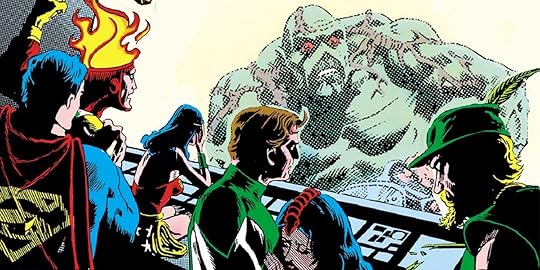
And, even though they don’t really feature in the story, describing the Justice League:
There is a house above the world, where the over-people gather. There is a man with wings like a bird. There is a man who can see across the planet and wring diamonds from its anthracite. There is a man who moves so fast that his life is an endless gallery of statues. In the house above the world, the over-people gather... And sit... And listen... ...To a dry, mad voice that whispers of Earthdeath.
So what is the down side here? Nothing really, but I do think readers have to at least bear the following in mind: Alan Moore only came aboard for the second run of this series, which means that by the time this book kicks off all the fundamentals had already been covered. That’s to say, Moore didn’t create Swamp Thing and he doesn’t tell the Origins story of the character. This had come before, and, since I haven’t read that yet, I do not know how that differs from, or impacts on, this particular part of the Swamp Thing mythos.
Have you ever been under? All the way under? Like I have? Oh like I have? - John Hiatt
I know this is a beloved book and so, so many people adore this and everything else Alan Moore wrote, especially in the 80s, and that all kinds of superlatives are thrown around when discussing Swamp Thing – and I’m not being contrarian when I say this isn’t all that and a bag of chips, either. Paul O’Brien from the House to Astonish podcast nailed it when he said that “if Alan Moore’s books were as good as everyone said they were, they’d cure cancer”. Which is to say, I think this isn’t a bad book but suffers somewhat from the enormous praise that’s built it up to an impossibly high standard, and when I finally read it, I found that it’s actually just an ok book.
First off, the numbering – “Volume 1”. Readers unfamiliar with Swamp Thing – and let’s face it, there are a lot! – might think this would be the best place to start but it in fact isn’t. At least, not if you want to see Alec Holland’s death/rebirth as Swamp Thing, or his relationship with Abby Cable née Arcane/Matt Cable, or his initial struggles with his new appearance. This book collects Moore’s first few issues writing the series but he started after nearly 20 issues had been out which means the book starts with issue #20 and goes through to #27, so you’re going to not quite get the characters/storyline from the get-go – and there’s no attempt to explain it later either.
You could argue that this is the first time the “real” Swamp Thing emerges as Moore’s take on the character is the first time Swamp Thing became more than a hacky monster tale and turned into a deeper, richer story. The second issue – The Anatomy Lesson – is the highlight of the book as Swamp Thing is captured and examined in a lab only to discover that Alec Holland isn’t Swamp Thing but that Swamp Thing is a mutated plant that thinks it’s Alec Holland (that might seem like a spoiler but it’s not as it happens really early on so it’s not like giving away the ending to the Sixth Sense - plus the book is 30 years old at this point!). It’s also a really well written story that starts off mysteriously, then goes back and circles back on itself in a neat one-issue story arc. I also really liked that Moore immediately defines that character his way with his vision of it on his second issue.
However, Moore only manages to create this kind of engrossing narrative magic a couple of times in this book – oddly in the issues that have very little going on in them – while the more action-packed stories are less artistic, less thoughtful, less involving, and it’s why I didn’t think this book is so amazing. There’s an extended story featuring one of the least threatening villains ever, the Floronic Man, aka Jason Woodrue, who should be renamed the Moronic Man. Why moronic? He attempts to wipe out humanity by upping the oxygen rate, not quite getting that this would also affect the plant life he believes he represents and is fighting for! Plus if your ace in the hole is a chainsaw, you’re done. You’re not Ash, this ain’t Evil Dead, I get the connection between chainsaws and trees, but seriously - a chainsaw against Swamp Thing? Come on.
The JLA get a cameo in this story despite not really doing anything – Superman and Green Lantern show up at the end to take away the Floronic Man after Swamp Thing defeats him and old Woodrue (wood – rue, get it? Not very subtle, Alan!) looks even more idiotic. He’s attempting to talk his way out of it and just looks like such a feeble old man next to Superman and Green Lantern - it’s pitiful. Superman puts his cape around Woodrue and takes him to Arkham. This guy was the big villain of the book!
Jason Blood/Etrigan close out the book as a demon shapeshifter emerges in the home for mentally disabled kids that Abby works in. Again, not a terrific villain and I felt Moore was pressing the horror angle a bit too hard. What I dislike about Etrigan – and for those who don’t know, Jason Blood made a deal with a demon, Etrigan, centuries ago, and the two are now bonded in one body forever – is the constant rhyming which I know is a big part of his character but it lends itself to soooo many bad rhyming couplets. That said, Moore does an admirable job with his rhymes and none of them stood out as too embarrassing.
Then there’s the 80s art… it’s ok in parts but pretty terrible in others. Stephen Bissette and John Totleben just can’t do action. The first issue opens with the military hunting down Swamp Thing and those helicopter attacks looked awful! The motion doesn’t look real and the explosions looked ridiculously phony. Also, towards the end of the book when Etrigan leaves and Jason Blood re-emerges, Blood’s character model up until then has been red hair with a streak of white but in this scene his hair’s gone dark blue and facially he looks identical to the character model of Matt Cable, Abby’s alcoholic husband. So Bissette and Totleben literally swapped out Jason Blood for Matt Cable in a scene featuring Jason Blood! That’s pretty damning. On the subject of faces, neither artist is particularly good at drawing them and frequently they look rushed and/or badly rendered.
But other times where there isn’t much movement or humans that just feature Swamp Thing? Beautiful. Not only that but the page layouts are really imaginative with plot elements framing a page and things like plant roots dividing up the panels. Or panels arrayed cleverly across two pages in a style that JH Williams III has made popular with his work on Batwoman. Before this, the only Swamp Thing I’d read was Scott Snyder/Yanick Paquette’s New 52 Swamp Thing and the most striking thing about that book was Paquette’s wonderful art and page layouts which I thought were original. Reading this book, it’s clear Paquette took his cue from Bissette and Totleben with their pioneering use of art and style in presenting their version of the character. So I’m split with the art – sometimes it’s hard to look at, badly rendered, or flat out too dated to be convincing, and other times I love what I’m seeing.
Swamp Thing is an interesting character and kudos for Moore for elevating the tone of the stories to a higher level. This first book has some nice narrative moments and does a major revamp of the way readers would see the character, but generally the stories, like the art, that comprise it are uneven at best. The book features some odd villains that are difficult to take seriously, and there’s no real direction for the character - I’m not sure what Swamp Thing’s purpose is - both things I’d like to see done better in later books. Saga of the Swamp Thing Volume 1 is a bit slow at times, a bit lugubrious like a lot of Moore’s writing, but otherwise it’s an ok read - just don’t get carried away by the hype.
2nd time reading, for a class on graphic novels, on the encouragement of G, and I like it better this time. It is pretty crazy in places, but also shows the depth that Moore brings to what seems to me to have been a mundane, run of the mill project. . . you know, a monster/horror book that he turns into this cosmic environmental hippie thing.
In some places it feels like a kind of mystic journey, an acid trip, a philosophical meditation on life and the planet, a meditation on the possibilities of comics, and so much more. Some of it is in verse, in one story the Justice League enters in. . . sometimes it feels like Moore has too many ideas going on for his own good, or that he is off his meds or on too many of them with his Druidic world view, but on any given page, there are more cool and inventive things than in most whole volumes of comics. He uses comics to try and say important things he cares about.
He's looking at racism/classism, the destruction of the planet, in part through the story of a doctor whose lab blows up, making him--not dead--but Swamp Thing, an organic conglomeration of human and Earth. And there's an endorsement of love and harmony as possible options in the face of dire present/future.
Moore also brings pathos and depth to a character lost in oblivion, as he does elsewhere time and time again. Moore loves comics. . . and he inspires the artists who work with him to match his level of inspiration. I still don't love this as much as some other Moore classics, but it is in there, one of the best, for sure. I'll read on, tryuing to immerse myself in the horror and grooviness.
Alec Holland's life was changed forever when he died and was reborn as Swamp Thing. Or was he?
My first exposure to Swamp Thing was in an issue of Captain Atom I had as a kid. At some point in the dim past, I read the first two Alan Moore trades but through the magic of getting older and drinking a small lake of beer, I've forgotten most of them. My wife nabbed me the first volume for my birthday so here we are.
The first issue of the trade ties up all the loose ends from Martin Pasko's run. From there, Alan Moore begins redefining the character and making Swamp Thing his own. By changing Swamp Thing from a man who became a plant to a plant who dreamed he was a man, he opens up a lot of new avenues for new stories and breaths new life into Old Swampy.
The Len Wein/Berni Wrightson Swamp Thing run felt like a throwback to EC Comics of the '50s. This feels more sophisticated and complex, focusing on psychological horror rather than the grotesque. The series later had the Sophisticated Suspense label slapped on it and it's a fitting one.
Alan Moore was the master of comics when we wasn't too busy bitching about them and this book is a big example why. It's not overwritten as some of his later stuff was but the man has a way with words. Once Swamp Thing stops trying to be Alec Holland, the roadblocks are removed and Moore starts taking Swamp Thing in new and interesting directions. Tom Yeates was good but the art really goes up a notch when Stephen Bissette and John Tottleben take over. Bissette's swamp animals in particular interest me since he later did the dinosaur book Tyrant.
Alan Moore's redefinition of Swamp Thing began something that eventually redefined comics. I need the other five volumes. Five out of five stars.
“The dark corners are being pushed back … a little more everyday. Perhaps there was once a world … we could have belonged to … maybe somewhere in Europe … back in the fifteenth century. The world was full of shadows then … full of monsters.”
So begins Alan Moore’s brilliant three-year run-on Saga of the Swamp Thing. The title had been set for cancellation due to low sales and DC execs gave relatively unknown writer Moore an opportunity to turn things around. By the time Rick Veitch took over in 1987, Moore and Swamp Thing had redefined the title and established it as a cult favorite.
Issue #21 The Anatomy Lesson from 1984 didn’t just change the Swamp Thing storyline but caused a ripple effect in comics that would darken the hue of graphic novels, adding a depth of horror and a more mature tone that has really never gone away.
The Floronic Man, Dr. Jason Woodrue (an older, minor character brought back to importance by Moore in a way that Tom King has in recent years, mining the great heritage of DC for new life) said of his autopsy “I am thinking about the old man. I am thinking about the cracking of his joints as he runs. I am thinking of the terror in his ancient, atrophied heart.”
Moore opened a previously locked door that fans have not allowed to be shut since.
Moore brings the Floronic man back, we also get to know Abigail Arcane better and of course Abby will become the love interest for Swamp Thing.
Bringing a literate, almost Bradburyesque tone to the title, this is an important run in the DC universe, as well as in comics, a MUST read for true comic book fans.
Swamp Thing is awesome. I was hoping for more swamp facts and swampishness in general but even though this is a classic it still feels fresh. Some of the swamp thing illustrations are incredible.
"The Anatomy Lesson" story in this volume is pretty amazing. In this story Swamp Thing discovers who or what he really is. Also, this volume introduces the idea of The Green, which is a really important concept in Swamp Thing lore. The art is freaky and the villains are quite interesting.
Alan Moore comes as close to legendary rock-star status in the comic book world as any comic book writer has ever come. If Grant Morrison is Mick Ronson, Moore is David Bowie.
With legendary titles like “The Watchmen”, “V for Vendetta”, “Miracle Man” and “The League of Extraordinary Gentleman” in his resume, Moore also wrote one of the all-time best (in my opinion) Batman graphic novels, “The Killing Joke”. He is also credited with writing one of the best Superman stories ever written, “Whatever Happened to the Man of Tomorrow?” (which I have not read yet).
He also resurrected another DC comic book series, originally created by Len Wein and Bernie Wrightson, that had been floundering somewhat in the mid-‘80s: “Swamp Thing”.
The tragic story of Dr. Alec Holland, who is murdered by a greedy industrialist but is resurrected as a giant green plant-creature that roams and protects the Louisiana bayous is, perhaps, well-known to fans of Swampy.
It was Moore, though, that re-invented Swampy’s origin story by famously making him “a plant that thinks it’s a man”, bringing a darkly existential twist to the story by questioning the very notion of humanity and its ecological place in the world.
Book One of the “Saga of the Swamp Thing” compiles issues 20-27, the issues in which Moore was brought on to be head writer.
Issue #20, appropriately entitled “Loose Ends”, carries on and completes a storyline started by the previous series writer, Martin Pasko. Moore essentially kills off or dismisses every character deemed secondary or ultimately unnecessary to the continuation of the series, and the issue also ends with Swamp Thing’s “death” and eventual removal from the swamp by the Sunderland Corporation. Issue #21 literally starts with a “rebirth” of Swampy. (Think Baby Groot only slimier and a lot more bloodshed.)
The villain of the series is Jason Woodrue, a.k.a. The Floronic Man, who has the capability to talk to plants. Purposely ingesting pieces of Swamp thing, Woodrue’s powers are increased tenfold. He is now bent on world domination by turning all vegetation on Earth against humanity.
The cameo appearance of the Justice League of America (Issue #24) has the potential to be cheesy, but it surprisingly works, mainly because Moore wisely uses them to reshape Swamp Thing as a very different kind of superhero.
Moore would go on to write for the series for several years, revitalizing it and making it one of the most beloved lines in the DC Universe.
So good. Like the great EC horror comics from the 1950s, Alan Moore’s Swamp Thing stories from the mid-1980s do not exploit our fear of the Other, but instead force us to face the dark, downright nasty underpinnings of our own modern world, the frailty and absurdity of our own bodies. These are psychological, often philosophical horror stories, sharp and subversive, lyrical and hypnotic, brought to life by artists Steve Bissette and John Totleben in wonderfully creepy fashion.
By the way, as I am reading this series in its single-issue form, I found myself enjoying the letter pages quite a bit. In a letter written months prior to the arrival of Alan Moore (published half a year later in #22: those were slower times...), for example, Roger Myers from Berkshire, England, warns American readers still unfamiliar with then-2000 AD writer Moore that they "are in for a real treat," because "that man is nothing short of absolutely brilliant." And then the enthusiastic responses to Moore's first issue, of course: "destined for stardom," Paul Harrison from Shropshire wisely predicted. Letter pages, sigh...
I'm slightly biased in favor of Swamp Thing in general since reading Snyder's work, and I'm willing to let some other things slide because this is still Alan Moore of Watchmen and V for Vendetta as he's first gaining his fame in the early 80's, so even when I'm juggling all this in my mind, where does this first volume actually land?
It's okay. It doesn't feel *at all* like a comic for children, and I keep this in my mind because at the time this was written, *MOST of them STILL WERE*. Instead, it's full of tales of descending into madness, loss of identity, fear, and even a bit of heroism when no one else wants to even attempt it.
I mean, who gives a crap about some bumluck Louisiana town being ravaged by some *other* green meanie? Not the Justice League, that's for sure. As we see.
I really enjoyed the story where Alec was on the autopsy table for the entire tale. It was a great twist on the ghost story, especially when he comes back and learns that his entire self-identity is a lie.
There's so much of that going on throughout this volume, too, and it's definitely not limited to Alec, himself. The Swamp Thing is hardly the only major character. In fact, the villains are all nicely rounded and fairly easy to sympathize with. :)
That being said, I'm judging this all by the time it was written.
If I judged it by today's standards, I might say that it has greater subtlety than most of the comics coming out, it suffers greatly in the actual artwork being produced, and the themes feel only a bit less well-defined and bigger than life than some of the best I've read out of the modern batch.
But is that merely a sign of changing tastes after more than 30 years? Possibly. After having attempted 40's and 50's comics, my auto-vomit reaction was in full bloom, so I can absolutely appreciate how adult this one is compared to all that dross. It's all relative.
I think it's safe to say that this one began to pave the way for all the wonderfully dark and adult comics that started flooding the market only several years later, and where would we be without our Gaimans and our Millers and, of course, our Moores? :)
It was quite surreal when I got the first book of Alan Moore's Swamp Thing run, also dubbed The Saga of The Swamp Thing. It was even more surreal reading it. Many people were telling me for years about Swamp Thing was an overlooked masterpiece and how Alan really revitalized this at the time little known monster comic and how he managed to move comics into being a medium that was more respected, and finally getting some recognition for it rather than peers that had tried and not necessarily succeeded like Gerber or Eisner. To be honest, I was actually afraid to read this at first.
Yet, I was quite pleased to see that Alan's take on this muck and crusted monstrosity was just as good as everyone had said it was. Alan writes with a deft hand and with this first arc, we see that he has no plans of playing it safe and littering in his ideas for a slow build, but rather to walk up to the plate and swing for a home run. The Anatomy Lesson, in particular, proves itself to be one of the best singular issues of comics that has ever been done, the way that Alan Moore weaves the tale of Swamp Thing's origin is one of the finest twists ever pulled off in a comic, and one that I won't dare take away from the audience, it is meant to be experienced. But I can't merely give Alan the credit, as the superbly illustrated work of Stephen Bissette and John Totleben. Few artists have the ability of getting under my skin and actually creeping me out, much as there's few books that can creep me out, yet Bissette and Totleben work together to create some of the most nightmare inducing panels that I've ever seen in a comic, few artists can achieve a similar effect for me: Paul Azaceta, Andrea Sorrentino, Richard Corben.
But it is the writing that sticks out more to the eye, out of all the superhero deconstructions that Alan did in the 80s, Swamp Thing is the one that's not really even a superhero deconstruction, it's more of a deconstruction of old monster stories and American horror in general. While Miracleman is a deconstruction of the Superman/Shazam superego type (though the concept leans more towards Shazam) and Watchmen is a deconstruction of caped crimefighters like Batman, Green Arrow, or Daredevil, Swamp Thing is an odd book that sits in the middle, with Alan allowing himself a rare opportunity to try something fresh and new with an oddity such as Swamp Thing. I've never really considered Swamp Thing a tried and true 'superhero' much like how I consider Batman or John Constantine to not really be superheroes (though, funnily enough this book was where John first appeared.) Swamp Thing, for me, is an odd detour in Alan's journey with his commentary on superheroes and what they mean to us, and it was also a way for Alan to stretch his creative muscles and show that he wasn't a one trick pony, and that he could play with more genres that just the superhero one, and as someone who likes reading more than just superhero comics, it's quite nice to see something so radically different.
As mentioned before, with it only being the beginning of Moore's run, one might expect that Moore would want to play it safe and use his first stories to try and set up what he plans to do with his run for Swamp Thing, and while most writers may use 6 issues to set up the tone and world of the run that they're going to write, Moore only needs two issues to set up the world and tone and then spends the rest of the series telling strange, yet personal stories. Though Moore doesn't quite do the strange one offs until later on with the series, the first two arcs in the series are also strong and uniquely realized. Moore's knowledge of the DC universe and its more obscure characters, such as his inclusion of Etrigan The Demon, also comes into play throughout this trade, though it becomes more apparent as the series goes on, the inclusion of such characters like Etrigan, The Floronic Man, and The Monkey King showcases Moore's enthusiasm and love for the universe that he once had, which is quite apparent and rather nice to see as this series continued to take form.
Much like Miracleman, Swamp Thing is much more straight forward in what the story is about, but it just touches the edge of complexity that Watchmen would later bring. With Swamp Thing's commentary on the state of horror as well as its unique approach to the monster concept, Alan turned Swamp Thing into an existential journey of a being unsure of its identity. He takes much of his tone from a variety of sources such as Lovecraft, EC Comics, previous horror comics from DC Comics, and even Stephen King, yet Alan's vision is purely his own. The way that he plays with the genre speaks to his understanding of the genre, and will be more apparent as the run moves forward. Another thing that is apparent is Alan's respect for his audience, which is something I've always admired him for, he rarely ever talks down to his audience or tries to tell them how to think or feel, but allows them the treat of coming to their own conclusions, it is sad to see how Moore has started to teeter from this with From Hell and, to a lesser extent Promethea.
Swamp Thing, much like Alan's other works in mainstream comics, is unlike anything anyone has ever seen before or after it was published. Many people have tried to follow up what Alan did with such titles as Swamp Thing, Miracleman, or Watchmen, but sadly there's so many who don't comprehend what made such works so brilliant and eventually making pale imitations that lack. That's not to say that others have managed to follow Alan's footsteps and add a new twist to what he helped to start, but none have ever come close to ever repeating what he did to mainstream comics. But with this run, we've only seen the beginning...and it'll only become better from here.
‘All I knew were the suburbs of fear ... and now here I am, in the big city.’
Welcome to the Alan Moore revolution, the almost unknown artist who is about to start a British remapping of the American comic book landscape, similar in a way to the effect the Beatles had on the pop scene( Moore, who is incidentally also a musician, is closer in spirit to David Bowie and Led Zeppelin). Before Watchmen or V for Vendetta, it all starts with this series about a superhero from a backwoods Louisiana swamp, a minor horror property in the DC catalogue. Alan Moore was invited to take over the character after very low sales figures and given free rein by a forward looking editor. With support from young and daring artists like Stephen Bisette, John Totleben, Rick Veitch or Alfredo Alcala, Moore redefines not only the genre, but the whole way we approach the medium: it’s time for the comics to grow up and to address adult issues in a mature and original manner. It’s time to earn some respect as graphic-novels and not as facile entertainment for children. Incidentally, this is also the first major series to ditch the restrictive and outdated censorship from the Comic Book Authority.
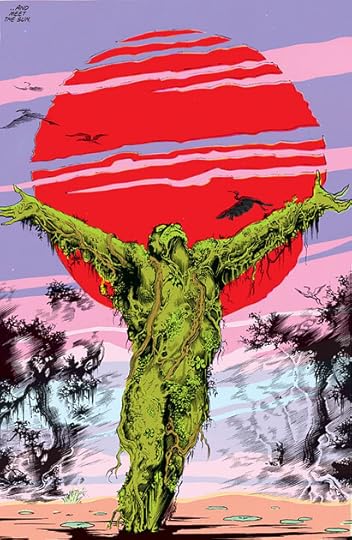
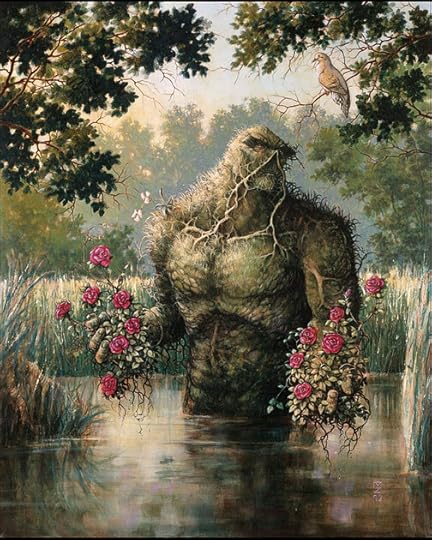
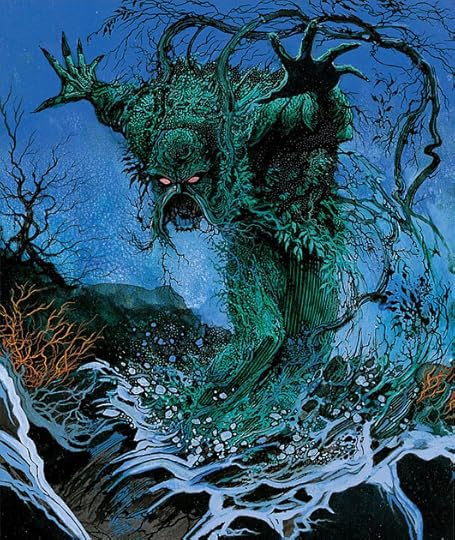
My review covers only the Alan Moore period, issues 20 to 65, collected in 6 hardcover albums, about 1200 pages. Knowledge of what went on before is helpful, but not necessary to follow the events in this story arc. Knowledge of the larger history of the DC Universe, Golden Age, Silver Age and Modern is also useful. Since I am in general staying away from the two giants (Marvel and DC), I did have some problems with some of the guest characters featured here. This is where the introductions to each of the six albums proved useful, providing the necessary background information. The artwork also took some time to get used to and was a bit uneven if I’m totally honest. Still, even when it is a bit rushed or taken over by guest artists, it remains a strong support for Moore’s scripts and, when it hits the right spots, it gets mind-blowingly awesome. I’ve tried to save a few of my favorite panels and posters for this review, but there are whole issues that made me go Wow! Before I try to sketch a road map for the Alan Moore run on Swamp Thing, I will say that he is the main attraction for picking up the Saga: for his original ideas, for his breaking the barriers for both the horror genre and for the comic book format, for his poetic style, for his engagement with environmental and social issues, for his knowledge and respect of comic book history and characters, for his support of artists against the corporate control of creativity.
>>><<<>>><<<
First album starts with a bloody sweep clean of the slate for what went on in the first 19 issues of Swamp Thing v2. The monster from the swamp is killed by mercenaries hired by Sunderland Corporation. His remains are taken to a secret laboratory ( The Anatomy Lesson ) where they are studied by a man named Jason Woodrue, who will soon be revealed as another of the DC superheroes: The Floronic Man. Meanwhile, most of the Swamp Thing’s friends and allies are hunted down and eliminated or forced into hiding. The first major change introduced by Moore in this first cycle is to move away from the standard origin story of most superheroes. The original Swamp Thing, Alec Holland, was a scientist who was burned to death in a bomb explosion. He was reanimated in the waters of the swamp by the super powerful chemicals he was researching. Moore gives his monster an identity crisis, resolved by the revelation that he is not a man with superpowers, but a vegetable that has absorbed the memory and the personality of Alec Holland. The Swamp Thing was never human. He is an avatar, a champion of the Green – the super-conscience of our planet’s biomass.
This first album has two main story arcs: The Floronic Man gets his own connection to the Green and goes on a rampage against humanity, as retribution for the way humans are destroying the planet. Swamp Thing must sever his connection to the Green before Woodrue saturates the air with oxygen and burns everything down
“You have waged bitter and undeclared war upon the green, gutting the rain forests, mile after mile, day after day, but know this: the war has come home! It is man's turn to embrace the scythe.”
The second cycle is pure horror and follows Abigail Cable, who will become the main love interest in the series for the Swamp Thing, as she starts working with autistic children in a local institution while the place is attacked by a couple of visitors from Hell, the Monkey King/ Kamara and the rhyming devil Etrigan.
The second album is where the series really took off for me. It starts with a private ghost story, one in which the Swamp Thing must bury the last remains of his humanity ( The Burial ). The episode also recaps for us the origin story of the Alec Holland character. The Arcane Cycle follow Abby Cable as she is tormented by her former husband Matthew, now possessed by the spirit of a previous nemesis for Swamp Thing: Anton Arcane. In the second part of the cycle, the Swamp Thing must descend into Hell in search of the soul of Abby – a riff on both Dante’s Inferno and the Orpheus/ Eurydice myth. In Hell, Swamp Thing is helped by several forgotten DC heroes from the past. There is a single issue here that is a homage to a children’s series that I loved for its word games and for its science-fiction plot: Pog There is also what is probably the most beautiful and romantic issue in the whole run, a welcome respite from the relentless horrible things that happen to Abby and the Swamp Thing : Rite of Spring
The third album introduces the concept of multiple incarnations for the Swamp Thing through the Ages and two characters that will be major players in Neil Gaiman’s Sandman Universe – Cain and Abel as keepers of stories and dreams in Abandoned Houses Moore decides to take the series in a new direction that he calls American Gothic . Under instruction from a new character that will later earn his own long-running series and film franchise (John Constantine), the Swamp Thing starts to travel across America, Easy-Rider style, as a witness to an impending Apocalypse. The American Gothic Cycle is linked in the DC Universe to a major event known as the Crisis of Infinite Earths. In short, a secret cabal of shamans and sorcerers in Patagonia is harvesting psychic energies from terrified humans in order to summon an Abomination that will bring down Heaven. Constantine is trying to prevent the summoning and wants Swamp Thing by his side in the quest. The cycle will spill over into the fourth album.
“Maybe the world has run out of room for monsters... or maybe... they're just getting harder to recognize.”
Among the horrors witnesses by Swamp Thing are a toxic-waste hobo who destroys his home and his vegetal body ( The Nukeface Papers), underwater vampires, a female werewolf, zombies, a haunted house, gun violence, racism, slavery, zombies ( Strange Fruit ) and others.
The fourth album closes the American Gothic cycle and ends with the most ambitious and spectacular universal battle between Good and Evil. There is a single issue here ( Windfall ) that also explores the fight between good and evil in individual consciences, triggered by a bite from the fruiting body of Swamp Thing, a sort of aromatic sweet potato with psychedelic/schizoid effects (LSD?). Moore returns the whole superhero concept back to individual choice and responsibility. Another favorite issues for the whole run is found in The Parliament of Trees where Swamp Thing visits the hidden sanctuary of past champions of the Green deep in the Brazilian tropical forest.
Album #5 is moving the action to Gotham City, a chance to visit Arkham Asylum and meet with Batman and other DC regulars. While Swamp Thing was battling for the future of the whole Universe, bigots and morons in Louisiana accuse Abby Cable of perversion with monsters. Sent to trial, Abby jumps bail and ends up in Gotham City, where she is immediately arrested again. Swamp Thing gives in to anger and unleashes his new found powers on the metropolis, transforming the asphalt jungle into a real, green and vibrant tropical forest. Without spoiling the actual events, the highlight of the album for me is The Garden of Earthly Delights - Alan Moore at his anarchist best.
A single issue here ( The Flowers of Romance ) brings back a couple of support characters from issue #20 for an exploration of domestic abuse and psychological torment of a woman by her trusted partner. The album ends on another high note that marks the transition of the series from strict horror content to science-fiction in an issue painted entirely in shades of blue: My Blue Heaven
Album #6 offers us several incarnations of the Swamp Thing as a space vagabond, an exile who seeks for a way to return to earth and to Abby in the weirdest places. Alan Moore run is brought to a close with both skill ( Loose Ends (reprise) ) and emotion The Return of the Good Gumbo . The whole idea of superheroes as savers of humanity is challenged.
Saga of the Swamp Thing, under Alan Moore’s guidance, was a wild ride, an incredible journey and a thought provoking study of existential threats to both individual sanity and planetary survival. Whatever reservations I usually have about superhero comics or series running into hundreds of issues were swept aside by the sheer energy and invention of the creative team working on the albums. All the accolades and the prizes won by them are well earned.
This made me question if I should have gotten my Watchmen tattoo, because it made me realize that there are comics out there that I haven't read yet that have the potential to be just as good if not better than Watchmen, and this is one of those. Then I remembered that Alan Moore wrote both Watchmen and this. I should have gotten an Alan Moore tat is the problem. Seriously, one of the greatest things I've ever read.
Essential early Alan Moore, this weird old DC horror about a swamp creature truly holds up. It is a bit awkward in proto-Vertigo comics when say the Justice League shows up, but it's still written in such a literary way. The classic 'Anatomy Lesson' chapter is in this volume which everyone should read.
It may not be Moore's absolute best, because far more was still yet to come, but there's no question this was quality writing from a less overstuffed era and very much worth reading today...
Alan Moore's impact on the pop-culture landscape is apparent, though I personally feel like his writing can sometimes be a bit dry or esoteric (and I'm looking at you V for Vendetta).
But GODDAMN this book had some of the finest writing I've ever come across. Poetic and terrifying and hypnotic and beautiful. I'm not (or rather wasn't) a Swamp Thing fan, nor am I that well versed in the history of the DC Universe, but I was glued to every word on every page of this thing.
If you're into graphic storytelling, this should be required reading.
Obviously a classic that is a must read. Great story telling and old school artwork. Pretty terrifying at stages but also quite q complex for a horror type story. Political environmental issues discussed for it times 80s so I guess pretty topical back then. Really enjoyed this but preferred Watchmen.
You can find my review on my blog by clicking here.
In the early 1980s, the Swamp Thing was revived in a series entitled The Saga of the Swamp Thing with writer Martin Pasko leading the charge. While it stretched out till issue #19, its unpopularity and poor sales led DC Comics to consider cancellation until the editorial teams offered to hand over the reins to writer Alan Moore who was mostly only known for 2000 AD and V for Vendetta during this period. What they didn’t know is that they made one of the most beneficial and critical decisions within their organization as writer Alan Moore went on to shock the world with an impressive and memorable career filled with quintessential masterpieces, including Batman: The Killing Joke, Watchmen, and From Hell. Offered a clean slate, he thus takes over The Saga of the Swamp Thing from issue #21 and reinvents the character’s origin story while constructing him on a much more intimate and metaphysical level.
What is Saga of the Swamp Thing (Book One) about? Collecting issues #20-27 of The Saga of the Swamp Thing and containing a foreword by famed horror author Ramsey Campbell as well as an introduction by Swamp Thing co-creator Len Wein, this volume presents an origin story for the mythical creature from the depths of the swamps who struggle to understand its true nature as he only wishes to grasp onto intangible humanity. Following a brutal confrontation with the villainous Sunderland Corporation, the Swamp Thing’s fate remains a mystery. Then enters an unusual and radical villain, Jason Woodrue, also known as the Floronic Man, who looks into the Swamp Thing and discovers a fatal truth that will toss him into a furious transformation as he’s unable to comprehend his own self and spirals into a frenzied examination of environmentalism. The volume also explores a secondary arc where the Swamp Thing is needed to confront demonic beings and possessed children.
As expected by writer Alan Moore, he brings a metaphysical touch to a character that was only barely explored superficially. Through introspection and reality-altering sequences, he looks into the creature’s identity to try and decipher if he’s a man, plant, or monster. He also brings into play the Floronic Man to further expand the mythology behind the Swamp Thing and establish their roots within the world, giving the villain a different perspective on how he should feel about himself and how the world treats their ecological terrain. In an organic fashion, writer Alan Moore also brilliantly incorporates the classic horror elements that immediately distinguish this comic book series from the rest of DC’s repertoire in the 1980s. His ability to create adult-targeted mature content is, after all, what essentially leads DC to bring forth the Vertigo imprint that went on to be one of the bests in the game. It also helps when writer Alan Moore brilliantly integrates DC superheroes into his universe while making them incompetent in the realm of the Swamp Thing.
It wouldn’t be complete without the artists in the creative team who perfectly complement writer Alan Moore’s wild ideas. Reminiscent of trending artwork in the 1980s, this volume embraces the chaotic structure and vivid colours worthy of any hypnagogic sequence in comic books. Through rough penciling, unconventional panel structures, extreme close-ups, and an oddly satisfying fusion of realism and surrealism, the artwork is able to capture the sinister, gloomy, and enthralling qualities of the story. The colours are also heavily assorted and used to contrast between the foreground and the background. This is even more evident on splash pages that make for some memorable moments within the story. If anything, the artwork brings a very hallucinogenic edge to the narrative, especially when it ventures into the metaphysical or the horror.
Saga of the Swamp Thing (Book One) is a reinvigorating origin story for a creature in the midst of an identity crisis while offering relevant social, political, and ecological commentary.
I was reading this over a long period, in spurts. With the craziness of life, I just haven't had much time to read graphic novels, unfortunately. I read this on my Ipad, which is really good for looking at comic panels. I love how the Kindle (Comixology) version allows you to tap on each panel and it magnifies the panel. This is the Alan Moore classic that revamped the character. It's very, very dated in the art style, but that's okay. It's historical. The colors are really bright, almost obnoxiously so. It's an 80s comic printing thing, and as I've studied comic art history, that was kind of fun to experience the medium. I was quite pleasantly surprised at how scary this was. Each story is kind of like a monster of the week format, which I absolutely love. For such an older comic, it really was spooky, scary and disturbing. In fact, this would have made a good Halloween read. I think I finished it in the late spring, so unfortunately, I didn't get to enjoy the spookiness for October. I definitely ship Swamp Thing/Alec and Abigail. Their doomed(ish) romance appeals to my sensibilities. I had watched the short-lived but very good DC TV show Swamp Thing and it was nice to compare it with the comic story (it holds up very well, IMO).
There's something about Swamp Thing that I really dig, so I know I'll be reading more.
I would recommend reading this if you don't mind the dated look of 80s era comic books.
The best part of this Saga is the hype that surrounds it and invites the reader into the swamp. It is supposed to be Moore's first real foray, it is supposed to be an environmental hyper-roar. Of course, in the end it turns out that most of the stuff is just trippy.
The introductory pages were quite something though - they built this one up unlike any other comic I have read. Moore for instance goes on this vein before introducing the story to the reader:
One of the major factors separating comic books from its more respectable cousin, fiction, Moore says, is duration.
The stories in the pages of a comic, they never end - not in the way a movie or a book can end. One menace may have been averted, but there is always another in a month's time, say.
The characters will continue indefinitely until poor sales or something cancels the series. Even then, Moore says, the character might live on - avoiding limbo by occupying guest slots in other comics. The stories never end once put into a comic.
More importantly, Moore goes on, unless you are very lucky, does the story ever begin - for you. Anyone picking up a comic book for the first time is almost certain to find themselves in the middle of a continuum that may have been running before the reader's birth even. And will quite possible outlive him.
So I like Alan Moore, and that's a bias. But as I started reading this I thought, "Are you kidding me? This is seriously awesome." Swamp Thing is one of the coolest, weirdest books I have ever read. Moore's writing is fierce, the 80's coloring is wild, the stories are as much science-fiction as they are horror. Every single page was enthralling. I was giddy after finishing it, wanting to read yet another of his works. There was literally no moment of "I wish he had done this."
When I started reading Alan Moore's Swamp Thing, I was unsure of what to expect. I had heard a great deal about this famous series and finally ran across a collected works of the venerable AM run. This first volume collects issues #20-#27. While 20 might seem an odd number to start volume one on, it makes eminent sense in the context of Alan Moore taking over the writing duties for this series.
His breathtaking vision for the "reboot" of the Swamp Thing made him famous. Moore changes the premise of Alec Holland being turned into the Swamp Thing, which had the simplistic feel of a typical monster story. This could be considered in keeping with the times, this was written in 1972, but Alan Moore showed his visionary style by taking the Swamp Thing and turning it into a vehicle for his then-radical ideas about nature, the environment and even just changing up the way comic stories were told. Moore's Swamp Thing wasn't a person (Alec Holland) who had been transformed into a plant, but rather a plant that had the consciousness of Alec Holland who was dead. Moore's Swamp Thing also seems to occupy a DC world that was contiguous to the "normal" world of Superman and Batman, but at the same time it seemed to have its own goings on.
The more common heroes such as the Justice League and Superman do make appearances at certain points, as do more esoteric (back then at least) characters such as John Constantine and Jason Blood (Etrigan). But the main brilliance was that, in essence, Swamp Thing was a plant that thought of itself as a having the thoughts of a human.
Alan Moore's true brilliance though is found in the dialogue and the prose that fills this volume. What a well written book. Even the annoying Etrigan (a rhyming demon) works out well in AM's skilled hands. The artwork was more than likely ground breaking for its time and surprisingly enough isn't wretched even in this day and age. Some of the full page splash scenes are rather stunning to this day and so seem to work with this world of his.
If you are interested in the Swamp Thing world or just enjoy the writings of Alan Moore, this is a great series to start with. Moore's writing is truly beautiful and the issues that he brings up- for example the Floronic Man and Swamp Thing's similarities and differences when they viewed Nature and humanity interacting. Moore was well ahead of his time with the environmental outlook his book stresses. It was also nice to see a story where the Justice League, while present, had little to nothing to do with the ending-as it was the Swamp Thing all along that was able to deal with the Floronic Man, while the JLA members including Superman were unable to do anything.
This is my first time reading Swamp Thing and I am glad I waited till I was an adult to fully appreciate and understand all the subtle brilliance required to pen a work of such substance. I truly enjoyed this volume and will continue on the Alan Moore run of Swamp Thing for as long as it continues. A great book -far, far ahead of it's time.
This was a well-written and opening volume to the Saga of the Swamp Thing. The chapters were fun to read. What i really appreciated was the psychological and existential aspects of the story. The Swamp Thing origin arc, his existence within the swamp, his search for meaning and reflection throughout the story was neat to read in my opinion. I will keep reading the additional volumes with reviews to come. I would recommend this to Alan Moore fans and graphic novel fans. Thanks!
This one gets points for being a brilliant reinvention of a fairly silly character. Something that really shouldn't be any good.
This book is a nice jumping-on point if you're curious about what happened to comics in the mid-80's, the time when everything got pretty dark. It certainly qualifies as a piece of history in that respect.
Great moments in this one, but the art certainly feels specific to its time.
I've started wondering if the art and the trends within comic book art might be something that has held the medium back in terms of mainstream success. The thing is, they slap a new cover on popular books every ten years or so. And that's the only art associated with it. So you end up with stuff that's not too dated most of the time.
For example:
A couple tweaks, all is well.
But with comics, it's not that simple. Which means that you end up with some classics of the medium that have some fairly dated art. Early Sandman, Frank Miller's Daredevil stuff.
Don't get me wrong. I have a place in my heart for this stuff. But it's gotta be difficult for someone to go to the theater and see the spectacular visuals of the Avengers and then go back and read the older books. It must seem like complete slow motion. In a weird way, the superheroes of our movies have surpassed the physicality of the superheroes in our comics from the 70's and 80's. I didn't really think it was possible, but I'm pretty sure that Chris Hemsworth looks more like a comic book superhero than ACTUAL COMIC BOOK THOR. I almost believe in the existence of Chris Hemsworth less than I do Thor, which makes no sense.
At any rate, this is a pretty damn good book, so if the art turns you off, I'd say consider it a history lesson, and 15 minutes in you won't even notice.
This is a masterpiece. I had always heard glowing reviews of Moore's Swamp Thing run but had never had the opportunity to read it myself. Now that I have, it met all the hype and then some.
The second issue of this volume, No. 21 "Anatomy Lesson," is the greatest single issue of a comic book I have ever read. And I don't take that statement lightly. (Note: this should be considered by the reader as Moore's first issue on the book, as No. 20 was used to tie up loose ends for the previous author's story arc. This is where Moore made the character his own. That said, he did a great job on No. 20, as well.)
Moore took a "horror book" and absolutely stuck with that theme but he did it in a way I found to be considerably more terrifying than a slasher, gore-fest, what's-about-to-jump-out! type of fear.
Moore was able to conjure a deep, permeating horror in a primal way. It really tapped into the fears we all have: loss, hopelessness, failure, what the future holds, etc. It was terrifying and completely soul crushing, effecting me hours into the night after I'd stopped reading.
This is absolutely a "monster" title, but that monster isn't Dr. Holland (Swamp Thing). The monster is the world he inhabits.
For the sake of potential readers, that's all I will say other than this: READ. THIS. BOOK.