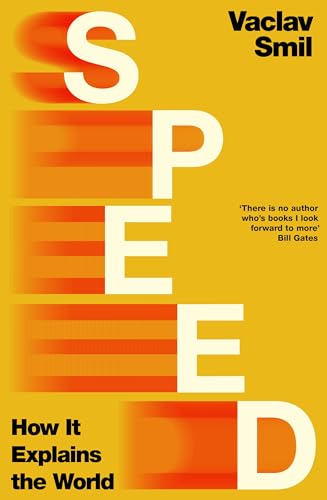
Prepare to view the world through a new lens – SPEED – a groundbreaking exploration that challenges your perceptions of life’s driving force, from the internationally bestselling author
'There is no author whose books I look forward to more' Bill Gates
‘There is perhaps no other academic who paints pictures with numbers like Smil’ Guardian
In a world that feels like it’s moving faster than ever, Smil examines how our relentless pursuit of speed – in areas such as production, travel and communication – shapes not only our technological landscape but also our social and environmental realities. And through engaging anecdotes and striking statistics, Smil challenges the assumption that faster is always better.
He invites readers to reconsider the implications of our collective obsession with speed, and its intricate relationship with nature and innovation. For example, he highlights the surprising fact that erosion can actually accelerate mountain growth, and he points out that the rapid adoption of mobile phones – achieving 90 per cent penetration in just nineteen years – reflects historical patterns of technological adoption, suggesting that our world may not be moving significantly faster than in the past.
Whether exploring the tiny mites that can traverse 300 times their body length in a second or the societal impacts of high-frequency trading, Speed invites readers to engage in a more balanced conversation about the role of speed in our lives, in an age defined by haste.
Vaclav Smil is a Czech-Canadian scientist and policy analyst whose work spans energy, environment, food, population, economics, history, and public policy. Educated at Charles University in Prague and later at Pennsylvania State University, where he earned his Ph.D. in geography, Smil emigrated from Czechoslovakia to the United States in 1969 following the Soviet invasion, before beginning his long academic career at the University of Manitoba in 1972. Over the decades he established himself as a leading voice on global energy systems, environmental change, and economic development, with particular attention to China. Smil has consistently argued that transitions to renewable energy will be gradual rather than rapid, emphasizing the persistence of coal, oil, and natural gas and highlighting the difficulties of decarbonizing critical industries such as steel, cement, ammonia, and plastics. He has also been skeptical of indefinite economic growth, suggesting that human consumption could be sustained at much lower levels of material and energy use. Widely admired for his clear, data-driven analyses, Smil counts Bill Gates among his readers, while colleagues have praised his rigor and independence. Known for his reclusiveness and preference for letting his books speak for him, he has nonetheless lectured extensively worldwide and consulted for major institutions. A Fellow of the Royal Society of Canada and a member of the Order of Canada, Smil remains a highly influential public intellectual.
Classic Smil. Lots of data, plenty of comparisons, and some really interesting analyses. It’s a fantastic compendium of knowledge on certain aspects of how our civilization has developed. However, it’s a much tougher sell than his previous books. He’s adopted a more technical style—it feels almost like a draft for a scientific paper. As I was reading, one question kept getting louder: how is he going to wrap this up? What’s the punchline? Then came the 'coda' and... Well, that’s just it—what’s the takeaway? What was the point of all that analysis? Why should a reader give up several hours of their time for this? For me, it’s one of his weaker titles.
Vaclav Smil proves again that he can only collect a loosely strung collection of statistics and numerical facts into rough categories with no overarching theme. I love facts as well, but the density gets boring. Some sections had great explanations of interesting topics; his explainer of tectonic plate movements was superb because it was less of a spam of random numeric facts. When there’s an actual theme to talk about, Smil is great. Otherwise his books are repositories for the facts and notes he’s take in his research - a clustered brain dump, unsynthesised.