Bronze Medalist: 2015 Readers' Favorite Book Awards Finalist: 2015 Independent Author Network Book of the Year Awards
THE GODS ARE BACK. DID YOU MYTH THEM?
You probably saw the press conference. Nine months ago, Zeus's murder catapulted the Greek gods back into our world. Now they revel in their new temples, casinos, and media empires—well, all except Apollo. A compulsive overachiever with a bursting portfolio of godly duties, the amount of email alone that he receives from rapacious mortals turns each of his days into a living hell.
Yet there may be hope, if only he can return Zeus to life! With the aid of Thalia, the muse of comedy and science fiction, Apollo will risk his very godhood to help sarcastic TV producer Tracy Wallace and a gamer-geek named Leif—two mortals who hold the key to Zeus's resurrection. (Well, probably. Prophecies are tricky buggers.)
Soon an overflowing inbox will be the least of Apollo’s troubles. Whoever murdered Zeus will certainly kill again to prevent his return, and avoiding them would be far easier if Apollo could possibly figure out who they are.
Even worse, the muse is starting to get cranky.
Discover a world where reality TV heroes slay actual monsters and the gods have their own Twitter feeds: Zeus Is Dead: A Monstrously Inconvenient Adventure!
An award-winning writer of speculative fiction, Michael G. Munz was born in Pennsylvania but moved to Washington State in 1977 at the age of three. Unable to escape the state’s gravity, he has spent most of his life there and studied writing at the University of Washington.
Michael developed his creative bug in college, writing and filming four exceedingly amateur films before setting his sights on becoming a novelist. Driving this goal is the desire to tell entertaining stories that give to others the same pleasure as other writers have given to him. He enjoys writing tales that combine the modern world with the futuristic or fantastic.
Michael has traveled to three continents, and has an interest in Celtic and Classical mythology. He also possesses what most "normal" people would likely deem far too much familiarity with a wide range of geek culture, though Michael prefers the term geek-bard: a jack of all geek-trades, but master of none—except possibly Farscape and Twin Peaks.
Michael dwells in Seattle where he continues his quest to write the most entertaining novel known to humankind and find a really fantastic clam linguine.
So, you think you know about Greek mythology? When you hear the name Homer you don't automatically think of a beer-guzzling, yellow, fat little man (Unless the 18th century writer was a beer-guzzling, yellow, fat little man...I have no way of knowing). What I mean is, you've read The Ilead and The Odyssey. You know the difference between Neptune and Poseidon, so you obviously know more than most. Well, mere mortal, you know nothing. Nothing, I tell you!
Michael G. Munz does more than tell you this story. He gives the characters character (wow, does that look strange on paper). You may know the basics, but do you know how cranky a Muse can become if she hasn't washed her hair in a few days? Or the fine art of slow-motion kickboxing? What about the Idiot Ball? Do you know about Dionysus's Hangover Hammer? Or the Ninja's Templar? I say again, you know NOTHING!
The story begins when Zeus is killed. What? Hold up, how do you kill an immortal being? (Shit, do you want me to tell you everything? Read the damn book.) Even worse, he is killed by another god. And, with his death, the rule of Withdrawal from the earth disappears, so the gods want to make it known to mankind that they are back. What would be the best way, though? Of course, a news conference!
When Apollo gets a vision of a mortal who can bring back Zeus, he has to track that mortal down without letting the others know. After all, one of them killed his father (that would be Zeus, if you haven't figured it out yet), so he doesn't know who he can trust. And with the help of his Muses, he tracks him down in (where else) a Starbucks.
And that is basically the point where the Styx really hits the fan. The mortal's name is Leif and he's somewhat of a wise-ass dick who doesn't know when to keep his mouth shut. (Just a thought on that: What else can you expect from a guy called Leif? What could have possessed his parents in giving him that name? Did the mother have a horrible pregnancy and decide to punish the poor kid for the rest of his life?) (Just a thought on that thought: If your name is Leif, and you took offense to the first thought, please know that I didn't mean you - especially if you are bigger than me. You carry it off like nobody else...)
So, can Zeus be brought back? Will Apollo be able to convince Leif of helping him? Will everything work out the way it is supposed to in the end? Will publishers stop giving us books that starts with "The Girl-" (That last one doesn't get answered in this book, I was just wondering.)
_________________________
Okay, this book knocked the socks off me - especially since I discovered it by accident. After reading GOOD OMENS by Pratchett and Gaiman, I've never really come across anything that made me laugh as hard about deities. And while some reviews reference Douglas Adams (and others straight-out disagree with me on this), I want to put this book up there with G.O. Maybe it got that extra boost because I didn't expect it to be this good, I don't know. But, in my opinion, were they alive today, I believe the great Sir Terence Pratchett and Douglas Adams would have given this book their nod of approval.
In the end, I highlighted more than 80 parts on my Kindle (a new record for me). Best of all, at the time of writing this review, it costs only about a dollar at Amazon (Kindle format).
Most chuckles I've had all year. Highly recommended to all who prefers good humor.
The Greek Gods return to our modern world - only Zeus is Dead. Part detective novel, part murder/mystery and 100% good, clean fun
Dealing with dumb questions at a press conference “King Poseidon,”—the next question came from a “correspondent” for a prominent fake-news program on a comedy cable channel—“a lot of you have names that start with A or H. Just what’s that about?” The question garnered a few snickers about the room. In the wide shot, Tracy caught sight of Apollo, Hermes, and Dionysus cracking smiles. Poseidon merely arched an eyebrow. Hera, however, lifted her arm, raising the correspondent out of his chair with a small demonstration of power. Following a moment’s study, she flicked her wrist to one side. With a yelp, the reporter ceased to exist in the room. “Next question.” No one asked just what she had done, but the correspondent did fail to show up for work for the rest of the week. “Neat little trick,” whispered Chelsea. Tracy nodded. “I’ve had job interviews like that.”
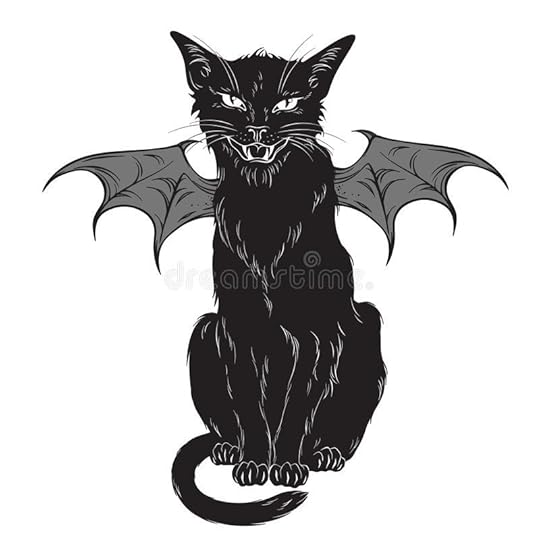
Look at the cute death-kitty And so it came to be that the creatures eventually dubbed “razorwings” were among the most fearsome of all for one particular reason. They were impossibly cute. In fact, they were kittens—fuzzy, adorable kittens, each the color of fresh snow and no bigger than a cantaloupe. They were also feral; spat a paralyzing poison; and flew on colorful, batlike wings capable of slicing through a human arm. Yet once you attached all that to a kitten, it became the zoological equivalent of a death threat on pink stationery with hearts dotting the i’s. It was difficult to take them seriously, even in the swarms in which they generally traveled. Sharp claws? Check, but attached to a kitten. Piercing teeth? Yes, but, again, in the mouth of an adorable little kitten! One in ten able to chew through metal? Oh, you’d better believe it, but wookit da kitty!
Enter the Owl Sneaking through the Olympian servants’ quarters disguised as an owl was a fair bit easier. The quasi-immortals who boarded there used trained owls for all sorts of things after becoming enamored with a certain mind-bogglingly successful book series about teenaged wizardry. Athena, fanatical of owls to the point of choosing them as her symbol long ago, especially loved it. It gave the place a definite whimsy, but cleaning up the owl pellets hacked all over every conceivable surface added more work than the birds saved. Apollo was just grateful for a way to slip into the gardens without attracting attention. He only hoped he had timed this right.
Quotes Birds do not like carrying jewelry for anyone! Tolkien understood that.
The platypus, for example, is not actually a terrestrial animal but a bioengineered probe designed to blend in amongst the planet’s other creatures, sent to Earth by aliens who did not do enough research. There’s no reason at all to mention that right now, but wasn’t it fun?
Apollo, the Muse Thalia, with the two mortals Leif and Tracy have the deadly task of bringing Zeus back to life.
Zeus Is Dead A Monstrously Inconvenient Adventure By: Michael G. Munz Narrated by: Travis Baldree This is an Audible book I requested and the review is voluntary. What a hoot! My cheeks are sore from smiling for hours! This was such a clever, snarky but not annoying, funny look at what life would be like if the Greek gods lived with us today. It is well thought out and so unique! It is so crazy, you don't know what will happen next. I am convinced that the author is the brain spawn of Mel Brooks and Monty Python! This book is creative chaos in a genius fashion...lol! It kept me interested from the very beginning to end! It was a wild and crazy ride but I loved every bit! Travis Baldree performed all the fabulous voices and made the story even better! He kept all the strange characters and their bizarre ways straight, I don't know how, there were a lot of characters. Comedy is not easy to do and make it come out funny but he was spot on! There were laugh out loud scenes and giggle scenes but most of the book I was truly smiling! Loved this book!
Beware. This is a long book, something that generally doesn't concern me--bring it! usually! If I like a book I want lots of it. And this one is big--441 pages if you're counting--but will feel even longer. It was a book I had to slog through, which was made harder that this was supposed to be a humorous book and being a mythology & fantasy nerd, I thought this would be a slam dunk for me. And at moments it was--but he threw it seems everything into this book. There were so many grossly unfunny jokes, ones that even dads would pass up as too cheesy, one after another, that the ghost of Pratchett or Wodehouse would not be able to save it. There was also a rather smug undercurrent of misogyny throughout this book, and there were many parts I could not /raise eyebrow high enough. More on that.
There was one thing I did like, enough that really I give him a 1.5, and it's featured right on the cover. And the overall plot isn't bad--someone murders Zeus, which allows all the Olympic Gods to come out of hiding and reveal themselves to the world. Intrepid TV producers and also Zeus bastard daughter (Tracy), gets mixed up with Apollo and this one smarmouth antisocial nerd (Leif) to bring Zeus back to life. Part of the gods coming back was also unleashing monsters all over the world, to keep the humans busy. The most "fearsome" of all were the razorwings, because "They were impossibly cute. In fact, they were kittens--fuzzy, adorable kittens, each the color of fresh snow and no bigger than a cantaloupe. They were also feral; spat a paralyzing poison; and flew on colorful, batlike wings capable of slicing through a human arm." All the scenes in the book involving the razorwings I loved--and actually the Furies were kind of funny too.
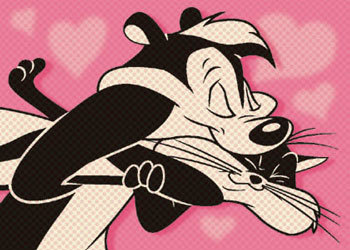
Where the book started to veer downhill for me though was when Aphrodite shoots Leif in the heart to make him fall in love with Tracy (whom he barely tolerated before), to discourage them from finding out more about Zeus. And lo, let the stalking begin! Because when a man falls in love with a woman, he follows her secretly state from state, breaking into her car, and hiding in the trunk. And then, for the next 400 pages, constantly interrupt all the main characters, try to rub up or grab her, make ceaselessly smarmy comments or puns at inappropriate moments--basically this, page after page of this:
A cartoon that always disturbed me as a kid. Why won't that pervy wanna-be Charles Boyer leave that poor cat alone?! I also have hit the limit of the word "smirk"--the characters were all constantly smirking back and forth to each other. And I'm sorry, I just instantly imagine Martin Shkreli, PharmaBro, in my head when I read or hear that word--and it's also kind of a strong verb to constantly be applying to your characters, which I'm sure made me hate them all that much more. He also breaks the fourth wall every few pages and goes on frequent (to me) unfunny digressions, adding to the "goddamn! so much of this should have been edited out!" feeling.
For example, and this happens many times in the book--the characters, accompanied by the muse of comedy, Thalia (which makes it so much worse), often get distracted from their quest to save basically the world by laughing at various funny words. Legumes for example. Or here: "A Muse isn't allowed to have outside interests?" "Hrmph. I also enjoy macramé and Ping-Pong." "Ping-Pong's a funny word," Tracy observed. "Ping-Pong! Ping-Pong!" She giggled again.
At this point in the book, I had seen them tee-hee about various "silly" words enough times that I put a bookmark in it, to show the place where I started to point the thumb downward. It's not also just Leif being a creepy time-to-get-a-restraining-order tagalong, but all the male characters you eventually want to choke after a while. Because as said before, the book feels engorged in so many ways, you start to notice when pages and pages of dialogue go on for what feels like forever because of CONSTANT interruptions of the female characters. If the author was trying to show how annoying aggressive mansplaining might be, then kudos--we have evidence of it to show the future. Over the course of many pages of dialogue for example, I just counted and Apollo interrupts one of the Fates 14 times, greatly stretching it out. When the Fate says, "You know, this would be over and done by now if you would just let me speak." (His response is, "Yes, but I do so enjoy the sight of you talking.") But by that point I was like, "Oh my god, YES! One of the characters acknowledges the past 300 pages of annoyance!" but no...
When I got to at the climax of the book and found: "I don't blame them, but I didn't shut them up in tartar sauce!" "Tartarus." "I was being funny."
That's when I got pissed off entirely at the book. Thumb down. Boooooo. Again this is comedy, so very subjective. For me, thinking about it more, it was not routed enough in any kind of reality. So much of it was winking unbelievability, with so many 4th wall breakage, that nothing was really taken seriously. All or none of the characters could die and it wouldn't really matter in the slightest. And honestly, like 200 pages of it should have been cut or trimmed.
Disclaimer: I received a free copy of this book in exchange for an honest review.
If there is an award for being the most well-researched smart-ass, I think Michael G. Munz would take the prize. And I mean that with the most adoring and praise-inducing admiration I can manage. While I'll try not to polish the author's ego too much, this book quickly rose through my level of favorites with it's wit, geekiness, and careless disregard of the ever prevalent fourth walls; Zeus is Dead is clever, yet entertaining in a manner that made it hard to put down. If you like Greek Mythology, humor, and ridiculous plot lines common in stories like Monty Python or Space Balls, you might like this book. It may be a love it or hate it sort of project, but I thankfully was one of the former readers.
Now that I've gushed a little bit, and possibly lost a few readers for using the term "smart-ass" in my review, I guess I should take some time to actually talk about the work. The first thing I should probably warn you is this is not a "linear" sort of story-line. If you want to go from point A to point B, this may not be the book for you. Part of the fun of this story is the careless side-trips we encounter along the way. One minute you're talking about the gods return to power, the next a clumsy, poorly trained ninja is tripping in the forest and being rewarded with glitter paper. While the main characters are important, so is some of the silly none-sense thrown in on the side. I'd liken some of the side-trips to the book Stardust; you never know what will turn out to be relevant later.
This book works because it embraces the ridiculousness. Yet, there is still a story that carries you through it. There are a few moments of language and poking fun that happen that may offend a few readers, but it is a story involving Greek gods, so that may be a given in those aspects. To be honest, there were probably some jokes that went over my head at times, but I never felt to bogged down by them. It was fun, yet balanced, which is something that is pretty difficult to manage. I liked that the gods in this story were still "human" on many levels. They didn't feel fearfully overpowered, their misadventures kept me entertained, as well as their modern adaptions in comparison to their more historical counterparts. It really did bring a fresh twist to some old subject matter.
And adorable kitten monsters of death. Can I keep one?
This is one of those books that is less about the ending, and more about the journey along the way. I'm not sure I wanted to reach the end, to be honest. I was having a little too much fun giggling along the way.
This book is unlike anything I have ever read before in my life. In this story the Greek Gods are alive and well, except for Zeus, he’s dead (see title). With the King of the Gods out of the way, the remaining Olympians reveal themselves to the 21st century.
Zeus is Dead is filled with great wit and humor (some of it a bit on the geeky side). It revolves around Zeus’ daughter Tracy and her heroic quest to avenge her father’s death. Tracy undertakes this quest with the help of Apollo, Thalia (one of the muses) and Tracy’s love interest, Leif (although the interest only goes one way and that’s with the “help” of Aphrodite). Together they battle monsters, Gods and razor wings (poison spitting, bat-winged, deadly tiny white kittens).
I loved how the author kept the Gods true to their mythological form. They are not characters so much as caricatures, each one with a personality that is over the top. Michael Munz knows his Greek Gods and has delivered an entertaining book that reminds me of a Mel Brooks movie, there is so much going on that you have to pay attention so you don’t miss something.
As someone who has read his fair share of Homer and Aristophanes, I really appreciate how much Michael Munz has brought some new life to these characters. At the same time, Zeus is Dead would be a great way for the uninitiated to be introduced to the Pantheon.
A huge Thanks to the author and his team for providing me a copy of the book but at the same time i am also going to apologize for the review i am going to write
It feels like i have been reading this book for ages now. Right now i look like a zombie in progress, with swollen red eyeballs threatening to pop out and eye bags reaching the floor.To think of it, the book was only 446 pages and i have read books more voluminous than this one but nothing has induced fatigue as much as this book has. It was more or less like having run a marathon with this book.
Lets move to serious territories and discuss the book
The book has one of the most innovative and creative story lines i have ever come across. The basic theme and the title of the book in itself was hilarious. To be fair, the author has an amazing skill of humor but the problem lies with the deliverance which is a bit chaotic. The book is funny. No doubt about that but the sentences are complex and there is too much thought process and ideas squeezed into one line which makes you lose track of the whole conversation and the point of it.
Somehow i am reminded of the quote
" You young men have too many jokes. When there are no jokes you've nothing left."
by Henry James in The Portrait of a Lady
The book needs simpler narration and coherent thoughts because as of now, i feel that the author starts with one idea, moves to other and another creating a complex narration failing to hold the reader for long and in turn adding pages to the already overflowing book.
In my opinion, the author should go through a rigid selection process as to which ideas and jokes he needs to keep and which to throw away in spite of how much alluring and creative it seems(trust me i know how hard it is as i am constantly battling this war myself)
Overall the book is a fantastic concept and attempt. Pretty brainy too. A little bit work on the narration and selective thoughts and then this book will be one of the most amazing books around because usually humor in a book is not as successful as it claims to be but this book and the author have shown me that there is a possibility where a comedy can be actually fun and hilarious. His jokes were spot on but then again it lacked a strength of coherent narration.
And My God !! there is too much babbling and mumbling.... but if anybody cares, Leif has been an interesting character and one of the best characters in the whole book. It was fun watching all the greek gods in their modern appearances.
The book brings forward one of the most creative and fun themes you could think off and with greek gods in play, it offers so much potential and scope for a comedy ride and it does deliver on its promises but sadly to only an extent. Everything works in its favor except for one major detail. The narration. Each line runs wild with thought after thoughts. Too many jokes and things in one single line and wavering from the main point you intended to talk and orbiting around the globe too long with your mumbling, creating a dragging narration and in turn a voluminous read.
With just under 500 pages, this book is a helluva lot longer than anything I've read recently, but the description looked promising so I gave it a shot. The basic structure is built like most books I've read, but that's the only thing typical about it. "May I read your shirt in braille, Miss?" Gems like this one pop up throughout the book, and even at the end where many authors lose steam, Mr. Munz carries his humor all the way through. It's definitely not a quick read, but each chapter offers great amusement on its own, and within the larger context of the story. The end of each chapter left me with a chuckle every time, and the introduction into the next did the same. Often, I'd read the next chapter's intro just because, even when I knew I'd (sadly) have to put it down until my next reading opportunity. Well edited and with a great cover, Zeus is Dead clearly falls under the category of professionally produced e-books, this author is the real deal. Throughout the book the author is a visible narrator, but he does so in such a way that that in itself is also funny. The characters, though numerous, were easy to keep track of as individuals because the author treated them as such. Each character has clearly defined traits displayed throughout the text. With a humorous book like this, (imo) the author ran the risk of those characters becoming caricatures, but he deftly avoided gross exaggeration for the sake of effect, relying instead on his character development skills to bring them to life. I intend to read more from Michael G. Munz.
I really wanted to love this book, but I ended up only liking it okay. I'm a huge fan of Greek Mythology and while reading the book I felt it read like an adult version of Percy Jackson, but less compelling. While the premise is awesome, I honestly feel I only finished reading it because it was about Greek Gods. Munz chose to constantly use the fourth wall throughout the book and it worked great in some instances, but then became an overused tool used lazily to fill in the blanks for narrative inconsistencies; and by the end of the book I was tired of it. While I did finish the book, there were a myriad of problems with the narrative that I could not shake. Aside from wasting a lot of paper on pointless fight scenes and odd tangents that had nothing to do with the story, (if anything the final battle deserved more pages than the fight with a turtle monster) the very sexist nature of the prose could not be escaped. Not only were the female characters written as bad caricatures of femininity, but the men in the book seemed to only value them for their looks and seemed to sneer at their attempts at asserting themselves as something other than objects to be desired or looked at. This book is for a very specific audience and I don't think that I am it.
This is a very unique book. Why? The author is unusually aggressive about breaking the “Fourth Wall” (aka, the separation between the reader and the characters/narrator). This enables a whole new kind of humor. It was very cheeky. For example, at one point the narration says (paraphrasing) “Intelligent readers may be wondering if this is all a devious trick! It may or may not be a devious trick. We won’t tell you. Of course, you may say... why bring this up at all if there is NO trickery involved? Maybe we just want to mess with you,” and so on.
At another point, a character asks, “Hey, is this some sort of ‘abandon the younger protagonists to stand on their own for dramatic tension’ thing?” In this way, the book was simultaneously it’s own story and a commentary on the art of story-telling. I also learned about “the idiot ball,” from this book. Apparently when a story line is fueled by a character’s stupidity, nerds on the internet say, “That character was holding the idiot ball.” In this book, the idiot ball is a literal dangerous magical weapon, which characters plant on each other as a tactic.
Overall the style reminded me of Terry Pratchett, only perhaps even wackier. The author is not afraid to shy from even the highest heights of absurdity. For example, there are deadly razor-winged kitten monsters (kind of funny) and because they’re white with red and blue wings, patriotic groups refuse to kill them even though they are a menace (extremely funny.)
On a more serious note, about the book's themes. I like the idea of friendship, rather than love, as being a driving force of change and improvement in someone’s life. I also like the way the humans had the courage to define themselves as far more than the pawns which the gods considered them to be.
The only thing I didn’t like about this book: I wasn’t too pleased with the characterization of the goddess Demeter. She was depicted as a doddering, kindly, senile old grandmother type, which helped along the humor... but wasn't true to my own mental picture of this goddess. The tale of Persephone is my favorite from all of mythology, and Demeter’s role in that story is anything but feeble and doddering. She brings winter upon the entire world in an outstanding and powerful demonstration of motherly love! Where's that Demeter, huh?
However, in general, I enjoyed the character portraits of the gods, and how they were updated for the modern day (like Dionysius being a casino owner in Las Vegas.) I also loved the strong female protagonist in this book (It’s really easy to win my reader loyalty with a strong female protagonist.) Her badass reactions to sleazy men who hit on her, were especially hilarious and awesome to me.
Read this book! If you have a good sense of humor and/or an interest in meta-exploration of the craft of writing, you will really enjoy it.
I have been looking for other authors to fill the void when Christopher Moore does not have a new book out. This guy is now on my list.
In his writing style with this book, the author is almost a character of its own. A few times the asides were a little bit long or distracting to me which is why I give it four instead of five stars, but honestly it was such a fantastically fun read that I, a busy mom with three kids, finished the book, and was so glad I read it.
In fact, I am now going to see if he has written anything else I can read.
So, I came across this book initially on the wonderful imgur. I was drawn in by the puns. Those of you who follow me know I have a serious problem with puns. It's an epundemic. (See!?). Add Greek mythology on top of that? This Classics minoring internet-dweller was sold.
Y'all, this book is effing hilarious. I loved the way that Munz sucked the reader in, not just with the plot of his book but with his engagement with the readers. It was as though the book narrator was telling you, the reader, a story personally. This might sound like an odd comparison, but the way the author "breaks the fourth wall" so to speak with his readers was reminiscent of Lemony Snicket in his Series of Unfortunate Event. But less dark and macabre, of course. I snickered aloud more than once, and that takes skill. I'm admittedly a bit of a humor snob when it comes to books, but I guess me and Munz are just on the same humor wave length because this was simply great.
The story features a lot of characters, including the entire Greek pantheon. This wasn't a problem though. Each character was written in a unique style/personality so that I was never left confused or concerned by the cast. Munz also did a great job with story navigation. Zeus is Dead follows different plot lines and characters, but again the flow just worked well and it was easy to transition. And in a rare display, I was interested in each of these characters' stories. There was never a point where I was like "ugh, we're back on him again?" I thoroughly enjoyed everything that this novel had to offer.
As for the plot itself, I really liked the concept behind it. Could you imagine if any god or gods from any denomination just popped up and said heyyyy we're real by the way and started living like celebrities? I may be alone in this, but I would totally watch Juno's new reality show Juno What I'm Sayin'? or read Rama's new book. There's a hero and a quest and an homage to Hecate which just makes me insanely happy because no one ever mentions Hecate and she's easily my second favorite god(dess). It's a fabulous idea that's well constructed from start to finish. And the more you read, the more you'll want to know what exactly happened to Zeus?
It's worth noting that even though I came to the table with a pretty good knowledge of the Greek gods and goddesses, that is absolutely not a requirement to enjoy this book. Each deity, myth, muse, monster, and any other "m" words are well explained and elaborated. This book is approachable to anyone, regardless of their mythological education. And if that's the case, you just might learn a thing or two from Zeus is Dead.
If you are in search of a Greek epic for the Social Media age, a good laugh, or a book that features fuckingmurderous flying kittens, then I cannot recommend this book enough. Please go and enjoy this book. It's fantastic and will be joining my Classics shelf as soon as I can get my hands on a physical copy. (And next to my razorwing plushie, right Michael?) Thank you to Munz and his blog tour lovelies for my copy in exchange for my honest review.
Alright, so Zeus has been murdered and the rules of the game have changed. Gods freely interact with the mortal humans, and this is more than with a friendly hello. The gods are loving their freedom. The humans are not quite sure how to handle this. But no one seems to really ask, "Who killed Zeus?"
This book takes the reader on an adventure that looks deeper into the death of Zeus. It follows the need for one of the many Greek gods and goddesses to help the unfolding of a prophecy while trying to keep out of sight of the killer. Along the way, a series of oddball humans fall into the story and we are taken along on their journey into the chaos that is humorous deity-drama. The writing is quirky and witty. The fourth wall is not only broken, but rather torn down for the reader to either get a good laugh or feel annoyed by the multiple interruptions in the story-telling.
The story and the characters are quite interesting. What I felt weak in some descriptive imagery, the book made up for in creative narration and character interactions. It's a smart, fast-paced adventure that will leave you thrown for a loop. Depending on your sense of humour, that could be a good or bad thing. Taking the story too seriously might lead to disappointment. There's somewhat of a snide tone to some of the narration, and the plot should not be questioned too much in depth. It's fun, charming and meant for entertainment, not dissection.
As the title describes, there are monsters, nothing falls in place smoothly and it is quite the adventure. Worth a read if you are looking for a good laugh.
This is a spectacular book! I can't get over how well-researched, knowledgeable, and downright fun this book was to read. It's long...and you don't want it to end. The plot is a great starting point: the Greek Gods return to Earth and wreak their own special kind of havoc. A couple of mortals are involved, and quests are given. But that doesn't begin to cover the hilarity and suspense of the book. There are monsters, big and small. Muses. Plasma televisions. The action scenes are masterfully written. The slapstick is hilarious. And I found myself completely trusting the author to bring it all together at the end. And there are jokes. Jokes in the setting, jokes in the dialogue, jokes in the characterizations. Inside jokes, but the reader is the insider. Subtle jokes, but the reader is given the key. I took this book on vacation, and I could not put it down.
I loved this book. The Greek Gods have returned, and a couple of mostly hapless humans are caught up in forces that are mostly beyond their control. It's hilarious throughout: the fourth wall is shattered to dust, and yet the story remains engaging--this is no mean feat, and something I really admired about this book. But all other considerations aside, it's a really fun and funny book that reminded me of the best of Christopher Moore's early work. Highly recommended to fans of fantasy and humor.
Disclosure: I got a copy for free and wrote a pseudonymous blurb. It was a pleasure to do--this is really a delightful book.
I don't quite know what to say about this book. I was expecting a daft piece of fluff, possibly along the so-bad-that-it's-good line. Instead, I got a highly enjoyable, fast-paced and well-written read, which I became more and more engrossed in as the story went along. It's daft, to be sure, but the research and writing is sound, and I didn't want it to end.
This ended up being a really great book. It started slow and awkward. The humor was a little forced at first. But, it became a book I couldn't put down. The story telling was spectacular and the style of humor really grew on me. I highly recommend it.
Hilarious! The Gods are back and their family dysfunction set against a modern backdrop is wonderful. Watching the Gods struggle with the added responsibilities brought on by increased population and modern technology is fantastic. We have Titans, Gods, demigods, the mortal children of Gods, Muses, Fates, Erinyes, monsters, and even some mortal humans with absolutely no genetic relationship to any Gods. Munz has a wonderful sense of humor and no fear of breaking the fourth wall. In fact sometimes he completely shatters it, usually resulting in outbursts of laughter on the part of the reader. Be prepared for this if you are reading in public. The dialogue is snappy, irreverent, sometimes choleric and excellently written. Action scenes completely draw you in. You’ll find yourself holding your breath waiting for what happens next. The only thing wrong with this book is that it ends. The characters are so real that you want to continue to hang out with them.
This book was so ridiculous that it was hysterically entertaining. I laughed out loud throughout the entire thing and kept telling people, even before I finished it, that they needed to read it. If you like Christopher Moore, you will like this book.
Over a thousand years ago Zeus ordered the withdrawal of the Olympians from the world of man. But then not too long ago, someone managed to kill the king of the gods. With his death came the end of the order to withdraw and the gods came back. Fully and spectacularly. Nine months after the Return, Apollo decides to look into the murder and teams up with a Muse, one of Zeus' half-human children and a love struck tag-a-long to find out what happened and maybe bring Zeus back.
Like I said, I laughed hard throughout this book and fully intend to get the next.
"Zeus Is Dead: A Monstrously Inconvenient Adventure" is a humorous tale of the impact of Zeus's death on the Greek gods and modern human society. The tale is rife with puns and satire, as well as humorous happenings. Apollo, a TV producer, a gaming geek, and a big game hunter, and some muses attempt to resurrect the deceased god while fending off other gods, who like the new order, and monsters that are appearing on earth. Gods in Las Vegas, on Twitter, and TV add to the confusion.
I recommend the novel, but I also recommend pacing your reading so that you can enjoy the puns and the humor without racing over the laughs/groans that abound.
NOTE: I received the eARC via the publisher. My opinion is honest and true and is not influence by my relationship with the publisher.
This book was the most fun I've had with a mythological story ever. It has love drama (though no real romance to speak of), it has a murder mystery, sacrifice, heroism and a number of incredible, well-developed characters who play their roles so well, it's impossible to put any two of them in the same box. They are complex, realistic (as much as any mythological god can be), with depth that has you thinking 'Well, Munz definitely explored all the idiocy of the myths to create something spectacular.'
Writing style: Dripping with irony and sarcasm in the places where the forth wall came down, Zeus Is Dead is a hilarious account of the stupidity, huge ego and super powers of the Greek gods. Munz's comments in the narrative had me snicker and appreciate his incredible sense of humor.
Story line: Told from an omniscient POV, there is still a lot hidden from the reader. For example, the true mystery of the story isn't revealed until the exact opportune moment. Zeus Is Dead is the perfect comically dangerous epic adventure, where real monsters meet TV heroes, gods and titans battle each other and the humans save the day.
Themes: - What makes a book into a worthy epic adventure? - Greek mythology: the lovely, the ridiculous and the down right idiotic. - The whims of the gods - how they dictate human life (or do they) - Where there is power, there should also be knowledge and wisdom, but most of the time there isn't (obviously).
Characters: Tracy is the most reasonable, down-to-earth person in this story. She's pragmatic and hates being manipulated. Also, love and romance aren't exactly called for where she's concerned - bad breakup and all that. Which is why she gets suspicious of anyone who tries to tell her how in love with her they are. She knows the meaning of loyalty and sacrifice and I liked that about her.
Leif, a geeky personal fallen under the spell of (a.k.a. playful arrow) of a naughty half-god, he is the one to always ask the stupid (and right and difficult) questions. He makes good points from time to time, though he's not the heroic type. He loves sci-fi fiction and calls himself genre savvy.
Apollo, the god of a myriad of things, is the boy to go to. For everything. You want to be healed? He's the right man. You want a sun chariot? Go to Apollo. How about you'd like to know the future? You guessed it - run to Apollo. What's worse is that for some reason he can't say 'no'. He is smart though, reasonable (for a god) and quite likeable.
Thalia, the muse of science fiction (and some other arts and crafts) is an amiable character who can bring humor or sarcasm to a scene, making it even more hilarious than it already is. She has good ideas from time to time, and I really enjoyed her reasoning.
Ares is the most idiotic character of them all. You can always trust him to say something stupid. He's the god of war, but he's more violent than reason dictates. But then reason isn't one of his strong points.
All other characters are incredible as well, but I don't have space or time to mention them all.
In conclusion: Zeus Is Dead is the perfect read for lovers of mythology, humor and epic adventures. When you pick up this book, just expect the unexpected.
Disclaimer: While I aim to be unbiased, I received a copy of this for free to review.
First up, I should explain how I know the author – Mr. Munz used to be published by Booktrope, the now-defunct hybrid publisher that released by debut novel, No Rest for the Wicked. I always liked Booktrope because of the quality of their books, and this has passed on to Munz’ new publisher, Red Muse Press.
The book itself was a hell of a lot of fun, and Munz’ style reminds me of a mixture between Douglas Adams and Terry Pratchett. He’s often irreverent and occasionally self-referential, and while it does occasionally pull the reader out of the story, it works well 95% of the time, and it’s all part of that style that he has that sets him apart from other people.
That’s why I gave this book a 9/10. It really was a fantastic read, and I even dropped the author a message to let him know that it had helped to get me through a bit of a tough time. His writing really transported me out of reality and into his world, which was quite the accomplishment, and it kept me flicking through the pages right up to the end of the book.
So, the story line. Loosely speaking, it follows the story of what happens when the Greek gods make their triumphant return, after Zeus is murdered and the rest of the gods announce their return via a press conference. See, that’s the gimmick here – it’s set in our modern world, and so the gods have blogs and Twitter feeds. It’s interesting to see how Munz was able to blend the classical with the contemporary, and it works really well.
Of course, there’s a whole story line set to this backdrop, and our heroes (because after all, that’s what they are) need to deal with all sorts of horrors along the way, including the worst horror of all – flying kittens with sharp teeth, who are perfectly designed because humans stop to stare at how cute they are just before they’re torn apart.
Overall, this is the kind of book that I’d recommend to anyone, because it’s such a great read and because it crosses genres easily without feeling artificial. And, as a bonus, it reflects the world that we live in. I often find that references to social media can feel artificial in some books, but it works well here and is, in many ways, required for the story to be what it is.
Terry Pratchett meets Douglas Adams in this farce of Greek gods returning to modern times.
The idiot ball, for those who are unaware, is the bane of good fiction. In any television show, movie, neighborhood play, or, yes, novel whenever a previously intelligent character does something that anyone with more than badger feculence for brains would consider gut-wrenchingly foolish—or fails to grasp a solution to a problem so obvious it may as well be dressed in a neon green pantsuit, jumping up and down while playing the cymbals—that character may be said to be “carrying the Idiot Ball.”
Though legions of geeks on the internet refer to the Idiot Ball in strictly tropological terms, the actual Idiot Ball does exist in the Muses’ Hall of Creative Abstract Concepts on Olympus.
It very much resembled a golden golf ball, save for the fact that it was without dimples . . . . And Dionysus was now carrying the Idiot Ball. – ZEUS IS DEAD, Chapter 25, pp. 248-249
The premise: in ancient times, the Greek pantheon of gods was banished from our world by Zeus, and in our time fellow gods who were chafing under his restriction figured out how to remove the ban, by killing Zeus. There follow prophecies and artifacts and all the usual politics and self-serving attitudes of the classical Greek gods – but each hilarious chapter starts with relevant excerpt from their blogs, Twitter feeds, television interviews and celebrity rags that follow the Olympians like paparazzi puppies. The gods have reality shows. Dionysius runs Las Vegas.
Apollo is appalled at it all, and wants things back the way they were, but is constrained by not knowing who the killer or conspirators are. With the help of his Muses—who are now inspiring sitcoms and science fiction, etc—Apollo follows vague prophecies and accosts mortals, in places like Starbucks.
The saying might be, “Whom the gods want to destroy, they first make mad,” but in this case it’s more like, “Whom the gods think might destroy something, they cover in madcap chaos.” The Large Hadron Collider and the God Particle get involved. The fourth wall gets broken repeatedly, with you asking for more. And Cerberus get groomed like a poodle.
I have not enjoyed a tongue-in-cheek comedy book this much in a long, long time.
This book is absolutely hilarious. It is simultaneously a murder mystery, classic hero quest, and old school comedy. This may seem impossible, but the combination is seamless.
Let's start with the comedy. This is not your modern, tasteless humor that will seem dated in 10 or 20 years when the trend dies. This comedy goes back to the timeless masters. The setup is masterfully done with verbal misdirection, odd and surprising combinations, and goofy situations. Even puns. But have no fear if you're the type to groan at a pun. They are used in conjunction with other techniques, so once you're laughing for another reason, the pun slides right in for effect.
On to the mythology. From reading the other reviews, I was a little afraid that I needed to be an expert on mythology. Don't be afraid! The characters are introduced in layers with excellent pacing. You will get a small group. All you need to know about them will be explained in the book. Then you have time to get comfortable with them. Only then are new characters introduced. It works wonderfully. Plus, there is guide in the back if you need it. You won't need it.
You probably should be somewhat familiar with common tropes from these genres (as most people who read books will be), because a lot of the humor comes from the characters (and narrator) being fully aware of the tropes and cliches they fulfill. The self-awareness of the book is crucial to it working properly. Otherwise it might come across as a blind mash-up. Munz shows us he knows what he's doing by carefully keeping the tradition in some parts and radically departing at others. Weaving all these threads together could have been a catastrophe in less deft hands, but it seamlessly stays together and seems natural here.
Most importantly, the book will immediately draw you in with a fun, original premise and keep you in the whole way through. If you're looking for a sophisticated comedy with an adventure, then this book will not disappoint you. If you're looking for something light and goofy, then it also won't disappoint you.
I remember first stumbling upon this book online as I was browsing further stories related to ancient gods. I was disappointed that it was not available in audiobook format and promptly made for the author’s Facebook page. He reassured me that plans were underway to have this book prepared in my preferred format. To say that the wait was worth it would be an understatement, even if it was a little over a year.
This book exceeded my every expectation. I felt the story had a Douglas Adams, Hitchhiker’s Guide to the Galaxy, style vibe to it. The humor laced throughout these words was awesome and helped develop a much different portrayal of the ancient Olympians than I had previously envisioned in my mind.
As I found myself further into the story, I had to ask myself “What would Samuel L Jackson do?” Why, the answer is quite simple, he would continue on this wonderful journey that mixes present times with that of the ancient Greeks.
This story introduced numerous characters that became instant classics. My favorite of these was the Guardian Tree. He brought me back to another character named “Turd” from a previous series I’ve listened to and I found myself feeling like a bit of a tree hugger at a certain point in the story due to emotions evoked by Mr. Munz. Another instant favorite was our “treat-style God” introduced later in the story.
Another stylistic choice by Mr. Munz was the use of flashbacks to earlier chapters by chapter number. I also quite enjoyed the other miscellaneous dialogues that took place at the start of each chapter and throughout the book to ensure listeners/readers were paying attention.
This book was made even better by the wonderful narration of Travis Baldree. I couldn’t imagine a better narrator for this story. His voice differentiation was amazing, especially in scenes that involved multiple characters speaking in rapid succession such as those involving the Erinyes.
This was quite the fun tale and one I can’t wait to listen to again.
The death of Zeus has removed previous restrictions placed on the Pantheon allowing them access to the mortal realm once again. The Pantheon integrates eagerly into modern society by garnering new worshipers, creating new monsters, and reclaiming their mantles with added celebrity status. Apollo soon receives prophetic visions that test his loyalty and makes him question the loyalty of those around him.
Zeus Is Dead is an amusing cohesive story with a narrative that parodies familiar literary tropes while simultaneously breaking the fourth wall. I enjoyed the modern adaptation of Greek mythical entities within this book. Though they were satirical representations they were still identifiable and possessed qualities from their mythological origin.
I thought the narrative created a unique and engaging reading experience. It took me a while to get used to the writing style but once adjusted, I found the narrative to be charming. There is a constant stream of embedded jokes that are cleverly reinforced and built upon. The humor is present on multiple levels creating an ironic, self-reflective metafiction.
Though the humor elements are dominant, this book also has a well composed underlying story. I was further impressed by it's ability to instill tension while still remaining transparent. I enjoyed how built up tension was resolved by something silly and unexpected transpiring.
I liked the characters especially their interactions with each other. I adored the odd fantastical creatures that appeared. I also liked that the world building and magic systems were detailed, descriptive, and explained well.
I enjoyed reading Zeus Is Dead and can honestly say I've never read anything like it. It's an amusing story that explores humor on multiple levels while actively involving the reader.
So what kind of laugher are you? Do you snort? Bark? Giggle? Guffaw? Wheeze? Hyperventilate? Well believe me (or not – your choice) when I tell you that you will do all of that & more when reading this book! There are so many quips, quotes and LOL moments that I did all of the above & more. I went through a LOT of Kleenex I was laughing so hard! Michael sure has a way with words and knows his Greek Mythology. The style that this was written in is hard to explain – it is like it is in first person of the NARRATOR who is telling you the story and it works perfectly with or in fact is what makes this story so hilarious and hard to put down! This is without a doubt the funniest book I have read in a long time, if ever! Right from page 1 to The End it had me in stitches and wonder & awe! That Michael or any author for that matter. Can link myth/fiction/reality/pop culture all together and come up with such a fantastically hilarious book that you just can’t put down! So don’t MYTH out! Get your copy today! (Come on! You know it had to come up somewhere!)
This book is cleverly written, witty, and quite silly! The story is a romp through the modern world with ancient characters- the Greek gods are back! I loved Greek mythology as a kid, so watching the gods adapt to modern mortals throughout the course of this adventure is just plain fun. The plot gallops from misadventure to misadventure, dodging monsters, eluding the Furies, and trying to figure out who killed Zeus. The characters are likable, the pop/geek culture references make me feel smart, and the story is pretty satisfying. The narrative itself is a character, so anyone unfamiliar with snarky asides like those in A Hitchhiker's Guide or any of the Discworld books might be off-put by that, but if you grin at the number 42 or the mention of Rincewind, this book will be your new favorite. In my opinion, this element gets a bit carried away at times, leaving me wishing I could get back to the story, which is good enough to keep me reading late into the night. Overall, I really enjoyed it, and am hoping for a sequel so I can follow up on some of my favorite Muses!
This was the most pleasurable fiction read I've enjoyed in years. I was actually so surprised that I looked up the author to find out if he was "a somebody" because it was sort of a fluke that I saw this book and decided to read it. I will actively seek out more by this author. I tried to prolong the reading of this book because I was sad that it would come to an end.
The book used Greek mythology set in modern times as a jumping off point for clever and quirky world-building. The style was purposely attempting to mimic Douglas Adams with many asides to the reader. The resulting humor was relaxing and simple and made for an enjoyable read. I read it on the treadmill and before bed. I loved the detail and the pace. I would highly recommend this book for mythology fans, monster fans, and anyone who likes a good comedy read.