

What do you think?

Dogs of War #3
Bee Speaker
From the Arthur C. Clarke award winner, Adrian Tchaikovsky, comes the third instalment of the DOGS OF WAR science fiction series, a future where genetically engineered “Bioforms” have inherited not the Earth, but the Solar System.
The end of the world has been and gone.
There was no one great natural disaster, no all-consuming world war, no catastrophic pandemic. Only scores of storms, droughts, and selfish regional conflicts. Humanity was not granted a heroic end. Instead, it bled to death from a thousand cuts.
But where Earth fell apart, Mars pulled together. Engineered men and beasts, aided by Bees – an outlawed distributed intelligence – survived through co-operation, because there was simply no alternative.
Fast forward to today. A signal – 'For the sake of what once was. We beg you. Help.' – reaches Mars.
How could they refuse? A consortium of Martian work crews gather the resources for a a triumphal return to the blue-green world of their ancestors. And now here they are – three hundred million kilometres from home.
And it has all already gone horribly wrong.
The end of the world has been and gone.
There was no one great natural disaster, no all-consuming world war, no catastrophic pandemic. Only scores of storms, droughts, and selfish regional conflicts. Humanity was not granted a heroic end. Instead, it bled to death from a thousand cuts.
But where Earth fell apart, Mars pulled together. Engineered men and beasts, aided by Bees – an outlawed distributed intelligence – survived through co-operation, because there was simply no alternative.
Fast forward to today. A signal – 'For the sake of what once was. We beg you. Help.' – reaches Mars.
How could they refuse? A consortium of Martian work crews gather the resources for a a triumphal return to the blue-green world of their ancestors. And now here they are – three hundred million kilometres from home.
And it has all already gone horribly wrong.
448 pages, ebook
First published June 3, 2025
About the author
Adrian Tchaikovsky
198 books20.2k followersADRIAN TCHAIKOVSKY was born in Lincolnshire and studied zoology and psychology at Reading, before practising law in Leeds. He is a keen live role-player and occasional amateur actor and is trained in stage-fighting. His literary influences include Gene Wolfe, Mervyn Peake, China Miéville, Mary Gently, Steven Erikson, Naomi Novak, Scott Lynch and Alan Campbell.
Ratings & Reviews
Friends & Following
Create a free account to discover what your friends think of this book!
Community Reviews
Displaying 1 - 30 of 289 reviews

June 17, 2025
First, let me state that the cover is gorgeous (especially the colour scheme) - almost gorgeous enough to let me forget that it doesn't fit with the hardcover design of the previous 2 books. *growls*
Secondly, yes, the cover is giving something of the story away. But I didn't think that was too much of a spoiler; rather something meant to wet one's appetite, which it very much did (especially since the reader doesn't know who/where the wasp is).
That out of the way, let's get into the nitty-gritty of it.
We are in the far future from the last book. Earth has ... crashed. Well, not Earth the planet, but humanity. Apparently, it wasn't one big calamity, but a series of natural disasters, wars, illnesses and other things humans refused to acknowledge as the threat to the species that they were (sound familiar? yeah ...). Bee tried to help but humans declared it the enemy so it fled. To Mars. There, it wasn't alone since humans had already tried to terraform the place (see the 2nd book in the series). Bioforms tried to survive on the harsh planet free from humans (though not without conflict with Earth) and when Bee offered help, it was accepted. So Mars is relatively well off now while Earth ... ahem. We're not extinct but basically in the Dark Ages. There are bunkers that function like castles did once upon a time. There is the Apiary with its "monks" that are apparently trying to preserve knowledge of the old world and thus remember Bee. There are poor people rying to manage to produce enough to eat.
One day, a signal is sent from Earth to Mars, pleading for help (not surprising since even the most advanced tech will eventually fail if not maintained).
Thus, an expeditionary force comprising of 4 Bioforms (one humanoid, 3 "others") travel to Earth (yes, they have space traveling capabilities) in order to help. Which might have been the worst idea they could have had.
Things on Earth are ... not well. And certainly, not everything is as it seems.
I loved strolling through a devastated, much depopulated Earth. It was reminding me a bit of Mad Max. *lol* I also like that the author chose to show a different way our civilisation can / might practically end itself instead of the grandiose BANG we see in so many movies.
Most of all, I enjoyed seeing the tech and the bioforms. I've always been on their side after all. *chuckles* And yes, I have a soft spot for the dogs although Irae (reptilian) was my favorite character in this installment - if only for the snarkiness and volatile nature, though all the stuff "built into" it was highly fascinating as well.
A lot of misunderstandings, some born from cultural differences, others due to intrigue. But who is behind it all, pulling the strings? And to what end? A vertiable race against time and I liked puzzling along. Though it didn't take long for me to figure it out. The author's writing style is so good, though, that I didn't care and just enjoyed the journey.
Creepiest of all, for me personally, was . It was different from what was done to and not just because the former didn't deserve it while the latter very much did. No, it was my personal experience with - true, I didn't have a , but the principle remains the same and it was a special and shudder-worthy kind of body-horror creeping me out in a wonderful way.
The questions posed about self and collective, community and solitary life, what immortality can look like, where humanity is headed technology-wise (if we even know wtf we're doing or just doing it because we can before we really understand any of it like with AI) - it was all quite interesting to get Tchaikovsky's take.
No idea if there will be more books (I think this was planned as a trilogy) but if so, I'll definitely be reading and recommending them left and right.
Secondly, yes, the cover is giving something of the story away. But I didn't think that was too much of a spoiler; rather something meant to wet one's appetite, which it very much did (especially since the reader doesn't know who/where the wasp is).
That out of the way, let's get into the nitty-gritty of it.
We are in the far future from the last book. Earth has ... crashed. Well, not Earth the planet, but humanity. Apparently, it wasn't one big calamity, but a series of natural disasters, wars, illnesses and other things humans refused to acknowledge as the threat to the species that they were (sound familiar? yeah ...). Bee tried to help but humans declared it the enemy so it fled. To Mars. There, it wasn't alone since humans had already tried to terraform the place (see the 2nd book in the series). Bioforms tried to survive on the harsh planet free from humans (though not without conflict with Earth) and when Bee offered help, it was accepted. So Mars is relatively well off now while Earth ... ahem. We're not extinct but basically in the Dark Ages. There are bunkers that function like castles did once upon a time. There is the Apiary with its "monks" that are apparently trying to preserve knowledge of the old world and thus remember Bee. There are poor people rying to manage to produce enough to eat.
One day, a signal is sent from Earth to Mars, pleading for help (not surprising since even the most advanced tech will eventually fail if not maintained).
Thus, an expeditionary force comprising of 4 Bioforms (one humanoid, 3 "others") travel to Earth (yes, they have space traveling capabilities) in order to help. Which might have been the worst idea they could have had.
Things on Earth are ... not well. And certainly, not everything is as it seems.
I loved strolling through a devastated, much depopulated Earth. It was reminding me a bit of Mad Max. *lol* I also like that the author chose to show a different way our civilisation can / might practically end itself instead of the grandiose BANG we see in so many movies.
Most of all, I enjoyed seeing the tech and the bioforms. I've always been on their side after all. *chuckles* And yes, I have a soft spot for the dogs although Irae (reptilian) was my favorite character in this installment - if only for the snarkiness and volatile nature, though all the stuff "built into" it was highly fascinating as well.
A lot of misunderstandings, some born from cultural differences, others due to intrigue. But who is behind it all, pulling the strings? And to what end? A vertiable race against time and I liked puzzling along. Though it didn't take long for me to figure it out. The author's writing style is so good, though, that I didn't care and just enjoyed the journey.
Creepiest of all, for me personally, was . It was different from what was done to and not just because the former didn't deserve it while the latter very much did. No, it was my personal experience with - true, I didn't have a , but the principle remains the same and it was a special and shudder-worthy kind of body-horror creeping me out in a wonderful way.
The questions posed about self and collective, community and solitary life, what immortality can look like, where humanity is headed technology-wise (if we even know wtf we're doing or just doing it because we can before we really understand any of it like with AI) - it was all quite interesting to get Tchaikovsky's take.
No idea if there will be more books (I think this was planned as a trilogy) but if so, I'll definitely be reading and recommending them left and right.

April 26, 2025
Another excellent, fast paced, plot driven story that puts us a couple of centuries beyond the previous books Dogs of War and Bear Head. Civilisation on Earth has collapsed, but the colony on Mars has endured with the help of Bees, an outlawed distributed intelligence. Then a request for help from Earth results in an intrepid work crew from Mars answering the call from the old homeworld. Our story starts after our brave and hopeful crew have arrived on Earth, and where things have already started to go spectacularly wrong.
It’s an ensemble piece, with each of the 60+ short chapters being told from the perspective of one of 9 key characters. Gluing the narrative together are the four visitors from Mars, whose good intentions and ill preparedness put them in the position of both creating and resolving problems and conflicts between the incumbent organisations: a feudal group based in an old bunker, a monastery dedicated to the worship of Bees, and the Factory - a bastion of remaining technology from before the collapse.
Tchaikovsky is an excellent storyteller, and this is another great example of the “small group with limited resources in an inhospitable environment” setup that he so ably uses in his stand-alone novels Alien Clay and Shroud. While the themes of distributed intelligence and coercion carry through from the previous books in the series, these are just undercurrents in a more straight-forward power struggle of good vs. bad, albeit with some nicely blurred lines between them.
The conclusion of the story is satisfying, although largely plays out as expected. Happily, though, it leaves a rich combination of characters, organistions, and power relationships that are ripe with potential for another novel in the series if the author so chooses… something I will be looking out for.
Thank you #NetGalley and Head of Zeus for the free review copy of #BeeSpeaker without obligation. All opinions are my own.
It’s an ensemble piece, with each of the 60+ short chapters being told from the perspective of one of 9 key characters. Gluing the narrative together are the four visitors from Mars, whose good intentions and ill preparedness put them in the position of both creating and resolving problems and conflicts between the incumbent organisations: a feudal group based in an old bunker, a monastery dedicated to the worship of Bees, and the Factory - a bastion of remaining technology from before the collapse.
Tchaikovsky is an excellent storyteller, and this is another great example of the “small group with limited resources in an inhospitable environment” setup that he so ably uses in his stand-alone novels Alien Clay and Shroud. While the themes of distributed intelligence and coercion carry through from the previous books in the series, these are just undercurrents in a more straight-forward power struggle of good vs. bad, albeit with some nicely blurred lines between them.
The conclusion of the story is satisfying, although largely plays out as expected. Happily, though, it leaves a rich combination of characters, organistions, and power relationships that are ripe with potential for another novel in the series if the author so chooses… something I will be looking out for.
Thank you #NetGalley and Head of Zeus for the free review copy of #BeeSpeaker without obligation. All opinions are my own.

May 25, 2025
3.5/5
I went into Bee Speaker with high hopes. Both Dogs of War and Bear Head impressed me, and I was curious to see where Tchaikovsky would take us next. Two centuries have passed since the last book, and now the action shifts to a ravaged Earth and a thriving Mars. Tchaikovsky is especially good at throwing together a mismatched crew in a hostile environment and making you interested in them.
The premise is solid. A cryptic distress signal from Earth draws a group of genetically engineered Martians back to the planet of their origin. Things fall apart quickly, and what starts as a help mission turns into pure chaos. There are techno-Feudal warlords, a strange religious order devoted to the outlawed Bee intelligence, and a still-functioning remnant of old-world tech in the form of the Factory. It’s a world of broken allegiances, stubborn survivors, and hard decisions.
Where the book falters, for me, is in the way it’s told. The choice to structure it with over 60 chapters through the eyes of nine main characters makes the story feel cluttered. Time and time again, I was essentially reading the same scene again, just from a different point of view. Initially, it was interesting, but after some time the structure tired me a bit. Some characters felt vibrant and necessary. Others, not so much.
Then there’s the info-dumping. I get that we’re jumping 200 years ahead, and some context is needed. But the pacing took a hit every time the story paused to rehash events or dive into background explanations that didn’t always feel urgent or fresh. I didn’t mind being reminded of the past books, but I didn’t need to be reminded quite so often, or so thoroughly.
That said, Tchaikovsky’s imagination is still firing on all cylinders. The Bees remain one of the coolest ideas in the series. There’s a lot of richness here, even if it’s sometimes buried beneath repetition.
The ending is satisfying, but not shocking. It ties up this chapter nicely and leaves room for more. And I’ll likely read the next one if it comes, because despite my frustrations, this world is interesting.
So, is Bee Speaker worth reading? If you’ve come this far with the series, yes, absolutely. Just don’t expect the same momentum or clarity you found in the earlier books. It’s a good story caught in a slightly unwieldy frame. Not a misfire, but not a masterpiece either.
I went into Bee Speaker with high hopes. Both Dogs of War and Bear Head impressed me, and I was curious to see where Tchaikovsky would take us next. Two centuries have passed since the last book, and now the action shifts to a ravaged Earth and a thriving Mars. Tchaikovsky is especially good at throwing together a mismatched crew in a hostile environment and making you interested in them.
The premise is solid. A cryptic distress signal from Earth draws a group of genetically engineered Martians back to the planet of their origin. Things fall apart quickly, and what starts as a help mission turns into pure chaos. There are techno-Feudal warlords, a strange religious order devoted to the outlawed Bee intelligence, and a still-functioning remnant of old-world tech in the form of the Factory. It’s a world of broken allegiances, stubborn survivors, and hard decisions.
Where the book falters, for me, is in the way it’s told. The choice to structure it with over 60 chapters through the eyes of nine main characters makes the story feel cluttered. Time and time again, I was essentially reading the same scene again, just from a different point of view. Initially, it was interesting, but after some time the structure tired me a bit. Some characters felt vibrant and necessary. Others, not so much.
Then there’s the info-dumping. I get that we’re jumping 200 years ahead, and some context is needed. But the pacing took a hit every time the story paused to rehash events or dive into background explanations that didn’t always feel urgent or fresh. I didn’t mind being reminded of the past books, but I didn’t need to be reminded quite so often, or so thoroughly.
That said, Tchaikovsky’s imagination is still firing on all cylinders. The Bees remain one of the coolest ideas in the series. There’s a lot of richness here, even if it’s sometimes buried beneath repetition.
The ending is satisfying, but not shocking. It ties up this chapter nicely and leaves room for more. And I’ll likely read the next one if it comes, because despite my frustrations, this world is interesting.
So, is Bee Speaker worth reading? If you’ve come this far with the series, yes, absolutely. Just don’t expect the same momentum or clarity you found in the earlier books. It’s a good story caught in a slightly unwieldy frame. Not a misfire, but not a masterpiece either.

January 12, 2026
Fast-paced, endlessly inventive, and constantly reflective, this newest entry into the Dogs of War series is an absolute delight. A lot of the ideas in this story are ones that Tchaikovsky likes to play with, ideas about society, technology, responsibility, community, morality, faith, tradition, and more. But set generations after the previous novel the story offers a remarkably rich world and large tapestry of characters through which to explore those ideas, all done with his signature wit. The characters are colorful and complicated and wonderful, I really enjoy spending time with all of them. I will say that due to the pacing and the number of perspectives we share it doesn’t always feel like as intimate relationship with the characters as in some of his other novels. We understand they fears, doubts, goals, hopes, and so on, but we don’t experience them as deeply as we could. Still, the characters are more than just avatars for simplistic ideas or archetypes; they all feel genuine and robust, and even with a less intimate connection to them I still cared about their well-being, and the difference narrative tones and attitudes are clear across the various perspectives. Tchaikovsky has done what he seems to excel at, which is take characters and then shift them away from being human just a little, whether that be due to technology or species or whatnot, and then put them in a messy, unexpected environment, and meticulously investigate how those slight changes from humanity might change how they understand things, how they attempt to realize their goals, how they understand themselves and each. He creates enough alien in the human, or enough human in the alien, to give us a new way to understand ourselves, to analyze our decision-making hierarchies and see what masters we may serve, what collars may be around our necks.
The writing moves quickly, giving enough exposition to remind readers of where things ended in the last novel and what has happened in the interceding generations, but it is exposition given across chapters in clever and interesting ways, never just dumped on you all at once. The writing is reflective and witty, balancing humor and commentary with a tenacious eye toward action and character. None of the characters have a full grasp of the situation, there is a bit of chaos and doubt and fear among all of them, and we get to experience that through the writing, with enough emotionally descriptive flair to bring the scenes to life quickly and easily, effortlessly pulling the reader into the alien landscape of what Earth has become. This series has always explored the double-edged sword of technology, and the ways that the people controlling it can easily abuse it, but uncontrolled doesn’t mean safe, either. Best intentions and atavistic self-preservation, or xenophobia, don’t always work well together, and this story is never shy of investigating itself. Still, it seems to hold onto a fundamental optimism, the idea that, no matter what changes come about, if we work together out of mutual care and respect there are few if any obstacles we cannot conquer. The story offers a wonderfully complicated critique of power, what it means to gain it, and preserve it. The quiet but critical power of the wives who don’t wield any swords but still control who they’re pointed at, the spiritual and mythic power of the monks based in knowledge and myth, the brutal power of the guns and the blades, of heredity and tradition, the power of mobility, of technology, of communication, of humility. This story is wildly fun, it has a few bits of decent action and a lot of tension, the literal clashing of worlds, and yet it never fails to reflect, to think, to ponder. It is smart, and while many of the ideas are ones that Tchaikovsky explores in other novels it still fascinates, entertains, and meditates in equal measure. I don’t need more stories in his world, but he has build a world that can sustain countless more engaging and interesting storiesand I will be more than happy to read all of them.
(Rounded from 4.5)
The writing moves quickly, giving enough exposition to remind readers of where things ended in the last novel and what has happened in the interceding generations, but it is exposition given across chapters in clever and interesting ways, never just dumped on you all at once. The writing is reflective and witty, balancing humor and commentary with a tenacious eye toward action and character. None of the characters have a full grasp of the situation, there is a bit of chaos and doubt and fear among all of them, and we get to experience that through the writing, with enough emotionally descriptive flair to bring the scenes to life quickly and easily, effortlessly pulling the reader into the alien landscape of what Earth has become. This series has always explored the double-edged sword of technology, and the ways that the people controlling it can easily abuse it, but uncontrolled doesn’t mean safe, either. Best intentions and atavistic self-preservation, or xenophobia, don’t always work well together, and this story is never shy of investigating itself. Still, it seems to hold onto a fundamental optimism, the idea that, no matter what changes come about, if we work together out of mutual care and respect there are few if any obstacles we cannot conquer. The story offers a wonderfully complicated critique of power, what it means to gain it, and preserve it. The quiet but critical power of the wives who don’t wield any swords but still control who they’re pointed at, the spiritual and mythic power of the monks based in knowledge and myth, the brutal power of the guns and the blades, of heredity and tradition, the power of mobility, of technology, of communication, of humility. This story is wildly fun, it has a few bits of decent action and a lot of tension, the literal clashing of worlds, and yet it never fails to reflect, to think, to ponder. It is smart, and while many of the ideas are ones that Tchaikovsky explores in other novels it still fascinates, entertains, and meditates in equal measure. I don’t need more stories in his world, but he has build a world that can sustain countless more engaging and interesting storiesand I will be more than happy to read all of them.
(Rounded from 4.5)

June 11, 2025
2.5 stars for a massively disappointing read in a beloved series that teetered on the edge of feeling like an overall negative experience/waste of time. The only thing that pushed me to round up to 3 here is how incredible the bioform POVs continue to be in this series. Tchaikovsky is simply amazing at writing compelling enhanced-animal POV characters and giving them organic internal conflicts and unique sensory/emotional experiences based on the combination of their animal ancestry, bio-enhancements, and present-day cultural values.
Unfortunately, these POVs made up less than half of the page count, and instead we focused more on human and distributed intelligence character POVs who just utterly broke up my momentum with this story and centered characters I was so much less interested in. There was a much more streamlined and focused book in here with fewer POVs that I think would've hit with me like Dogs of War and Bear Head did before. Or maybe not to the same extent even, since I wasn't in love with the plot here either and the stakes just felt so reduced from where they were in the previous books. But I think leaning into the unique worldbuilding aspects of this universe with the bioforms instead of away from them would've been the way to go. Instead, we leaned into a more run-of-the-mill post-apocalyptic Earth scenario with a supremely uninteresting warrior cult in the Mad Max vein. It's Tchaikovsky, so it still felt creatively done with a fresh and humane spin, but it just wasn't working much for me.
I started my Tchaikovsky journey with Shadows of the Apt and Ogres, cementing him as one of my favorite fantasy authors. I then delved into his sci-fi with Elder Race, the 2 Dogs of War books, and the 3 Children of Time books, which cemented Tchaikovsky as one of my favorite sci-fi authors.
I've now read his 4 most recent sci-fi releases all within the past year as they've come out, and I think I'm just tired of him in this particular writing mode. I need to double back and explore the rest of his fantasy for sure, as this most recent bunch of sf has been a bit too much for me, and I should've spread them out more. Reading these new releases one after the next, they're starting to feel a little samey and predictable, and I see him returning to a lot of the same present-day political/ecological themes along with continually mining similar ideas around hive minds/distributed intelligences to the point of diminishing returns.
I appreciate what he's trying to do in the Children of Time and Dogs of War books in leveraging the history and awesome worldbuilding he's already laid the groundwork for to then write interconnected standalones with time jumps -- it's a way to tell new stories without needing to build everything from the ground up and gives him a chance to move the meta-narratives along in interesting ways. And in both cases, I thought the sequels to the originals were solid follow-ups if not quite reaching the special heights of the first books. But also in both cases, I don't think he had a good enough story for the third volume, and I'd rather he leave these series alone than go back to these wells with volumes that don't measure up and then which diminish the series on the whole. Goodness knows he's not lacking for ideas for other books, and I can't help but feel like this one just wasn't needed.
The Dogs of War duology that existed before was such a perfect little set of books, and my rec would be to treat it like a duology still and pretend like this one doesn't exist.
Unfortunately, these POVs made up less than half of the page count, and instead we focused more on human and distributed intelligence character POVs who just utterly broke up my momentum with this story and centered characters I was so much less interested in. There was a much more streamlined and focused book in here with fewer POVs that I think would've hit with me like Dogs of War and Bear Head did before. Or maybe not to the same extent even, since I wasn't in love with the plot here either and the stakes just felt so reduced from where they were in the previous books. But I think leaning into the unique worldbuilding aspects of this universe with the bioforms instead of away from them would've been the way to go. Instead, we leaned into a more run-of-the-mill post-apocalyptic Earth scenario with a supremely uninteresting warrior cult in the Mad Max vein. It's Tchaikovsky, so it still felt creatively done with a fresh and humane spin, but it just wasn't working much for me.
I started my Tchaikovsky journey with Shadows of the Apt and Ogres, cementing him as one of my favorite fantasy authors. I then delved into his sci-fi with Elder Race, the 2 Dogs of War books, and the 3 Children of Time books, which cemented Tchaikovsky as one of my favorite sci-fi authors.
I've now read his 4 most recent sci-fi releases all within the past year as they've come out, and I think I'm just tired of him in this particular writing mode. I need to double back and explore the rest of his fantasy for sure, as this most recent bunch of sf has been a bit too much for me, and I should've spread them out more. Reading these new releases one after the next, they're starting to feel a little samey and predictable, and I see him returning to a lot of the same present-day political/ecological themes along with continually mining similar ideas around hive minds/distributed intelligences to the point of diminishing returns.
I appreciate what he's trying to do in the Children of Time and Dogs of War books in leveraging the history and awesome worldbuilding he's already laid the groundwork for to then write interconnected standalones with time jumps -- it's a way to tell new stories without needing to build everything from the ground up and gives him a chance to move the meta-narratives along in interesting ways. And in both cases, I thought the sequels to the originals were solid follow-ups if not quite reaching the special heights of the first books. But also in both cases, I don't think he had a good enough story for the third volume, and I'd rather he leave these series alone than go back to these wells with volumes that don't measure up and then which diminish the series on the whole. Goodness knows he's not lacking for ideas for other books, and I can't help but feel like this one just wasn't needed.
The Dogs of War duology that existed before was such a perfect little set of books, and my rec would be to treat it like a duology still and pretend like this one doesn't exist.
June 7, 2025
thank you to Netgalley and the publisher for an e-arc in exchange for an honest review! <3
’We will teach them to dream’
Bee Speaker is the third entry into Tchaikovsky’s Dogs of War series, and unfortunately I did not enjoy it as much as its predecessors.
This is not to say that it was a completely unenjoyable book. I very much liked reading from the perspectives of Ada, a Martian Humaniform, Wells, a Dogform, and particularly Irae, a Dragonform, who had an incredibly unique viewpoint, and whose fluctuating moods (due to their body temperature) kept their chapters feeling fast-paced and engaging. The writing and prose were consistently good, and while I did think the book could have been shorter, the pacing was mostly well-done.
My overall issue lies with the scope of this book. What I loved about Dogs of War and even Bear Head was their focus on the politics of Earth, and humans dealing with change and societal upheaval in the face of powerful technologies like the Bioforms and conscious AI’s. Tchaikovsky has done so many space operas and far-future sci-fi’s that I was really taken by this series’s plot taking place on Earth (and sometimes Mars), and being set in our near-future. I was disappointed, and slightly irritated, that this book fell into the former typical cliche that Tchaikovsky and so many sci-fi authors have done before. Bee Speaker, in my opinion, removed most of what made this series so unique. If it wasn’t for the Bioforms, this really could just have been any other space opera.
This lack of USP was exacerbated by the stories focus on Bees, the Distributed Intelligence that has been hanging over the plot since the first book. Being a conscious and sentient ‘AI’, Bees to me has very little personality, and thus my interest in her is next to none. It is, for me at least, almost impossible to take interest in the stakes of a story revolving around an entity that I know has millions of other copies of herself elsewhere. And even if I’m not meant to root for Bees, even if I’m meant to root for the humans populating Earth after its climate collapse (another uncreative stereotype - think Mad Max with dog-people), those people were unlikeable and their POV’s lacked character and charisma. As I said before, I did care for the Martian crew, but their chapters were broken up by pages of, to be blunt, boring nothingness.
Overall, Bee Speaker gets 2.5/5 stars rounded up to 3/5 stars for Netgalley. This is definitely the weakest entry in the series for me, but I am still holding out hope for the next one!
’We will teach them to dream’
Bee Speaker is the third entry into Tchaikovsky’s Dogs of War series, and unfortunately I did not enjoy it as much as its predecessors.
This is not to say that it was a completely unenjoyable book. I very much liked reading from the perspectives of Ada, a Martian Humaniform, Wells, a Dogform, and particularly Irae, a Dragonform, who had an incredibly unique viewpoint, and whose fluctuating moods (due to their body temperature) kept their chapters feeling fast-paced and engaging. The writing and prose were consistently good, and while I did think the book could have been shorter, the pacing was mostly well-done.
My overall issue lies with the scope of this book. What I loved about Dogs of War and even Bear Head was their focus on the politics of Earth, and humans dealing with change and societal upheaval in the face of powerful technologies like the Bioforms and conscious AI’s. Tchaikovsky has done so many space operas and far-future sci-fi’s that I was really taken by this series’s plot taking place on Earth (and sometimes Mars), and being set in our near-future. I was disappointed, and slightly irritated, that this book fell into the former typical cliche that Tchaikovsky and so many sci-fi authors have done before. Bee Speaker, in my opinion, removed most of what made this series so unique. If it wasn’t for the Bioforms, this really could just have been any other space opera.
This lack of USP was exacerbated by the stories focus on Bees, the Distributed Intelligence that has been hanging over the plot since the first book. Being a conscious and sentient ‘AI’, Bees to me has very little personality, and thus my interest in her is next to none. It is, for me at least, almost impossible to take interest in the stakes of a story revolving around an entity that I know has millions of other copies of herself elsewhere. And even if I’m not meant to root for Bees, even if I’m meant to root for the humans populating Earth after its climate collapse (another uncreative stereotype - think Mad Max with dog-people), those people were unlikeable and their POV’s lacked character and charisma. As I said before, I did care for the Martian crew, but their chapters were broken up by pages of, to be blunt, boring nothingness.
Overall, Bee Speaker gets 2.5/5 stars rounded up to 3/5 stars for Netgalley. This is definitely the weakest entry in the series for me, but I am still holding out hope for the next one!

November 19, 2025
Third book of a hardish, science fiction Mars Colonization/ Uplift/ Brain Uploading/ Artificial Intelligence/ Mind Control/ Autocratic Coup Conspiracy set on an Apocalyptic future Earth crossover series.
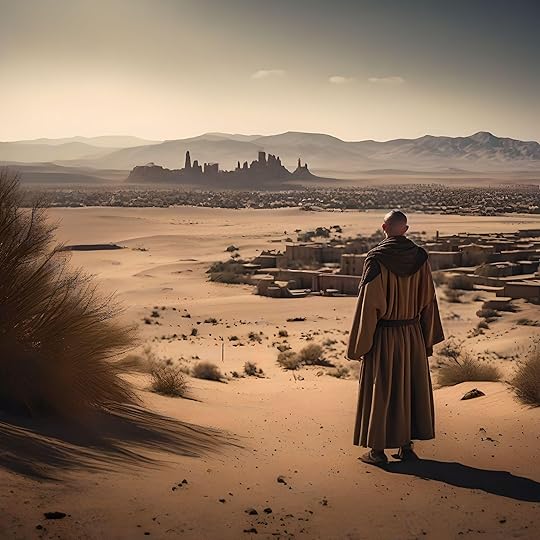
The blighted Earth where a monastery apiary holds the distributed intelligence Bees, long after The Crash.
My dead-pixel-formatted copy was a toothsome 434 pages. It had a 2025 copyright.
Adrian Tchaikovsky is a British author of science fiction and fantasy novels. He has published more than twenty (20) novels in several series and standalone. Additionally, he has published several novellas and numerous short stories. I've read many books by the author, mostly his science fiction. The last book being Saturation Point (Terrible Worlds: Transformations) (my review).
Note this book was the third in the author's Dogs of War series. Reading all the previous books is not necessary to get this book. However, reading Bear Head (Dogs of War, #2) (my review) is. The books share characters, but more importantly, the world-building in Bear Head is necessary to understand the Martian characters.
TL;DR Synopsis
200 years after The Crash that devastated the Earth, the Martians return. The fledgling Mars colony had barely survived being cutoff, and then only through the reluctant efforts of the proscribed bioform, distributed intelligence, The Bees that had been hiding out there. Now the terraforming of Mars is gaining ground, and there are surpluses. An expedition leaves Mars in response to a signal not heard in decades from Earth. Having maintained and extended pre-Crash technology, they want to help. The Earth is in poor shape; civilized society has collapsed, along with the environment. The population is greatly reduced and struggling. Although some remnants of The Old remain in the feudal bunkers of the immortal rich, the monasteries that conserve technology, and the robot semi-autonomous factories still in operation. The Martians, both human derived and bioforms, adapted for Mars are not human. The expedition "trying to help" starts a war, yet another one an on the ropes Earth can ill afford.
Tchaikovsky is a reliable author for me. He is also a very prolific author of science fiction and fantasy. One of the things he does well is to mashup familiar tropes in unusual ways and create genre benders. This was quite the mashup. I counted at least six (6) main tropes in play, each contributing a theme. The main ones were a Benevolent Alien Invasion, The Apunkalypse with Beast Men and distributed intelligence (a market basket of AI tropes and collective intelligence). This was a jam-packed novel.
In twist after twist over a large number of pages, with many sometimes bewildering POV changes, Tchaikovsky successfully mashes up: the Max Max-like Post-Apocalypse, The Island of Doctor Moreau , A Canticle for Leibowitz , and distributed intelligence. Nothing really new here, but the riffs of established tropes and schools of red herrings were well done.
The Review
Tchaikovsky is a good writer. The physical prose was immaculate with no errors I could find. My edition was Americanized. A pity, I prefer the author's native Brit speak. The story did contain a modicum of his humor with the Snarky Non-Human Sidekick. Although I didn't laugh out loud, I did chuckle several times. I'm a fan of apocalypse fiction. Tchaikovsky's description of "the empty Earth" is very economical, but effective. I can see how he writes so many books so quickly. He lets the reader's imagination do his work.
On Earth, it's a very Mad Max-esque future with a touch of Canticle for Liberwitz, with bioforms, Martians who might as well be bioforms, immortal rich folk "passing" as mortal, and distributed intelligences.
There was a raft of POVs. Their switching consumed a lot of linear inches of the narrative. I liked the Martians' POVs the best. There was a bizarre flashback POV to a Martian who starts the book as a corpse. The other classes of POVs were: the monk, the distributed intelligences, the Griffens (the Mad Max types), and the Factory folk. With the distributed intelligences, be prepared for exposition on how distributed systems challenge the notion of individuality and consciousness. Frankly, there were more POVs than necessary.
Plotting was good, but very busy. There were numerous POVs and only three terrestrial locations. There was also a certain amount of predictability to the plotting. Tchaikovsky loves his tropes. He riffs on them well enough to make them interesting even to a tried and true trope-spotter. However, there are only so many ways they can end. In addition, there were a couple of plot lines left in the wind blowing over the near-barren Earth. This smacks of Serial Fiction?
There was no sex, some drugs, and no rock 'n roll in the story. The Mad Max crew drank beer. Alcohol distillates were available, but only in very limited supply. They were also party to some performance-enhancing pharmaceuticals that had survived from the past.
Violence was: physical including "jaws and claws", edged-weapon, and firearms. Major human characters, even those not biomodified, had the constitution of a rhinoceros. Uplifted dogs and serpents could take a lot of punishment, too. Gore and trauma are moderately detailed. Body count was high. Despite the few people scratching out a living, life was still very cheap.
World-building was an update on the post-apocalyptic desolation. Tchaikovsky made modern embellishments, such as environmental collapse, pollution, and updated distributed intelligence, self-replicating machines, and contemporary biological modification technology. I personally enjoyed the combination of life forms, both human and uplift, and residual high tech. Tchaikovsky's riff on the IRL mega-rich's survival bunkers, working 200 years into the future, was interesting. You can see the influence of Douglas Rushkoff's 2022 book Survival of the Richest: Escape Fantasies of the Tech Billionaires , and a possible endgame for it.
Summary
This wasn't a great work, because of its dependence on too many tropes. It was also a somewhat predictable good work. The author's abilities are shown through. In particular, with his mods of tired tropes and his humor. Overall, I'd give the series three stars, but this was the best of the three Dogs of War series. Although it was not a sophisticated story, it's worth a read.
My biggest question, is about the obviously dangling plot lines. How many books are in this series?
The blighted Earth where a monastery apiary holds the distributed intelligence Bees, long after The Crash.
My dead-pixel-formatted copy was a toothsome 434 pages. It had a 2025 copyright.
Adrian Tchaikovsky is a British author of science fiction and fantasy novels. He has published more than twenty (20) novels in several series and standalone. Additionally, he has published several novellas and numerous short stories. I've read many books by the author, mostly his science fiction. The last book being Saturation Point (Terrible Worlds: Transformations) (my review).
Note this book was the third in the author's Dogs of War series. Reading all the previous books is not necessary to get this book. However, reading Bear Head (Dogs of War, #2) (my review) is. The books share characters, but more importantly, the world-building in Bear Head is necessary to understand the Martian characters.
TL;DR Synopsis
200 years after The Crash that devastated the Earth, the Martians return. The fledgling Mars colony had barely survived being cutoff, and then only through the reluctant efforts of the proscribed bioform, distributed intelligence, The Bees that had been hiding out there. Now the terraforming of Mars is gaining ground, and there are surpluses. An expedition leaves Mars in response to a signal not heard in decades from Earth. Having maintained and extended pre-Crash technology, they want to help. The Earth is in poor shape; civilized society has collapsed, along with the environment. The population is greatly reduced and struggling. Although some remnants of The Old remain in the feudal bunkers of the immortal rich, the monasteries that conserve technology, and the robot semi-autonomous factories still in operation. The Martians, both human derived and bioforms, adapted for Mars are not human. The expedition "trying to help" starts a war, yet another one an on the ropes Earth can ill afford.
Tchaikovsky is a reliable author for me. He is also a very prolific author of science fiction and fantasy. One of the things he does well is to mashup familiar tropes in unusual ways and create genre benders. This was quite the mashup. I counted at least six (6) main tropes in play, each contributing a theme. The main ones were a Benevolent Alien Invasion, The Apunkalypse with Beast Men and distributed intelligence (a market basket of AI tropes and collective intelligence). This was a jam-packed novel.
In twist after twist over a large number of pages, with many sometimes bewildering POV changes, Tchaikovsky successfully mashes up: the Max Max-like Post-Apocalypse, The Island of Doctor Moreau , A Canticle for Leibowitz , and distributed intelligence. Nothing really new here, but the riffs of established tropes and schools of red herrings were well done.
The Review
Tchaikovsky is a good writer. The physical prose was immaculate with no errors I could find. My edition was Americanized. A pity, I prefer the author's native Brit speak. The story did contain a modicum of his humor with the Snarky Non-Human Sidekick. Although I didn't laugh out loud, I did chuckle several times. I'm a fan of apocalypse fiction. Tchaikovsky's description of "the empty Earth" is very economical, but effective. I can see how he writes so many books so quickly. He lets the reader's imagination do his work.
On Earth, it's a very Mad Max-esque future with a touch of Canticle for Liberwitz, with bioforms, Martians who might as well be bioforms, immortal rich folk "passing" as mortal, and distributed intelligences.
There was a raft of POVs. Their switching consumed a lot of linear inches of the narrative. I liked the Martians' POVs the best. There was a bizarre flashback POV to a Martian who starts the book as a corpse. The other classes of POVs were: the monk, the distributed intelligences, the Griffens (the Mad Max types), and the Factory folk. With the distributed intelligences, be prepared for exposition on how distributed systems challenge the notion of individuality and consciousness. Frankly, there were more POVs than necessary.
Plotting was good, but very busy. There were numerous POVs and only three terrestrial locations. There was also a certain amount of predictability to the plotting. Tchaikovsky loves his tropes. He riffs on them well enough to make them interesting even to a tried and true trope-spotter. However, there are only so many ways they can end. In addition, there were a couple of plot lines left in the wind blowing over the near-barren Earth. This smacks of Serial Fiction?
There was no sex, some drugs, and no rock 'n roll in the story. The Mad Max crew drank beer. Alcohol distillates were available, but only in very limited supply. They were also party to some performance-enhancing pharmaceuticals that had survived from the past.
Violence was: physical including "jaws and claws", edged-weapon, and firearms. Major human characters, even those not biomodified, had the constitution of a rhinoceros. Uplifted dogs and serpents could take a lot of punishment, too. Gore and trauma are moderately detailed. Body count was high. Despite the few people scratching out a living, life was still very cheap.
World-building was an update on the post-apocalyptic desolation. Tchaikovsky made modern embellishments, such as environmental collapse, pollution, and updated distributed intelligence, self-replicating machines, and contemporary biological modification technology. I personally enjoyed the combination of life forms, both human and uplift, and residual high tech. Tchaikovsky's riff on the IRL mega-rich's survival bunkers, working 200 years into the future, was interesting. You can see the influence of Douglas Rushkoff's 2022 book Survival of the Richest: Escape Fantasies of the Tech Billionaires , and a possible endgame for it.
Summary
This wasn't a great work, because of its dependence on too many tropes. It was also a somewhat predictable good work. The author's abilities are shown through. In particular, with his mods of tired tropes and his humor. Overall, I'd give the series three stars, but this was the best of the three Dogs of War series. Although it was not a sophisticated story, it's worth a read.
My biggest question, is about the obviously dangling plot lines. How many books are in this series?

January 6, 2026
Bee Speaker
★★★★☆
A quick, clever sci-fi read that’s clearly having fun with its ideas. The concept is strong, the worldbuilding is efficient, and the story keeps moving without getting bogged down in explanation. There’s a lightness to it, even when it’s asking serious questions, which makes it easy to enjoy start to finish.
Short, smart, and a good time. Solid four stars.
★★★★☆
A quick, clever sci-fi read that’s clearly having fun with its ideas. The concept is strong, the worldbuilding is efficient, and the story keeps moving without getting bogged down in explanation. There’s a lightness to it, even when it’s asking serious questions, which makes it easy to enjoy start to finish.
Short, smart, and a good time. Solid four stars.
June 12, 2025
Disappointed in this read, having loved the first two entries in this series. I’m a huge Tchaikovsky fan and have read the majority of his works. Think this one is my least favorite.
To me, it didn’t keep with the scope of the first two books. It seemed much more of a micro event. I really only enjoyed one character’s POV (Irae). Every other character was flat to me. Even Bees! Which is sad, because I liked her in previous books!
To me, it didn’t keep with the scope of the first two books. It seemed much more of a micro event. I really only enjoyed one character’s POV (Irae). Every other character was flat to me. Even Bees! Which is sad, because I liked her in previous books!
October 9, 2025
The Honey Nut Cheerios bee just got a serious upgrade!

July 27, 2025
Tchaikovsky rarely misses, this was great.

June 24, 2025
What a great series this turned out to be. And an excellent addition to it. Bee Speaker was a great story, not exceptional, but I enjoyed it throughout. The evolution of the world as seen thorugh progressive populations of Bioforms has been very gratifying. Moar please

July 4, 2025
Not as good as books 1 & 2 of the trifold but still a good read. Recommended

November 19, 2025
Well, fuck me, that was a wild ride and I was sat for the entirety of it.
I did not expect this book to turn out the way it did - it is such a different point of view from the previous two, but I loved the way it was done. The world building as usual is close to perfection, especially the brief snapshots to the past. The point of views from the various characters, with the few interjections from Bees, give such a well rounded overview of the story, it's truly masterful.
Just another example of how talented Adrian is, love you, need about a hundred more of those, cheers.
I did not expect this book to turn out the way it did - it is such a different point of view from the previous two, but I loved the way it was done. The world building as usual is close to perfection, especially the brief snapshots to the past. The point of views from the various characters, with the few interjections from Bees, give such a well rounded overview of the story, it's truly masterful.
Just another example of how talented Adrian is, love you, need about a hundred more of those, cheers.

June 30, 2025
Review originally on JamReads
Bee Speaker is the third novel in the science fiction series Dogs of War (it is important to note that the three books are standalones), written by Adrian Tchaikovsky, published by Head of Zeus. A fast-paced story that smartly plays with a huge cast of characters in another example of Tchaikovsky's rich imagination, almost bordering the science fantasy territory; the premise of throwing a mismatched crew into a hostile place, taken to the extreme, and incredibly executed.
A cryptic distress signal from Earth draws a crew of genetically engineered Martian Bioforms to start a mission on the planet where all originated; however, from very own first moment, things will go really wrong, turning it into chaos, and having the Martians to deal with the different factions running on this part of the world. A society that comprises such varied groups as an order that reveres the Bee intelligence, Techno-feudal warlords, an old remnant of tech known as the factory and even some really old individuals; a really unstable world where violence is a common answer and where our crew will have to their best to survive.
Part of what makes Bee Speaker such a really interesting experience is how Tchaikovsky manages to weave together the nine different POV characters: relatively short chapters, many times describing the same situation from the head of other character, highlighting the differences in their background and how that influences their lines of thought. Each POV has a characteristic voice, from Irae, the reptile bioform, much more prone to violence, to Wells, the bioform that was meant to be the communication operator of the mission, passing by humans as the brother Cricket; all of them are easily recognisable and unique. This particular narrative style can become a bit chaotic by moments, but I personally enjoyed how it helps to create a contrast between the characters, allowing us to learn much about them by their answer to certain situations.
The worldbuilding is another of the strengths of this book: a post-technological disaster Earth where different factions survive, with remnants of the old tech; I love how in this situation, the line between technology and magic is so blurred, as when the knowledge is lost, advance technology is indistinguishable from magic. This hostile place puts most of the groups in a pretty much precarious situation, and the Martians are outside of their element, having to learn fast.
The pacing is fast, partly motivated by the short chapters, which invite the reader to continue to learn what will happen next; you can easily devour this book because the author is always giving you another treat. While the ending is a bit in the predictable side, I think it is still a great conclusion, putting the foundations to maybe a follow-up novel in the same part of the world.
Bee Speaker is a great science fiction novel, a standalone instalment in the Dogs of Wars series that plays the best with its strengths, another proof of how wild Tchaikovsky's imagination can be. Another of the highlights of the year for me!
Bee Speaker is the third novel in the science fiction series Dogs of War (it is important to note that the three books are standalones), written by Adrian Tchaikovsky, published by Head of Zeus. A fast-paced story that smartly plays with a huge cast of characters in another example of Tchaikovsky's rich imagination, almost bordering the science fantasy territory; the premise of throwing a mismatched crew into a hostile place, taken to the extreme, and incredibly executed.
A cryptic distress signal from Earth draws a crew of genetically engineered Martian Bioforms to start a mission on the planet where all originated; however, from very own first moment, things will go really wrong, turning it into chaos, and having the Martians to deal with the different factions running on this part of the world. A society that comprises such varied groups as an order that reveres the Bee intelligence, Techno-feudal warlords, an old remnant of tech known as the factory and even some really old individuals; a really unstable world where violence is a common answer and where our crew will have to their best to survive.
Part of what makes Bee Speaker such a really interesting experience is how Tchaikovsky manages to weave together the nine different POV characters: relatively short chapters, many times describing the same situation from the head of other character, highlighting the differences in their background and how that influences their lines of thought. Each POV has a characteristic voice, from Irae, the reptile bioform, much more prone to violence, to Wells, the bioform that was meant to be the communication operator of the mission, passing by humans as the brother Cricket; all of them are easily recognisable and unique. This particular narrative style can become a bit chaotic by moments, but I personally enjoyed how it helps to create a contrast between the characters, allowing us to learn much about them by their answer to certain situations.
The worldbuilding is another of the strengths of this book: a post-technological disaster Earth where different factions survive, with remnants of the old tech; I love how in this situation, the line between technology and magic is so blurred, as when the knowledge is lost, advance technology is indistinguishable from magic. This hostile place puts most of the groups in a pretty much precarious situation, and the Martians are outside of their element, having to learn fast.
The pacing is fast, partly motivated by the short chapters, which invite the reader to continue to learn what will happen next; you can easily devour this book because the author is always giving you another treat. While the ending is a bit in the predictable side, I think it is still a great conclusion, putting the foundations to maybe a follow-up novel in the same part of the world.
Bee Speaker is a great science fiction novel, a standalone instalment in the Dogs of Wars series that plays the best with its strengths, another proof of how wild Tchaikovsky's imagination can be. Another of the highlights of the year for me!

December 28, 2025
Somewhat of a disappointment after the excellent Dogs of War and the even excellent-er Bear Head. Bee Speaker has almost none of the deep commentary on inequality, colonialism, animal rights, and racism that the other books had. It does have the excellent characters and pleasantly dark sense of humor, but it all feels a bit hollow.

March 17, 2026
3rd book in series/ lots of swearing including F-word/Mixed 1st and 3rd person
Although this is the third book in the Dogs of War series it takes place several decades after the last book so you could read it without reading the previous books. You might be confused about things referred to from past books but the author does include basic information about Bioforms and other stuff for people reading this one first. I do recommend reading books in the order they are in a series.
POSSIBLE SPOILERS FROM PREVIOUS BOOKS IN THE SERIES BUT I'LL TRY TO KEEP IT TO A MINIMUM!!!
Ok, so if you've read the previous books you only have to see the title or the cover image to know that this book involves Bees. However don't get too excited if Bees is your favorite character from previous books because she mostly not in it until near the end.
In the decades after "Bear Head" there was some apocalypse that led to society on Earth being pushed back to medieval times. There are quaint villages that farm the land and do things the old-fashioned way because technology is gone. But not all technology everywhere is gone. There is a remnant hanging out in the Dog Factory that runs the place. The Dog Factory makes dog Bioforms but the process is not always successful and puppies die (sad face). A major player in this area is the Griffin bunker, so named because back in the day when things looked dire a man named Griffin designed a bunker and inhabited it his cronies and these are the descendants. They are basically a bunch of dudes who likes to terrorize the villagers. They still have some guns and are not afraid to use them. The other notable place is the Apiary, which is full of monks who guard knowledge and says that Bees lives there and is their protector.
On Mars the apocalypse caused the Martians to band together to help keep the place going because there would be no more care packages from Earth now and they were alone and only had each other. It caused people to develop this helping instinct that works on Mars where everyone else does that too but not so much on Earth where people are greedy and all 'me first'. Unfortunately the Martians don't know that about Earth so when they receive a message from Earth purporting to be from Bees (part of Bees stayed on Earth, most of her went to Mars) the Martians want to help, of course. A four person crew is selected and off they go to Earth!
Only to have one of their crew get shot, a human woman is debilitated by the increased Earth gravity, a dog Bioform is overloaded by it's senses and loses track of what's happening, and the final crewmember, a dragon Bioform, is in danger of being overwhelmed by the heat of Earth (it's cold on Mars) and when Irae the dragon gets too hot it loses all thought and wants to go on a killing rampage. Thankfully they equipped Irae with a vest that helps her control her body temperature, she can dial up or down with a thought.
The first quarter of the book is "anything that could go wrong, does go wrong" and the poor Martians end up in all kinds of trouble. Tchaikovsky shows his masterful writing skills in choosing which character's POV to use to tell the events of each chapter and certain characters are told in 1st person and some in 3rd person. He does a wonderful job of writing 1st person from very different types of people. He makes it look easy, like Olympic figure skaters. It writing was an Olympic sport Mr. Tchaikovsky would have a gold medal for sure.
Although this is the third book in the Dogs of War series it takes place several decades after the last book so you could read it without reading the previous books. You might be confused about things referred to from past books but the author does include basic information about Bioforms and other stuff for people reading this one first. I do recommend reading books in the order they are in a series.
POSSIBLE SPOILERS FROM PREVIOUS BOOKS IN THE SERIES BUT I'LL TRY TO KEEP IT TO A MINIMUM!!!
Ok, so if you've read the previous books you only have to see the title or the cover image to know that this book involves Bees. However don't get too excited if Bees is your favorite character from previous books because she mostly not in it until near the end.
In the decades after "Bear Head" there was some apocalypse that led to society on Earth being pushed back to medieval times. There are quaint villages that farm the land and do things the old-fashioned way because technology is gone. But not all technology everywhere is gone. There is a remnant hanging out in the Dog Factory that runs the place. The Dog Factory makes dog Bioforms but the process is not always successful and puppies die (sad face). A major player in this area is the Griffin bunker, so named because back in the day when things looked dire a man named Griffin designed a bunker and inhabited it his cronies and these are the descendants. They are basically a bunch of dudes who likes to terrorize the villagers. They still have some guns and are not afraid to use them. The other notable place is the Apiary, which is full of monks who guard knowledge and says that Bees lives there and is their protector.
On Mars the apocalypse caused the Martians to band together to help keep the place going because there would be no more care packages from Earth now and they were alone and only had each other. It caused people to develop this helping instinct that works on Mars where everyone else does that too but not so much on Earth where people are greedy and all 'me first'. Unfortunately the Martians don't know that about Earth so when they receive a message from Earth purporting to be from Bees (part of Bees stayed on Earth, most of her went to Mars) the Martians want to help, of course. A four person crew is selected and off they go to Earth!
Only to have one of their crew get shot, a human woman is debilitated by the increased Earth gravity, a dog Bioform is overloaded by it's senses and loses track of what's happening, and the final crewmember, a dragon Bioform, is in danger of being overwhelmed by the heat of Earth (it's cold on Mars) and when Irae the dragon gets too hot it loses all thought and wants to go on a killing rampage. Thankfully they equipped Irae with a vest that helps her control her body temperature, she can dial up or down with a thought.
The first quarter of the book is "anything that could go wrong, does go wrong" and the poor Martians end up in all kinds of trouble. Tchaikovsky shows his masterful writing skills in choosing which character's POV to use to tell the events of each chapter and certain characters are told in 1st person and some in 3rd person. He does a wonderful job of writing 1st person from very different types of people. He makes it look easy, like Olympic figure skaters. It writing was an Olympic sport Mr. Tchaikovsky would have a gold medal for sure.

May 27, 2026
Adrian Tchaikovsky, as a prophet and Cassandra and Pandora of our age, has been getting mighty grim lately. Most of his recent books have taken a depressingly dim view of humanity’s chances, and it’s hard to blame him. Sometimes I have to opt out, because I can’t handle the misery, and it’s only because he’s so good at his job that I feel that misery too keenly. The man has never written a bad novel, but sometimes the novels are about bad things to the extent that I just can’t take it.
The second book in the Dogs of War series verged on that territory (the first being one of my favourites of his), with its psychotic despot politicians and petty mean little billionaires. Too close to home and a hard pill to swallow after the joyous conclusion to Dogs of War. And to start with I was wondering if this wouldn’t be the same, with its Earth-wiped-clean and poisoned soil and Mad Max bunker knights.
But the vestiges of the old Bioforms found their way through, the dogs and dragons and, of course, the Bees. The remnants of that fascinating and feared Distributed Intelligence, both insect and human. And Tchaikovsky’s understanding of the miserable shortcomings of men and the frustrating sidelining of women woven subtly throughout. A satisfying perilous denoement and a big cathartic battle to end it all. The potential for people to be better than they have been, to expand their world and flourish again. As one of the Martians described this diminished Earth and the Factory Bees as Pandora’s box, so this novel manages to end with the smallest and most profound of all things: hope.
The second book in the Dogs of War series verged on that territory (the first being one of my favourites of his), with its psychotic despot politicians and petty mean little billionaires. Too close to home and a hard pill to swallow after the joyous conclusion to Dogs of War. And to start with I was wondering if this wouldn’t be the same, with its Earth-wiped-clean and poisoned soil and Mad Max bunker knights.
But the vestiges of the old Bioforms found their way through, the dogs and dragons and, of course, the Bees. The remnants of that fascinating and feared Distributed Intelligence, both insect and human. And Tchaikovsky’s understanding of the miserable shortcomings of men and the frustrating sidelining of women woven subtly throughout. A satisfying perilous denoement and a big cathartic battle to end it all. The potential for people to be better than they have been, to expand their world and flourish again. As one of the Martians described this diminished Earth and the Factory Bees as Pandora’s box, so this novel manages to end with the smallest and most profound of all things: hope.

March 3, 2025
4.25/5 I received a copy of this book in exchange for an honest review.
Being a big fan of the other two Bioform books (Dogs of War, Bear Head) I was excited to hear that Tchaikovsky was releasing a new entry in this series. These are pretty much standalone books and have pretty conclusive endings at the end of each entry. I was satisfied with the ending of Dogs of War and didn't feel like I *needed* another book but Bear Head was one of my biggest surprises, I thought it was hilarious and just a really fun time.
This book has more of a serious tone again and we get a mixture of Bioform, human, and a few other factions and races of characters that are thrown into conflict and testing the bounds of this broken world they find themselves in.
I think the characters are all pretty well written, especially the Bioforms which are the strong point of the series, exploring animal hybrids and their internal monologues never ceases to be interesting.
The world building is pretty good in this one and builds off the previous two books, I did think some of the elements at the end needed a gentler and more gradual introduction, it felt like we got quite a lot right at the end and new conflicts sprung up only to be resolved fairly quickly. I was also hoping to see some Shadows of the Apt connections, maybe that's misguided but I could have seen that feasibly happening.
Overall, happy I read this. I'm not sure it *needed* to be written and was sort of hoping for some bigger more definitive conclusions but this was a fun story in a well built world. I'd read another one in this world but also I'm fine if it ends here, but I do think if there is another book in the series I kind of want a bigger concept that can really shake things up.
This was more of a plot focused book, I do think the ideas in Dogs of War and Bear Head were a bit more interesting and novel but the world and interaction of the factions here was the strong point.
Being a big fan of the other two Bioform books (Dogs of War, Bear Head) I was excited to hear that Tchaikovsky was releasing a new entry in this series. These are pretty much standalone books and have pretty conclusive endings at the end of each entry. I was satisfied with the ending of Dogs of War and didn't feel like I *needed* another book but Bear Head was one of my biggest surprises, I thought it was hilarious and just a really fun time.
This book has more of a serious tone again and we get a mixture of Bioform, human, and a few other factions and races of characters that are thrown into conflict and testing the bounds of this broken world they find themselves in.
I think the characters are all pretty well written, especially the Bioforms which are the strong point of the series, exploring animal hybrids and their internal monologues never ceases to be interesting.
The world building is pretty good in this one and builds off the previous two books, I did think some of the elements at the end needed a gentler and more gradual introduction, it felt like we got quite a lot right at the end and new conflicts sprung up only to be resolved fairly quickly. I was also hoping to see some Shadows of the Apt connections, maybe that's misguided but I could have seen that feasibly happening.
Overall, happy I read this. I'm not sure it *needed* to be written and was sort of hoping for some bigger more definitive conclusions but this was a fun story in a well built world. I'd read another one in this world but also I'm fine if it ends here, but I do think if there is another book in the series I kind of want a bigger concept that can really shake things up.
This was more of a plot focused book, I do think the ideas in Dogs of War and Bear Head were a bit more interesting and novel but the world and interaction of the factions here was the strong point.

January 25, 2026
4.5 stars.
I’ve greatly enjoyed all three of the Dogs of War novels, but this is my personal favourite. There’s a hefty time-jump from the events of Bear Head. Now, several generations later, we find Earth a much declined planet. The pockets of humanity that remain are living in a vaguely medieval manner but with a ragged assortment of leftover technologies. Patriarchal clans seem to have the upper hand and most of the remaining guns. More peaceable types live precariously just so long as they can keep the thugs from defaulting to their belligerent instincts.
Into this mess arrives a self-appointed group of Martians consisting of two heavily Mars-adapted humans, a similarly adapted reptile, and an adapted canine: all equals in their venture to Earth, all with human-level intelligence. They come for the most noble of reasons, with every intention to help the mother planet. Mayhem ensues.
It is pure sf entertainment, not an ounce of fat on it. Just what I wanted to brighten up a dark and dreary January.
I’ve greatly enjoyed all three of the Dogs of War novels, but this is my personal favourite. There’s a hefty time-jump from the events of Bear Head. Now, several generations later, we find Earth a much declined planet. The pockets of humanity that remain are living in a vaguely medieval manner but with a ragged assortment of leftover technologies. Patriarchal clans seem to have the upper hand and most of the remaining guns. More peaceable types live precariously just so long as they can keep the thugs from defaulting to their belligerent instincts.
Into this mess arrives a self-appointed group of Martians consisting of two heavily Mars-adapted humans, a similarly adapted reptile, and an adapted canine: all equals in their venture to Earth, all with human-level intelligence. They come for the most noble of reasons, with every intention to help the mother planet. Mayhem ensues.
It is pure sf entertainment, not an ounce of fat on it. Just what I wanted to brighten up a dark and dreary January.

January 24, 2026
9- (close to five stars) Adrian Tchaikovsky did it again - he created an absolutely fasinating, thrilling and inspiring novel in his 'Dogs of War' universe (the books in this series can be read on their own. I didn't read the first one, but had no trouble reading the second and this one). Of course here are the usual elements of Tchaikovsky's novels: new forms of consciousness (here a reptile whose mind gets sluggish when it's cold and who loses control when it's hot - and Bees), multiple characters whose stories form a tapestry and a humanist view of the world, where empathy and caring for the weak are important to the characters and structures of oppression are analyzed to see how they function and how they can be taken apart.
Here the setting is Earth two hundred years after the crash - a post apocalyptic world where pockets of civilisation try to rebuild. Mars has kept technology and when Martians (uplifted animals and genetically altered humans) receive a call for help they send out an expedition. The Martians landing on Earth soon find out that they are not adapted to life on the planet any more and their plans soon go awry. Also on Earth several factions from before the crash have survived in the nooks and crannies and rear their heads ... some to help, others to try and regain control ...
One of the discussions online in the past few years, revolved around a paper describing how the ultra rich build bunkers to try and survive climate chaos, and how they discuss ways to keep their servant population under control - even in a world where money loses all its worth. Tchaikovsky has read the same article as I did, as he here shows ways in which these ideas of billionaires take an unexpected turn.
At the same time there is a thread in this book about religion - one of the protagonist being a monk living in the Apiary where he serves Bees. The story explores how religions can turn into cults (here: parasitic wasps) - using people as pawns - when their own survival becomes the highest good, instead of care for people around them. Also Tchaikovsky explores what the role can be of religious structures in a post-religious world, concluding: 'I he wanted the world of tomorrow to hold something like Bees ... the benevolent protector of knowledge and the weak - he could attempt to bring that tomorrow about. There was nobody else.'
Of course this was well written, with well built tension coming from clashing societal structures and personal expectations. There is some good action, a bit of horror (which Tchaikovsky likes to add to his books - and I like that) and the ending is great!
Absolutely recommended, though I would not say this is essential - if you haven't read the 'Children of...' books, or 'Shards of Earth', start there. But if you are a fan like me, this will not disappoint.
Here the setting is Earth two hundred years after the crash - a post apocalyptic world where pockets of civilisation try to rebuild. Mars has kept technology and when Martians (uplifted animals and genetically altered humans) receive a call for help they send out an expedition. The Martians landing on Earth soon find out that they are not adapted to life on the planet any more and their plans soon go awry. Also on Earth several factions from before the crash have survived in the nooks and crannies and rear their heads ... some to help, others to try and regain control ...
One of the discussions online in the past few years, revolved around a paper describing how the ultra rich build bunkers to try and survive climate chaos, and how they discuss ways to keep their servant population under control - even in a world where money loses all its worth. Tchaikovsky has read the same article as I did, as he here shows ways in which these ideas of billionaires take an unexpected turn.
At the same time there is a thread in this book about religion - one of the protagonist being a monk living in the Apiary where he serves Bees. The story explores how religions can turn into cults (here: parasitic wasps) - using people as pawns - when their own survival becomes the highest good, instead of care for people around them. Also Tchaikovsky explores what the role can be of religious structures in a post-religious world, concluding: 'I he wanted the world of tomorrow to hold something like Bees ... the benevolent protector of knowledge and the weak - he could attempt to bring that tomorrow about. There was nobody else.'
Of course this was well written, with well built tension coming from clashing societal structures and personal expectations. There is some good action, a bit of horror (which Tchaikovsky likes to add to his books - and I like that) and the ending is great!
Absolutely recommended, though I would not say this is essential - if you haven't read the 'Children of...' books, or 'Shards of Earth', start there. But if you are a fan like me, this will not disappoint.

February 12, 2026
I really should have waited for that ebook hold to come through in Libby to have the text in front of me when I needed it. Narration was great, but still too many POVs to keep up (thanks for having 3 voices, it helped a lot).
Bees was always one of the more interesting bioforms, but here they shine. Even though, as one of them put it, it was "not out circus, not our monkeys".
It's very likely that I will eye read this book one day, for the most part just to get all the Irae quotes down. He got me chuckling a lot. "Napoleon Barbarian or something" - he really didn't pay attention to his history lessons.
Bees was always one of the more interesting bioforms, but here they shine. Even though, as one of them put it, it was "not out circus, not our monkeys".
It's very likely that I will eye read this book one day, for the most part just to get all the Irae quotes down. He got me chuckling a lot. "Napoleon Barbarian or something" - he really didn't pay attention to his history lessons.

June 26, 2025
So, he's done it again. Another fantastic book from Adrian Tchaikovsky. This is the third in his Dogs of War series, and hopefully not the last, though if this series has to end this is a good place to end it.
Once again the writing is excellent, and once again Tchaikovsky gives you a bunch of unusual characters to fall in love with. Irae and Wells are definitely up there with some of his oddest characters, and made this an extra fun read. I especially loved Irae's irreverent attitude and the gradual unveiling of each progressively disturbing surprise.
If you've not read any Tchaikovsky then this series is a good place to start. The three books are all relatively short and effectively standalone, though reading them in order is probably a good idea.
Another five-star read for me, and another reminder why I love this guy's writing.
Once again the writing is excellent, and once again Tchaikovsky gives you a bunch of unusual characters to fall in love with. Irae and Wells are definitely up there with some of his oddest characters, and made this an extra fun read. I especially loved Irae's irreverent attitude and the gradual unveiling of each progressively disturbing surprise.
If you've not read any Tchaikovsky then this series is a good place to start. The three books are all relatively short and effectively standalone, though reading them in order is probably a good idea.
Another five-star read for me, and another reminder why I love this guy's writing.
March 22, 2025
I love this author and I find some of his books resonate more with me than others. I hadn’t read the 2 previous novels in the series. I loved the ideas in this book and it didn’t quite draw me in. Would definitely appeal to many readers. Thank you to the author. Thank you to #netgalley and the punisher for an ARC.

November 13, 2025
Enjoyable finale to the trilogy but I felt like this one was a little bit weaker than the first 2. I didn't gel with the setting as well and I felt like it didn't touch on as many moral / philosophical concepts as the previous books.

July 17, 2026
"I see scarves and cloaks, brightly colored. Strips of cloth tied about them. Bright heraldry, painted, cracking, over leather. They are the barbarians coming to the gates, long hair and long faces and guns. They look, the thought takes me, like they're from some old metal album cover." Lol

September 25, 2026
Sadly fell flat for me after enjoying the two previous books.

June 29, 2025
Do you know the feeling of starting a hard SF novel and not understanding anything in the first chapter? Yep, that was the first chapter of this one, reading the thoughts of our presumably friendly distributed bee intelligence. It took a few more chapters of other POVs to get a grasp on the setting. Cricket, the monk, was more relatable. There is also Deacon, the dog bioform… Deadon is a Good Dog! And then we move onto other humans and more bizarre bioforms. Remember the previous story? Mars comes to Earth! They are looking for Bees and they want to help. Not so easy when what remains on Earth is more akin to a Mad Max movie.
Pretty, if somewhat ominously spoilerish book cover.
Yes, you should read the previous novels/novellas in this world for context.
I liked the characters and the setting. Irae probably being everybody‘s favourite. I liked the plot. But for some reason that I haven‘t been able to identify yet, the story did not grab me. I stubbornly plodded through the first third of this and then started to skim heavily until the last few chapters, which I read a little more thoroughly again. Yes, good story and good ending with a hopeful outlook and all loose ends neatly tied up. But somehow this just dragged fiercely for me.
I can’t say why didn’t I like this as a whole. There was just not enough… forward momentum? A red thread? Too many POVs? I‘m not sure. But I was definitely very bored most of the time, despite liking the story. I had looked forward to more interesting exploration of Bees‘ personality. If that happened, it was definitely too late for me and too little to notice during my extensive skimming.
Definitely not as lively and captivating as the first two. Therefore, sadly only ⭐️⭐️½.
If you are a Tchaikovsky fan and you have read the previous two stories in this world, go for it! Mileage might vary.
I received an advanced copy of this book from the publisher or author through NetGalley. All opinions are my own and I was not required to give a positive review.
Pretty, if somewhat ominously spoilerish book cover.
Yes, you should read the previous novels/novellas in this world for context.
I liked the characters and the setting. Irae probably being everybody‘s favourite. I liked the plot. But for some reason that I haven‘t been able to identify yet, the story did not grab me. I stubbornly plodded through the first third of this and then started to skim heavily until the last few chapters, which I read a little more thoroughly again. Yes, good story and good ending with a hopeful outlook and all loose ends neatly tied up. But somehow this just dragged fiercely for me.
I can’t say why didn’t I like this as a whole. There was just not enough… forward momentum? A red thread? Too many POVs? I‘m not sure. But I was definitely very bored most of the time, despite liking the story. I had looked forward to more interesting exploration of Bees‘ personality. If that happened, it was definitely too late for me and too little to notice during my extensive skimming.
Definitely not as lively and captivating as the first two. Therefore, sadly only ⭐️⭐️½.
If you are a Tchaikovsky fan and you have read the previous two stories in this world, go for it! Mileage might vary.
I received an advanced copy of this book from the publisher or author through NetGalley. All opinions are my own and I was not required to give a positive review.

May 24, 2025
I am grateful to NetGalley for providing an advance copy of this book in exchange for my honest review.
‘Bee Speaker’ is a new novel by Adrian Tchaikovsky. It is the third instalment of his ‘Dogs of War’ science-fiction series, set in a future where genetically engineered Bioforms live alongside humans. Although I have not read the first two books of the series, I did not sense I was significantly missing out on any background or context in this book. It is a riveting story, something of a ‘First Encounter” between humans and non-humans. Entertaining and thought-provoking throughout, with a fine ending. I greatly enjoyed it and look forward to reading the first two books in the series.
The setting is as follows (paraphrased from the publishers description).
The end of the world has come and gone. Humanity has bled almost to death from a thousand cuts. While Earth fell apart, on the almost forgotten colony on Mars, engineered humans and beasts aided by Bees and their Distributed Intelligence, has survived and thrived, becoming an independent entity over the generations with little to connect them to their ancestors on Earth. Until a signal arrives, begging for help…
What happens next is the story told, from multiple perspectives, in this book. What could go wrong ? Well, the reader will soon find that pretty much everything could and does go wrong.
This book has a lot of characters and communities. The population on Earth has decreased and humans have abandoned cities and major population areas. The surviving communities pretty much live a subsistence lifestyle, with some groups having a little more technology and therefore hegemony than others. Conflict is common, alliances shaky with various superstitions and folk-traditions becoming commonplace. Some groups have old and failing technology while others attempt to retain human knowledge for a better future. Then there are the groups with weapons who use them or threaten violence to pursue their aims.
In short, a desperate mess of humanity, lacking any unity or cooperation. The remaining humans face an even bleaker future without external help.
The initial chapters set the scene. A dystopian Earth of course, but with some human communities having Bioform dogs . Physically powerful and sentient creatures, they are largely equivalent to their humans partners, although feared and distrusted by many.
Mr Tchaikovsky’s books rapidly grab the readers attention and this is certainly the case with “Bee Speaker”. The plots are exciting and the cast of humans and other Spacers is always fascinating. What I enjoy most are what has formed these characters, what makes them who they are and how they think. And most of all, the relationships they build, cultivate and cherish. In this book, relationships within and between various groups of humans and ‘human-adjacent sentience’. The plot unfolds from several perspectives, with multiple protagonists providing the reader with their thoughts amongst the fears and uncertainty of their lives.
And into this dysfunctional Earth, the arrival of a small expedition of capable and carefully selected Martians, returning to their ancestral home to provide much-needed help. That is the plan anyway.
The four Martians are a mix of the lifeforms that have evolved on Mars. Far in advance of humans in many ways. Not only in technology but also their worldview and attitudes to other lifeforms. Intelligence and societal governance is more advanced than Earth has ever been. Peaceful solutions and cooperation have been essential to their survival on a hostile planet. They do not see themselves as Humans. There was much discussion about even sending help to Earth. A distant planet which has largely lost contact with the Mars Colony over generations. Yet their advanced and benevolent society concluded, not entirely by consensus, that helping their very distant ancestors was the right thing to do.
The Martians who arrived on Earth are a diverse group. Democratic in leadership, individualistic in their outlook on Earth and their views of the human inhabitants. And to further complicate matters, the Earth environment, climate, atmosphere and gravity is having exaggerated influence on their physiology and thought processes. Beyond what they had expected. I loved these otherworldly characters. They are the heart and soul of this book. And the action and excitement as well. The Martian society may be far advanced in behavioural terms, but there are still signs in their DNA of their human and animal origins, both strengths and weaknesses. Instincts are near the surface as they encounter this ancestral planet of Earth. Once they enter the plot, we see the story from their perspective as well. This is a particularly attractive part of Mr Tchaikovsky writing. Seeing and feeling a foreign world from a Martian point of view. And the Martian characters have a wide range of feelings and opinions about their mission, particularly when things go wrong !
This brings us to another fascinating aspect of the story. Earth societies are a mess. How will the people respond to the arrival of a group of strangers, in their eyes barely resembling humans and some of them closer to medieval beasts. One would think (hope ?) that failing societies would be grateful or at least open to external assistance. It goes without saying, events do not progress as planned. There is death and mayhem amongst the fear and misunderstanding. Also some fine examples of tolerance, benevolence, dignity and bravery. It is probably not hard to guess which groups display the more humane characteristics.
I loved the plot developments and many of the side stories of life on Mars and Earth. As in his other books, Mr Tchaikovsky injects humour into the plot, amongst the action and excitement. One Martian character is particularly snarky in thought and speech. Laugh-out-loud hilarious sometimes ! An example is his initial impressions of life on Earth:
It is truly amazing how many flavours of dumbness an apocalypse can spawn.
The other Martian characters tend to be more cerebral, thoughtful and compassionate. The reader will enjoy these characters as well, with their admirable aims and determination to help the dysfunctional human communities, come what may.
Bees play a role as well, but not until the latter stages of the book. Whilst AI is the current obsession in the Technology industry today, perhaps mankind should prepare for what might come next. Distributed Intelligence, or DisInt. The Bees have this attribute and consequently have comprehension, thoughts and actions proportional to their numbers. And they can quickly increase to very, very large numbers, consequently achieving superior influence and power. The Bees role on Mars is portrayed as not entirely benign, but enabling and then almost separate to the Martian society and its evolution. The reader will wonder what role Bees might play on a messed-up Earth. Almost as a side story, DisInt has become a part of some humans on Earth, albeit in a basic, limited mode. This adds richness and colour to the story and enables twists and turns in the plot.
The conclusion and what may happen next is somewhat unexpected, poignant, a little bitter-sweet yet satisfying. Thought-provoking and offering tentative optimism.
I would recommend this book to anyone who has enjoyed Mr Tchaikovsky’s other books. While the plots is certainly compelling and imaginative, it is the character development that really stands out. Particularly with the Martians visitors. Deep, rich, believable characters with all the flaws and strengths one might hope to find in such a story.
Which brings me to my one, small quibble. Very small. The book has a lot of moving parts; distinct entities and characters. I care less for some of them, not due to their behaviour or actions, but due to a lack of background. Not knowing very much about their past and how they came to be. Perhaps this is something developed in the first two books of the series ? One or two characters could have been omitted from this book and the plot would not have been greatly affected. This might have allowed for a deeper, richer character development for some of the secondary yet important characters.
I finished reading this book about a week ago and it is still fresh in my memory and will, I expect, remain there for a long time. It has been a pleasure writing this review, revisiting the fascinating plot, a ‘First Contact’ of sorts. Exploring themes of communication, comprehension, learning, trust and benevolence between cultures and species. And of course revisiting with the memorable characters, particularly the Martians. I do hope Mr Tchaikovsky is able to weave some of them into his future writing plans. ‘Bee Speaker’ is a Great Read and a wonderful addition to Mr Tchaikovsky’s body of work. I wish him all the very best with the publication.
‘Bee Speaker’ is a new novel by Adrian Tchaikovsky. It is the third instalment of his ‘Dogs of War’ science-fiction series, set in a future where genetically engineered Bioforms live alongside humans. Although I have not read the first two books of the series, I did not sense I was significantly missing out on any background or context in this book. It is a riveting story, something of a ‘First Encounter” between humans and non-humans. Entertaining and thought-provoking throughout, with a fine ending. I greatly enjoyed it and look forward to reading the first two books in the series.
The setting is as follows (paraphrased from the publishers description).
The end of the world has come and gone. Humanity has bled almost to death from a thousand cuts. While Earth fell apart, on the almost forgotten colony on Mars, engineered humans and beasts aided by Bees and their Distributed Intelligence, has survived and thrived, becoming an independent entity over the generations with little to connect them to their ancestors on Earth. Until a signal arrives, begging for help…
What happens next is the story told, from multiple perspectives, in this book. What could go wrong ? Well, the reader will soon find that pretty much everything could and does go wrong.
This book has a lot of characters and communities. The population on Earth has decreased and humans have abandoned cities and major population areas. The surviving communities pretty much live a subsistence lifestyle, with some groups having a little more technology and therefore hegemony than others. Conflict is common, alliances shaky with various superstitions and folk-traditions becoming commonplace. Some groups have old and failing technology while others attempt to retain human knowledge for a better future. Then there are the groups with weapons who use them or threaten violence to pursue their aims.
In short, a desperate mess of humanity, lacking any unity or cooperation. The remaining humans face an even bleaker future without external help.
The initial chapters set the scene. A dystopian Earth of course, but with some human communities having Bioform dogs . Physically powerful and sentient creatures, they are largely equivalent to their humans partners, although feared and distrusted by many.
Mr Tchaikovsky’s books rapidly grab the readers attention and this is certainly the case with “Bee Speaker”. The plots are exciting and the cast of humans and other Spacers is always fascinating. What I enjoy most are what has formed these characters, what makes them who they are and how they think. And most of all, the relationships they build, cultivate and cherish. In this book, relationships within and between various groups of humans and ‘human-adjacent sentience’. The plot unfolds from several perspectives, with multiple protagonists providing the reader with their thoughts amongst the fears and uncertainty of their lives.
And into this dysfunctional Earth, the arrival of a small expedition of capable and carefully selected Martians, returning to their ancestral home to provide much-needed help. That is the plan anyway.
The four Martians are a mix of the lifeforms that have evolved on Mars. Far in advance of humans in many ways. Not only in technology but also their worldview and attitudes to other lifeforms. Intelligence and societal governance is more advanced than Earth has ever been. Peaceful solutions and cooperation have been essential to their survival on a hostile planet. They do not see themselves as Humans. There was much discussion about even sending help to Earth. A distant planet which has largely lost contact with the Mars Colony over generations. Yet their advanced and benevolent society concluded, not entirely by consensus, that helping their very distant ancestors was the right thing to do.
The Martians who arrived on Earth are a diverse group. Democratic in leadership, individualistic in their outlook on Earth and their views of the human inhabitants. And to further complicate matters, the Earth environment, climate, atmosphere and gravity is having exaggerated influence on their physiology and thought processes. Beyond what they had expected. I loved these otherworldly characters. They are the heart and soul of this book. And the action and excitement as well. The Martian society may be far advanced in behavioural terms, but there are still signs in their DNA of their human and animal origins, both strengths and weaknesses. Instincts are near the surface as they encounter this ancestral planet of Earth. Once they enter the plot, we see the story from their perspective as well. This is a particularly attractive part of Mr Tchaikovsky writing. Seeing and feeling a foreign world from a Martian point of view. And the Martian characters have a wide range of feelings and opinions about their mission, particularly when things go wrong !
This brings us to another fascinating aspect of the story. Earth societies are a mess. How will the people respond to the arrival of a group of strangers, in their eyes barely resembling humans and some of them closer to medieval beasts. One would think (hope ?) that failing societies would be grateful or at least open to external assistance. It goes without saying, events do not progress as planned. There is death and mayhem amongst the fear and misunderstanding. Also some fine examples of tolerance, benevolence, dignity and bravery. It is probably not hard to guess which groups display the more humane characteristics.
I loved the plot developments and many of the side stories of life on Mars and Earth. As in his other books, Mr Tchaikovsky injects humour into the plot, amongst the action and excitement. One Martian character is particularly snarky in thought and speech. Laugh-out-loud hilarious sometimes ! An example is his initial impressions of life on Earth:
It is truly amazing how many flavours of dumbness an apocalypse can spawn.
The other Martian characters tend to be more cerebral, thoughtful and compassionate. The reader will enjoy these characters as well, with their admirable aims and determination to help the dysfunctional human communities, come what may.
Bees play a role as well, but not until the latter stages of the book. Whilst AI is the current obsession in the Technology industry today, perhaps mankind should prepare for what might come next. Distributed Intelligence, or DisInt. The Bees have this attribute and consequently have comprehension, thoughts and actions proportional to their numbers. And they can quickly increase to very, very large numbers, consequently achieving superior influence and power. The Bees role on Mars is portrayed as not entirely benign, but enabling and then almost separate to the Martian society and its evolution. The reader will wonder what role Bees might play on a messed-up Earth. Almost as a side story, DisInt has become a part of some humans on Earth, albeit in a basic, limited mode. This adds richness and colour to the story and enables twists and turns in the plot.
The conclusion and what may happen next is somewhat unexpected, poignant, a little bitter-sweet yet satisfying. Thought-provoking and offering tentative optimism.
I would recommend this book to anyone who has enjoyed Mr Tchaikovsky’s other books. While the plots is certainly compelling and imaginative, it is the character development that really stands out. Particularly with the Martians visitors. Deep, rich, believable characters with all the flaws and strengths one might hope to find in such a story.
Which brings me to my one, small quibble. Very small. The book has a lot of moving parts; distinct entities and characters. I care less for some of them, not due to their behaviour or actions, but due to a lack of background. Not knowing very much about their past and how they came to be. Perhaps this is something developed in the first two books of the series ? One or two characters could have been omitted from this book and the plot would not have been greatly affected. This might have allowed for a deeper, richer character development for some of the secondary yet important characters.
I finished reading this book about a week ago and it is still fresh in my memory and will, I expect, remain there for a long time. It has been a pleasure writing this review, revisiting the fascinating plot, a ‘First Contact’ of sorts. Exploring themes of communication, comprehension, learning, trust and benevolence between cultures and species. And of course revisiting with the memorable characters, particularly the Martians. I do hope Mr Tchaikovsky is able to weave some of them into his future writing plans. ‘Bee Speaker’ is a Great Read and a wonderful addition to Mr Tchaikovsky’s body of work. I wish him all the very best with the publication.

October 4, 2025
[Blurb Goes Here...]
In my humble opinion, Adrian Tchaikovsky is one of the sci-fi masters of his generation. In Bee Speaker, he creates a world where war has come and gone. While Earth lost its footing, Mars pulled its weight and created an almost perfect society—filled not with people, but with creatures that used to be human. Bio-mods abound, all intrinsically designed to make colonization safer and easier for the human-animal hybrid species. After decades, from the cold void of space, comes a cry for help. Earthlings are struggling, and they need Martians to come and assist them to stand on their own two feet.
But not all is as it seems.
This is one of those rare books that grabs you by the throat and doesn't let go until you finish it. Action-packed, there's little time for respite as adventure and conflict pull your curiosity deeper and deeper into a realm of the fantastical.
What can be said about Tchaikovsky's style? It's impeccable. It's relentless. It's one of a kind... words are not enough to convey the mastery he wields.
Thank you for the advanced copy!
In my humble opinion, Adrian Tchaikovsky is one of the sci-fi masters of his generation. In Bee Speaker, he creates a world where war has come and gone. While Earth lost its footing, Mars pulled its weight and created an almost perfect society—filled not with people, but with creatures that used to be human. Bio-mods abound, all intrinsically designed to make colonization safer and easier for the human-animal hybrid species. After decades, from the cold void of space, comes a cry for help. Earthlings are struggling, and they need Martians to come and assist them to stand on their own two feet.
But not all is as it seems.
This is one of those rare books that grabs you by the throat and doesn't let go until you finish it. Action-packed, there's little time for respite as adventure and conflict pull your curiosity deeper and deeper into a realm of the fantastical.
What can be said about Tchaikovsky's style? It's impeccable. It's relentless. It's one of a kind... words are not enough to convey the mastery he wields.
Thank you for the advanced copy!
Displaying 1 - 30 of 289 reviews