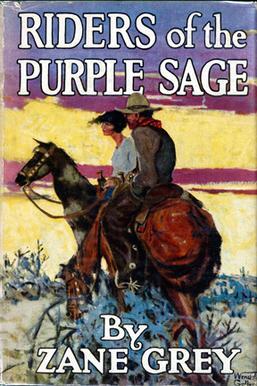
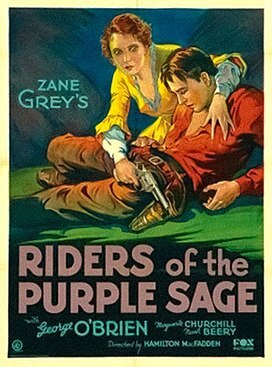
Riders of the Purple Sage by Zane Grey
Before I opened this book, I thought it was just a fundamental cowboy story, and indeed, as I read it anonymous images coaxed from every Western movie I’ve ever seen interjected themselves into the experience. (For some reason – I don’t know why – I couldn’t help but envision Humphrey Bogart as “Lassiter”, the taciturn protagonist, ostensibly honorable, yet willing killer - of Mormons in particular). My expectation – and I’m also not sure why – was a novel along the lines of the “Hardy Boys” series which I consumed voraciously as a young reader. I do attribute some portion of my love of reading to the “Hardy Boys”, but was not prepared to devote much effort to reading a rather long novel if it proved to be as simple as those childhood stories.
Much to my pleasant surprise, I easily became absorbed in “Riders”, and while I’m sure it may not be considered great art, this novel presented a fascinating and somewhat complex story with a few plot twists that caught me by surprise – and that have shown up in movies ever since!
The reasons for my reading this novel are purely serendipitous. My family and I were touring the area of southwest South Dakota including the “Badlands”. There is no shortage of scenic vistas that include long stretches of rolling wasteland marked by low-lying brush and bushes featuring subtle purple and lavender shades of color. I have no idea if in fact these were “purple sages”, but the variations are commonplace. (The novel takes place in Utah, which apparently has these same or similar purple shrubberies). Furthermore, in each obligatory visit to the area’s gift shop and book stores, copies of this novel were for sale. My father had also mentioned to me years ago that he had read many of the novels of Zane Grey, who was indeed a popular author in the early twentieth century. So I picked up a cheap paperback version which promised “The only uncut, uncensored edition!” What a hook!
“Riders of the Purple Sage” is a morality tale about a sometimes strong woman and heroine who has been persecuted by her Mormon Church leaders. The Mormons are not presented in a good light in this novel, and I suspect that there’s been some dispute over the years about this representation. As a work of fiction, I know that the depiction may not be accurate or fair – Mormon men are uniformly portrayed as tyrannical and domineering in their relations with women – and considering that the novel was written in 1912, this aspect of the book surely must have caused some controversy.
The story is also somewhat complex, with several plots unfolding that eventually come together at the end of the story, and conveniently leave open the certainty of a sequel. Plausibility is at times stretched thin, and the characters often behave with a one dimensional consistency and predictability. I don’t know what the inspiration was for Grey’s Lassiter, but clearly the genesis of many Western heroes begins here: Shane; the Lone Ranger; and “The Stranger” in High Plains Drifter. It’s no wonder visions of every Western and cowboy movie I ever saw accompanied me during this read! Grey also has his heroes contemplate and wax on about the serene beauty of the “purple sage” a couple of dozen times too many, much like the stock phrases utilized by Homer. But in defense of Grey, as I had experienced in South Dakota, the purple variations of color are ubiquitous in some western locales.
The novel has a bunch of treatments and sub-plots that keep the reader interested and fascinated: shifting and uncertain romances; a heroine that vacillates between determined strength and feeble despondency; the mysterious innocence of a beautiful young woman who comes of age while recuperating from a gunshot; repeated depictions of the intolerance of religion and the attempted subjugation of women; the young and noble cowhand inspired by unexpected love. There are also some shocking surprises such as the sudden and senseless (and misguided) murder of a rustler.
As you expect of a mass market novel written in this era, there’s no explicit sex, outrageous foul language, or extreme depictions of violence. But there doesn’t need be. Zane Grey has created a host of imperfect characters and might-be heroes braided into a readable and fast-moving story. The reader finds that sometimes you like certain characters, and other times they are repugnant or they fail you. By design, Grey imposes a feeling of uncertainty and uneasiness about these characters, their intentions and their actions, and casts into doubt their moral stature. Just like people in real life.