It feels overwhelming to write a review of this. Atwood is more impressive than I thought, and I am humbled. She played a key role in building the foundation of the Canadian literature business, which at the time she needed it was nonexistent. Atwood is all about community: in life as well as in story. It permeates all she does.
Atwood starts by saying that all writers write from a context, and that to understand that writer we must understand that context. She then expertly weaves her perspective of what was happening in the world, starting with girlhood just after WWII, into what was happening with her at that time and how she built it all into specific choice works. But at the same time she was writing novels, starting in the 1960s, she was working with a close group of motivated talent to help build a Canadian literary identity when there wasn’t one.
I was impacted by how unspoiled Margaret Atwood grew up, and how her industriousness at finding cheap places to live and being able to make do with their challenges helped her succeed. But she wasn’t unprivileged, her genius mind winning her a Woodrow Wilson fellowship to Harvard where she went on to attend the PhD program, and that explained to me why I was sometimes turned off in her work by the whiff of academic (I see you, Penelopiad).
And, of course, there’s Graham, the love and partner of her life, who takes up much of the book in the end. Perhaps too much for this reader, but I could forgive her that. Because here she laid out the blood and guts of her love and the pain of losing him, and this emotionally moving chunk gave balance to the intellectually stimulating first half.
If you’re a junkie for all kinds of information on the book world, you will be fed. But her memoir-of-sorts would serve best if you have a few of her works under your belt before reading this, as she does weave them into her history.
I was daunted by the length of this memoir, and as per my usual m.o. with nonfiction, I lined up the novels I’d read as I went. But I never wanted to read anything but this. The story captivated me.
Here are some tid-bits about her writing process:
On writing Handmaid’s Tale:
“On a page with a swan image at the top, I began to write. A woman was walking, looking down at her feet. Impossible red flowers were sprouting from a gravel path. Then there was a cellar, and another woman on her knees, blood streaming down her face.
‘What’s this then?’ I asked myself. ‘And who’s this?’
My novels often start this way—with a scene, and image, some words. The opening scene often moves elsewhere in the book: The Handmaid’s Tale began with the group hanging scene, but that part eventually shifted toward the back of the book.”
On writing Alias Grace:
“…I got a blinding headache, along with the realization that I had to discard much of what I’d written: it’s hard to have a duplicitous narrator in the third person, unless we take it as a given that the narrator—the author—is lying to us. But a first person narrator can lie, and conceal, and leave things out, and often does. When a story is being told, there’s always a listener, stated or implied; and there is always a reason why the story is being told to that listener.”
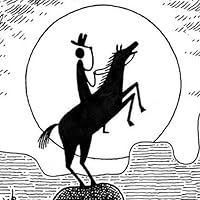
Atwood pays her respects to the poet part of her that grew alongside the novelist, sharing some of her poems in the memoir. She also shares doodles and drawings, making me feel there’s little she cannot do. But Atwood seems to take as much delight in making fun of herself while sharing her vulnerabilities as she does at sharing what she accomplished and what mattered to her.
Filled with too many great photos, a comic strip or two, and doodled end-papers to recommend the audio version.