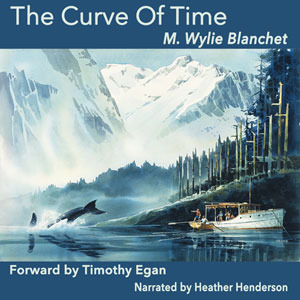
This is a volume of remembered experiences, incredible journeys the author took with her family in a small boat exploring the shores of British Columbia.
Muriel and her husband Geoffrey moved West in the early 1920s and settled on Vancouver Island. At the time, Vancouver was a small, grubby, sawmill town and the province was considered a backwater. But the couple loved the landscape and began raising their children there. They bought a small boat they called The Caprice and used it for recreation. One day Geoffrey went out in the boat on a day trip and never returned. The boat was picked up later, but he was nowhere to be found and was presumed dead.
One might think that Muriel, left a widow in her early thirties with five children, might never want to set foot in a boat again. But a year after her husband’s death, she bundled her young children into the boat and began travelling the inland seas during the summers. The family would leave their secluded seven acre property on Vancouver Island each year in June and return later in October. These are her memories of their adventures during the fifteen summers she travelled with her children up and down the coast, investigating inlets, recreating the travels of early explorers and examining artifacts in the empty villages of native peoples. During their travels they were frequently lost or never sure of exactly where they were, forced to rely on pilot books and out of date charts to navigate their way along the rocky shore. At the time, the coastal rainforest was still intact and much of what they saw is now gone. The book is neither a story nor a log, just an account of the adventures Muriel and her children enjoyed during these summer camping holidays.
Blanchett first published this small volume in the United Kingdom, but with little publicity the book was completely unnoticed in Canada. The Canadian edition published in 1968 was well received and she started a second volume shortly afterwards. Blanchett died of a heart attack while writing it, found by friends slumped over her typewriter and hard at work. This volume is now considered a classic travelogue in Canadian literature, one of the few to chart a woman’s experience travelling the coastal waterway during that time period, recording her nomadic experiences and sharing her interactions with the natural world.
Blanchett approaches the rugged natural beauty of the British Columbia Coast with an appreciative eye. Her narrative reflects the way she viewed her surroundings, not as someone pitted against nature but rather as a part of it. She did not see the landscape as a dangerous, hostile wilderness, something to be feared, confronted, challenged and conquered. What she saw she described as beautiful, striking and awesome. She alluded to its dangers by simply acknowledging the powerful tides, the dangerous rapids, the unpredictable winds and the heavy insistent fog which could appear out of nowhere. In one instance, she describes coming upon a wall of rock that suddenly appeared ten feet in front of her vessel, rising out of the sea in the fog. But she did not panic or cower before it. Instead, mesmerized by its majesty, she stepped out on the deck to get a better look and to marvel at the flocks of seabirds nesting in its crevices.
Anyone the family met in these isolated surroundings was hospitable, ready to share what little they had and open to the infrequent experience of human visitors. We know little about the children themselves who serve as her crew and three of the five, Joan, Peter and John are most frequently referred to in the text. In later sections two other names are mentioned, that of Elizabeth and David and the introductory remarks by a friend speak of her taking five children on these journeys.
The Caprice was not a large vessel, only twenty-five feet long and 150 square feet. It was a challenge to pack everyone (and sometimes the dog) into this small space with all the gear and supplies they needed. Everything had to have its exact place or no one could move. Each person had one mug, one plate, one set of clothes, their pajamas and a bathing suit. Sleeping on board was cramped and uncomfortable so they spent every opportunity they had sleeping on the shore in their tent. Living on a boat in such close quarters must have been an uncomfortable, uneasy experience at times. Blanchett’s even tempered approach to whatever trying circumstances confronted her is not just remarkable but unusual.
Blanchett spends little time on the domestic challenges of these adventures, instead using her narrative to record the spellbinding landscapes, the interesting people they encountered and the almost sensual experience of eating freshly caught salmon without knives and forks, the fish cooked on an open grate over a fire on a deserted beach.
Several noteworthy experiences are described in detail. One involved meeting Mike, a logger who almost died in a barroom brawl and retreated to the isolated wilderness to heal his body and soul. There he built a house, nurtured the soil over several years and planted scores of apple trees. Surrounded by his thoughts, his books and the trees, he got his life back and stayed, happy and spiritually content in the new home he had created.
In another adventure, the family was caught on the top of a mountain in heavy fog after a challenging and strenuous hike, unable to find their way back down and forced to navigate a nerve racking descent. They proceeded down slowly and carefully holding the hand of the person in front of them, the back of that person the only thing they could see clearly. They also had to cross swaths of wet granite which had been bathed with the fog and were now as slippery as ice. They negotiated this harrowing part of the journey by sitting down and sliding on their buttocks, their visibility the meager three or four feet in front of them, enough to keep them from falling off a precipice but not enough to give them any sense of direction.
Blanchett also records some humorous moments on their journeys, including the time she whistled a duck to join young John who was having difficulty sleeping and the time she and the two boys, without a book to read aloud to each other in the late evening, made up a story about a whale they called Henry, a story that continued over many subsequent adventures and was frequently refereed to over the years.
Blanchett is cautious, pragmatic and level-headed and appears able to cope with anything. Even the moments when she experiences concern, she quickly acknowledges it, deals with it and quite remarkably just moves on. After a harrowing adventure, she looks back and questions why they were worried, minimizing her “irrational fright” and saying to her children, “weren’t we sillies to worry”. Her competence on the water promotes a calm that allows all of them to have a positive connection to the landscape and the experience of their adventure. Any time there was true danger, it was never presented as such, but was seen as an opportunity to connect with the world, to become engaged and a part of it.
Blanchett has created a single narrative choosing not to divide the text into dated sections about her various trips. Instead, each section focuses on the experience of a visit to a specific location. This results in the creation of a long narrative of small sketches which can be disorienting and confusing for the reader. One is never sure what year it is, the age of the children or the distance travelled. In each section, she skips back and forth between short passages of domestic life and the experiences of coastal life as they wander the landscape, pondering their connection to it and think of others who had explored it before them. In the process, she creates beautiful descriptive paragraphs of the lakes, waterfalls, rivers and the sea itself. She writes of exploring the beaches, fishing for their meals, looking for seahorses and encountering a host of wild animals including black, brown and grizzly bears, bald headed eagles, minks, a cougar, a pod of frolicking killer whales, vultures and a grey wolf and her cubs. As she describes each adventure she continues to show herself to be a competent and confident traveler who takes everything in stride, calmly facing every catastrophe and challenge she meets, including repairing the engine on the boat, dealing with a sick child or encountering a black bear. She does not dwell on personal dramas but minimizes them in the narrative to focus her attention on the experience and her connection with the natural beauty of the landscape. Her prose contains the meticulously recorded details of the phosphorescent bits of plankton in the sea, the relentless sometimes monotonous waves, and the every changing colors of the vast stretches of sea water.
Reading about the family’s travels to the Indian Villages is difficult and disturbing. They had spent the winter months researching the Indian’s history and their habits, determined to get the most from these visits. Blanchett was especially anxious to explore a past that she believed would soon disappear and be lost forever. She never described encounters with the First Nation people, but felt free to explore their surroundings. The family entered boarded up longhouses despite the posted “No Trespassing” signs, removed artifacts from the sites and even disturbed their dead. Many of the villages they visited were not abandoned, simply closed up for the summer while the villagers went up the rivers to their fishing grounds. Although present day readers might be aghast at their offhanded attitude, it must be remembered that Blanchett was a product of the time in which she lived, a time when a colonial approach to native people was the norm. Canadians have since become aware of the damage they have done by this cavalier manner which has negatively impacted First Nation people through several subsequent generations. Reading about Blanchett and her family trespassing on these peoples’ lands, exploring their private homes, sifting through their belongings and wandering through the places that housed their dead are painful to read, a sorrowful reminder of what was accepted behavior in the past.
This a book of travel and adventure, a very readable account of this unusual, independent, intelligent and brave woman who explored the waters between Vancouver Island and the rugged mainland coast of Canada with her family. I think about the children and the amazing childhood they must have experienced as well as the remarkable role model they had in a mother who was an adventurer and also a writer. It is a wonderful account of their adventures.