The annual charity fête at Backwater Hall in Mortshire is disrupted by the mysterious death of Lord Wherewithal and the theft of the Lisping Elbow. Confusion and misgivings abound. And, alas, the Earl of Thump's stuffed thisby is found disemboweled by the edge of the lake. Dr. Belgravius and his nephew, Luke Touchpaper, attempt to tie the loose ends together and wonder why Miss Underfold was seen wearing a hat decorated with black lilies. And why was Victoria Scone dancing the tango with Horace Gollop in The Soiled Dove?
Edward Gorey creates an intriguing and sharply mordant world and leaves us his own mystery-what has happened to the missing Night Bandage, volume two of the Mortshire secrets?
Born in Chicago, Gorey came from a colourful family; his parents, Helen Dunham Garvey and Edward Lee Gorey, divorced in 1936 when he was 11, then remarried in 1952 when he was 27. One of his step-mothers was Corinna Mura, a cabaret singer who had a brief role in the classic film Casablanca. His father was briefly a journalist. Gorey's maternal great-grandmother, Helen St. John Garvey, was a popular 19th century greeting card writer/artist, from whom he claimed to have inherited his talents. He attended a variety of local grade schools and then the Francis W. Parker School. He spent 1944–1946 in the Army at Dugway Proving Ground in Utah, and then attended Harvard University from 1946 to 1950, where he studied French and roomed with future poet Frank O'Hara.
Although he would frequently state that his formal art training was "negligible", Gorey studied art for one semester at The School of The Art Institute of Chicago in 1943, eventually becoming a professional illustrator. From 1953 to 1960, he lived in New York City and worked for the Art Department of Doubleday Anchor, illustrating book covers and in some cases adding illustrations to the text. He has illustrated works as diverse as Dracula by Bram Stoker, The War of the Worlds by H. G. Wells, and Old Possum's Book of Practical Cats by T. S. Eliot. In later years he illustrated many children's books by John Bellairs, as well as books in several series begun by Bellairs and continued by other authors after his death.
Now, we’re talking. This is an actual story and it’s a really good mysterious story. There is a fete going on at a mansion and we see all kinds of people coming and those who live there and what happens before they get there, as they are getting there. Then someone dies in Gorey fashion. The murder is never solved, also very Gorey, because why solve a murder in a mystery story.
I must say that the artwork in this story is some of the best I have seen in his work. I find it stunning and so detailed. Everything we’ve seen before is in this story in some way as almost a culmination.
By far, this is the best story in the book of Amphigorey again. I hope there are other good stories in this collection, and this is good and worth reading.
Another beautiful small book by Gorey. This one has something of a narrative. It's all told through a series of little events depicted in full page drawings and a small bit of description.
There's an annual charity party happening at an estate. Every one comes but the Earl is crushed by a statue from fallen from the rooftop and the prized estate heirloom, a worthless figure made of wax, has been stolen.
The Other Statue - Edward Gorey I'm on a run of reading about Gorey, so it was time to re-read the books of his that I had on hand. Sadly my local library doesn't have anything by him.
Reading several together I was struck by a couple of things. Previously I don't think I had noticed that Mortshire was a recurring county name. I rather like that many of his stories are set in the same place, as were Thomas Hardy's. Also, I really want to live there. It appeals to me the way early Christie stories do: wealthy, leisurely, lots of sitting and reading in the library. It's the appeal of Downton Abbey and the suspense, although in Gorey's work the suspense is never satisfied.
Weirdly I am put in mind of Jane Austen; all of his books come from exactly the same place as Northanger Abbey. There is such affection for and familiarity with books. It doesn't matter that all the ones mentioned by Austen are real and none of the ones in Gorey are. Someday I'd like to browse through his personal library: I expect to find a lot there I haven't read but would enjoy. He had 26,000 volumes: it's as if I could own every book I'd like to read*. Every single book on a shelf right here. I don't like to leave my house as it is, with a supply like that I never would.
Nothing profound in my thoughts. If there is another life after this life I hope I get to spend it in Mortshire. I'm sure it will be full of my kind of people.
Personal copy
*PS. I say that, but of course it doesn't matter how many books are in the house, I'm still going to want new ones. My To Read list never grows shorter.
A delight in the same vein as The Audrey-Gore Legacy, unless you're an Agatha Christie devotee and expect a fair-play solution. Actually, no need to worry about a fair-play solution because there isn't a solution to be found. But that's the beauty of it—you can't even be sure of the mystery. The murder, obviously, but I'd also like to know, who was interrupted on page 47 of The Romance of a Soda Cracker? Set during the annual charity fête at Backwater Hall, several objects vanish in very few pages. There's an unfortunate death and an absconding governess, who may not be who she pretends to be, along with a stolen heirloom and a discovery—unspecified—on the roof. Similar to The Awdrey-Gore Legacy, and just as fun to reread. Like a madcap episode of Downton Abbey
I'm not sure how long my flirtation with Edward Gorey's works is going to last. With The Other Statue and The Epiplectic Bicycle I have been mildly amused, but not captivated. His illustrations are good, but not so outstanding that they carry me away and make up for the sparse text and lack of any discernible plot. I think I can probably make the effort for one one more of his books, but if that doesn't grip me then Mr Gorey and I shall part company, but hopefully on reasonably good terms.
Update I: On a second reading, I got a little more out of the text than I did the first time around, so increased rating from 3* to 3.5*.
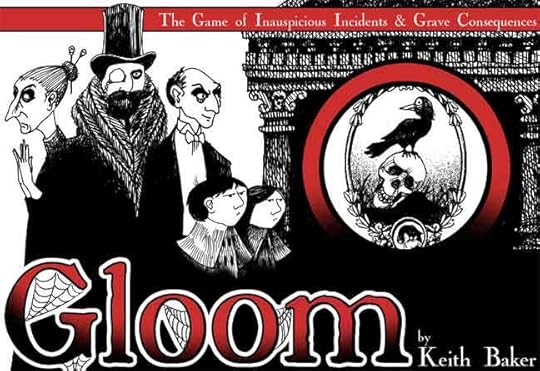
Update II: Here we are again. I took The Other Statue down from its shelf to compare Gorey's illustrative style with that of Todd Remick in the card game Gloom, which had struck me as being similar. I think the comparison bears out my impression that Remick is influenced by Gorey:
The artwork is whimsically macabre, as is the game play. It also owes something, perhaps, to Lemony Snicket's A Series of Unfortunate Events. It's a mordantly amusing game in which the object is to have your characters die Untimely Deaths in miserable circumstances - we're playing it this Christmas.
Anyway, as this is a book review rather than a game review, I shall return to Mr. Gorey. Third time around for this book and it's certainly grown on me - star rating now a solid 4. Now that I'm not expecting things to be explained, I can appreciate the spaces Gorey has left for the reader's own fancy to flesh out the plot, imagine motivations and build tentative theories about what may (or may not) be a reasonable narrative. It's a bit like reading a "choose-your-own-adventure" book which has most of its pages missing. There's no right of wrong answers and I've found different things in it on each reading - or perhaps I've brought different things. A fascinatingly clever collaboration between author and reader, with no doubt about which of the participants is the main creative force. I think I may be hooked.
The second book I bought at the Edward Gorey House, which was not damaged at all, is The Secrets: Volume One: The Other Statue, a delightful murder mystery sort of thing in which a statue falls on Lord Wherewithal. The book is described on its dedication page as an “Homage to Jane Austen,” although this homage is purely stylistic as the story is devoid of both romance and economics. It is also, in typical Gorey fashion, devoid of plot resolution, although this one does have discernible throughlines in that its enormous cast of twee characters all have at least two, and sometimes three, pages dedicated to chronicling their goings-on.
There are hints at the relationships between the various events, such as Augustus’ stuffed twisby and the Lisping Elbow both going missing. A closer read than I gave the book might reveal more of a real plot, and I have no doubt Gorey knew exactly what he was talking about with all of these semi-random happenings.
The illustrations are very much peak Gorey, with the gothic Backwater Hall as full of textured decadence and silly pseudo-Edwardian details as one could wish. The humans have big hats and big coats and big moustaches and it’s very tempting to color them all in with colored pencil.
All in all, it’s whimsical as all get-out and exactly what I wanted from a Gorey book.
Out of all the Edward Gorey books I've read so far, I think THE OTHER STATUE is among the finest and wittiest. Published in 1968, it is similar to most of Gorey's works from this era, but the humour is even more droll than usual and the characters amusingly named. Moments of great significance and total unimportance are juxtaposed in a hilarious manner.
No one reads Gorey for the plot alone, as the pen and ink drawings hold most of the charm, but a summary may be of interest. Like Gorey's first novel THE UNSTRUNG HARP, our tale is set in the province of Mortshire near Backwater Hall. A number of guests arrive for a party, but the weather turns stormy, and LordWherewithal is killed by a statue blown from the roof and the priceless heirloom, the Lisping Elbow is stolen. Who among the cast of characters could be responsible? The clergyman Rev. O. MacAbloo, Horace Gallop, a gypsy selling Orphobismic Lozenges, or Miss Quartermorning? I would suspect the governess Miss Underfold, but Dr Belgravius and his nephew Luke Touchpaper are out to find the person responsible.
Now that I have written a little about the book, I see that it sounds weird and silly, but this is a very entertaining book, and certainly the best introduction to Gorey around. Give it a look if you like droll humour.
A Gothic fête is brought to a halt by murder most foul in these series of creepy-yet-lovely vignettes drawn and captioned by Edward Gorey. There's a sort of hypnotic understatement in many of them: suspicious characters are just on their way out, scenes are revisited with subtle changes to them, mysteries are posited but never quite solved, something seemingly trivial is duly noted by the narrator, etc. The word I'm looking for is "ominous".
It is worth reading for the characters' names alone, Miss Underfold, Earl of Thump, Marquess of Wherewithal, his aunt, Lady Isobel Stringless, Dr. Maximilian Belgravius, Fenks the butler, Mr. MacAbloo and others. Was the statue that crushed Lord Wherewithal blown from the parapet or pushed? And who took his beloved Lisping Elbow made of wax?
The Other Statue is a somewhat average Edward Gorey work, filled with his familiar trappings of faded Victorian splendor and vague intrigue. The artwork is certainly up to snuff, but the incomplete tale (indications are that Gorey planned a sequel) leaves the reader a bit unfulfilled. Good fun, but not one of Gorey's best works.
On of my favorite Edward Gorey stories. It's so peculiar yet normal - everything he lists is exactly what happened in the order it happens, and yet all the interesting stuff is left to us to imagine.
Plus his drawings are brilliant, and so evocative.
Delightfully dark and unsettling, this short spooky story follows a collection of characters as they attend an ill-fated celebration. I especially loved the intricate pen and ink illustrations.
The autumn tints of 19-- were at their most brilliant for the annual charity fête on the grounds of Backwater Hall in Mortshire.
Dedicated in homage to Jane Austen, this murder mystery by the wonderful Edward Gorey will delight and intrigue in equal measures.
Who murdered Lord Wherewithal and who stole the Lisping Elbow? The story, told in the usual Gorey style, will leave you guessing. On the back of the book it states that The Night Bandage is to follow but, again, Gorey has left the reader guessing by never producing this work.
A lot of fun, which I think is the default praise for all the Gorey works I have had the pleasure of reading.
While Christmas shopping for my family I bought this one for myself. I love Gorey and I think it's sad that some of his books are hard to find.
This was a quick murder mystery that brings up more questions than it answers. Was it the nanny? The gypsy? What's the deal with the candle in the horse's hoof? What happened to the Lisping Elbow? Where can I find a copy of The Romance of a Soda Cracker?
I read this after a long day, so perhaps I wasn't at my highest mental clarity when I did so. But the point of this seemed lost to me.
I truly enjoy most of Gorey's work and his art is always wonderful (as it was here), but this just seemed bad to me. I understand wanting to let things to the reader's imagination, but this just seemed like he wanted to get away with writing as little as possible.