A narrator and her dog are criss-crossing the Swiss Alps. She travels with friends who share her interest in food, languages and their topographical contexts. They collect colours, even look for colourlessness, and develop the idea of a walk-in diary, a vain attempt to archive their observations.
Gradually, other mountains appear in their observations and memories, as do the mountains of literature and art. Mountains may be sites of fear and awe, of narrow-mindedness, racism and ever-looming collapse; Alpine lodges may be places of hospitality, retreat and unexpected encounters; of nature under threat.
In 515 notes, Zsuzsanna Gahse unfolds a finely woven interplay between her six characters while giving us a vivid panorama of mountain worlds, a multi-layered typology of all things mountainish.
182 It was an architect talking about fractals on the show, and about mountain formations. Sam is an architect and there was the gigantic architect in Venice with his diaries, and whether they have anything in common beyond their profession is uncertain. Sam's most recent statement about the Alps was that he would cement several mountains together, using a tried-and-trusted Roman cement mix. Black, if possible, he said. He meant he'd do it off the books.
Moutainish (2025) translated by Katy Derbyshire, from the original Bergisch teils farblos (2021) by Zsuzsanna Gahse.
It is published by Prototype Press and is the latest from the Asymptote Book Club, "dedicated to world literature in translation that partners with top independent publishers on both sides of the Atlantic."
The book club's introduction to the book can be found here.
Mountainish is written in 515 numbered notes, vignettes if one will, over 161 pages. The narrator (who I will take as female, although I'm not sure if this is stated) is travelling into the Swiss alps on a drive from Germany. The first note begins:
1. From the passenger seat on the drive from Venice to Munich, I saw the rock faces ready to collapse; above all, I saw their ability to collapse, and that collapse as hostility. Mile after mile of bare, rough, impersonal walls of stone. These mountains never intended to contend as natural beauties, though people do like speaking beautifully about them. They say that they call, the mountains; the mountains are calling you. And yet all mountains have in mind is collapse, and that's no empty accusation; a person can be buried alive in the wink of an eye in the Alps, beneath scree, falling rocks, by avalanches and murky masses of mud.
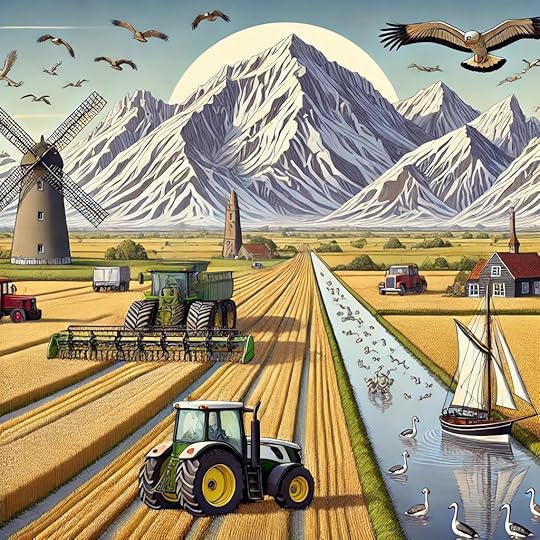
This sense that the narrator fears, rather than admires the mountains, runs throughout. And I'll declare a personal interest here, as someone born in Norfolk, to be a flat landscape is ideal and hills, let alone, mountains an aberration. ChatGPT's impression of a idyllic Norfolk scene, but with brooding mountains in the background and added eagles to fit this passage.
183 I first learnt about the Alps in books. Mossy green slopes and forests, an eagle soaring high above, looking down on a vast stretch. Good green, the silence and the eagle. I was not yet of age when I read that. Now, on second reading, I have found that memorable passage in Hofmannsthal's unfinished novel (Andreas oder die Vereinigten), two short pages with the eagle and the green, but otherwise I am disappointed by the rather contrived story. Only a few moments jut out, but those that do I take with me, along with the eagle (or the eagle quote), whenever I am in the mountains.
The narrator also feels some hostility from the natives of the area - for example aggressively tailgating her as she drives carefully up and down the slopes:
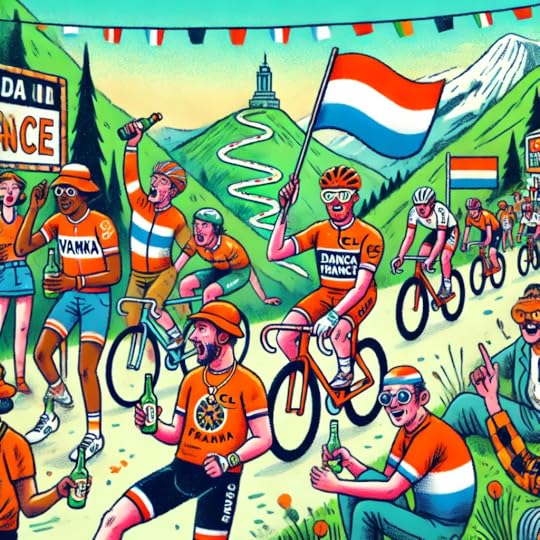
They wanted to blow up the foreign driver (foreign body) in my car, those bend-drivers, bend-braggers, possibly with Alpine roots and thus likely racist, they wanted to point out to me that there are Alpine people and then there are foreigners, whatever their skin colour. Those were the kind of thoughts they had at the very back of their minds. Back then, perhaps not these days. And I too had my thoughts, as I drove on. But perhaps some of the pushy drivers were Dutch. Many people in Holland grow tired of their flat land and hurl themselves, ravenous, upon everything formidable, including the rocky Alps, where they like to prove they can cope with mountains' quirks and passes and therefore push away the more cautious drivers, scatter them.
Which brings to mind bend 7 on Alpe d'Huez - Dutch corner.
Another cycling resonance comes with a uncontextualised comment #126, followed by one of a number of references which treats the mountains as architectural rather than natural phenomena:
126 The Dachstein, the Aletsch Arena, the Rhône Alps and Mont Ventoux share a team spirit. 127 Sam was drawing, and he spoke as he did so of the structures of individual mountain masses, of splintery and stable blocks, of notches, recesses, nicks and drill holes in the massifs. On a second sheet of paper, he sketched a weighty mountain in cross-section, showing individual cavities. Rail tunnel, military accommodation, air-raid shelter, water culvert and so on.
Mont Ventoux is a particular obsession of the narrator, the 'western giant of the Alps', one mountain that she says must remain untouched in her friend Sam's plan to redesign the Alps.
Stylistically, the use of mostly short vignettes allows for some narrative threads, but also something of a scattergun approach (some digressions are little to do with mountains). Note 41, on one of the narrator's friends, and her focus on colours, concludes with 'more on that later', followed by Note 42: More on that later is a quote with multiple sources. More on quotes later.
The narrator comments in an early passage on an encounter with a young architect (not Sam) who maintained five separate diaries:
In one of his diaries he listed each days activities, and another he kept notes on conversations and the third book was reserved for comments on architectural aesthetics, although those comments inevitably overlapped with the conversational notes I cannot remember other content areas; all I know is that I found one of the books funny. Perhaps he collected jokes as well, or his sexual escapades were amusing. This young man in Venice saw himself something of a Casanova.
Those separate entries must be a drain on the brain, I thought at the time, and his thoughts seemed to me like single segment of an orange, but now I am interested in fragmentation like this, now I see it as a challenge.I could outdo him with a tenfold diary system.
But in practice, she is defeated by any attempt to categorise her thoughts systematically, indeed one suspects she admitted defeat before she tried:
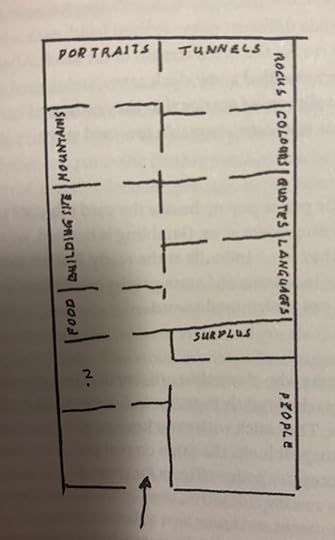
155 Now that most of the notes are spread flat, I can see the problems with my parallel diaries. I can put the topics relating to colours into one folder, but then there are other mountain topics alongside the mountain colours, and when it comes to skin colours they're to do with people, while people go in with the portraits; the incongruity within the groupings leads me down a dead end.
Which as an aside, is the issue with filing systems, including classic Microsoft folders, when one instead needs tags like Goodreads. Although Sam designs a room system instead for her to file her thoughts:
The vignettes also range from almost Delphic utterances - one reads ‘And amid the mountains stand rock-acquirers, rockobtainers, rock-getters’ - to more lengthy pieces (#55 runs over two and a half pages, and is a conversation with a mountain warden about their respective experiences of the mountains). In the interview Derbyshire says that Zsuzsanna Gahse’s "talked about her work being made up of three aspects: the essayistic, the vivid images—which are really scattered throughout—and then something that she calls narrative islands, these little tiny stories."
Key running themes includes the colours of the mountain scenery, if not the mountains themselves - alluded to in the original title, and the various dialects of Swiss-German, small communities divided by a common language and a mountain pass.
As the novel concludes the narrator's imagination roams past the Alps to other mountain ranges, including the Pyrenees and the Urals.
467 The main thing is that the stories and notes are not too well rounded.
468 I still like it best to see all notes as playing cards, to shuffle them, deal a few of the cards to six or seven players and leave the rest in the stack on the table. The players have a random selection of text in their hand, just for example: notes on colours, languages, mountain images and roast lamb, and now the idea is to link together as many texts as possible in a halfway plausible way, latch them all on to each other. The latched-together cards are laid face-up on the table, and after that the player can take more face-down notes from the stack.
Those seeking plot and character development should look elsewhere, but an impressive and original work.
The press
Founded in 2019 by Jess Chandler, Prototype is a publisher of fiction, poetry, anthologies and interdisciplinary projects. With an emphasis on producing unique and beautiful books, we are committed to championing the work of new voices in free-form contemporary literature.
Prototype is committed to creating new possibilities in the publishing of fiction and poetry through a flexible, interdisciplinary approach. Each publication is unique in its form and presentation, and the aesthetic of each object is considered critical to its production.
Through the discovery of high quality work across genres, Prototype strives to increase audiences for experimental writing, as the home for writers and artists whose work requires a creative vision not offered by mainstream literary publishers.
obsessed with the form of this, the note taking and blending together of the different subjects. not everything was equally interesting or memorable, but the vibes were there 🏔️
Performative reading I heard? Enjoyed some extracts that captured mountain community and life amongst the alps. Stuttered at other times and was a battle to get through.
This was such a unique book! I loved the format and found that it perfectly encapsulated the multitude of thoughts you have while hiking with the mix of simple thoughts interspersed with thought provoking observations/interactions.
There were some passages that I didn’t quite understand, mainly because it was discussing specific mountains that I am not familiar with. I did find that it took away from the reading experience a little but it was still enjoyable overall.
Thank you @prototypepubs for kindly gifting me this copy!
Was an interesting read in a format that I haven’t seen before and I’m sure some people liked it but I struggled to get past it. As intended it reads as a series of random but loosely connected diary entries however this lead to a struggle to gain momentum in any sort of loose plot, where there is a slight plot of moving across the alps, however it felt disjointed and jarring. Individually, the stanzas or entries where beautifully written and there were some really funny, witty, interesting passages written but again due to the form of the book these ideas and passages weren’t revisited or explored deeply and if the author did come back later on, too much had passed to properly connect and relate back to. Furthermore, while there were reoccurring characters, only getting small snippets of their lives every now and then meant I didn’t care for them as much as I would normally and overall felt I wasn’t invested as much into the world the author was trying to create.
I didn’t hate it but didn’t love it. And maybe thats down to my time of reading? As the format is bitesize entries of observations, ruminations and speculations i read Mountainish gradually over time, dipping in and out when I felt like a slower tranquil voice. Beautiful in places and full of concepts and ideas I would love to have seen/read developed. It at once felt boring and inaccessible, and also exciting and intimate. And maybe, thats exactly what it’s intension was? To engulf you inside a landscape full of the entire breadth of the mountain? Caves and bases to the peaks.
Arcadia: A mountainous district in the Peloponnese of southern Greece. In poetic fantasy it represents a pastoral paradise and in Greek mythology it is the home of Pan.
Gee whiz, this only 161-page book sure took me a while to read! I can promise you that contrary to according to Goodreads, I finished it in two sittings over the course of the month I started reading it. Mountainish is not going to end up on the 'Best of 2025' list, but there sure are some memorable passages in here. Some of my favourites are: