Jump to ratings and reviews
Rate this book

Moletown

Rate this book
Torben Kulhmann's stunningly illustrated, nearly wordless tale offers a fascinating window into an imaginary, yet hauntingly familiar world under our feet, where a mole suddenly recognizes the precarious balance between progress and preservation. But is it too late?

Kulhmann's open ended text encourages thoughtful exploration into possible solutions, and his delightful endpapers depict a montage of solutions that could very well save the moles' world and ours.

26 pages, Hardcover

First published January 20, 2015

1 person is currently reading
530 people want to read

About the author

Torben Kuhlmann

24 books195 followers
Torben Kuhlmann (1982) is a German communications designer, illustrator and picture book author. He studied Illustration and Communication Design at the Hamburg University of Applied Sciences . In 2014 he published his first book, Lindbergh - The adventurous story of a flying mouse, the product of his graduation thesis at the college.

Ratings & Reviews

What do you think?
Rate this book

Friends & Following

Create a free account to discover what your friends think of this book!

Community Reviews

5 stars
203 (24%)
4 stars
330 (40%)
3 stars
220 (27%)
2 stars
48 (5%)
1 star
12 (1%)
Displaying 1 - 30 of 184 reviews
Profile Image for Manny.
Author 48 books16.2k followers
January 2, 2016


A surrealist picture-book, almost without words, about the foundation and development of a mole city; it's a bit like John Marsden's The Rabbits and a bit like J.G. Ballard's Billennium but has a style all its own. There is a beautiful animated trailer version here.
______________________________

A remarkably apposite passage from Pynchon's Against the Day, which I came across a couple of days later:
In the center of town, some huge underground construction venture was in progress, citizens stood on overpasses and catwalks gazing down on concrete pits full of steam-machinery, draft animals, and debris. When asked its purpose, they frowned, puzzled, as if they had not quite heard the visitors. "Home," some said, "it's home. Where is home where you come from?"
Profile Image for Betsy.
Author 11 books3,274 followers
August 20, 2015
Cautionary tales for kids who can’t do a darn thing about the original problem. It’s sort of a subgenre of its very own. As I hold this lovely little book, Moletown, in my hands I am transported back in time to the moment I first encountered The Lorax by Dr. Seuss. A child of the 80s, my youth was a time when scaring kids straight was an accepted educational technique utilized in everything from environmental protection to saying no to drugs. The film version of The Lorax bore this out and gave me some nice little bite-sized psychological scars for years to come. These days we don’t usually go in for the whole learning-through-fear technique. Even picture books that sport a message are more prone to be mildly sad than anything else. What makes Moletown so very interesting then is its inclination to tap into popular tropes in our own history, then turn them ever so gently on their heads. The end result is a book where you might easily lose sight of the bigger picture, until that final moment when everything becomes horribly clear.

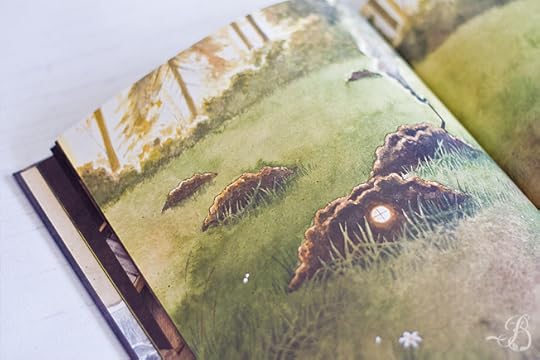
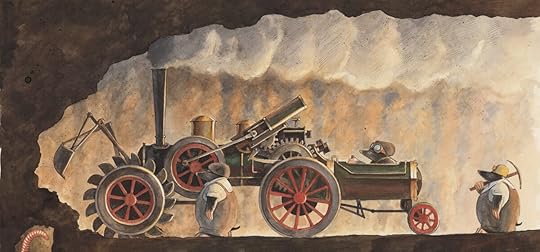
“The story of Moletown began many years ago.” A single solitary mole moves beneath a meadow to live. Not long thereafter he’s joined by other moles “And over time, life underground changed...” Before our eyes we see it. We see the vast construction projects taking place to make Moletown a livable community. We see the population explosion, the increased technological advances, and different transportation models. Life becomes busier for the moles, while outside in the meadow nature is taking a severe hit. The green is close to disappearing altogether, but turn to the last pages in the book and there we see evidence not just of change, but of the moles as a whole taking on the responsibility of their newly green again meadowlands.

Kuhlmann initially burst upon the American picture book scene with the highly detailed Lindbergh, a story of a mouse with a yen for flight. A little bit The Arrival, a little bit An American Tale and a little bit steampunk via Beatrix Potter, it was his hyper realistic animals placed in extraordinary circumstances that stayed with young readers. In Moletown that level of detail and attention is there, but the moles have a far more cartoonish feel to them. This is not to say that they don’t look like moles, every inch of them. Yet Kuhlmann has simplified his hyper-realistic renderings of animals and traded that attention in for set designs and landscapes. Here he plays with perspective, plunging us down into the heart of the moles’ mining operation, the scaffolding twisting around and around, down and down. Sharp eyed spotters will note other spreads where the stop signs are shaped like mole claws and the trains go vertically as well as horizontally. The details are there to an elegant degree, but the feel is different from Lindbergh certainly (as is the length of the piece).

One of the most amazing aspects of the book is the sense of time passing. In the early days of Moletown you see the immigrants arriving, looking very much like the European immigrants of the late 19th century. As time passes you see moles in Wright Brothers era caps, trench coats and fedoras of the 40s, a possible homage to the MTV image of the 80s (complete with Nintendo video game remotes), and finally the iPods and wind farms of the current age.

Many European artists find it difficult to break into the American market due to the fact that their art contains a distinctly “foreign” feel. Kuhlmann’s advantage here is that while it is easy enough to believe that the images in this story originated in Germany, there is nothing distinctly “other” about the book . . . at first. It’s only with multiple readings that you begin to notice the elements that probably could not have begun here in the States. For example, in more than one instance you’ll see a mole smoking. This is by no means the focus of the book, and you would have to look somewhat hard to find such moments, but I have seen American parents go ballistic over far lesser crimes in picture book illustration, so I’ve no doubt the occasional library patron will become incensed over what they believe to be the promotion of cigarettes. Other hints that the book is German? Well, I could be wrong but this may well be the only picture book you’ll find on the market today containing a two-page spread dedicated to accountancy.

One interesting thing about the book is the fact that the ending that we so deeply desire is embedded not in the book itself but in its endpapers. The final text in the book reads, “Many generations later, the moles’ green meadow had completely disappeared. Almost.” Turn the page and rather than provide a verbal explanation, the book gives us a glimpse of a series of photographs alongside an article from The Moletown Times which reads, “Agreement on Green”. The pictures show steps taken to preserve the environment and restore the meadow. I didn’t mind this method of summing up the steps taken to correct the past. Yet more interesting to me, by far, was how the book lets the reader reach their own slow realization that the seemingly inevitable trudge of technological advances and population increases are, in fact, detrimental. That picture at the beginning of the book of the immigrants arriving in Moletown, to an American reader, strikes you as a symbol of freedom from oppression and hardship. And because Kuhlmann keeps the book almost entirely wordless from start to finish, the glimpses of the meadow in its downward slide towards decay are shown without commentary. It’s up to the reader to realize that something has gone very wrong. How many will actually make that leap will be interesting to see.

Finding books to compare this one to can be difficult. The overall feeling I got was like the one in The Rabbits by John Marsden. But where that was a story of a culture being systematically destroyed, this has a sweeter if no less destructive feel. The Lorax hits the same environmental notes, but Moletown is the subtler of the two since it makes the reader implicit in the enjoyment one derives from Moletown’s culture (and from the fact that it’s a world that feels very much like our own). The best way to describe the story is to say that it’s a combination of the two, with a hopeful endnote all its own. Like all imports, it runs its greatest risk in becomes a forgotten piece since it can’t win many of our American children’s book awards. That said, I have faith that teachers, parents, and students will find in it a new approach to tackling the tricky subject of mass consumption vs. environmental action. Explicit in its message. Subtle in its presentation. In short, a beaut.

For ages 4-6.
Profile Image for Tijana.
866 reviews288 followers
Read
January 23, 2021
Jedan dobar predstavnik žanra "slikovnice za odrasle decu" koji deci u suštini može a ne mora da bude zanimljiv ali će se njihovi roditelji verovatno prvi mašiti knjige u knjižari. Zanatski je besprekoran, atmosfera još malo pa Kafkina "Jazbina", ali ostaje malo neke nedoumice.
Profile Image for Kelli.
931 reviews444 followers
September 30, 2017
Moletown manages to make its case by employing very few words: the industrialization of Moletown has had a devastating impact on the environment and the moles seem stuck in a cycle of working and watching tv. Hmmmm.
Torben Kuhlmann is a brilliant illustrator but I found this book to be very dark (literally) and depressing. My kids really didn't care for this, though they loved Lindbergh- The Tale of a Flying Mouse and Armstrong- The Adventerous Journey of a Mouse to the Moon. I would highly recommend both for the creativity and universal appeal. This one, with its important message, failed to capture the audience at my house. 2.5 stars
Profile Image for Christine.
7,225 reviews572 followers
July 11, 2015

Disclaimer: ARC via Netgalley.

I never really thought about moles much until I read William Horwood’s Book of Silence Trilogy and his Duncton Chronicles (the actual reading order should be Chronicles and then Silence). I liked Wind in the Willows, but I was a Ratty person, if you know what I mean. But after journeying with Horwood’s Privet, Mayweed, Rooster, and others, I’ve never looked at mole the same way.

Which is why when I saw this book as a read now option on Netgalley, I downloaded it.

Kuhlmann’s mole is a fable, like most animal tales are on some level. Perhaps, it is too heavy handed. I say perhaps because I found it a little heavy handed, but this is a picture book with little text. If I was a child, I’m not sure I would have the same reaction.

It’s a simple story, and a timely one, about when is too much progress too much. It is mostly pictures, with opening and closing lines being the primary written words. There are front and back pages done like newspapers, pointing to the past and future of Moletown. More importantly, the newspaper type illustrations at the end of the book make up for the abrupt ending of the painted story.

The charm in the book is the illustrations. Kuhlmann’s illustrations are stunning and even when seen on a computer screen, incredibly detailed. There is great use light as well as flashes of humor in how the moles are depicted. It is the type of illustrated book that will be treasured not so much for the story, but the beautiful rendering of that story.
Profile Image for madame Gabrielle.
756 reviews642 followers
September 16, 2021
bien trop court à mon goût et c’est ce qui justifie ma note de trois étoiles sur cinq … comme j’aurais aimé en lire davantage! toutefois, pour les illustrations, ça vaut le coup de l’emprunter.
Profile Image for Abigail.
7,988 reviews265 followers
July 10, 2019
The fabulously talented Torben Kuhlmann, the German author/illustrator who made his debut with Lindbergh: The Tale of a Flying Mouse , returns with this second picture-book, an almost wordless history of the development of Moletown. Founded when one mole moves in underneath a green meadow, the settlement soon grows, becoming ever more complex and developed. The surface soon shows the result of this underground urban sprawl, with only a tiny patch of green grass left...

Originally published in German as Maulwurfstadt, this gorgeously-illustrated cautionary tale doesn't really cover any new ground, when it comes to its ecological message about the dangers of overdevelopment. Dr. Seuss's The Lorax and Bill Peet's The Wump World have been around for many decades, and impart the same message. What makes Moletown stand out is Kuhlmann's beautiful artwork, and the fact that his overdeveloping society is made up of moles. There isn't much text here - only a few pages have any words at all - but the illustrations are more than capable of carrying the story. Recommended to fans of Kuhlmann's artwork (in whose number I now count myself), and to young readers who enjoy animal fiction.
Profile Image for Melki.
7,292 reviews2,611 followers
June 11, 2022
The author's stunning illustrations highlight this cautionary, nearly wordless tale of moles who take their industriousness a little too far.

description

description

It may seem a bit heavy handed, but no more so than The Lorax.
Profile Image for Andy.
1,320 reviews91 followers
June 20, 2018
Ein sehr, sehr, sehr, sehr niedliches Bilderbuch und ein Spiegel unserer Gesellschaft.
Profile Image for Klinta.
336 reviews179 followers
August 23, 2015
I would like to thank Netgalley, NorthSouth Books and the author – Torben Kuhlmann for a free digital copy of this book in exchange for my honest opinion.

It is hard to rate this book, as it has almost no text, but the pictures are amazing and the idea is something a lot of people are trying to shout out to the world - it is of course about progress moles make and its impact on environment.

This is a little children's book which has more pictures than actual text and I think is a perfect way for parents to interact with their children - explain what is happening in the book and compare it to their lives.

It is an retelling of something we've all seen and see still everyday, it shows the steps that are taken to make humans (in this case moles) comfortable and happy, at the same time sacrificing the environment.

It somewhat made me think of Animal Farm - that is about politics and human nature, which is important now as well, but it never talks about the big environmental issue, which now is a huge problem.

I loved the illustrations (just wow), loved the message and the most of all loved how parents would have to interact and explain the book to their child, which means that perhaps parents could get the message as well.

Full review!
Profile Image for Deanna.
61 reviews
June 5, 2019
This would not be the first, nor the tenth book I would use to have a conversation with a child about the environment and the impact humans are having on it. I wouldn't avoid it altogether, but its message is so suddenly bleak and if you don't look at the inside back cover page, you will miss the tiny (oversimplified) glimmer of hope.
Profile Image for Francesca.
1,962 reviews158 followers
July 12, 2015
Moletown di Torben Kuhlmann è un piccolo gioiello: una fiaba pressoché senza testo narrativo di accompagnamento, raccontata soltanto da meravigliose tavole.

Una fiaba, tuttavia, che è anche una metafora capace di affrontare un tema attuale come quello dell’ecosostenibilità, in modo piacevole e affascinante grazie alla esuberante ricchezza visiva.

La storia racconta di una talpa che si insedia a vivere in una tana sotto un prato verde e lussureggiante. Rimase sola per poco, poiché altre talpe presto desiderano possedere una bella casa simile.
Quindi, squadre di talpe-operaie si mettono al lavoro per ampliare la città: tutto grotte spaziose e accoglienti sono progettate e convertite a piccole unità abitative, il progresso tecnico avanza, la vita diviene più veloce, ma lo spazio vitale diventa altrettanto affollato e rumoroso. E inquinato.
Alla fine cosa rimane di tutta questa modernità? Un grigio e sporco deserto industriale.

Un libro per bambini dai 5 anni, questa è la raccomandazione editore.
In realtà, credo sia una storia adatta a tutte le età, capace, con le sue poche pagine, di essere uno specchio della società, trasmetter un messaggio e al contempo lasciare sbalorditi per la tecnica e fascino illustrativo.

Il progresso tecnico a ritmo spedito, l’inquinamento, la distruzione della natura, queste sono i temi chiave del libro. Comfort e serenità presto lasciano il posto a spazi ristretti, desolazione e rumore. La sporcizia e gli scarichi industriali hanno conquistato il mondo sotto la collina, con la conseguente distruzione dell’ambiente naturale, la distruzione dell’habitat, la contaminazione delle fonti vitali. L’idillio si è trasformato in un incubo invivibile.

Torben Kuhlmann è riuscito con Moletown ha regalare un vero capolavoro.

Un libro che non può lasciare indifferenti per lo stupore che sa suscitare, ma anche perché le affascinanti illustrazioni stimolano a riflettere, grandi e piccini, su problematiche quanto mai attuali e di primaria importanza.
Profile Image for Turrean.
910 reviews20 followers
June 24, 2016
Nearly wordless, the mole society in this book makes tons of "progress," ...but at what cost?

This is going to be a fantastic book to read along with The Lorax or The Little House. The illustrations are so rich; I think I'd like multiple copies so kids can pore over the details!
Profile Image for Bill.
308 reviews24 followers
July 4, 2015
Another stunningly illustrated (this time wordless) picture book from rising star (and 2015 Golden Island prize winner of Nami Concours) Torben Kuhlmann. His detail and visual storytelling sense (in this and his 2014 Lindberg) are a pleasure to experience.
Profile Image for Berfin Kanat.
425 reviews174 followers
June 2, 2019
Tatlı bir çocuk kitabı fakat kağıt kalitesi çok kötü.
Profile Image for nAeEMak نعیمک.
438 reviews3 followers
Read
February 21, 2025
یک کتاب تصویری دل‌پذیر. موش کورها به شکل عجیبی وقتی شبیه آدم‌ها طراحی می‌شوند خیلی بانمک هستند و این سنت انسان‌واری حیوانات – که نمی‌دانم اصطلاح تخصصی‌اش چی هست- حس باحال دارد مخصوصاً اگر مثل این کتاب شبیه دورانی باشد که هنوز چرخ‌دنده و مکانیک وسایل را زیبا می‌کرد و دنیای دیجیتال تمام طراحی‌ها را شبیه هم نکرده بود. کتاب دارد بهمان هشدارهای زیست‌محیطی می‌دهد. فقط چند صفحه است و هر صفحه پر از چیزهای باحالی که داریم کشف می‌کنیم و ناگهان تمام می‌شود. واقعاً ناگهانی شبیه زندگی خودمان و کتاب هم برای همین طراحی شده. تصویرسازی‌های کتاب پر از کشف است و دوست داری بدانی صفحۀ بعدی چی می‌شود یا چطوری می‌خواهد این زندگی زیرزمینی را به تصویر بکشد.
Profile Image for Pixelnische.
93 reviews13 followers
April 3, 2017
Vom Maulwurfshügel zur Metropole unter der Erde

Tief unten, unter einer saftiggrünen Wiese, lebt ein kleiner Maulwurf. Er lebte ganz alleine dort, doch das blieb nicht lange so. Nach ein paar Jahren gesellten sich immer mehr seiner Artgenossen hinzu und bauten gemütliche Maulwurfswohnungen unter der Wiese. Maulwurfshügel reihte sich an Maulwurfshügel, immer größer und größer wurde die Siedlung, bis eine richtige Stadt daraus entstanden war. Das Leben unterhalb der Grashalme hatte sich sehr verändert…

Zuerst in die Lüfte, nun unter die Erde

Ich gestehe: Ich bin ein Fangirl. Durch und durch. Ich habe Torben Kuhlmann sowohl als Autor und Illustrator, aber auch live auf der Frankfurter Buchmesse als sehr sympathischen Menschen kennengelernt und nehme ich euch jetzt einfach mal mit, auf eine kleine Reise ins Erdreich.

Das Warten auf das neue Buch des talentierten Lindbergh-Papas begann und wurde nun ein Jahr später endlich mit dem Erscheinen von Maulwurfstadt beendet, von dem ich euch nun berichten möchte.

Kuhlmanns zweites Bilderbuch ist wieder im typisch liebevollen, detaillierten Stil gezeichnet, kommt jedoch im Vergleich zu seinem Vorgänger mit weitaus weniger Text aus. Kuhlmann verzichtet weitestgehend auf Worte und verlässt sich ganz bewusst auf die ausdrucksstarke Bildsprache seiner in warmen Sepiatönen gehaltenen Illustrationen.

Eine kurze Einleitung in zwei, drei Sätzen führt uns sodann unter die Erde und stellt uns den ersten Bewohner unterhalb der Grasnarbe vor. Auf den nächsten Seiten unternehmen wir gemeinsam mit den Maulwürfen eine kleine Zeitreise und beobachten, wie sich aus einer einzelnen Behausung eine unglaublich große, technisch immer ausgereiftere Metropole entwickelt. Doch der rasante Fortschritt der kleinen Erdbuddler wirkt sich leider extrem auf ihre Umgebung aus. Wo früher eine saftig grüne Wiese war, sieht man nur noch schlammbraune Erdhügel mit zahlreichen rauchenden Schornsteinen, Strommasten und schwarzen Fördertürmen ragen, die vom rasend schnell entwickelten Leben unter Tage zeugen. Immer größere, gewaltigere Maschinen bohren sich tiefer und tiefer ins Erdreich. Die Maulwürfe ziehen in kleine Metallkistchen um, eine neben der anderen aufgereiht – eine metaphorische Darstellung unseres eigenen alltäglichen Lebens in “Wohnkisten” aus Beton und Stahl.

Maulwurfstadt – ein Spiegel unserer Zivilisation

Torben Kuhlmann hält mit diesem beeindruckenden Bilderbuch uns Menschen den mahnenden Spiegel vor. “Seht hin!“, sagen uns seine Zeichnungen. Wir haben uns von einfachen, in und mit der Natur im Einklang lebenden Menschen zu einer modernen Gesellschaft entwickelt, die vom industriellen Fortschritt und den damit verbundenen komfortablen Annehmlichkeiten profitiert. Leider haben wir sehr spät – hoffentlich nicht zu spät – bemerkt, dass diese Entwicklung auf Kosten unseres blauen Planeten geht. Zahllose Wälder werden gerodet und damit der Lebensraum vieler Tiere zerstört. Städte breiten sich aus, Seen und Wälder weichen breiten geteerten Straßen. In den Weltmeeren schwimmen ganze Müllstrudel. Das alles sind Auswirkungen der oftmals rücksichtslosen Expansion des Menschen.

Doch wir dürfen nicht vergessen, dass wir auf die Natur angewiesen sind; denn ohne das saftige Grün unter unseren Füßen wären wir gar nicht im Stande zu atmen. Eindrucksvoll überträgt der Hamburger die Entwicklung unserer modernen Industriegesellschaft auf die Figur der Maulwürfe. Seine Inspiration fand Kuhlmann in real existierenden Orten wie den Kohlezechen des Ruhrpotts oder den Ölfelder Aserbaidschans. Auch die emsigen Erdwühler müssen nach all den Jahren feststellen, dass von ihrer einst so wundervollen, grünen Wiese nur noch eine verschwindend kleine Grasfläche übrig geblieben ist. Auf dem Vorsatzpapier am Ende des Buches zeigt Torben Kuhlmann, dass auch die Maulwürfe im Begriff sind zu verstehen, wie wichtig dieses kleine grüne Fleckchen Erde für sie ist.

Als kleine Anmerkung möchte ich noch anführen, dass die Altersempfehlung mit 5 Jahren etwas niedrig eingestuft wurde. Ich denke, dass die Tiefgründigkeit des Themas in diesem Alter evtl. noch nicht vollständig erfassbar ist und würde »Maulwurfstadt« ab 6 oder 7 Jahren empfehlen. Doch allein die Zeichnungen sind schon eine Augenweide und so habe ich mit meinem 4jährigen Sohn gemeinsam die detaillierten Bilder bestaunt und ihn einfach beobachten lassen, was die Maulwürfe unter Tage erleben. Für alles andere ist noch Zeit.


Mein Fazit: Dieses eindrucksvoll gezeichnete Bilderbuch hält unserer Gesellschaft den warnenden Spiegel vor und schildert in intensiven Bildern eine Geschichte, die zum Nachdenken und Umdenken anregt. Kuhlmanns Maulwürfe haben begriffen, was der Mensch erst noch verinnerlichen muss: Die Natur muss geschützt und bewahrt werden, zu unserem Wohl und dem kommender Generationen. Denn auch die Kinder unserer Kindeskinder wollen barfuß über eine grüne Wiese rennen – und wer weiß, vielleicht entdecken sie dabei sogar einen Maulwurfshügel und erinnern sich dann an dieses Buch. Pflichtlektüre und ein Muss für das Bücherregal großer und kleiner Leser!

Lesehighlight | Prädikat »besonderes Buch« | Kategorie Kinder- und Bilderbuch

Vollständige Rezension mit Bildern auf buechernische-blog.de
Profile Image for Totoro.
389 reviews42 followers
May 1, 2017
wow , it was sooo pretty, the paintings and to think that there was this deep meaning behind it. it was just great
Profile Image for elena.
207 reviews4 followers
May 31, 2022
incredible illustrations
Profile Image for Nadina.
3,186 reviews5 followers
December 15, 2022
The illustrations were magnificent, and though there are not many words the pictures truly tell the story, and in a way it is a sad one. Not a bad book, but I feel adults would appreciate it more than kids.
Profile Image for Carmen Gatti.
478 reviews
June 11, 2024
Social commentary beautifully illustrated. It reminded me of hadestown
4 reviews
February 20, 2017
At what point does progress stop being a positive and instead destroy the entity it was meant to benefit? Moletown is a timely tale about a society of moles who build a society in their ancestral home. Overtime however, as their city grows and their inventions become bigger and louder, their home slowly shrinks. In this day and age as we debate the merits of policies that protect our habitat, Moletown offers a simple, yet powerful entry point for children to understand the trade offs our society makes.
Profile Image for Ashley.
143 reviews101 followers
October 1, 2016
I don't need/want to repeat everything others have said in praising this book. What I do want to do is point out some subtle yet powerful moments and themes to look for and to discuss with your little reading partner, dark though they may be:

- Watch the worms. They start out maintaining their own existence in the margins, then they are pushed out and disappear as the frame expands, then they wind up being literally sold by their former neighbors. There's a slavery parallel here that's remarkable.

- Notice how the machinery and infrastructure continually grow in proportion to the moles, eventually expanding beyond the margins of the page.

- Notice how the first moles cooked their own food, but begin eating fast food and out of cans once they get television sets.

- Pay attention to clothing. It doesn't take long before everyone is in worker attire, and everyone looks exactly alike.

- In the Times Square scene, notice how easy it is to miss the moles at first. They are blurry, while the cars, neon signs, and television set are clear. The individuals, the "people," are fading into oblivion. (Also on this page: the smoking mole, showing the continued descent into poor health and bad habits.)

- A discussion question for children regarding the last scene with the enclosed patch of grass: "Is it enough?"

This book is remarkable. I can't stop thinking about it. I borrowed it from the library but will absolutely be buying a copy. And I'll be recommending it to every parent I know who's bold and honest enough to share this with their child(ren). It's that important.
Profile Image for Clare O'Beara.
Author 25 books372 followers
September 22, 2015
Moletown is gorgeous and clever, an art book with fun and a message about our own lives.

The mole comes to live in a green meadow and his family and friends come to join him, but the intricate machines they build for tunnelling and mining coal make their lives more busy. They have a civilisation after enough time has passed, a dense urban underground population where moles hang up their helmets at night after a day in the office or works, all beautifully drawn.

The meadow however becomes polluted and dead, with smoke and soot instead of grass and trees. The moles have to find a way to regain the balance of nature.

If you enjoy clever drawings with beautiful detail and wonderful imagination, you'll love Moletown. The book was originally published in German and the few words have been translated but the pages can be understood without words. Any age of reader can enjoy the tale.
Profile Image for Andrea Lorenz.
1,079 reviews32 followers
September 9, 2015
In this nearly wordless picture book, Torben Kuhlmann creates a world of seemingly robotic moles who create their own little industrial revolution in the middle of a green meadow. The illustrations in Moletown are detailed and intricate - worth spending several minutes on each spread, investigating all of the little nooks, crannies, crooks, and hidey-holes that Kulhmann has created for the moles. The story, however, is clearly written for adults as an allegory of what is happening in our own society. The moles are voiceless and relatively robotic (as mentioned before). They aren't compelling characters and there isn't really a story arc. The moles move in, build their town, ruin the meadow, the end. This is clearly an art piece for grown-ups or a talking piece to be used in elementary classrooms rather than a storybook for children.

Read courtesy of the publisher.
Profile Image for Junko.
17 reviews3 followers
July 5, 2015
As Bill Teale stated, "Another stunningly illustrated (this time wordless) picture book from rising star (and 2015 Golden Island prize winner of Nami Concours) Torben Kuhlmann. His detail and visual storytelling sense (in this and his 2014 Lindberg) are a pleasure to experience."
Displaying 1 - 30 of 184 reviews

Can't find what you're looking for?

Get help and learn more about the design.