Jump to ratings and reviews
Rate this book

The Edmund Trilogy #3

The Farewell Symphony

Rate this book
Named after Haydn's work, in which the players leave the stage one by one, this completes the story of a gay man in his adult years, through Stonewall riots, the hedonism of the 70s and the ravages of AIDS in the 80s and 90s. It follows "A Boy's Own Story" and "The Beautiful Room is Empty".

504 pages, Hardcover

First published January 1, 1997

64 people are currently reading
2827 people want to read

About the author

Edmund White

139 books908 followers
Edmund Valentine White III was an American novelist, memoirist, playwright, biographer, and essayist. He was the recipient of Lambda Literary's Visionary Award, the National Book Foundation's Lifetime Achievement Award, and the PEN/Saul Bellow Award for Achievement in American Fiction. France made him Chevalier (and later Officier) de l'Ordre des Arts et des Lettres in 1993.
White was known as a groundbreaking writer of gay literature and a major influence on gay American literature and has been called "the first major queer novelist to champion a new generation of writers."

Ratings & Reviews

What do you think?
Rate this book

Friends & Following

Create a free account to discover what your friends think of this book!

Community Reviews

5 stars
433 (35%)
4 stars
459 (37%)
3 stars
255 (20%)
2 stars
62 (5%)
1 star
21 (1%)
Displaying 1 - 30 of 96 reviews
Profile Image for William2.
860 reviews4,045 followers
January 27, 2020
An absolutely astonishing book. The verbal brio is downright heady; its mastery, its facility, reminds me of the work of Martin Amis, although in terms of subject matter the two writers could not be more dissimilar.

The nameless gay narrator here has an astonishing prose style and a semi-permanent erection. He’s just one man in a New York teeming with newfound homosexual freedom, just after the storied Stonewall Uprising (1969). But the feral sexual insatiably here is a sign not simply of freedom or release after millennia of oppression, but of something else. I don’t know what, but it isn’t joyous, and it may very well be desperate. I keep thinking of the loose ends some people come to in the face of too much freedom, almost a kind of existential panic.
If my [gay] shrink thought that sex was a matter of cuddling and intimacy, I thought it was a cold, calculated rite promising transcendence but certainly not affection.(p.317)


It occurs to me that the sex, which is relentless, really could not have been moderated. To do so would have been a kind of dereliction, a failure to speak true and clearly. So the sex, some of it admittedly ecstatic, much of it dreary, is here in full, all of it assuming a premonitory chill. For this is the story of cultural efflorescence and death. The world described here—with its leather bars, orgies, fisting, poppers and Quaaludes; a world, too, of prodigious artistic ferment in virtually all media—is now utterly gone. You might as well be reading about the Plantagenets. The present era of safety in monogamy—gay marriage—grew out of this pandemic.

With brilliant precision, White develops a long line of interesting, often fascinating, often debauched, male characters who are sadly soon to be so many carcasses, so many piled bones. One seems to see their ghosts prefigured in their promiscuity; the effect is harrowing. So much life and talent about to be extinguished . . . .

I can still remember the joy in certain quarters when the “fags” started to die. It was not withheld. Not at all, it was a joyous, prancing, self-righteous, far-right victory lap. “God’s justice” for the abominations, they called it. Young adults today know virtually nothing about this time when no one knew what was killing people straight and gay in such numbers, and whether one might not oneself be next.

Ah but then the plague trickled beyond the queers, Jamaicans, IV druggies, and blood transfusers into the broader heterosexual population. Uh-oh, that was enough for Raygun, honor bound as he was to preserve the sanctity of heterosexual adultery at all costs. Things started to happen. And science—surprise!—after years of harrowing uncertainty, science revealed that it wasn’t hellfire or the Rapture after all that was killing so many so grotesquely. It was nothing more than a microscopic retrovirus perpetuating itself by means of the exchange of bodily fluids. See Randy Shilts et al.

Edmund White reminds me of Vladimir Nabokov, not in subject matter or tone or even diction so much as in his spritely thoroughly nailed metaphors and mastery of narrative propulsion. In fact, I’ve come to think there’s something of a Lolita-effect here; that is, taking a figure of rebarbative habits (Humbert Humbert in Lolita), and getting the reader to follow him eagerly despite his off putting nature. Is there anything objectionable in a man who fucks on average three partners a week, or more than 3,100 lovers over 20 years? Is there anything objectionable about a man who fucks 12-year-old girls? Another Nabokovian trope seems to occur in White’s middle American landscapes, which smack of the road trip in Lolita.

But I’m being too humorless. The novel by contrast is often funny. Now how can this possibly be? How can White be so hilarious in the looming shadow of the plague? Of course, he knows the end. He didn’t die and he knows who did die; that must surely help. But it would be like Daniel Defoe joking in A Journal of the Plague Year. Inconceivable, one would think, yet here it is. Most of the descriptive flights bite, like this one about country boy Butler and his many affectations in New York.

Certainly he was an epicurean who could pick quizzically over a single fresh sardine during a long evening in which I would knock back two dozen oysters, an entire roast chicken, potatoes with a whole head of garlic and half a gallon of California red. He kept up with me only in his alcohol consumption, although unlike me he modulated tastefully from blond Lillet on the rocks with a twist of orange peel to a white wine with the sardine, a light Beaujolais with the four kinds of goat cheese (chalky, white, near tasteless—the ultimate upper-class food), an Armagnac in a giant globe snifter to toy with beside the fire, as though he’d accepted it only for its light refracting properties.... When he crossed the room he appeared to have an extra folding place above his kneecaps. In sandals his feet looked immense, as though so much willowiness above need a big taproot below. When he danced he seemed to be treading grapes in place. In fact, closer study revealed that he never moved his size-twelve shoes at all, although his feet generated waves of motion sent up through his long legs and into his lean flanks and supple torso, down through his shoulders which shone as though they’d been chamoised with an expensive, furniture maker’s beeswax. (p.135)

Some things that aren’t here: friends in groups. There is the lone friend, and there are friends in the collective sense, but they never seem to merge into joyous community. There are just men trying to come. There is no other objective except to try to come more often. White is unsentimental and relentless in conveying this truth. Friendship is discounted. The minute love turns to friendship, it’s instant flaccidity, and hasta la vista, baby. The horrible sex-robbing nature of mere friendship is abhorred at length. And two relationships in particular, that between Joshua and the narrator, and between Kevin and the narrator, bring the point home.

The word count here must be 170,000 or so. A mighty tome, for the most part beautifully sustained. One point: throughout bisexuals are belittled or criticized as being dissembling, dishonest little rats who are actually gay men playing both sides of the field. Other than that bit of myopia, I found the book astonishing and humbling, as is all great art.
Profile Image for Jesse.
510 reviews642 followers
February 19, 2016
Every year or so I dutifully find myself undertaking yet another Edmund White novel, even though I’m well aware it will likely prove to be a frustrating experience for me. What exactly compels this constant return? Mostly because I’m compelled by the manner in which White’s distinctive form of “autofiction” revels in the minute observations that capture the particularities of lived life. His writing is structured by a principle of accumulation as he amasses vast catalogs of the little things—habits and objects and sounds and garments and slang words and bodies— that are individually experienced but in retrospect seem to become so many synecdoches standing in for entire eras. Thus when White writes that “no single song was long enough to sustain our drug-induced frenzy so the disc-jockey often went from one record to an identical cut in another copy of the same record, thereby doubling our pleasure,” he records the kind of vivid offhand details that are usually forgotten yet capture the unique texture of a particular moment in time.

White explicitly makes this an integral aspect of his autofiction. In a passage toward the end of The Farewell Symphony that deeply resonated with me, the novel’s unnamed narrator admits that “official history—elections, battles, legal reforms—didn’t interest” him, and that he “didn’t want to be a historian but rather an archaeologist of gossip.” Major historical and cultural events commence at the peripheries of the narrative, but always seem to remain just out of sight, shifting emphasis instead upon interactions between intimates and friend groups and larger social communities, carefully enumerating all the private little stories and jokes we tell and retell to each other.

And yet such sumptuousness of details can become too decadent, even overindulgent—I always reach a point, usually around the ¾ mark, when it feels like everything really should have been wrapped up already (it makes me empathize with the enervated partygoers in Buñuel’s The Exterminating Angel, compelled to linger long after the fête has reached its end). Endless aggregation of detail, even when meticulously managed, inevitably comes at the cost of narrative momentum, and a sense of inertia and stasis sets in. Which is strange effect, considering how The Farewell Symphony is crammed with so much activity.

At the same time I appreciate how the unnamed narrator allows space for other individuals and personalities to temporarily “take over” the narrative for stretches, brandishing it for their own purposes. Like so many specters summoned via memory’s ability of conjuration, the novel often evokes something closer to a memoir of a community than an individual, and each lovingly-crafted portrait becomes a kind of (futile) attempt at keeping their eventual loss at abeyance.

The novel, in the end, fashions itself into a lamentation for an entire generation of gay men that was quickly and brutally decimated by the AIDS crisis in the 1980s and 90s. In the novel’s closing pages White alludes to Haydn’s Symphony No. 45—more commonly known as “The Farewell Symphony”—a piece famous for its unorthodox conclusion that entails musicians to “get up [and] leave the stage” one by one “blowing out their candles as they go.” “In the end,” he explains, “just one violinist is playing.” It turns out to be a remarkably poignant metaphor for the final third of the novel, when most of the vivid presences who had been wandering in and out of the narrative unexpectedly fall sick and pass away with a shocking, almost surreal celerity. But like Haydn, White opts for quiet exits, with the deaths of even the most significant characters announced in passing statements. Such a tactic might be accused of sidestepping the devastating gravity of the situation, but the effect ultimately effectively conveys the heavy weight of absence. And in the end it is White himself who is left alone on the stage, playing wistfully until, finally, all lapses into silence.

[This review is cross-posted on my blog, Queer Modernisms.]
Profile Image for Maureen Stanton.
Author 7 books99 followers
May 27, 2011
This is a brilliant beautiful book. If Edmund White were not writing about gay culture, he'd be as widely read as Updike, Roth, and Delillo, and he should be.
Profile Image for Sketchbook.
698 reviews265 followers
April 30, 2020
For Edmund White (to rephrase Cocteau) : too much is never enough. His good, sometimes symphonic novel, which mixes non-stop same-sex with literary allusions and Proustian-type memories, accented by "intelligent" writing, has a special heartbeat that is defined by an excess of booze and drugs that replays the melody of binge sex. Without sex (3,000 partners, he tells us), life is utterly meaningless for White. It validates him, gives him a self-identification. Clearly, many others feel the same way. Google photos capture the changing picture of our Dorian Gray. White illuminates, though he doesnt realize it, Existential Nihilism.

His novel, encompassing AIDS, is socio-sexual history; in decades to come, will it seem like a kind of folk legend where having sex is just another function, an urgency, like needing to take a pee? Since the '70s White has been rebooting the same autobiography, but herein his best writing. (His Paris memoir, "Inside a Pearl," is sub-Elsa Maxwell gossip). To review a White "novel" is to review White himself....he doesnt hesitate to offer his fantasies and realities. Literature, Andre Malraux once said, reveals the landscape of its creator's inner life. And it can end, Malraux continued, by revealing us to ourselves.

With an indomitable will White has forged a "serious" career. He was a courtier to literary and social names, and oft did more than simply "kiss up" if necessary, he reports, to make convenient connections. He usually knew what to do. In this novel of climbing the lit'ry ladder while hitting the bars and sex clubs, White presents excellent sketches of James Merrill, Richard Howard, Glenway Westcott, Virgil Thomson (under other names); there's even a vivid scene w editor Helen Gurley Brown, which her ex-slaveys tell me is accurate.

White reflects the contradictory aspects of our national character: idealism vs worship of material success; a rugged individualism vs our wish to look and think like everybody else. Now 80, White has lived with HIV since the '80s. What's lacking in his novel, despite all the gropings and groupings, and perhaps lacking in his life, is any sense of joy or fun at any time. The literary pornography of Harriet Daimler ("The Woman Thing") is unique because she makes it hilarious.

At end, I'm reminded of the last line from Willa Cather's "Coming, Aphrodite!", a masterful novella : "A 'big' career takes its toll, even with the best of luck."
Profile Image for Edward.
78 reviews
January 20, 2022
Edmund White’s novel The Farewell Symphony is the third part of his semi-autobiographical trilogy (which began with A Boy’s Own Story, which I reviewed last March). The novel charts New York’s gay scene from the pre-Stonewall 1960s, through the gay liberation movement and up to the AIDS epidemic in the 1980s. Having recently watched the devastating mini-series about the AIDS crisis in the UK It’s a Sin, I was eager to find out more about the subject, and this seemed a good place to start.

From the very first page of the novel, White establishes death as a major theme. Death hangs over the narrative throughout, foreshadowing its inexorable ending. When the AIDS epidemic finally arrived about 60 pages from the end, I was marginally disappointed that the novel didn’t explore it further. Nonetheless, it was fascinating and gut-wrenching to read about the arrival of a mysterious virus that caused gay men to wither and die.

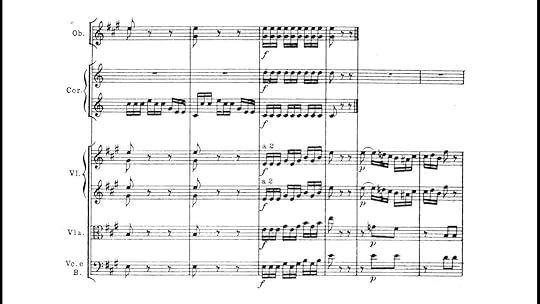
description
An extract from the last movement Haydn’s ‘Farewell’ symphony, showing the departure of the oboes and a horn.

The Farewell Symphony takes its title from Joseph Haydn’s Symphony No. 45 in F sharp minor, nicknamed the ‘Farewell’. White’s choice of title is very powerful. The symphony gets its nickname from the last part of the final movement, in which the orchestral players gradually leave the stage with their instruments until only two violinists remain. During the last chapter of the novel, White’s male friends and former lovers all die of AIDS one by one until only he is left. I find looking at the score for this part of the symphony particularly moving, seeing how the various instruments’ staves abruptly stop before the end of the line.

There is so much more in this novel than I’ve mentioned. It details White’s struggle to get his books published. It discusses the setbacks of ageing. It is also full of literary allusions, one of my favourites being: ‘the Italians pronounce [AIDS] as though it were the “Ides” of March’.

I loved this novel. From White’s detached literary prose, to the unexpected sections in Italy, to White’s striking honesty, it was a wonderful book. It has inspired me to find out more about the AIDS epidemic and to read more gay “classics”, which I have hitherto neglected.
Profile Image for Simon.
550 reviews19 followers
November 29, 2023
Sex (lots of sex) and self loathing in Europe and America. I suppose I always saw EW as a bit of a warrior for good, and I do still see him that way, but in this book he comes across as a bit of a twat. The ending is obviously sad and I am left wondering if EW was or is ever happy, truly happy.
Profile Image for Robert.
Author 43 books134 followers
April 10, 2013
The other day I was chit chattin’ on Facebook with my FB friend Dave and I told him I was reading this book and how much I was enjoying it and how candid Ed White has always been about his extremely promiscuous past in the go-go-gay ‘70’s. Dave replied that Edmund is slutty as fuck and that’s what he loves about him and I agreed. I said just want to be Ed’s best friend and Dave jokingly said that he just wants to pee on him and I suggested he just go ahead and ask Ed already. You know, just your typical FB chat. Dave is a funny guy. He’s published one book so far, this really great, very funny sort of autobio essay sort of book, and he’s currently busy working on another one. He’s also a movie reviewer for various online venues. His boyfriend is a film critic and has published a couple of books also, about movies – no, duh. They live in Los Angeles and have been together for some time now, at least 10 years, I’d guess. Actually they’re married.

What any of that about Dave and his BF has to do with The Farewell Symphony, you may ask. Well that sort of digression is what The Farewell Symphony is chock-full of and you may want to prepare for: information and backstory, biography and erudite observances about the many and varied people who crossed Edmund’s path throughout the 60’s into the late 90’s: acquaintances, lovers, friends, idols, peers, family members, you name it – this raconteur can toss off an amusing anecdote or shrewd observation about a casual trick or lifelong friend or parental figure or legendary colleague at the drop of a paragraph. He’s also adept at keen interpretations of societal mores and produces many compare/contrasts of American and European cultures and smart riffs on sex and gay liberation and proffers all his experiences with heartbreak and AIDS and love and death and the harsh reality of aging, especially when most of your friends have died prematurely, along with a host of other subjects, one after another, a long succession of thoughts that almost never feel like unnecessary digressions – they’re too smart, too interesting. Rest assured he is never more keenly aware or brutally honest than when he’s focusing that writer’s laser gaze upon himself. This third book in what has been dubbed The Edmund Trilogy rambles on and on and on for 400 + pages, generally keeping the interest level throughout, culminating in a heartbreaking, haunted final chapter that casts the meaning of the book’s title in stark relief (the Farewell Symphony is a work by Haydn in which the musicians leave the stage one by one until only one violinist remains playing). Ultimately I have to say that the second volume of the trilogy, The Beautiful Room is Empty, stands out as the finest of the trio, it being the more focused work, with an enthralling narrative thrust. Yes, The Farewell Symphony is messy and some might say indulgent and maybe they’re right, but I say this is Edmund White, and I bow to Edmund White with great respect. 4/5 stars.
Profile Image for Sean.
8 reviews17 followers
November 5, 2013
Before moving to Paris I bought myself a few packages of oversized black t-shirts, to match my new pair of black Nike running shoes. I thought I could plug into the latest iteration of the art-world uniform, spread around the internet as “Ghetto Gothic,” collaging morose adolescence with an efficient interest in over-designed sportswear. Apparently I had completely forgotten that, given my gainly physique, clothes work their hardest to fit me wrong. These draped layers of black should appear effortlessly streamlined. But on me, the silhouette struggles to build into one solid shape. A friend once told me I’m an impossible subject for a photograph. I won’t allow myself a single unselfconscious second to stand or sit still. I move my hands, lift my chin, shift my eyes, and repeat. But I’m convinced that, even more than these motions, the two long sticks that manage to pass for my legs, and this chest that somehow looks concaved -- this thing I sometimes name my body, it refuses to let itself be outlined. My attachment to my adolescence is as much psychological as it is physical. At 22 I’m still growing. When I was sixteen, change meant development, a means to an end. In my twenties, as change continues, I now brace myself for a life with no end, no form. Even death strikes me as just this same shapelessness inverted.

White’s “baggy” book, The Farewell Symphony, which maybe some would call “awkwardly draped” (?), fights to invent ways to tell a story about life. We find keystones, like sex and friendship, to guide us. But the novel’s doubled backbone flags its own failure. The narrator recalls, throughout the story, two irretrievable breakdowns: his unrequited love for Sean, and his latest lover Brice’s loss of life. In the end he refuses to narrate his relationship with Brice. Here the reader manages to receive a point, not a line. Maybe other novelists might build a story made up of so many moving parts in order to drown out any hope for meaning with the cranking and whirring of industry. But the novel never becomes mechanical. Meaning abounds, but it can only be touched and scraped through the labors of interpretation, which in White’s writing more closely resembles a game, not toil. Self-reflections, judgements of character, critiques of politics and nationalities -- all these registers White dishes out as gossip. Despite the extreme breadth of the novel, White succeeds in scrubbing the depths of a life, and it is precisely because he digs his tunnels to the center of this earth haphazardly, leaving them flimsy and even fragile. The reader must stay alert, fearing the tunnel might soon collapse behind him. But with this strange attentiveness he becomes committed. He invests in life.

If I typically lack the self-courage to look myself in the eyes, I manage to find my way to a mirror whenever I read novels, like White’s, that chronicle a year, a decade, or a life of a gay character. Invoking the nearly ritualistic ways gays build up their identities by assimilating things ineffably “like” them, or things they ineffably “like,” I read The Farewell Symphony as an opportunity to consider a comparison. My past, present, and future expanded with each passage, growing to incorporate the narrator’s actions and thoughts. It was then my choice to decide which of the points fit, and which points didn’t. But either way I was invested in this other life in front of me, because it was also my life, or could be my life if I wanted it to be. I hadn’t expected such an outcome, but I have discovered entirely new territories of myself just from gossiping on and on about White’s protagonist, which I whisper when I’m alone.
Profile Image for Gerasimos Reads .
326 reviews165 followers
May 19, 2020
An absolute masterpiece.

By far the best Edmund White book I've read so far and one of the best queer novels I have ever read in general. Reading though the perspective of the unnamed main character throughout all three books of White's autobiographical trilogy (a main character who is in many ways Edmund White himself) you start feeling like this is a real friend and you want to keep following him across the world, from 1950s mid-western American, to 1960s Paris, to 1970s Rome, to 1980s Fire Island New York.

As I was approaching the last page I felt genuinely depressed, as if I wasn't going to be able to hang out anymore with a real person I grew to love.
Profile Image for David.
638 reviews130 followers
October 15, 2017
It's a funny sort of mash up ... but very enjoyable.

Bits:
“The French, apparently, liked their Americans big, butch and dumb.”

“The great romantics always live alone since a long run can only dull the perfection of the opening night.”

“I dreamed I was a coyote looking from a mesa down on a cheerful fire. I was cold and lonely, but if I approached the campsite it would be to kill or be killed.”

“The only two choices, it appeared, were marriage, cruel to the wife, stifling to the husband, and gay promiscuity, by definition transitory, sexy and sad for the young, frustrating and sad for the old.”

“My impatience with her grief was not only that of an American optimist but also of a homosexual pessimist. The American in me was astonished, even offended, by her irrevocable decision to take grief’s veil and I wanted to line her up for an exercise class, a husband-hunting Caribbean cruise or a macrobiotic diet. But the homosexual in me, that lone wolf who’d been kept away from the campfire by boys throwing stones, who considered his needs to be perversions and his love to be a variety of shame - that homosexual, isolated, thick-skinned, self-mocking, fur torn and muzzle bloody, could only sneer at the incompetence of these heterosexuals in maneuvering their way through disaster. Of course men betray you, of Of course love is an illusion dispelled by lust, of Of course you end up alone.”

“I went out for a few weeks with Joey, a gaunt six-foot-three, hundred-and-fifty-pound kid from Long Island (‘Lawn Guyland,’ as he said it, and I imagined a million guys set up like bowling pins on a clipped green).”

“an Armagnac in a giant globe snifter to toy with beside the fire, as though he’d accepted it only for its light-refracting properties.”

“He was judicious to the extreme in his praise of other writers; once when I asked him to name his top ten, he couldn’t get beyond five”

New York: “even the ground was just the thinnest layer of macadam poured over ten stories of hidden wires, sewers, subways, all rattling and steaming like pots on a stove.”

“‘You show your best side to your friends and your worst to your lovers.’”

“When he came back from a trip to Asia and his first taste of opium, one of the ladies asked him if it caused impotence and he replied, ‘Poppycock.’”

“I couldn’t afford leather chaps and a matching motorcycle jacket, not would I have wanted to make such a commitment to a scene that back then was neither as acceptable not as potentially ludicrous as it was to become.”

“A line of black hair crept up his pale, ridged stomach like a trail of ants across tablets of white chocolate.”

“Which wasn’t true. I never felt good with men; with a gay man I always felt something indefinable was missing, whereas with a woman I knew what was missing: a man.”

“I often said I wasn’t rich enough to be heterosexual and that children were beyond my means.”

At the theatre: “Here and there, scattered among the couples, were a few gay men who’d come for the nudity - as well as for the hot and cold splashes of hysteria and wisdom, an invigorating bath that Tennessee Williams had first drawn for them.”

“My shrink told me that the biggest problem straight men had when they came out was the loss of status.”

“his big uncircumcised penis lolled so lazily, so majestically on his balls, like a river god on mossy rocks,”
Profile Image for Dennis.
12 reviews11 followers
September 11, 2007
This site really needs an "on hold" list.
I'll explain...

My mom gave this book to me, which is surprising since it's pretty much gay smut hidden in a Proustian pseudo-memoir. She would later scold me for owning the fantastic "Butt Book" (the magazine retrospective), which is an intelligent survey of smarty homosexuals masquerading as gay smut- little did she know they had pictures of her beloved White sucking toes in it accompanying his interview. I called her a hypocrite- end of story.

Ok, back to the review.

I started reading this at the beginning of summer when I had just graduated from Northwestern, and my life was spent blowing my graduation money and eating expensive meals in the grass while being unemployed. This book was the perfect accompaniment to my lazy picnics- the life of a slutty, pre-AIDS, gay dilettante trolling through various adventures abroad written through the rose colored glasses (lacey rose colored glasses, for that matter) of memory paired nicely with imported cheese and wine hidden in coke bottles.
But then I blew all my money, had no sex, got a job, and learned that life is ultimately pretty boring and dull- basically this doesn't go well with the languid recollections of a parlor gay.
In short, The Farewell Symphony had to be put on pause.
Profile Image for Eric Byrd.
623 reviews1,166 followers
July 1, 2019
I hated this the first time through. A loose, baggy monster--or so it seemed to someone coming to it straight from 'Forgetting Elena,' that jewel. Subsequently I've reread it, in little nonconsecutive forays, and have found much that's funny and wise and humorously raunchy (a friend of mine who's gay and thinks that deep down every straight man is revolted by homosexuality, is amazed that I can stomach, and even laugh at, some of the sex described in this book; in the face of my unshockability and continuing admiration for White, he's desperately taken to arguing that the book is really about becoming a writer, and thus really doesn't force me to confront homosexuality in any meaningful way). Everything I like about White is here.

And so ok, 'Max' is Richard Howard, 'Eddie' is James Merrill, 'Joshua' is David Kalstone. Who is 'Butler,' if anyone? And who is 'Ridgefield'?
Profile Image for Roger.
62 reviews
April 17, 2012
This book is a doozy. So vivid and so rich that after putting the book down I had to remind myself I didn't live this life, Edmund White did.
Profile Image for Tao Li.
2 reviews
February 16, 2021
Yes, I read it solely based on the alternative title of this book: Hilly Buttocks I Have Known; Thus, I have no more expectation of this installment than before-bed guilty pleasure. To my surprise, there are touching moments, memories and reflection in-between of sucking dicks, struggles with AIDs, gay rights moments and grieving all felt as real and relatable (maybe less so in literal experiencing sense) as loitering in the backside of gay bars. I have scrolled down and saw people suggesting the writer put too much focus on sex, giving gay men bad imagines (as if they were so obsessed with sex) or he takes himself too seriously. I agree with them to some extent, I have read fair bit of serious gay literary and lots of which seems to be flawed and preoccupied with sex—but very few can arouse you (all possible ways) as good as Edmund white. Besides, If I have slept as many men as he did, I would write a book about it. The book itself is a 3 star for me, but since author is seriously my type and charming and witty as Fxxx, extra star is my heart
Profile Image for Max Mcgrath.
126 reviews5 followers
August 17, 2025
Excellence. Thank you George for buying this for me
Profile Image for Steve Woods.
619 reviews78 followers
July 9, 2012
Together with the first two volumes in this trilogy, White has appeared out of what has been for me, the mist of gay literature as one of the most proficient writers I have ever read. This man wastes not a word, his characterizations are powerful but in a way such that they slide up on you. I felt that I really knew the characters peopling this tale-though at times that sense of things was uncomfortable for me. At times horrified, at times disgusted, at times enthralled, at times highly amused by a wit and word so incisively cynical I felt simply drawn through this book.

The whole milleau of gay life in the 70's and 80's before the age of AIDS is a completely foreign landscape to me. Had I not read this book I would never have thought that people could either think or behave in this way, though a few years in Darlighurst, Sydney during the 80's gave me some hints. The living of this life seems almost surreal to me, though it literally heaves with truth.

This major literary work in three parts spanning this man's whole life, has been an experinec for me and one I would not have missed, for the sake of some small prejudices.
Profile Image for Christopher Barnes.
30 reviews11 followers
August 28, 2007
Young gay men *need* to be reading Edmund White. I doubt most of the men in my generation even know who he is, let alone why he's important. His works chronicle a period in gay history that was incredibly important for us to be where we are today. He was in some ways the voice of his generation, and it is a sad, beautiful, engaging voice that makes reading this book a pleasure.
Profile Image for Jim Grimsley.
Author 47 books390 followers
Read
March 26, 2021
I have loved Edmund White's books since I first discovered them. I like this one mildly. I read it with some absorption, but more as a memoir than a novel; the chatty, I'm-talking-to-you-directly quality rarely attracts me in any book. but since I'm interested in White, the quality of talky-talk worked better than usual for me. But I was still weary of the voice by the end. This is not a novel in which the book becomes transparent and one feels the action as though it is happening around one. It is a long monologue. There are some wonderful passages of prose. White is as honest as any writer can be, and just lays it all out. He is like Genet in his unapologetic approach to writing about sex, but not as determined to be seen as a shadowy figure; in fact, he is almost desperately amiable, an aspect of his personality that he refers to directly in the book, his need to be liked, to be loved, by as many people as possible. There are absolutely hilarious passages - Tina chasing him through Rome in her car when he refuses to have sex with her is the best of them, but there are many more. But the sex is wearing. It is one thing to have 3,000 lovers; that would be, perhaps, a pleasant prospect. It is another thing to read about someone having 3,000 lovers, especially when he makes such a gargantuan effort to detail many of them. But White's purpose is to write this life as it was lived. It is a perfect snapshot of being gay in the seventies. As for the passages about his writing, I never care for reading a book about a writer; there are too many mirrors involved. Nevertheless I admire the book and am grateful to have read it. The lesson I take, for myself: in having sex, only more is more. In writing about sex, only less is more.
Profile Image for Clau MZ.
539 reviews18 followers
June 5, 2023
[started skimming around the middle] Can't believe I say this but... this was too horny, even for me.
520 reviews9 followers
March 22, 2021
I'm 20 years younger than White and a straight women, or I guess these days I'm a cisgender female, but this book brought back memories of all the gay young men I had the pleasure of hanging with from late '70's through the mid 80's. It also brought back memories of that horrible, terrifying time when AIDS first appeared. Every time one of my friends would cough, I would worry. I lost touch with most of those men years ago as my life went in a trajectory that included marriage and children, things our society denied them, and we slowly drifted apart. I have often thought of them and hoped they all made it through, yet sometimes I'm glad I don't know. I don't remember thinking much about the notoriously promiscuous gay lifestyle back then except that it sure seemed fun; however, as I read White's last book in this trilogy I found myself thinking about it more and more. Whether he intended this reaction or not, he really made me think about how hard it must have been (and still is) to have very primal rights denied to you because a "majority" decided you were a deviant. Of course, I have always been aware of the discrimination and have been very vocal against it, but I'm not sure I ever truly put myself in their shoes. White has helped me achieve a deeper level of empathy and understanding. I can't ask for much more from a book.
Profile Image for Bamboozlepig.
864 reviews5 followers
March 18, 2019
Could've been a good read had it not been full of overly pretentious self-absorption. White took himself too seriously. The plot jumped around from present time to past time and it was hard to keep track of. It felt less about White's life and more about a roster of how many guys he'd screwed. I'm also no prude, but the really graphic sexual details got old fast, especially since they seemed to be the main focus of the book.
Profile Image for Keith.
144 reviews3 followers
May 1, 2008
Dreadful. Edmund White takes himself way too seriously.
Profile Image for Dusty Myers.
57 reviews26 followers
December 18, 2007
With the third novel of his otherwise dull trilogy, White, and we all, have AIDS to thank. Whereas A Boy's Own Story had nothing to connect its narrative to outside of the narrator's own obsessions, The Beautiful Room is Empty had the Stonewall Uprising of 1969. Except the book ends with this event, it's literally on the last page, which is stupid seeing as how it was such a beginning of something; the book as a result isn't so much about gay liberation as it is about the narrator's obsessions—this time over hunky Midwestern Sean with the big dick and the swimmer's build.

The Farewell Symphony takes its name from a Haydn work in which all the musicians leave the stage one by one toward the end of the symphony, leaving just a single violinist on the stage. This violinist is White, blessed (or cursed) with having lived to tell the story of the AIDS crisis despite his own seropositive status. And he tells it well. Now that he has some serious human drama to write from, his little obsessions can fall to the background as the story of gay men in the latter half of the 20th century comes to the fore. As he puts it, "I thought that never had a group been placed on such a rapid cycle—oppressed in the fifties, freed in the sixties, exalted in the seventies and wiped out in the eighties" (405).

And AIDS does more in this novel than give White something real to report. Let me try to put it this way. Never had a book (or series of books) made me feel less..."authentically gay" than White's had. White's fucking a new dude on practically every page, half of whom we never get names of because he never bothered to. For gay men of White's generation (at least two removed from my own, I suppose) sexual promiscuity wasn't just a cake-and-eat-it-too matter of hedonism, it was an act of rebellion. Given that I was three when the AIDS crisis was first reported in a major newspaper, it's hard for me to get a hold of this, but I think I trust it. I buy the argument. If I knew myself to be gay at a time when gay people were not just hated but invisible—not in the U.S. legislative branch, not in primetime sitcoms, not hosting the Oscars—I imagine that encountering another man who wanted sex with men (even if anonymously in some public toilet) would feel like an affirmation.

What this results in is eighty percent of White's three novels—crazy, wild, rampant sex of every kinky variety with every shape and color of man that exists in this world. And quickly the parade of names of cock details becomes a tired and lonely parade of one man waving a banner nobody cares to look at anymore. And so reading White has always felt like reading first drafts of students' composition papers where they write about their mother or the home they grew up in, and all they can say is how "she always knew the exact thing to say" or "she's always there for me when I'm hungry or sad" or "it always feels so great to be sitting around our big deck on a summer night." On these papers I write things like get specific! or put us in a scene!

In short, there's no story here, and in the end there's no story in the recounting of one man's promiscuity. I've come to think that the whole notion of coupling comes from some inherent need we have to instill a narrative on our relationships. To string events in an order of some tangible length, enabling our sexual encounters to grow up from passing anecdotes to full-fledged stories. Seen this way, gay men (or at least gay writers) have a lot to be grateful for with the coming of AIDS. Yes, it's killed so many of us (and others), and yes it's put a puritanical (some might say heteronormative) shame on the idea of promiscuity, but it's also given us a real narrative complication. Perhaps more importantly, though, AIDS has tossed our anonymity out the window. We know each other now, and we know each other by name.
Profile Image for Nelson Minar.
452 reviews11 followers
June 20, 2025
I am sad having finished White's trilogy of autobiographical novels. Right now, I'm sad because I wish there were a fourth book. So much of his three books have been like a manual for a gay life I never had. I grew up too late for what White describes, with different constraints and hangups on sexuality and relationships. I'm envious of his life, the "right to express ourselves sexually wherever, whenever and with whomever we chose." I'm envious of his clear ability to describe his experiences and connections to so many people. This book ends about when White becomes my age now. I'd be curious to read another novel in this vein of his life after age 50, maybe some advice on what's to come. (The hint he offers, "Now that I’m fat and in my fifties I go to bed only with men I pay or men who love me or fans", is a little discouraging although I admire his brashness of inserting the personal ad.)

I'm also sad because the book is quite melancholy. It begins and ends in death, particularly his partner Brice. And then the last chapter, the death of nearly everyone in White's social circle. The last thirty pages or so are a poignant catalog of reconnecting with old friends and lovers as they are dying. And hanging over it all is White himself having HIV, the fear of his own potential death and the constraints of that fear. AIDS narratives are still an incredibly raw subject in gay writing and I appreciate White's view of this (written in 1997).

These books were very emotionally affecting for me. The honesty and directness, the unapologetic descriptions of his life. It's also admirable to see how the writing improves with each book, gets more complex and self reflective. The tone of this third book is quite different from the first two, more self conscious and thoughtful. At times it's a little overwritten, but there's so many great turns of phrase (see my highlights) it's worth it. Also the gravitas of the book can bear the weight of a little too much word polishing.

One thing I'm curious about is just how much detail White is able to conjure. Remembering exact descriptions of how he felt about a meal he had 25 years ago, or the awkwardness of a particular trick. He says somewhere he didn't keep diaries and notes. And he was drunk or high for a lot of what he describes. Perhaps some of these details benefit from the status of this as a "fictional autobiography". It's remarkably effective writing.

These three books have left feeling a great empathy for White. And for all gay men, even myself.


Update: I wanted to quote this paragraph from a 1997 interview Edmund White did on Fresh Air, because it's White speaking to a central theme in his writing I find so appealing.

Nor did all this sex preclude intimacy. For those who never lived through that period, and most of those who did, are dead, the phrase "anonymous sex" might suggest unfeeling sex, devoid of emotion. And yet, as I can attest, to hole up in a room at the baths with a body, after having opened it up and wrung it dry, to lie, head propped on a guy's stomach just where the tan line bisects it, smoke a cigarette, and talk to him late into the night and early into the morning about your childhood, his unhappiness and love, your money worries, his plans for the future. Well, nothing is more personal, more emotional.
Profile Image for Neil.
371 reviews11 followers
June 29, 2019
Edmund White has a lyrical prose, but to me this was just a collection of conquests, the sex explicitly and salaciously recounted. I would have liked a more plot driven narrative. When he told of his nephew coming to stay, the issues with his sister, his writing career, and towards the end the impact of the AIDS crisis - I read avidly as I was really drawn in. I enjoy a good bit of smut, but there’s only so many times you can read about c*ck, poppers, fisting and spunk!
Profile Image for Arthur.
197 reviews6 followers
October 18, 2016
One of the by-products of reading, especially fiction and, I think, especially, novels, is that through a really good or great novel, a reader is able to get inside of--experience--a world or a life that would never be actually part of his or her life. It is not the reason to read a book; a good book is an end in itself. But it has been for me, often, a wonderful outcome.

This novel, a beautifully, even elegantly written story, is about gay life through the perspective of a gay man. It is about his life up to the early development of HIV/AIDS through to its fuller but still unclear impact on what it means to be gay. It is a novel of death and, in that sense, it is graphic and hard to read (not for the faint of heart) even as it is heart wrenching and fascinating. It is also a novel about sex (and, therefore, not one I generally recommend). In that it is a novel about both death and sex, it is also a chronicle of a certain time. Yet, it is also an intensely personal and transparent novel and difficult to read for that reason--all of the death and all of the sex are intimately connected and narrated. The title, The Farewell Symphony, connects metaphorically to Haydyn's "Farewell Symphony" in which a violinist is left alone on the stage--only the narrator is left, but literally and symbolically.

I don't know that I will ever read another of White's novels, but I am glad to have read this one.
Displaying 1 - 30 of 96 reviews

Can't find what you're looking for?

Get help and learn more about the design.