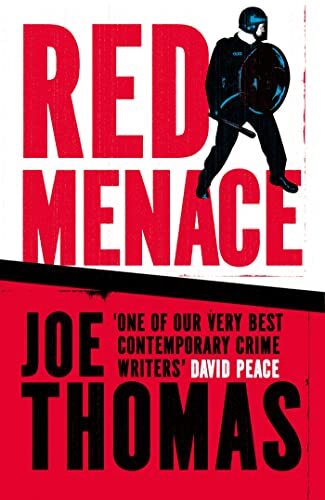
"A very early candidate for the crime novel of the year" IRISH TIMES Live Aid, July 1985. The great and the good of the music scene converge to save the world. But the TV glitz cannot disguise ugly truths about Thatcher's Britain.
Jon Davies and Suzi Scialfa have moved on since the inquest into the death of Colin Roach, but they're about to be drawn back into the struggle - Jon by his restless curiosity and Suzi by the reappearance of DC Patrick Noble.
Noble's other asset, the salaried spycop Parker, is a pawn in a game he only dimly comprehends. First, he's ordered to infiltrate the Broadwater Farm Estate in Tottenham; next will come Wapping, ground zero of a plot to smash the print unions. But who is Noble working for, and how far can he be trusted?
The Iron Lady is reforging the nation, and London with it. Right to Buy may secure her votes, but who really stands to benefit? Corruption is endemic and the gap between rich and poor grows wider by the day. Insurrection seems imminent - all that's needed is a spark.
REVIEWS FOR WHITE RIOT, A SUNDAY TIMES BOOK OF THE YEAR
'Rpresents everything that is good and important about the crime fiction genre' Irish Times 'Enthralling' Sunday Times 'Gripping' The Times 'Propulsive' Guardian
Not an "enjoyable" read by any stretch of the imagination. By which I mean the events are still so very recent and so horrifying that its hard to garner enjoyment from this extremely well researched and well written book. My only complaint is about my own lack of dye diligence. I should have read the blurb more carefully to find that this was the second in a trilogy. Now whilst it did not make this a great read I think I've missed out on the character formation from White Riot. Mea culpa.
Red Menace refers to Ken Livingstone, who wasn't the only person to be referred to in this manner at the time. Thankfully the events are not about the politics (or not wholly) nut rather the events surrounding the riots that seemed to happen anywhere and everywhere as Thatcher tried to turn us into capitalists and we lost a little of our souls as a consequence.
I'm late 50s so these events don't feel a long time ago. However I am also from the North of England and what went on in and around London was a long way from home and had little impact. What did impact were the deaths and beatings you heard about involving the police. The deaths were particularly difficult to understand. It was hardly surprising to anyone that riots occurred after things like that happened to ordinary, decent, people just trying to live their lives.
I think what I'm saying is that this book drags you right back into that era. People were angry, afraid, ready to fight, divided by wealth and power. And when I'd finished I wondered what was different now? Nothing save we have different minorities on the firing line. Joe Thomas manages very skilfully to weave fact and fiction with his characters. Its very clever. It's very believable and I now have to read the first in the trilogy because I know it'll be worth it.
Highly recommended. Thanks to Netgalley and Quercus Books for the advance review copy.
Red Menace (2024) is the second in the United Kingdom Trilogy and follows White Riot (2023).
If you haven't read White Riot then I recommend you do that before reading Red Menace. It's not essential but the experience is richer by having the knowledge of the events of the earlier volume. Both books feature the same set of characters and, like White Riot, Red Menace is an imersive, kaleidoscopic London novel told from multiple perspectives.
White Riot ended in 1983, in the aftermath of the death of Colin Roach inside Stoke Newington police station. Red Menace opens on the day of the Live Aid concert at Wembley Stadium on 13 July 1985.
This time out it's the Broadwater Farm riot on 6 October 1985 which saw two deaths, Cynthia Jarrett (the previous day) and PC Blakelock. We also relive the Wapping dispute when print unions tried to block distribution of The Sunday Times, along with other newspapers in Rupert Murdoch's News International group, after production was shifted to a new plant in Wapping in January 1986.
If you're old enough to have lived through the period then you will doubtless also be struck by the credible feeling of authenticity.
In amongst real characters like Margaret Thatcher and Paul Weller, we once again spend time with undercover cop Noble, photographer/journalist/activist Suzi Scialfa, and local councillor Jon Davies amongst others.
Once I'd got into the rhythm of the novel, and the various narratives, I was again immersed.
This is up there with David Peace's Red Riding Trilogy which, as you probably know, is very high praise.
I can't wait to read the final volume and am already pondering which real world events Joe Thomas will incorporate, and how the saga concludes for the lead characters.
4/5
More info....
Live Aid, July 1985. The great and the good of the music scene converge to save the world. But the TV glitz cannot disguise ugly truths about Thatcher's Britain.
Jon Davies and Suzi Scialfa have moved on since the inquest into the death of Colin Roach, but they're about to be drawn back into the struggle - Jon by his restless curiosity and Suzi by the reappearance of DC Patrick Noble.
Noble's other asset, the salaried spycop Parker, is a pawn in a game he only dimly comprehends. First, he's ordered to infiltrate the Broadwater Farm Estate in Tottenham; next will come Wapping, ground zero of a plot to smash the print unions. But who is Noble working for, and how far can he be trusted?
The Iron Lady is reforging the nation, and London with it. Right to Buy may secure her votes, but who really stands to benefit? Corruption is endemic and the gap between rich and poor grows wider by the day. Insurrection seems imminent - all that's needed is a spark.
This novel follows on from, ‘White Riot,’ and is the second in a planned trilogy. As before, we have a mix of fictional and real-life characters. Those that existed include Thatcher and Paul Weller, while we have a return of those involved with the police, Patrick Noble and Parker, Councillor Jon Davies and photographer and music journalist Suzi Scialfa.
I remember the Eighties very well and it is a little odd to think of those times as historical, but the novel encompasses Live Aid, riots on the Broadwater Estate and the movement of newspapers from the Strand to Wapping. This was an era of violence and discontent, and the author takes us from the somewhat naïve enthusiasm for Live Aid, through the riots and onto the Wapping dispute in 1986. At this time, print unions attempted to block production being moved from the City of London out to Wapping which was pretty much a wasteland at the time. I do remember walking through the Strand and watching the print presses rolling. Of course, journalism has changed so much since that time, but it was an era when Thatcher was determined to wage war on the unions and win.
Broadwater Farm is fairly close to where I work and protests were held around the death of Cynthia Jarrett, whose son was arrested by the police for having a false tax disc. She later collapsed and died when the police searched her flat, with suggestions of police involvement in her death (at the very least, it is arguable that having a false tax disc was hardly serious enough to demonstrate a search of the property). Demonstrations led to the later murder of PC Keith Blakelock and injuries to another police officer. Bernie Grant, a controversial council leader was said to have said, ‘What the police got was a bloody good hiding,’ but claimed later to be misquoted. He is another real-life character who is mentioned in this novel.
This is a very evocative read for anyone who lived through that time. I enjoy the mix of music and football that the author weaves into the story and feel that his characters are believable and of the time when the novel was set. I certainly plan to read the last in the trilogy. I received a copy of this book from the publisher, via NetGalley, for review.
Red Menace is the second in a planned trilogy of books by Joe Thomas covering events in the East End of London in the 1970s and the 1980s. It follows on from White Riot, and precedes the yet-to-be published True Blue. I was living in London at the time, and was aware as most of what was going on in Hackney. These events to me seem pretty recent, so much so that I had trouble just now when I entered Red Menace into the TripFiction database classifying it as ‘Historical Fiction’…
The characters and some of the detailed events described in the book are fictitious, But very clearly Joe Thomas has done a great deal of painstaking research. The book has a ring of truth about it. It primarily covers the Broadwater Estate riots in Tottenham and the movement of ‘Fleet Street’ to Wapping – and the links between the two. It is a story of bent police planting and dealing in drugs, dodgy East End councils being manipulated by corrupt land developers, and the freezing out of the once all powerful print Trade Unions – set against a series of ‘politically inspired’ pop concerts culminating in Live Aid in 1985.
It was a very different time. Though I am far from sure the black youth of North London feel any more supportive of the police now than they did then, or that corruption has been removed from the property development process. We used to think that such things were un-British – I’m not sure that we do any more. And world poverty hasn’t exactly gone away since Live Aid.
Red Menace is an excellent and nostalgic trip down memory lane. The London of the day is well portrayed and the (fictitious) characters are well drawn and convincing.
1985 and following the defeat of the miners, Thatcher is firmly in power and eyeing the print unions as her next target.
Following on from White Riot, Red Menace covers a wide number of events: the formation of Red Wedge, the death of Cynthia Jarrett and subsequent violence, the Wapping dispute, the Docklands expansion and the ongoing corruption at Stoke Newington police station.
The main characters from the previous book remain, with the addition of several new characters, including a gangster turned legit businessman who resorts to his old methods when dealing with obstacles to his move into the Docklands property business. Music, specifically Weller and Style Council, features but with less prominence than in White Riot.
As with the previous novel, the proliferation of narrative voices does affect the flow at times and can be confusing initially. New readers would benefit from reading the first novel to better understand the backstory of the main characters, particularly Noble and Parker.
This is a fictional retelling of a significant period in UK history, the effects of which we are still suffering today. Informative and enraging and stirs a range of emotions for those of us who were politically active at the time.
1985 and whilst London hosts Live Aid, the city hides a lot of conflict. Suzi Scialfa is still reporting on music and news, she sees the formation of the Red Wedge, a group of artists with left wing views opposed to the Conservative government. Jon Davies is still trying to fight corruption and now his attention is drawn to abuse of power and the development of the London Docklands, particularly Wapping. Meanwhile unrest is growing in Tottenham after the death of a woman on the Broadwater Farm Estate. As Margaret Thatcher controls the country, London is close to explosion. This is the second book in a proposed trilogy and it is brilliant. I love the way Thomas takes actual events and people and weaves a narrative around them where fact and fiction are so close. His group of characters are believable and operate on the fringes in different areas but all have beliefs in right and wrong. The knowledge of events and the understanding of motives is excellent and this takes me back to my youth with all the cultural references that are pitch perfect.
The 80s are considered a light and vapid age. It was the age when a lot of musician, included pop musician, were involved in politics and movements Rock Against Racism, Red Wedge, A Conspiracy of Hope were the best way to involve people. This trilogy is exciting, a brutal portrait of an era that was the best and the worst at the same time. Read it. Highly recommended. Many thanks to the publisher for this ARC, all opinions are mine
Enjoyable read that has become all too real with the far right on our streets fighting the police and civil society. The death throes of these dinosaur views? Anyway, back to the book. Like its predecessor, it takes us back to the early eighties and the opposition to Margaret Thatcher. What is hopeful is how far we’ve come since. Great story, based upon so much research. Read it.
A very good read, based on police and municipal corruption in North & East London in the 1980s. The characters are compelling and the story is an important one. My opinion of it is probably partly based on the fact I was there, I even met some of the semi-fictionalised characters - but thankfully not some of the others. But even if this is not a world you know about it, its certainly worth a read.
A sequel that deftly expands upon the sleek yet grimy ‘White Riot’ in every way. I found myself immediately transported back to London while reading this book, but more than that, I found hope here. Stoke Newington was an ugly place in the 1970s and ‘80s, and while I wouldn’t say it’s since become a paradise necessarily, things have improved. Bad times pass. Evil eventually fails.
Cleverly written and superbly structured. This should be a damning indictment of the police, the government and certain corporations, for their policies and actions in London during the 1980's. Sadly, most of this comes as no great shock to those of us on the left of the arguments at that time. When the winners get to write the story, we need people like Joe Thomas to write the truth.
Like its predecessor, this book brought back a lot of memories, some of which had been buried fairly deeply by the passage of years. The book picks up from Thomas’s previous novel, White Riot, which had recounted life in Hackney in 1978 and then 1983, and the dreadful racist attacks that were prevalent. That novel was told from various perspectives, focusing on undercover police officers, journalists, liberally inclined employees of Hackney Council, and members of the community, and was notable for its blending of fiction with real events.
This book continues that multi-perspective approach and moves onwards from 1983, including the iconic Live Aid concert in July 1985 and then the vicious riot at Broadwater Farm. As now, in 1985 I was living in Muswell Hill in North London, not too far from Hackney and Tottenham, and remember news about the Broadwater Farm riot breaking out. Everyone knew that it was coming, not least because of reports of a raid on the local Express Dairy in which hundreds of milk bottles had been stolen. It was only a matter of time before they would be raining down on the police in the form of petrol bombs.
Joe Thomas captures the horror of that riot very effectively, deftly managing the various strands of his story. The plot is actually for too complicated to be easily summarised here, but Thomas keeps it moving forward.