The secret history of our most vital organ: the human heart.
The Man Who Touched His Own Heart tells the raucous, gory, mesmerizing story of the heart, from the first "explorers" who dug up cadavers and plumbed their hearts' chambers, through the first heart surgeries -- which had to be completed in three minutes before death arrived -- to heart transplants and the latest medical efforts to prolong our hearts' lives, almost defying nature in the process.
Thought of as the seat of our soul, then as a mysteriously animated object, the heart is still more a mystery than it is understood. Why do most animals only get one billion beats? (And how did modern humans get to over two billion, effectively letting us live out two lives?) Why are sufferers of gingivitis more likely to have heart attacks? Why do we often undergo expensive procedures when cheaper ones are just as effective? What do Da Vinci, Mary Shelley, and contemporary Egyptian archaeologists have in common? And what does it really feel like to touch your own heart, or to have someone else's beating inside your chest? Rob Dunn's fascinating history of our hearts brings us deep inside the science, history, and stories of the four chambers we depend on most.
Robert Dunn is a biologist, writer and professor in the Department of Applied Ecology at North Carolina State University.
He has written several books and his science essays have appeared at magazines such as BBC Wildlife Magazine, Scientific American, Smithsonian Magazine, National Geographic and others. He has become known for efforts to involve the public as citizen scientists.
Dunn's writings have considered the quest to find new superheavy elements, why men are bald, how modern chickens evolved, whether a virus can make a person fat, the beauty of the Gulf of St. Lawrence, the biology of insect eggs, the secret lives of cats, the theory of ecological medicine, why the way we think about calories is wrong, and why monkeys (and once upon a time, human women) tend to give birth at night.
Ph.D., Ecology and Evolution, University of Connecticut (2003). He was a Fulbright fellow in Australia. He is currently the William Neal Reynolds Distinguished Professor at NC State University.
More like a 3.5 star. I like the idea and concept, but a few of the arguments were a bit convoluted (ex: he discusses a 2012 meta-analysis looking at medication+angio/stent for atherosclerosis vs medication alone then jumps back about 30 years by referencing studies in the 80s/90s that contradicted the meta-analysis's findings...huh? I do research and those paragraphs didn't make as much sense). I also felt like bits were missing from the story such as the development of heart valve replacements/repair and the extension of the heart-lung machine to ECMO (extracorporeal membranous oxygenation - allows the lungs to rest and heal while the heart pumps, which could have been briefly introduced/explained) and the development of the complex operations to save children born with hypoplastic left heart syndrome.
One thing that I think would have been very good for the book, considering this is written for a lay audience, is an actual description - with pictures - of the normal working anatomy of the heart. Because there's a point at which Dunn describes in writing the four congenital malformations that comprise Tetralogy of Fallot and even I found it really hard to visual what he was talking about and I know what they are.
(Caveat: if you are an animal lover, this book may not be for you. The history of medical discovery is paved with the use of laboratory animals for research, often in non-ethical ways, none more so than the treatment of cardiac ailments.)
Das Herz war damals (um 1800) und nicht mehr so sehr heute für viele ein wahres mysterium. Der autor Robert Dunn beginnt mit einem bericht darüber, wie seine mutter trotz der heutigen beeindruckenden technologie und medizin fast an einer zu hohen dosis von digitalis gestorben wäre – einem medikament, das verwendet wird, um einen schnellen herzschlag zu verlangsamen.
Er kämpfte offen mit den Chirurgen um ihn herum und gewann fast immer. Die Leute liebten es entweder, mit ihm zu arbeiten, oder sie hörten auf. ---Robert Dunn
Dunn erinnert sich dann an einen vorfall im Jahr 1893, bei dem ein afroamerikanischer Arzt in Chicago einem opfer einer stichwunde im herzen das leben rettete, indem er in die wunde schnitt und den im herzbeutel gefundenen riss vernähte. Dem ging ein gewisser forssmann voraus.
This entire review has been hidden because of spoilers.
This book is mis-titled. It should be called The Evolution of the Human Heart and its Maladies or something like that. Dunn teaches in the Ecology and Evolution department at his college, and it's clear that his passion is for evolution. If the title were more accurate, I wouldn't have read this book. I didn't want to read about the heart. I wanted to read stories of people who discovered important things about the heart. I wanted to read about surgeries. I wanted to read about a man who literally touched his own heart (it's crazy, but I thought I was going to read some crazy story as indicated by the title). There are some stories, some colorful characters, some extreme cases of trial and error, but I wanted trial and terror (couldn't resist). Anyway, I was disappointed with this book but only because it's not what I wanted to read. I did learn a lot from it, and I like Dunn's style. His prose is easy to read, and it's conversational and interesting. I did get tired of his evolution obsession but only because, again, that's not what I wanted to read about. I recommend this book if you want to know about the evolution of the human heart and its maladies with a few stories thrown in about scientists and inventors.
This is one of those books that comes along at the right time and hits you right in the feels.. wait it's nonfiction, yes. But it hit me in the feels. Why? My young cousin just had a heart transplant. Yes, you heard that right, like last week. I had seen this book on our library shelves and actually thought I might have read it- I hadn't, I pulled it off the shelf last week and then was immersed.
It's a general history of understanding the heart and how to treat its ailments. It was the perfect book to learn with a poetic explanation that comes from the 1400s in which it was thought that God wrote our life stories on the inside of our hearts. Then came surgery on dogs, then true heart surgery, understanding blue babies, catheterizations, air quality, and diet, etc. and then how doing CT scans on mummies led us to some more understanding and how our hearts can compare to others animals'
It was a fascinating look and told without too heavily relying on understanding deep science but also not placating to an uninterested readership. It read well. The storytelling in particular was made it accessible, but I agree with others that something like "a natural history" or another type of title would have sold it a little bit better as a fairly comprehensive look at the heart or even his use often of "broken hearts" should have made it in the title!
Actually 4.5 stars. As a former cardiac nurse I found " The Man Who Touched His Own Heart" totally fascinating. It is the history of cardiology that started long before it was recognized as a specialty and begins with Da Vinci's anatomical studies. The book can probably get pretty gory at times for those a bit squeamish when it comes to medical explanations but there are also parts that are laughable at their absurdity. I especially liked the chapter on the first cardiac catheterization and angiogram. Pacemakers, cardiac surgery, heart transplants and LVEDs are all discussed. Robb Dunn uses his subtle comments and humor to engage the reader. I enjoyed this book because I like getting to know the history of medicine and how we got to where we are today. For me, knowing this, it opens up what possibilities the future might hold.
This book is a fantastic nonfiction, if you are into the whole history of heart surgery. I really enjoyed reading this book, and honestly learned a lot. I can honestly say, that I have not read anything like this book. Dunn has a way of writing nonfiction that still makes it more than just a list of facts. His sense of humor really adds to all of the detailed research that was done to put this book together. From the beginning of heart surgeries to what we are all accustomed to today, he gives all the details and agonizing process of how it all happened. For anyone who is interested in bio science or the body this is a great book to read. "The Man Who Toughed His Own Heart," is truly enlightening.
The first half of the book, including all of the historical tales, is great. Although, not complete. This is the highlights reel of heart history. If any of the people or innovations in that part interested you, Dunn just shows you the entrance to the rabbit hole. Great stuff for lay people though. The second half is more modern day science analysis, and not as well written as the first half. There are some correlations that make me scratch my head and even got a little preachy in his section "Sugarcoating Cholesterol."
Did I enjoy it? Yes. Did it make me think? Yes. Will I recommend it? To a few. Mainly for the history portion.
I thought it was super interesting to learn about how everything with heart procedures and learning how the heart worked was super interesting. Being in the medical field, the heart is super complex so it was cool to learn about how things came to be about the heart.
THIS BOOK IS INCREDIBLE!! Wish I could give 10 stars 🌟 Author Rob Dunn has scratched just the surface of humans understanding of arguably the most important organ: the heart. Through gory details, Dunn explains all through from the very first understanding, predictions, and scientific experiments by humans, to our most recent knowledge. I’ve learned an immense amount of information about the heart, and I cannot wait to now continue my education. Truly an incredible, inspiring read.
Everything you wanted to know about the science of the human heart in a series of essays about medical pioneers.
This was a really interesting idea that just grew a little dull and tedious for this lay reader. I am fascinated by man's quest for knowledge and the lengths some will go to further their own education, and so a book chronicling the development of heart science/medicine was very intriguing to me. And in truth, much of what was written was quite interesting, it was simply bogged down in the writing, which jumps around and is disorganized and a bit heavy-handed.
I read this on a kindle and the book is rife with end-notes. If you are familiar with the kindle, you know what a pain it can be to read end-notes electronically (just as end notes in a physical book can be annoying to constantly be flipping to the back to read the author's commentary on his own writing, or worse yet, to simply read "ibid." Few of the end notes were worth the time and effort, and about half way through I started glancing at the notes collectively by the chapter to see if anything looked like it was really worth the time.
The book started off quite well and I was excited and looking forward to reading this, but after two or three chapters I couldn't remember why this was once interesting to me. I wanted to like this (I wouldn't have requested it if I wasn't interested) and it started off well, but I lost interest (or the author failed to hold my interest). Some of the details about how animals have been used in experiments didn't bother me. I'm not faint at heart and I understand the medicine has often explored the workings of animals before progressing to humans. However, I know plenty of people for whom this might be a bother.
I wish I could recommend this book, but I think that it would only appeal to those who are already in the medical field, and even then I'm not certain it would be worth the read.
Looking for a good book? The Man Who Touched His Own Heart is a tedious non-fiction read exploring the progress of man's knowledge of how the heart works and how to fix it. I received an electronic copy of this book from the publisher, through Netgalley, in exchange for an honest review.
An interesting work chronicling the history of cardiovascular science and medicine. Dunn does a good job in the beginning drawing the reader into the story with his descriptions of Galen and Da Vinci. However, soon after the 100 page mark the book gets more and more disorganized. Dunn jumps around constantly between time periods, various scientists and physicians, and patients.
There are sporadic descriptions of the inner workings of the heart and CV system, though there isn't one central section devoted to this. The reader is given snippets of its function throughout the book. For a lay person without prior knowledge, this book is very confusing, disorganized, and doesn't seem to be thought out. Dunn also seems to be overly poetic a lot, and it honestly just comes off as trying too hard.
All in all, there are much better medical books available. I would skip this one.
A must read for everyone who is interested in our once most precious and mysterious organ, heart of course. Dunn has the mastery of synthesizing enormous materials from the Prince of the Heart ages ago to our current understanding and operation of the heart. I was fascinated with how we developed the understanding of the basic structure of the heart, the veins, the diseases, and ultimately the curing of countless heart diseases. It’s the men and women who made daring and fabulous discoveries that attracted me most. Without them, we might still be at the mercy of our broken heart. The book should deserve 5 stars if I have not lost interest in the final 3 chapters.
I really liked this book. It is engaging and flows nicely. I was amazed at how recent effective heart treatment really is, basically in my lifetime. Dunn recounts the history of heart study in a very entertaining way. His inclusion of a little history of the characters involved really adds to the story. People who enjoyed The Emperor of All Maladies or The Immortal Life of Henrietta Lacks will enjoy this one as well. See my complete review at http://bit.ly/1DHagz9. I received a complimentary egalley of this book from the publisher for the purpose of an independent and honest review.
Feel your heart beating. You are alive. You need to know more about that heart. Read this book. Rob Dunn writes in short sentences. He uses historical and current people to illustrate important findings about the human heart: cholesterol LDL, HDL, triglycerides, bipasses, stents, statins. He also delves into other primate hearts, even snake hearts. He is comprehensive and informative. The story of medicine, treatment and fads for the heart is well told. READ THIS BOOK if you care about your heart.
I received an advance copy of this book from Netgalley.com. Although there were many interesting aspects of this book, I couldn't finish it. The exhaustive amount of history was tedious. But it was the experiments on dogs, removing dog hearts and putting them back, that really got to me. Yes, we humans owe much of our medical advances to lab animals. But it's something I just can't bear to be reminded about.
As someone who has worked in various areas of Cardiology for 25 years I found this book super interesting! If you are interested in the heart you will find anything and everything here, told in an easy enough way so that even if you have no knowledge of the heart and its workings you will find it easy to understand.
This was somewhat interesting in that it provided a lot of background on the development of the science of heart medicine and surgery. However, despite the title, it was more a narrative of the history of the developments in this science, rather than a collection of tales. I was expecting more anecdotes and interesting stories rather than a simple factual description of the developments.
I never realized how little we knew about our heart. This book reveals how far we've come and in the past century. With the rapid advances we are making one can only hope 2.5 billion beats is enough before we figure out how to add another billion beats to our lifetime.
Simply wasn't a fan. Interesting subject definitely, but the author jumps around and doesn't describe events chronologically after a certain point. Which is confusing since a good first portion of the book is organized that way. Unfortunately, after about halfway through I was just bored with the book.
Very interesting collection of stories that illuminate previous thoughts about the heart, as well as the progression of what is understood of it today.
Honestly, it was more of a 2.5 out of 5 for me, but I grade down when the book is a struggle to get to the end.
When I read books about sciences, I often feel like I am missing two degrees in the book's pet field of study and a fondness for reading the driest research papers. However, this book was decently accessible for someone with only the basic knowledge of the human body from high school biology. It did not seem as comprehensive (for the time of publishing) as the story of cancer and its relationship with humanity like one of my favorite "I don't think I understand everything, but I like this beautiful thing anyways and will make this my benchmark for all other books of this genre" type of book, "The Emperor of All Maladies." That's unfair and a probably uninformed comparison, but this is my review, so whatever.
This book did a lot right to make me happy to read it. I was in for the ride just with the topic of the heart since it affects me and every other mammal I know. I liked when Dunn took the time to mention people who had their skin in the game; that is to say, he included the people who may not be the person who did it first or succeeded first, but also the people who were a part of the process of innovation. I like learning about the whole history of a thing, so it was great to see Dunn do this.
The things that this book did that I did not really like was the ordering of events. After the first quarter or third of the book, it was a little difficult for me to keep track when breakthroughs were made when. Chronology is something that not everything needs, but my memory does not remember that this book did this. My memory is not perfect, but I want a science book for laypeople to be easy to remember in order rather than reorder mentally. I am not sure this makes sense, but sometimes Dunn's conversational style of writing could have been edited down a bit more. Also, I wanted a few more pictures of a heart (both normal and atypical) in a book about the heart; visualization is fun! Also, more surgeries would have been fun.
Overall, I would recommend to people with a healthy curiosity of the human heart or would say, "yes, that actually sounds interesting" after reading the title and the inside blurb about the book. Warning: it sucks to be a lab rat; it sucks to be a lab primate; it sucks to be a lab dog (I really did not know how many dogs were involved; I thought it was going to involve more mice). You might not want to read this if you do not like reading about animals being used for science.
I'm generally a fan of Rob Dunn, but this book gets a decidedly mixed review from me.
The thing is: Rob Dunn's really good when he sticks to his wheel-house, which is ecology and evolution (incidentally also favorites of mine... duh). I don't think he's quite as effective as say, Sam Keane, in explaining medical history and physiology.
A few critiques: the chapters were much longer than his standard, which worked for some chapters, but others felt really drawn out. There was also an absence of pictures and images in places it would have really been helpful, like describing the heart or experiments done to explore the heart. The chapter headings were a bit annoying: too creative, when they should have been more direct. I like to know what I am about to read. The cholesterol bit really got stretched out and was maybe too tangentially related to the heart and more to the circulatory system.
On the other hand! When the book was interesting, I really enjoyed it. It definitely touched on topics not found in other books. I really liked the chapter on metabolism and body size (an AP biology concept!) and why heart disease differs between humans and other animals. I was a little baffled by his evolutionary history of the heart. The author claimed that the lungs were independent of the swim bladder. Work by Neil Shubin contradicted some of his passages. I entrust that Neil Shubin is the correct one since his most recent book is more current AND this is a more direct line of research for him.
The book, like the vessels of the heart, branches in odd directions. Maybe it would have been better if he had divided it into parts like "The History of the Discovery of the Circulatory System", "Modern Heart Disease and Circulatory system" and "Evolution and Further Exploration of the Heart/Circulatory system" (pretty close?). I did really like the link between pathogens and cholesterol. Some of the stories were freaky, yet interesting, though it was honestly hard to read sometimes knowing how much dogs suffered for human knowledge about the heart. (They are often long-suffering research animals). Perhaps though, I wasn't as interested in the topic as I thought?
Overall, the book is unique and you will definitely learn from it, but it just didn't rank at the top of my list.
Rob Dunn's book is a history lesson with an amazing list of characters. The book starts with the story of Daniel Hale Williams, an surgeon of African American - white parents. Williams performed a surgery that was groundbreaking at the time. Dunn also shares Williams other accomplishment that show him to be an unsung hero in American medicine. Another chapter tells the story of Werner Forssmann, a scientist who developed a catheter that allowed him to investigate problems in the heart. Forssmann's unorthodox methods are described as well as how is work led to many lives being saved. Other stories focus the doctors and scientists who worked on heart transplants, the creation of statins to alleviate atherosclerosis, nutrition as a way to improve heart health and more. Dunn writes in an easy style that brings each of these doctors and scientists to life. I thoroughly enjoyed this book and found each chapter to be a surprise in more ways than one. Anyone with an interest in scientific discovery and history should read it.
I loved the science and some of the history. A lot of the material was new to me, which is hard to find in a popsci-ish book on this topic given my background
But I can’t give more than 3 stars for the dismissive way the book routinely presents terrible doctors performing medical experimentation without informing the patients (and which ultimately resulted in their deaths), so that they could win a fame and fortune arms race against their colleagues, or how the author justifies the US government performing medical torture on prisoners.
These things were not okay then, they are not okay now, and it is the responsibility of anybody telling these stories to make it very clear how unethical this was. If it couldn’t pass IRB now, don’t justify it as being valuable maybe??
I really like these types of books: science-based, anecdote-laden, medical in nature. I was excited to pick this one up, but about half-way through I started to lose interest. Maybe it was the pacing, or perhaps it was just Dunn's writing style. Occasionally, this leisurely, educational stroll through the history of cardiac science had me checking my own pulse to ensure I was still awake.
The best way I can describe the experience of reading this book is to say that it's like being at a dinner party and listening to people regale you with anecdotes of scientific breakthroughs. But like at any such gathering, there are stories that captivate, and stories that bore... sometimes the tales are either overly long or a little too repetitive.
That said, the moments of revelation and profound insight into the heart's mysteries were intriguing. I just wish there'd been more of them.
This is a very interesting, addictive and well-written book about the history of the heart; or rather the history of the study of the heart and how ignorant we still are in this topic.
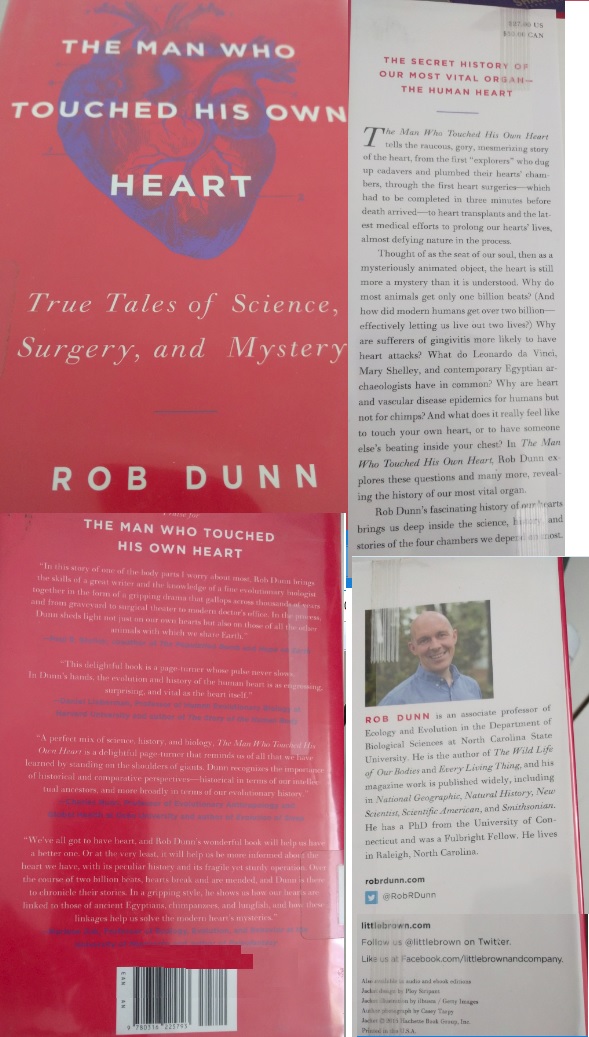
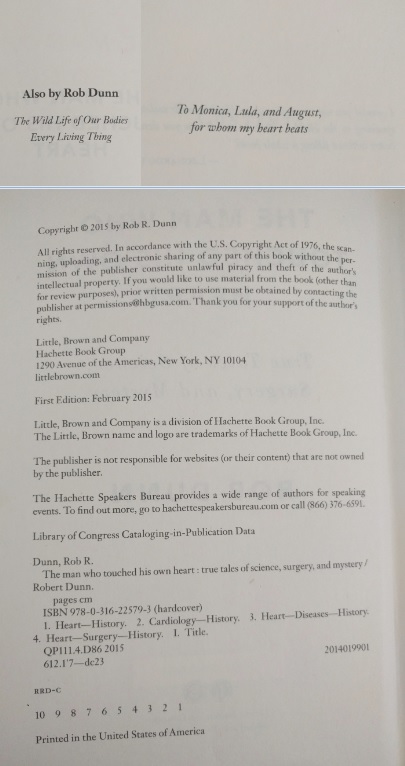
This is the cover and jacket of the book I read:
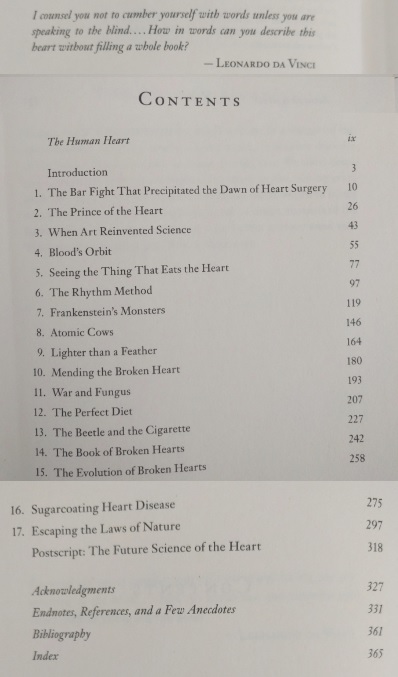
This is the table of contents. The book starts with a catchy story about a man who was involved in a fight and was stabbed in the heart. This happened long time ago when surgery was not developed yet, and it describes with great accuracy what the doctors did for this man: basically sit down and watch him as he evolved by himself. Many other chapters are interesting and fascinating. Here is the list:
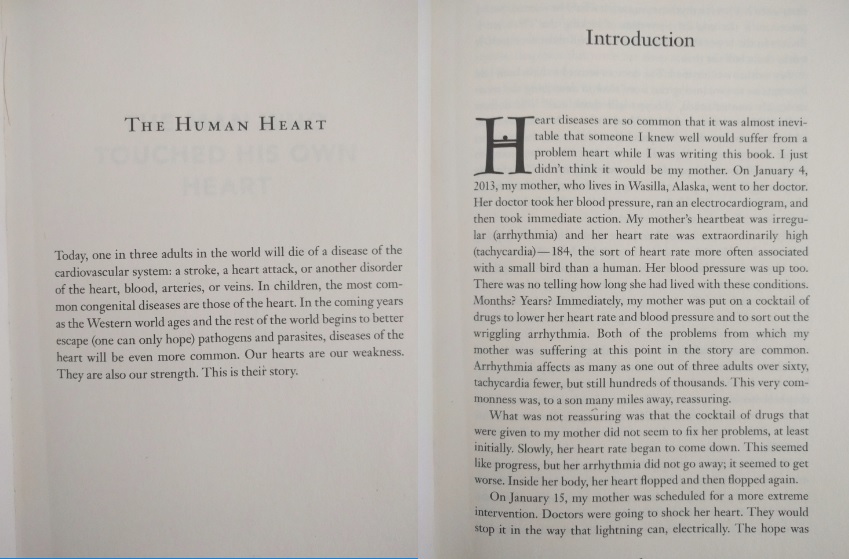
This is the introduction: here is another witty story from the writer: his mother having cardiac problems and being put into medication and treatment. All this doctor is trying to show is that the "science" of the heart has advanced almost nothing since we began to study this organ.
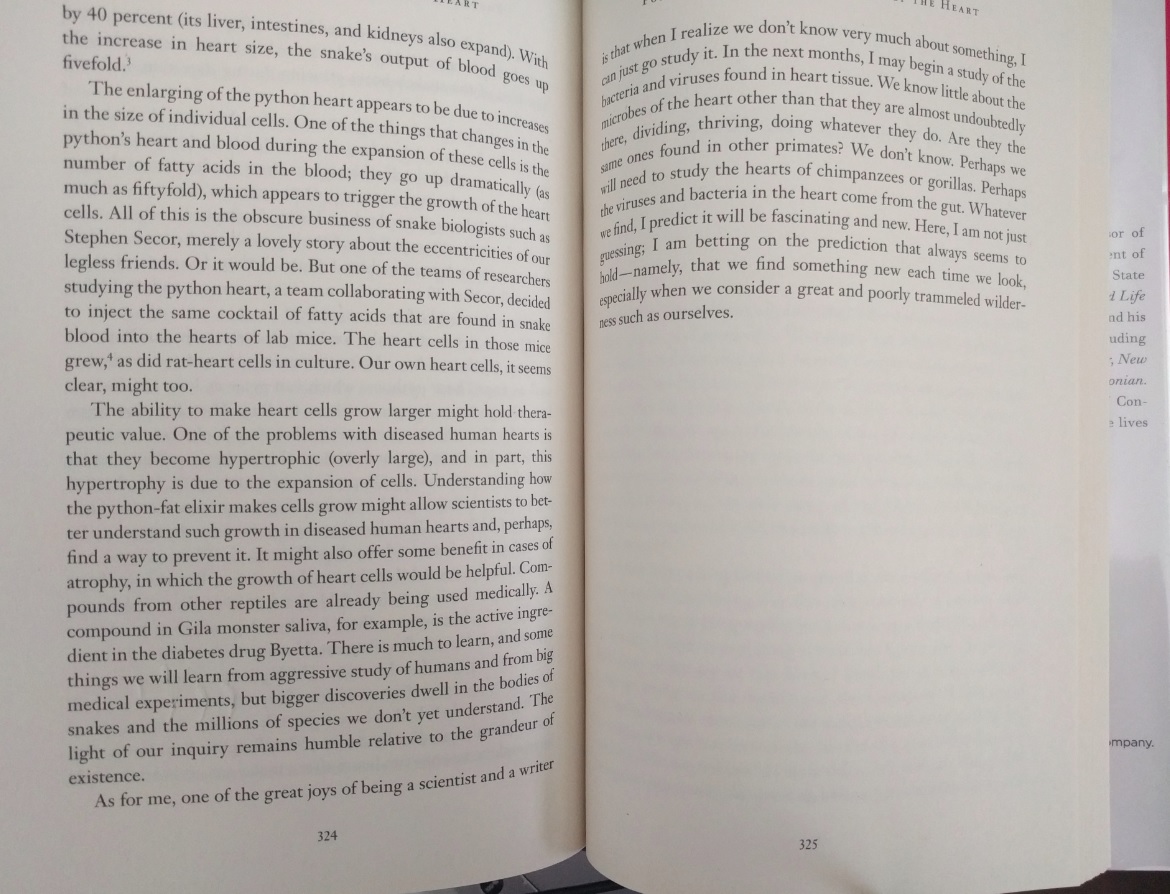
Here is an excerpt where the author talks about the bacteria that lives in the organs. He was about to start studying this aspect of the topic when he wrote this book in 2015:
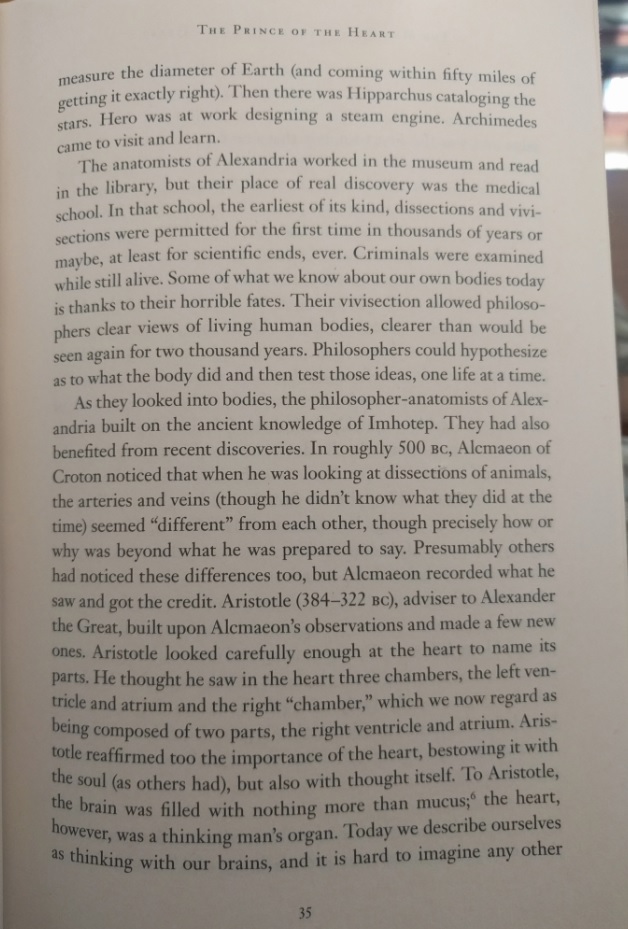
This is a fascinating description of the practice of vivisection. A form of punishment for criminals that were also volunteered to study the human body:
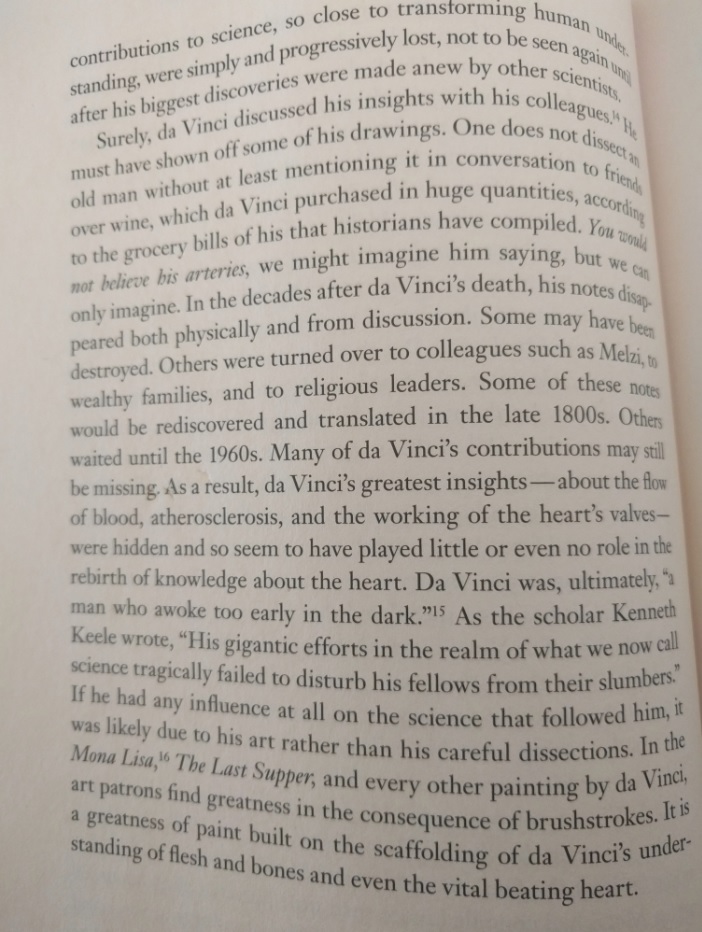
The following page is a story of Leonardo Da Vinci and his genius. He studied the heart a lot, but most of his work was lost. The author tells this story much better in this page:
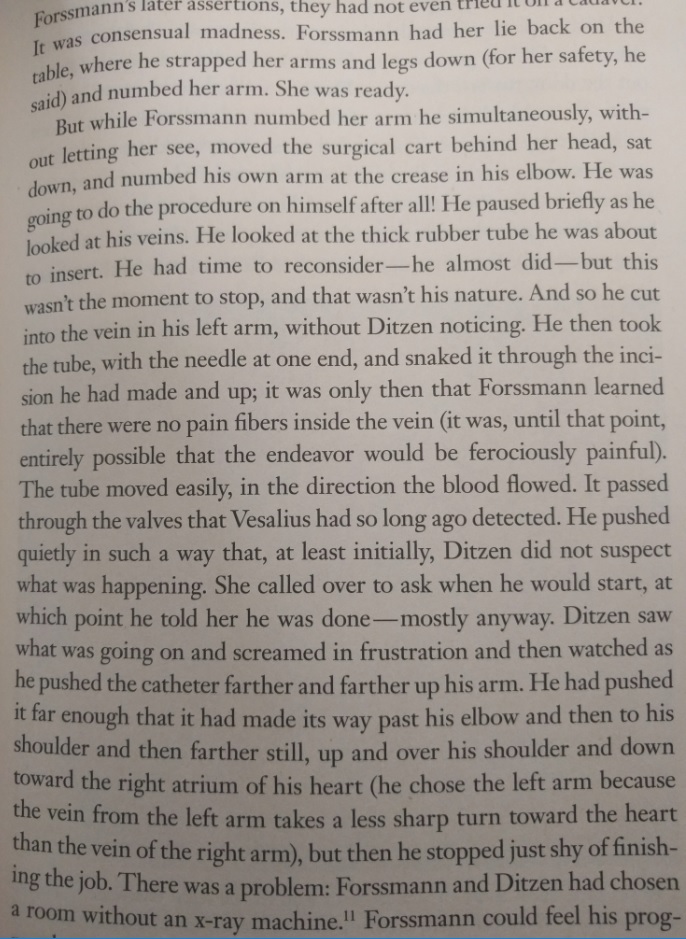
Yet another of those stories that this author has a gift for telling: descriptions of the initial experiments with catheterization... how the doctors did the procedures on themselves just for the love of science:
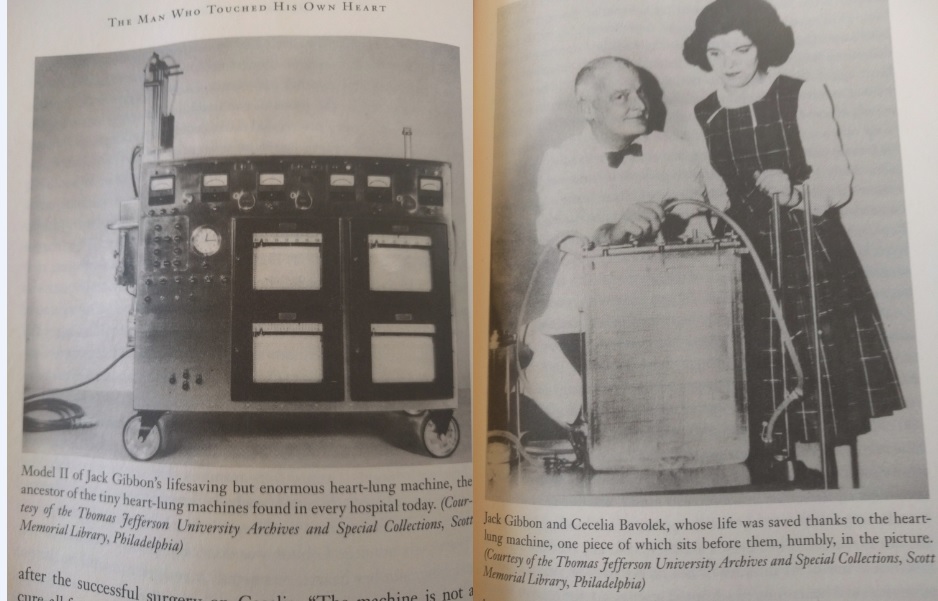
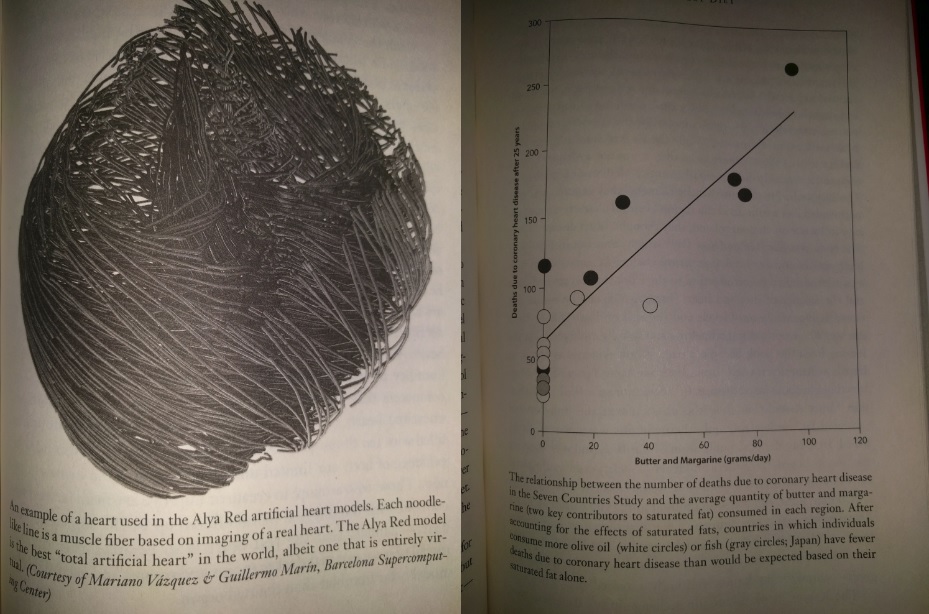
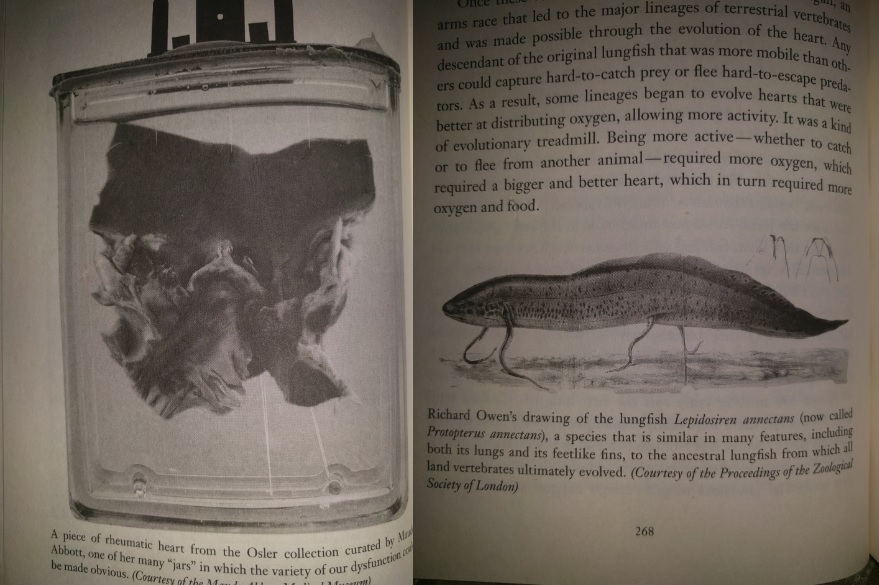
Finally, a couple of pages with pictures in the book: machines and other devices for the science of heart:
In conclusion, this is a very good book. I read it from cover to cover and was hooked till the end. I loved it and will be willing to read more from this author.
It is an informative narrative of the history of cardiology, interventional cardiology, and thoracic and cardiovascular surgery. Every chapter tells the story of a certain disease or procedure that changed how the medical world sees heart diseases today. Based on the title, I expected medical anecdotes and interesting cases. The book is more historical and factual but not boring, hence I was not disappointed. Some chapters are more interesting than the others especially the first half of the book so I ended skipping the last three chapters. I would still recommend the book especially to those who are interested in the diseases of the heart. It is simple, fun, and entertaining while staying informative.
I really enjoyed the way the author was able to make such a complicated topic (the heart/heart surgery) so easy to understand. It was quite interesting to learn that heart surgery started due to a bar fight and heart transplants were first experimented on cats and dogs with some degree of success. The book is worded in a way in which each chapter smoothly transitions to the next, making it somewhat addicting and prompting the reader to go on.
Absolutely fantastic book! It covers the history of our studying the heart, and progresses to when we actually started trying to fix it through surgery and medicine. The author loves to point out areas that have had little to no research done, which really helps understand how much there is left to do. The evolution of the heart is a fascinating subject that is poorly studied. I highly recommend this book to any science, anatomy, medicine, or evolution enthusiast.