Un soir d’orage, il se passe des événements étranges au château de Moulinsart… Des verres, des fenêtres et des vases se brisent sans raison apparente. Le phénomène étrange va jusqu’à briser les vitres d’une voiture passant devant la grille…
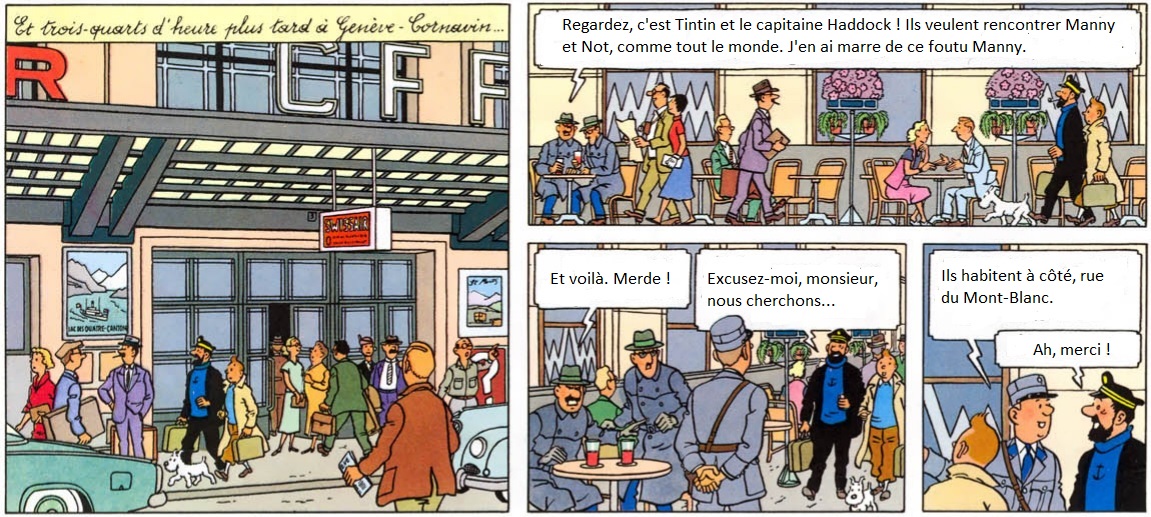
Quelques jours plus tard, Tournesol doit partir pour Genève afin d’assister à un congrès de physique nucléaire. Dés lors le phénomène s’arrête et plus aucun verre ne se brise. Très vite Tintin et Haddock font la relation entre les verres cassés et Tournesol…
Tintin et Haddock décident donc d’aller voir dans le laboratoire de Tournesol. Ils y trouvent une drôle de machine, ainsi que de nombreux débris de verre confirmant leur hypothèse. Mais à ce moment ils sont bousculés par un homme étrange, qui s’échappe mais qui laisse derrière lui un paquet de cigarettes sur lequel est inscrit le nom de l’hôtel où doit descendre Tournesol….
Georges Prosper Remi (22 May 1907 – 3 March 1983), better known by the pen name Hergé, was a Belgian comics writer and artist. His best known and most substantial work is The Adventures of Tintin comic book series, which he wrote and illustrated from 1929 until his death in 1983, leaving the twenty-fourth Tintin adventure Tintin and Alph-Art unfinished. His work remains a strong influence on comics, particularly in Europe.
"Hergé" is the pseudonym of George Remí, making a game with the initials of his name inverted. Throughout the evolution of his star character, Tintin, we can see the progress of this author: from the first titles marked by the ultraconservative doctrine of the director of the newspaper Le Petit Vingtième, to the breaking of conventions embodied from The Blue Lotus , as well as the evolution of the society of his time. The research carried out by Hergé to historically contextualize his Adventures, as well as his implicit social criticism, have made Tintin a masterpiece of the 20th century.
After seventeen successful adventures, Tintin's reputation as an adventurer, world traveler and intrepid reporter is solid and his sterling character as a dependable, forthright, stalwart young man is well established. His friendships with an oft-times inebriated Captain Haddock and the intensely deaf but entirely endearing Professor Calculus are an integral part of each story in the ever lengthening Tintin canon. At this point, what is Hergé to do but pull a rabbit out of his hat and produce what is probably the most complex and exciting Tintin adventure to date.
THE CALCULUS AFFAIR is the exciting story of the good professor's development of a devastating ultrasonic weapon and the resulting struggle to kidnap Calculus and hijack the weapon by rival terrorist teams from Borduria and Syldavia. The fast-paced tale is interspersed with hilarious comedic moments centered on Wagg, a completely annoying and utterly obnoxious insurance salesman, with the thick skin of a rhinoceros able to withstand and shrug off the onslaught of Haddock's most colourful and vitriolic nautical invective.
A return cameo appearance by the eardrum busting opera soprano, Bianca Castafiore, kidnapping, gunplay, espionage, counter-espionage, high speed chases, fistcuffs and pratfalls all told and illustrated in Hergé's inimitable style, the usual outrageous wordplay that leaps off the springboard of Calculus's deafness, laugh out loud comedic interludes and much more make THE CALCULUS AFFAIR one of the most delightful stories in the entire Tintin repertoire.
Random fact time! I just read, in volume 2 of L'Histoire de la Suisse pour les Nuls, that Bertrand Piccard, hero of Solar Impulse, the record-breaking round-the-world solar powered aircraft, isn't just the son of voyage-to-the-bottom-of-the-sea legend Jacques Piccard; he's also the grandson of Auguste Piccard, who turns out to be the model for Hergé's Professeur Tournesol/Professor Calculus. Now that's what I call a dynasty.
More than a passing likeness, wouldn't you say? _______________________ [After reading]
I discover that we were nearly visited by Tintin and friends. Perhaps we were out at the time, or they were too busy rescuing le professeur Tournesol from the sinister spy ring who were trying to kidnap him or something. Mille sabords !
این جلد یکی از جدیترین و سیاسیترین داستانهای تنتنه چون ماجراجویی سبکِ کودکانه تنتن میره به سمت فضای تاریک و پرتنش جنگ سرد. قصه از اینجا شروع میشه که یه روز صبح توی قصر مولینسارت، شیشهها بیهیچ دلیلی میریزن و میشکنن. اولش همه فکر میکنن کار جنوپری هاست، اما خیلی زود میفهمن پشت ماجرا اختراع تازه پروفسور کلکولسه (تورنسل) قرار داده. اون یه دستگاهی ساخته که با امواج صوتی میتونه هر چیزی رو خرد خاکشیر کنه. همون لحظه معلوم میشه این کشف علمی برای ارتشها میتونه حکم بمب اتم رو داشته باشه و سلاح مرگباری عه. اینجا به بعد داستان وارد سیاست میشه. دو کشور خیالی سیلداویا (که قبلاً توی ستاره مرموز و مقصد ماه دیده بودیم) و بوردور (کشوری دیکتاتوری که پارودی بلوک شرق و شوروی سابقه) وارد ماجرا میشن. هر دو میخوان کلکولسه و اختراعش رو تصاحب کنن. کلکولسه، طبق معمول، گیج و سر بههواست، حتی متوجه نیست همهچی بهخاطر اختراع اونه. تا اینکه دزدیده میشه و تنتن و کاپیتان هادوک مجبور میشن طی یک عملیات تمامعیار جاسوسی نجاتش بدن :)
قسمت خفن داستان اما اینجاست که هرژه توی این جلد دقیقاً داشت بازتاب جنگ سرد رو به تصویر میکشید یعنی. سالهای دهه ۵۰، که دنیا بین دو بلوک شرق و غرب تقسیم شده بود و مسابقه تسلیحاتی عجیب غریبی شروع شدا بود. امواج صوتی که کلکولسه اختراع کرده بود نماد هر تکنولوژی جدیدی بود که میتونست دنیا رو به دو سمت پیشرفت و رفاه، یا ویرانی و جنگ سوق بده. اگرچه کلکولسه دانشمندیه که نیت خیر داره، ولی اختراعش بهراحتی میتونه تبدیل به وسیله نابودی جهان بشه. هادوک و تنتن هم این وسط نماد وجدان و انسانیتان که از علم اخلاقی حمایت میکنن.
Tintin and Captain Haddock are in for a different sort of adventure in The Calculus Affair. It all begins when the glasses, mirrors, chandeliers, and china at Marlinspike start breaking with no apparent cause. Tintin finds a new invention in the Professor's laboratory and concludes that it may have caused the glass breakage in Marlinspike. Soon afterward, in Geneva, Professor Calculus disappears. Tintin and the Captain so begin their adventure to rescue both the Professor and the microfilms of his invention from falling onto the wrong hands.
This is one of the engaging adventures of Tintin. The story is clever with enough action. There is also humour enough to treat us to a good laugh. Madam Castafiore appears in this story and almost assist in Tintin's quest to rescue the Professor.
Its been a long time since I read this or watched it and I've quite forgotten the story. So this reading was as fresh as new. And enjoyed it a lot.
صفحه اول کتاب نوشته بود که این جلد، در بحبوحهی جنگ سرد در سال ۱۹۶۵ نوشته شده و هرژه توی این جلد روابط خصمانهی دو بلوک رو بازنمایی کرده.
پیرنگ این جلد هم حاصل همین کشمکش میان دو کشوره. یکی اسمش سیلداویاست و دیگری بوردوریا.
پرفسور کلکولس (چرا توی ترجمههای قدیمی میگن تورنسل؟!) در ابتدای داستان میره مسافرت. شیشههای عمارت کاپیتان هادوکم شروع میکنن به شکستن. همه چی رازآلوده، رازهایی که نمیتونی حدس بزنی چی پشتشه. تنتن و هادوک حدس میزنن این اتفاقات باید ربطی به پرفسور داشته باشه پس میرن دنبالش و باقی ماجراها پیش میاد.
اول کتاب نوشته این جلد یکی از شاهکارهای تکنیکی هرژهست. از لحاظ داستانپردازی حق با این جملهست. گرهگشاییها در این قسمت به شیوههای جذابی انجام میشن (مخصوصا کمد کاستافیوره و کت ژنرال رو دوست داشتم!) و خردهروایتهای بامزه هم کم وجود نداره توی این جلد. معماآلود بودن ابتدای داستان هم باعث میشه این قسمت رو دوست داشته باشم. ماجراجوییها خیلی توی جنگل و فضاهای غریب نیست، برای همین از این حیث کمتر دوست دارم این جلد رو. فضاها اکثرا شهری و معمولیان.
در کل جلد جذابیه ولی برای من خاطرهانگیزی قسمتهایی که ماجراها در فضاهای طبیعی میگذره نیست.
پینوشت: در نسخهی فرانسوی اسم پرفسور تورنسل هست و در نسخه انگلیسی کلکولس.
Tintin was one of the comic book heroes of my childhood. I'm going to read my way through the series again as I listen to a radio program about him, and his creator, Hergé. After the double book adventure to the moon, we come back to one book adventure, and as it turned out there wouldn't be any more double book adventures in this series.
It's called The Calculus Affair, and starts with Professor Calculus having invented a machine that is capable of destroying glass at long distance, much to Captain Haddocks dismay as his whiskey glasses start to explode before he can drink from them. Before Tintin and the captain realise that these glass explosions are related to professor Calculus he is off to a conference, where he is kidnapped, so Tintin, Snowy, and Captain Haddock have to come to his rescue.
This is a great book. The action is pretty much non stop. From the time the heroes go to the professors rescue, they hardly stop to take a breath. They are more or less always trying to get somewhere, and when they do get there, they find out they're just a few seconds too late and have to get to the next place, very very fast. In terms of action, this is the best of the Tintin books. It rivals Tintin in the land of the Soviets in terms of how fast everything moves, but this one actually has a plot, and therefore it is quite unfair to compare the two.
The one thing that drags it a little down for me, is that it doesn't have that much humour. Granted it has a good long sequence with captain Haddock and a sticky plaster that is probably among the best slapstick sequences in the series. Still, the book centres more on the action than the humour. The Tintin books that I like the best are the ones that manage to combine these two elements, so to me this one is not quite among very best, but it is very close to the top.
Yine savaşın gölgesinde bir Herge hikayesi. Neden bilmiyorum ama Tenten dahil olmak üzere en sevdiğim karakterlerden biri Turnusol. Sanırım bütün karakterler o kadar absürt, ırkçı ve işe yaramaz ki her ne kadar kulakları iyi duymadığı için herşeyi yanlış anlasa da Turnusol sanırım favorim.
İyi fikir aslında. Tüm seri bittiğinde sevmediğimden en sevmediğime bir karakter sıralaması yapayım. Bu ciltte de Kaptan Haddock "Balkanlı gerizekalı" dedi ya gerçekten ırkçılıklarının sınırı yok.
Ve yine ne yok? Bir tane bile kadın karakter yok. Telefonun ucunda hat bağlatmak için kullandıkları bir "küçük hanım" var, o kadar. Halbuki bence Tenten gibi macera ruhlu, güçlü, eğlenceli bir kadın karakter harika olmaz mıydı?
I've read ALL the Tintin comics (as well as watched the movie) and I'm a huge fan. :) The characters are awesome, each plot unique, and the villains: unforgettable. A great read for all ages, and the best written comics I have ever seen. For history nerds, mystery solvers, and adventurers alike. A must-read for EVERYONE!!! :D
Strange things are happening at Captain Haddock's estate at Marlinspike. Thugs are up to something, and all the glass is mysteriously exploding. Soon Tintin and the Captain discover that Professor Calculus had been kidnapped. Their investigation leads them to Switzerland and then to Borduria, ruled by the iron grip of the Stalinist Kurvi Tasch regime. The Bordurians, it turns, out have kidnapped the Professor, to develop nuclear weapons and thus enable them to attain world domination.
This is quite eerily prophetic, being written in 1956, when it seemed quite impossible for a tinpot dictatorship to acquire such weapons of mass destruction, but we now we see these very same devices being developed by tyrannies such as Iran and North Korea.
The Calculus Affair is filled with espionage and gripping adventure
ক্যালকুলাসের কাণ্ড টিনটিনের পুরোনো স্বাদের অ্যাডভেঞ্চার হলেও স্টার্টিং আর এক বিপদ থেকে উদ্ধার হয়ে আবার আরেক বিপদে পড়ার যে কমন সিকোয়েন্স থাকে সেটা সীমিত করে দারুণভাবে সবকিছু ম্যানেজ করার ব্যাপারটার জন্য এত ভালো লেগেছে। আর প্রফেসর ক্যালকুলাসের কিডন্যাপ হলেই বরং টিনটিনের পোয়াবারো; সূর্যদেবের বন্দীর মতো এবারেও সেরকম জমজমাট! আর কোল্ড ওয়ারের পলিটিক্সটা ইউজ করা হয়েছে বলে এতটা রিয়েলিস্টক লেগেছে কমিক্সটা। পরপর এমন দুটো টিনটিনের কমিক্স যেখানে দুটোতেই টিনটিন ডিক্টেটরশিপের বিরুদ্ধে। এরকম পাওয়ারফুল ভিলেন হলেই মজাটা বেশি হয়। ক্যালকুলাসের কাণ্ড টিনটিনের ওয়ান অফ দ্য বেস্ট অ্যাডভেঞ্চার্স।
Sin duda mi preferido. El top de entre los tops de esta serie. Por la trama, por el dibujo… ¡por todo! Es una historia de espionaje redonda, emocionante y con algunos toques de humor, sello de la casa. Es “El cortina rasgada” de Hitchcock, pero versión Hergé. Y en lugar de Paul Newman y Julie Andrews, tenemos a Tintín, Haddock, Tornasol y Milú. Con apariciones estelares de los Hernández y Fernández y de Bianca Castafiore. La guerra fría y los regímenes totalitarios en dos países imaginarios, y sin hablar de comunismo o nazismo. Sencillamente, un cómic redondo. Si alguien quisiera leer únicamente un cómic de Tintín, le recomendaría este sin dudarlo… aunque, francamente, ¿por qué quedarse con solo uno, cuando hay tantos que disfrutar?
کتاب شال ۱۹۶۵ منتشر شده، وسط جنگ سرد و طبیعی هم هست که از شرایط زمانهی خودش تاثیر گرفته. بامزه ست و یک تصویرگری فوق العاده داره که من از تماشا کردنش لذت بردم، از همهی جزئیاتی که خلق کرده کیف کردم.
Álbum muy completo que sigue a Tintín y compañía en una aventura para rescatar, nuevamente, al profesor Tornasol. El científico ha creado un arma que forma parte de los intereses del peculiar país de Syldavia. Es un cómic reminiscente de la Guerra Fría. Hergé juega sobre seguro al situar el conflicto en países ficticios, pero las referencias son claras. El trabajo del dibujante alcanza casi la perfección, aunque por momentos echo de menos la inocencia de los tomos más antiguos. Es una sensación extraña.
I ha ir Kommode i mim Chinderzimmer es paar Tim & Struppi Comics entdeckt und se natürlech direkt wieder müese läse - nostalgia be hittin' und die nid vorhandeni Fraue-Repräsentation ou lol. Bis überhoupt mau e Frou öbbis darf säge, vergeit öbbe d Heufti vom Buech u de ischs ersch no irgend e Randfigur wo nie meh vorchunnt. Die einzigi Frou, wo chli e Roue spiut, isch d Operesängerin u dere ihre einzigi erkennbari Eigeschaft isch, dass sie süchtig nach Kompliment für ihre Gsang isch. Ja moin. Pluspünkt gits füre geng wie geng tollpatschig aber sehr liebenswürdig Struppi, wo am Professor Bienlein si Schirm saved und füre Käptn Haddock und sis widerspenstige Nasepflästerli. Would not recommend to feminists but would def keep this in my nostalgic Büecherregau.
The absurdity of the spy thriller 22 February 2012
Tintin is one of those series of books that you read one and wonder how Herge is going to be able to top it, and sure enough he comes along with a comic that pretty much tops all of the previous ones that he has written. Unfortunately, as the bar gets raised, it becomes more and more difficult to exceed expectations. This, I believe, is the case with The Calculus Affair. Some have suggested that the Calculus Affair is the beginning of the final stage of the Tintin comics. All of the characters have been developed and the style has been perfected, but in a way, The Calculus Affair literally stands out on its own. This is a spy story where Cuthbert Calculus has developed a device that can be weaponised and as such there is a struggle between the superpowers to obtain this device. In the story the two superpowers are represented by the countries of Borduria and Syldavia, and while in Tintin they are a couple of small Eastern European countries they represent the larger Communist - Capitalist divide. However, Herge is not necessarily labelling them as such, theough we see that Borduria is representative of a police state where as Syldavia is not. What is even more interesting is that up until now we were under the impression that Syldavia was a good country, however in this album they become the antagonists alongside Borduria in that both countries want to weaponise Cuthbert's invention against his wishes. What makes this comic stand out though is not the cold war nature of this spy thriller (and the Cold War was ramping up at this stage, as well as the nuclear arms race) but that there is so much going on that has absolutely nothing to do with the story itself. It is almost as if the spy story takes a back step to the absurd comedy that permeates this story. For instance, we have the introduction of Joylon Wagg, an insurance salesman that seeks shelter in Marlinspike after the windows of his car shatters. He has nothing to do with the plot, but keeps on popping up during the story to act as a foil to Captain Haddock. The story opens with Joylon Wagg, and closes with Joylon Wagg. Then there is the Sticky Tab. The Sticky Tab has nothing to do with the story, and as the animated cartoon shows, it can be completely removed and we still have a consistent story, however to remove the Sticky Tab is to do a great injustice to this work (and the animated show pretty much does that). We also have the umbrella, which Snowy picks up and carries about with him through half the comic (until he loses it, and tries to take somebody elses). The glass shattering episodes at the beginning are thick and fast, and ends up turning Marlinspike into a comedy of errors and a media circus (as Herge so brilliantly draws in the beginning). The Thompson Twins make a small appearance in this story as well, and while their entrance has been done similarly in Destination Moon, it is still a shock when they are brought in. We are told that 'two men have been arrested at the bomb site asking questions' and we know that the Bordurian agents were present, so we expect that it will be them. Turns out it is Thompson and Thomson in Swiss clothing, and their little antics in the hospital are to be expected of these two nitwits. It is interesting that the only character in the Tintin comics that seems to have a family is Joylon Wagg, though there are a number of characters which we don't know much about their background. We know that the Thompson Twins are a couple of detectives and are silly, but we don't know much beyond that. In the same way we have little information on Tintin beyond him being a reporter, though we do know that he is young and unmarried. However, I am not entirely sure that Herge was intending anything with this because Tintin is purely an adventure story, and in the adventure story, we need not worry about such backgrounds.
Professor Calculus invents a sonic machine that shatters china and glass but, if developed and fall into the wrong hands, could topple cities and devastate Earth! When Calculus visits Geneva he is kidnapped by Bordurians (a made up country that is Soviet-like) and its up to Tintin and Captain Haddock to save the day!
I read this when I was a kid and recently came across this at the library and decided to have a look at it again, nostalgia being what it is. What surprised me the most from this book was that despite it being an espionage, James Bond style storyline, theres an awful lot of slapstick humour in it. For example there's an extended sequence featuring a piece of sticky tape and a larger than life caricature of an insurance salesman. I didn't realise how much Haddock was a silent-era comedian (minus the silence) either. He's constantly falling over, hitting his head on things, tripping on things, and bearing the brunt of any physical violence. And then there's overkill on the comedy with Thompson & Thomson who show up every now and then.
What I essentially loved and remembered were still here though: the superb drawings and Herge's clear line style were a joy to see again. The story meanders all over Europe and it's wonderful to see 50s era Europe depicted on the page, really really excellent drawing. And of course Captain Haddock's bizarre dialogue, his best being "Billions of bilious blue blistering barnacles!" but also including "Bashi-bazouk!", "Ectoplasm" and a "Certified Diplodocus!".
It's a wonderful comic book which, while not being Tintin's best outing, is nonetheless effortlessly charming and entrancing. A great read for all ages.
4.5🌟 از کتاب هایی که کتابراه رایگان کرده بود، کمیک بود دوست داشتنی مثل همیشه، درمورد دانشمندی به نام تورنسل که ادعا میکنه سلاحی ساخته بسیار قوی، بنابراین چندین کشور به دنبال به دستور آوردن دکتر تورنسل و اختراعش هستن و ادامه ی ماجرا...
No había leído nunca un tebeo de Tintín y debo decir que me ha encantado, no solo por su apartado artístico también por su apartado histórico y su representación de la Guerra Fría a través de los ojos de un autor claramente anticomunista. Seguiré leyendo más historias de Tintín.
Tämä on kyllä yksi parhaimmista Tintti-kirjoista tähän mennessä. Tapahtumat vyöryvät alusta loppuun ja juoni pitää otteessaan. Vakoilua, kaappauksia, sekaannuksia ja huumoria Hergén upean kuvituksen säestämänä.
Suosittelen tätä kirjaa kaikille, joita seikkailut, vakoilu, klassinen sarjakuva, Tintti ja upea kuvitus kiinnostavat 😊
There's a vague consensus amongst fans and critics that "The Calculus Affair" is Herge's greatest creation. Well, in some ways that's true, but things aren't perhaps quite as clear cut.
The plot is really quite simple: Calculus invents a new technology with possible weapons applications; he is kidnapped by agents from Syldavia and/or Borduria; his friends must save him. It's the plot of Prisoners of the Sun set in the richer locale of King Ottokar’s Sceptre, in a nutshell.
Where "The Calculus Affair" triumphs is in the artwork: never before had Herge's work been so exquisitely rendered. Everything from the crowded Bordurian streets at evening, to the pink skies of sunset and the European vistas. (Perhaps, despite all of Herge's meticulous research, this suggests that photographs have nothing on experience after all?) One suspects that after the colourless emptiness of space in Explorers on the Moon, Herge relished the challenge to draw scenes bursting with life again. Some of his half-page frames (the crowd outside Marlinspike's gates, a Bordurian town) are lush and joyous.
Again, though, there's nothing in the plot that distinguishes this from the serialised comic strip that it was. The album breaks up rather neatly into quarters: first, a string of strange scientific anomalies with no explanation (which last perhaps too long), then an uneasy tour of Geneva, followed by a dash of political intrigue, and then a chase sequence. This had been done numerous times before, and he didn't really make any special attempt here to make the basics of the plot unique. However, I believe this to be the beginning of his late period, in which the following 5 completed works would either transform the "Tintin" formula for their own ends, or dash it completely. Here, what elevates "The Calculus Affair" is in the beauty, the atmosphere, and the interconnectedness.
From the opening page, there is a strong sense of foreboding with more than one mysterious figure stalking our heroes, and this unease fills the pages relentlessly until the opera sequence, where we're dashed into a chase narrative to climax the work. And the plot is overarching whilst also using our characters to their fullest. Various dangers loom in and out of the frame, but their motives remain consistent and it never feels as if one villain is simply replacing another in a tired formula. Also, Herge subtracts the comedy of the Thompsons (and even Calculus and Snowy, neither of whom appears for any length of time), but gives us the brilliantly blabbering Jolyon Wagg in their stead. (Wagg instantly proves himself a marvelous foil to the Captain, since - unlike many leading men of comics - Tintin is never annoyed at anyone, so can only be outraged by villainy.) Not to mention a certain infamous piece of sticking plaster...
As always, there are a couple of useless elements, but only a couple, primarily involving the cliffhangers. When the cliffhanger is "how will they survive this?" and the answer is just "oh! they survived!", it's not really good enough. Herge at his best didn't like to show the strings - note his touches of realism in explaining why Tintin and Haddock found disguises so easily, or why it is that Tintin can drive a tank - but on a few of the later pages, this gets lost. (And there is some outright silliness when Tintin drives over some mines in terror, and then we learn that the mines must have been duds. For a three-frame episode, it seems redundant.)
Perhaps this will lose a little something for children of today, who know little of an era of mounting European tensions, but then again I hope not. While Borduria very much relies on comparisons with the central Europe of the time, it comes alive and the politics within work on their own terms.
Artistically, this is an outright triumph. In terms of plot construction and consistency, it is really no more than an engrossing political conspiracy movie, but it stands on an equal footing with the surrounding albums. "The Calculus Affair" is an example of what Herge could achieve when he was working at full creativity and with great resources, and for that it deserves five stars.
The Calculus Affair is a top tier Tintin adventure, a thrilling Cold War spy story. It is filled with suspense, mystery, and some of the best humor in the entire series. The plot kicks off when Professor Calculus develops a terrifying new secret weapon that uses ultrasound to shatter objects. Soon, agents from the rival totalitarian states of Borduria and Syldavia are after him, leading to a tense international chase to rescue the kidnapped professor. Tintin and Captain Haddock are thrown into a world of secret agents, hidden microphones, and narrow escapes. The story is brilliantly paced, keeping you on the edge of your seat from start to finish.
Professor Calculus is at the absolute center of this story. While he is often the source of comic relief, here he is the target of an international manhunt, and the stakes could not be higher. His invention is so dangerous that the fate of the world seems to rest on his safety. The book also features the wonderfully infuriating Jolyon Wagg, an insurance salesman who constantly imposes on Captain Haddock.
Hergé's artwork masterfully creates the tense atmosphere of the Cold War. The scientific laboratories, the quiet towns, and the moments sneaking across borders all carry a film like atmosphere. The depiction of Borduria, with its stark, oppressive architecture and mustachioed dictator, is a brilliant piece of satire and world building.
Tintin is truly a lifelong asset. The albums never grow old, because each reread feels fresh. As a child, you marvel at the adventures, as an adult you admire the research and subtle satire, and over the years you simply come to treasure them as companions. They are like windows always waiting for you to step through and hear the echoes of footsteps on cobbled streets, the roar of an airplane, or the silence of a jungle. Tintin is art, history, and friendship captured forever, ready to be rediscovered whenever you choose to turn the pages again.
Professor Calculus invented a sonic weapon and is captured by foreign spies. Captain Haddock and Tintin, with their dog Snowy follow the spies through MANY obstacles to prevail in the end. This is my first Tintin book. Captain Haddock is constantly getting himself into a new problem and has an endless set of exasperation phrases to exclaim every time. Tintin is a bright young boy that figures everything out before the police or anyone else can. And Snowy uses his canine senses to constantly help.
It is a constant healthy mix of adventure, mystery, and even humor.
From wiki: The Calculus Affair (French: L'Affaire Tournesol) is the eighteenth volume of The Adventures of Tintin, the comics series by the Belgian cartoonist Hergé. It was serialised weekly in Belgium's Tintin magazine from December 1954 to February 1956 before being published in a single volume by Casterman in 1956.
So, if this was serialized from Dec '54 to Feb '56, that is 15 months. Since this book is 62 pages, that means about 4 pages per month, or 1 page from this book per week. This story about spies and foreign countries coincides with the mid-50's hyper-attention to the Cold War developing.
I can maybe score this 3.5. I would have to compare it to other mid-1950's comics to fully understand its appeal. I'll let it round up to 4.
Another adventure!! Thoroughly enjoyed the entire episode!! A perfect blend of adventure and comic relief with a new character!!
Titin is as usual at his best!! Nothing holmes style!! Snowy is as adorable as always!! Captain Haddock's comedy when he is irritated always evoke laughter!! The detective twins has got a lesser role!! Calculus role is minor though the plot revolves around him!!
The adventure is more scientific!! After the exploration of moon, this involves a bit of science!!