

What do you think?

West of Sunset
In 1937, F. Scott Fitzgerald was a troubled, uncertain man whose literary success was long over. In poor health, with his wife consigned to a mental asylum and his finances in ruins, he struggled to make a new start as a screenwriter in Hollywood. By December 1940, he would be dead of a heart attack.
Those last three years of Fitzgerald’s life, often obscured by the legend of his earlier Jazz Age glamour, are the focus of Stewart O’Nan’s gorgeously and gracefully written novel. With flashbacks to key moments from Fitzgerald’s past, the story follows him as he arrives on the MGM lot, falls in love with brassy gossip columnist Sheilah Graham, begins work on The Last Tycoon, and tries to maintain a semblance of family life with the absent Zelda and daughter, Scottie.
Fitzgerald’s orbit of literary fame and the Golden Age of Hollywood is brought vividly to life through the novel’s romantic cast of characters, from Dorothy Parker and Ernest Hemingway to Humphrey Bogart. A sympathetic and deeply personal portrait of a flawed man who never gave up in the end, even as his every wish and hope seemed thwarted,
Those last three years of Fitzgerald’s life, often obscured by the legend of his earlier Jazz Age glamour, are the focus of Stewart O’Nan’s gorgeously and gracefully written novel. With flashbacks to key moments from Fitzgerald’s past, the story follows him as he arrives on the MGM lot, falls in love with brassy gossip columnist Sheilah Graham, begins work on The Last Tycoon, and tries to maintain a semblance of family life with the absent Zelda and daughter, Scottie.
Fitzgerald’s orbit of literary fame and the Golden Age of Hollywood is brought vividly to life through the novel’s romantic cast of characters, from Dorothy Parker and Ernest Hemingway to Humphrey Bogart. A sympathetic and deeply personal portrait of a flawed man who never gave up in the end, even as his every wish and hope seemed thwarted,
289 pages, Hardcover
First published September 28, 1984
About the author
Stewart O'Nan
77 books1,422 followersStewart O'Nan is the author of eighteen novels, including Emily, Alone; Last Night at the Lobster; A Prayer for the Dying; Snow Angels; and the forthcoming Ocean State, due out from Grove/Atlantic on March 8th, 2022.
With Stephen King, I’ve also co-written Faithful, a nonfiction account of the 2004 Boston Red Sox, and the e-story “A Face in the Crowd.”
You can catch me at stewart-onan.com, on Twitter @stewartonan and on Facebook @stewartONanAuthor
With Stephen King, I’ve also co-written Faithful, a nonfiction account of the 2004 Boston Red Sox, and the e-story “A Face in the Crowd.”
You can catch me at stewart-onan.com, on Twitter @stewartonan and on Facebook @stewartONanAuthor
Ratings & Reviews
Friends & Following
Create a free account to discover what your friends think of this book!
Community Reviews
Displaying 1 - 30 of 751 reviews

May 4, 2015
West Of Sunset is Stewart O’Nan’s terribly sad but absorbing novel about the last few years in the life of writer F. Scott Fitzgerald.
This isn’t the glamorous flapper-era Fitzgerald. His jet-setting European days are in the past. He’s no longer the golden boy. He’s in his early 40s now, and broke. (His books, apart from his first, This Side Of Paradise, never sold particularly well.) After years of alcoholism, his body is a wreck. His wife, Zelda, is in a mental institution. His fiesty daughter, Scottie, is in school. There are expenses to pay. So he heads out to Hollywood to write screenplays and help fix other people’s scripts.
Once there, he reunites with lots of literary types: Dorothy Parker, Robert Benchley, both of whom provide lots of funny one-liners. There’s a fine early scene with his frenemy Ernest Hemingway (at Marlene Dietrich’s place). There are movie moguls and movie stars. A post-Petrified Forest, pre-Casablanca Humphrey Bogart is a big Gatsby fan.
But amidst this fake, surreal world of superficial glamour, Scott’s there to work. And he does. He gets up early. Brings a briefcase to the studio office filled with Cokes so he won’t be tempted to run across to the store for a bottle of Gordon’s. He works on scripts. Egos intervene. Others are brought in to work with him or replace him. He’s moved from one project to another. Meanwhile, he meets and falls in love with British gossip columnist Sheilah Graham, who resembles a younger version of Zelda and has her own demons. And, inspired by the setting, he begins work on his final novel, The Last Tycoon, which he won't live to complete.
What’s intriguing is that although we know what’s coming – relapses, fights, pleas, hospital visits – we keep reading. Those interested in old Hollywood will find plenty to enjoy. O’Nan drops lots of names, but what keeps the book smoothly on track is his steady, observant narration. Fitzgerald was a great writer, and had lots of charm, but he was also very human. There’s something cathartic about watching him fall so spectacularly off the wagon when, for instance, he’s sent on an all-expenses paid trip to Dartmouth to research the college party circuit for the film Winter Carnival.
And while Graham is fascinating, it’s the scenes when Scott is visiting Zelda – who’s transformed from the beautiful debutante he first met into a bloated, unrecognizable woman with chipped teeth – that have a mysterious, ghostly hush about them. Somehow you get to understand the mysterious thread connecting the two. (Scott almost always ends up drinking during his visits with her.)
For Fitzgerald fans – of course, I love The Great Gatsby, and in fact just finished Paradise – what’s most interesting is witnessing him write, seeing how he constructs scenes, comes up with bits of plot, uses his own experience to see through a character’s eyes.
You’ve got to have a lot of confidence to write a book about one of America’s best prose stylists. And while this is no Gatsby, it’s well done. O’Nan has some problems with pacing, there’s a bit too much name-dropping at the beginning and sometimes he spells things out a little too clearly, but he’s a fine writer.
What a lovely image: it's apt, and I like the suggestion of violence. In another scene, when Scott's getting ready to meet an old flame, we get this little detail:
This is sharp writing, complete with period details (saddle shoes, "flivver") that beautifully evoke another era.
Perhaps the best compliment I can give O’Nan is that his well-researched historical novel has made me want to go back to Fitzgerald’s books. On the subject of research, a bibliography or afterward about O'Nan's source material would have helped. Its absence really stands out.
***
3.5 stars, rounded up to 4
This isn’t the glamorous flapper-era Fitzgerald. His jet-setting European days are in the past. He’s no longer the golden boy. He’s in his early 40s now, and broke. (His books, apart from his first, This Side Of Paradise, never sold particularly well.) After years of alcoholism, his body is a wreck. His wife, Zelda, is in a mental institution. His fiesty daughter, Scottie, is in school. There are expenses to pay. So he heads out to Hollywood to write screenplays and help fix other people’s scripts.
Once there, he reunites with lots of literary types: Dorothy Parker, Robert Benchley, both of whom provide lots of funny one-liners. There’s a fine early scene with his frenemy Ernest Hemingway (at Marlene Dietrich’s place). There are movie moguls and movie stars. A post-Petrified Forest, pre-Casablanca Humphrey Bogart is a big Gatsby fan.
But amidst this fake, surreal world of superficial glamour, Scott’s there to work. And he does. He gets up early. Brings a briefcase to the studio office filled with Cokes so he won’t be tempted to run across to the store for a bottle of Gordon’s. He works on scripts. Egos intervene. Others are brought in to work with him or replace him. He’s moved from one project to another. Meanwhile, he meets and falls in love with British gossip columnist Sheilah Graham, who resembles a younger version of Zelda and has her own demons. And, inspired by the setting, he begins work on his final novel, The Last Tycoon, which he won't live to complete.
What’s intriguing is that although we know what’s coming – relapses, fights, pleas, hospital visits – we keep reading. Those interested in old Hollywood will find plenty to enjoy. O’Nan drops lots of names, but what keeps the book smoothly on track is his steady, observant narration. Fitzgerald was a great writer, and had lots of charm, but he was also very human. There’s something cathartic about watching him fall so spectacularly off the wagon when, for instance, he’s sent on an all-expenses paid trip to Dartmouth to research the college party circuit for the film Winter Carnival.
And while Graham is fascinating, it’s the scenes when Scott is visiting Zelda – who’s transformed from the beautiful debutante he first met into a bloated, unrecognizable woman with chipped teeth – that have a mysterious, ghostly hush about them. Somehow you get to understand the mysterious thread connecting the two. (Scott almost always ends up drinking during his visits with her.)
For Fitzgerald fans – of course, I love The Great Gatsby, and in fact just finished Paradise – what’s most interesting is witnessing him write, seeing how he constructs scenes, comes up with bits of plot, uses his own experience to see through a character’s eyes.
For three hours he wrote badly, rushing things, frustratingly aware of the ugly clock above the sink, sometimes stalking out to his car in a rage because he'd had to leave in the middle of a scene, and yet every morning he managed to produce a couple of pages. They might be rickety, but he had the eye and the patience of a professional used to fixing worse.... If a scene didn't play, he took the good lines and saved them in his notebook for later.... Like an athlete, he had trained himself, day after day, and trusted that when he came to the arena he would naturally perform… When he was working, it worked. It was when he stopped that the world returned, and his problems with it, which was the reason he worked in the first place. He was a writer – all he wanted from this world were the makings of another truer to his heart.
You’ve got to have a lot of confidence to write a book about one of America’s best prose stylists. And while this is no Gatsby, it’s well done. O’Nan has some problems with pacing, there’s a bit too much name-dropping at the beginning and sometimes he spells things out a little too clearly, but he’s a fine writer.
Above the red neon topping the crown of the Brown Derby, searchlights scissored against the dark sky.
What a lovely image: it's apt, and I like the suggestion of violence. In another scene, when Scott's getting ready to meet an old flame, we get this little detail:
Like many men in their forties, he tended to dress in the style of his youth as if it were the current fashion. His herringbone jacket had twice been patched at the elbows, the lining resewn, but as long as it fit him and was clean, he saw no reason to retire it. Likely, the high-waisted slacks and white saddle shoes he wore to his lunch with Ginevra cried 1922 to the waiting valet and maitre d’, as if he’d come directly from the set of a Harold Lloyd short – the snooty new beau who ends up walking home after being flattened by the lovebirds’ flivver.
This is sharp writing, complete with period details (saddle shoes, "flivver") that beautifully evoke another era.
Perhaps the best compliment I can give O’Nan is that his well-researched historical novel has made me want to go back to Fitzgerald’s books. On the subject of research, a bibliography or afterward about O'Nan's source material would have helped. Its absence really stands out.
***
3.5 stars, rounded up to 4

November 28, 2014
Gatsby Among the Locusts: Stewart O'Nan's Novel of Fitzgerald in Hollywood
A copy of this novel was provided by Viking Adult through Netgalley in exchange for an honest review. This novel will be published January 13, 2015.

Stewart O'Nan
Stewart O'Nan has written a compelling novel of the last years of F. Scott Fitzgerald and his years in Hollywood. Told in a series of episodes, both in the days of the "Golden Age of Hollywood" and in flashbacks of Fitzgerald's memories of his life during the Jazz Age with his Southern beauty, Zelda Sayre Fitzgerald, O'nan captures the portrait of a man who recognizes the passage of an era, whose literary works no longer hold the public's interest. Fitzgerald knows he is a man past his days of creativity. His marriage to Zelda is shattered by her madness. Years of hospitalization in the best private hospitals have bankrupted him. Their daughter, Scottie is due a proper education. Only the best prep school will do. The tuition is beyond his financial capability.
Fitzgerald is living beyond his financial means, drawing advances on stories unwritten. The novel promised to Max Perkins is a year past due, soon two years past due. Long time agent Harold Ober has not lost faith. He has become Fitzgerald's banker, loaning him money to keep him afloat. It is Ober who finds a slot for Fitzgerald at MGM Studios in Hollywood. It could be Fitzgerald's salvation or his undoing.
Fitzgerald knows that everyone is gambling on his staying sober. His alcoholism is at the root of his problems. Gin is at the root of his weakness. Seagram's. That's his brand.
Hollywood is at it's peak of creating the American dream. Fitzgerald's old friend Irving Thalberg is dead. L.B. Mayer has taken the helm and Fitzgerald joins a crew of elite writers who have hired on out west beneath the iconic Hollywood sign. Aldous Huxley has amazed with his script for "Pride and Prejudice." And Fitzgerald finds himself among many of the members of the Algonquin Round Table. Dottie Parker wistfully attempts to draw him into a tryst for old time's sake. But Fitzgerald resists, riddled with guilt, thinking of his long lost Zelda, back in Highland Hospital in Asheville, North Carolina.
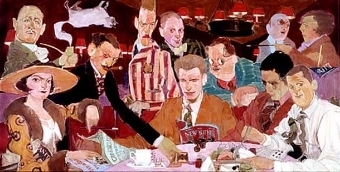
Even the Round Table moved west for "Ars Gratia Artis," they thought.
Fitzgerald is lured by his Algonquin pals to join them in the Garden of Allah, a hotel surrounded by a number of Villas. Here are Dorothy Parker and her husband of convenience whose sexuality lures him elsewhere than Dorothy's bed. There's S.J. Perelman, a host of others. Humphrey Bogart and girlfriend "Mayo" are intriguing companions. Surprisingly, Bogart finds Fitzgerald a swell fellow. Bogie's a literate man. He especially appreciates "Gatsby." However, the gang at the Garden are a great temptation to Scott. The booze flows freely during the parties around the pool. Sticking to Cokes is tough. Being on the wagon when nobody else is, well--that's a constant challenge.
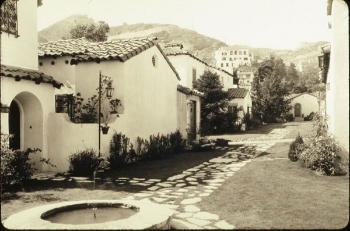
The Garden of Allah, 8152 Sunset Blvd., Hollywood, California
The studio is generous. Fitzgerald has a six month contract. The weekly checks finally begin to build up a balance in the bank account. Creditable projects come his way. However, Fitzgerald learns that this new Hollywood is a fickle thing. Projects that are spun with initial glowing press releases die quickly on the vine. They won't sell to the public. Fitzgerald draws paychecks for projects never completed.
Enter a beautiful young woman, Sheila Graham. Fitzgerald is fascinated. She bears a striking resemblance to the young Zelda. He wonders why no one can see that resemblance but him.
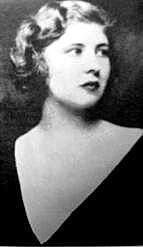
Sheila Graham, Fitzgerald's lost Zelda
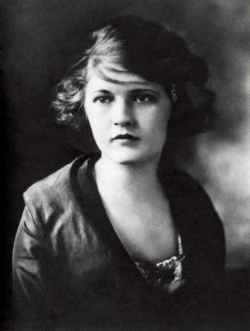
Zelda Sayre Fitzgerald, Yes, I can see the resemblance.
What ensues is an intense and complex love story. Graham is an enigma. Engaged to the Marquis of Donegal, Fitzgerald is curious why Graham continues to show interest in him. Her true history emerges in bed. Lots of skeletons rattle in Hollywood. She was born Lily Shiel, a child of the London slums, raised as a star of the burlesque stage in London, exhibiting her body to men who paid to see it. She had married an officer, John Graham, returning from the Great War. She said he was unable to consummate the marriage. She broke the engagement to the Marquis, terrified her past would be revealed.
She kept Fitzgerald at a distance. Especially as his failures as a screenwriter grew. His attempts at sobriety failed. She insisted on his taking "the Cure," an arduous, painful process. She moved him from "The Garden," first to Malibu, then to Encino, both "West of Sunset" Boulevard, the location of the Garden.
Scott's trips to visit Zelda also wore on the relationship. Scott was constantly riddled with guilt. Yet, they always returned to one another. Both had an irresistible carnal appetite for the other.
During his romance with Sheila, Scott continued to keep his promises to Zelda to spend vacations with her and to ensure visits to Zelda from their daughter Scottie. The relationship between Zelda and Scottie was a tempestuous one. Zelda, at times, was merciless in her criticism of Scottie, her appearance, lack of grace, and her resemblance to Scott as opposed to Zelda. Naturally, Scottie grew to where she attempted to avoid any visits with her mother. Scott mediated between the two of them, acting as the great appeaser, negotiating with each of them, assuring each of them that both loved one another. Scott introduced Scottie to Sheila. The two got along famously. Nor did Scottie condemn her father for seeking another relationship.
Fitzgerald was put on "Three Comrades" drawn from the novel by Erich Maria Remarque. It would be his only screen credit. Ernest Hemingway emerges to encourage Fitzgerald to use the film to warn the world to the growing danger of fascism. Fitzgerald's treatment is masterful, including shots of Hitler's diatribes, marching Nazis, flags and drums bearing swastikas. However, Mayer, has those scenes shot again, removing all overt scenes of Nazism removed from the picture at the insistence of a German cultural attache. Hooray for Hollywood.
O'Nan depicts Fitzgerald's spiraling Hollywood decline in unflinching, spare, lean prose. A contract unrenewed. Days as a freelance scriptwriter. Fitzgerald moved from project to project. Fitzgerald, uncredited, punching up dialogue for Vivien Leigh on Selznick's "Gone With the Wind." It is the last hurrah.
Yet, perhaps, Fitzgerald, banished from the Hollywood lot, is finally Fitzgerald's redemption as a writer. These are the days of the Pat Hobby stories, the stories of a drunk screenwriter in Hollywood. The days of the essays that become "The Crackup." And, finally, "The Love of the Last Tycoon." True. Bernice was long past bobbing her hair. Fitzgerald finally recognized that. He was a writer on the return, recognizing, finally, the Jazz Age was over. As always, one wonders what might have been. O'Nan helps us explore that question.
O'Nan captures not only the decline of an iconic American writer, but the decline of world civilization into the conflagration of the Second World War. As with O'Nan's other novels I have read, this is the work of an accomplished writer who immerses the reader in the lives and times of another era with the skill of a master. O'Nan is an author whose each work should be anticipated with the sense of excitement and new discovery. He never disappoints. West of Sunset is O'Nan's fifteenth novel. Highly recommended.
A copy of this novel was provided by Viking Adult through Netgalley in exchange for an honest review. This novel will be published January 13, 2015.
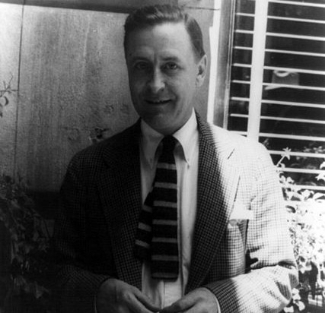
"There are no second acts in American lives," F.Scott Fitzgerald, found among his notes to his last, unfinished novel, The Love of the Last Tycoon.


Stewart O'Nan
Stewart O'Nan has written a compelling novel of the last years of F. Scott Fitzgerald and his years in Hollywood. Told in a series of episodes, both in the days of the "Golden Age of Hollywood" and in flashbacks of Fitzgerald's memories of his life during the Jazz Age with his Southern beauty, Zelda Sayre Fitzgerald, O'nan captures the portrait of a man who recognizes the passage of an era, whose literary works no longer hold the public's interest. Fitzgerald knows he is a man past his days of creativity. His marriage to Zelda is shattered by her madness. Years of hospitalization in the best private hospitals have bankrupted him. Their daughter, Scottie is due a proper education. Only the best prep school will do. The tuition is beyond his financial capability.
Fitzgerald is living beyond his financial means, drawing advances on stories unwritten. The novel promised to Max Perkins is a year past due, soon two years past due. Long time agent Harold Ober has not lost faith. He has become Fitzgerald's banker, loaning him money to keep him afloat. It is Ober who finds a slot for Fitzgerald at MGM Studios in Hollywood. It could be Fitzgerald's salvation or his undoing.
Fitzgerald knows that everyone is gambling on his staying sober. His alcoholism is at the root of his problems. Gin is at the root of his weakness. Seagram's. That's his brand.
Hollywood is at it's peak of creating the American dream. Fitzgerald's old friend Irving Thalberg is dead. L.B. Mayer has taken the helm and Fitzgerald joins a crew of elite writers who have hired on out west beneath the iconic Hollywood sign. Aldous Huxley has amazed with his script for "Pride and Prejudice." And Fitzgerald finds himself among many of the members of the Algonquin Round Table. Dottie Parker wistfully attempts to draw him into a tryst for old time's sake. But Fitzgerald resists, riddled with guilt, thinking of his long lost Zelda, back in Highland Hospital in Asheville, North Carolina.

Even the Round Table moved west for "Ars Gratia Artis," they thought.
Fitzgerald is lured by his Algonquin pals to join them in the Garden of Allah, a hotel surrounded by a number of Villas. Here are Dorothy Parker and her husband of convenience whose sexuality lures him elsewhere than Dorothy's bed. There's S.J. Perelman, a host of others. Humphrey Bogart and girlfriend "Mayo" are intriguing companions. Surprisingly, Bogart finds Fitzgerald a swell fellow. Bogie's a literate man. He especially appreciates "Gatsby." However, the gang at the Garden are a great temptation to Scott. The booze flows freely during the parties around the pool. Sticking to Cokes is tough. Being on the wagon when nobody else is, well--that's a constant challenge.

The Garden of Allah, 8152 Sunset Blvd., Hollywood, California
The studio is generous. Fitzgerald has a six month contract. The weekly checks finally begin to build up a balance in the bank account. Creditable projects come his way. However, Fitzgerald learns that this new Hollywood is a fickle thing. Projects that are spun with initial glowing press releases die quickly on the vine. They won't sell to the public. Fitzgerald draws paychecks for projects never completed.
Enter a beautiful young woman, Sheila Graham. Fitzgerald is fascinated. She bears a striking resemblance to the young Zelda. He wonders why no one can see that resemblance but him.

Sheila Graham, Fitzgerald's lost Zelda

Zelda Sayre Fitzgerald, Yes, I can see the resemblance.
What ensues is an intense and complex love story. Graham is an enigma. Engaged to the Marquis of Donegal, Fitzgerald is curious why Graham continues to show interest in him. Her true history emerges in bed. Lots of skeletons rattle in Hollywood. She was born Lily Shiel, a child of the London slums, raised as a star of the burlesque stage in London, exhibiting her body to men who paid to see it. She had married an officer, John Graham, returning from the Great War. She said he was unable to consummate the marriage. She broke the engagement to the Marquis, terrified her past would be revealed.
She kept Fitzgerald at a distance. Especially as his failures as a screenwriter grew. His attempts at sobriety failed. She insisted on his taking "the Cure," an arduous, painful process. She moved him from "The Garden," first to Malibu, then to Encino, both "West of Sunset" Boulevard, the location of the Garden.
Scott's trips to visit Zelda also wore on the relationship. Scott was constantly riddled with guilt. Yet, they always returned to one another. Both had an irresistible carnal appetite for the other.
During his romance with Sheila, Scott continued to keep his promises to Zelda to spend vacations with her and to ensure visits to Zelda from their daughter Scottie. The relationship between Zelda and Scottie was a tempestuous one. Zelda, at times, was merciless in her criticism of Scottie, her appearance, lack of grace, and her resemblance to Scott as opposed to Zelda. Naturally, Scottie grew to where she attempted to avoid any visits with her mother. Scott mediated between the two of them, acting as the great appeaser, negotiating with each of them, assuring each of them that both loved one another. Scott introduced Scottie to Sheila. The two got along famously. Nor did Scottie condemn her father for seeking another relationship.
Fitzgerald was put on "Three Comrades" drawn from the novel by Erich Maria Remarque. It would be his only screen credit. Ernest Hemingway emerges to encourage Fitzgerald to use the film to warn the world to the growing danger of fascism. Fitzgerald's treatment is masterful, including shots of Hitler's diatribes, marching Nazis, flags and drums bearing swastikas. However, Mayer, has those scenes shot again, removing all overt scenes of Nazism removed from the picture at the insistence of a German cultural attache. Hooray for Hollywood.
O'Nan depicts Fitzgerald's spiraling Hollywood decline in unflinching, spare, lean prose. A contract unrenewed. Days as a freelance scriptwriter. Fitzgerald moved from project to project. Fitzgerald, uncredited, punching up dialogue for Vivien Leigh on Selznick's "Gone With the Wind." It is the last hurrah.
Yet, perhaps, Fitzgerald, banished from the Hollywood lot, is finally Fitzgerald's redemption as a writer. These are the days of the Pat Hobby stories, the stories of a drunk screenwriter in Hollywood. The days of the essays that become "The Crackup." And, finally, "The Love of the Last Tycoon." True. Bernice was long past bobbing her hair. Fitzgerald finally recognized that. He was a writer on the return, recognizing, finally, the Jazz Age was over. As always, one wonders what might have been. O'Nan helps us explore that question.
O'Nan captures not only the decline of an iconic American writer, but the decline of world civilization into the conflagration of the Second World War. As with O'Nan's other novels I have read, this is the work of an accomplished writer who immerses the reader in the lives and times of another era with the skill of a master. O'Nan is an author whose each work should be anticipated with the sense of excitement and new discovery. He never disappoints. West of Sunset is O'Nan's fifteenth novel. Highly recommended.

November 7, 2014
I love The Great Gatsby. In fact, it is probably my all-time favorite book. I also enjoyed Fitzgerald 's other works so I could not resist the chance to read O'Nan's fictionalized account of Fitzgerald's time in Hollywood as a screenwriter during the last few years of his life . The writing is really very good - I can almost see Fitzgerald at this resort hotel in Ashville and then with Zelda on the excursion to celebrate their anniversary. This is a down and out time in their lives - Zelda in a mental hospital and Scott in financial trouble and trying to stay sober. So he goes to Hollywood out of financial necessity.
It's sometimes a problem for me when reading someone's imagined account of the life of a real person. What's true? What's not? From what I know , O'Nan certainly has captured some of the truth - the tumultuous marriage of Scott and Zelda reflected in references to the past , Zelda 's mental health issues and time at an asylum , Scott 's battle with alcohol and his relationship with gossip columnist , Sheilah Graham .
The author did a great job of depicting the time and the place. We meet Bogie, Joan Crawford, Dorothy Parker, Myna Loy and other Hollywood personalities. It was fun to imagine that these conversations might have taken place. The decadence of the Hollywood life with the parties and heavy drinking and the cut throat, back stabbing atmosphere of the studios rang true.
While hard to condone the affair with Graham, while Zelda was in the asylum, the time in Hollywood was tough for Fitzgerald - trying to make a living, being moved from script to script, barely getting contract renewals, struggling with alcoholism and heart problems. I thought that O'Nan beautifully told the story of a great writer with all of his flaws.
Thanks to PENGUIN GROUP Viking and NetGalley.

November 17, 2016
West of Sunset by Stewart O’Nan is a 2015 Viking publication.
Fans of F. Scott Fitzgerald or those who enjoy tales centered around old Hollywood will find this to be an interesting and poignant read.
The story is pretty gloomy, as the last years of Fitzgerald’s life in Hollywood is fictionalized. Zelda is in an institution suffering through good and bad days, but mostly unable to cope in the outside world for extended periods of time. Fitzgerald is broke and in desperate need of cash in order to keep Zelda in a reputable hospital and see his daughter educated.
Which is how he ended up in Hollywood writing screenplays with unbalanced success. He meets a gossip columnist and begins a relationship with her, as he struggles with his guilt over Zelda, his daughter, and with his drinking and drug issues.
Ultimately, this is a sad tale, but does give the reader a different perspective of Fitzgerald during those Hollywood years. He did make an honest effort at writing screenplays, but Hollywood is often fickle and his plays were often rejected, or instantly forgotten.
The name dropping was interesting, too, and will appeal to those who like stories set in Hollywood and centered around the era of Myrna Loy, Humphrey Bogart, and Joan Crawford.
The story is a little slow moving, but does paint a plausible portrait of Fitzgerald’s sad and conflicted final days.
Overall, this was an okay read, but a little depressing.
3.5 stars
Fans of F. Scott Fitzgerald or those who enjoy tales centered around old Hollywood will find this to be an interesting and poignant read.
The story is pretty gloomy, as the last years of Fitzgerald’s life in Hollywood is fictionalized. Zelda is in an institution suffering through good and bad days, but mostly unable to cope in the outside world for extended periods of time. Fitzgerald is broke and in desperate need of cash in order to keep Zelda in a reputable hospital and see his daughter educated.
Which is how he ended up in Hollywood writing screenplays with unbalanced success. He meets a gossip columnist and begins a relationship with her, as he struggles with his guilt over Zelda, his daughter, and with his drinking and drug issues.
Ultimately, this is a sad tale, but does give the reader a different perspective of Fitzgerald during those Hollywood years. He did make an honest effort at writing screenplays, but Hollywood is often fickle and his plays were often rejected, or instantly forgotten.
The name dropping was interesting, too, and will appeal to those who like stories set in Hollywood and centered around the era of Myrna Loy, Humphrey Bogart, and Joan Crawford.
The story is a little slow moving, but does paint a plausible portrait of Fitzgerald’s sad and conflicted final days.
Overall, this was an okay read, but a little depressing.
3.5 stars

April 26, 2022
Shorter reviews coming!!!!
Or few sentences… with an honest rating!
Excellent written blurb
Stewart O’Nan did this story justice …
“O’Nan” was the ‘man’ to write this deeply absorbing story —
but it’s soooo sad!!!
Sad ending too!!!!
Old Hollywood it is!
… but ‘not’ the ‘happy-go-lucky’ flapper era….
Horrible alcohol abuse, ‘coke’ and ‘chocolate’ diet, tuberculosis (as my own dad had before I was born- then died at age 34 - when I was 4, in Oakland, Ca.)….
other devastating demons….
mental illness,
struggles to get work, financial struggles, tragedy upon tragedy!
Lots of ‘star’ name dropping ..
As if Scott Fitzgerald and Zelda wasn’t enough!
A great writer makes all the difference ….
In LOVE with Stewart O’Nan
Or few sentences… with an honest rating!
Excellent written blurb
Stewart O’Nan did this story justice …
“O’Nan” was the ‘man’ to write this deeply absorbing story —
but it’s soooo sad!!!
Sad ending too!!!!
Old Hollywood it is!
… but ‘not’ the ‘happy-go-lucky’ flapper era….
Horrible alcohol abuse, ‘coke’ and ‘chocolate’ diet, tuberculosis (as my own dad had before I was born- then died at age 34 - when I was 4, in Oakland, Ca.)….
other devastating demons….
mental illness,
struggles to get work, financial struggles, tragedy upon tragedy!
Lots of ‘star’ name dropping ..
As if Scott Fitzgerald and Zelda wasn’t enough!
A great writer makes all the difference ….
In LOVE with Stewart O’Nan

August 8, 2017
"So we beat on, boats against the current,
borne back ceaselessly into the past."
-last line from the novel,
'The Great Gatsby' by F. Scott Fitzgerald
I have never been a fan of F. Scott Fitzgerald, although I admit that I have read only two of his novels.... 'The Great Gatsby' and 'Tender is the Night'. Perhaps it would be fairer to say that I look at the 1920s (the time period Fitzgerald writes about in some of his novels) with distaste and disgust. Other than the introduction of jazz into the culture, I view the 1920s as symbolic of all that I dislike about society at that time... the excesses, greed and the huge inequality present among the social classes. However, I DO like the writing of Stewart O'Nan. I have been working my way through his novels and even though I had my doubts about the appeal of this one, 'West of Sunset', I decided to read it anyway. Perhaps it is due to Stewart O'Nan's expert storytelling but what I found was an engaging and compulsively readable story.. the story of a tragic figure, trying his best to come to terms with consequences of his own poor decisions, trying to find a way to take care of his obligations to his family and wrestling with the reality that he had moved beyond his creative peak.
This story, 'West of Sunset' is a fictional account of the last several years in the life of F. Scott Fitzgerald.. a period from 1937-1940. The opening scene sets the mood for the entire book... a mood of sadness, bewilderment and desperation... and maybe just a little hope. The reader's first experience with Scott Fitzgerald is his arrival at the Highland Hospital in North Carolina.. the mental hospital where his wife Zelda has been residing to treat her continuing emotional problems. Scott had been given permission to take Zelda on an outing for the day to celebrate their 17th wedding anniversary. This beautifully heartbreaking scene evoked so many feelings... feelings of longing and nostalgia for better times, regret, sadness and weariness. Sitting beside Zelda in the car, Scott thought.... "In her twenties, baby faced and petite, she's seemed girlish. She'd been an athlete and a dancer, a notorious flirt, her stamina and fearlessness irresistible. Now, just shy of thirty-seven, she was pinched and haggard, cronelike, her smile ruined by a broken tooth. Some well-meaning soul had fixed her hair for the occasion.. one (a style) she would never choose, especially since it made her face even sharper, hawkish." Although Scott and Zelda had been married for 17 years, they had been living apart for a long time, both trying to deal with Zelda's emotional issues. Scott, in a moment of self-awareness, questioned whether it was this very unpredictability and volatility characterizing Zelda's emotional state that had attracted him from the beginning...... "As his wife, she'd now been hospitalized as long as not and in fitful moments the question of whether she's been mad all along and he had been attracted to that madness unsettled him."
Not only was Scott Fitzgerald dealing with his wife's mental illness and their forced separation as husband and wife, but he was also trying to cope with his own health problems... recurrent bouts of pneumonia which he was sure was a result of his having contracted tuberculosis years before, heart problems and of course alcoholism. His fondness for gin had caused many problems in his life.. in his marriage and his inability to write. Because of this problem, he was finding it difficult to make a living. He had earned the reputation as being unreliable to publishers and yet, he needed money desperately for Zelda's continued care, boarding school expenses for their daughter, Scottie and of course, his own living expenses. Scott Fitzgerald was a man under a great deal of strain and pressure.
Finally, his agent Harold Ober managed to talk MGM Studios in Hollywood into giving him a chance at writing movie scripts. At this time Scott also had an idea for a new novel.... one that would be his last and left unfinished at his death. Scott had people depending on him. He had no money and he hoped the script writing would allow him to meet his obligations. So in 1937, Scott Fitzgerald boarded a train and headed west.
Once in Hollywood, Scott was determined to stay sober. He was aware that everyone was skeptical that he could and they were expecting him to fail. At first, he did well. He arose early each morning, filled his briefcase with Coca Colas and went to his office. He started early... first working on his novel and various short stories, some which sold, some which were rejected. He then joined the writing team to work on movie scripts; but it didn't take long for him to become frustrated. Hollywood, being what it was, was often fickle and a script he was working on one day might be abandoned for unknown reasons the next. The work was unfulfilling and he was lonely.
Scott met up with some old friends in Hollywood... Dorothy Parker and her husband, Marlon Brando and his girlfriend and of course, Ernest Hemingway. Scott was convinced to move to Dorothy Parker's hotel.. the Garden of Allah and immediately he was pulled back into his old habits. The alcohol flowed freely and often. One night at a party, Scott saw a woman across the room.. a woman whose resemblance to a young Zelda, took his breath away and he became obsessed with her. The woman, a gossip columnist, was hiding a particularly colorful past she had left behind in London but Scott pursued her and the two fell in love. Ultimately though, the love affair would become just one more thing which added to the pressures and complications of Scott Fitzgerald's life.
This story, based partly on fact and partly on imagination, contained all the elements of an American tragedy...one that played out against the backdrop of the glamorous facade of old Hollywood. Scott Fitzgerald, weary in body and spirit, was trying desperately to hold his crumbling life together. He climbed onto and fell off the wagon of sobriety so many times I lost count and yet the strangest thing happened... even though I was aware that many of Scott's problems were of his own making, I couldn't help but root for him and hope that he could finally pull himself together. I have never been a fan of F. Scott Fitzgerald's writing but Stewart O'Nan created a story which allowed me to see the humanity of not only the writer but the person. Like many others, Fitzgerald was a slave to his vices and his demons and despite all evidence to the contrary, he doggedly pursued that ever elusive dream of fame and fortune in Hollywood. The dream never did materialize for him there and yet I couldn't help but admire his tenacity. I still don't think I would read more novels or short stories written by Fitzgerald; but after reading this book, I don't believe I will ever think of him in quite the same way I used to.
borne back ceaselessly into the past."
-last line from the novel,
'The Great Gatsby' by F. Scott Fitzgerald
I have never been a fan of F. Scott Fitzgerald, although I admit that I have read only two of his novels.... 'The Great Gatsby' and 'Tender is the Night'. Perhaps it would be fairer to say that I look at the 1920s (the time period Fitzgerald writes about in some of his novels) with distaste and disgust. Other than the introduction of jazz into the culture, I view the 1920s as symbolic of all that I dislike about society at that time... the excesses, greed and the huge inequality present among the social classes. However, I DO like the writing of Stewart O'Nan. I have been working my way through his novels and even though I had my doubts about the appeal of this one, 'West of Sunset', I decided to read it anyway. Perhaps it is due to Stewart O'Nan's expert storytelling but what I found was an engaging and compulsively readable story.. the story of a tragic figure, trying his best to come to terms with consequences of his own poor decisions, trying to find a way to take care of his obligations to his family and wrestling with the reality that he had moved beyond his creative peak.
This story, 'West of Sunset' is a fictional account of the last several years in the life of F. Scott Fitzgerald.. a period from 1937-1940. The opening scene sets the mood for the entire book... a mood of sadness, bewilderment and desperation... and maybe just a little hope. The reader's first experience with Scott Fitzgerald is his arrival at the Highland Hospital in North Carolina.. the mental hospital where his wife Zelda has been residing to treat her continuing emotional problems. Scott had been given permission to take Zelda on an outing for the day to celebrate their 17th wedding anniversary. This beautifully heartbreaking scene evoked so many feelings... feelings of longing and nostalgia for better times, regret, sadness and weariness. Sitting beside Zelda in the car, Scott thought.... "In her twenties, baby faced and petite, she's seemed girlish. She'd been an athlete and a dancer, a notorious flirt, her stamina and fearlessness irresistible. Now, just shy of thirty-seven, she was pinched and haggard, cronelike, her smile ruined by a broken tooth. Some well-meaning soul had fixed her hair for the occasion.. one (a style) she would never choose, especially since it made her face even sharper, hawkish." Although Scott and Zelda had been married for 17 years, they had been living apart for a long time, both trying to deal with Zelda's emotional issues. Scott, in a moment of self-awareness, questioned whether it was this very unpredictability and volatility characterizing Zelda's emotional state that had attracted him from the beginning...... "As his wife, she'd now been hospitalized as long as not and in fitful moments the question of whether she's been mad all along and he had been attracted to that madness unsettled him."
Not only was Scott Fitzgerald dealing with his wife's mental illness and their forced separation as husband and wife, but he was also trying to cope with his own health problems... recurrent bouts of pneumonia which he was sure was a result of his having contracted tuberculosis years before, heart problems and of course alcoholism. His fondness for gin had caused many problems in his life.. in his marriage and his inability to write. Because of this problem, he was finding it difficult to make a living. He had earned the reputation as being unreliable to publishers and yet, he needed money desperately for Zelda's continued care, boarding school expenses for their daughter, Scottie and of course, his own living expenses. Scott Fitzgerald was a man under a great deal of strain and pressure.
Finally, his agent Harold Ober managed to talk MGM Studios in Hollywood into giving him a chance at writing movie scripts. At this time Scott also had an idea for a new novel.... one that would be his last and left unfinished at his death. Scott had people depending on him. He had no money and he hoped the script writing would allow him to meet his obligations. So in 1937, Scott Fitzgerald boarded a train and headed west.
Once in Hollywood, Scott was determined to stay sober. He was aware that everyone was skeptical that he could and they were expecting him to fail. At first, he did well. He arose early each morning, filled his briefcase with Coca Colas and went to his office. He started early... first working on his novel and various short stories, some which sold, some which were rejected. He then joined the writing team to work on movie scripts; but it didn't take long for him to become frustrated. Hollywood, being what it was, was often fickle and a script he was working on one day might be abandoned for unknown reasons the next. The work was unfulfilling and he was lonely.
Scott met up with some old friends in Hollywood... Dorothy Parker and her husband, Marlon Brando and his girlfriend and of course, Ernest Hemingway. Scott was convinced to move to Dorothy Parker's hotel.. the Garden of Allah and immediately he was pulled back into his old habits. The alcohol flowed freely and often. One night at a party, Scott saw a woman across the room.. a woman whose resemblance to a young Zelda, took his breath away and he became obsessed with her. The woman, a gossip columnist, was hiding a particularly colorful past she had left behind in London but Scott pursued her and the two fell in love. Ultimately though, the love affair would become just one more thing which added to the pressures and complications of Scott Fitzgerald's life.
This story, based partly on fact and partly on imagination, contained all the elements of an American tragedy...one that played out against the backdrop of the glamorous facade of old Hollywood. Scott Fitzgerald, weary in body and spirit, was trying desperately to hold his crumbling life together. He climbed onto and fell off the wagon of sobriety so many times I lost count and yet the strangest thing happened... even though I was aware that many of Scott's problems were of his own making, I couldn't help but root for him and hope that he could finally pull himself together. I have never been a fan of F. Scott Fitzgerald's writing but Stewart O'Nan created a story which allowed me to see the humanity of not only the writer but the person. Like many others, Fitzgerald was a slave to his vices and his demons and despite all evidence to the contrary, he doggedly pursued that ever elusive dream of fame and fortune in Hollywood. The dream never did materialize for him there and yet I couldn't help but admire his tenacity. I still don't think I would read more novels or short stories written by Fitzgerald; but after reading this book, I don't believe I will ever think of him in quite the same way I used to.

December 3, 2014
F. Scott Fitzgerald has been canonized as one of the greatest American writers of the 20th century. His oeuvre is not that large (for example, compared to rival Ernest Hemingway)--his 44 years on the planet came and went like a flash in the Jazz Age pan, his glamorized life with Zelda mythologized almost more than his solo presence. When I think of Fitzgerald, I think of Gatsby. How not? But O'Nan captures the screenwriting Fitzgerald, the scenarist whose work in Hollywood is largely unnoticed.
This fictionalized bio of Scott's years from 1937-1940 focus on his failing health, his waning status, and the final, declining years living in Hollywood, apart from his wife, Zelda, who was institutionalized for bipolar disorder. His visits with Zelda and his daughter, Scottie, were spare, usually during Xmas season. He clung to his few friends and even less work, while battling with alcohol and living on amphetamines and a briefcase of Cokes. His affair with gossip columnist Sheilah Graham was presented with pathos and nuance, a volatile pairing at best. O'Nan captures the melancholy atmosphere and the era quite capably, the Hollywood Golden Age, burnished in some ways, tarnished in others. O'Nan also subtly envelopes the irony of producing the flashy glitz of shallow romance/war movies at a time when Hitler was on the rise and the harrowing truth of Germany's power was minimized by Hollywood.
Although the author is now immortalized, his bright light was diminishing in the years before his death, and he had very few friends he could count on, and was frequently in debt. We are introduced to the weak and desolate figure of the writer and husband/father, captive to his addictions and ill-health, divided by his needs and desires. The fraught characterizations of F. Scott, Zelda, and Sheilah Graham were spot-on, but the Hollywood set, like Bogie, L.B. Mayer, Selznick, Dorothy Parker, and others, were more like set decoration, well-placed for artistic design, but flattened and sprinkled for effect. Fitzgerald also referred to Hemingway, but Ernest was always offstage. This isn't a book for lovers of the flickering, fleeting Lost Generation. It is a peek into the charred last years of Fitzgerald, his battle with writing, at war with his demons.
On Tom Wolfe's death: "I envied his powers, as I envy Ernest's, knowing they're not mine. I like to think the three of us...were after what might be called the American soul."
I found this book to be a bit flat and dry in places, but I commend O'Nan for creating a peek into Fitzgerald's soul at the end of his life, tattered though it was. It is hard to believe that this literary giant was merely a malingering has-been when he died. Like Melville, history revised and electrified him, but that was later. This novelized version of F. Scott's last few years is a somber story of a frustrated, compulsive, and nostalgic man.
This fictionalized bio of Scott's years from 1937-1940 focus on his failing health, his waning status, and the final, declining years living in Hollywood, apart from his wife, Zelda, who was institutionalized for bipolar disorder. His visits with Zelda and his daughter, Scottie, were spare, usually during Xmas season. He clung to his few friends and even less work, while battling with alcohol and living on amphetamines and a briefcase of Cokes. His affair with gossip columnist Sheilah Graham was presented with pathos and nuance, a volatile pairing at best. O'Nan captures the melancholy atmosphere and the era quite capably, the Hollywood Golden Age, burnished in some ways, tarnished in others. O'Nan also subtly envelopes the irony of producing the flashy glitz of shallow romance/war movies at a time when Hitler was on the rise and the harrowing truth of Germany's power was minimized by Hollywood.
Although the author is now immortalized, his bright light was diminishing in the years before his death, and he had very few friends he could count on, and was frequently in debt. We are introduced to the weak and desolate figure of the writer and husband/father, captive to his addictions and ill-health, divided by his needs and desires. The fraught characterizations of F. Scott, Zelda, and Sheilah Graham were spot-on, but the Hollywood set, like Bogie, L.B. Mayer, Selznick, Dorothy Parker, and others, were more like set decoration, well-placed for artistic design, but flattened and sprinkled for effect. Fitzgerald also referred to Hemingway, but Ernest was always offstage. This isn't a book for lovers of the flickering, fleeting Lost Generation. It is a peek into the charred last years of Fitzgerald, his battle with writing, at war with his demons.
On Tom Wolfe's death: "I envied his powers, as I envy Ernest's, knowing they're not mine. I like to think the three of us...were after what might be called the American soul."
I found this book to be a bit flat and dry in places, but I commend O'Nan for creating a peek into Fitzgerald's soul at the end of his life, tattered though it was. It is hard to believe that this literary giant was merely a malingering has-been when he died. Like Melville, history revised and electrified him, but that was later. This novelized version of F. Scott's last few years is a somber story of a frustrated, compulsive, and nostalgic man.

November 14, 2014
I think everyone (except maybe my boyfriend) goes through a period in their lives where they are completely fascinated by F. Scott and Zelda Fitzgerald. At least many of the people I've known. They were a fascinating duo at a fascinating time in American history. O'Nan's story is about the Fitzgeralds, primarily Scott, over the last three years of his life with the occasional flashback. In the late 1930s, Scott is in California working at MGM studios and Zelda is back East confined to a mental hospital where she would ultimately die in a horrific fire (not detailed in this story).
The story is told from Scott's point of view with occasional flashbacks to help flesh out the backstory to his life and relationship with Zelda and their daughter, Scottie. He is in a tough position at this point, holding onto a lot of guilt for not being able to keep his family together, and also for carrying on an affair in California behind Zelda's back.
I'm not usually a fan of this sort of historical fiction because I have a hard time suspending belief and always get caught up in the authenticity of a story and find a lot of dialogue in these sorts of stories hard to believe. I didn't have that issue here. My biggest concern that it would be a very name-droppy story as there are references to a lot of other big names: Hemingway, Bogart, Dorothy Parker, Marlene Dietrich, Katherine Hepburn, etc. But it occurred to me that of course the story would feel name-droppy - it was a very name-droppy period in the very name-droppy Hollywood. It felt authentic and not at all forced or awkward, which I appreciated.
The dialogue itself was also convincing. Scott referred to daughter Scottie as Pie, and O'Nan includes the pet name throughout the story. I felt a connection to Scott, and actually felt sympathy for him which is not something I've ever really felt before.
This book has made me interested again in the Scott and Zelda story, and I've pulled a few books out of my stacks to read very soon, Zelda Fitzgerald: Her Voice in Paradise and Sometimes Madness Is Wisdom: Zelda and Scott Fitzgerald: A Marriage. I swore I had a collection of their letters as well, so I'll keep digging to see if I can unearth it. I appear to be starting on a Lost Generation kick since my book club is reading Hemingway's A Moveable Feast this month. Love when these sorts of connections come together in my reading.
I came across 16 Things F. Scott Fitzgerald Doesn't Want You to Worry About while thinking of what to say in my review here. It's part of a letter from Scott to Scottie when she was away at camp when she was 11 years old, but it's still relevant advice to anyone now. Especially the part about not worrying about dolls.
The story is told from Scott's point of view with occasional flashbacks to help flesh out the backstory to his life and relationship with Zelda and their daughter, Scottie. He is in a tough position at this point, holding onto a lot of guilt for not being able to keep his family together, and also for carrying on an affair in California behind Zelda's back.
I'm not usually a fan of this sort of historical fiction because I have a hard time suspending belief and always get caught up in the authenticity of a story and find a lot of dialogue in these sorts of stories hard to believe. I didn't have that issue here. My biggest concern that it would be a very name-droppy story as there are references to a lot of other big names: Hemingway, Bogart, Dorothy Parker, Marlene Dietrich, Katherine Hepburn, etc. But it occurred to me that of course the story would feel name-droppy - it was a very name-droppy period in the very name-droppy Hollywood. It felt authentic and not at all forced or awkward, which I appreciated.
The dialogue itself was also convincing. Scott referred to daughter Scottie as Pie, and O'Nan includes the pet name throughout the story. I felt a connection to Scott, and actually felt sympathy for him which is not something I've ever really felt before.
This book has made me interested again in the Scott and Zelda story, and I've pulled a few books out of my stacks to read very soon, Zelda Fitzgerald: Her Voice in Paradise and Sometimes Madness Is Wisdom: Zelda and Scott Fitzgerald: A Marriage. I swore I had a collection of their letters as well, so I'll keep digging to see if I can unearth it. I appear to be starting on a Lost Generation kick since my book club is reading Hemingway's A Moveable Feast this month. Love when these sorts of connections come together in my reading.
I came across 16 Things F. Scott Fitzgerald Doesn't Want You to Worry About while thinking of what to say in my review here. It's part of a letter from Scott to Scottie when she was away at camp when she was 11 years old, but it's still relevant advice to anyone now. Especially the part about not worrying about dolls.

October 12, 2014
This book is a novelization of F. Scott Fitzgerald's final years as he struggled to make a living as a screenwriter in Hollywood in the late 1930's in order to pay for his daughter's education and his wife Zelda's prolonged stay in a mental hospital. During this period he also fell in love with Sheila Graham. The depiction of life in Hollywood at this time, particularly the precarious careers of screenwriters, was very interesting. Scott faced many demons, including Zelda's illness and his own alcohol abuse, tuberculosis and heart disease, as well as his stalled career. He was a complicated man who tried to do his best and his story is really poignant.
I did not love this book immediately. There was so much name dropping, and Scott's pursuit of Sheila felt stalkerish and weird. However the cumulative impact of the book was quite affecting. Even though I knew the story of Scott and Zelda, I kept wishing he could have a happier ending. It was a very well written book that made it easy to empathize with Scott. I really enjoyed the book.
I received a free copy of this book from the publisher.
I did not love this book immediately. There was so much name dropping, and Scott's pursuit of Sheila felt stalkerish and weird. However the cumulative impact of the book was quite affecting. Even though I knew the story of Scott and Zelda, I kept wishing he could have a happier ending. It was a very well written book that made it easy to empathize with Scott. I really enjoyed the book.
I received a free copy of this book from the publisher.

July 14, 2014
3.5 I knew very little of Fitzgerald's personal life outside of his and Zelda's relationship so I have no basis for comparison. O'Nan did a fantastic job portraying Hollywood, all the drinking and parties, of this time period. Also thought he did a great job showing how responsible he felt for Zelda's welfare and his daughter's happiness. His relationship with Sheilah seemed to bring him little joy and much guilt. I think that is what threw me off in this novel, the tone basically stayed the same. Although highs and lows were written, it was more a tell me instead of a show me. I actually felt little emotion. So I liked it, loved learning more of this famous author's life. I think I just wanted a little more emotional connection to the story.
ARC from publisher.
ARC from publisher.

December 29, 2020
1.5 Stars and rounding up because I’m feeling generous. I really enjoyed the other book I read by this author (Last Night at the Lobster) but holy crap was this a snoozer! Focusing on the last years of an interesting character in American history’s life where his success had waned and worked a dreary 9-5 and barely even mentioning the Hollywood royalty he was surrounded by was certainly an interesting choice. Unfortunately it did not work at all for me and was a slog to get through 🙁

October 29, 2020
Covering the years 1937-1940, this book takes readers back in time to a lesser known period in F. Scott Fitzgerald’s life – his time in Hollywood as a screen writer. At this point in his life, Fitzgerald’s heyday is behind him. His wife, Zelda, suffering from schizophrenia, is confined to a North Carolina sanitarium. Their teenage daughter, Scottie, resides in an east coast boarding school. We follow his life as he develops a relationship with columnist Sheilah Graham, interacts with various famous people (stars and fellow writers), travels to visit Zelda and Scottie, and struggles with alcoholism.
This book is definitely not cheery but seems realistic. The novel conveys Fitzgerald’s increasing frustration with the never-ending changes of Hollywood scripts without the scriptwriter’s knowledge. It seems an author of his talent is not appreciated due to the need to meet popular tastes and the censor’s rules.
O’Nan has created a nuanced and believable story of a man whose life is in decline but has not given up. He is still writing, pursuing projects, and working hard when he is not self-sabotaging with alcohol. I particularly liked the interactions between Scott and Zelda, portraying their deep connection while also showing how the relationship has eroded due, in part, to her mental illness and his alcoholism.
The strength of the novel lies in the author’s ability to get into Fitzgerald’s head. O’Nan succeeds in illuminating his thoughts, motives, and attitudes in a convincing manner. Though the tone is melancholy, I enjoyed this glimpse into Fitzgerald’s work, family, and relationships near the end of his life.
This book is definitely not cheery but seems realistic. The novel conveys Fitzgerald’s increasing frustration with the never-ending changes of Hollywood scripts without the scriptwriter’s knowledge. It seems an author of his talent is not appreciated due to the need to meet popular tastes and the censor’s rules.
O’Nan has created a nuanced and believable story of a man whose life is in decline but has not given up. He is still writing, pursuing projects, and working hard when he is not self-sabotaging with alcohol. I particularly liked the interactions between Scott and Zelda, portraying their deep connection while also showing how the relationship has eroded due, in part, to her mental illness and his alcoholism.
The strength of the novel lies in the author’s ability to get into Fitzgerald’s head. O’Nan succeeds in illuminating his thoughts, motives, and attitudes in a convincing manner. Though the tone is melancholy, I enjoyed this glimpse into Fitzgerald’s work, family, and relationships near the end of his life.

October 6, 2014
First, a big thanks to Gooodreads FirstReads and the publisher for enabling me to be an early readers.
When most of us think of F. Scott Fitzgerald, we remember him as a literary legend: the creator of the Great Gatsby, part of the glittering Scott-and-Zelda duo, full of shimmer and promise.
In this latest book, Stewart O’Nan introduces us to Fitgerald-as-outsider: “a poor boy from a rich neighborhood, a scholarship kid at boarding school, a Midwestern in the East, an easterner out West.”
Daringly, he recreates and re-imagines the Hollywood years, striving to support his increasingly estranged wife Zelda who is in a sanitarium and his daughter Scottie (“Pie”) who, away at a pricey boarding school, is the tenuous link between her parents.
Mr. O’Nan has obviously done his research: the love affair with the irrepressible and ambitious Sheilah Graham, the friendships with Bogie and Mayo (yes, THAT Bogie!), the stints as a writer during the great screen era (who would have thought that Fitzgerald wrote briefly for the Gone with the Wind script!), the drunken adventures with the scion of the head of Paramount, the rivalry with Ernest Hemingway, the shared spaces with Aldous Huxley and other literary greats.
A book like this will inevitably open up the age-old debate: is it fair for one of today’s writers to mesh his own fictional voice with the voice of an iconic writer? Should fiction ever impinge upon fact? I am of the mind that the writer should have free rein to imagine, as long as he labels his work fiction and not biography.
Stewart O’Nan wisely does not try to capture F. Scott Fitzgerald’s voice but he does capture the sense of futility that haunted him at the end of his days. And he also captures the ruthlessness that defined Hollywood in that era. In places, I found O’Nan’s book to be spellbinding in its mission to summon the spirit of F. Scott Fitzgerald. As long as the reader approaches the book with the realization that this is fiction-based-on-facts, it’s a very compelling read.
When most of us think of F. Scott Fitzgerald, we remember him as a literary legend: the creator of the Great Gatsby, part of the glittering Scott-and-Zelda duo, full of shimmer and promise.
In this latest book, Stewart O’Nan introduces us to Fitgerald-as-outsider: “a poor boy from a rich neighborhood, a scholarship kid at boarding school, a Midwestern in the East, an easterner out West.”
Daringly, he recreates and re-imagines the Hollywood years, striving to support his increasingly estranged wife Zelda who is in a sanitarium and his daughter Scottie (“Pie”) who, away at a pricey boarding school, is the tenuous link between her parents.
Mr. O’Nan has obviously done his research: the love affair with the irrepressible and ambitious Sheilah Graham, the friendships with Bogie and Mayo (yes, THAT Bogie!), the stints as a writer during the great screen era (who would have thought that Fitzgerald wrote briefly for the Gone with the Wind script!), the drunken adventures with the scion of the head of Paramount, the rivalry with Ernest Hemingway, the shared spaces with Aldous Huxley and other literary greats.
A book like this will inevitably open up the age-old debate: is it fair for one of today’s writers to mesh his own fictional voice with the voice of an iconic writer? Should fiction ever impinge upon fact? I am of the mind that the writer should have free rein to imagine, as long as he labels his work fiction and not biography.
Stewart O’Nan wisely does not try to capture F. Scott Fitzgerald’s voice but he does capture the sense of futility that haunted him at the end of his days. And he also captures the ruthlessness that defined Hollywood in that era. In places, I found O’Nan’s book to be spellbinding in its mission to summon the spirit of F. Scott Fitzgerald. As long as the reader approaches the book with the realization that this is fiction-based-on-facts, it’s a very compelling read.

October 23, 2014
Full disclosure: I love about 95% of Stewart O'Nan's works, fiction and non-fiction; I think he is a terrific writer and researcher and I'm always eager to read his latest offering. Further disclosure: I'm "Meh" on F. Scott Fitzgerald; in particular, I think "The Great Gatsby" is supremely over-rated.
So how would I like O'Nan's novelization of the last few years of Fitzgerald's life in his new book, "West of Sunset"? Well, I loved it! O'Nan really pulled me right into the late 1930s Hollywood scene. I was fascinated by the descriptions of how the studios worked in those days, and as a "classic" film enthusiast, it was particularly interesting to read arcane bits about many of the films I've seen over the years.
I was particularly intrigued by the insider-look at how screenwriting was accomplished; when O'Nan observes that in the 1930s "...the collaborative process was a case of the narrowest majority agreeing on the broadest effects to please the widest audience", I can't help but think that times haven't changed! This peek at "how the sausage is made" is going to interest any reader who has ever wondered how stories get mangled from the page to the screen.
Depicting Fitzgerald's relationship with his wife, Zelda, O'Nan provides a sadly touching portrait of the struggles that still face people with mental illness and their families. Fitzgerald's late years filled me with both sadness and admiration for the light that was fading.
Throughout the story, O'Nan very realistically imagines how Fitzgerald may have conceived his final (unfinished) novel, "The Last Tycoon". As an accomplished and prolific author himself, O'Nan certainly has personal experience to bring to this tale of a writer's life; his struggles, demons, frustrations and joys.
O'Nan captivated me yet again, AND taught me some new things in the process!
So how would I like O'Nan's novelization of the last few years of Fitzgerald's life in his new book, "West of Sunset"? Well, I loved it! O'Nan really pulled me right into the late 1930s Hollywood scene. I was fascinated by the descriptions of how the studios worked in those days, and as a "classic" film enthusiast, it was particularly interesting to read arcane bits about many of the films I've seen over the years.
I was particularly intrigued by the insider-look at how screenwriting was accomplished; when O'Nan observes that in the 1930s "...the collaborative process was a case of the narrowest majority agreeing on the broadest effects to please the widest audience", I can't help but think that times haven't changed! This peek at "how the sausage is made" is going to interest any reader who has ever wondered how stories get mangled from the page to the screen.
Depicting Fitzgerald's relationship with his wife, Zelda, O'Nan provides a sadly touching portrait of the struggles that still face people with mental illness and their families. Fitzgerald's late years filled me with both sadness and admiration for the light that was fading.
Throughout the story, O'Nan very realistically imagines how Fitzgerald may have conceived his final (unfinished) novel, "The Last Tycoon". As an accomplished and prolific author himself, O'Nan certainly has personal experience to bring to this tale of a writer's life; his struggles, demons, frustrations and joys.
O'Nan captivated me yet again, AND taught me some new things in the process!

October 28, 2014
A special thank you to PENGUIN GROUP Viking, NetGalley, and Penguin First to Read for an ARC in exchange for an honest review.
As WEST OF SUNSET opens, Stewart O’Nan takes readers to the mountains of North Carolina, as Scott Fitzgerald is visiting his wife, Zelda for their anniversary, a day trip to Chimney Rock, where Zelda is a patient of Highland Mental Hospital in Asheville, North Carolina, due to her depression and mental illness.
At age forty, Scott and Zelda have experienced numerous setbacks, and now with Scottie, their daughter off at boarding school, he no longer has a home and has become a transient. A relief, somewhat, as this is one less expenditure; however, it saddens him, as they have no home to go back to, with their cherished possessions now housed in a dusty storage.
Scott is financially struggling, as has cut back on his expenses in order to pay for both the high cost of the hospital and Zelda’s care, as well as Scottie’s tuition, but somehow he has refused to skimp on his responsibilities, as this would be too easy. Every month Zelda’s mother urges him to allow her daughter to come to Montgomery; however, she is not ready, if she ever would be. His hope is that Dr. Carroll would help her get well so he could go to Hollywood and make enough to cover his debts and maybe buy himself time to write the novel he owed Max.
With Zelda everything is a test and presently, here in NC, Zelda, thirty-seven, is no longer the woman he met seventeen years ago—the dancer, flirty, and the irresistible woman she once was, even though she is exercising and eating healthy and following the doctor’s orders for the moment (until her next outburst).
Scott begins questioning himself--if she indeed had been mad all along; as possibly he was attracted to this side of her; however, despite all they squandered, he would never dispute that they were made for each other. He continues to put off telling Zelda about his upcoming trip to Hollywood and finally puts his intentions in a letter as he makes his way to Hollywood.
At one point there was always a promise of at least a thousand a week, which he so desperately needs to pay off their debts. But Ober couldn’t get them to commit—as the studios had concerns about his drinking as he continues to tell them he has not touched a drop, as his drawers are still full of empty bottles.
In Hollywood, he meets Sheilah Graham, an L.A. gossip columnist and they become lovers. This is of course, a stage name as she grew up an orphan and did not come from money. Over time Scott knows in her eyes, he is old, weak, and unreliable and sure she is tired of playing nursemaid until the end. Their relationship appears not to be a highly romantic one; however, more of a convenience and friendship.
Most of Scott's income came from short stories, he also started to get involved in the film industry, and once again in dire financial straits, and spent the second half of the 1930s in Hollywood, working on commercial short stories, and scripts including Gone with the Wind, and his fifth and final novel,The Love of the Last Tycoon and screenwriter.
A huge fan of Scott and Zelda, I devour and am totally captivated by anything written about this intriguing couple and era. We all know and have read about the glitz and glamour of the Jazz Age; however, feel Stewart O’Nan delivers a compelling intimate portrayal of one man’s struggle with compassion and clarity—as Fitzgerald strives for success in his writing, his work, and some sort of order for his own personal life, as a husband and father—even through the temptations and desperate need for fame, fortune, money and alcohol.
As you read WEST OF SUNSET, you feel Scott’s inward blame for Zelda’s condition, as he had loved her, but possibly not enough—as much as he loved himself or his need for success as a writer.
It is so sad to realize the hurt and struggles of this highly talented man, who really does not become a true literary legend until after his death. Of course the account is not all doom and gloom, as readers get to experience the Hollywood glamour, celebrities and old friends and acquaintances such as Dottie Parker and her husband Alan Campbell, Humphrey Bogart, Ernest Hemingway, Joan Crawford, and stars such as Gary Cooper and yes, he still felt the need to pretend upon his arrival—stating his wife is still in New York, to keep up the pretension.
Highly recommend to any reader intrigued with Scott Fitzgerald--regarded as one of the greatest American writers of the 20th century. Stewart O’Nan skillfully captures the tragedy, the details, mood and feelings of one man’s last attempt at fame in the final years of his life with grace, impeccable research, and engaging prose. Well Done!
Judith D. Collins Must Read Books
As WEST OF SUNSET opens, Stewart O’Nan takes readers to the mountains of North Carolina, as Scott Fitzgerald is visiting his wife, Zelda for their anniversary, a day trip to Chimney Rock, where Zelda is a patient of Highland Mental Hospital in Asheville, North Carolina, due to her depression and mental illness.
At age forty, Scott and Zelda have experienced numerous setbacks, and now with Scottie, their daughter off at boarding school, he no longer has a home and has become a transient. A relief, somewhat, as this is one less expenditure; however, it saddens him, as they have no home to go back to, with their cherished possessions now housed in a dusty storage.
Scott is financially struggling, as has cut back on his expenses in order to pay for both the high cost of the hospital and Zelda’s care, as well as Scottie’s tuition, but somehow he has refused to skimp on his responsibilities, as this would be too easy. Every month Zelda’s mother urges him to allow her daughter to come to Montgomery; however, she is not ready, if she ever would be. His hope is that Dr. Carroll would help her get well so he could go to Hollywood and make enough to cover his debts and maybe buy himself time to write the novel he owed Max.
With Zelda everything is a test and presently, here in NC, Zelda, thirty-seven, is no longer the woman he met seventeen years ago—the dancer, flirty, and the irresistible woman she once was, even though she is exercising and eating healthy and following the doctor’s orders for the moment (until her next outburst).
Scott begins questioning himself--if she indeed had been mad all along; as possibly he was attracted to this side of her; however, despite all they squandered, he would never dispute that they were made for each other. He continues to put off telling Zelda about his upcoming trip to Hollywood and finally puts his intentions in a letter as he makes his way to Hollywood.
At one point there was always a promise of at least a thousand a week, which he so desperately needs to pay off their debts. But Ober couldn’t get them to commit—as the studios had concerns about his drinking as he continues to tell them he has not touched a drop, as his drawers are still full of empty bottles.
In Hollywood, he meets Sheilah Graham, an L.A. gossip columnist and they become lovers. This is of course, a stage name as she grew up an orphan and did not come from money. Over time Scott knows in her eyes, he is old, weak, and unreliable and sure she is tired of playing nursemaid until the end. Their relationship appears not to be a highly romantic one; however, more of a convenience and friendship.
Most of Scott's income came from short stories, he also started to get involved in the film industry, and once again in dire financial straits, and spent the second half of the 1930s in Hollywood, working on commercial short stories, and scripts including Gone with the Wind, and his fifth and final novel,The Love of the Last Tycoon and screenwriter.
A huge fan of Scott and Zelda, I devour and am totally captivated by anything written about this intriguing couple and era. We all know and have read about the glitz and glamour of the Jazz Age; however, feel Stewart O’Nan delivers a compelling intimate portrayal of one man’s struggle with compassion and clarity—as Fitzgerald strives for success in his writing, his work, and some sort of order for his own personal life, as a husband and father—even through the temptations and desperate need for fame, fortune, money and alcohol.
As you read WEST OF SUNSET, you feel Scott’s inward blame for Zelda’s condition, as he had loved her, but possibly not enough—as much as he loved himself or his need for success as a writer.
As quoted, “Between the tragedy in Europe and Zelda´ struggles, he had the debilitating sense that his life was governed by sources beyond this control.“
“In Scarlett he saw Zelda wildness and pride, in Rhett his own rage and dissipation. They weren’t innocents like Romeo Juliet. Their love was undeniable for the same reasons it couldn’t survive.”
It is so sad to realize the hurt and struggles of this highly talented man, who really does not become a true literary legend until after his death. Of course the account is not all doom and gloom, as readers get to experience the Hollywood glamour, celebrities and old friends and acquaintances such as Dottie Parker and her husband Alan Campbell, Humphrey Bogart, Ernest Hemingway, Joan Crawford, and stars such as Gary Cooper and yes, he still felt the need to pretend upon his arrival—stating his wife is still in New York, to keep up the pretension.
Highly recommend to any reader intrigued with Scott Fitzgerald--regarded as one of the greatest American writers of the 20th century. Stewart O’Nan skillfully captures the tragedy, the details, mood and feelings of one man’s last attempt at fame in the final years of his life with grace, impeccable research, and engaging prose. Well Done!
Judith D. Collins Must Read Books

September 4, 2014
I wanted to give this book a higher rating out of fondness for Stewart O'Nan who I have thought a wonderful writer since reading the brilliant and pithy Last Night at the Lobster back when it came out.
I generally avoid fictionalized biography. If the subjects are well known, it's hard to restructure their lives enough to craft original fiction. If a person's life is interesting to me, most of the time I'd much rather read a well-written biography and I can't say Stewart O'Nan's new novel challenged me to change my mind.
On the plus side 'West of Sunset' captures Hollywood in the late 1930s well. It's atmospheric and full of inside references that make it a diverting and engaging read for any film, or Fitzgerald, aficionado. The bit players are lively and the research on display here is clearly top notch.
The problem is that the book never really shakes off the shackles of its research to come to life as a work of fiction. F. Scott Fitzgerald, that doomed icon of an earlier age feels like a shadow man walking inevitably towards his doom. He is seen from a distance and there is little drama in his dissipation and his meager attempts at sobriety. We see him fall in love with Sheilah Graham, but there is little heat in their affair or in the representation of his ever conflicted marriage to Zelda. I'm betting there's a biography out there that has more zip to it than this novel. Still, it's a nice book and I don't regret having read it, but if you aren't already a Hollywood or Fitzgerald junkie, this one isn't for you.
Despite my lukewarm feelings about this forthcoming book, I still plan on reading the other O'Nan books I have hiding on my shelves. This may not be his most emotionally engaging work, but even here his writing never falters and never fails to make the pages turn.
I generally avoid fictionalized biography. If the subjects are well known, it's hard to restructure their lives enough to craft original fiction. If a person's life is interesting to me, most of the time I'd much rather read a well-written biography and I can't say Stewart O'Nan's new novel challenged me to change my mind.
On the plus side 'West of Sunset' captures Hollywood in the late 1930s well. It's atmospheric and full of inside references that make it a diverting and engaging read for any film, or Fitzgerald, aficionado. The bit players are lively and the research on display here is clearly top notch.
The problem is that the book never really shakes off the shackles of its research to come to life as a work of fiction. F. Scott Fitzgerald, that doomed icon of an earlier age feels like a shadow man walking inevitably towards his doom. He is seen from a distance and there is little drama in his dissipation and his meager attempts at sobriety. We see him fall in love with Sheilah Graham, but there is little heat in their affair or in the representation of his ever conflicted marriage to Zelda. I'm betting there's a biography out there that has more zip to it than this novel. Still, it's a nice book and I don't regret having read it, but if you aren't already a Hollywood or Fitzgerald junkie, this one isn't for you.
Despite my lukewarm feelings about this forthcoming book, I still plan on reading the other O'Nan books I have hiding on my shelves. This may not be his most emotionally engaging work, but even here his writing never falters and never fails to make the pages turn.

June 14, 2015
I really love this bio , I focuses on the last few years of his life where he is unhealthy , alcoholic who despite his brilliance can't get a job and keep it. His wife was institutionalize ex by this point and it seems his relationship with his daughter was steadily declining. There is not much written that I have seen about this sad point in his life, so I found this to be a fascinating read . Iran honestly it seems like the people from this Time period had crazy drama .... I found this book well written and it kept my attention witch let's be honest bios sometimes come off as being dry . If your looking for a book about the glitz and glam part of his life like The Great Gatsby this is not the boom for you . But if you want to know what a life of living that way will do to you than this is the book. I find myself Collecting biographies from this time period it all started with a few Marilyn bios but man you can't make some of this stuff up!!!

July 1, 2016
Es geht hier um die letzten drei Lebensjahre von F. Scott Fitzgerald und das ist der Grund, warum ich das Buch gelesen habe. Noch recht frisch sind meine Eindrücke aus dem Film „Genius“ über den Verleger Max Perkins. In dem Film geht es vor allem um das Verhältnis zu Tom Wolfe, aber auch Fitzgerald, gespielt von Guy Pearce, kommt am Rande vor.
Fitzgerald arbeitete 1937 als Drehbuchautor in Hollywood. Ehrlich gesagt, mich interessieren Romane, die an der Westküste spielen kaum (im Gegensatz zu Romanen, die in New York oder Boston spielen). Ständig Sonne, Oberflächlichkeiten, Glamour, Mangel an Kultur. Glücklicherweise teilte Fitzgerald manche meiner Antipathien.
Anknüpfungspunkte fand ich dennoch, weil ich mich vor einigen Jahren mit Exilanten beschäftigten, die teilweise (vor allem durch Hilfe des European Film Fund) als Drehbuchautoren in Hollywood unterkamen. Aus diesem Grund hatte ich mir auch Hollywood in the Thirties und Helmut G. Aspers großartiges Etwas Besseres Als Den Tod: Filmexil In Hollywood; Portrats, Filme, Dokumente zugelegt. Beides Werke, die bei meiner O’Nan-Lektüre immer griffbereit lagen und die mich tiefer in die Filmwelt dieser Zeit eintauchen ließen. Dabei habe ich richtig Lust bekommen, mir diese alten Schinken mit Spencer Tracy, Robert Taylor und Joan Crawford wieder oder erstmals anzuschauen. Wie Fitzgerald seine Umwelt auf verwendbare Details für seine Skripts abtastete, ist spannend und schärft den Blick beim Filmeschauen.
Damals war es nicht nur üblich, dass mehrere Autoren an einem Buch arbeiteten – nacheinander, parallel und nicht selten gegeneinander; es war auch üblich, Schauspielern Rollen auf den Leib zu schreiben. Wurde der Star ausgetauscht, wurde die Rolle grundlegend überarbeitet. Ich weiß wenig über das Filmgeschäft heute, kann mir aber nicht vorstellen, dass das immer noch so ist.
Ein anderes interessantes Detail: Fitzgerald arbeitet zeitweise auch am Drehbuch zu „Vom Winde verweht“. Man erfährt in dieser Episode, dass beim Brand von Atlanta alte Kulissen aus „King Kong“ dran glauben mussten.
O’Nan schafft es wunderbar Sympathien für Figuren zu erzeugen, die nicht fehlerfrei sind. Ein so positives Bild der Beziehung Fitzgeralds zu seiner nervenkranken Frau Zelda habe ich nirgends gelesen – ganz im Gegenteil. Dabei ist er alkoholkrank, hat eine Geliebte, seine besten Jahre hinter sich, zweifelt an sich.
Und der Einblick in die Traumfabrik ist auch einige Jahre vor der wachsenden Zahl von Exilanten keineswegs unpolitisch; obwohl sich Hollywood den Nazis gegenüber bis zum Kriegseintritt bewusst neutral verhielt. Da trifft man auf Hemingway, der in Spanien einen Dokumentarfilm über den Bürgerkrieg drehte; Fitzgerald überarbeitete das Manuskript zur Verfilmung von Remarques „Die drei Kameraden“, ein Nazi erscheint in den Filmstudios und nimmt Einfluss auf die Fertigstellung des Films.
Kein brillantes, aber ein sehr schönes Buch!
Fitzgerald arbeitete 1937 als Drehbuchautor in Hollywood. Ehrlich gesagt, mich interessieren Romane, die an der Westküste spielen kaum (im Gegensatz zu Romanen, die in New York oder Boston spielen). Ständig Sonne, Oberflächlichkeiten, Glamour, Mangel an Kultur. Glücklicherweise teilte Fitzgerald manche meiner Antipathien.
Anknüpfungspunkte fand ich dennoch, weil ich mich vor einigen Jahren mit Exilanten beschäftigten, die teilweise (vor allem durch Hilfe des European Film Fund) als Drehbuchautoren in Hollywood unterkamen. Aus diesem Grund hatte ich mir auch Hollywood in the Thirties und Helmut G. Aspers großartiges Etwas Besseres Als Den Tod: Filmexil In Hollywood; Portrats, Filme, Dokumente zugelegt. Beides Werke, die bei meiner O’Nan-Lektüre immer griffbereit lagen und die mich tiefer in die Filmwelt dieser Zeit eintauchen ließen. Dabei habe ich richtig Lust bekommen, mir diese alten Schinken mit Spencer Tracy, Robert Taylor und Joan Crawford wieder oder erstmals anzuschauen. Wie Fitzgerald seine Umwelt auf verwendbare Details für seine Skripts abtastete, ist spannend und schärft den Blick beim Filmeschauen.
Damals war es nicht nur üblich, dass mehrere Autoren an einem Buch arbeiteten – nacheinander, parallel und nicht selten gegeneinander; es war auch üblich, Schauspielern Rollen auf den Leib zu schreiben. Wurde der Star ausgetauscht, wurde die Rolle grundlegend überarbeitet. Ich weiß wenig über das Filmgeschäft heute, kann mir aber nicht vorstellen, dass das immer noch so ist.
Ein anderes interessantes Detail: Fitzgerald arbeitet zeitweise auch am Drehbuch zu „Vom Winde verweht“. Man erfährt in dieser Episode, dass beim Brand von Atlanta alte Kulissen aus „King Kong“ dran glauben mussten.
O’Nan schafft es wunderbar Sympathien für Figuren zu erzeugen, die nicht fehlerfrei sind. Ein so positives Bild der Beziehung Fitzgeralds zu seiner nervenkranken Frau Zelda habe ich nirgends gelesen – ganz im Gegenteil. Dabei ist er alkoholkrank, hat eine Geliebte, seine besten Jahre hinter sich, zweifelt an sich.
Und der Einblick in die Traumfabrik ist auch einige Jahre vor der wachsenden Zahl von Exilanten keineswegs unpolitisch; obwohl sich Hollywood den Nazis gegenüber bis zum Kriegseintritt bewusst neutral verhielt. Da trifft man auf Hemingway, der in Spanien einen Dokumentarfilm über den Bürgerkrieg drehte; Fitzgerald überarbeitete das Manuskript zur Verfilmung von Remarques „Die drei Kameraden“, ein Nazi erscheint in den Filmstudios und nimmt Einfluss auf die Fertigstellung des Films.
Kein brillantes, aber ein sehr schönes Buch!

May 29, 2015
though it has been a while, at one point i did know an awful lot about f. scott fitzgerald - or as much as could be known from various biographies. so from the outset, i knew where o'nan's novel was headed. even though that was the case, i still found this an interesting read. i am just a bit bummed that i did not get as immersed in the book as i had hoped - i really thought this was going to be an awesome, escapist read (something i am in desperate need of lately).
stewart o'nan has been a glaring gap in my reading for far too long, so i am glad to have finally taken some time to read one of his books. it's clear he cares deeply about fitzgerald, as evidenced by his sympathetic portrayal in west of sunset. fitzgerald was a deeply troubled and messy guy. f. scott and zelda together were a hot mess. by the time fitzgerald hit hollywood, the shine was off his star; he was fairly broke and homeless - though not without means of earning a living in the potentially lucrative studio systems. i think o'nan does a good job showing readers the effort fitzgerald was making to be productive and provide for zelda and their daughter, scottie, from a distance. (zelda was back east, receiving in-patient hospital care for mental health issues, and scottie was away at school. periodically, f. scott did travel back to visit, and scottie also spent time with her father in california, during her vacations.)
but i felt a bit detached while i was reading and also felt some things (situations, characters...) were not as well developed or explored as they could have been. i also felt the pacing to be a bit off for me. there was such a long build-up to the end... but then it all wound down so quickly in comparison to the exposition. but (yes, a 2nd 'but') my reading mood has been terrible for a while now (everything is just feeling meh or okay, nothing's really wowing me). i am not sure if my mood is causing me to be harder on this book than i would be were i not feeling this way? so i am hanging on to my copy of this book and will reread it down the road.
stewart o'nan has been a glaring gap in my reading for far too long, so i am glad to have finally taken some time to read one of his books. it's clear he cares deeply about fitzgerald, as evidenced by his sympathetic portrayal in west of sunset. fitzgerald was a deeply troubled and messy guy. f. scott and zelda together were a hot mess. by the time fitzgerald hit hollywood, the shine was off his star; he was fairly broke and homeless - though not without means of earning a living in the potentially lucrative studio systems. i think o'nan does a good job showing readers the effort fitzgerald was making to be productive and provide for zelda and their daughter, scottie, from a distance. (zelda was back east, receiving in-patient hospital care for mental health issues, and scottie was away at school. periodically, f. scott did travel back to visit, and scottie also spent time with her father in california, during her vacations.)
but i felt a bit detached while i was reading and also felt some things (situations, characters...) were not as well developed or explored as they could have been. i also felt the pacing to be a bit off for me. there was such a long build-up to the end... but then it all wound down so quickly in comparison to the exposition. but (yes, a 2nd 'but') my reading mood has been terrible for a while now (everything is just feeling meh or okay, nothing's really wowing me). i am not sure if my mood is causing me to be harder on this book than i would be were i not feeling this way? so i am hanging on to my copy of this book and will reread it down the road.

March 10, 2016
A fictional version of Fitzgerald's last years, spent in Hollywood in the late 1930's, working at the studios trying to make enough money to keep Zelda in the asylum and Scottie in school, his dreams and yearnings, his self-defeating tendencies, his aching responsibility for his mentally ill wife and late life romance with gossip columnist Sheilah Graham... my favorite locales are here, especially the Garden of Allah and the ghostly figure of Alla Nazimova, the owner of the place--what had begun as her private residence and become a kind of sanctuary/clubhouse/bungalow dorm for Eastern intellectuals and Round-Tablers such as Dorothy Parker--who has some terrific scenes in the book--Robert Benchley and bohemian actors like Bogart and his then-wife Mayo. (The Garden of Allah can be seen in the movie In a Lonely Place, coincidentally starring Bogart--and appears in the novel Chocolates for Breakfast by Pamela Moore, as well as in the terrific biography of silent screen actress Nazimova by Gavin Lambert)
But like the silent figure of Nazimova, standing on her balcony late at night as the revelry unfolded below around the pool, the Twenties haunts this novel, especially as Scott compares the wreck his and Zelda's lives have become compared with the careless beauty and manic highs of their emblematic youth. Front loaded with incredible insights and fantastic snappy dialogue, the book dissects the brutal second act of the life of one of our great writers, and yet, always maintains its affection and its bittersweet tone, rather than plunging off the deep end into real bitter tragedy... makes me want to read The Last Tycoon immediately. I've only read one Stewart O'Nan before this--The Speed Queen,--which I loved, but West of Sunset makes me want to read more of them--he has like 12.
But like the silent figure of Nazimova, standing on her balcony late at night as the revelry unfolded below around the pool, the Twenties haunts this novel, especially as Scott compares the wreck his and Zelda's lives have become compared with the careless beauty and manic highs of their emblematic youth. Front loaded with incredible insights and fantastic snappy dialogue, the book dissects the brutal second act of the life of one of our great writers, and yet, always maintains its affection and its bittersweet tone, rather than plunging off the deep end into real bitter tragedy... makes me want to read The Last Tycoon immediately. I've only read one Stewart O'Nan before this--The Speed Queen,--which I loved, but West of Sunset makes me want to read more of them--he has like 12.
August 10, 2014
I have loved all of the other books by Stewart O'Nan that I have read, so I was extremely excited to get a galley copy of West of Sunset. Sadly, I really didn't care for it at all. The book is a fictional biography of the last three years of F. Scott Fitzgerald's life. His wife Zelda is in a mental institution. He is an extreme alcoholic, and his fortunes have turned. He has moved out to Hollywood to write for the movies, but at this point in his life he has trouble even making that work.
I generally don't enjoy fictional histories of real people. I would much rather read a real biography. I find people trying to tell a narrative of someone's life constrained by what actually happened while trying to create an actual story around it never works out that well. I was bored by the entire thing. Usually I am entranced by O'Nan's writing style and that was far from the case with this book. I mostly couldn't wait to be done with it. I was very disappointed to like this as little as I did.
I generally don't enjoy fictional histories of real people. I would much rather read a real biography. I find people trying to tell a narrative of someone's life constrained by what actually happened while trying to create an actual story around it never works out that well. I was bored by the entire thing. Usually I am entranced by O'Nan's writing style and that was far from the case with this book. I mostly couldn't wait to be done with it. I was very disappointed to like this as little as I did.

January 12, 2015
Full disclosure: I received an advance copy of this book from NetGalley in exchange for an unbiased review.
F. Scott Fitzgerald is one of my favorite writers of all time. Like many, I was first introduced to his writing in high school through The Great Gatsby, which I fell in love with pretty instantaneously, and then devoured everything else he wrote. But while I am familiar with F. Scott Fitzgerald the author, I honestly never knew much about F. Scott Fitzgerald the man, save his tumultuous relationship with his wife, Zelda.
Stewart O'Nan's new book, West of Sunset, follows Fitzgerald at the end of his life. In 1937, despite the successes he achieved with his first few books, he is teetering on financial ruin, and his renown has been eclipsed by other American writers, such as Ernest Hemingway. His reputation has been soiled by his days as a violent alcoholic, as well as Zelda's mercurial and sometimes destructive behavior. With nowhere else to turn, he lands a job as a screenwriter in Hollywood.
Scott finds Hollywood to be a garden of temptation, of both the alcoholic and female persuasions. He begins working at MGM, and is reunited with old friends like Dorothy Parker and her husband Alan Campbell, and Humphrey Bogart and then-wife Mayo Methot. He finds life as a screenwriter not particularly challenging, although he doesn't enjoy having to navigate studio politics, which cause him to be bounced from one film to the next, and he sees his work get edited by other writers and directors. He uses his spare time to try and write another novel, about a powerful movie director, but can't quite muster the confidence.
While he tries to immerse himself in Hollywood life, he also tries to be a dutiful husband to Zelda, who is living in a mental hospital, and their daughter, Scottie. And as he struggles with his addiction to alcohol, he meets Hollywood columnist Sheilah Graham, and promptly falls in love with her. Their tumultuous relationship, juxtaposed against his financial woes, his on-again, off-again binge drinking, and his guilt over betraying Zelda, causes his health to decline, and his career to do the same.
As a fan of old Hollywood, I found this book very interesting, as it touched on movies, actors, directors, and writers that I've heard of, and whose work I've seen over and over again. O'Nan paints Fitzgerald as a tremendously flawed character, desperately trying to redeem himself as a writer, a husband, a father, and a man, and not having much luck on any front. I've always been a fan of O'Nan's storytelling ability, having read all of his books, and while this one moves a bit slow at times, and feels repetitive after the fifth or sixth time Scott's alcoholism relapses, O'Nan's talent is once again on display.
This is an enjoyable, but somewhat melancholy, look at an entirely different side of one of literature's leading lions, and some of Hollywood's glory days. If you're as fascinated by movie and literary nostalgia as I am, pick this one up.
See all of my reviews (and other stuff) at http://itseithersadnessoreuphoria.blo....
F. Scott Fitzgerald is one of my favorite writers of all time. Like many, I was first introduced to his writing in high school through The Great Gatsby, which I fell in love with pretty instantaneously, and then devoured everything else he wrote. But while I am familiar with F. Scott Fitzgerald the author, I honestly never knew much about F. Scott Fitzgerald the man, save his tumultuous relationship with his wife, Zelda.
Stewart O'Nan's new book, West of Sunset, follows Fitzgerald at the end of his life. In 1937, despite the successes he achieved with his first few books, he is teetering on financial ruin, and his renown has been eclipsed by other American writers, such as Ernest Hemingway. His reputation has been soiled by his days as a violent alcoholic, as well as Zelda's mercurial and sometimes destructive behavior. With nowhere else to turn, he lands a job as a screenwriter in Hollywood.
Scott finds Hollywood to be a garden of temptation, of both the alcoholic and female persuasions. He begins working at MGM, and is reunited with old friends like Dorothy Parker and her husband Alan Campbell, and Humphrey Bogart and then-wife Mayo Methot. He finds life as a screenwriter not particularly challenging, although he doesn't enjoy having to navigate studio politics, which cause him to be bounced from one film to the next, and he sees his work get edited by other writers and directors. He uses his spare time to try and write another novel, about a powerful movie director, but can't quite muster the confidence.
While he tries to immerse himself in Hollywood life, he also tries to be a dutiful husband to Zelda, who is living in a mental hospital, and their daughter, Scottie. And as he struggles with his addiction to alcohol, he meets Hollywood columnist Sheilah Graham, and promptly falls in love with her. Their tumultuous relationship, juxtaposed against his financial woes, his on-again, off-again binge drinking, and his guilt over betraying Zelda, causes his health to decline, and his career to do the same.
As a fan of old Hollywood, I found this book very interesting, as it touched on movies, actors, directors, and writers that I've heard of, and whose work I've seen over and over again. O'Nan paints Fitzgerald as a tremendously flawed character, desperately trying to redeem himself as a writer, a husband, a father, and a man, and not having much luck on any front. I've always been a fan of O'Nan's storytelling ability, having read all of his books, and while this one moves a bit slow at times, and feels repetitive after the fifth or sixth time Scott's alcoholism relapses, O'Nan's talent is once again on display.
This is an enjoyable, but somewhat melancholy, look at an entirely different side of one of literature's leading lions, and some of Hollywood's glory days. If you're as fascinated by movie and literary nostalgia as I am, pick this one up.
See all of my reviews (and other stuff) at http://itseithersadnessoreuphoria.blo....

January 7, 2015
From its start, when Scott and Zelda Fitzgerald meet for an outing from her asylum in North Carolina, the novel creates a tender, sympathetic portrait of two thoroughly wrung out and exhausted people. The reader watches this couple who, in spite of their dizzying highs and crushing lows, could be like any other couple who have weathered years of love and heartbreak. But as the focus moves to Scott, one begins to understand the Gatsby-esque capacity he had for hope that makes him extraordinary.
In a desperate attempt to keep his wife in the best institution possible and his daughter in the best school possible, Scott travels to Hollywood to join the legions of writers hoping for credit in a screenplay. O'Nan seamlessly weaves in memories and letters, establishing a Fitzgerald so enamored with his youth and his past that he places the burden of it on the shoulders of gossip columnist, Sheilah Graham. As their relationship progresses, we see the gradual regression of a man who has taxed his body and soul beyond measure.
Through O'Nan's sensitive and restrained portrayal of Scott, I have a new understanding of Scott's personal hell, and how black-outs and benders are truly liked skipped heartbeats in the lives of alcoholics. The depiction of the false and changeable illusion of Hollywood dreams can be seen in the opulent sets and the capricious starts and stops to productions. The beauty of the natural landscape, however, and the warmth of Sheilah and others like her, create a balance for the reader.
There are many novels written about famous people, and one of the pitfalls is a possibility of the narrative to lapse into biographical telling. O'Nan never does this. Because of his graceful writing and well-drawn characters, WEST OF SUNSET could be about the Fitzgeralds or anyone. It is a masterpiece worthy of a screenplay, worthy of its esteemed subjects, and destined to become a classic. I give WEST OF SUNSET my highest recommendation.
In a desperate attempt to keep his wife in the best institution possible and his daughter in the best school possible, Scott travels to Hollywood to join the legions of writers hoping for credit in a screenplay. O'Nan seamlessly weaves in memories and letters, establishing a Fitzgerald so enamored with his youth and his past that he places the burden of it on the shoulders of gossip columnist, Sheilah Graham. As their relationship progresses, we see the gradual regression of a man who has taxed his body and soul beyond measure.
Through O'Nan's sensitive and restrained portrayal of Scott, I have a new understanding of Scott's personal hell, and how black-outs and benders are truly liked skipped heartbeats in the lives of alcoholics. The depiction of the false and changeable illusion of Hollywood dreams can be seen in the opulent sets and the capricious starts and stops to productions. The beauty of the natural landscape, however, and the warmth of Sheilah and others like her, create a balance for the reader.
There are many novels written about famous people, and one of the pitfalls is a possibility of the narrative to lapse into biographical telling. O'Nan never does this. Because of his graceful writing and well-drawn characters, WEST OF SUNSET could be about the Fitzgeralds or anyone. It is a masterpiece worthy of a screenplay, worthy of its esteemed subjects, and destined to become a classic. I give WEST OF SUNSET my highest recommendation.

January 21, 2015
This was an interesting fictional depiction of F. Scott Fitzgerald following his literary fame and glory days. His wife, Zelda, is in a mental asylum and his daughter, Scottie, is at a boarding school back east. He can’t afford to pay the bills and goes to Hollywood to try to become a screenwriter. This book was stronger when Scott was visiting Zelda and Scottie or remembering their past rather than what he was doing in Hollywood. There was too much name dropping and boring details of writing screenplays. O’Nan did do a good relaying of Scott tumbling into bad health with his heart condition and his alcoholism during these few years (1937-1940) before his death. His relationship with gossip columnist, Sheila, was also portrayed well as she tried to pull him away from his eventual demise. Scott seemed to care for his wife and daughter, but because the family was so broken apart and far away he sought comfort in this younger woman. Maybe she reminded him of the youthful and fun Zelda and was a distraction to his problems. I guess I was more interested in the bigger picture, not all the small details of what he was working on as a screenwriter. I have enjoyed reading other fictional accounts of this couples history, but this one fell a little short on keeping me fully entertained.
I want to thank “The Life of a Book Addict” Goodreads group and Viking for providing me with a copy of the book.
I want to thank “The Life of a Book Addict” Goodreads group and Viking for providing me with a copy of the book.

December 9, 2014
Oh, did I ever like this book, since it fed my obsession with Scott and Zelda Fitzgerald.
I'm a fan of O'Nan's. He's a local boy, and I like how he takes ordinary, kind of down-and-out characters, gets them in trouble, and yet allows them to demonstrate some dignity and sometimes even a little class.
He went a little out of character in this novel and selected the not-at-all-ordinary F. Scott Fitzgerald as his protagonist. He covers the last 3 years of Fitzgerald's life, a very down period when Zelda was confined to a mental hospital, and Fitzgerald was drowning in debt trying to pay for Zelda's care an their daughter Scottie's education. By this time, his writing wasn't selling as well as it had in the 20's, and he took a job as a Hollywood scriptwriter out of desperation. Suffice it to say that it's pretty much all downhill from there. Fitzgerald is kind of pathetic, and just can't stop making mistakes, but he's never completely unlikable and he never completely loses his dignity. O'Nan portrays his weaknesses, but in a kind light, making it clear that he really wants to do the right thing. Come to think of it, he portrays Fitzgerald a little like Nick portrays Gatsby.
I'm a fan of O'Nan's. He's a local boy, and I like how he takes ordinary, kind of down-and-out characters, gets them in trouble, and yet allows them to demonstrate some dignity and sometimes even a little class.
He went a little out of character in this novel and selected the not-at-all-ordinary F. Scott Fitzgerald as his protagonist. He covers the last 3 years of Fitzgerald's life, a very down period when Zelda was confined to a mental hospital, and Fitzgerald was drowning in debt trying to pay for Zelda's care an their daughter Scottie's education. By this time, his writing wasn't selling as well as it had in the 20's, and he took a job as a Hollywood scriptwriter out of desperation. Suffice it to say that it's pretty much all downhill from there. Fitzgerald is kind of pathetic, and just can't stop making mistakes, but he's never completely unlikable and he never completely loses his dignity. O'Nan portrays his weaknesses, but in a kind light, making it clear that he really wants to do the right thing. Come to think of it, he portrays Fitzgerald a little like Nick portrays Gatsby.

March 30, 2015
I can’t explain why, but I happen to love reading depressing-as-hell stories of people in the twilight of their lives, whose worlds are falling apart around them, and then they die.
I’m sure there is a German word (“schadenfreude” comes close) that would adequately describe this inexplicable love I have for reading about other people’s misery and despair, but for now, I’m okay with letting that aspect of my psyche go unexamined.
Basically, if you are like me, then you’ll most likely enjoy Stewart O’Nan’s novel “West of Sunset”.
In 1937, the writer F. Scott Fitzgerald, who, at 41, was already a washed-up alcoholic whose best years were far behind him, moved to Los Angeles to work for various movie studios as a script doctor. In a nutshell, his job was to take badly-written screenplays for grade-B movies and try to salvage them. It was a shit job, with very little prestige, and he knew it, but it was easy money for a writer, even a has-been writer like him.
Back east, his wife, Zelda, was still institutionalized. For all intents and purposes, their marriage was over, but Scott kept hope alive out of a sense of husbandly duty and the fact that he was still truly in love with her. There was also the matter of Scottie, their teen-aged daughter, who grew up to be relatively well-balanced and stable, given the two hot messes that were her parents.
O’Nan’s novel covers the last three years of Scott’s life, in which he becomes involved with Sheilah Graham, a well-known L.A. gossip columnist. Their adulterous affair was not much of a secret among the Hollywood crowd, nor was it considered that scandalous.
The novel slowly wavers between Scott’s literary output at the time (he was publishing mostly short stories for Esquire magazine and, in his final year, working on “The Last Tycoon”, his unfinished posthumously-published novel), his drunken escapades with a small circle of Hollywood friends and acquaintances that included Humphrey Bogart, his affair with Sheilah, and his occasional trips back east to see Zelda and Scottie.
Like most books about writers‘ lives, “West of Sunset” is not action-packed. It’s actually quite slow and plodding in parts. Thankfully, O’Nan’s simple, to-the-point, and yet, at times, poetic prose helps to move the story along. When Scott dies of a heart attack in his Los Angeles apartment, it seems inevitable and anticlimactic.
I suppose this book would only interest readers who like to read fictionalized stories about lives of famous writers. If you neither know nor care who F. Scott Fitzgerald is, then, for God’s sake, don’t read it. “The Great Gatsby” is one of my all-time favorite novels, and I find the lives of Scott and Zelda fascinating, so I felt that I had to read this book. I’m glad I did, but it’s certainly not to everyone’s taste, I’m sure.
I’ll put it bluntly: this will never make for an entertaining movie. Like the movie “Capote”---which, besides a powerhouse performance by the late Phillip Seymour Hoffman, was as exciting as watching grass grow---it would be unbearably boring as shit.
Strangely enough, this genre has become quite popular in recent years. I guess I’m not the only one who enjoys reading about has-been writers and their inglorious final years before death.
By the way, this book would be a great companion piece for either Therese Anne Fowler’s excellent novel “Z: A Novel of Zelda Fitzgerald”, and/or Fitzgerald’s own final novel “The Last Tycoon”. Both are also depressing as hell...
I’m sure there is a German word (“schadenfreude” comes close) that would adequately describe this inexplicable love I have for reading about other people’s misery and despair, but for now, I’m okay with letting that aspect of my psyche go unexamined.
Basically, if you are like me, then you’ll most likely enjoy Stewart O’Nan’s novel “West of Sunset”.
In 1937, the writer F. Scott Fitzgerald, who, at 41, was already a washed-up alcoholic whose best years were far behind him, moved to Los Angeles to work for various movie studios as a script doctor. In a nutshell, his job was to take badly-written screenplays for grade-B movies and try to salvage them. It was a shit job, with very little prestige, and he knew it, but it was easy money for a writer, even a has-been writer like him.
Back east, his wife, Zelda, was still institutionalized. For all intents and purposes, their marriage was over, but Scott kept hope alive out of a sense of husbandly duty and the fact that he was still truly in love with her. There was also the matter of Scottie, their teen-aged daughter, who grew up to be relatively well-balanced and stable, given the two hot messes that were her parents.
O’Nan’s novel covers the last three years of Scott’s life, in which he becomes involved with Sheilah Graham, a well-known L.A. gossip columnist. Their adulterous affair was not much of a secret among the Hollywood crowd, nor was it considered that scandalous.
The novel slowly wavers between Scott’s literary output at the time (he was publishing mostly short stories for Esquire magazine and, in his final year, working on “The Last Tycoon”, his unfinished posthumously-published novel), his drunken escapades with a small circle of Hollywood friends and acquaintances that included Humphrey Bogart, his affair with Sheilah, and his occasional trips back east to see Zelda and Scottie.
Like most books about writers‘ lives, “West of Sunset” is not action-packed. It’s actually quite slow and plodding in parts. Thankfully, O’Nan’s simple, to-the-point, and yet, at times, poetic prose helps to move the story along. When Scott dies of a heart attack in his Los Angeles apartment, it seems inevitable and anticlimactic.
I suppose this book would only interest readers who like to read fictionalized stories about lives of famous writers. If you neither know nor care who F. Scott Fitzgerald is, then, for God’s sake, don’t read it. “The Great Gatsby” is one of my all-time favorite novels, and I find the lives of Scott and Zelda fascinating, so I felt that I had to read this book. I’m glad I did, but it’s certainly not to everyone’s taste, I’m sure.
I’ll put it bluntly: this will never make for an entertaining movie. Like the movie “Capote”---which, besides a powerhouse performance by the late Phillip Seymour Hoffman, was as exciting as watching grass grow---it would be unbearably boring as shit.
Strangely enough, this genre has become quite popular in recent years. I guess I’m not the only one who enjoys reading about has-been writers and their inglorious final years before death.
By the way, this book would be a great companion piece for either Therese Anne Fowler’s excellent novel “Z: A Novel of Zelda Fitzgerald”, and/or Fitzgerald’s own final novel “The Last Tycoon”. Both are also depressing as hell...

July 12, 2023
Outstanding historical novel that focuses on F. Scott Fitzgerald's final years (1937 - 1940), which were, for the most part, spent in Hollywood working as screenwriter. He was pretty much a failure at it, though he did gain a credit for an Academy Award winning film. But generally, with more than a fair amount of bad luck, he kept getting fired or attached to film projects that ended up getting canned. Part of this had to due, I suspect, with Fitzgerald's own perfectionist habits as a writer, but his ability to keep falling off a wagon he never really fully climbed onto left Fitzgerald swirling faster and faster down the alcoholic drain. I couldn't help but recall Fitzgerald's 1931 short story "Babylon Revisited." The story is basically a wish-list of lies that Fitzgerald composed in order to make sense of his life at that point in 1931. The Jazz age was a glittery wreck of memories beyond the dark curtain of the Depression, but Charlie Wales, the Fitzgerald character in the story, is back in Paris, supposedly over his alcoholism, and on his feet with a new (if vague) job in Prague, seeking the return of his daughter from her guardian brother and sister and law. But the ghosts of the past are always there to remind Wales where he had been, and maybe where he (and the futer Fitzgerald) will be going.
Still, between the bouts of booze and Hershey bars and Coke, Fitzgerald tries to be dutiful. He has Zelda, who is in an asylum back in North Carolina, to care for, and his soon-to-be college bound daughter, "Scottie" to take of Someone has to pay the bills. I was actually surprised how much Fitzgerald, despite his numerous failures, did work. He even did, after being fired, a brief stint working on "Gone With the Wind." Despite the booze and bad luck, Fitzgerald actually gets ahead of his debts a few times. He may have been a drunk, but he was a hard working one.
Anyway, the novel is full of Jazz age flashbacks, and believingly peopled with Hollywood and Literary stars. Hemingway, Bogart, Dorothy Parker, Zelda (in various manic incarnations), all make appearances. In addition, O'Nan recreates the Hollywood studio system of the late 30s in all its dumbed-down make a buck trashy glory. You may never view TCM Golden Age movie showings the same again. For about half the book I thought "West of Sunset" was going to something of a neat but sad love story, bookended by Zelda, and F. Scott's real life Hollywood love interest, gossip columnist Sheilah Graham. But O'Nan's too good a writer to let that happen. It's still a love story I suppose, but a messy and tragic one. One feels that Graham's feelings toward Fitzgerald, as she takes him into her house because of his health, are rooted more in pity than love. Fitzgerald is pretty pathetic, even as he tries one more time to fashion a great piece of writing (which would published posthumously as "The Last Tycoon"). The ghostly outlines of that last effort were probably, even if he had lived, the limits of his diminished abilities. Fitzgerald himself had by that time become a sad, unrealized ghost. Filling in those outlines would have required more than the once great writer had left to offer.
Still, between the bouts of booze and Hershey bars and Coke, Fitzgerald tries to be dutiful. He has Zelda, who is in an asylum back in North Carolina, to care for, and his soon-to-be college bound daughter, "Scottie" to take of Someone has to pay the bills. I was actually surprised how much Fitzgerald, despite his numerous failures, did work. He even did, after being fired, a brief stint working on "Gone With the Wind." Despite the booze and bad luck, Fitzgerald actually gets ahead of his debts a few times. He may have been a drunk, but he was a hard working one.
Anyway, the novel is full of Jazz age flashbacks, and believingly peopled with Hollywood and Literary stars. Hemingway, Bogart, Dorothy Parker, Zelda (in various manic incarnations), all make appearances. In addition, O'Nan recreates the Hollywood studio system of the late 30s in all its dumbed-down make a buck trashy glory. You may never view TCM Golden Age movie showings the same again. For about half the book I thought "West of Sunset" was going to something of a neat but sad love story, bookended by Zelda, and F. Scott's real life Hollywood love interest, gossip columnist Sheilah Graham. But O'Nan's too good a writer to let that happen. It's still a love story I suppose, but a messy and tragic one. One feels that Graham's feelings toward Fitzgerald, as she takes him into her house because of his health, are rooted more in pity than love. Fitzgerald is pretty pathetic, even as he tries one more time to fashion a great piece of writing (which would published posthumously as "The Last Tycoon"). The ghostly outlines of that last effort were probably, even if he had lived, the limits of his diminished abilities. Fitzgerald himself had by that time become a sad, unrealized ghost. Filling in those outlines would have required more than the once great writer had left to offer.

March 4, 2021
I can’t believe this doesn’t have a higher rating. I love Gatsby and so truly enjoyed this historical fictional account of the last 3 years of F. Scott’s life. I found his flawed character compelling and loved the anecdotes about other Hollywood stars. Even though I knew how it would end (Fitzgerald died fairly young of a heart attack - since most would know that don’t consider it a spoiler), I still was heartbroken for him, Zelda, Scottie their daughter, and Sheilah.

March 1, 2015
I reviewed this book for an on-line publication last March. I was taking a break from blogging at that time, but it came out in paperback in December, 2015 and was on my list of favorite reads for last year. I am posting the review here now.
What a sad story. A fictionalized tale of F Scott Fitzgerald's last years, it is even sadder than that author's fiction. Stewart O'Nan is masterful at writing about sad, tortured, sometimes broken people. In an interview on Other People, he says he wanted to get inside the facts presented in Fitzgerald biographies and create the actual incidents the man lived through in those last years of his life, so of course it had to be a novel.
We read about the writer's visits with his wife Zelda, who by then is institutionalized and undergoing the barbaric treatments used in the 1930s: electric shock, insulin shock, etc. Sometimes he takes Zelda and their daughter Scottie, by then in boarding school, on week long vacations. Though their love and marriage and family are basically a shambles, they all try desperately and awkwardly but unsuccessfully to be there for each other. Heartbreaking.
But Scott, as he is called in the novel, is the one who must pay for it all. His career as a novelist is also over, his royalties a mere pittance, so he takes a job in Hollywood as a screenwriter in the studio system. The indignities match the pay in their enormity. Scott is an alcoholic though he manages to stay off the booze long enough to write in a tiny office five days a week from nine to six. But there are binges.
Still longing for romance, he falls in love with gossip columnist Sheilah Graham. Still hoping for another bestseller, he begins a novel, The Last Tycoon. It is all a race against disaster and annihilation; a race he loses at the age of 46.
Though O'Nan has never lived in Los Angeles, he captures the city and Hollywood at the end of the 1930s. He includes several celebrities in the story: Ernest Hemingway, Dorothy Parker, Humphrey Bogart, and more, in their interactions with Fitzgerald. This novel has the zing of a Fitzgerald creation layered over the crushing despair of a man who was once the highest paid and most famous writer in America.
From the little I have read about Scott and Zelda, I had formed the opinion that Fitzgerald was a despicable husband who crushed Zelda's creativity and free spirit. In West of Sunset, he comes across as a man burdened with a mentally ill wife. He loved her once, the magic is so over, but he tries to do right by her and Scottie. The truth? Who knows for sure? The novel is possibly as close to Fitzgerald's truth as we will get.
What a sad story. A fictionalized tale of F Scott Fitzgerald's last years, it is even sadder than that author's fiction. Stewart O'Nan is masterful at writing about sad, tortured, sometimes broken people. In an interview on Other People, he says he wanted to get inside the facts presented in Fitzgerald biographies and create the actual incidents the man lived through in those last years of his life, so of course it had to be a novel.
We read about the writer's visits with his wife Zelda, who by then is institutionalized and undergoing the barbaric treatments used in the 1930s: electric shock, insulin shock, etc. Sometimes he takes Zelda and their daughter Scottie, by then in boarding school, on week long vacations. Though their love and marriage and family are basically a shambles, they all try desperately and awkwardly but unsuccessfully to be there for each other. Heartbreaking.
But Scott, as he is called in the novel, is the one who must pay for it all. His career as a novelist is also over, his royalties a mere pittance, so he takes a job in Hollywood as a screenwriter in the studio system. The indignities match the pay in their enormity. Scott is an alcoholic though he manages to stay off the booze long enough to write in a tiny office five days a week from nine to six. But there are binges.
Still longing for romance, he falls in love with gossip columnist Sheilah Graham. Still hoping for another bestseller, he begins a novel, The Last Tycoon. It is all a race against disaster and annihilation; a race he loses at the age of 46.
Though O'Nan has never lived in Los Angeles, he captures the city and Hollywood at the end of the 1930s. He includes several celebrities in the story: Ernest Hemingway, Dorothy Parker, Humphrey Bogart, and more, in their interactions with Fitzgerald. This novel has the zing of a Fitzgerald creation layered over the crushing despair of a man who was once the highest paid and most famous writer in America.
From the little I have read about Scott and Zelda, I had formed the opinion that Fitzgerald was a despicable husband who crushed Zelda's creativity and free spirit. In West of Sunset, he comes across as a man burdened with a mentally ill wife. He loved her once, the magic is so over, but he tries to do right by her and Scottie. The truth? Who knows for sure? The novel is possibly as close to Fitzgerald's truth as we will get.

February 23, 2015
I first became aware of F. Scott Fitzgerald as a personality when I read Ernest Hemingway’s A Moveable Feast, a favorite book of mine. The young Fitzgerald in Paris is a memorable character in that reminiscence, but one seen through the lens of Hemingway’s acute and possibly jaundiced eye. It was hard even then to reconcile the dissolute and distracted Fitzgerald with the brilliant creator of Gatsby.
But it was not Fitzgerald who drew me to West of Sunset; it was O’Nan. I have loved his books about poignant moments in the lives of ordinary people, especially Last Night at the Lobster. Elizabeth Strout gives him the perfect honorific: “king of the quotidian.” I was curious to see what he’d do with someone decidedly not ordinary.
West of Sunset tells the story of the last few years of Fitzgerald's life, when he is struggling as a Hollywood writer to pay his not inconsiderable bills. His wife Zelda, now believed to be bipolar, lives in an expensive mental health clinic. Daughter Scottie goes to boarding school. The lives of the golden couple of the Jazz Age are tawdry; glimpses of medicated Zelda are affecting and disturbing. Under the searchlights of Hollywood, he falls for a gossip columnist, Sheilah Graham. There are cameos of Dorothy Parker, Humphrey Bogart, and, briefly, Hemingway, and a glimpse of the movie industry at its most glittering moment when every opening night was an event. Fitzgerald works diligently as a screen writer but with little success. And always, always there is too much alcohol.
I did say that O’Nan wrote about ordinary life. What could be more ordinary than family problems, money issues, and alcoholism? Freighted with these woes, Scott Fitzgerald dies in incremental stages. It may have been a heart attack in the end, but the great writer had been dying for some time. O’Nan has sympathy for him, even while seeing him with clarity as a ruined person. It’s that sympathy which I find most appealing. O’Nan is empathetic with Fitzgerald’s efforts to write good dialogue even when the movie is B-grade; he admires Fitzgerald's craft and acknowledges his all-too-human frailties. It’s a view of Fitzgerald I find impossible to resist.
I love it a little less than his fiction, but O’Nan’s books stick with me, and this one will too.
But it was not Fitzgerald who drew me to West of Sunset; it was O’Nan. I have loved his books about poignant moments in the lives of ordinary people, especially Last Night at the Lobster. Elizabeth Strout gives him the perfect honorific: “king of the quotidian.” I was curious to see what he’d do with someone decidedly not ordinary.
West of Sunset tells the story of the last few years of Fitzgerald's life, when he is struggling as a Hollywood writer to pay his not inconsiderable bills. His wife Zelda, now believed to be bipolar, lives in an expensive mental health clinic. Daughter Scottie goes to boarding school. The lives of the golden couple of the Jazz Age are tawdry; glimpses of medicated Zelda are affecting and disturbing. Under the searchlights of Hollywood, he falls for a gossip columnist, Sheilah Graham. There are cameos of Dorothy Parker, Humphrey Bogart, and, briefly, Hemingway, and a glimpse of the movie industry at its most glittering moment when every opening night was an event. Fitzgerald works diligently as a screen writer but with little success. And always, always there is too much alcohol.
I did say that O’Nan wrote about ordinary life. What could be more ordinary than family problems, money issues, and alcoholism? Freighted with these woes, Scott Fitzgerald dies in incremental stages. It may have been a heart attack in the end, but the great writer had been dying for some time. O’Nan has sympathy for him, even while seeing him with clarity as a ruined person. It’s that sympathy which I find most appealing. O’Nan is empathetic with Fitzgerald’s efforts to write good dialogue even when the movie is B-grade; he admires Fitzgerald's craft and acknowledges his all-too-human frailties. It’s a view of Fitzgerald I find impossible to resist.
I love it a little less than his fiction, but O’Nan’s books stick with me, and this one will too.
Displaying 1 - 30 of 751 reviews