

What do you think?

The Persian
'A superb and compelling espionage drama inside the Iran Israel shadow war by the top spy thrillerist of these wild turbulent times' Simon Sebag Montefiore
'A great spy writer' Tim Shipman
What happens when a spy is forced to reckon with the consequences of his deception?
Kamran Esfahani, a Persian Jewish dentist from Stockholm, dreams of starting afresh in California. To finance his new life, he agrees to spy for Mossad in Iran, working with a clandestine unit tasked with sowing chaos and sabotage inside the country. When he's captured by Iranian security forces, Kamran is compelled to confess his experiences as a spy, in a testimonial dealing not only with the security of nations, but also with revenge, deceit, and the power of love and forgiveness in a world of lies.
Mixing suspense with strikingly cinematic action, David McCloskey takes readers deep into the shadow war between Iran and Israel, delivering propulsive storytelling and riveting tradecraft.
THE FOURTH NOVEL FROM FORMER CIA OFFICER, THE REST IS CLASSIFIED PODCAST CO-HOST AND THE BESTSELLING AUTHOR OF ***THE TIMES THRILLER OF THE YEAR***DAMASCUS STATION ('One of the best spy thrillers in years' THE TIMES) AND ***SUNDAY TIMES BOOK OF THE YEAR*** MOSCOW X
READER REVIEWS
'A brilliant gripping read. This is one of his best books'
'An excellent read from the pen of one who has been there and done it all, especially in light of current events in the Middle East.'
'This is the best book I have read in years. A superb spy novel.'
'Couldn't put it down, this is an amazing book...This is a must read from a great writer!'
'A great spy writer' Tim Shipman
What happens when a spy is forced to reckon with the consequences of his deception?
Kamran Esfahani, a Persian Jewish dentist from Stockholm, dreams of starting afresh in California. To finance his new life, he agrees to spy for Mossad in Iran, working with a clandestine unit tasked with sowing chaos and sabotage inside the country. When he's captured by Iranian security forces, Kamran is compelled to confess his experiences as a spy, in a testimonial dealing not only with the security of nations, but also with revenge, deceit, and the power of love and forgiveness in a world of lies.
Mixing suspense with strikingly cinematic action, David McCloskey takes readers deep into the shadow war between Iran and Israel, delivering propulsive storytelling and riveting tradecraft.
THE FOURTH NOVEL FROM FORMER CIA OFFICER, THE REST IS CLASSIFIED PODCAST CO-HOST AND THE BESTSELLING AUTHOR OF ***THE TIMES THRILLER OF THE YEAR***DAMASCUS STATION ('One of the best spy thrillers in years' THE TIMES) AND ***SUNDAY TIMES BOOK OF THE YEAR*** MOSCOW X
READER REVIEWS
'A brilliant gripping read. This is one of his best books'
'An excellent read from the pen of one who has been there and done it all, especially in light of current events in the Middle East.'
'This is the best book I have read in years. A superb spy novel.'
'Couldn't put it down, this is an amazing book...This is a must read from a great writer!'
397 pages, Kindle Edition
First published September 30, 2025
About the author
David McCloskey
12 books1,681 followersDavid McCloskey is the author of five books, including London Station, The Seventh Floor, and The Persian. He is also cohost of the podcast The Rest Is Classified. A former CIA analyst, he worked at Langley and in field stations across the Middle East. He lives in Dallas, Texas.
Ratings & Reviews
Friends & Following
Create a free account to discover what your friends think of this book!
Community Reviews
Displaying 1 - 30 of 426 reviews

August 20, 2025
As much as I liked "Damascus Station" and Moscow X," this one really didn't do it for me. I found the multiple timelines and perspectives confusing and was a quarter through the book before I figured out what was going on. It kind of smoothed out after that but was painfully slow. I kept reading and while the ending somewhat redeemed the book, I wouldn't really recommend this. If you haven't read David McCloskey before, start with "Damascus Station."
Thanks to NetGalley and W. W. Norton & Company for an advanced reader copy.
Thanks to NetGalley and W. W. Norton & Company for an advanced reader copy.

November 24, 2025
I picked up The Persian as my first foray into David McCloskey’s work, and I’m glad I did. What immediately struck me was that while it doesn’t lean heavily into trade craft—there are fewer long scenes of surveillance gadgetry or deep-tech spy maneuvers than some thrillers—the storyline still had me hooked from the start. The pacing never slackens, and the author clearly knows how to turn the screw of tension. Others have noted that McCloskey “delivers an intricate story of … the deadly shadow war between Iran and Israel.”
The characters stood out to me as especially well-formed and believable. The protagonist’s reluctant transformation, the emotional undercurrents of conflicted loyalties, and the moral ambiguity of the espionage world all felt real. I appreciated how the “cross and double cross” elements were handled—McCloskey keeps them clean enough that I never got lost, yet they still felt layered and clever. Professionally-reviewed remarks support this: one reviewer said, “characters are vividly drawn and often endearing” and praised the way the multiple threads weave together without losing coherence.
The interludes in the present day worked remarkably well. I found that jumping back and forth between past operations and present consequences gave depth to the story, grounding the action in real stakes. It kept the suspense alive, because even as I understood there was an endpoint coming, I couldn’t quite predict how it would play out. And speaking of the ending—-you’ll only get the “last kept secret” in the very last few minutes of the audio version. That reveal hit me as satisfying and unexpected enough to make me want to continue exploring McCloskey’s catalogue. One reviewer calls the novel “a masterfully constructed espionage thriller … the tension consistently building … and just when you think you know how the story ends… bam!”
All told: this first McCloskey book was a strong start. Smooth narration of the Audible version helped me stay immersed, the characters held their weight, and the plot delivered solidly without over-indulging in technical tradecraft. I’ll definitely be seeking out another McCloskey book before long.
The characters stood out to me as especially well-formed and believable. The protagonist’s reluctant transformation, the emotional undercurrents of conflicted loyalties, and the moral ambiguity of the espionage world all felt real. I appreciated how the “cross and double cross” elements were handled—McCloskey keeps them clean enough that I never got lost, yet they still felt layered and clever. Professionally-reviewed remarks support this: one reviewer said, “characters are vividly drawn and often endearing” and praised the way the multiple threads weave together without losing coherence.
The interludes in the present day worked remarkably well. I found that jumping back and forth between past operations and present consequences gave depth to the story, grounding the action in real stakes. It kept the suspense alive, because even as I understood there was an endpoint coming, I couldn’t quite predict how it would play out. And speaking of the ending—-you’ll only get the “last kept secret” in the very last few minutes of the audio version. That reveal hit me as satisfying and unexpected enough to make me want to continue exploring McCloskey’s catalogue. One reviewer calls the novel “a masterfully constructed espionage thriller … the tension consistently building … and just when you think you know how the story ends… bam!”
All told: this first McCloskey book was a strong start. Smooth narration of the Audible version helped me stay immersed, the characters held their weight, and the plot delivered solidly without over-indulging in technical tradecraft. I’ll definitely be seeking out another McCloskey book before long.
July 2, 2025
I was able to get an early copy of The Persian from NetGalley.
The Persian is written from the viewpoint of Kamran Esfehani, an Iranian Jew that has been working for the Mossad for a few years. You quickly learn that he is writing his story under duress, while being held prisoner by the General.
He is writing his tale for the last time. It starts with his recruitment by the Mossad in Sweden and continues through different missions up to ultimately his capture.
We know his reasons for cooperating with Mossad, we see why Mossad is targeting these individuals in Tehran and the story is gripping.
This story has many excellent characters and as the story continues, you grow attached to them. There are twists to the story, a few surprises and you want to see how it ends.
I must say that the ending was completely surprising and I cannot think of a better one. It was excellent. I held the book for a few minutes just thinking about it, shocked by how good it was.
Another masterclass by David McCloskey.
The Persian is written from the viewpoint of Kamran Esfehani, an Iranian Jew that has been working for the Mossad for a few years. You quickly learn that he is writing his story under duress, while being held prisoner by the General.
He is writing his tale for the last time. It starts with his recruitment by the Mossad in Sweden and continues through different missions up to ultimately his capture.
We know his reasons for cooperating with Mossad, we see why Mossad is targeting these individuals in Tehran and the story is gripping.
This story has many excellent characters and as the story continues, you grow attached to them. There are twists to the story, a few surprises and you want to see how it ends.
I must say that the ending was completely surprising and I cannot think of a better one. It was excellent. I held the book for a few minutes just thinking about it, shocked by how good it was.
Another masterclass by David McCloskey.
October 23, 2025
Unfortunately I struggled to finish Mc Closkey’s latest book which was very disappointing as his earlier novels were excellent. It felt that he was trying to be LeCarre without a strong and eventual storyline. However, he does create an authenticity in his books which kept me reading.
Sorry David not your best, at least in my opinion.
Sorry David not your best, at least in my opinion.

March 30, 2026
‘The Persian’ by David McCloskey is an insider’s fictional novel about ideological and warlike sparring between Israel’s and Iran’s “special collections” units, i.e. spies, and the people they each recruit to work “in the field”. To tell the truth, since both countries utilize the same techniques in trying to damage the other, the fact that one group are Jews and the other are Muslims barely registered to this reader. The novel describes what only can be a “Great Game”, indeed. The author, David McCloskey, may or may not have intentionally designed the action in such a manner that the leaders of the antagonists could have been interchangeable, I don’t know. McCloskey was a CIA analyst, and he worked at Langley and in Middle Eastern field stations before becoming an author of spy novels.
From Wikipedia:
“The "Great Game" was a 19th-century diplomatic and strategic rivalry between the British and Russian Empires for supremacy in Central and South Asia. Spanning roughly from 1830 to 1907, the contest centered on Russia's expansion toward India, considered the "jewel" of the British Empire, and Britain's efforts to secure a buffer zone, particularly in Afghanistan.”
In my opinion the Great Game is still ongoing between many nations, but in ‘The Persian’ it is Israel and Iran who are the opposing teams.
I have copied the book blurb:
”From former CIA analyst and best-selling author David McCloskey, a novel that takes readers deep into the shadow war between Iran and Israel.
Kamran Esfahani, a dentist living out a dreary existence in Stockholm, agrees to spy for the Mossad after he’s recruited by Arik Glitzman, the chief of a clandestine unit tasked with running targeted assassinations and sabotage inside Iran. At Glitzman’s direction, Kam returns to his native Tehran and opens a dental practice there, using it as a cover for the Israeli intelligence agency. Kam proves to be a skillful asset, quietly earning money helping Glitzman smuggle weapons, run surveillance, and conduct kidnappings. But when Kam tries to recruit an Iranian widow seeking to avenge the death of her husband at the hands of the Mossad, the operation goes terribly wrong, landing him in prison under the watchful eye of a sadistic officer whom he knows only as the “General.”
And now, after enduring three years of torture in captivity, Kamran Esfahani sits in an interrogation room across from the General, preparing to write his final confession.
Kam knows it is too late to save himself. But he has managed to keep one secret—only one—and he just might be able to save that. In this haunting thriller, careening between Tehran and Tel Aviv, Istanbul and Stockholm, David McCloskey delivers an intricate story of vengeance, deceit, and the power of love and forgiveness in a world of lies.”
Of course, the book is fascinating since it reads like a fictionalized story based on real life, and it includes what are very likely loads of insider information about the spycraft which is possibly true and as real as the book feels to be.
I highly recommend ‘The Persian’! Especially today in the second month of Donald Trump’s and Benjamin Netanyahu’s new Middle Eastern war. However, the book is only a fictional chapter in the tribal struggle between Israel and Iran, and a “feels real” look at the spying trade only. It holds no answers or suggestions on ending the hatreds. It does highlight why some of the clashes have grown these regional disputes into unresolvable ideological armageddons.
From Wikipedia:
“The "Great Game" was a 19th-century diplomatic and strategic rivalry between the British and Russian Empires for supremacy in Central and South Asia. Spanning roughly from 1830 to 1907, the contest centered on Russia's expansion toward India, considered the "jewel" of the British Empire, and Britain's efforts to secure a buffer zone, particularly in Afghanistan.”
In my opinion the Great Game is still ongoing between many nations, but in ‘The Persian’ it is Israel and Iran who are the opposing teams.
I have copied the book blurb:
”From former CIA analyst and best-selling author David McCloskey, a novel that takes readers deep into the shadow war between Iran and Israel.
Kamran Esfahani, a dentist living out a dreary existence in Stockholm, agrees to spy for the Mossad after he’s recruited by Arik Glitzman, the chief of a clandestine unit tasked with running targeted assassinations and sabotage inside Iran. At Glitzman’s direction, Kam returns to his native Tehran and opens a dental practice there, using it as a cover for the Israeli intelligence agency. Kam proves to be a skillful asset, quietly earning money helping Glitzman smuggle weapons, run surveillance, and conduct kidnappings. But when Kam tries to recruit an Iranian widow seeking to avenge the death of her husband at the hands of the Mossad, the operation goes terribly wrong, landing him in prison under the watchful eye of a sadistic officer whom he knows only as the “General.”
And now, after enduring three years of torture in captivity, Kamran Esfahani sits in an interrogation room across from the General, preparing to write his final confession.
Kam knows it is too late to save himself. But he has managed to keep one secret—only one—and he just might be able to save that. In this haunting thriller, careening between Tehran and Tel Aviv, Istanbul and Stockholm, David McCloskey delivers an intricate story of vengeance, deceit, and the power of love and forgiveness in a world of lies.”
Of course, the book is fascinating since it reads like a fictionalized story based on real life, and it includes what are very likely loads of insider information about the spycraft which is possibly true and as real as the book feels to be.
I highly recommend ‘The Persian’! Especially today in the second month of Donald Trump’s and Benjamin Netanyahu’s new Middle Eastern war. However, the book is only a fictional chapter in the tribal struggle between Israel and Iran, and a “feels real” look at the spying trade only. It holds no answers or suggestions on ending the hatreds. It does highlight why some of the clashes have grown these regional disputes into unresolvable ideological armageddons.

August 14, 2025
Disclaimer: I won this ARC in a GoodReads giveaway but that in NO WAY influenced my review. The book should be published in late Sept. 2025.
I loved this book and hated this book all at once. I LOVED it because I learned a LOT about world affairs and the Middle East which I was woefully ignorant about. For that reason I also hated the book because it forced me to do a lot of look-ups along the way in reading the book---locations and groups for the most part. Do you know what The Mossad is? Do you know exactly where locations in Iran are? It is not a fast or pleasant read but I feel it is a very important story for everyone...hence the 5 star rating.
I loved this book and hated this book all at once. I LOVED it because I learned a LOT about world affairs and the Middle East which I was woefully ignorant about. For that reason I also hated the book because it forced me to do a lot of look-ups along the way in reading the book---locations and groups for the most part. Do you know what The Mossad is? Do you know exactly where locations in Iran are? It is not a fast or pleasant read but I feel it is a very important story for everyone...hence the 5 star rating.
October 12, 2025
This book is very slow, you have no idea, and mostly given up in the first 30% of the book. You would have no idea who are these people and why their ideology interests you. Not until 50% of it , there is finally a story line that make sense. One thing I'm not sure is why the author choose to do so much deep dive into the culture, the hatred of the Isreal and Iran and in the end, you don't really like any of the characters.
While the ending of the book is a happy one, I actually don't think this is realistic and the drag of the whole book is way too much that I'm a bit disappointed.
While the ending of the book is a happy one, I actually don't think this is realistic and the drag of the whole book is way too much that I'm a bit disappointed.
This entire review has been hidden because of spoilers.
July 12, 2025
This was a very compelling story that drew me in from the start. I wasn't sure how the story being told as a confession from a prisoner would go, but the author laid it all out very nicely. There were plenty of shocking moments that made me actually gasp and enough twists to keep things very interesting. I continue to enjoy the author's story telling and will look forward to whatever book he writes next!
Thank you to W.W. Norton & Company and Net Galley for this ARC. #ThePersian #NetGalley
Thank you to W.W. Norton & Company and Net Galley for this ARC. #ThePersian #NetGalley

October 7, 2025
I feel like the author has lost steam with this one. I bought it thinking it would link together with his other previous novels but I don’t think there were any similar characters. I was disappointed with the plot and just did not feel invested in the story.
December 14, 2025
A brutal battle between spy organizations - Israel's Mossad and Iran's Qods Force - that becomes personal forms the centerpiece of this story. It's told from the perspective of Kam Esfahani, a Persian Jew, as he writes (and rewrites) his confession from prison in Iran. Kam, who was assisting Mossad in their attempts to kill scientists and key military figures in Iran, was captured in an otherwise successful operation to kidnap an Irani Colonel. His capture was mostly due to his desperate attempt to help Roya, a woman whom he had deceived into assisting Mossad's operation, escape retribution. The plot is intricate and occasionally confusing to follow, but that is not unusual in a spy thriller - and in this case, knowing that there is one last secret that Kam has withheld from his confession (and the reader) extends the suspense to the final pages of the book. This may be McCloskey's best effort so far.
October 13, 2025
In full disclosure: the author is a personal friend, so I can’t give an unbiased review. However, Dave does an excellent job in describing the spy recruitment process and dangerous assignments for espionage. I definitely recommend this book for those who love spy thrillers!
July 4, 2026
A clever thriller set in the permanent war between Israel and Iran. I find with each new book McCloskey more accurately reflects the moral quagmire and the books are better for it.

November 28, 2025
3.5 stars. I ultimately liked this book a lot but it’s def my least favorite of McCloskey’s books (though I would characterize myself as a David McCloskey super fan, so that’s still pretty good.) This book was just very slow and I was not called to keep picking it up (until I literally just forced myself to read the last 80 pages, which were great and not slow at all.) It might just boil down to me missing the CIA and Artemis Aphrodite Proctor, a setting and character where McCloskey seems more comfortable.

February 5, 2026
Really disappointing. Super curious about the publisher, agent and editor conversations behind this. Such a departure from the previous excellent books is a risk and this book was ultimately boring and with cypher women characters - and I wouldn't have said anything like this about the previous books. I did appreciate the history and culture elements but these didn't make up for the plot and character weaknesses. I nearly didn't finish it.

March 23, 2026
David McCloskey is hands down my favorite "new" author. When the greats of the espionage genre are mentioned, his name should be among them. Although his career is just starting, his talent is evident. Being told through a prisoner's confession, The Persian is both unique and extremely effective. Every part of The Persian works. Nothing was wasted or extraneous. It all works.
Thanks to W.W. Norton & Company for the galley via NetGalley.
Thanks to W.W. Norton & Company for the galley via NetGalley.

October 2, 2025
It’s really uncomfortable reading anything with Mossad as the good guys right now, although in this case the moral ambiguity of their actions is not ignored. Not sure I buy the ending, either. That said, this is suspenseful and engaging.

October 14, 2025
This is much better than McCloskey's immediately preceding book, the abysmal The Seventh Floor, but not as good as his first two. I found the main character, Kam, uncompelling, and the main conceit (the story is being related by Kam as a "confession") poorly motivated. Also, unfortunately I guessed his big secret pretty early on, rendering the end somewhat anti-climactic.

October 10, 2025
His best yet...and I am a huge fan of his first three novels. This one rings true and paints a very realistic picture of how the Mossad may operate in Iran. Emotional, action-packed, and full of vibrant characters.
November 6, 2025
Honestly I found it boring and monotonous

November 12, 2025
Since the 1979 Islamic Revolution and the arrival of the mullahs at the head of Iran’s attempt at theocracy relations with the United States have been fraught with hatred. Over the years wars, assassinations, terrorism, computer related attacks, spying, kidnappings, a nuclear deal and its revocation, and economic sanctions have been the norm. Today Iran finds itself at a crossroad. Its Supreme leader, Ayatollah Ali Khamenei is eighty-six years old and nearing the end of his reign, and as Karim Sadjadpour writes in his November/December 2025 issue of Foreign Affairs, “The Autumn of the Ayatollahs” the twelve day war last June laid bare the fragility of the system he built. Israel bombed Iranian urban centers and military installations, allowing the United States to drop fourteen bunker busting bombs on their nuclear sites. Tehran’s ideological bravado and its inability to protect its borders along with the defeat of its proxies, Hezbollah and Hamas has reduced its threat to the region.
Apart from the succession problem Iran faces a choice of how to prioritize its nuclear program, but with no negotiations, oversight, or concrete knowledge of Tehran’s stock of nuclear material another war with Israel seems inevitable. Despite Donald Trump’s insistence that the United States “obliterated” Iran’s nuclear enrichment program, officials and analysts are less sanguine. Iran may have been weakened, but it has not become irrelevant. As the rhetoric between Iran and the Trump administration ratchets up it is clear that the Tehran government suffered an ignominious defeat at the hands of Israel and the United States. The Iranian economy continues in a freefall, and the regime remains in power through coercion and threats. In this domestic and diplomatic climate, a novel that reflects the current forceful environment should attract a strong readership. THE PERSIAN by former CIA analyst and best-selling author David McCloskey, fits that need as the author takes readers deep into the shadow war between Iran and Israel and plays out a scenario that is quite plausible.
McCloskey begins the novel describing the assassination of Abbas Shabani, an Iranian scientist who was an expert on drone-cladding, making drones invisible. The murder was carried out by a woman using a joystick at a Mossad site near Tel Aviv. The operation continues Israeli policy of killing anyone it believes is a threat to the Jewish state engaging in any component of Iran’s nuclear preparation – a policy that is accurate in fiction as well as the real world. McCloskey immediately shifts to an Iranian interrogation room where Kamran (Kam) Esfahani, a Persian Jewish dentist. Kam, the main character and narrator of this taut political thriller, is counting down the days until he has enough money to leave Sweden for sunny California. The interrogation allows Kam to rewrite and rework his confession over a three year period enabling the author to recount his novel through Kam’s acknowledgement of being part of a plot that killed Ismail Qaani, a member of the Qods Force, Unit 840. The group is run by Colonel Jaffer Ghorbani whose reason for being created is to kill Jews. Kam had been recruited by Arik Glitzman, head of the Mossad’s Caesarea Division, who offered to pay him a fortune to sow chaos in Iran. Trading the monotony of dentistry for the perils of espionage, he runs a sham dental practice in Tehran as a cover for smuggling weapons and conducting surveillance. McCloskey offers a wonderful description of Glitzman which is emblematic of his character development as the head of the elite team within the Caesarea Division of Mossad is described as “Napoleonic, short and paunchy with a thatch of black hair and a round face bright with a wide smile. There was fun in his eyes and if they had not belonged to a secret servant of the state…they might have belonged to a magician, or a kindergarten teacher.”
In addition to using Kam’s voice to relate a major part of the story, McCloskey organizes the novel by repeatedly shifting back and forth in time and location as he organizes his chapters. A key character who appears often is Roya Shabani who witnessed the assassination of her husband and seeks revenge against Israel. She will be given that opportunity as part of Ghorbani’s unit, initially carrying out low level tasks. Soon her immediate superior, Hossein Moghaddam, a Qods Operation Officer, who falls for her carries out an assassination of Meir Ben-Ami, Arik Glitzman’s deputy reflecting the real world that Israeli and Iranian intelligence regularly engage in.
McCloskey’s CIA background and research allow him to portray assassinations, the use of technology for spy craft, recruitment of assets, and organizing operations in such a realistic manner heighten the reader’s immersion into the novel. In an NPR interview which took place on “All Things Considered” program on September 29, 2025, McCloskey admits that as a former CIA analyst who has been posted throughout the Middle East he is able to draw upon a great deal of inside knowledge in creating his characters and present them as authentically as possible. The authenticity of his characters and storyline is enhanced as his novel must pass through CIA censors and at times he is amazed as to what the “Publication Review Board” allowed to remain in the book. In a sense the book itself is prewritten as the actions of Iranian and Israeli intelligence officials and agents create the bones of an insane spy novel.
Aspects of McCloskey’s novel weigh heavily on the real world of espionage as the author delves into the fact that Israel was at a disadvantage in the world of espionage since it did not have diplomatic relations with the countries that surround her in the Arab world – it did not have embassies to hide intelligence officers who could carry out its operations. As a result, operational teams are cobbled together, surged to where they are needed, and disbanded when the operation is completed. Israel has to create different types of cover than the United States, United Kingdom and others because of this disadvantage and it amazes how successful they are when the playing field is not level.
McCloskey is very successful in creating multiple storylines as he goes back and forth between time periods and locations. A major shift occurs when the kidnapping of a target fails as somehow he is murdered. This causes Glitzman to change his plans on the fly resulting in Roya becoming a major focus of the novel. Her evolution from the spouse of a scientist to an espionage asset is fascinating as is that of Kam. The author does an exceptional job tracing Kam’s progression from an unsuccessful Iranian Jewish dentist raised in Sweden into a reluctant and fearful spy into someone who becomes devoted to his mission. The explanation that is offered makes sense as Kam develops his own feelings of revenge toward Iran and its agents who kicked his family out of the country, for decades has laid siege to the country of Israel and wants to eradicate its entire population. The problem is that his mission will result in his capture and the reader must wait until the last page to learn the entire truth bound up in his confession.
The author’s goal in the book, which was already written before the war of last summer, was to go beneath that kind of overt conflict and get to the heart of the shadow war between Israel and Iran. After reading THE PERSIAN it is clear that he accomplishes his goal completely as his characters must survive in a world of intrigue, paranoia, and what appears to be a world of endless violent retribution.
Apart from the succession problem Iran faces a choice of how to prioritize its nuclear program, but with no negotiations, oversight, or concrete knowledge of Tehran’s stock of nuclear material another war with Israel seems inevitable. Despite Donald Trump’s insistence that the United States “obliterated” Iran’s nuclear enrichment program, officials and analysts are less sanguine. Iran may have been weakened, but it has not become irrelevant. As the rhetoric between Iran and the Trump administration ratchets up it is clear that the Tehran government suffered an ignominious defeat at the hands of Israel and the United States. The Iranian economy continues in a freefall, and the regime remains in power through coercion and threats. In this domestic and diplomatic climate, a novel that reflects the current forceful environment should attract a strong readership. THE PERSIAN by former CIA analyst and best-selling author David McCloskey, fits that need as the author takes readers deep into the shadow war between Iran and Israel and plays out a scenario that is quite plausible.
McCloskey begins the novel describing the assassination of Abbas Shabani, an Iranian scientist who was an expert on drone-cladding, making drones invisible. The murder was carried out by a woman using a joystick at a Mossad site near Tel Aviv. The operation continues Israeli policy of killing anyone it believes is a threat to the Jewish state engaging in any component of Iran’s nuclear preparation – a policy that is accurate in fiction as well as the real world. McCloskey immediately shifts to an Iranian interrogation room where Kamran (Kam) Esfahani, a Persian Jewish dentist. Kam, the main character and narrator of this taut political thriller, is counting down the days until he has enough money to leave Sweden for sunny California. The interrogation allows Kam to rewrite and rework his confession over a three year period enabling the author to recount his novel through Kam’s acknowledgement of being part of a plot that killed Ismail Qaani, a member of the Qods Force, Unit 840. The group is run by Colonel Jaffer Ghorbani whose reason for being created is to kill Jews. Kam had been recruited by Arik Glitzman, head of the Mossad’s Caesarea Division, who offered to pay him a fortune to sow chaos in Iran. Trading the monotony of dentistry for the perils of espionage, he runs a sham dental practice in Tehran as a cover for smuggling weapons and conducting surveillance. McCloskey offers a wonderful description of Glitzman which is emblematic of his character development as the head of the elite team within the Caesarea Division of Mossad is described as “Napoleonic, short and paunchy with a thatch of black hair and a round face bright with a wide smile. There was fun in his eyes and if they had not belonged to a secret servant of the state…they might have belonged to a magician, or a kindergarten teacher.”
In addition to using Kam’s voice to relate a major part of the story, McCloskey organizes the novel by repeatedly shifting back and forth in time and location as he organizes his chapters. A key character who appears often is Roya Shabani who witnessed the assassination of her husband and seeks revenge against Israel. She will be given that opportunity as part of Ghorbani’s unit, initially carrying out low level tasks. Soon her immediate superior, Hossein Moghaddam, a Qods Operation Officer, who falls for her carries out an assassination of Meir Ben-Ami, Arik Glitzman’s deputy reflecting the real world that Israeli and Iranian intelligence regularly engage in.
McCloskey’s CIA background and research allow him to portray assassinations, the use of technology for spy craft, recruitment of assets, and organizing operations in such a realistic manner heighten the reader’s immersion into the novel. In an NPR interview which took place on “All Things Considered” program on September 29, 2025, McCloskey admits that as a former CIA analyst who has been posted throughout the Middle East he is able to draw upon a great deal of inside knowledge in creating his characters and present them as authentically as possible. The authenticity of his characters and storyline is enhanced as his novel must pass through CIA censors and at times he is amazed as to what the “Publication Review Board” allowed to remain in the book. In a sense the book itself is prewritten as the actions of Iranian and Israeli intelligence officials and agents create the bones of an insane spy novel.
Aspects of McCloskey’s novel weigh heavily on the real world of espionage as the author delves into the fact that Israel was at a disadvantage in the world of espionage since it did not have diplomatic relations with the countries that surround her in the Arab world – it did not have embassies to hide intelligence officers who could carry out its operations. As a result, operational teams are cobbled together, surged to where they are needed, and disbanded when the operation is completed. Israel has to create different types of cover than the United States, United Kingdom and others because of this disadvantage and it amazes how successful they are when the playing field is not level.
McCloskey is very successful in creating multiple storylines as he goes back and forth between time periods and locations. A major shift occurs when the kidnapping of a target fails as somehow he is murdered. This causes Glitzman to change his plans on the fly resulting in Roya becoming a major focus of the novel. Her evolution from the spouse of a scientist to an espionage asset is fascinating as is that of Kam. The author does an exceptional job tracing Kam’s progression from an unsuccessful Iranian Jewish dentist raised in Sweden into a reluctant and fearful spy into someone who becomes devoted to his mission. The explanation that is offered makes sense as Kam develops his own feelings of revenge toward Iran and its agents who kicked his family out of the country, for decades has laid siege to the country of Israel and wants to eradicate its entire population. The problem is that his mission will result in his capture and the reader must wait until the last page to learn the entire truth bound up in his confession.
The author’s goal in the book, which was already written before the war of last summer, was to go beneath that kind of overt conflict and get to the heart of the shadow war between Israel and Iran. After reading THE PERSIAN it is clear that he accomplishes his goal completely as his characters must survive in a world of intrigue, paranoia, and what appears to be a world of endless violent retribution.

August 15, 2026
Kamran is a Persian Jewish dentist struggling to make ends meet in Stockholm, but he has dreams of living in America. When he gets recruited by Mossad his dream has the chance of becoming reality, but only after one dangerous deep into Tehran. Kamran proves to be a good agent but makes one mistake, that costs him his freedom and the fulfilment of his dream. Can the Iranians break him to find out the truth?
I found it quite slow to start with and the constant changing of the present day into the past as really quite difficult to follow. But things settle down and it turns into a proper thrilling soy story. A good read.
I found it quite slow to start with and the constant changing of the present day into the past as really quite difficult to follow. But things settle down and it turns into a proper thrilling soy story. A good read.
August 25, 2026
Thought I’d try a different genre and was intrigued by the political backdrop. However, I expected more from a spy novel - the pace was slow, never reached thriller status and I didn’t feel particularly invested in any of the characters. Better stick to memoirs and romantasy.
Read
April 19, 2026This was a great read, especially now. The writing is great. The story is interesting and suspenseful. I felt that I gained a better understanding of the people involved on both sides of the conflicts between Israel and Iran.

September 21, 2026
It’s shit
July 29, 2026
Do you want to read a geopolitical thriller that is straight from the 2026 news headlines? Do you want to learn about spy tradecraft in an entertaining novel? Do you want to gain a sense of how Israelis may view the Middle East and Iran while at the same time gaining insight at how Iranians may view Israel’s involvement in Gaza and Iran’s domestic affairs? Do you like novels written in first-person by a narrator who may not always be dependable, particularly when recounting his experiences under duress and threats of torture? If you answer yes to one or more of the above questions, this novel may be an excellent selection for you.
Kamran Esfahani recounted from his first-person perspective a series of events that occurred three to four years prior in a final, written confessional made at the request of an unknown person simply referred to as General while Esfahani served his last days of captivity in an unknown location. Esfahani, a native-born Iranian whose family emigrated to Sweden shortly after the fall of the Shah of Iran during his childhood, operated an unsuccessful dental practice in Stockholm, Sweden. Feeling somewhat inferior to his wealthy brother and desiring to earn a significant amount of money so he can realize his dream of retiring in California, Esfahani agreed to work for Mossad (the national intelligence agency of Israel) after being recruited by Arik Glitzman, the chief of Mossad’s Caesarea Division (a part of Israeli intelligence responsible for causing chaos and undermining the ruling mullahs within Iran proper). Glitzman was interested in recruiting a native-born Persian speaking Iranian who was emersed in Persian culture so that person could infiltrate the Qods, an Iranian militarized group lead by the mysterious Colonel Jaffar Ghorbani. Qods used kamikaze drones to target and to kill members of the Caesarea Division while they were at their residences inside Israel.
Through surveillance and kidnapping of a member of Qods, Mossad learned that Hossein Moghaddam was a member of Qods, who traveled outside of Iran likely to make contact with individuals who provided logistical and other support that enabled Qods to launch drone attacks against members of the Caesarea Division in Israel. By following Moghaddam on a trip to Istanbul, Mossad learned that Moghaddam was working with Roya Shabani, the mother of young daughter, Alya, and the wife of now deceased and former Qods member, Abbas Shabani, who was killed by Mossad because Abbas had technical knowledge of special materials that when used to manufacture drones could help drones evade radar defense systems within Israel. Abbas was gunned down by a remote drone operated by Mossad while driving Roya and Alya to a local Tehran restaurant to celebrate Alya’s birthday. To enact revenge on Mossad, Roya joined Qods, helped with administrative tasks for that group, and traveled sparingly outside of Iran in furtherance of Qods’ goals. Though the use of a false flag persona and a staged rescue attempt after Roya was detained in Istanbul by Mossad, Esfahani convinced Roya that he was a member of an elite Iranian intelligence group that was seeking to root out Israeli spies operating within Qods. Will Roya believe Esfahani and provide him information on Qods in the belief that it will help find Israeli spies? Will Qods conduct additional attacks on members of the Caesarea Division that will impact Glitzman and his colleagues? Will Esfahani be able to continue his guise as a member of Iranian intelligence long enough to pass along importance information about Qods to Mossad?
This is an intelligent geopolitical thriller that is far more sophisticated and enlightening than similar novels by Brad Thor or the Mitch Rapp series without the byzantine complications of early Tom Clancy novels. There are several reasons why I enjoyed this novel. First, I found explanations of the security state of Iran, including the Guidance Patrol (the Iranian morality police that enforces dress codes and modesty laws) and its secret police, to be informative and interesting as I only had general knowledge of how the Iranian people were oppressed by their government. Second, the details of the topography and atmosphere of Tehran and its vicinity with its closeness to mountains and the desert, the terrible smog due to traffic jams in the city, and following the characters as they traversed the streets of downtown Tehran increased the tension in the novel. Beyond Tehran, the novel provided an important reminder of just how close the major cities in the Middle East are as compared to the United States. One of my acquaintances told me an interesting story about 15 years ago when he used to travel to Israel for business. He was staying outside of Tel Aviv at a time when missiles were launched from Lebanon into Haifa. He mentioned the Israelis near Tel Aviv at that time were not worried because Haifa was so far away. My acquaintance recounted that his daily commute in the United States to work was about the same distance as where he was staying outside of Tel Aviv to where the missiles were aimed in Haifa. The constant threat due to proximity to hostile neighboring countries in the Middle East cannot be underestimated. Third, the novel explored in detail the stress and difficulty that members of the intelligence community and their families face daily. Glitzman’s marriage to Tzipi and the impact of Glitzman’s job on his young daughter Oriana were explored in depth. The stress of operations, separation from family for weeks or months at a time, and unexpected trips to places that the operative cannot disclose to family and friends provided insight into the challenges of being in the intelligence community. It is evident that the author had vast personal experience to draw upon. Finally, I thought the most powerful scene of the novel occurred when Glitzman and Ghorbani met for the first time. Each man gave a defense of the actions of his country, which was always justified through the lens of protecting their citizens from the aggressions of the other country. Highly recommended.
Kamran Esfahani recounted from his first-person perspective a series of events that occurred three to four years prior in a final, written confessional made at the request of an unknown person simply referred to as General while Esfahani served his last days of captivity in an unknown location. Esfahani, a native-born Iranian whose family emigrated to Sweden shortly after the fall of the Shah of Iran during his childhood, operated an unsuccessful dental practice in Stockholm, Sweden. Feeling somewhat inferior to his wealthy brother and desiring to earn a significant amount of money so he can realize his dream of retiring in California, Esfahani agreed to work for Mossad (the national intelligence agency of Israel) after being recruited by Arik Glitzman, the chief of Mossad’s Caesarea Division (a part of Israeli intelligence responsible for causing chaos and undermining the ruling mullahs within Iran proper). Glitzman was interested in recruiting a native-born Persian speaking Iranian who was emersed in Persian culture so that person could infiltrate the Qods, an Iranian militarized group lead by the mysterious Colonel Jaffar Ghorbani. Qods used kamikaze drones to target and to kill members of the Caesarea Division while they were at their residences inside Israel.
Through surveillance and kidnapping of a member of Qods, Mossad learned that Hossein Moghaddam was a member of Qods, who traveled outside of Iran likely to make contact with individuals who provided logistical and other support that enabled Qods to launch drone attacks against members of the Caesarea Division in Israel. By following Moghaddam on a trip to Istanbul, Mossad learned that Moghaddam was working with Roya Shabani, the mother of young daughter, Alya, and the wife of now deceased and former Qods member, Abbas Shabani, who was killed by Mossad because Abbas had technical knowledge of special materials that when used to manufacture drones could help drones evade radar defense systems within Israel. Abbas was gunned down by a remote drone operated by Mossad while driving Roya and Alya to a local Tehran restaurant to celebrate Alya’s birthday. To enact revenge on Mossad, Roya joined Qods, helped with administrative tasks for that group, and traveled sparingly outside of Iran in furtherance of Qods’ goals. Though the use of a false flag persona and a staged rescue attempt after Roya was detained in Istanbul by Mossad, Esfahani convinced Roya that he was a member of an elite Iranian intelligence group that was seeking to root out Israeli spies operating within Qods. Will Roya believe Esfahani and provide him information on Qods in the belief that it will help find Israeli spies? Will Qods conduct additional attacks on members of the Caesarea Division that will impact Glitzman and his colleagues? Will Esfahani be able to continue his guise as a member of Iranian intelligence long enough to pass along importance information about Qods to Mossad?
This is an intelligent geopolitical thriller that is far more sophisticated and enlightening than similar novels by Brad Thor or the Mitch Rapp series without the byzantine complications of early Tom Clancy novels. There are several reasons why I enjoyed this novel. First, I found explanations of the security state of Iran, including the Guidance Patrol (the Iranian morality police that enforces dress codes and modesty laws) and its secret police, to be informative and interesting as I only had general knowledge of how the Iranian people were oppressed by their government. Second, the details of the topography and atmosphere of Tehran and its vicinity with its closeness to mountains and the desert, the terrible smog due to traffic jams in the city, and following the characters as they traversed the streets of downtown Tehran increased the tension in the novel. Beyond Tehran, the novel provided an important reminder of just how close the major cities in the Middle East are as compared to the United States. One of my acquaintances told me an interesting story about 15 years ago when he used to travel to Israel for business. He was staying outside of Tel Aviv at a time when missiles were launched from Lebanon into Haifa. He mentioned the Israelis near Tel Aviv at that time were not worried because Haifa was so far away. My acquaintance recounted that his daily commute in the United States to work was about the same distance as where he was staying outside of Tel Aviv to where the missiles were aimed in Haifa. The constant threat due to proximity to hostile neighboring countries in the Middle East cannot be underestimated. Third, the novel explored in detail the stress and difficulty that members of the intelligence community and their families face daily. Glitzman’s marriage to Tzipi and the impact of Glitzman’s job on his young daughter Oriana were explored in depth. The stress of operations, separation from family for weeks or months at a time, and unexpected trips to places that the operative cannot disclose to family and friends provided insight into the challenges of being in the intelligence community. It is evident that the author had vast personal experience to draw upon. Finally, I thought the most powerful scene of the novel occurred when Glitzman and Ghorbani met for the first time. Each man gave a defense of the actions of his country, which was always justified through the lens of protecting their citizens from the aggressions of the other country. Highly recommended.

October 18, 2025
This might be my favorite of McCloskey's smart, action-filled, and tightly plotted thrillers. I don't quite see why this is seen as fourth in a series, other than themes; the scenes and the cast are quite different. But moral complexities, questions of loyalty, belonging, and the ambiguity of the world are definitely the same. This novel has some echoes of Le Carré's The Little Drummer Girl, in a good, not in a derivate way, although McCloskey strikes me as bit less cynical/despondent/hopeless than Le Carré sometimes is.

July 21, 2025
READ MY FULL REVIEW AT Best Thriller Books
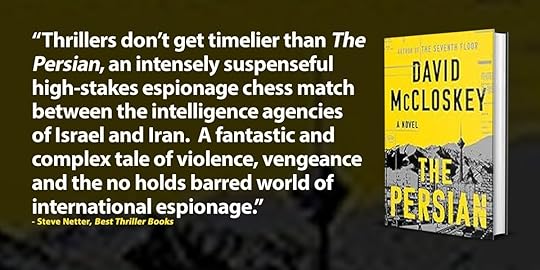
Make sure to check out the full review
Make sure to check out the full review
October 17, 2025
Couldn’t get into it.
Just could not get into it. I don’t know why. word. word. word. word. word. word. word. word. word. word. word. word. (they have a minimum on word count).
Just could not get into it. I don’t know why. word. word. word. word. word. word. word. word. word. word. word. word. (they have a minimum on word count).

April 5, 2026
This was my first novel by McCloskey—a selection for book club. While spy thrillers aren’t my favorite genre, I was interested in trying something new.
THE PERSIAN’s story unfortunately took a long time to unfold. The first third of this novel was painfully slow.
The book delves into the spiritual and political war between Israel and Iran. Both countries are engaging in surveillance—the Iranians to identify and assassinate key Israeli intelligence agents, and the Israelis to try to stop them. The Israelis recruit Kam, a Swedish (and Jewish) dentist of Iranian descent, who goes to work for the Mossad in Tehran. He is captured and tortured for several years, with the events preceding his capture interspersed throughout the story. Luckily, most of the torture occurs off-page, with the majority of the scenes of his captivity surrounding Kam writing a confession of the Mossad’s intelligence activities for the Iranian General, who is also in charge of the Iranian Quods Force operation.
Another key character is Roya, the wife of an Iranian scientist who was killed by the Mossad. She ends up caught up in the intrigue when she begins working for her former husband’s agency.
As a spy novel, THE PERSIAN isn’t for the faint of heart. This is about a bloody war of back-and-forth violence between Israel and Iran, although none of the violence is particularly gratuitous. And the connection to current day events is chilling. More importantly, the story helps to reveal how incredibly dangerous this work is to the agents and their families.
While THE PERSIAN suffered from early pacing issues, it did eventually grab my attention. I enjoyed the ending, too.
THE PERSIAN’s story unfortunately took a long time to unfold. The first third of this novel was painfully slow.
The book delves into the spiritual and political war between Israel and Iran. Both countries are engaging in surveillance—the Iranians to identify and assassinate key Israeli intelligence agents, and the Israelis to try to stop them. The Israelis recruit Kam, a Swedish (and Jewish) dentist of Iranian descent, who goes to work for the Mossad in Tehran. He is captured and tortured for several years, with the events preceding his capture interspersed throughout the story. Luckily, most of the torture occurs off-page, with the majority of the scenes of his captivity surrounding Kam writing a confession of the Mossad’s intelligence activities for the Iranian General, who is also in charge of the Iranian Quods Force operation.
Another key character is Roya, the wife of an Iranian scientist who was killed by the Mossad. She ends up caught up in the intrigue when she begins working for her former husband’s agency.
As a spy novel, THE PERSIAN isn’t for the faint of heart. This is about a bloody war of back-and-forth violence between Israel and Iran, although none of the violence is particularly gratuitous. And the connection to current day events is chilling. More importantly, the story helps to reveal how incredibly dangerous this work is to the agents and their families.
While THE PERSIAN suffered from early pacing issues, it did eventually grab my attention. I enjoyed the ending, too.
August 19, 2026
******MINOR SPOILERS FOLLOW
Told for the most part as a confession, three years on from a somewhat 'botched' operation in which he was captured, Kamran Esfehani, an Iranian Jew, tells the story of his work for Mossad. Working n a landscape filled with ideologues on both sides, Kam, an unsuccessful dentist living in Sweden, chooses the work for a dream of a better life in California. The novel takes place during a covert -- obviously -- war between two units whose sole mission is to wipe out their counterparts on the other side. Kam's story reveals that there is no place for kind-hearted espionage agents amongst the moral ambiguity, and highlights the human cost on both sides.
The pace of the first half of the book is rather deliberate and there isn't a lot in the way of real spy-craft -- some tech gadgetry used to hijack cell-phones notwithstanding.
It ain't Smiley but the plot is clean and easy to follow. Some of the characters, particularly the Iranians are rather cartoonish villains but then people who murder thirty thousand of their own people for protesting probably are cartoonish villains. My biggest issue with the book is Kam himself. Without revealing too much of the plot, he is just not exactly Mossad material in any way. They kn0w that and being able to speak Persian (Farsi?) fluently isn't going to disguise what an unsuitable subject Kam is. While I enjoyed the second half a great deal more (and may read another novel by the author), this book hinges on the credibility of Kam as the titular character and narrator and, with a moral compass that points more or less northwards., he doesn't really have any.
3.5 STARS
Told for the most part as a confession, three years on from a somewhat 'botched' operation in which he was captured, Kamran Esfehani, an Iranian Jew, tells the story of his work for Mossad. Working n a landscape filled with ideologues on both sides, Kam, an unsuccessful dentist living in Sweden, chooses the work for a dream of a better life in California. The novel takes place during a covert -- obviously -- war between two units whose sole mission is to wipe out their counterparts on the other side. Kam's story reveals that there is no place for kind-hearted espionage agents amongst the moral ambiguity, and highlights the human cost on both sides.
The pace of the first half of the book is rather deliberate and there isn't a lot in the way of real spy-craft -- some tech gadgetry used to hijack cell-phones notwithstanding.
It ain't Smiley but the plot is clean and easy to follow. Some of the characters, particularly the Iranians are rather cartoonish villains but then people who murder thirty thousand of their own people for protesting probably are cartoonish villains. My biggest issue with the book is Kam himself. Without revealing too much of the plot, he is just not exactly Mossad material in any way. They kn0w that and being able to speak Persian (Farsi?) fluently isn't going to disguise what an unsuitable subject Kam is. While I enjoyed the second half a great deal more (and may read another novel by the author), this book hinges on the credibility of Kam as the titular character and narrator and, with a moral compass that points more or less northwards., he doesn't really have any.
3.5 STARS
Displaying 1 - 30 of 426 reviews