

What do you think?

Shocking Paris: Soutine, Chagall and the Outsiders of Montparnasse
For a couple of decades before World War II, a group of immigrant painters and sculptors, including Amedeo Modigliani, Marc Chagall, Chaim Soutine and Jules Pascin dominated the new art scene of Montparnasse in Paris. Art critics gave them the name "the School of Paris" to set them apart from the French-born (and less talented) young artists of the period. Modigliani and Chagall eventually attained enormous worldwide popularity, but in those earlier days most School of Paris painters looked on Soutine as their most talented contemporary. Willem de Kooning proclaimed Soutine his favorite painter, and Jackson Pollack hailed him as a major influence.
Soutine arrived in Paris while many painters were experimenting with cubism, but he had no time for trends and fashions; like his art, Soutine was intense, demonic, and fierce. After the defeat of France by Hitler's Germany, the East European Jewish immigrants who had made their way to France for sanctuary were no longer safe. In constant fear of the French police and the German Gestapo, plagued by poor health and bouts of depression, Soutine was the epitome of the tortured artist. Rich in period detail, Stanley Meisler's Shocking Paris explores the short, dramatic life of one of the most influential artists of the twentieth century.
Soutine arrived in Paris while many painters were experimenting with cubism, but he had no time for trends and fashions; like his art, Soutine was intense, demonic, and fierce. After the defeat of France by Hitler's Germany, the East European Jewish immigrants who had made their way to France for sanctuary were no longer safe. In constant fear of the French police and the German Gestapo, plagued by poor health and bouts of depression, Soutine was the epitome of the tortured artist. Rich in period detail, Stanley Meisler's Shocking Paris explores the short, dramatic life of one of the most influential artists of the twentieth century.
256 pages, Hardcover
First published April 14, 2015
About the author
Stanley Meisler
5 books9 followersStanley Meisler served as a Los Angeles Times foreign and diplomatic correspondent for thirty years, assigned to Nairobi, Mexico City, Madrid, Toronto, Paris, Barcelona, the United Nations and Washington. He still contributes articles to the Los Angeles Times Book Review, Sunday Opinion and Art sections and writes a News Commentary for his website, www.stanleymeisler.com.
For many years, Meisler has contributed articles to leading American magazines including Foreign Affairs, Foreign Policy, the Atlantic, The Nation, the Reader’s Digest, the Quarterly Journal of Military History, and the Columbia Journalism Review. While most of these articles focus on foreign affairs and political issues, he also has contributed more than thirty articles on artists and art history to the Smithsonian Magazine.
Meisler has twice won the Korn-Ferry Award for Excellence in United Nations Reporting and is a recipient of the Ford Foundation Area Training Fellowship in African Studies. He conducted classes in international reporting at the Columbia University School of Journalism in 2003 and 2004.
For many years, Meisler has contributed articles to leading American magazines including Foreign Affairs, Foreign Policy, the Atlantic, The Nation, the Reader’s Digest, the Quarterly Journal of Military History, and the Columbia Journalism Review. While most of these articles focus on foreign affairs and political issues, he also has contributed more than thirty articles on artists and art history to the Smithsonian Magazine.
Meisler has twice won the Korn-Ferry Award for Excellence in United Nations Reporting and is a recipient of the Ford Foundation Area Training Fellowship in African Studies. He conducted classes in international reporting at the Columbia University School of Journalism in 2003 and 2004.
Ratings & Reviews
Friends & Following
Create a free account to discover what your friends think of this book!
Community Reviews
Displaying 1 - 30 of 61 reviews

May 12, 2016
Several GR reviewers complain of Stanley Meisler's focus on Soutine in "Shocking Paris", but Soutine brought the book alive for me and I am going to argue that the focus on Soutine is what makes the book great.
Meisler is in a strange position writing this book, because it's not a thorough academic or historical study of the Ecole de Paris, the School of Paris, and it's not a straight up biography of Soutine. Well, so he gives it the subtitle "Soutine, Chagall and the outsiders of Montparnasse," and that kind of gives you a sense that Soutine is at least one of the primary focuses. So I don't think there's any false advertising here. And I'm not what would be gained by focusing more on other artists. Chagall and Modigliani are much better known than Soutine, and maybe don't need the introduction Soutine does, and the rest of the artists are likely lesser known and perhaps not as magnetic in character, or, on the other hand, waiting to written about by someone drawn to them as Meisler is to Soutine.
Before I go into something of a chapter break down I am going to post an image, one of Soutine's landscapes. I looked at this yesterday with the help of Sabah's keen analysis and eye for detail. If you feel up for a little exercise, take a cursory look and write your initial impressions. What this is a painting of. What the mood is, the general feeling and tone.
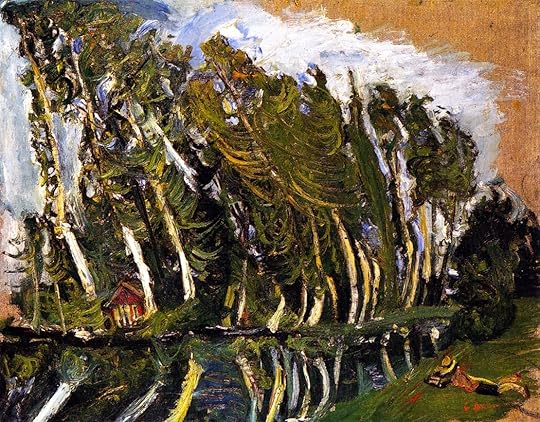
Now look a bit closer. Look for inconsistencies. Note the reflection on the waters and the way it differs or distorts the scene it is reflecting. Look at the person relaxing with a book, hat perfectly in place, as the wind nearly pulls the trees right out of the ground.
If you were to see this painting in person, whole layers of texture, dimensionality and chaos would be added. People who see Soutine's paintings in person say they seem to be in perpetual motion.
In the introduction to "Shocking Paris" Messler acknowledges his focus on Soutine, and speaks of the difficulties of any biographical work with Soutine as a subject. "Soutine is the key artist in the book, and that creates a temptation. He left no writing--no letters, diaries, notebooks--about his art, his personal problems, his feelings about Paris or, in fact, anything else. In her 1993 book on Soutine, French biograpnher Clarice Nicoidski lamented the difficulty of sorting out the truth when the handful of witnesses contradict each other. 'The difficulty with Soutine,' she wrote, 'stems from the fact that every testimony, even the most sincere, even the most impartial, is immediately put in question by a detail, an anecdote, another testimony.'"
Soutine, like his paintings, embodied wild contradictions and constant motion.
And yet, Meisler does a beautiful job opening a window into his life, his process, his madness and tenderness.
Partial chapter break down.
Chapter 1 opens with a description of the conditions that lead to an emigration of Jews from Eastern Europe to Paris between the two world wars. I will not go into it, but I will say, these were not exactly easy times for Jews in Paris, which was still reeling from the Dreyfus Affair. They were not easy times for Jews anywhere. But it was easier in Paris than in Eastern Europe. And particularly for artists, and certainly for Soutine, who grew up in poverty in a large family. Soutine and many other immigrant artists, most of them Jewish, came to Paris and began making art that was non-traditional, even for the Paris avant-guarde. I am reminded of the theoretical writing by Deleuze and Guattari, which I think about a lot, particularly the essay "What Is A Minor Literature" in From Kafka: Towards a Minor Literature. In this book is an argument that people who write in a language that is not theirs, whether that means their cultural presence is contested or they weren't born speaking that language, there is something revolutionary that happens. It opens up space for that language to breathe and grow and change. “Language stops being representative in order to now move toward its extremities or its limits” (23).
Something like this pressing against the boundaries of symbolic and representational language happens, for so many reasons, and these outsiders become in many ways the insider outsiders, and the local avant-garde is not happy about it. But that comes much later in the book.
In Chapter 2 we see the relationship between Modigliani, already established, and Soutine arrives, young, eccentric (to put it mildly), poor, unkempt, unable to speak French. Modigliani is Soutine's first friend, and his only friend for some time. In this chapter we begin to get a feel for the world of artists and their agents and benefactors. We also see that yes, Soutine and Modigliani are not the kind of people one might invite to a delicate tea party with fine china.
In the third chapter Soutine leaves Paris for a time. He is paid to live on the countryside and paint. He is miserable, but productive. During this time Modigliani dies (he died quite young) and Soutine is heart-broken and bereft.
Chapter four: An American art collector buys just about all of Soutine's paintings. Soutine becomes suddenly well-known and fairly wealthy. And we begin to meet other artists in the School of Paris who are beginning to become known.
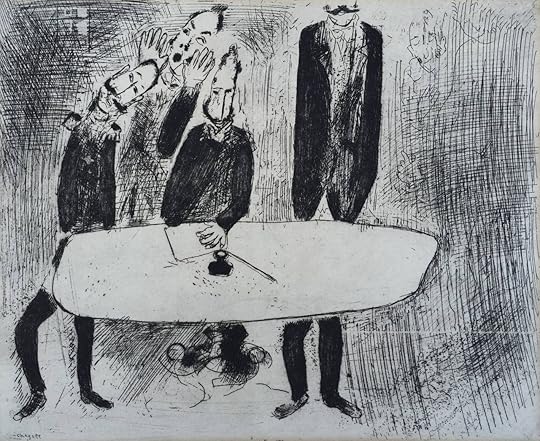
In Chapter 5 the focus shifts to Chagall and Léon Samoilovitch Bakst. Chagall I imagine you've all heard of, but perhaps you haven't heard of Bakst. He was a painter, costume maker and set designer. There is a lot of information about him out there if you want to look. Bakst was one of Chagall's early and influential teachers (they worked on sets together for the Russian ballet) and in a roundabout way led him to Paris. But Bakst didn't help Chagall or see him much in Paris. Chagall managed on his own. Meisler describes Chagall's social and therefore business skills as much more refined than Soutine's. (In other words, Chagall had them.) Chagall starts in Russia, goes to Paris, goes back to Russia during WWI, and in the 20s goes back to Paris. This is an interesting chapter. It ends with Chagall being commissioned to do etchings for Gogol's Dead Souls.
Lets see, I'd like to go through the rest of the book and outline the chapters a little, but I think that's all I have in me right now. I highly recommend this book. One gets a look at Paris between the wars as a gathering place for artists who struggle to make a home there but who do create a community of sorts and find ways to live and do their work. Here are some of the many artists one gets to meet (maybe for the first time, maybe not): Chana Orloff, Jeanne Hebuterne (Modigliani's artist lover who committed suicide after his death), Max Jacob, Kikoine, Moise Kisling, Kramsztyk, Kremgne, Henri Epstein, Aizik Feder, Jacques Lipchitz. (Both Orloff and Lipchitz I believe were mainly sculptors.)
Also the book follows Soutine's journey through to the end, when he dies, during WWII, of an ulcer, at least partially because he is in hiding and can't get proper care. I found it to be very rich and engaging to learn of him both in terms of an artist, and in his relationships. He was obsessed with Rembrant, and his love was quite passionate. (In fact, in homage to Rembrandt he spent quite a bit of time painting a rotting carcass, which wasn't endearing to everyone involved.) He was such a perfectionist, and so sensitive to his own ideas and to the comments and attentions of others, that he often destroyed his own work. He was not so much against cleanliness, as many thought to be true, but terrified of the gas heating of water and therefore, for many years, perhaps even decades, barely bathed. And toward the end of the life he discovered domestic partnership of a kind (well, two kinds) and Meisler does a lovely job with this. One thing that I still find disturbing is that Soutine was buried, at the insistence of the woman he was lovers with at the time of his death, with a cross on his grave stone, and it is still there. It was during the war, so there were no Jews there to contest, and after the war it was left that way. Hard for me to understand why this would be.
Another thing that sticks with me is that while in France there have been many exhibits related to the Paris School, in the U.S. there have been next to none and the school is largely forgotten. I hope that changes.
Thanks Sabah for encouraging me to write this review. Hope it is somewhat coherent.
Meisler is in a strange position writing this book, because it's not a thorough academic or historical study of the Ecole de Paris, the School of Paris, and it's not a straight up biography of Soutine. Well, so he gives it the subtitle "Soutine, Chagall and the outsiders of Montparnasse," and that kind of gives you a sense that Soutine is at least one of the primary focuses. So I don't think there's any false advertising here. And I'm not what would be gained by focusing more on other artists. Chagall and Modigliani are much better known than Soutine, and maybe don't need the introduction Soutine does, and the rest of the artists are likely lesser known and perhaps not as magnetic in character, or, on the other hand, waiting to written about by someone drawn to them as Meisler is to Soutine.
Before I go into something of a chapter break down I am going to post an image, one of Soutine's landscapes. I looked at this yesterday with the help of Sabah's keen analysis and eye for detail. If you feel up for a little exercise, take a cursory look and write your initial impressions. What this is a painting of. What the mood is, the general feeling and tone.
Now look a bit closer. Look for inconsistencies. Note the reflection on the waters and the way it differs or distorts the scene it is reflecting. Look at the person relaxing with a book, hat perfectly in place, as the wind nearly pulls the trees right out of the ground.
If you were to see this painting in person, whole layers of texture, dimensionality and chaos would be added. People who see Soutine's paintings in person say they seem to be in perpetual motion.
In the introduction to "Shocking Paris" Messler acknowledges his focus on Soutine, and speaks of the difficulties of any biographical work with Soutine as a subject. "Soutine is the key artist in the book, and that creates a temptation. He left no writing--no letters, diaries, notebooks--about his art, his personal problems, his feelings about Paris or, in fact, anything else. In her 1993 book on Soutine, French biograpnher Clarice Nicoidski lamented the difficulty of sorting out the truth when the handful of witnesses contradict each other. 'The difficulty with Soutine,' she wrote, 'stems from the fact that every testimony, even the most sincere, even the most impartial, is immediately put in question by a detail, an anecdote, another testimony.'"
Soutine, like his paintings, embodied wild contradictions and constant motion.
And yet, Meisler does a beautiful job opening a window into his life, his process, his madness and tenderness.
Partial chapter break down.
Chapter 1 opens with a description of the conditions that lead to an emigration of Jews from Eastern Europe to Paris between the two world wars. I will not go into it, but I will say, these were not exactly easy times for Jews in Paris, which was still reeling from the Dreyfus Affair. They were not easy times for Jews anywhere. But it was easier in Paris than in Eastern Europe. And particularly for artists, and certainly for Soutine, who grew up in poverty in a large family. Soutine and many other immigrant artists, most of them Jewish, came to Paris and began making art that was non-traditional, even for the Paris avant-guarde. I am reminded of the theoretical writing by Deleuze and Guattari, which I think about a lot, particularly the essay "What Is A Minor Literature" in From Kafka: Towards a Minor Literature. In this book is an argument that people who write in a language that is not theirs, whether that means their cultural presence is contested or they weren't born speaking that language, there is something revolutionary that happens. It opens up space for that language to breathe and grow and change. “Language stops being representative in order to now move toward its extremities or its limits” (23).
Something like this pressing against the boundaries of symbolic and representational language happens, for so many reasons, and these outsiders become in many ways the insider outsiders, and the local avant-garde is not happy about it. But that comes much later in the book.
In Chapter 2 we see the relationship between Modigliani, already established, and Soutine arrives, young, eccentric (to put it mildly), poor, unkempt, unable to speak French. Modigliani is Soutine's first friend, and his only friend for some time. In this chapter we begin to get a feel for the world of artists and their agents and benefactors. We also see that yes, Soutine and Modigliani are not the kind of people one might invite to a delicate tea party with fine china.
In the third chapter Soutine leaves Paris for a time. He is paid to live on the countryside and paint. He is miserable, but productive. During this time Modigliani dies (he died quite young) and Soutine is heart-broken and bereft.
Chapter four: An American art collector buys just about all of Soutine's paintings. Soutine becomes suddenly well-known and fairly wealthy. And we begin to meet other artists in the School of Paris who are beginning to become known.
In Chapter 5 the focus shifts to Chagall and Léon Samoilovitch Bakst. Chagall I imagine you've all heard of, but perhaps you haven't heard of Bakst. He was a painter, costume maker and set designer. There is a lot of information about him out there if you want to look. Bakst was one of Chagall's early and influential teachers (they worked on sets together for the Russian ballet) and in a roundabout way led him to Paris. But Bakst didn't help Chagall or see him much in Paris. Chagall managed on his own. Meisler describes Chagall's social and therefore business skills as much more refined than Soutine's. (In other words, Chagall had them.) Chagall starts in Russia, goes to Paris, goes back to Russia during WWI, and in the 20s goes back to Paris. This is an interesting chapter. It ends with Chagall being commissioned to do etchings for Gogol's Dead Souls.
Lets see, I'd like to go through the rest of the book and outline the chapters a little, but I think that's all I have in me right now. I highly recommend this book. One gets a look at Paris between the wars as a gathering place for artists who struggle to make a home there but who do create a community of sorts and find ways to live and do their work. Here are some of the many artists one gets to meet (maybe for the first time, maybe not): Chana Orloff, Jeanne Hebuterne (Modigliani's artist lover who committed suicide after his death), Max Jacob, Kikoine, Moise Kisling, Kramsztyk, Kremgne, Henri Epstein, Aizik Feder, Jacques Lipchitz. (Both Orloff and Lipchitz I believe were mainly sculptors.)
Also the book follows Soutine's journey through to the end, when he dies, during WWII, of an ulcer, at least partially because he is in hiding and can't get proper care. I found it to be very rich and engaging to learn of him both in terms of an artist, and in his relationships. He was obsessed with Rembrant, and his love was quite passionate. (In fact, in homage to Rembrandt he spent quite a bit of time painting a rotting carcass, which wasn't endearing to everyone involved.) He was such a perfectionist, and so sensitive to his own ideas and to the comments and attentions of others, that he often destroyed his own work. He was not so much against cleanliness, as many thought to be true, but terrified of the gas heating of water and therefore, for many years, perhaps even decades, barely bathed. And toward the end of the life he discovered domestic partnership of a kind (well, two kinds) and Meisler does a lovely job with this. One thing that I still find disturbing is that Soutine was buried, at the insistence of the woman he was lovers with at the time of his death, with a cross on his grave stone, and it is still there. It was during the war, so there were no Jews there to contest, and after the war it was left that way. Hard for me to understand why this would be.
Another thing that sticks with me is that while in France there have been many exhibits related to the Paris School, in the U.S. there have been next to none and the school is largely forgotten. I hope that changes.
Thanks Sabah for encouraging me to write this review. Hope it is somewhat coherent.

Read
March 20, 2015"The artists of the School of Paris came to France in a mass and rare migration, honed their art in the schools and museums of France, ignored the styles of French painters as young as themselves and produced a host of exciting and unique works of art. A good deal of great art would have been lost if they had come to Paris and did nothing more than mimic the bland work of young French painters."
Meisler is talking about artists such as Modigliani, Chagall, and Jules Pacsin, but the "key artist" in this group, the man who gets the bulk of the attention here, is Chaim Soutine. This may be because when Meisler graduated from college in the early 1950s, he discovered a family connection to the artist, and as he notes, whenever he saw a Soutine painting in a museum afterwards, he gave it extra notice. The anti-social, anti-hygienic, often downright bizarre artist most definitely has an interesting story, especially once his work was discovered and people started trying to acquire his paintings and he literally went from rags to riches. And while Soutine's life and work is definitely the main thrust of this book, Shocking Paris also reveals much more: a brief examination of Russia and the anti-Semitic policies that drove many artists to find a haven in France, a look at forces inside Jewish orthodoxy that also had an impact on some artists' emigration to Paris, a look at the changing art scene that had moved from Montmartre to Montparnasse, French anti-Semitism, the effects of outside forces (the Depression, or luck in finding a patron to support one's work) that had the potential to make or break an artist's career and set up rivalries among the artists, and then there's the exploration of the Nazi occupation of France that sent huge numbers of foreign-born Jews to the camps and sent some of the artists in this book into hiding. Moving chronologically through 20th-century French history, he intertwines these outside events with the stories of some of the artists of the Paris School, although as I've already said, it is Soutine's work and life that is the main thrust of the book, so perhaps the title is a bit misleading.
Personally speaking, if he had just made this book about Soutine, it would be much more reflective of what Meisler's actually accomplished here than what the title makes the reader think is going to be in this book. Even the paintings by artists of the Paris School he's chosen to illustrate this book are dominated by Soutine's works, and his "Aftermath" chapter is given largely over to discussions about Soutine. At the same time, Soutine's life was anything but dull and makes for really good reading -- especially his life in hiding after the Nazi occupation. As part of his focus on this artist, Meisler also points out the problems with trying to get a handle on the man from the biographical standpoint, and even from criticism of his works. For example, he notes how Jewish critics have come up with some "convoluted theses" about him by looking for Jewish content that isn't reflected in his work.
When all is said and done, the book is very reader friendly, interesting from an historical standpoint, and even if the reader knows absolutely nothing about the School of Paris or any of the artists that composed this group, Meisler makes the information accessible and interesting from the standpoint of human interest. However, the focus on Soutine, while incredibly interesting, detracts a bit from what is seemingly implied by the title. Still, I would definitely recommend it to anyone who may have an interest in the topic -- even though it's a bit top heavy on the Soutine side, it's still a good introduction to the Montparnasse art scene and the history of the time that helped to shape this group of incredible artists and which had a major impact on their careers.

February 19, 2015
Disclaimer: ARC via Netgalley
This little book is mostly a biography of Soutine, though to call it a straight out biography would be misleading. While the book’s focus is Soitine attention is paid to a variety of Jewish immigrant painters. Meisler connects these men to the Paris school and traces the art world it contained until after the Second World War. Overall the book is good, though there is a weak part. The connection made to Anti-Semitism and the Paris school.
That criticism aside, the book is engrossing, looking not only the artists but the dealers and the women in their lives. There is a bit about Varian Fry as well. As someone who lives in Philadelphia, I found the chapters about Barnes to be rather interesting. The book is engaging, as well as a quick read packed with facts and analysis.
Soutine is the focus, and Meisler does a good job of presenting an artist that not many people are familiar with. He does this despite the larger presence of more famous artists such as Chagall and Picasso. Something that must have been difficult to do.
Meisler also directs the reader to further reading.
This little book is mostly a biography of Soutine, though to call it a straight out biography would be misleading. While the book’s focus is Soitine attention is paid to a variety of Jewish immigrant painters. Meisler connects these men to the Paris school and traces the art world it contained until after the Second World War. Overall the book is good, though there is a weak part. The connection made to Anti-Semitism and the Paris school.
That criticism aside, the book is engrossing, looking not only the artists but the dealers and the women in their lives. There is a bit about Varian Fry as well. As someone who lives in Philadelphia, I found the chapters about Barnes to be rather interesting. The book is engaging, as well as a quick read packed with facts and analysis.
Soutine is the focus, and Meisler does a good job of presenting an artist that not many people are familiar with. He does this despite the larger presence of more famous artists such as Chagall and Picasso. Something that must have been difficult to do.
Meisler also directs the reader to further reading.

December 4, 2025
Started strong but dragged about halfway. Mostly about Soutine.

February 21, 2015
Stanley Meisler's "Shocking Paris: Soutine, Chagall and the Outsiders of Montparnasse" is an interesting narrative of the art scene of Montparnasse in Paris prior to World War 2. My chief complaint is that it focuses entirely too much on Chaim Soutine. I prefer some of the artists of this time, such as Marc Chagall, Jules Pascin and Moïse Kisling. The title sounds like it would include information on the other artists, but the book focuses a bit too much on just one, Soutine, though it does give some minimal attention to some of the others. I perhaps might feel a bit differently if I was more a fan of Soutine's works.
Other than that, the book is well researched and flows well. It is interesting (unlike some of the really dry books we've had to read in some of my art classes) and I had no problem finishing it. I would recommend this book to art majors and history buffs. I would read more of Mr. Meisler's works in the future, especially if they focused on an artist whose work I really enjoyed. Overall, I would rate the book a solid 4.6.
This book was won from the Goodreads.com website.
Other than that, the book is well researched and flows well. It is interesting (unlike some of the really dry books we've had to read in some of my art classes) and I had no problem finishing it. I would recommend this book to art majors and history buffs. I would read more of Mr. Meisler's works in the future, especially if they focused on an artist whose work I really enjoyed. Overall, I would rate the book a solid 4.6.
This book was won from the Goodreads.com website.

March 17, 2015
I find this period of history that takes place in Paris extremely interesting. I was excited to read this book since I love the work of Chagall and some of the others. I found that from reading this book I got a good idea of the type of "bohemian" lifestyle that many of the artists lived and created their art in. There was the constant fear of the French police and the German gestapo that the Jewish immigrants had to work under.
I was however disappointed that this books main focus was on Soutine with very little information about the other artists. While I found the novel interesting I thought the title a bit deceiving. It is more like a biography of Soutine with inclusion of the others as they touched his life.
The writing was very precise and the characters well drawn. I did have a little trouble finishing the book as I felt there was some repetition of facts such as Soutine's Russian accented French and his escapades in the Modigliani's cafe.
I think this book is best suited to art history students and those seeking information about Soutine's life. I gave it 4 stars for the writing which was excellent.
I was however disappointed that this books main focus was on Soutine with very little information about the other artists. While I found the novel interesting I thought the title a bit deceiving. It is more like a biography of Soutine with inclusion of the others as they touched his life.
The writing was very precise and the characters well drawn. I did have a little trouble finishing the book as I felt there was some repetition of facts such as Soutine's Russian accented French and his escapades in the Modigliani's cafe.
I think this book is best suited to art history students and those seeking information about Soutine's life. I gave it 4 stars for the writing which was excellent.

January 9, 2015
If I could rate 3.5 I would. The amount of information in this book regarding Soutine & the School of Paris is prodigious; however the repetition of documented facts (Modigliani's cafe antics, Soutine's Russian accented French) simply became annoying. The writing style seemed at times to be distracted, adding bits and pieces as if just recalled. However, the look at bohemian life in Montparnasse gave a very good impression of what it was like to be an emigre artist trying to "make it". Perhaps a larger issue for these emigres became the constant fear of the French police and the German Gestapo and how it shaped their lives and ultimately their art. As the "unknown" of the title, Soutine was the epitome of the tortured artist; the one who author Meisler calls one of the most influential artists of the twentieth century. Shocking Paris is a good start to study the School of Paris.

March 12, 2023
This was an amazing book. Not only is it an extremely interesting history of an art movement and group of outsider artists but it is a history of a time that we do not want to repeat. The similarities between pre world war 2 fascist Europe and the ignorance, bigotry and racism towards Jews, immigrants, LGBTQ and other outsiders in today’s USA is a little too close for comfort.

May 26, 2017
This book was so interesting. It was mainly about the artist Soutine and secondarily Chagall and other Jewish artists escaping the Nazis and other religious intolerant. All ending up in Montparnasse and Paris.


September 3, 2017
Shocking Paris: Soutine, Chagall and the Outsiders of Montparnasse is a narrative and exploration of the art scene of Paris leading up to the events in World War II. Meisler thoroughly researched the subject before he began writing the book, as evidenced by the factual focus and smooth writing style shown. Many suggestions for further reading are included at the back of the book, so if you find yourself curious about something specific during the course of your reading, it won’t be difficult to track down more information on it.
Despite the description, this book mostly focuses on Soutine, with slight diversions to the other artists mentioned in the title (as well as a couple of others). I personally was ok with this, as the time spent with Soutine really brought him to life for me. There was so much I hadn’t known previously about him or his works, so I really appreciated this in-depth look at his life. The information about the events going on at the same time (the growing anti-Semitism, World War II, etc) really helped to give context to all of his works. Context I had never heard of. It brought a whole new understanding to his works, as well as a new level of appreciation for them.
There is a lot of focus in this book on Jewish artists and the effects of anti-Semitism on them and their works. This is not something I had been aware of previously; it was never mentioned in any of my numerous art history classes. So I found myself utterly enthralled at the sudden exposure to so much information.
One thing I particularly enjoyed about this novel was Meisler’s choice to also include information about the art dealers. I agree with his interpretation that art dealers have a lot to do with an artists’ success or lack-thereof, so including the influential ones of the time is vital. Without them you risk missing fundamental parts of an artist’s story.
As mentioned above, Soutine is the focus of the novel. Amadeo Modigliani and Marc Chagall also get a couple of chapter’s (each) of their own, but the attention to them is clearly on their connections to Soutine. Essentially; the information provided about the two artists provides further context for Soutine’s biography. They had to be mentioned.
Many other artists are mentioned in passing. Some would argue these artists (such as Picasso) are actually bigger in name and possibly should have been given more attention. Considering it isn’t hard to find information about these artists, I’m ok with Meisler’s decision to briefly touch upon them and then move on.
I have to confess, there’s one sentence in particular, out of the whole book that absolutely broke my heart: “When World War II ended, Chagall was the only School of Paris painter of international standing still alive.” I don’t think I need to explain why that quote hurt me as much as it did.
Overall I found that Shocking Paris was a really interesting and worthwhile read. While the focus was slightly different than I anticipated, I still enjoyed it and actually agreed with many of the choices Meisler made when it came to details mentioned.
For more reviews, check out Quirky Cat's Fat Stacks
Despite the description, this book mostly focuses on Soutine, with slight diversions to the other artists mentioned in the title (as well as a couple of others). I personally was ok with this, as the time spent with Soutine really brought him to life for me. There was so much I hadn’t known previously about him or his works, so I really appreciated this in-depth look at his life. The information about the events going on at the same time (the growing anti-Semitism, World War II, etc) really helped to give context to all of his works. Context I had never heard of. It brought a whole new understanding to his works, as well as a new level of appreciation for them.
There is a lot of focus in this book on Jewish artists and the effects of anti-Semitism on them and their works. This is not something I had been aware of previously; it was never mentioned in any of my numerous art history classes. So I found myself utterly enthralled at the sudden exposure to so much information.
One thing I particularly enjoyed about this novel was Meisler’s choice to also include information about the art dealers. I agree with his interpretation that art dealers have a lot to do with an artists’ success or lack-thereof, so including the influential ones of the time is vital. Without them you risk missing fundamental parts of an artist’s story.
As mentioned above, Soutine is the focus of the novel. Amadeo Modigliani and Marc Chagall also get a couple of chapter’s (each) of their own, but the attention to them is clearly on their connections to Soutine. Essentially; the information provided about the two artists provides further context for Soutine’s biography. They had to be mentioned.
Many other artists are mentioned in passing. Some would argue these artists (such as Picasso) are actually bigger in name and possibly should have been given more attention. Considering it isn’t hard to find information about these artists, I’m ok with Meisler’s decision to briefly touch upon them and then move on.
I have to confess, there’s one sentence in particular, out of the whole book that absolutely broke my heart: “When World War II ended, Chagall was the only School of Paris painter of international standing still alive.” I don’t think I need to explain why that quote hurt me as much as it did.
Overall I found that Shocking Paris was a really interesting and worthwhile read. While the focus was slightly different than I anticipated, I still enjoyed it and actually agreed with many of the choices Meisler made when it came to details mentioned.
For more reviews, check out Quirky Cat's Fat Stacks

February 8, 2018
Shocking Paris: Soutine, Chagall and the Outsiders of Montparnasse tells the story of the immigrant artists in Paris from just before World War I to the years leading up to the Second World War, most of whom were Jewish and came from the Russian empire. The artist Chaim Soutine is the author’s main topic (the author is a distant relative) but the book also covers many other painters of the period, most notably Modigliani, Chagall, and Pascin. As the book makes very clear, they were vastly different in their styles of painting and especially in their respective personalities.
The term “School of Paris” was coined by certain art dealers primarily to describe the concentration of Jewish painters in the city during the 1920’s. They experienced rabid anti-Semitism which only increased dramatically during the 1930s influenced by Hitler’s rise in Germany. Some were lucky and fled to the United States to escape the Nazis, others stayed in France and went into hiding, some lost their lives. Some of the artists died young due to illness - Modigliani was only 35 when he succumbed to tuberculosis and Soutine was 50 when he died of a perforated ulcer.
An entire chapter is devoted to Dr. Albert Barnes who was one of the first to appreciate Soutine’s work and brought back numerous of his paintings and so many of the others of his generation to hang in his world-famous Barnes Museum in Philadelphia. As a proud native of Philadelphia, I am so grateful to Dr. Barnes for creating this masterpiece of a museum.
The book brought back many wonderful memories of my first visit to France with my best friend and the wonderful small museums we visited in Paris: Musee de l’Orangerie and the Jeu de Paume where these works were first exhibited and also the magnificent museums along the French River: Musée National Marc Chagall in Nice, Musée National Pablo Picasso in Vallauris, Musee Matisse in NICE (my personal favorite) and Musee Picasso in Antibes.
The term “School of Paris” was coined by certain art dealers primarily to describe the concentration of Jewish painters in the city during the 1920’s. They experienced rabid anti-Semitism which only increased dramatically during the 1930s influenced by Hitler’s rise in Germany. Some were lucky and fled to the United States to escape the Nazis, others stayed in France and went into hiding, some lost their lives. Some of the artists died young due to illness - Modigliani was only 35 when he succumbed to tuberculosis and Soutine was 50 when he died of a perforated ulcer.
An entire chapter is devoted to Dr. Albert Barnes who was one of the first to appreciate Soutine’s work and brought back numerous of his paintings and so many of the others of his generation to hang in his world-famous Barnes Museum in Philadelphia. As a proud native of Philadelphia, I am so grateful to Dr. Barnes for creating this masterpiece of a museum.
The book brought back many wonderful memories of my first visit to France with my best friend and the wonderful small museums we visited in Paris: Musee de l’Orangerie and the Jeu de Paume where these works were first exhibited and also the magnificent museums along the French River: Musée National Marc Chagall in Nice, Musée National Pablo Picasso in Vallauris, Musee Matisse in NICE (my personal favorite) and Musee Picasso in Antibes.

April 14, 2015
The School of Paris were a group of immigrant artists centred around Montparnasse, Paris in the decades before WWII. The main focus of this fascinating and well-researched exploration of their lives and work is Soutine – not surprisingly as the author is a distant relation – but also features other artist of the group such as Modigliani and Chagall. Not a conventional biography as such, it’s a wide-ranging study of this important period in art history, and puts the artists into their social and historical context. With the rise of anti-Semitism this was a turbulent period in French history and Meisler makes it come alive. I thoroughly enjoyed the book and learnt a great deal. It’s written in an accessible and engaging style (although it’s sometimes a little unfocussed and repetitious) and will be of interest to anyone wanting to know more about this important group of artists and the times they lived in.
March 21, 2019
This is book focuses more on the School of Paris painters and their world between the two world wars. It discusses the careers of such painters as Marc Chagall, Amedeo Modigliani, and especially Chaïm Soutine. The emphasis is less on art technique and art history, and more on the lives of the artists, the business of art and their dealers and patrons, including Albert Barnes of Philadelphia, and occasionally glimpses at the politics of the interwar years as anti-Semitism and nationalism led to another terrible conflict.
The book is comfortably written and very enjoyable to read. So if you are looking for an intense work of art history, this book may not do the trick. But for a reader with a general interest in art, the lives of artists, and the politics in Europe in the first half of the twentieth century, this book is recommended.
The book is comfortably written and very enjoyable to read. So if you are looking for an intense work of art history, this book may not do the trick. But for a reader with a general interest in art, the lives of artists, and the politics in Europe in the first half of the twentieth century, this book is recommended.

September 26, 2017
Beautifully written book. Discusses the "School of Paris" painters. These are the (jewish) immigrant painters like e.g. Soutine, Modigliani and Chagall. Painters in the post impressionist era, living in Montparnasse in Paris.
The book focusses on mainly Soutine. Describes his life. Soutine survived the second world war, but most of the School of Paris painters ended up in the concentration camps in the second world war. This not only by fact that their art was seen as detestable by the Nazi regime, but also since the painters were jewish.
Great great read for anyone interested in modern art history.
The book focusses on mainly Soutine. Describes his life. Soutine survived the second world war, but most of the School of Paris painters ended up in the concentration camps in the second world war. This not only by fact that their art was seen as detestable by the Nazi regime, but also since the painters were jewish.
Great great read for anyone interested in modern art history.

August 11, 2015
Not really so "shocking" account of the School of Paris artists in the first half of the 20th century. The focus mostly on Chaim Soutine and Marc Chagall. It's quite short, I guess I felt more like I had read a long magazine article than a book. I can't quite put my finger on what seemed sort of scattershot about this..maybe the focus turned away from the artists to world events a little too often?

Read
May 11, 2015Review by Esther Nussbaum for the Jewish Book Council.
May 27, 2018
Excellent very readable account of the School of Paris in the early 20th century.

February 19, 2025
I really love this book. It is pretty much my favorite topic. It is definitely my favorite neighborhood because I lived in Montparnasse. The Montparnasse neighborhood could have been a character itself. There was very little discussion of what was happening in Montparnasse aside from the artists. Even though this neighborhood is extremely important in terms of Parisian history with the French resistance, running out of the catacombs. Also, it was home to Jean Moulin and other major historical figures. It’s incredible that these artists were in the same spaces as all the other historic people - Sartre! Nevertheless, the contents of this book are extremely important because it talks about Jewish artists in Paris, post-impressionism. I feel that the author did a very good job of explaining the horrific complexity of France during Nazi occupation and Vichy France. I applaud the author for talking about Drancy and French complicity during the holocaust. I really gained an appreciation for Soutine. Chagall and Modi are my favorite artists but I also have a deeper respect for Soutine after reading this book. Hearing about another side of Chagall was disappointing but needed. I wish the author spent more time talking about the complexity of Modigliani and Jeanne. A lot of of this book was focused on Soutine. And, that’s probably the right thing because Soutine is often forgotten or misunderstood when it comes to the School of Paris (in the U.S.). If you love these artists, French history, World War II, history, and memoirs of Paris - this is your book.
November 30, 2019
Having seen Soutine's paintings at the Barnes Foundation and at the 2018 Jewish Museum exhibition, I was happy to have found Meisler's 1988 article on Soutine in "The Smithsonian". Here, Meisler tries to expand that article into a book. Unfortunately, there is little to add as Meisler admits, so a contrast of the paths of two Russian emigre artists, Soutine and Chagall, is one way used to get to book-length.
There are two problems in dealing with Soutine. First, he left no written record. Second, it is difficult to use words to describe his dramatic, color-rich, disturbing paintings.
Meisler includes a quote from Faure (p.97) that comes closest: "Here the mystery of the greatest painting shines forth. Flesh more like flesh than flesh itself, nerves more like nerves than nerves, even if they are painted with streams of rubies, with sulphur on fire, droplets of turquoise, emerald lakes crushed with sapphire, streaks of purple and pearl, a palpitation of silver that quivers and shines, a wondrous flame that wrings matter to its depths after having smelted all the jewels of its mines."
There are two problems in dealing with Soutine. First, he left no written record. Second, it is difficult to use words to describe his dramatic, color-rich, disturbing paintings.
Meisler includes a quote from Faure (p.97) that comes closest: "Here the mystery of the greatest painting shines forth. Flesh more like flesh than flesh itself, nerves more like nerves than nerves, even if they are painted with streams of rubies, with sulphur on fire, droplets of turquoise, emerald lakes crushed with sapphire, streaks of purple and pearl, a palpitation of silver that quivers and shines, a wondrous flame that wrings matter to its depths after having smelted all the jewels of its mines."
February 16, 2025
An overview of the immigrant painters in Paris in the 1920s-1930s, with special focus on Chaim Soutine (a distant relative-by-marriage of the author), Marc Chagall and Modigliani. All three were Jewish, and the book's second theme is the growing climate of antisemitism in the years leading up to, and during WWII.
The author was somewhat hampered in his undertaking by the fact that Soutine himself did not leave letters, diaries, autobiographical notes or essays on his thoughts about art, and did not exactly unburden himself psychologically to his contemporaries. So there is not much to go on beyond the bare biographical facts and some memoirs by his friends and associates.
The author is also not really interested in art criticism as such, and at the end of the book I didn't really feel I had learned much. Still, the book is engaging and as such it's a good introduction to the artistic life in Paris in the 1920s-1930s that goes a little beyond the usual suspects.
One random remark: the coloring of the title on the cover page is evocative of Piet Mondriaan rather than Soutine - why?
The author was somewhat hampered in his undertaking by the fact that Soutine himself did not leave letters, diaries, autobiographical notes or essays on his thoughts about art, and did not exactly unburden himself psychologically to his contemporaries. So there is not much to go on beyond the bare biographical facts and some memoirs by his friends and associates.
The author is also not really interested in art criticism as such, and at the end of the book I didn't really feel I had learned much. Still, the book is engaging and as such it's a good introduction to the artistic life in Paris in the 1920s-1930s that goes a little beyond the usual suspects.
One random remark: the coloring of the title on the cover page is evocative of Piet Mondriaan rather than Soutine - why?
May 18, 2021
This was a fantastic book that taught me about the mix of writers, artists and political figures in Paris during the early 20th century. I am so surprised that most people don't know about The School of Paris, even though we have such familiarity with its artists. I also came to understand how much creativity came from the Jewish culture which suffered under great oppression in Russia and the eastern European countries. Chagall turned out to be a bit of a selfish jerk even though his paintings were full of beauty. Soutine, Soutine...why don't we know about him in the U.S.? It may be likely because of Mr. Barnes, whose exhibit on Soutine I am about to visit in Philadelphia later this week. A warning: this book is so dense with facts that I took 17 pages of notes, a habit I have now for my reading diary. But rarely so many pages! I feel as though I've completed a course in art history. You must be an art lover to appreciate this book.

December 6, 2022
Shocking Paris tells the story of the School of Paris, a group of immigrating painters and sculptures, which includes among them Amedeo Modigliani Chaim Soutine and Marc Chagall in the neigh-borough of Paris of Montparnasse.
The book focuses its story on the life of Chaim Soutine with the brief experiences of other artists such as the short life of Amedeo Modigliani.
As an artist, interested in understanding the stories of artists I particularly liked the book. I was not particularly interested in the life of Soutine but still, his life was fascinating to read.
The book is well written but probably too short.
The book focuses its story on the life of Chaim Soutine with the brief experiences of other artists such as the short life of Amedeo Modigliani.
As an artist, interested in understanding the stories of artists I particularly liked the book. I was not particularly interested in the life of Soutine but still, his life was fascinating to read.
The book is well written but probably too short.

January 29, 2024
Very readable story of the immigrant artists that moved to Paris in the early 20th century. As the title states it covers Soutine and Chagall with some detail. He talks of Modigliani and the other artists and their different styles. It gave me a good feel for that time period in Paris and especially Montparnasse.

August 28, 2018
An excellent book on a lesser know art movement. It draws you in and keeps you reading. The focus is on Chaim Soutine, much better known in Europe than in the US. And there considered one of the top three from the Paris School, the other two being Chagalll and Modigliani.

March 31, 2022
A close and fascinating examination of a time when Paris was overrun by young foreign artists - Modigliani, Chagall, Soutine, Lipschitz and others in the School of Paris - looking for new and remarkable ways to express themselves.
June 22, 2025
This was a spectacular guide into the lives of Soutine, Chagall, Modigliani, and their compatriots the era of the School of Paris. As someone who grew up going to the Barnes, this has been wonderfully helpful to understand the lives of some of my favorite artists.

March 18, 2018
Visited St. Louis Art Museum, noticed "Woman in Pink" by Chaim Soutine. It disturbed me. Went home and kindled Soutine. Found this book. Pretty intriguing not difficult to read.

September 26, 2019
Well researched and written..an education on the School of Paris
While mostly fixed on Chaim Soutine, which gives us our context, this book well renders the artists of the School of Paris and helps us understand their beginnings as well as their ends. Beautifully written.
While mostly fixed on Chaim Soutine, which gives us our context, this book well renders the artists of the School of Paris and helps us understand their beginnings as well as their ends. Beautifully written.
Displaying 1 - 30 of 61 reviews