

What do you think?

Vivienne: A Novel
Did Vivienne Volker kill Wilma Lang? This question has dogged Vivienne ever since Wilma jumped from a window to her death shortly after Volker stole her lover, the visionary artist Hans Bellmer, in the 1970s. Once a famous artist and fashion icon, Volker is now in her eighties and spends her days in religious contemplation in rural Pennsylvania alongside her daughter Velour Bellmer, her granddaughter Vesta Furio, her much younger boyfriend—a garbageman named Lou—and Franz, the family dog. Their quiet lives are disrupted when Vivienne’s work is selected for inclusion in a high-profile retrospective called "Forgotten Women Surrealists" at the prestigious NAT Museum. However, when rumors of her past misdeeds begin to circulate and she is dropped from the show, a gallery curator enters the picture hoping to capitalize on the buzz generated by the controversy, sending the family's tensions, hopes, and dreams to a dizzying peak. Set over the course of a fateful week, Vivienne deftly weaves surreal prose with a Greek chorus of internet comments and text messages, to ask the what is the cost of vision, what is the price of art?
264 pages, Paperback
First published September 10, 2024
Ratings & Reviews
Friends & Following
Create a free account to discover what your friends think of this book!
Community Reviews
Displaying 1 - 30 of 101 reviews
![Profile Image for s.penkevich [hiatus-will return-miss you all].](https://i.gr-assets.com/images/S/compressed.photo.goodreads.com/users/1735525095i/6431467._UX200_CR0,11,200,200_.jpg)
August 12, 2025
‘But we’re all guilty, you know.’
In the world of self-proclaimed influencers and social media metric mining no scandal ever goes to waste. The spicier the better to drive engagement. And so poet Emmalea Russo’s debut novel, Vivienne, finds social media kicking up the dust of a little-remembered but deadly tale from art history as we are plunged into a spiraling vortex of comment feeds and the anxious mind of the family at the heart of a reinvigorated controversy. Channeling familiar scandals of Surrealist artist lives from affairs to extensive age gaps and latching the narrative backdrop to a fictionalized version of German surrealist Hans Bellmer, Russo delivers an innovative and incisive look at how poking old wounds often opens fresh ones. Especially when arm-chair comment warriors are primed are ready to start a hashtag trending and the question whether Vivienne Volker was connected to any foul play in the decades old death of Wilma Lang who took her life out through a window. Formally daring and endlessly gripping—I finished this in under 24 hours in rapt attention—Vivienne is a promising debut despite a misfire of an ending that completely cuts the legs of flow and tension right out from under itself. Still, Russo’s vision and thematic social critiques are as sharp as her prose and Vivienne is a fascinating foray into the frictions around legacy, generational trauma, muse culture, communal dynamics of discourse and the moral theater of social media driven by a desire for engagement clicks over earnest criticism.
‘What is the difference between an artist and a killer? Lars wonders aloud as he swivels. Must be something about the soul? Fabric, and plastic, flesh and bone.’
Emmalea Russo began publishing as a poet several years back and her poetic sensibilities truly shine here in Vivienne, her debut novel. Russo places the reader directly in the eye of the social media storm, spiraling through the inner voices of three generations of women—Viv, her daughter Velour, and granddaughter Vesta—and of Lar’s, who is ‘soaring high high high on the demented sewn wings of Vivienne Volker,’ in order to bring attention to his art gallery capitalizing on the buzz over ‘a name he heard for the first time only recently.’ Though the most compelling voice is that of social media doomscrolling, complete with rather humorous screennames like “fornicationstaion”, “obitchuary,” or “thotleader11” (and some subtle hints that there may be a bit of puppetry at work to the discourse) that drive a discourse that gets Viv removed from a prominent gallery showing and fuels conspiracy theories. At the heart of this novel are the dynamics of mass communication on platforms where negative or mean spirited content boosts engagement and social media functions not unlike a Greek chorus or barometer on the Vivianne situation. There is a much more focused intent on social media dynamics than novels with similar approaches such as the recent book Yellowface by R.F. Kuang (which, arguably, was still a more effective look at situations such as this from a broader perspective though had a different aim) and Russo does well by having these segments feed into a larger theme on art imitating life yet life being driven by art.
‘I think art is the absence of fear.’
Erykah Badu
Vivienne is a novel about art pushing boundaries and Russo ensures her own art aims to do the same. While the novel follows a fictional scandal, it is rooted in actual history by being tangentially grounded in the art of real-life Hans Bellmer. While Bellmer was never married to a Wilma and no Vivienne came crashing into their lives, one can detect inspiration from his real-life wife, Unica Zürn, who plunged to her death from an open window during a 5 day release from a mental hospital after Bellmer was already paralyzed from a stroke.
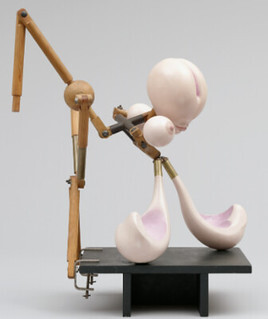
Bellmer’s The Machine-Gunneress in a State of Grace (1937) which figures prominently into the novel
‘I’m interested in his strange, discombobulated doll sculptures,’ Russo stated in an interview with The Creative Independent, ‘I’m also very interested in the uncanny, so the notion that this real artist would be in the book, but also that he would have this alternative existence felt appropriate.’ The novel, which creates a fictional reality of lesser-known surrealists, incorporates much from the art world, such as frequent allusions to Dorothea Tanning among others. With a character in the peripheries named Max Furio and all the age-gaps and affair scandals, readers familiar with Max Ernst and his multiple artist lovers such as Tanning, Peggy Guggenheim, and my favorite, Leonora Carrington who was significantly younger than him like every relationship in this novel, will likely find some amusement seeing Russo stir fact and fiction together to paint her narrative canvas.
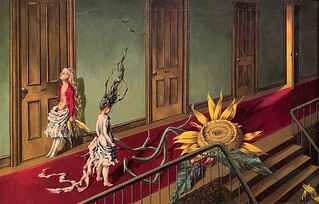
Dorothea Tanning’s Eine Kleine Nachtmusik (“A Little Night Music”) and the song of the same name appear frequently in the novel.
Perhaps Russo’s greatest strength here is her writing, which injects plenty of tension and intrigue into what would otherwise be a fairly stiff and cold novel as well as illuminates the story with rather dynamic imagery. Many of the scenes come together like a painting, each word another brushstroke that builds into really visceral moments felt more deeply by the vague surrealist bent of the imagery. There is a real attention to how the scene would be seen by the “viewer” as her words amalgamate like ‘ little pixels of nature and rapture.’ All in all, it affects a rather gorgeous visual nature:
The writing here reminds me of what author Amina Cain champions in her book on writing, A Horse at Night in which she extolls the virtues of visual imagery that can carry loads of resonance along with it, the sort that demonstrates how ‘an impression can be just as important as meaning.’
Vivienne is at its best when it allows the imagery to slide into the absurd or surreal, though when the novel takes a big shift into an absurdity at the end which, despite retaining themes on agency, creation, and legacy, feels too much of a surprise shift that would have worked better as its own story and, truthfully, really soured an ending that was more of less perfect as it was. Russo trusts her readers and while she may not tie up loose ends, there are a lot of minor details pointing towards something greater. Like who really is posting these retrospective video compilations on the artist and who is really behind these screennames? There is a mystery hanging over every page that really keeps you pushing on to see where it all leads.
‘Lars could become the glowing representative of the Bellmer-Volker clan, delivering their hidden genius to the world, piece by piece, show by show, forevermore.’
Russo also excels at creating a cast of characters who are interesting to follow even if you don’t necessarily like them. The titular artist is a big of an oddball and much of the mystery is in decoding her. Now 82 with a 40 year old garbage truck driving boyfriend, she has given up on the art world to mostly spend time in church or with her granddaughter who goes to bed every night praying ‘let no one die anytime soon, let there be no bad news.’ The recent cancellation has forced her to revisit old hurts and the volatility of such soul searching is felt on every page as both the reader and the characters find themselves navigating a field where they are ‘trapped in the space between things and words which only continues to widen.’
Though the idea of “cancel culture” is a familiar battleground for Russo who once had a poetry book publication canceled by her publisher. Not for anything she had done or said but for having published articles in Compact Magazine, an association for which she was deemed a work hazard due to issues around other writers who had published in the magazine. Russo took to her own Substackto discuss the issue following her removal:
The novel is an incisive look at the ways our lives can be at the mercy of social media discourse, always quick to call foul, and how careers and lives can be dashed upon the rocks of such discourse. The real horror here, however, is that such scandals may flare up due to ulterior motives that use claims of ‘harm reduction’ as the mask under which they operate.
‘It was hard work, Vivianne concluded, being a muse.’
Emmalea Russo’s Vivianne is a rather exciting and engaging novel that, despite a rather dramatically disappointing epilogue, made for an enjoyable read nonetheless. There is a slow-burn horror element always in the periphery of the novel, like a nocturnal sound you can’t quite hear and can’t quite place but stick like a thorn in the mind you cannot ignore. The unsettling dolls in the basement, the surreal threads that never come to a fully-conclusive head, the open violence or religious condemnations of comments sections that also hint to sinister collaboration or social engineering amongst participants. But the real horror is the ways we see lives manipulated by social media and the blurring line between art and life in which people operate to pile on to scandal. A bummer of an ending but a rather fun book altogether, Vivienne is one hell of an early promise debut and I cannot wait for Russo’s next novel.
3.5/5
In the world of self-proclaimed influencers and social media metric mining no scandal ever goes to waste. The spicier the better to drive engagement. And so poet Emmalea Russo’s debut novel, Vivienne, finds social media kicking up the dust of a little-remembered but deadly tale from art history as we are plunged into a spiraling vortex of comment feeds and the anxious mind of the family at the heart of a reinvigorated controversy. Channeling familiar scandals of Surrealist artist lives from affairs to extensive age gaps and latching the narrative backdrop to a fictionalized version of German surrealist Hans Bellmer, Russo delivers an innovative and incisive look at how poking old wounds often opens fresh ones. Especially when arm-chair comment warriors are primed are ready to start a hashtag trending and the question whether Vivienne Volker was connected to any foul play in the decades old death of Wilma Lang who took her life out through a window. Formally daring and endlessly gripping—I finished this in under 24 hours in rapt attention—Vivienne is a promising debut despite a misfire of an ending that completely cuts the legs of flow and tension right out from under itself. Still, Russo’s vision and thematic social critiques are as sharp as her prose and Vivienne is a fascinating foray into the frictions around legacy, generational trauma, muse culture, communal dynamics of discourse and the moral theater of social media driven by a desire for engagement clicks over earnest criticism.
‘What is the difference between an artist and a killer? Lars wonders aloud as he swivels. Must be something about the soul? Fabric, and plastic, flesh and bone.’
Emmalea Russo began publishing as a poet several years back and her poetic sensibilities truly shine here in Vivienne, her debut novel. Russo places the reader directly in the eye of the social media storm, spiraling through the inner voices of three generations of women—Viv, her daughter Velour, and granddaughter Vesta—and of Lar’s, who is ‘soaring high high high on the demented sewn wings of Vivienne Volker,’ in order to bring attention to his art gallery capitalizing on the buzz over ‘a name he heard for the first time only recently.’ Though the most compelling voice is that of social media doomscrolling, complete with rather humorous screennames like “fornicationstaion”, “obitchuary,” or “thotleader11” (and some subtle hints that there may be a bit of puppetry at work to the discourse) that drive a discourse that gets Viv removed from a prominent gallery showing and fuels conspiracy theories. At the heart of this novel are the dynamics of mass communication on platforms where negative or mean spirited content boosts engagement and social media functions not unlike a Greek chorus or barometer on the Vivianne situation. There is a much more focused intent on social media dynamics than novels with similar approaches such as the recent book Yellowface by R.F. Kuang (which, arguably, was still a more effective look at situations such as this from a broader perspective though had a different aim) and Russo does well by having these segments feed into a larger theme on art imitating life yet life being driven by art.
‘I think art is the absence of fear.’
Erykah Badu
Vivienne is a novel about art pushing boundaries and Russo ensures her own art aims to do the same. While the novel follows a fictional scandal, it is rooted in actual history by being tangentially grounded in the art of real-life Hans Bellmer. While Bellmer was never married to a Wilma and no Vivienne came crashing into their lives, one can detect inspiration from his real-life wife, Unica Zürn, who plunged to her death from an open window during a 5 day release from a mental hospital after Bellmer was already paralyzed from a stroke.
Bellmer’s The Machine-Gunneress in a State of Grace (1937) which figures prominently into the novel
‘I’m interested in his strange, discombobulated doll sculptures,’ Russo stated in an interview with The Creative Independent, ‘I’m also very interested in the uncanny, so the notion that this real artist would be in the book, but also that he would have this alternative existence felt appropriate.’ The novel, which creates a fictional reality of lesser-known surrealists, incorporates much from the art world, such as frequent allusions to Dorothea Tanning among others. With a character in the peripheries named Max Furio and all the age-gaps and affair scandals, readers familiar with Max Ernst and his multiple artist lovers such as Tanning, Peggy Guggenheim, and my favorite, Leonora Carrington who was significantly younger than him like every relationship in this novel, will likely find some amusement seeing Russo stir fact and fiction together to paint her narrative canvas.
Dorothea Tanning’s Eine Kleine Nachtmusik (“A Little Night Music”) and the song of the same name appear frequently in the novel.
Perhaps Russo’s greatest strength here is her writing, which injects plenty of tension and intrigue into what would otherwise be a fairly stiff and cold novel as well as illuminates the story with rather dynamic imagery. Many of the scenes come together like a painting, each word another brushstroke that builds into really visceral moments felt more deeply by the vague surrealist bent of the imagery. There is a real attention to how the scene would be seen by the “viewer” as her words amalgamate like ‘ little pixels of nature and rapture.’ All in all, it affects a rather gorgeous visual nature:
‘Lars plays the video again from the beginning. Exhausted, he thinks of his mother, gone. And his father uptown. And his dad’s cash (largely gone) which had backed Gallery X. The ocean is gone. The garments are gone. The giant sewing needle and pubic hair and bird wings and wallpaper, gone gone gone. Just the white cube of an empty art room and Lars in the middle, dressed in all back: shirt, jacket, and combat boots.’
The writing here reminds me of what author Amina Cain champions in her book on writing, A Horse at Night in which she extolls the virtues of visual imagery that can carry loads of resonance along with it, the sort that demonstrates how ‘an impression can be just as important as meaning.’
Vivienne is at its best when it allows the imagery to slide into the absurd or surreal, though when the novel takes a big shift into an absurdity at the end which, despite retaining themes on agency, creation, and legacy, feels too much of a surprise shift that would have worked better as its own story and, truthfully, really soured an ending that was more of less perfect as it was. Russo trusts her readers and while she may not tie up loose ends, there are a lot of minor details pointing towards something greater. Like who really is posting these retrospective video compilations on the artist and who is really behind these screennames? There is a mystery hanging over every page that really keeps you pushing on to see where it all leads.
‘Lars could become the glowing representative of the Bellmer-Volker clan, delivering their hidden genius to the world, piece by piece, show by show, forevermore.’
Russo also excels at creating a cast of characters who are interesting to follow even if you don’t necessarily like them. The titular artist is a big of an oddball and much of the mystery is in decoding her. Now 82 with a 40 year old garbage truck driving boyfriend, she has given up on the art world to mostly spend time in church or with her granddaughter who goes to bed every night praying ‘let no one die anytime soon, let there be no bad news.’ The recent cancellation has forced her to revisit old hurts and the volatility of such soul searching is felt on every page as both the reader and the characters find themselves navigating a field where they are ‘trapped in the space between things and words which only continues to widen.’
Though the idea of “cancel culture” is a familiar battleground for Russo who once had a poetry book publication canceled by her publisher. Not for anything she had done or said but for having published articles in Compact Magazine, an association for which she was deemed a work hazard due to issues around other writers who had published in the magazine. Russo took to her own Substackto discuss the issue following her removal:
‘I’d chosen to publish alongside people whose views he took to be “anti-liberatory.” Guilt by association. There is, of course, a long history of men punishing women for stepping out of line or being hard to read, but ordinary misogyny aside, Baudrillard and Byung-Chul Han were right: we surveil and punish each other under the guise of liberation and safety, thus doing the state’s work for it. It’s freaky, tricky. And it does make me scared for many things, including poetry.’
The novel is an incisive look at the ways our lives can be at the mercy of social media discourse, always quick to call foul, and how careers and lives can be dashed upon the rocks of such discourse. The real horror here, however, is that such scandals may flare up due to ulterior motives that use claims of ‘harm reduction’ as the mask under which they operate.
‘It was hard work, Vivianne concluded, being a muse.’
Emmalea Russo’s Vivianne is a rather exciting and engaging novel that, despite a rather dramatically disappointing epilogue, made for an enjoyable read nonetheless. There is a slow-burn horror element always in the periphery of the novel, like a nocturnal sound you can’t quite hear and can’t quite place but stick like a thorn in the mind you cannot ignore. The unsettling dolls in the basement, the surreal threads that never come to a fully-conclusive head, the open violence or religious condemnations of comments sections that also hint to sinister collaboration or social engineering amongst participants. But the real horror is the ways we see lives manipulated by social media and the blurring line between art and life in which people operate to pile on to scandal. A bummer of an ending but a rather fun book altogether, Vivienne is one hell of an early promise debut and I cannot wait for Russo’s next novel.
3.5/5

November 27, 2024
A disturbing, slightly disgusting read … and yet one that still asks the reader to consider whether life imitates art are or if art imitates life.
- Quick snapshots of hazy situations & mental health
- Generational traumas effect on healing / personal growth
- Short read, which I personally loved the most because I’m in that phase where everything needs to be quick because I'm so busy!!
- Quick snapshots of hazy situations & mental health
- Generational traumas effect on healing / personal growth
- Short read, which I personally loved the most because I’m in that phase where everything needs to be quick because I'm so busy!!

May 2, 2025
I was never a fan of the surrealist movement and I should have known what I was getting myself into. I was in it until the epilogue I’m gonna be so for real
June 11, 2024
An astonishing debut novel. Russo's prose is poetic, moving even. I love it. Such a clever plot that centers around an artist who has been sequestered away in rural PA, living with their daughter and granddaughter, until an art exhibit brings her back into the spotlight. The narrative deals with cancellation and the cost of being an artist, what you lose and what you gain.
December 19, 2024
thanks to the publishers for my copy!
i don’t know how to review this because i have literally zero idea what the fuck i just read
i don’t know how to review this because i have literally zero idea what the fuck i just read

October 19, 2024
Resonant novel fashions a (fictional) update of (actual) deceased artist Hans Belmer’s long-surviving (fictional) lover Vivienne Volker. Vivienne may or may not have been involved in the long-ago suicide of Belmer’s lover Wilma Lang, who may or may not suggest (actual) writer and artist Unica Zürn. But never mind all that. It’s just the (intriguing) backstory to power the contemporary plot and stylistic gymnastics. These feats include revolving POVs and entire chapters rendered in YouTube comments. Themes include shady shenanigans of the art-world “industry”; the hypocrisies of cancel culture (the author was a prey of same); and cross-generational sex/romance offered nonchalantly. Book may haunt you months after reading if you later learn more about Belmer and Zürn.
Read
October 30, 20244.5
Three generations of artistic and odd women.
The grandmother, Vivienne, a renowned artist, is facing cancellation for unsubstantiated events that occurred in her past.
Cancel culture, creation and the art world are featured heavily and entertainingly through the clever use of mixed media such as online comments, texts, letters & posts.
The book has a surreal and absurdist feel to it - the ending and relationships in particular are ludicrous and scandalous. There are some fever-dream-esque moments scattered throughout as well as some slight horror elements.
I was along for the crazy ride.
Love the cover.
Three generations of artistic and odd women.
The grandmother, Vivienne, a renowned artist, is facing cancellation for unsubstantiated events that occurred in her past.
Cancel culture, creation and the art world are featured heavily and entertainingly through the clever use of mixed media such as online comments, texts, letters & posts.
The book has a surreal and absurdist feel to it - the ending and relationships in particular are ludicrous and scandalous. There are some fever-dream-esque moments scattered throughout as well as some slight horror elements.
I was along for the crazy ride.
Love the cover.

Read
November 18, 2025Since its release in fall 2024 Emmalea Russo's Vivienne has had time to percolate with the culture it so sharply interrogates. A slanted satire, the book poetically autopsies online mores and offers a giddy sojourn to the realm of the artist, both the world they invent for themselves, and that imposed from outside. Three generations of a family are positioned as focus for the novel, and Russo bestows this trio with an enchanted ordinariness. What constitutes a violent act? By the end, flesh and blood puts words to shame.
Read my interview with the author at Xray Literary Magazine.
Read my interview with the author at Xray Literary Magazine.
December 25, 2024
The first 215 pages are interesting. My biggest gripe with them is, as always with these sorts of contemporary books attempting to hold a mirror up to modern society, is a lack of ambition. The characters are interesting. The story is interesting. The plot could be padded, but the skeleton is there. And I loved how the plot is moved forward by integrating tweets, texts, and YouTube comments. It could have been 200 pages longer.
All that said, one of the worst, most nonsensical endings of a book I’ve ever read. Totally took away everything else from the book I liked. I’ll buy Ms. Russo’s next book, but man what a bizarre ending.
All that said, one of the worst, most nonsensical endings of a book I’ve ever read. Totally took away everything else from the book I liked. I’ll buy Ms. Russo’s next book, but man what a bizarre ending.

Read
October 6, 2024????????
July 7, 2025
words on a page words on a page

March 8, 2025
It’s called surrealism look it up
December 12, 2025
is surrealism inherited or is it thrust upon you? what about an affinity for age gap relationships?
art history fiction is delicious, so this was a treat to read!!
art history fiction is delicious, so this was a treat to read!!

Did Not Finish
February 6, 2026In my pursuit of abandoning more books this year that do not interest me, I fear Vivienne is the first to fall.
Failed to interest me and felt lackadaisical and aimless.
I am being very brave something something attachment style I need to do this more
Failed to interest me and felt lackadaisical and aimless.
I am being very brave something something attachment style I need to do this more
June 19, 2025
mind numbing (derogatory).
October 5, 2025
This is a book trying to be cool.

September 21, 2026
Felt nothing one way or the other for this so I’ll just jot down some thoughts real quick. Picked this up cuz I like Bellmer and Zurn as much as the next BFA victim. Everything here felt kinda half barred out, like everything hung between a 3 and a 4 out of 10 on the Do I Need to Get Off the Sofa for This scale. It’s sooooo 2022-2024 in its concerns that it already feels dated and pretty thin. I was never bored, was sometimes engaged but was very often baffled by the whole endeavor. I’ll also just say we have to stop with the listing out of comment sections in novels. Really. What does this achieve? Stop.
Kudos to the writer though for writing a whole new book based off the ending from this everyone seems to have hated. That’s pretty rad honestly.
Kudos to the writer though for writing a whole new book based off the ending from this everyone seems to have hated. That’s pretty rad honestly.
Read
November 12, 2024Truly lost for words here 🧍♀️
November 22, 2024
Ugh, that was so good! I had ZERO expectations and was surprised in the best way possible.
February 24, 2025
emmalea russo makes writing look soooo easy……this was cosmic
March 8, 2025
Thus far, reminding me energetically of Against Nature by Huysmans. High praise I think!
Let’s see how it all unfolds.
Update: it is unbearable to read YouTube comments. Online or in a novel. Disagreeable part of the experience, hard not to skip each full page of comments.
In conclusion, too short! Unambitiously short. As if the otherwise brave author suddenly became afraid of her material, or tired of it, or unconvinced.
Honestly needs another like… 200 pages. Of real text, without all the line spacing given by YouTube Comments.
Let’s see how it all unfolds.
Update: it is unbearable to read YouTube comments. Online or in a novel. Disagreeable part of the experience, hard not to skip each full page of comments.
In conclusion, too short! Unambitiously short. As if the otherwise brave author suddenly became afraid of her material, or tired of it, or unconvinced.
Honestly needs another like… 200 pages. Of real text, without all the line spacing given by YouTube Comments.
June 25, 2025
3.5 stars
August 15, 2025
i enjoyed the three generations’ pov. HATED the online comments sections. i feel like the idea was stronger than the execution. still, impressive for a debut novel.
September 2, 2025
yuck not for me!


January 29, 2025
I’m being extremely generous with my rating. It’s more of a two star book but I appreciated the author’s attempt at creativity. This book is more of an art piece than an actual novel. The structure reminds me of a collage in written form and blends prose with social media texts, articles, etc. I enjoyed how there are multiple characters’ perspectives and how at its core, it’s about the different generations of women in this one family. However intriguing, it is a little too quirky and gross at times. The story could have been much more developed. The ending was terrible.

June 13, 2025
it makes your stomach churn within yourself, it makes your tongue curl back into your throat. it is weird, it irks, it is grotesque and has so many underlying elements and complex characters who are in their written each so idiosyncratically! love love LOVE! My only wish is that it was LONGER. it also brings in the question, can we really separate the art from the artist? I love it
January 8, 2025
What is the cost of art, and what becomes of your legacy? An artist from another era faces modern day cancel culture. Set over the course of a fateful week, Vivienne deftly weaves surreal prose with a Greek chorus of internet comments and text messages. Themes include family, relationships, mothers and daughters, feminism, internet culture, legacy, and art. I love books with mixed media aspects and internet culture. I loved how this book shows the ocean of the internet and the many layers of discourse and analysis made by the seemingly endless chorus of voices aching to be heard. I loved the dichotomy of the online world paired with vignettes of Vivienne’s family in real life. I liked the inside look of how a family deals with online cancellation and discourse. While the narrative was interesting, I do feel like it was a very surface level exploration of these themes and ideas; this isn’t a criticism on this book, rather, I feel as if these themes and ideas are so nuanced and layered that a novel that truly explored all the ins and outs of these ideas would be long and scatterbrained. I like how this book is about the consequences of giving yourself authentically to your art, and how artists in all their nuanced complexities cannot be watered down or simplified by online shallow discourse. Overall, I wanted more from this, and I felt like there was so much more to say, but I still fell in love with this book for what it was and recommend it for anyone interested in the premise.

August 25, 2025
Does art imitate life or does life imitate art?
In this startling, disturbing if somewhat disgusting debut, the life and work of Vivienne Volker, a surrealist artist and wife to a fictionalised Hans Bellmer, is put back under the spotlight as her once-controversial art and role in the death of Bellmer’s wife force us to consider cancel culture and how much, if at all, can art be separated from the artist.
Vivienne is Emmalea Russo’s debut novel and, despite a narratively and dramatically unsatisfying epilogue, it maintains a strong and compelling narrative, poetic prose and surrealist approach echoing both Russo’s earlier poetic work and the subject matter. The book is at its best when it means fully into the surrealist elements and throughout the story, just lurking at the periphery, are elements of horror and the weird, never fully addressed or answered but enough to unsettle. The horror made manifest throughout is the power of social media, anonymising discourse and threats and dehumanising its victims.
Art pushes boundaries and Russo ensures her novel is right at the forefront; the uncanny dolls, the suspected suicide of Bellmer’s wife and the sudden shift in the epilogue and its questions on agency and creation. Russo has shown a strong start with Vivienne and I look forward to reading more of her fiction.
In this startling, disturbing if somewhat disgusting debut, the life and work of Vivienne Volker, a surrealist artist and wife to a fictionalised Hans Bellmer, is put back under the spotlight as her once-controversial art and role in the death of Bellmer’s wife force us to consider cancel culture and how much, if at all, can art be separated from the artist.
Vivienne is Emmalea Russo’s debut novel and, despite a narratively and dramatically unsatisfying epilogue, it maintains a strong and compelling narrative, poetic prose and surrealist approach echoing both Russo’s earlier poetic work and the subject matter. The book is at its best when it means fully into the surrealist elements and throughout the story, just lurking at the periphery, are elements of horror and the weird, never fully addressed or answered but enough to unsettle. The horror made manifest throughout is the power of social media, anonymising discourse and threats and dehumanising its victims.
Art pushes boundaries and Russo ensures her novel is right at the forefront; the uncanny dolls, the suspected suicide of Bellmer’s wife and the sudden shift in the epilogue and its questions on agency and creation. Russo has shown a strong start with Vivienne and I look forward to reading more of her fiction.

Read
November 14, 2024I kindly received „Vivienne“ to review.
I want to start with that this book is either your cup of tea or you are a coffee drinker.
It is curious to start. Three generations of women and Ll of them somewhat eccentric to the point you don’t know if they are just strange or a tad bit rude.
The story deals with a lot of things. For such a short book maybe a bit too much? It starts with the topic of cancel culture when Vivienne‘s (a former surrealist artist - retired if you will) art is excluded from an exhibition because a rumore surfaces of Vivienne being involved with a suicide.
The book is very fragmented so to say it follows her life in the countryside as a old woman is a far reach. If I had to describe it I would say it is about ideologies of art, religion and life itself. Long story short: it is about what it means to be an artist with all its pros and cons. But then again it was so strange at times that it seemed very cryptic that I am not very sure.
The characters are neither likeable nor unlikable. We read about Vivienne but we don’t know more than the people that just heard of her.
I want to start with that this book is either your cup of tea or you are a coffee drinker.
It is curious to start. Three generations of women and Ll of them somewhat eccentric to the point you don’t know if they are just strange or a tad bit rude.
The story deals with a lot of things. For such a short book maybe a bit too much? It starts with the topic of cancel culture when Vivienne‘s (a former surrealist artist - retired if you will) art is excluded from an exhibition because a rumore surfaces of Vivienne being involved with a suicide.
The book is very fragmented so to say it follows her life in the countryside as a old woman is a far reach. If I had to describe it I would say it is about ideologies of art, religion and life itself. Long story short: it is about what it means to be an artist with all its pros and cons. But then again it was so strange at times that it seemed very cryptic that I am not very sure.
The characters are neither likeable nor unlikable. We read about Vivienne but we don’t know more than the people that just heard of her.
Displaying 1 - 30 of 101 reviews