

What do you think?

The Emma of Normandy Trilogy #2
The Price of Blood
Menaced by Vikings and enemies at court, Queen Emma defends her children and her crown in a riveting medieval adventure
Readers first met Emma of Normandy in Patricia Bracewell’s gripping debut novel, Shadow on the Crown. Unwillingly thrust into marriage to England’s King Æthelred, Emma has given the king a son and heir, but theirs has never been a happy marriage. In The Price of Blood, Bracewell returns to 1006 when a beleaguered Æthelred, still haunted by his brother’s ghost, governs with an iron fist and a royal policy that embraces murder.
As tensions escalate and enmities solidify, Emma forges alliances to protect her young son from ambitious men—even from the man she loves. In the north there is treachery brewing, and when Viking armies ravage England, loyalties are shattered and no one is safe from the sword.
Rich with intrigue, compelling personalities, and fascinating detail about a little-known period in history, The Price of Blood will captivate fans of both historical fiction and fantasy novels such as George R. R. Martin’s Game of Thrones series.
Readers first met Emma of Normandy in Patricia Bracewell’s gripping debut novel, Shadow on the Crown. Unwillingly thrust into marriage to England’s King Æthelred, Emma has given the king a son and heir, but theirs has never been a happy marriage. In The Price of Blood, Bracewell returns to 1006 when a beleaguered Æthelred, still haunted by his brother’s ghost, governs with an iron fist and a royal policy that embraces murder.
As tensions escalate and enmities solidify, Emma forges alliances to protect her young son from ambitious men—even from the man she loves. In the north there is treachery brewing, and when Viking armies ravage England, loyalties are shattered and no one is safe from the sword.
Rich with intrigue, compelling personalities, and fascinating detail about a little-known period in history, The Price of Blood will captivate fans of both historical fiction and fantasy novels such as George R. R. Martin’s Game of Thrones series.
448 pages, Hardcover
First published February 5, 2015
About the author
Patricia Bracewell
8 books525 followersPatricia Bracewell grew up in Los Angeles where her love of stories led to college degrees in Literature, a career as a high school English teacher, and a yearning to write. Her first novel, Shadow on the Crown, about the 11th century queen of England, Emma of Normandy, was published in 2013. Its sequel, The Price of Blood, appeared in 2015. The final book of her Emma of Normandy Trilogy, The Steel Beneath the Silk will be published March 2, 2021.
Patricia lives with her husband in Oakland, California. Look for her on Facebook at https://www.facebook.com/PatriciaBrac... and on Instagram as Patabrace.
Patricia lives with her husband in Oakland, California. Look for her on Facebook at https://www.facebook.com/PatriciaBrac... and on Instagram as Patabrace.
Ratings & Reviews
Friends & Following
Create a free account to discover what your friends think of this book!
Community Reviews
Displaying 1 - 30 of 244 reviews

January 25, 2022
I love this series. This is the second book in the trilogy. Patricia Bracewell has did it again and weaved the continuing story of Emma of Normandy. It is a captivating tale of facts and fiction with so few historical facts available.
Emma is forced into a loveless marriage to King Aethelred. The king mistrusts everyone including his sons and Queen. He has visions of his dead brother.
The Vikings are on the attack and ravage the land. Towns and villages are burned crops are destroyed and women are raped and killed.
Emma fears for her son, Edward heir to the crown. She makes alliances to secure their future.
Elgiva, daughter of the kings greatest rival has her own ambitions and desires.
Athelstan, the kings oldest son, still in love with Emma is waiting in the wings.
His father is old. Can he claim the kingdom and the Queen for himself?
This book is beautifully written. The chapters alternate between Emma and Elgiva. The character development is just amazing. Each one comes alive on the page it is written
Historical Fiction st it’s best.
Emma is forced into a loveless marriage to King Aethelred. The king mistrusts everyone including his sons and Queen. He has visions of his dead brother.
The Vikings are on the attack and ravage the land. Towns and villages are burned crops are destroyed and women are raped and killed.
Emma fears for her son, Edward heir to the crown. She makes alliances to secure their future.
Elgiva, daughter of the kings greatest rival has her own ambitions and desires.
Athelstan, the kings oldest son, still in love with Emma is waiting in the wings.
His father is old. Can he claim the kingdom and the Queen for himself?
This book is beautifully written. The chapters alternate between Emma and Elgiva. The character development is just amazing. Each one comes alive on the page it is written
Historical Fiction st it’s best.

February 12, 2015
Emma of Normandy is best known as the mother of Edward the Confessor despite her own queenly life dramas which are worth noting on their own grounds. Patricia Bracewell returns with the second book in the ‘Emma of Normandy Trilogy’ revisiting Emma, Aethelred the Unready, Athelstan (his eldest son), and the villainous Elgiva in, “The Price of Blood”.
“The Price of Blood” is very similar to “Shadow on a Crown” in terms of structure, style, prose, and essence. Bracewell introduces the cast of characters and even a glossary of terms which is very helpful as “The Price of Blood” follows in its predecessor’s footsteps of alternating chapter view points from character-to-character (you will flip back to the descriptions). In line with this, “The Price of Blood” wouldn’t really work as a stand alone novel and is definitely recommended to be read as a follow-up to “Shadow on the Crown”, as intended.
Bracewell’s novel begins with a somewhat slow start which eventually melts into a faster-paced plot. The story isn’t necessarily as eventful or action-packed as “Shadow on the Crown” but there is still something magical about it which encourages page-turning. Bracewell’s descriptions are vivid and sometimes borderline literary and raw which adds depth to the pages.
“The Price of Blood” is standout on the front that it eschews fluff for a historical/political focus. Yes, there are some magick/spiritual meanderings along with the slight mention of sex and romance but overall the text will satisfy history lovers.
One of the highlights of “The Price of Blood” is Bracewell’s ability to make each character thrive in his/her own personality. Each figure is alive, believable, and unique with individualistic merits. This makes the varied story viewpoints easy-to-read and adds a macro view to the plot versus causing confusion. Although, Emma is once again not as mainstream as preferred but Elgiva certainly expands intrigue in “The Price of Blood”.
As Bracewell’s novel progresses (slightly past the halfway point); the plot thickens and becomes more eventful. Moreover, Bracewell’s interpretations of the possible emotional impacts of events is standout and adds a sort of psychological baring to “The Price of Blood” making the novel more layered and multifaceted than many other HF novels.
The final chapters of “The Price of Blood” are fast-paced and move at a steady pace leading to a solid conclusion that is both a cliffhanger and stirs emotions. Without a doubt, Bracewell leaves readers anxious for the third novel and aching for more.
Bracewell leaves “The Price of Blood” with a sufficient ‘Author’s Note’ explaining her liberties, conjectures, and inspirations. It should be noted that much of “The Price of Blood” is fictional aside from the actual political stirrings which have been chronicled. Yet, the novel is not fluffy and is strongly informative and rooted within the time period. On an aside, a genealogical table would certainly be helpful to most readers.
Overall, “The Price of Blood” is not as strong as “Shadow on the Crown” and feels more like a buildup to the third book from the first. Despite this, Bracewell’s prose is solid, the story is meaningful, and the novel is moving. Although the text may confuse as a stand alone novel; it is a must-read for those whom read the first novel and it definitely builds anticipation for the third.
“The Price of Blood” is very similar to “Shadow on a Crown” in terms of structure, style, prose, and essence. Bracewell introduces the cast of characters and even a glossary of terms which is very helpful as “The Price of Blood” follows in its predecessor’s footsteps of alternating chapter view points from character-to-character (you will flip back to the descriptions). In line with this, “The Price of Blood” wouldn’t really work as a stand alone novel and is definitely recommended to be read as a follow-up to “Shadow on the Crown”, as intended.
Bracewell’s novel begins with a somewhat slow start which eventually melts into a faster-paced plot. The story isn’t necessarily as eventful or action-packed as “Shadow on the Crown” but there is still something magical about it which encourages page-turning. Bracewell’s descriptions are vivid and sometimes borderline literary and raw which adds depth to the pages.
“The Price of Blood” is standout on the front that it eschews fluff for a historical/political focus. Yes, there are some magick/spiritual meanderings along with the slight mention of sex and romance but overall the text will satisfy history lovers.
One of the highlights of “The Price of Blood” is Bracewell’s ability to make each character thrive in his/her own personality. Each figure is alive, believable, and unique with individualistic merits. This makes the varied story viewpoints easy-to-read and adds a macro view to the plot versus causing confusion. Although, Emma is once again not as mainstream as preferred but Elgiva certainly expands intrigue in “The Price of Blood”.
As Bracewell’s novel progresses (slightly past the halfway point); the plot thickens and becomes more eventful. Moreover, Bracewell’s interpretations of the possible emotional impacts of events is standout and adds a sort of psychological baring to “The Price of Blood” making the novel more layered and multifaceted than many other HF novels.
The final chapters of “The Price of Blood” are fast-paced and move at a steady pace leading to a solid conclusion that is both a cliffhanger and stirs emotions. Without a doubt, Bracewell leaves readers anxious for the third novel and aching for more.
Bracewell leaves “The Price of Blood” with a sufficient ‘Author’s Note’ explaining her liberties, conjectures, and inspirations. It should be noted that much of “The Price of Blood” is fictional aside from the actual political stirrings which have been chronicled. Yet, the novel is not fluffy and is strongly informative and rooted within the time period. On an aside, a genealogical table would certainly be helpful to most readers.
Overall, “The Price of Blood” is not as strong as “Shadow on the Crown” and feels more like a buildup to the third book from the first. Despite this, Bracewell’s prose is solid, the story is meaningful, and the novel is moving. Although the text may confuse as a stand alone novel; it is a must-read for those whom read the first novel and it definitely builds anticipation for the third.

February 6, 2015
Bracewell started her series about Queen Emma with her compelling debut Shadow on the Crown. The Price of Blood picks up in 1006 with Emma’s husband King Aethelred mired in suspicions of everyone around him and haunted by the ghost of his dead brother. Aethelred’s primary policy aims to keep all his strongest leaders fighting with each other so that they have no ability to rebel against him. He listens to advice only from the man he knows is willing to commit murder for him—clearly not the counselor of high moral standards. Instead of stability, this crazed plan brings England to desperate straits, unable to defend herself from Viking raids. Aethelred’s eldest son shows signs of having the leadership qualities his country so desperately needs, but as we watch Aethelred’s fear of his son mount we doubt he will be permitted to aid his father in any meaningful way.
Against this dark backdrop Bracewell builds a plot of intrigues, court politics, battlefields and daily life both among the Vikings and this early English royal family. Her psychologically taut portrayal of Emma is utterly engaging. Bound by violently conflicting vows and needs, Emma tries to act in the best interests of England, the King and her children—although those three arenas of interest often conflict. It does not help that she must deny any hope for the love she shares with the king’s eldest son. The young woman of Shadow on the Crown has sharpened into a sophisticated and savvy ruler who wages power struggles with her self-destructive husband in her attempts to bring about wise policies. That her hold on power is so fragile and her husband’s personality so volatile fills the pages with suspense and powerful tension. Ironically, Aethelred’s real enemies stay hidden from him—although they are vividly brought to life for us with their schemes and ambitions. Instead of the people he most needs to defeat, Aethelred attacks those who could help him.
One of the great strengths of this novel lies in the portions told from Aethelred’s point of view. While we are inside his mind, we see his thinking in action and how it is that he gradually comes to suspect evil intent of everyone around him. He is not a simple mad man. It’s way more complicated and, frankly, all the more worrisome for that. It does not matter what Emma’s motives are, for example, he will find a reason to distrust her actions. This holds true for his sons, his bishops and other advisors. Here’s a passage showing Aethelred’s reaction to Emma’s request to return to the court and her place at his side. To most people this would sound loving or at least positively concerned. Indeed she means no harm toward her husband but wishes to help him rule well—all in his best interests, if he could only see it. This, however, is how he winds it up into contortions of distrust in his mind:
“What maddened him, though, was not the thought of Emma at his court, but the knowledge that she had so damned many allies. His first wife had lived in his shadow, where she belonged. Emma, though, courted his churchmen and ealdormen, garnered information, and corresponded with men of power. His mother had done the same, and her ambitions for him had led to the murder of a king. When he considered that, his ill temper turned to misgiving. What might Emma’s ambitions for her son lead her to do?”
This is skillful placement of the reader inside Aethelred’s thought patterns. We might not sympathize with this man but we want to know what he will do next. We can’t resist seeing how far his twisted mind will take us. Just when we need to escape from the grimness of Aethelred, Bracewell shifts point of view and we are inside Emma’s mind or that of Aethelred’s eldest son, or Elgiva, who returns to this book as a formidable challenge to Emma and Aethelred. These point of view shifts greatly deepen the book and place the reader in a variety of emotional states.
This is a book of rising psychological drama, an in-depth portrayal of family dynamics at their most disastrous as they spill out onto a stage that encompasses a whole country. There is a Shakespearean feel to these conflicts and their subtle working out inside the minds of these living, breathing characters. This is not a happy book, but it’s one you won’t want to miss. It’s a profoundly insightful book that keeps drawing the reader along its intriguingly dark paths.
Against this dark backdrop Bracewell builds a plot of intrigues, court politics, battlefields and daily life both among the Vikings and this early English royal family. Her psychologically taut portrayal of Emma is utterly engaging. Bound by violently conflicting vows and needs, Emma tries to act in the best interests of England, the King and her children—although those three arenas of interest often conflict. It does not help that she must deny any hope for the love she shares with the king’s eldest son. The young woman of Shadow on the Crown has sharpened into a sophisticated and savvy ruler who wages power struggles with her self-destructive husband in her attempts to bring about wise policies. That her hold on power is so fragile and her husband’s personality so volatile fills the pages with suspense and powerful tension. Ironically, Aethelred’s real enemies stay hidden from him—although they are vividly brought to life for us with their schemes and ambitions. Instead of the people he most needs to defeat, Aethelred attacks those who could help him.
One of the great strengths of this novel lies in the portions told from Aethelred’s point of view. While we are inside his mind, we see his thinking in action and how it is that he gradually comes to suspect evil intent of everyone around him. He is not a simple mad man. It’s way more complicated and, frankly, all the more worrisome for that. It does not matter what Emma’s motives are, for example, he will find a reason to distrust her actions. This holds true for his sons, his bishops and other advisors. Here’s a passage showing Aethelred’s reaction to Emma’s request to return to the court and her place at his side. To most people this would sound loving or at least positively concerned. Indeed she means no harm toward her husband but wishes to help him rule well—all in his best interests, if he could only see it. This, however, is how he winds it up into contortions of distrust in his mind:
“What maddened him, though, was not the thought of Emma at his court, but the knowledge that she had so damned many allies. His first wife had lived in his shadow, where she belonged. Emma, though, courted his churchmen and ealdormen, garnered information, and corresponded with men of power. His mother had done the same, and her ambitions for him had led to the murder of a king. When he considered that, his ill temper turned to misgiving. What might Emma’s ambitions for her son lead her to do?”
This is skillful placement of the reader inside Aethelred’s thought patterns. We might not sympathize with this man but we want to know what he will do next. We can’t resist seeing how far his twisted mind will take us. Just when we need to escape from the grimness of Aethelred, Bracewell shifts point of view and we are inside Emma’s mind or that of Aethelred’s eldest son, or Elgiva, who returns to this book as a formidable challenge to Emma and Aethelred. These point of view shifts greatly deepen the book and place the reader in a variety of emotional states.
This is a book of rising psychological drama, an in-depth portrayal of family dynamics at their most disastrous as they spill out onto a stage that encompasses a whole country. There is a Shakespearean feel to these conflicts and their subtle working out inside the minds of these living, breathing characters. This is not a happy book, but it’s one you won’t want to miss. It’s a profoundly insightful book that keeps drawing the reader along its intriguingly dark paths.

April 14, 2015
I have waited impatiently for the arrival of the second installment of Patricia Bracewell's Emma of Normandy trilogy, and it did not disappoint. A surprisingly brief period of time is covered (1006-1012), leaving much to occur in the final book (or maybe we'll get lucky and get more than a trilogy, fingers crossed). The Price of Blood is action packed, detailing the Viking raids that plagued Aethelred's England during this period.
Using the sparse amount of historical documentation that exists regarding Queen Emma and those around her, Bracewell has developed a plausible and exciting story with multifaceted characters and beautifully described scenery. It is easy for the reader to imagine themselves within a dark medieval hall, watching invaders from the ramparts, or hearing the news of the gory death of a loved one. History is not whitewashed or romanticized, and unknown elements are creatively provided while staying true to what is known.
Emma of Normandy is known more for what happened to her than what she was truly like, but this author develops her into a character that is strong, yet dutiful. Prideful, yet self-controlled. A despised wife, but loving mother. Elements of Emma's life are explained in a way that makes her a woman that I can sympathize with, even if I don't always agree with her.
Since the story is also told from the points of view of Aethelred, Athelstan, and Elgiva, we see events fall into place in a way that is often far from what was intended by those who put things in motion. Aethelred pushes his sons away, much to his own detriment, out of pride and unearned distrust. Athelstan is honorable, even when being otherwise might actually be better for the kingdom. Elgiva is as beautiful and selfish as before, but her plans seem to fall apart around her, which made me feel that there was at least some justice in these war torn times.
With much left to be resolved, I will anxiously await Bracewell's next installment to learn the fate of each of these captivating characters.
Due to my fevered quest to be certain that I got my hands on a copy of this book, I actually ended up with it on Kindle from NetGalley and in hardcover from Viking Publishing. I thank both of them for this excellent book. Opinions expressed are my own.
Using the sparse amount of historical documentation that exists regarding Queen Emma and those around her, Bracewell has developed a plausible and exciting story with multifaceted characters and beautifully described scenery. It is easy for the reader to imagine themselves within a dark medieval hall, watching invaders from the ramparts, or hearing the news of the gory death of a loved one. History is not whitewashed or romanticized, and unknown elements are creatively provided while staying true to what is known.
Emma of Normandy is known more for what happened to her than what she was truly like, but this author develops her into a character that is strong, yet dutiful. Prideful, yet self-controlled. A despised wife, but loving mother. Elements of Emma's life are explained in a way that makes her a woman that I can sympathize with, even if I don't always agree with her.
Since the story is also told from the points of view of Aethelred, Athelstan, and Elgiva, we see events fall into place in a way that is often far from what was intended by those who put things in motion. Aethelred pushes his sons away, much to his own detriment, out of pride and unearned distrust. Athelstan is honorable, even when being otherwise might actually be better for the kingdom. Elgiva is as beautiful and selfish as before, but her plans seem to fall apart around her, which made me feel that there was at least some justice in these war torn times.
With much left to be resolved, I will anxiously await Bracewell's next installment to learn the fate of each of these captivating characters.
Due to my fevered quest to be certain that I got my hands on a copy of this book, I actually ended up with it on Kindle from NetGalley and in hardcover from Viking Publishing. I thank both of them for this excellent book. Opinions expressed are my own.

March 13, 2015
Review from 2015
B for narration / A for content, so 4.5 stars
This is the second book in a trilogy about Emma of Normandy who was Queen of England at the beginning of the eleventh century, some decades before the Norman invasion of 1066. This is a little-known period of history and not one often come across in historical fiction, but Patricia Bracewell brings it to vibrant life, skilfully fleshing out historical figures and events to create a compelling and complex story.
Life in Anglo Saxon England was every bit as turbulent and full of intrigue as in the more familiar Tudor period; and in fact, I’d say that anyone who enjoys historical fiction set in that period is likely to enjoy this for the same reasons. The Price of Blood opens in 1006, when England was beset by threats from without – the Viking raiders – and within – powerful magnates in the North, who were far enough from the centre of power in the South as to be laws upon themselves and whose loyalty to the king was not always absolute. And then there is the king himself, who seems to be his own worst enemy, suspecting his sons of wanting to depose him and surrounding himself with toadies who give him bad advice, his mounting fears and insecurities leading to a deep-seated paranoia and mistrust of any who attempt to gainsay him.
Emma’s story was begun in the previous book, Shadow on the Crown, when she married King Æthelred (widely known now as “the unready”) who wed her only in order to cement the French alliance he hoped would stop the Vikings mounting raids on the South coast of England. He looks upon her merely as a broodmare and is disdainful, dismissive and often outright cruel to her. By the time The Price of Blood begins, Emma has born Æthelred a son, Edward, but her growing popularity among the people and at court cause him to resent her and to despise her even more. But despite the mistreatment she endures, Emma retains her dignity and continues to put the welfare of England above her own desires. The birth of her son gives her a purpose – to keep him safe, she will have to make alliances and formulate stratagems of her own, which could prove every bit as dangerous as the threats being posed to the country from external forces.
Because this is the second book in the series, and I haven’t yet read the first (although I plan to do so) I did feel there were a few pieces of the puzzle missing – although there really is enough in the story to enable the listener to get a sense of what has gone before. The story is told from four different points of view – thankfully in the third person! (so much historical fiction of late has a first person viewpoint, which I find overly limiting) – Emma, Æthelred, Althestan, his eldest son, and most likely successor, and the Lady Elgiva. Elgiva is the daughter of one of Æthelred’s northern magnates and the king’s former mistress, who, in this book, is married to Cnut, the son of one of Æthelred’s most hated enemies. In fact, Emma and Elgiva provide an interesting dichotomy in the story; both are women who have to fight for agency and their place in what is very much a man’s world, but they do so from opposite ends of the spectrum. Emma is strong and determined, her selflessness and adherence to duty truly admirable, whereas Elgiva is more of a Lady Macbeth type, one who uses guile and sex to get what she wants.
The differing viewpoints of the two male protagonists are also fascinating. Æthelred’s method of preserving his seat on the throne is to “divide and rule”, to sow dissent among the nobles and his sons, setting set faction against faction. His eldest son, Athelstan is the focus for the many disgruntled nobles who see Æthelred as a threat to England’s security and are urging Athelstan to depose him before his indecision and reliance on bad advice see the country falling to the Danes. Athelstan is torn – he knows the danger his father poses to England, yet his innate sense of honour and loyalty will not allow him to take such a step without compunction. All this is further complicated by his love for Emma, a love which is reciprocated, but can never be.
Not a great deal is known of Emma’s life, so anyone planning to listen to this (and/or the preceding book) needs to realise that while the author has meticulously researched the period and has based her book very firmly on real historical events, Emma’s characterisation and her story are largely fictionalised. That’s not a criticism, however, because in Emma, Ms Bracewell has created a truly memorable character, one who grows from the naïve girl who came to England in order to forge an alliance, to a woman whose courage and compassion inspire the respect and devotion of the English people, and whose determination to preserve the kingdom for her son sees her emerging from the shadows to become a wily political player in her own right.
Heather Wilds is a narrator I’ve listened to quite a lot and whose performances I have, for the most part, enjoyed. She’s a good fit for this book, because her lovely, natural contralto voice has the kind of gravitas that is needed to carry off such a meaty, complex story, while she is also able to portray all the different characters appropriately and convincingly. The book has a large secondary cast featuring Æthelred’s sons, Emma’s waiting women, Elgiva’s father and brothers, the Danish King Swein and his son Cnut; and Ms Wilds differentiates effectively between them all by using a variety of accent, register and timbre. The narrative is well-paced and expressively read, although once again, in both narrative and dialogue, there are several times she takes breaths mid-sentence or gives phrases an odd inflection, which is something of a vocal tick of hers. Fortunately, the story is sufficiently compelling as to allow the listener to if not ignore, then to at least get past those slight imperfections and concentrate on the story.
There are a couple of minor production issues in the copy I listened to; one is that some of the edits between paragraphs are very obvious, and another is that in Chapter 23, between 15 and 16 minutes in, there is a repeated line.
Overall, The Price of Blood is an absorbing piece of historical fiction about a little-known queen, wrapped up in an accomplished performance from Heather Wilds. It’s a thoroughly engrossing listen and I will certainly be looking out for the final book in the trilogy.
B for narration / A for content, so 4.5 stars
This is the second book in a trilogy about Emma of Normandy who was Queen of England at the beginning of the eleventh century, some decades before the Norman invasion of 1066. This is a little-known period of history and not one often come across in historical fiction, but Patricia Bracewell brings it to vibrant life, skilfully fleshing out historical figures and events to create a compelling and complex story.
Life in Anglo Saxon England was every bit as turbulent and full of intrigue as in the more familiar Tudor period; and in fact, I’d say that anyone who enjoys historical fiction set in that period is likely to enjoy this for the same reasons. The Price of Blood opens in 1006, when England was beset by threats from without – the Viking raiders – and within – powerful magnates in the North, who were far enough from the centre of power in the South as to be laws upon themselves and whose loyalty to the king was not always absolute. And then there is the king himself, who seems to be his own worst enemy, suspecting his sons of wanting to depose him and surrounding himself with toadies who give him bad advice, his mounting fears and insecurities leading to a deep-seated paranoia and mistrust of any who attempt to gainsay him.
Emma’s story was begun in the previous book, Shadow on the Crown, when she married King Æthelred (widely known now as “the unready”) who wed her only in order to cement the French alliance he hoped would stop the Vikings mounting raids on the South coast of England. He looks upon her merely as a broodmare and is disdainful, dismissive and often outright cruel to her. By the time The Price of Blood begins, Emma has born Æthelred a son, Edward, but her growing popularity among the people and at court cause him to resent her and to despise her even more. But despite the mistreatment she endures, Emma retains her dignity and continues to put the welfare of England above her own desires. The birth of her son gives her a purpose – to keep him safe, she will have to make alliances and formulate stratagems of her own, which could prove every bit as dangerous as the threats being posed to the country from external forces.
Because this is the second book in the series, and I haven’t yet read the first (although I plan to do so) I did feel there were a few pieces of the puzzle missing – although there really is enough in the story to enable the listener to get a sense of what has gone before. The story is told from four different points of view – thankfully in the third person! (so much historical fiction of late has a first person viewpoint, which I find overly limiting) – Emma, Æthelred, Althestan, his eldest son, and most likely successor, and the Lady Elgiva. Elgiva is the daughter of one of Æthelred’s northern magnates and the king’s former mistress, who, in this book, is married to Cnut, the son of one of Æthelred’s most hated enemies. In fact, Emma and Elgiva provide an interesting dichotomy in the story; both are women who have to fight for agency and their place in what is very much a man’s world, but they do so from opposite ends of the spectrum. Emma is strong and determined, her selflessness and adherence to duty truly admirable, whereas Elgiva is more of a Lady Macbeth type, one who uses guile and sex to get what she wants.
The differing viewpoints of the two male protagonists are also fascinating. Æthelred’s method of preserving his seat on the throne is to “divide and rule”, to sow dissent among the nobles and his sons, setting set faction against faction. His eldest son, Athelstan is the focus for the many disgruntled nobles who see Æthelred as a threat to England’s security and are urging Athelstan to depose him before his indecision and reliance on bad advice see the country falling to the Danes. Athelstan is torn – he knows the danger his father poses to England, yet his innate sense of honour and loyalty will not allow him to take such a step without compunction. All this is further complicated by his love for Emma, a love which is reciprocated, but can never be.
Not a great deal is known of Emma’s life, so anyone planning to listen to this (and/or the preceding book) needs to realise that while the author has meticulously researched the period and has based her book very firmly on real historical events, Emma’s characterisation and her story are largely fictionalised. That’s not a criticism, however, because in Emma, Ms Bracewell has created a truly memorable character, one who grows from the naïve girl who came to England in order to forge an alliance, to a woman whose courage and compassion inspire the respect and devotion of the English people, and whose determination to preserve the kingdom for her son sees her emerging from the shadows to become a wily political player in her own right.
Heather Wilds is a narrator I’ve listened to quite a lot and whose performances I have, for the most part, enjoyed. She’s a good fit for this book, because her lovely, natural contralto voice has the kind of gravitas that is needed to carry off such a meaty, complex story, while she is also able to portray all the different characters appropriately and convincingly. The book has a large secondary cast featuring Æthelred’s sons, Emma’s waiting women, Elgiva’s father and brothers, the Danish King Swein and his son Cnut; and Ms Wilds differentiates effectively between them all by using a variety of accent, register and timbre. The narrative is well-paced and expressively read, although once again, in both narrative and dialogue, there are several times she takes breaths mid-sentence or gives phrases an odd inflection, which is something of a vocal tick of hers. Fortunately, the story is sufficiently compelling as to allow the listener to if not ignore, then to at least get past those slight imperfections and concentrate on the story.
There are a couple of minor production issues in the copy I listened to; one is that some of the edits between paragraphs are very obvious, and another is that in Chapter 23, between 15 and 16 minutes in, there is a repeated line.
Overall, The Price of Blood is an absorbing piece of historical fiction about a little-known queen, wrapped up in an accomplished performance from Heather Wilds. It’s a thoroughly engrossing listen and I will certainly be looking out for the final book in the trilogy.

November 30, 2014
I enjoyed the first book in this series. This book (obviously book 3 is in the works) could have been cut in half. It started out interesting, but slowly turned repetitive. Instead of page turning Viking battles, we only heard of them through characters complaining they weren't part of the action. The Vikings invading England is a fascinating subject. Those details were non-existent. Instead the author focused on the same 4 themes: Emma (boring in book 2) was always kept away from her husband who hated her (historically we don't know that) and always pining for her children. Athelstan, angry and always complaining about his father, but never being involved in much (except 1 minor battle scene) Aethelred always sitting around, seeing his dead brother's ghost complaining how he hated Emma and how he mistrusted everyone and Elgiva (the only interesting character) even turned dull waiting in the shadows, like me...for something to happen. This story had so much potential, but it fell flat. I could skim 50 pages and the story would be the same. Actually, the story stayed the same from the beginning. At the conclusion of book 2..still nothing happened. I blame this on the author not telling the story from the heart of the matter. Example, it is documented Aethelred sent 80 ships to capture a fleet. Instead of being on those boats, seeing and feeling the bad decision, we just hear about it from a complaining character. We read, the Vikings did this, the Vikings did that. What a page turner this would have been....had we actually been taken to those incidents? I know my friends on GRs loved this, I did not.

November 23, 2014
This is a wonderful second installment to the Emma of Normandy trilogy. I loved Ms. Bracewell's first novel "Shadow on the Crown" and I found her to be an extraordinarily talented writer. Therefore I am thrilled that she has maintained her high standard into her second novel. I loved every minute of this book.
Throughout this novel I faced the ongoing terror of Viking invasion right alongside Emma and the people of England. Within these pages this era of history has been vividly brought to life and it's most assuredly not pretty. It was a dark and brutal time to live and the common person in particular suffered greatly.
The brilliance of this novel is that both sides of the coin have been shown. We do not just see things from the perspective of the Saxon English, but also the perspective of the Danish. Emma herself is Norman, struggling to portray herself as English and inspire loyalty in the people of her adopted homeland. This is incredibly difficult for her and she walks a fine line between being the gentle English Queen that so many expect her to be and being the intelligent, trilingual woman that she truly is. Not surprisingly she keeps her mastery of the Danish tongue to herself.
I really enjoyed the inclusion of Elgiva and her Danish husband in this novel. Once again it shows a different perspective, one in which we realize that some people in the North of England had Danish loyalty rather than Saxon. It was such a turbulent time, not just due to the English shores facing perpetual invasion but also within the political sphere itself--even the Saxon King Athelred does not know who to trust.
Through this novel this period of history has become more than just facts on a page to me, it has become a stark reality. This is why I love historical fiction. When coupled with an author such as Ms. Bracewell, historical fiction is truly the best thing you could ever pick up to read. It takes us one step closer to understanding a time that is entirely different to our own. Yet we are people just as they were and I relish the connection I'm able to form with them.
Needless to say, I'm greatly enjoying Emma's story and I cannot wait until the next novel!
Thank-you very much to Goodreads First Reads for my advanced copy of this novel.
Throughout this novel I faced the ongoing terror of Viking invasion right alongside Emma and the people of England. Within these pages this era of history has been vividly brought to life and it's most assuredly not pretty. It was a dark and brutal time to live and the common person in particular suffered greatly.
The brilliance of this novel is that both sides of the coin have been shown. We do not just see things from the perspective of the Saxon English, but also the perspective of the Danish. Emma herself is Norman, struggling to portray herself as English and inspire loyalty in the people of her adopted homeland. This is incredibly difficult for her and she walks a fine line between being the gentle English Queen that so many expect her to be and being the intelligent, trilingual woman that she truly is. Not surprisingly she keeps her mastery of the Danish tongue to herself.
I really enjoyed the inclusion of Elgiva and her Danish husband in this novel. Once again it shows a different perspective, one in which we realize that some people in the North of England had Danish loyalty rather than Saxon. It was such a turbulent time, not just due to the English shores facing perpetual invasion but also within the political sphere itself--even the Saxon King Athelred does not know who to trust.
Through this novel this period of history has become more than just facts on a page to me, it has become a stark reality. This is why I love historical fiction. When coupled with an author such as Ms. Bracewell, historical fiction is truly the best thing you could ever pick up to read. It takes us one step closer to understanding a time that is entirely different to our own. Yet we are people just as they were and I relish the connection I'm able to form with them.
Needless to say, I'm greatly enjoying Emma's story and I cannot wait until the next novel!
Thank-you very much to Goodreads First Reads for my advanced copy of this novel.

September 30, 2026
3.5*
The Price of Blood continues the story of Emma of Normandy as Queen of England, picking up in 1006 amid growing tensions within the royal court and increasing Viking attacks. I didn’t find this one quite as compelling as Shadow on the Crown, but I still enjoyed it. As with the first book, Patricia Bracewell’s writing is very well done, and it’s clear how much research has gone into the story. The pacing felt a little slower for me, and I didn’t feel quite as invested in the story as I was with the first book. Still, it was an interesting and well-researched read, and I’m definitely continuing with the series.
The Price of Blood continues the story of Emma of Normandy as Queen of England, picking up in 1006 amid growing tensions within the royal court and increasing Viking attacks. I didn’t find this one quite as compelling as Shadow on the Crown, but I still enjoyed it. As with the first book, Patricia Bracewell’s writing is very well done, and it’s clear how much research has gone into the story. The pacing felt a little slower for me, and I didn’t feel quite as invested in the story as I was with the first book. Still, it was an interesting and well-researched read, and I’m definitely continuing with the series.

May 23, 2014
The second installment of Patricia Bracewell’s Emma of Normandy trilogy, THE PRICE OF BLOOD (Viking, February 5, 2015), expands and deepens the eleventh century world the author so convincingly recreated in 2013’s SHADOW ON THE CROWN. Using the sketchy summary events of the Anglo-Saxon Chronicle as her warp, Bracewell weaves a richly detailed, compelling tale of ambition, duty, and forbidden love. As does the best historical fiction, THE PRICE OF BLOOD immerses its reader in a milieu replete with particulars of time and place in order to better examine the essential constants of human nature. As well-researched and beautifully drawn as Bracewell’s Anglo-Saxon England is—the author deserves much praise for the deft assurance with which she evokes Britain’s far past—it is her deeply resonant, finely nuanced characterizations that capture the reader’s interest and heart.
The novel opens in 1006, with the kingdom of England in the direst of straits. Famine stalks the land; illness and accident strike down the king’s sons, one after the other; northern ealdormen, only tenuously loyal to their southern king, grumble and conspire against him. No longer satisfied with bribes, Danish Vikings raid and pillage far inland; full-scale invasion looms. Convinced he labors under a curse for having stolen his brother’s throne, uneasy King Aethelred defies anyone or anything that seeks to break his hold on the crown. Seconded by an upstart advisor as self-serving and ruthless as the Danes themselves, Aethelred shuns the advice, and even the presence, of his sons, his proven allies, and his politically astute Norman wife, Queen Emma. But try as Aethelred might to shunt her aside, Emma refuses to retire. Determined to preserve the kingdom intact for her young son, Aethelred's designated heir, she cultivates a coalition of sympathetic allies and earns the respect and devotion of the English people through her courage and compassion. And little though Aethelred will like it, Emma harbors a secret skill that just might prove the key to England’s salvation—though it could well cost her the trust of the man she loves, the king’s eldest son Athelstan.
Against the surging backdrop of imminent Danish doom, the four viewpoint characters—Emma, Athelstan, Aethelred, and Elgiva, the beautiful, conniving noblewoman set on supplanting Emma as queen—seek to order for themselves the demands of loyalty, ambition and love. Desperate to preserve his seat on the throne, Aethelred sows division among his nobles and sons, endangering the very existence of the kingdom he rules. Athelstan, urged by the king’s dismayed allies to wrest the throne for himself, struggles to define what he owes a father whose disastrous indecision all but assures Danish victory and who has repaid his allegiance by naming Emma’s son as heir. Athelstan’s love for Emma only compounds the cost of continued loyalty to his unstable father. Wily Elgiva, forced to fend for herself after Aethelred cruelly executes her father and brothers, turns to the Danes for help in landing a throne. Her determination to rise by whatever means necessary contrasts sharply with Emma’s devotion to her children, her kingdom, and her vows. But Emma’s selflessness comes at great personal cost, as she can only further her son’s future at the expense of Athelstan’s standing and happiness. With consummate skill, Bracewell stirs the reader’s sympathy for each of these characters and their conflicting desires. A delicious, compelling tension results, for the reader knows all four cannot succeed. Who will triumph and at what price?
Evoking the pagan mindset that persists alongside the kingdom’s official—and threatened—Christianity, themes of curse and prophecy inform the narrative. Aethelred suffers visions of his murdered brother’s wraith and believes his reign cursed to failure. Athelstan repeatedly seeks out a seeress for guidance, only to be told that fire and smoke will engulf England and calamity awaits the king’s sons. Wedded to a prophecy that foresaw her as queen, Elgiva embraces the enemy and the dark arts. Though restricted by her husband’s commands and the conventions of queenship, Emma alone operates unencumbered by preconceived notions of her fate. Relying on her faith and wits to guide her, she forges her own destiny, one that may well decide that of her adopted people. In the forthcoming third installment of the trilogy, we will discover how well she succeeds.
As for author Patricia Bracewell, she has nimbly avoided the curse of the mediocre middle book. One need not be a seeress to predict that THE PRICE OF BLOOD will grow her devoted and appreciative audience and establish her as a premier writer of historical fiction today.
The novel opens in 1006, with the kingdom of England in the direst of straits. Famine stalks the land; illness and accident strike down the king’s sons, one after the other; northern ealdormen, only tenuously loyal to their southern king, grumble and conspire against him. No longer satisfied with bribes, Danish Vikings raid and pillage far inland; full-scale invasion looms. Convinced he labors under a curse for having stolen his brother’s throne, uneasy King Aethelred defies anyone or anything that seeks to break his hold on the crown. Seconded by an upstart advisor as self-serving and ruthless as the Danes themselves, Aethelred shuns the advice, and even the presence, of his sons, his proven allies, and his politically astute Norman wife, Queen Emma. But try as Aethelred might to shunt her aside, Emma refuses to retire. Determined to preserve the kingdom intact for her young son, Aethelred's designated heir, she cultivates a coalition of sympathetic allies and earns the respect and devotion of the English people through her courage and compassion. And little though Aethelred will like it, Emma harbors a secret skill that just might prove the key to England’s salvation—though it could well cost her the trust of the man she loves, the king’s eldest son Athelstan.
Against the surging backdrop of imminent Danish doom, the four viewpoint characters—Emma, Athelstan, Aethelred, and Elgiva, the beautiful, conniving noblewoman set on supplanting Emma as queen—seek to order for themselves the demands of loyalty, ambition and love. Desperate to preserve his seat on the throne, Aethelred sows division among his nobles and sons, endangering the very existence of the kingdom he rules. Athelstan, urged by the king’s dismayed allies to wrest the throne for himself, struggles to define what he owes a father whose disastrous indecision all but assures Danish victory and who has repaid his allegiance by naming Emma’s son as heir. Athelstan’s love for Emma only compounds the cost of continued loyalty to his unstable father. Wily Elgiva, forced to fend for herself after Aethelred cruelly executes her father and brothers, turns to the Danes for help in landing a throne. Her determination to rise by whatever means necessary contrasts sharply with Emma’s devotion to her children, her kingdom, and her vows. But Emma’s selflessness comes at great personal cost, as she can only further her son’s future at the expense of Athelstan’s standing and happiness. With consummate skill, Bracewell stirs the reader’s sympathy for each of these characters and their conflicting desires. A delicious, compelling tension results, for the reader knows all four cannot succeed. Who will triumph and at what price?
Evoking the pagan mindset that persists alongside the kingdom’s official—and threatened—Christianity, themes of curse and prophecy inform the narrative. Aethelred suffers visions of his murdered brother’s wraith and believes his reign cursed to failure. Athelstan repeatedly seeks out a seeress for guidance, only to be told that fire and smoke will engulf England and calamity awaits the king’s sons. Wedded to a prophecy that foresaw her as queen, Elgiva embraces the enemy and the dark arts. Though restricted by her husband’s commands and the conventions of queenship, Emma alone operates unencumbered by preconceived notions of her fate. Relying on her faith and wits to guide her, she forges her own destiny, one that may well decide that of her adopted people. In the forthcoming third installment of the trilogy, we will discover how well she succeeds.
As for author Patricia Bracewell, she has nimbly avoided the curse of the mediocre middle book. One need not be a seeress to predict that THE PRICE OF BLOOD will grow her devoted and appreciative audience and establish her as a premier writer of historical fiction today.

December 14, 2014
A wonderful return to the Emma of Normandy series, covering the turbulent early years of the 11th century. This is a harrowing tale, difficult times for all levels of society, including England's queen and princes. Beautifully written.

May 21, 2024
Emma of Normandy became queen of England in the early 11th century. Aethelred was her husband, the king… much older than Emma was and they rarely got along. In fact, Emma was attracted (and it was mutual) to Aethelred’s oldest son, Athelstan. Aethelred had many children from his first wife, many close to Emma’s age. When one of the top nobles is murdered in 1008, his daughter (Elgiva), fearing for her life, runs. She ends up marrying the heir to the Danish throne. The Danes and Vikings are teaming up to attack England. Emma wants to keep her toddler son close, but Aethelred wants to keep her away from him, so sends him to be raised by his daughter and her husband, who is Aethelred’s closest advisor… one who really doesn’t have Aethelred’s best interests in mind.
This is the second in a trilogy, and I didn’t even remember the first book (or that there was one) until I looked it up after finishing (though it wasn’t that long ago – 3 years – since I listened to the audio). Given that, I’d say you don’t need to read the first one to read this one. This is a time period I don’t think I’ve read anything else of, but I really liked Emma’s strong character. Elgiva was also a strong character, but she wasn’t a terribly nice person. Now, all that being said, in reality, there isn’t much known about these women, so their roles in history, as portrayed in this book, are fictional. Luckily, there is a good cast of characters at the beginning of the book (also luckily, I wasn’t listening to the audio, so it was easy to refer to), since many of the characters have names starting with E or AE! There is also a glossary, and an author’s note at the end.
This is the second in a trilogy, and I didn’t even remember the first book (or that there was one) until I looked it up after finishing (though it wasn’t that long ago – 3 years – since I listened to the audio). Given that, I’d say you don’t need to read the first one to read this one. This is a time period I don’t think I’ve read anything else of, but I really liked Emma’s strong character. Elgiva was also a strong character, but she wasn’t a terribly nice person. Now, all that being said, in reality, there isn’t much known about these women, so their roles in history, as portrayed in this book, are fictional. Luckily, there is a good cast of characters at the beginning of the book (also luckily, I wasn’t listening to the audio, so it was easy to refer to), since many of the characters have names starting with E or AE! There is also a glossary, and an author’s note at the end.

August 29, 2014
After the smashing success of Bracewell’s debut novel, Shadow on the Crown, I could hardly expect that she could provide a follow-up that was just as good. But to my absolute satisfaction, The Price of Blood was even better. This is, simply, the best historical fiction I’ve ever read. This author’s portrayal of Emma of Normandy and her Viking-ravaged 11th century England is head and shoulders above anything else I’ve encountered in the genre, and I cannot sing this book’s praises enough.
This book is technically the second in a trilogy, and though it could certainly be read as a standalone, I don’t know why you would forgo a single page of Bracewell’s meticulously researched, female empowering fiction. In any case, The Price of Blood details the events in England between 1006 and 1012 AD, from a variety of perspectives, but most primarily that of Emma, Queen of England, and Elgiva, an ambitious noblewoman. Throughout the book, England is besieged by Danish ships and soldiers, and there seems to be very little to be done to in fighting them off. With this period of extreme upheaval as a backdrop, Bracewell hones in on these two women who desire power in a time and place where women are nothing more than breeding machines.
Regardless of anything else that goes on, this book is absolutely phenomenal for the way it portrays Emma and Elgiva and their fight for power and agency. Both have untapped political cunning and desires for the throne, but are thwarted from exercising their abilities by their husbands and the men in their lives. Though Emma is certainly the protagonist and Elgiva could be seen as the antagonist, the fact remains that these two ladies are some of the best examples of badass historical women I’ve ever encountered in fiction—Elgiva especially. (I kind of hate to say it, but though Emma is strong and determined and admirable, Elgiva’s methods of connivery and using sex to get her way are infinitely more interesting). The Price of Blood definitely highlights the powerlessness of women in medieval England, and shows both the futility of these characters’ efforts to gain influence as well as their small triumphs in this area.
Beyond that, The Price of Blood is just solid. The research is there, the writing is there, the language and the atmosphere and the characters—all flawless. Not only is Patricia Bracewell portraying Emma of Normandy’s life, she’s captured a snapshot of the entirety of England and is giving it to her readers. Her attention to detail is superb and the amount of background knowledge this book provides is almost overwhelming. The author didn’t just do her homework—she aced it.
There is not a single thing to dislike about this book. It’s strongly written, has nuanced protagonists, and is supported by a truly impressive amount of historical research. The Price of Blood is, far and away, one of the best historical novels I’ve read in months (possibly years). Everything I like to see from the genre is evident here, and then some. This is absolutely re-read worthy, top shelf material. I am wholly impressed.
📌 . Blog | Review Database | Twitter | Instagram | Goodreads
This book is technically the second in a trilogy, and though it could certainly be read as a standalone, I don’t know why you would forgo a single page of Bracewell’s meticulously researched, female empowering fiction. In any case, The Price of Blood details the events in England between 1006 and 1012 AD, from a variety of perspectives, but most primarily that of Emma, Queen of England, and Elgiva, an ambitious noblewoman. Throughout the book, England is besieged by Danish ships and soldiers, and there seems to be very little to be done to in fighting them off. With this period of extreme upheaval as a backdrop, Bracewell hones in on these two women who desire power in a time and place where women are nothing more than breeding machines.
Regardless of anything else that goes on, this book is absolutely phenomenal for the way it portrays Emma and Elgiva and their fight for power and agency. Both have untapped political cunning and desires for the throne, but are thwarted from exercising their abilities by their husbands and the men in their lives. Though Emma is certainly the protagonist and Elgiva could be seen as the antagonist, the fact remains that these two ladies are some of the best examples of badass historical women I’ve ever encountered in fiction—Elgiva especially. (I kind of hate to say it, but though Emma is strong and determined and admirable, Elgiva’s methods of connivery and using sex to get her way are infinitely more interesting). The Price of Blood definitely highlights the powerlessness of women in medieval England, and shows both the futility of these characters’ efforts to gain influence as well as their small triumphs in this area.
Beyond that, The Price of Blood is just solid. The research is there, the writing is there, the language and the atmosphere and the characters—all flawless. Not only is Patricia Bracewell portraying Emma of Normandy’s life, she’s captured a snapshot of the entirety of England and is giving it to her readers. Her attention to detail is superb and the amount of background knowledge this book provides is almost overwhelming. The author didn’t just do her homework—she aced it.
There is not a single thing to dislike about this book. It’s strongly written, has nuanced protagonists, and is supported by a truly impressive amount of historical research. The Price of Blood is, far and away, one of the best historical novels I’ve read in months (possibly years). Everything I like to see from the genre is evident here, and then some. This is absolutely re-read worthy, top shelf material. I am wholly impressed.
📌 . Blog | Review Database | Twitter | Instagram | Goodreads

March 4, 2016
It took me three tries to finish this book. It suffers from typical middle in a trilogy problems. I found the pacing to be slow and very repetitive, and that the book overall lacked a central plot. The characters all have the same problems, over and over, without a lot of growth or change. Events happened, but none of the four central characters drove anything to happen. The exception is Elgiva, who became my favorite. Emma only become kind of interesting again at the very end of the book. While I know based on the history how it pans out between the two of them, I feel like I'll read book three the way I read book two: cheering for Elgiva.

March 5, 2015
The Price of Blood, by Patricia Bracewell, is the second book in The Emma of Normandy Trilogy. The first book, Shadow on the Crown, followed fifteen year old Emma as she left her homeland of Normandy and everything she knew to marry Aethelred, the haunted King of war torn and pillaged England. Viking invasions were blooding the land and causing much internal strife. The second book picks up in 1006 where Shadow on the Crown leaves off and then ends in 1012. While these books are fiction they are based on real people, actual battles, and true events that have been recorded in history. Bracewell used many works by Anglo-Saxon scholars to conduct her research. What resulted is an extraordinary piece of historical fiction that uses rich language, detailed plot lines, and extensive character development. Bracewell is a wonderfully talented writer which is seen in Shadow on the Crown and The Price of Blood.
Queen Emma is an unforgettable heroine that easily captures reader's hearts, as well as the hearts and support of the English Court and commoners. This does not endear her to the King or her stepchildren. They view her and her young son Edward, who was named the rightful heir to the thrown, as threats. She is strong, intelligent, and dialed into the political landscape. Emma also keeps tabs on what is going on inside her family, the Court, and with other nobles.
In Shadow on the Crown, Emma falls in love with her eldest stepson, Athelstan. He returns her feelings but they know nothing can ever come of their dangerous love except heartache. When The Price of Blood begins the King already distrusts and dislikes Emma and he thinks Athelstan is out to steal his crown. If Emma or Athelstan gave the King any reason to think that they had feelings for each other it would lead to their destruction. This leads to the two battling their desire for each other throughout The Price of Blood.
The Price of Blood does a wonderful job of illustrating just how hard it was to be female during this time. Women practically had no say in their lives and belonged fully to whichever man they were betrothed to. It saddened me to see Emma have no control of her son Edward's life. The King wanted them separated so that Emma would not influence Edward as he grew older, thus he had him sent away. Bracewell also demonstrated how disease heavily plagued the people of that age. Sickness spread like wildfire and there was nothing they could do but pray.
Patricia Bracewell has created an exceptional historical trilogy in Emma of Normandy. The Price of Blood is well written, well researched, and I thoroughly enjoyed it. I am eagerly awaiting the final novel in her trilogy to see what becomes of England, Emma, Athelstan, Aethelred, and her children. If you are looking for a pivoting series to read then you definitely need to get The Emma of Normandy trilogy.
*I was provided a complimentary copy of this novel by the Publisher for a honest review*
Queen Emma is an unforgettable heroine that easily captures reader's hearts, as well as the hearts and support of the English Court and commoners. This does not endear her to the King or her stepchildren. They view her and her young son Edward, who was named the rightful heir to the thrown, as threats. She is strong, intelligent, and dialed into the political landscape. Emma also keeps tabs on what is going on inside her family, the Court, and with other nobles.
In Shadow on the Crown, Emma falls in love with her eldest stepson, Athelstan. He returns her feelings but they know nothing can ever come of their dangerous love except heartache. When The Price of Blood begins the King already distrusts and dislikes Emma and he thinks Athelstan is out to steal his crown. If Emma or Athelstan gave the King any reason to think that they had feelings for each other it would lead to their destruction. This leads to the two battling their desire for each other throughout The Price of Blood.
The Price of Blood does a wonderful job of illustrating just how hard it was to be female during this time. Women practically had no say in their lives and belonged fully to whichever man they were betrothed to. It saddened me to see Emma have no control of her son Edward's life. The King wanted them separated so that Emma would not influence Edward as he grew older, thus he had him sent away. Bracewell also demonstrated how disease heavily plagued the people of that age. Sickness spread like wildfire and there was nothing they could do but pray.
Patricia Bracewell has created an exceptional historical trilogy in Emma of Normandy. The Price of Blood is well written, well researched, and I thoroughly enjoyed it. I am eagerly awaiting the final novel in her trilogy to see what becomes of England, Emma, Athelstan, Aethelred, and her children. If you are looking for a pivoting series to read then you definitely need to get The Emma of Normandy trilogy.
*I was provided a complimentary copy of this novel by the Publisher for a honest review*

April 29, 2018
This very fine novel is the 2nd volume of the Emma of Normandy trilogy.
Once more the author has managed, although real documentation about this period of history is hard to find, a thorough research by using again the Anglo-Saxon Chronicle.
Storytelling is of an absolute wonderful quality, and so the story itself is again written in a very elegant kind of style, so much so that it keeps you spellbound through-out.
This volume continues where part 1 left off, and that's now from the year AD 1006 until AD 1012, and it tells again the story about the life of Emma of Normandy, who's the sister of Richard II and Robert of Normandy, as well as the great-aunt of William "The Conqueror" of Normandy.
The story itself is about Emma and her elderly husband King AEtheltred of England, who find themselves beleaguered by on the one side the Viking armies and on the other side by people within the court, whether they are councillors, sons or the ghost of the King's dead brother.
Also someone who will play a devious part towards the Royal couple within this tale is the beautiful and ambitious Elgiva, who's married to King AEthelred's greatest adversary, by casting her lot with that of the Viking army.
When the Vikings do attack, it is Athelstan, the King's eldest son and the man who's in love with Emma, who will stand up and fight them, although it is against his father's command, and by doing so the family ties are starting to break and chaos is starting to develop in a crumbling Kingdom.
It is finally Queen Emma who steps into the void, but still the question remains and only time will tell, will her actions save her and her son for the immediate future?
This historical story of Emma of Normandy is brought to us in a convincing way and in a splendid style, for it pictures vividly life at court with all the dangers, treachery and death.
This lady has provided another stunning book, one that I would like to recommend to anyone, and one that I want to call "A Priceless Entertaining Sequel"!
Once more the author has managed, although real documentation about this period of history is hard to find, a thorough research by using again the Anglo-Saxon Chronicle.
Storytelling is of an absolute wonderful quality, and so the story itself is again written in a very elegant kind of style, so much so that it keeps you spellbound through-out.
This volume continues where part 1 left off, and that's now from the year AD 1006 until AD 1012, and it tells again the story about the life of Emma of Normandy, who's the sister of Richard II and Robert of Normandy, as well as the great-aunt of William "The Conqueror" of Normandy.
The story itself is about Emma and her elderly husband King AEtheltred of England, who find themselves beleaguered by on the one side the Viking armies and on the other side by people within the court, whether they are councillors, sons or the ghost of the King's dead brother.
Also someone who will play a devious part towards the Royal couple within this tale is the beautiful and ambitious Elgiva, who's married to King AEthelred's greatest adversary, by casting her lot with that of the Viking army.
When the Vikings do attack, it is Athelstan, the King's eldest son and the man who's in love with Emma, who will stand up and fight them, although it is against his father's command, and by doing so the family ties are starting to break and chaos is starting to develop in a crumbling Kingdom.
It is finally Queen Emma who steps into the void, but still the question remains and only time will tell, will her actions save her and her son for the immediate future?
This historical story of Emma of Normandy is brought to us in a convincing way and in a splendid style, for it pictures vividly life at court with all the dangers, treachery and death.
This lady has provided another stunning book, one that I would like to recommend to anyone, and one that I want to call "A Priceless Entertaining Sequel"!

January 17, 2016
I really struggled to read this novel. I have read, and mildly enjoyed, the first in the series, but this sequel just wasn't enjoyable at all, and was lacking in both pace and character-interest.
Long passages broke up chapters that thankfully held a mild tension, but these were just awful reading. Aethelred staring into space as ghosts of his past haunted him and as he looked back on his life. Yet the rest of the book set Aethelred up as the villain. So were we to feel sympathy toward him listening to his regret and agony, or was he the one that we hated? It was all so confusing.
Emma worried constantly about Athelstan yet, during the section that I read, they had no interaction with each other, so it was quick to forget any relationship even existed between them. I also found Emma lacking in regard to sass and power. She wasn't interesting to read about at all, made so by the lack of action that she had in the novel beyond walking room to room and worrying. The most interesting character to read about was Athelstan, dealing with marriage alliances, the threat from the Dances, and trying to manage his overbearing and poorly counselled father, with the added impact of Emma.
Long passages broke up chapters that thankfully held a mild tension, but these were just awful reading. Aethelred staring into space as ghosts of his past haunted him and as he looked back on his life. Yet the rest of the book set Aethelred up as the villain. So were we to feel sympathy toward him listening to his regret and agony, or was he the one that we hated? It was all so confusing.
Emma worried constantly about Athelstan yet, during the section that I read, they had no interaction with each other, so it was quick to forget any relationship even existed between them. I also found Emma lacking in regard to sass and power. She wasn't interesting to read about at all, made so by the lack of action that she had in the novel beyond walking room to room and worrying. The most interesting character to read about was Athelstan, dealing with marriage alliances, the threat from the Dances, and trying to manage his overbearing and poorly counselled father, with the added impact of Emma.

October 1, 2019
5 Star ReRead
How I love reading about Emma of Normandy and what a superb book this was! How can I wait until the next in the trilogy and could I hope that there are 4 instead of 3?
I must admit that Shadow on the Crown unsettled me as ;my Emma was not in love with Athelstan,.however I was not there and they are novels. The author stated in her afterward "The passion that I have imagined between Athelstan and Emma, I admit, is pure fiction"
This one, though, was just so very satisfying. When Emma said" Do not kill my son" in Danish, I was enthralled.That event, of course, in this version would complicate Emma's life.She was so very brave and that bravery I am sure is not fiction.
Was she a wonderful wife and mother? Probably she was not. Did she make a lot of mistakes? I am sure she did. Was she self serving? Most likely, although that may have been a great survival mechanism. A very fine work and highly recommended.
How I love reading about Emma of Normandy and what a superb book this was! How can I wait until the next in the trilogy and could I hope that there are 4 instead of 3?
I must admit that Shadow on the Crown unsettled me as ;my Emma was not in love with Athelstan,.however I was not there and they are novels. The author stated in her afterward "The passion that I have imagined between Athelstan and Emma, I admit, is pure fiction"
This one, though, was just so very satisfying. When Emma said" Do not kill my son" in Danish, I was enthralled.That event, of course, in this version would complicate Emma's life.She was so very brave and that bravery I am sure is not fiction.
Was she a wonderful wife and mother? Probably she was not. Did she make a lot of mistakes? I am sure she did. Was she self serving? Most likely, although that may have been a great survival mechanism. A very fine work and highly recommended.
November 20, 2014
The Price of Blood by Patricia Bracewell is the second book in Bracewell's trilogy about Queen Emma of England. This novel is another excellently researched, gripping read that chronicles the upheavals of early 11th century England.
All of the characters are well written especially King Aethelred and Queen Emma. I really liked how the author chose to write the character of the king and why his personality is the way it is and why he acts the way he acts. Without giving anything away, the king is greatly troubled and beset from his own inner demons, the unrest of his northern nobles, and the invasions from various groups of Vikings. A fantastic, heavily imbued with detail story line, this book is not to be missed.
If one would like to take a journey back in time to the turbulent 11th century then read this book and series. A fantastic tale by a highly talented author.
All of the characters are well written especially King Aethelred and Queen Emma. I really liked how the author chose to write the character of the king and why his personality is the way it is and why he acts the way he acts. Without giving anything away, the king is greatly troubled and beset from his own inner demons, the unrest of his northern nobles, and the invasions from various groups of Vikings. A fantastic, heavily imbued with detail story line, this book is not to be missed.
If one would like to take a journey back in time to the turbulent 11th century then read this book and series. A fantastic tale by a highly talented author.

September 26, 2022
"The Price of Blood" is an exhilarating novel that vividly portrays the Viking raids that terrorized Aethelred's England during a tumultuous period. The book is filled with a wealth of historical details, seamlessly woven into the narrative without feeling overwhelming or as if the author is bombarding the reader with information. Patricia Bracewell skillfully balances the intricacies of the past with compelling storytelling, creating a vivid and immersive experience. Her ability to craft engaging characters and a gripping plot allows readers to become fully absorbed in the world she creates, making the historical context come alive in a remarkable way. Full review you can find on my blog: https://poetryofreading.blogspot.com

October 21, 2016
4.5* I loved the historical accuracy and the way the author depicted the people, places, events, and the times as a whole. The only reasons I hesitate to award 5* are that the romance between Emma and her stepson felt a little forced and melodramatic, and that the book felt like a transition between the first and last of the trilogy -- it didn't have as much of its own identity. But I did truly like it and I will look forward to the next book.

June 21, 2014
400 pages of whining and fighting. Considering how eventful Emma's life was and that this is to be a trilogy, I feel the years covered by this book should have been covered by a few chapters at most, not an entire book.

May 28, 2021
It’s probably weird to read the first and third books in a series before the second, but that’s how I read the Emma of Normandy series by Patricia Bracewell. Given how much I enjoyed Shadow on the Crown (Book 1) and The Steel Beneath the Silk (Book 3), it will come as no surprise that I also enjoyed The Price of Blood.
The Price of Blood covers Emma’s years in England from 1006 to 1012. Here, Emma is building up her sphere of influence, especially with the bishops and other members of the Church, while Elgiva (her enemy from Book 1), clinging on to the prophecy that she will be the mother of kings, marries Cnut, son of Swein Forkbeard.
In terms of plot, The Price of Blood carries on from where Shadow on the Crown ended and we see the continual devolution of the relationship between Æthelred and his sons, especially Æthelstan and Edmund. The Danes continue to wreck havoc, and because Elgiva is married to one of them, we get a better look at what they are planning. It definitely raises the stakes for me, and the threat from the Danes feels more immediate.
Emma remains a sympathetic character, and my heart broke to see Æthelred purposely drive a wedge between her and her son. I don’t have a lot of say about her because it’s pretty much all good, but I do have something to say about the villains. In Book One, Elgiva was the main villain because Emma was still establishing her footing in court. Now that Emma is acknowledged as Queen, the people threatening her power are, apart from Æthelred, Ealdorman Eadric and his wife, Edyth. For some reason, Edyth has taken a dislike to Emma and decided to marry Eadric, who has all the trust of Æthelred. The fact that they have the king’s ear makes them the more dangerous villains, and I have absolutely no sympathy for them, given the atrocious acts that Eadric commits.
And then we have Elgiva. If you remember, I didn’t like her in the first book, but I felt like I could somewhat sympathise with her in the third. This positive feeling somewhat carries over to The Price of Blood because unlike the other two villains in this book, I found myself fairly sympathetic towards Elgiva. Sure, she’s just as scheming and power hungry as ever, but I can see that she’s doing her best to move herself from the position of pawn to player, and I appreciate where she’s coming from. She’s undervalued, her worth defined in terms of the marriage she makes, who she’s the daughter of, and if she can bear sons, and no one is listening to what she has to say. It’s no wonder that she tries to seize power the ways that she knows how.
If you’re into historical fiction, strong female characters and court politics (with some fighting thrown in for good measure), I think you’d enjoy this trilogy. I’ve enjoyed all three books and if you think you’d enjoy this, I’d strongly recommend you pick up the first book and try it.
This review was first posted at Eustea Reads
The Price of Blood covers Emma’s years in England from 1006 to 1012. Here, Emma is building up her sphere of influence, especially with the bishops and other members of the Church, while Elgiva (her enemy from Book 1), clinging on to the prophecy that she will be the mother of kings, marries Cnut, son of Swein Forkbeard.
In terms of plot, The Price of Blood carries on from where Shadow on the Crown ended and we see the continual devolution of the relationship between Æthelred and his sons, especially Æthelstan and Edmund. The Danes continue to wreck havoc, and because Elgiva is married to one of them, we get a better look at what they are planning. It definitely raises the stakes for me, and the threat from the Danes feels more immediate.
Emma remains a sympathetic character, and my heart broke to see Æthelred purposely drive a wedge between her and her son. I don’t have a lot of say about her because it’s pretty much all good, but I do have something to say about the villains. In Book One, Elgiva was the main villain because Emma was still establishing her footing in court. Now that Emma is acknowledged as Queen, the people threatening her power are, apart from Æthelred, Ealdorman Eadric and his wife, Edyth. For some reason, Edyth has taken a dislike to Emma and decided to marry Eadric, who has all the trust of Æthelred. The fact that they have the king’s ear makes them the more dangerous villains, and I have absolutely no sympathy for them, given the atrocious acts that Eadric commits.
And then we have Elgiva. If you remember, I didn’t like her in the first book, but I felt like I could somewhat sympathise with her in the third. This positive feeling somewhat carries over to The Price of Blood because unlike the other two villains in this book, I found myself fairly sympathetic towards Elgiva. Sure, she’s just as scheming and power hungry as ever, but I can see that she’s doing her best to move herself from the position of pawn to player, and I appreciate where she’s coming from. She’s undervalued, her worth defined in terms of the marriage she makes, who she’s the daughter of, and if she can bear sons, and no one is listening to what she has to say. It’s no wonder that she tries to seize power the ways that she knows how.
If you’re into historical fiction, strong female characters and court politics (with some fighting thrown in for good measure), I think you’d enjoy this trilogy. I’ve enjoyed all three books and if you think you’d enjoy this, I’d strongly recommend you pick up the first book and try it.
This review was first posted at Eustea Reads

March 19, 2021

[Blog]::[Youtube]::[Twitter]::[Instagram]::[Pinterest]::[Bloglovin]
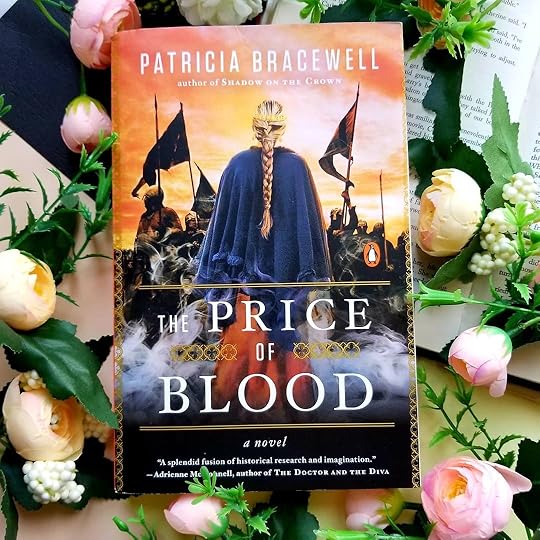
“The Price of Blood” is a gripping continuation to “Shadow on the Crown,” and I could not put it down!
There is so much happening in the story! The author does a terrific job in writing the tale. Many events take place, from the attack of Canterbury to the shocking events at All Hallows. I loved the author’s writing style, as she slowly builds the turbulent uprising between the characters and the situations.
Similar to the previous book, Emma goes through a lot in the story! From having more children to deciding who is trustworthy, she goes through many emotions. I enjoyed her scenes with Ælfheah and Æthelred. However, more than Emma, I thoroughly enjoyed Elgiva’s storyline. From leaving her father to marrying Cnut, Elgiva never has a dull moment. I loved the way she takes advantage of being Cnut’s wife on characters like Aldyth and Hemming! Also, I enjoyed her scenes with Alric.
Similarly, even the new antagonists like Edyth and Eadric were conniving and manipulative. Some of my memorable moments were when they both manipulate Emma’s life, where Eadric plots to take her son and Edytic schemes by undermining her authority.
However, there were some characters who I felt were not given enough importance. For instance, I felt that Athelstan was the same as in the previous novel, and there was not much growth. Also, it would have been nice if there was some progress in his relationship with Emma.
Apart from that, “The Price of Blood” was fantastic! The climax in the end completely shocked me as I did not expect the character! It perfectly sets the pace for the trilogy’s final book, “The Steel Beneath the Silk,” which I look forward to reading!

March 24, 2017
When I began reading The Price of Blood by Patricia Bracewell, I did not realize that it is book #2 of a trilogy on Emma of Normandy who was the second queen of Aethelred the Unready whose reign in England (979-1016) was besieged by Vikings who continually would sail to the SE corner of England
(Kent & Sandwich) and begin to 'rape and pillage' as well as burn, kill, steal until the Vikings would demand money. This money or tribute consisted of geld(a tax which was paid to these raider for peace) or gafol ("tribute paid to an enemy army to purchase peace"). It was a horrific time. King Aethelred was unable to raise a big well-trained army to fight the Vikings as the Vikings were so much better trained and usually they greatly outnumbered the English. Emma as all other women during the medieval period had no rights. She did belong to the king. She had to put up with how he treated her, and he did not treat her well. Being queen gave her a position that everyone in England had to respect except the king. Her duty was to produce hiers for the king which she did, but Emma was smart and Aethelred had to deal with that which he did not like. Her intelligence helped her in her battles with the king. The author writes about this aspect of the story very well. Basically, I picked this book up and could not put it down. This installment does not have to be read as part of the trilogy. It is a stand alone book as well. The ending is dynamite! I could not read it as quickly as I wished to do. Very well done! I highly recommend The Price of Blood.
(Kent & Sandwich) and begin to 'rape and pillage' as well as burn, kill, steal until the Vikings would demand money. This money or tribute consisted of geld(a tax which was paid to these raider for peace) or gafol ("tribute paid to an enemy army to purchase peace"). It was a horrific time. King Aethelred was unable to raise a big well-trained army to fight the Vikings as the Vikings were so much better trained and usually they greatly outnumbered the English. Emma as all other women during the medieval period had no rights. She did belong to the king. She had to put up with how he treated her, and he did not treat her well. Being queen gave her a position that everyone in England had to respect except the king. Her duty was to produce hiers for the king which she did, but Emma was smart and Aethelred had to deal with that which he did not like. Her intelligence helped her in her battles with the king. The author writes about this aspect of the story very well. Basically, I picked this book up and could not put it down. This installment does not have to be read as part of the trilogy. It is a stand alone book as well. The ending is dynamite! I could not read it as quickly as I wished to do. Very well done! I highly recommend The Price of Blood.

May 3, 2024
Once again, Patricia Bracewell has written a stunning account of Emma of Normandy and her years as Queen of the Court. Like it's predecessor, it's told from several points of view which include many other developed characters. So not only do we learn more about Emma and the king she despises, but we also get a glimpse of the very selfish Elgiva, who would do anything to be queen, and anything to get revenge on those who wronged her. And we have Aethelstan, who is forced to continue to support a father he has no love or respect for in order to protect his own inheritance which is in direct conflict of the ambitions of the woman he loves, Queen Emma.
I enjoyed this book more than the first because it moved so fast! There was constant action and deceit taking place, I could hardly put it down at night. Both sides, English and Danish do horrible things to the civilians just trying to live their lives without being raped, set on fire or murdered. Eadric, the kings right hand man, does evil, unspeakable things to not only adults but children under the guise of the crown. While the Danish wreak havoc on every settlement they come into contact with. There is no picking a side or rooting for one over the other. I think that's why I loved this book so much, it didn't go easy on me, it didn't have me fall in with one side or the other. I liked how the author made sure we saw all the brutality, she didn't push a bias.
A very well-written, well-imagined story of a powerless queen who nevertheless is determined to protect her children and her adopted country to the best of her abilities. I'm going to take a short break then get right into the third book The Steel Beneath The Silk
I enjoyed this book more than the first because it moved so fast! There was constant action and deceit taking place, I could hardly put it down at night. Both sides, English and Danish do horrible things to the civilians just trying to live their lives without being raped, set on fire or murdered. Eadric, the kings right hand man, does evil, unspeakable things to not only adults but children under the guise of the crown. While the Danish wreak havoc on every settlement they come into contact with. There is no picking a side or rooting for one over the other. I think that's why I loved this book so much, it didn't go easy on me, it didn't have me fall in with one side or the other. I liked how the author made sure we saw all the brutality, she didn't push a bias.
A very well-written, well-imagined story of a powerless queen who nevertheless is determined to protect her children and her adopted country to the best of her abilities. I'm going to take a short break then get right into the third book The Steel Beneath The Silk

March 23, 2022
"The Price of Blood" - written by Patricia Bracewell and published in 2015 by Viking, Penguin Group. Having read and enjoyed the first in this Emma of Normandy trilogy I was interested to continue her saga. As a young bride to Aethelred, King of England, Emma soon found that her hopes of being an equal partner were in vain. This continues in this second book as she bears him children and the country is once more thrown into war with the invading Viking warriors. So much political intrigue. Emma manages to keep abreast of what is going on, offering advice (rarely taken), while protecting her children. "Emma...courted his churchmen and ealdormen, garnered information, and corresponded with men of power." I really appreciated Bracewell's descriptive writing and will try hard to finish the trilogy while the story is still fresh in my mind.

May 19, 2020
Emma of Normandy is so interesting, and I think Bracewell has done a reasonable job bringing her to life. This is a pretty bog standard historical fiction, and Bracewell has done a serviceable job creating characters that aren’t too anachronistic and that stay mostly within the bounds of what’s known.
Most of what appeals to me about this is Emma herself, because she’s a fascinating figure in a pivotal moment in English history. If you’d like to know more about her, listen to the episode of the Rex Factor podcast that focuses on her. They do a great job of telling her story.
Most of what appeals to me about this is Emma herself, because she’s a fascinating figure in a pivotal moment in English history. If you’d like to know more about her, listen to the episode of the Rex Factor podcast that focuses on her. They do a great job of telling her story.
July 10, 2021
As a story, fascinating; as a series, riveting. The author fleshes out scanty history in a very satisfying way. I'm looking forward to the third book in the series. Emma's continuing development from frightened girl bride to powerful force behind a luckless king provides a strong narrative strand; the parallel story of the king's one-time mistress Elgiva, who becomes in this book the concubine of a foreign prince, gives dimension to the struggle going on for Britain's wealth.

May 19, 2020
I wonder when the last installment will be published. I can’t wait to finish the story of Emma and England at that time.

March 25, 2021
This novel was even better than the first one in the series. But it’s probably necessary to read book one first, the second one picked up right where the first one left off. Can’t wait to start the final book in the series!
Displaying 1 - 30 of 244 reviews