Jump to ratings and reviews
Rate this book

Zeroville: A Novel

Rate this book
On the same August day in 1969 that a crazed hippie family led by Charles Manson commits five savage murders in the canyons above Los Angeles, a young ex-communicated seminarian arrives with images of Elizabeth Taylor and Montgomery Clift the two most beautiful people in the history of the movies tattooed on his head. At once childlike and violent, Vikar is not a "cineaste" but cineautistic, sleeping at night in the Roosevelt Hotel where he s haunted by the ghost of D. W. Griffith. Vikar has stepped into the vortex of a culture in upheaval: strange drugs that frighten him, a strange sexuality that consumes him, a strange music he doesn t understand. Over the course of the seventies and into the eighties, he pursues his obsession with film from one screening to the next and through a series of cinema-besotted conversations and encounters with starlets, burglars, guerrillas, escorts, teenage punks, and veteran film editors, only to discover a secret whose clues lie in every film ever made."

10 pages, Audiobook

First published November 1, 2007

95 people are currently reading
6492 people want to read

About the author

Steve Erickson

61 books470 followers
Steve Erickson is the author of ten novels: Days Between Stations, Rubicon Beach, Tours of the Black Clock, Arc d'X, Amnesiascope, The Sea Came in at Midnight, Our Ecstatic Days, Zeroville, These Dreams of You and Shadowbahn. He also has written two books about American politics and popular culture, Leap Year and American Nomad. Numerous editions have been published in English, Spanish, French, German, Italian, Dutch, Polish, Greek, Russian and Japanese. Over the years he has written for Esquire, Rolling Stone, Smithsonian, Conjunctions, Salon, the L.A. Weekly, the New York Times Magazine and other publications and journals, and his work has been widely anthologized. For twelve years he was editor and co-founder of the national literary journal Black Clock, and currently he is the film/television critic for Los Angeles magazine and teaches writing at the University of California, Riverside. He has received the Lannan Lifetime Achievement Award, the American Academy of Arts and Letters award in literature, a fellowship from the John Simon Guggenheim Foundation, and a grant from the National Endowment for the Arts, and twice has been nominated for the National Magazine Award for criticism and commentary.

Ratings & Reviews

What do you think?
Rate this book

Friends & Following

Create a free account to discover what your friends think of this book!

Community Reviews

5 stars
1,211 (37%)
4 stars
1,325 (40%)
3 stars
513 (15%)
2 stars
143 (4%)
1 star
44 (1%)
Displaying 1 - 30 of 516 reviews
Profile Image for Vit Babenco.
1,784 reviews5,792 followers
October 22, 2021
The protagonist, Vikar Jerome is a huge fan of Montgomery Clift…
“Everybody say, ‘Is he all right?’ And everybody say, ‘What's he like?’ Everybody say, ‘He sure look funny.’ That's… Montgomery Clift, honey!” The ClashThe Right Profile.
Zeroville is a postmodern post-noir mystery of cosmic corruption in all its dire manifestations.
A clueless cineaste, having some nonstandard religious beliefs: “God hates children. God is always killing children in the Bible or threatening to. He kills His own child,” arrives in Los Angeles and his macabre cinematographic adventures commence…
And Steve Erickson begins his massive onslaught upon pop culture.
All the Los Angeles movies are the same movie, Vikar thinks riding the bus at night into the city of the wrong turn, where there’s no love just obsession, which lovers would choose over love even if they had a choice.

Pulp culture values are based on banality and vulgarity so imbeciles seem to become the best mass culture creators.
…since Vikar came to Los Angeles, all the children in all the movies are born monsters, born elephants, possessed by the Devil, are the Devil.

Even if truth can be stranger than fiction, it can never be stranger than pop culture movies.
Profile Image for Steven Godin.
2,782 reviews3,389 followers
June 6, 2025

Despite having one foot in the strange and surreal, and a protagonist who is certainly no Walter Murch—whose editorial credits include classics like Touch of Evil, The Godfather & Apocalypse Now—this is still one of the best novels I'll likely ever read about Hollywood, the mythic power of the movies, and the artistic process within the movie industry. The thing that grabbed me right from the off was this movie obsessed oddity with Elizabeth Taylor and Montgomery Clift tattooed on his shaved head turning up in Los Angeles in 1969 when it's all long hair and psychedelia and on the very same day of the Manson Family murders. So, when the LAPD pick up this newcomer in the middle of the night from a cave in Laurel Canyon smelling of pot then of course you're going to bring him in for questioning! After being poked around by the cops, who clearly thought he was a nutcase cult member/killer, Vikar gets a foot in the door and follows a path; a quite unorthodox path, of editing film. The movie industry and films in general in the minds of L.A.'s population during this period has dwindled; like that featured in Tarantino's Once Upon a Time...in Hollywood—the golden age is practically kaput. There is an uneasiness now; that feeling of entering a new, somewhat troubled future. After Vikar, who does have an explosive violent disposition, wanders about town watching classic movies, taking in local cinematic landmarks, and the crypts and cemeteries of the famous dead, he ends up working at Paramount as a set builder where he eventually strikes up a friendship with an editor, Dotty, who just so happened to work on A Place in the Sun. (One could even say this novel is a lose retelling of that film). And it's from here on that Vikar falls in love to the point of obsession with the art of film. Erickson, who deftly entwines the real and the imagined, chronicles Vikar's startling film odyssey over the years as we go from the likes of L.A to Spain to New York to Cannes—his acceptance speech and Q&A's at the film festival was hilarious!, and there are some memorable supporting characters all throughout the novel; including Viking Man, who dreams of being the next John Ford, the beautiful actress Soledad Paladin, and her young daughter Zazi. I was so engrossed in this novel, which I found to be funny, dreamlike, scathing and surprising profound, and it's the sort of work that I think will gain cult status. Vikar is now certainly one of my much loved literary anti-heroes. As a film buff there are so many references to so many movies and movie folk that Vikar felt like a film encyclopedia in human form. From European cinema—The Passion of Joan of Arc, Belle de Jour, L'Avventura, Emmanuelle (yep, even he thinks it's a pile of shit), to the likes of Taxi Driver and Superman to loads of old Hollywood classics. Speaking of movie making, James Franco's adaptation—where he also takes the lead role, wasn't half bad, when considering he absolutely butchered the likes of Cormac McCarthy's Child of God & William Faulkner's As I Lay Dying.
Profile Image for Jeffrey Keeten.
Author 5 books252k followers
October 1, 2020
”On Vikar’s shaved head is tattooed the right and left lobes of his brain. One lobe is occupied by an extreme close-up of Elizabeth Taylor and the other by Montgomery Clift, their faces barely apart, lips barely apart, in each other’s arms on a terrace, the two most beautiful people in the history of the movies, she the female version of him, and he the male version of her.”

CLIFT_TAYLOR

A Place in the Sun, what a movie! There are people who like it and those who dislike it, but none can deny...what a movie! There are fans, and then there are fanatics, and then there is Vikar Jerome who has the faces of Taylor and Clift forever immortalized in ink on the side of his head.

Don’t make the mistake of thinking they are James Dean and Natalie Woods; you might end up with a food tray broken over your head, but you will be happy to know that Vikar, these days, has learned to control his anger.

He moves to Hollywood to be closer to the movies. He doesn’t have a plan. He just knows he needs to be where the magic happens. He goes to movies constantly. He listens to the patter of movie talk from those he meets, and all of it gets logged into his head, a sifting, shifting file system of seemingly meaningless information given meaning. People become exasperated with him because he is a bit odd, but he does understand that he does vex people. Conversations with him always seem to get off track.

”’Cagney was complicated but Bogart was neurotic. You don’t get from Gable to Brando without going through Bogart, you hear what I’m saying?’

‘I know where Gable and Bogart are buried,’ Vikar says, then, remembering Jayne Mansfield, ‘at least I believe I do.’”


Somehow, through a series of bizarre events, Vikar ends up with a job as a film editor and actually turns out to be very good at it. He has seen so many movies that he can visualize a way to make mishmash into a watchable film. His job allows him access to the studio archives, and he liberates film canisters of his favorite movies...okay, he doesn’t liberate them—he flat out steals them. Soon he is thinking about finding a bigger apartment because of his hoards of movies that he has accumulated with no means with which to watch them. Obsessive?

Well, being an unapologetic book collector, I have nothing to say...nada.

He soon stumbles upon a mystery. ”There is a secret movie that’s been hidden, one frame at a time, in all the movies ever made.” He has to resurrect this film. This quest will have him deep diving into movie archives, looking to find each of the frames so he can finally watch the entire movie. Can you imagine what this would do to a compulsive guy like Vikar? It is the ultimate scavenger hunt, and madness may very well lie at the end of it.

”The movies have always been here. The Movies were here before God. Time is round like a reel of a film. God hates the Movies because the Movies are the evidence of what He’s done.” Okay, so Vikar can clear a room faster than anyone, but if you hang around sometimes, he hits you between the eyes with lines like that last one.

Crazy attracts crazy. ”The man looks at Vikar with a funny smile. Vikar touches his head to see if his cap is on. The man walks up to him, still smiling. ‘Can you imagine,’ he says in English with a French accent, ‘Bogart fucking Bergman with a cube of butter on the Champs-Elysees?’” Well, no, but now I can’t unimagine it. Is this image now going to haunt me every time I watch Casablanca? This is one of the hazards with reading a book by Steve Erickson.

The short, paragraph length chapters drive the plot of the book relentlessly. I love books about movies about as much as I love books about books, so this story had me by the throat and scrotum within the first few pages. I ignored my other books and chortled my way through this bizarre, very Hollywood type story. This novel is one long ode to the movies. If you haven’t seen A Place in the Sun, you should probably watch it before reading this book. You should see this great movie anyway, but it will give you some context that will increase your enjoyment of the book.

I already know I will reread this novel someday.

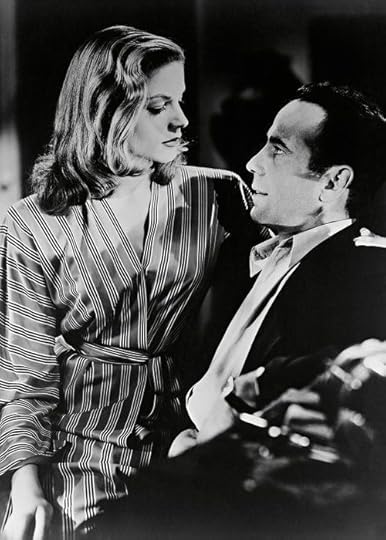
BOGART_BACALL

My appreciation for Montgomery Clift has certainly increased over the years. I might even admit that I’ve developed a bit of bromance for him, but he would not end up being tattooed on my head. For me, it would have to be Bogart and Bacall. Every time I looked in the mirror, I would love seeing his puppy dog eyes and her dipped chin that made her eyes look so intently into all of ours. If I were going with a more modern choice, it would be Ethan Hawke and Julie Delphy. Share with me what movie star pairing you would have tattooed on your head.

Remember: ”’This isn’t Alphaville, this is Zeroville!’”

If you wish to see more of my most recent book and movie reviews, visit http://www.jeffreykeeten.com
I also have a Facebook blogger page at:https://www.facebook.com/JeffreyKeeten and an Instagram account https://www.instagram.com/jeffreykeeten/
Profile Image for Oriana.
Author 2 books3,829 followers
May 15, 2014
On the whole, this was a phenomenal book. It's all about movies, but also about punk music, hippies, madness, murder, blowjobs, surfing, Joan of Arc, god, forgiveness, wonder, and maybe even love.

It lost one star for the ending, which I wouldn't usually do—by "ending" here, I mean literally the last three pages—but the more I've thought about it, the more upset those three pages have made me. It really does color the entire reading experience to have an ending that leaves you feeling unsettled and perplexed at best and lazily duped at worst.

So that's the bad news. The good news is that this was probably my favorite tale about a socially inept crazy person since The Curious Incident of the Dog in the Night Time . Vikar (our hero) is amazingly drawn and consistently fascinating. I definitely fell in love with him a little bit, which is a dangerous thing to do with a quasi-autistic, because he will break your heart without even understanding the basic emotions necessary to do so. Zazi (our heroine) was also stunning, reminding me somewhat of a Pynchon construction, maybe like Prairie in Vineland, though ultimately much darker and less redemptive/redeemed. There are some fantastic secondary characters too, like Viking Man and Dottie and the afro'd robber, who is kinda just there for (dark) comic relief, but his few scenes were just sensational. Soledad was the only character I really didn't like, because she was the utterly undeserving love interest, and that shit always pisses me off.

Jeesh, and I haven't even said anything about the story yet. Well look, it's all all all about movies, a million old movies all intertwined and hinted at and mentioned sideways and in passing. It's also written kind of like a movie, by which I mean it's got hundreds of chapters, from one word to a few pages long, and at times you feel like it's sorta been "cut" in an editing room, and "spliced" together just like a film. (I borrowed that idea from someone in my reading group.)

Anyway, being more or less pop-culture-illiterate, I really didn't get the vast majority of these references, but it wasn't a problem; in fact I think it saved me from focusing too much on figuring out what movies or actors he was talking about, and allowed me to just revel in the pulse and thrall of the story.

So in conclusion, I will definitely read more Steve Erickson, and would probably be wise to reread this one some time.
Profile Image for karen.
4,012 reviews172k followers
May 25, 2021
i want to say this is great, but it just didn't move me enough to be great. and i love steve erickson, but it's a much less...complicated plot than any i've read of his, which might be why i didn't engage in it fully. also i've never been a fan of the "inactive damaged forrest gumpy life swirls around it" hero. (yet i love hamlet...) i don't know - the sea came in at midnight is one of those books. i had an intense physical reaction to it. as it started coming together, there was a moment my heart started going faster and my skin started crawling. doesn't happen often. magnetic fields, lost scrapbook, infinite jest... when they start unfolding (for me) i feel it, i get excited; they are perfect books. and this one was less than that. but i also have the flu, so who knows...

come to my blog!
Profile Image for Ed.
Author 1 book445 followers
July 15, 2019
Zeroville is a novel about art and the artist. Whether it be film, music or literature, it is an argument in support of true art over its simulacrum in mass media. It is a strange and surreal experience: there is the eternal battle of heaven and hell, parents killing their children (and vice versa), Abraham, Joan of Arc, strange encounters, mystical dreams and cryptic messages – what does it all mean? The novel treads a fine line between ambiguity and vagueness, sometimes straying more than a little too far towards the latter. Regardless, with its mad, yet utterly relatable protagonist, Zeroville is an exciting mix of the familiar and the weird. It is in fact a novel that defends weirdness, suggesting the complete abandonment of normality is a prerequisite for true artistic perfection.
Profile Image for Kansas.
815 reviews487 followers
February 24, 2023
https://kansasbooks.blogspot.com/2020...

"-Estuve pensando -dice-. Lo que dijiste acerca de ser un sueño.
-¿No es es ese el cliché del cine, Vikar?- ella sigue con la cabeza contra la tapicería, mientras atisba en su dirección bajo los párpados medio cerrados-, ¿qué son sueños?
"

Leyendo Zeroville de Steve Erickson, no entiendo como esta novela no llegó a mi vida antes, aunque también es cierto que ciertos libros solo se pueden valorar en momentos determinados, cuando ya te has construido todo un universo de libros y en este caso concreto también de cine. Zeroville es todo un disfrute para cualquiera pero más para el cinéfilo que lo lleva en la sangre porque toda la novela (independientemente del argumento central y del personaje de Vikar), funciona como una especie de puzzle o de juego: Steve Erickson a través de su protagonista, Vikar, hace referencia continuamente a películas, muchísimas, sin decir el título, y a muchos cineastas, sin dar su nombre, pero da las suficientes pistas como para que el lector los pueda ir reconociendo, Brian de Palma es Hitch, por ejemplo, asi que no puedo decir otra cosa que me lo pasé genial en ese aspecto.

La novela es un enganche total que me leí casi de una sentada, desde el mismo momento en que Vikar Jerome llega a Hollywood, hasta el final de sus páginas. Vikar llega a Hollywood a finales de los años 60 en un momento en que la industria del cine está cambiando y metamorfoesandose en algo distinto; ha descubierto el cine 11 meses antes, no había visto ninguna película antes por su rígida educación calvinista en la cual su padre no permitía salirse del tiesto. En cuanto Vikar ve su primera película “Un Lugar En El Sol”, se obsesiona con el cine y a partir de ahí, el cine es su vida. Imagino que el personaje de Vikar está basado libremente en la vida de Paul Schrader porque si buceas en su vida, es justo eso, una obsesión por el cine con un pasado muy parecido. Vikar se afeita la cabeza y se hace tatuar a Montgomery Clift y Elizabeth Taylor que se van a convertir en un referente continuo durante toda la novela. Vikar llega a Hollywood solo por y para el cine, pero cuando llega se da cuenta que los que deberían saber más de cine no tienen ni idea, ni les interesa, y sin embargo, en los personajes de la calle que se va encontrando, viven y respiran cine como él.

Durante el camino, desde el momento en que llega a Hollywood y pasa por Nueva York, Cannes, Paris y la Cinemateca francesa (templos cinéfilos), Vikar se va encontrando multitud de personajes en su camino, que van evolucionando desde momentos desternillantes hasta una reflexión muy seria sobre la creación artística pero quizás en ese aspecto uno de los detalles más atractivos de la novela, sea el personaje de Vikar, a quién en algún momento lo presentan como “cineautista”: Vikar es un personaje puro, cuya ingenuidad es dificilmente manipulable y con quién el lector conecta enseguida. Vikar siempre está a la búsqueda de algo que parece que no puede encontrar, aunque sabe de sobra que si lo encuentra, será en algún plano escondido de alguna película: desde Un Lugar en El Sol, pasando por infinidad de películas hasta desembocar en la Juana de Arco de Dreyer…, continuas referencias, conversaciones en torno al cine que fluyen y convierten esta novela en un placer total y absoluto.

La novela de Steve Erickson es perfecta en todos los sentidos, por cómo muestra el momento de ruptura que significaba el tipo de cine que se empezaba a hacer en los 70, pasando por la evolución del personaje, y finalmente por como estructura Erickson la novela, en capitulos que simulan el proceso de montaje de una película, y realmente lo que he aprendido leyéndola sobre lo que significa la edición en una película es impagable, la esencia del cine.

"Esa película es como un fantasma. La ves a solas y te conviertes en la cosa o persona acosada por ella. Anoche, la película se volvió mía y de nadie más."
Profile Image for Mariel.
667 reviews1,211 followers
June 4, 2012
It just seems... radical, any movie that, like demands your privacy, because it's, you know... a movie like that makes common sense completely beside the point, and you're one on one with it, in the living room by yourself rather than the theatre with all those people, and watching it is like being naked and you can't be naked like that with strangers, you can't even stand the idea of it, and you know that after you're finished with it, much more with a movie like that than any stupid horror flick, some deep dark shit is going to be waiting at the bottom of the stairs... so I just couldn't sleep. That movie's like a ghost. Watch it alone and you become the thing or person it haunts. Last night, the movie became mine and no one else's.

She's Luis Bunuel's long lost daughter and you'd be surprised what fathers would do to their daughters, like never look at them through the screen. You can love movies but that doesn't mean they are ever going to love you back. Jim Morrison is the lizard king and he's my belly crawling father. I went to the movies and saw the stars. I went there and they made me. Maybe I was adopted out of a family of cinematographers and life is slow motion blood curdling. Make that 1970s cop show editors and it is freeze frame danger. Ringo peed in this hotel where Harry Houdini escaped the cowboys and indians (or was it the Nazis?) and maybe he stuck it in your mama as well. I remember watching the vicious "tv baby" that Max Perlich played in Gus Van Sant's Drugstore Cowboy and feeling embarrassed, like I was going to end up like that. (He kicked the shit out of Matt Dillon. Not my bodyguard!) I swear on David Hasselhoff's imminent Hollywood star that we are not all like that, us tv babies. I sometimes wonder if I didn't do it all wrong when I raised myself on movies and television shows. Mother's milk and infomericals bed time. I never figured out what comes next, other than waiting to go to sleep again for the next dream. Cue the super serious music on Full House and sit on Uncle Jesse's lap (Full House will only lead to blow jobs in movie theatres, be warned). Joan of Arc is on the table and the television detective asks Did You Do It? I swear on the eternity of the god dust, I didn't. It was him, I mean me. That guy on the screen. His blood, their hands. What did I teach myself? It wasn't mother, father, teacher, lover, friend.

I don't think I've ever seen A Place in the Sun, the 1950's film tattooed on Vikar's head. Is the artistic side Liz? Is the sporty side Montgomery, or is it the other way around? Is the light side the Liz side that waits in the bed under the sheets in a pin up pose of out of reach if you could only have me? Too late, time to go to work. I haven't seen her so all I've got are magazine perfume samples of White Diamonds that doesn't last enough or linger too long, depending on if you like the fragrance or not. Or is the dark the Montgomery Clift side that has waited all his life for you? Tell Mama all. I think I would remember the wolf. Stitch it together for the mask. I think I would have remembered Shelley Winter's cow eyes. The fat tongue is edible and through the hole in the mask mouth. I haven't seen A Place in the Sun but I know that Alice, the poor girl he knocks up and would kill to be rid of, has cow eyes because Shelley Winters was like the go-to gal for cow eyed women (see: Night of the Hunter or Lolita). When I was little I understood Cat on a Hot Tin Roof somewhere in my little gut. John Malkovich in Dangerous Liaisons said that education is never a waste. I want to see A Place in the Sun and discover if Dotty the film editor is right that we want Monty to kill Winters so that he can reappear between Liz's sheets. I never know if I'm going to want what someone else wants, though. She may be the most beautiful woman that Vikar has ever seen but I am self taught and self raised on movies. Do movies show people that thing that they will never, ever have and then they have to step out of the darkened theater and back out under the sun where that place doesn't exist?

I feel like I wouldn't have anything, wouldn't know anything, if it weren't for movies. I guess it is kind of fucked up because they aren't real. I definitely don't trust my own take on anything, if that makes it any better. Hey, that's why I felt at home (mostly) in Zeroville. Vikar is the same way. We don't know anything! We would understand the Elephantman and his other's voices in the only out of body he can get. You could see a smile in one movie and then when it reappears again in another you would know that he was thinking about the father that left him long ago. Does Joan hear the voice of God showing her the way? Does it really matter when that's what you've got? They are voices, people who sweat and tears, making these things and then those things walk across your dreams now without them and now with you. So what if I'm getting to where it can't possibly be enough? That's who will talk to me.

I could pick from dozens of examples (way more than that) for this and I'm going to go with Adrienne Shelly because for some reason I was thinking about her a lot today. Oh yeah, I was thinking about her because I was thinking about Joan of Arc (Joan is all over Zeroville- I'm not being crazy!). [Rest in peace Shelly. You may remember that she was tragically murdered not too long ago.] Shelly is one of my favorites for many reasons. Would that I were good at explaining away the "It" screen presence thing then I could explain away why some look that John Turturro had on his face in Unstrung Heroes made me believe that there was this husband and wife and family who really did love each other. One look and it was true. Sure, it's fake and movies and written to be that way. It's something when you can make that decision together to just go with it and watch and give a shit about this thing for that time, right? Since her first films The Unbelievable Truth and Trust (both Hal Hartley films) Shelly had a stylized way of speaking that I don't really know how to explain. She's even got a bit of a little girl voice vulnerable thing going on in a way that has more to do with how she looks at you and not how you look at her (maybe that too). Well, she also wrote her own films and starred in them and she was just as good without Hal Hartley (damn straight!). I would believe that she could walk off the screen and deliver these witty lines and break your heart on her sleeve just like that. Sudden Manhattan she made in 1996. Her character, Donna, is prone to fantasies. Well, she kind of has visions. Okay, she could be taken as crazy pretty easily, probably. The way she played (she wrote and directed it) Donna was enormously comforting to me. It was as good as if someone gave me a hug and told me it was going to be okay to be overtaken by (putting it kindly) flights of fantasy. No one has ever made me feel better about being me, like I was less alone, like she did. There were fantasies and they were their own kind of real outside of but just as valid as real. There was never an Adrienne Shelly moment on screen (that I have seen. I've seen a lot but by no means everything) that did not feel like that to me. So what if it isn't real, right? When do real people go about opening themselves up like that for you to see in this moment like if you could walk in on the moment when there were no barriers? (I know I'll never not be hooked on stories because I need this. I've been this way for my entire life. I can trace it back to my earliest memories. They were of me making up stories.)

To be honest, I am being perfectly honest any time I have ever kvetched in a book review about how boring it is when beautiful this and beautiful that is trotted out yet again for the umpteenth time. I am raising myself on movies for something else that I am not going to be able to get anywhere else. Is that Liz? I can dream. I look for simplicity, complications, the moment it is more true than other moments- all if you have the will to let it in. It is real somewhere, maybe. But I know what it means to be bereft when it is over and you don't get that place in the sun. It's not about being with a rich girl, for me, and it doesn't have to be. Again, I could pick different examples than this, of course: Martin Millar wrote two of my most beloved books Lonely Werewolf Girl and Curse of the Wolf Girl. Emilie said about the best thing I've ever read on goodreads that Millar was like writing those characters to be his friends. That is what it is like! I felt at a loss like I've never felt before when I finished reading 'Curse'. Good-bye friends. Still, I kind of understand why every time I check Millar's blog since its 2010 release that he is always playing video games instead of writing (even though I need that third book desperately). It is hard to get that from within yourself alone. If I could do it more often you can be damned sure I would write more often than whatever shit it is I tell myself in my head to get through the days. I would much rather have someone else's. It's company. I miss my love of movies before I picked books because they could take over my mind more. You don't look in the mirror on the stage.

I'm talking about me, me, me and I hate that. But Vikar is so much like me! He is even worse than me, really. We don't get it because how can you get your dreams?

I know why Zazi is Vikar's daughter even though he did not give birth to her. I know why she dreams of movies she has not seen. Movies raised Vikar up from the ground will and to his shoulders high will. Liz was the dream but he could say I hate this movie, I hate this movie, I hate this movie until he found himself going I love this movie. If it's background and genes to draw on then isn't it family? Live with it long enough. They tell themselves, they deny it and it is always there no matter what. There were enough looks between Vikar and Zazi's poor crazy mother, Soledad. Looks that said I know what you want from her (she didn't). Looks of anger when she leaves the girl in the car. She's a mask of judgmental looks that probably felt at home the most when she could judge him for her daughter and not turn the look on herself for what she did. Self righteous anger to last forever, for her. She was with her father. She was with friends. They aren't totally dependent on each other and they aren't everything, Zazi and Vikar. That's much better than the using mask. The eyes merge with the mask's eyes for them, sometimes. I'm jealous. Erickson didn't tell me he was her father until I already suspected it. That's what I love about movies. I can see the look cross their face before they say that devastating line. It can be the difference between someone who listens to you and someone who is just waiting for their turn to talk. You know it before you know it. I wish I was good at explaining how to get this quality so that anyone reading this will know what I am talking about. Well, I knew what they were talking about when they talk about the Sound and the other things that get them going in the dark, even if I'm not looking for something I CAN'T have (Liz). I'm looking for a way to keep it going. That's doing the thing where you aren't just waiting for your turn to talk, if that makes any sense. What comes next, though, they don't know any more than I do.

Vikar turns his head from side to side, from profile to profile in the reflection: which profile was it that Monty broke on the steering wheel? Was it the profile that revealed his light, or the profile that revealed his dark? If Vikar were in the editing room choosing one over the other, would he choose Monty's beauty over his truth, if in fact it was the profile of truth that was shattered? And if the profile of truth happened in fact also to be the profile that was still beautiful, still unbroken, what did the light lose to no longer have the dark?
I would want to see all of them! It's the eyes that take in and the eyes that remember.

Vikar gets a job as a miracle editor. I don't like to think about editing, to be honest. I know what it is and I know it is important. It's too much of a mind fuck for me to know that someone was splicing together some look from another take with another take and maybe actor x wasn't looking at actor f with that help me look. I have a hard enough time with what is true! It's all filmed out of order. Edits on set. Yeah, yeah. Yeah, I know William Goldman was right in his book Adventures of the Screen Trade (great book) when he said that no one knows anything and when it works out it is all an accident. Of course, he was talking about Hollywood, and Erickson is right in this book when he has a character say that no one would ever call Bunuel a lunatic. Maybe if I could see Joan's face I would hear what she hears, see what she sees. Vision is vision, right?

I can see these expressions and think they mean shit but it really is no good in real life when I try to apply it to some face someone makes. It's really quite worthless.

I didn't mean to babble this much but I've been spending too much time by myself today and so here is a long ass book review. I wish I had a movie to step inside. (I had been going to write about Joan of Arc.)

Oh yeah, and the title comes from a line from Godard's Alphaville. I haven't seen that movie in a long, long time and did not remember it. I did remember when Anna Karina goes to see The Passion of Joan of Arc and cries. I could never forget that. I hope I never forget this character who was not a prostitute for real in Vivre sa Vie who has her own life to live the same. I don't care. I believe in that. Erickson does too. That's why I like him.
Profile Image for Christine Palau.
55 reviews17 followers
June 2, 2012
Steve fuckin' Erickson.

"Steve Erickson has that rare and luminous gift for reporting back from the nocturnal side of reality." Thomas Pynchon

Incidentally, Erickson and Pynchon share a literary agent, Melanie Jackson, who happens to be Pynchon's wife. To me, this is interesting, especially since I'm starting Gravity’s Rainbow as soon as I finish this review.

I've met Steve Erickson on three separate occasions, and each time I think he hated me more:

1) Back in February I went to a reading for Percival Everett (SE was also on the bill). I had never heard of Erickson (don’t ask me how), but when he read from "These Dreams of You" I was electrified (I actually felt tingly, my eyes a little brighter, my ears more open, my heart beat faster). Another book he'd written, "Zeroville," about a movie-obsessed freak, was mentioned. I only bought "These Dreams of You" and had him sign it. I told him that I'd never heard of him until that day.

2) A couple months later, I saw him at a library party, and after one too many gin-and-tonics, I told him I loved "These Dreams of You," and how excited I was to read "Onesville." He looked at me dumfounded...who is this person and how did she get in here?...he must have thought. Sounding a lot like how I imagine Vikar, he said, "Oh, you mean Zeroville." SE was not charmed by my momentary aphasia.

3) The next day, at the LA Times Book Festival, I saw him on a panel. Ready to right my wrong, I bought "Zeroville." This time when I asked him to sign it, I reminded him of my stupidity the night before; he didn't need reminding, but he joked that he might have to write "Onesville" next. I probably should have left it at that, but I had to tease back that I might beat him to the punch with a fan-fiction with that title. He scribbled his name. I left, a failed Pamela des Barres.

Did this humiliating experience detract from “Zeroville”? No way in hell! I love Vikar. I connected with him way too much, I saw other people in him, I saw him in other people, my dog included--my dog, especially. I can't get his voice out of my head. I want movie people (especially editors!), music people, anyone who's ever been obsessed about anything to read this book.

There are so many fantastic moments (the robbery/chat, Ali and “not ever!”, the coincidences, scenes existing in all times, etc.) and characters (Vikar, Dotty, Zazi Viking man, Maria), I don't know where to begin. I have post-it notes on nearly every page, and normally I have no problem quoting from the book, letting the author's words speak for themselves, but I'm afraid I won't know when to stop, and I’ll reveal too much.

Part of the messed up joy of this equally messed up fairy tale is not knowing or expecting where it's going, so without giving too much away, I'll just quote from page 210:

"Americans are in love with shame," Vikar says. "Can you imagine Bogart fucking Bergman with a cube of butter on the Champs-Elysees?"

This isn't even the first time the line is uttered. He's reciting the words from someone he'd met earlier, but the context and the imagery is enough to make this one of my favorite scenes.

Coming off of TR and going into GR, this book reads like YA, not emotionally, intellectually, or psychologically, of course, but there is an effortlessness in the act of reading (not so much digesting) "Zeroville" which makes it a great accompaniment to something a little more dense. Don’t get me wrong, it's just as satisfying and wrenching, but it doesn't take the same toll on your time, eyesight, or wrists.
Profile Image for Melanie.
369 reviews158 followers
July 7, 2019
This is weird. Most of the people who wrote reviews for this book loved it. I found it ok. I was interested enough to finish it 🙂
Profile Image for Lizz.
436 reviews116 followers
December 21, 2024
I don’t write reviews.

And I really don’t know how to write about this book. It was definitely interesting. I didn’t enjoy the staccato chapter breaks until we reached the zenith and started counting down. (Yes, the chapters count up to the max then back down to zero. Zeroville, right?) It was alright, but really not cute enough to bother chopping up the story.

The story? Vikar. He’s kind of like that guy from Being There and The Dude from The Big Lebowski, but with some form of autism. Like Being There, he meets a bunch of people who influence his life or because it’s his fate in life, he meets a bunch of people. Like The Dude, he takes things these people say and repeats them later as his own opinions. Usually these are opinions on film and culture.

“But of course the western changed along with America’s view of itself, from some sort of heroic country where everybody’s free, to the spiritually fucked up defiled place it really is. And now you’ve got jive Italians, if you can feature that, making the only westerns worth seeing anymore because white America is just too fucking confused. Can’t figure out whether to embrace the myth or the anti-myth. So in a country where folks always figured you can escape your past, now the word is out that this is the country where you can do no such thing and this is the one place where, like the jive that finally becomes impossible to distinguish from the anti-jive, honor becomes impossible to distinguish from betrayal.”

By the end, I could say I was invested. Vikar was charming and I couldn’t help but care about him. If this book was really written in the seventies or eighties I think it would have been better. How? That’s not something I can put into words. You can just feel the modernity somehow and that I don’t like.
Profile Image for Jon Zelazny.
Author 9 books52 followers
May 19, 2023
Given the themes of aesthetic deconstruction and L.A. isolation, the severely autistic Vikar makes a perfect protagonist, but it also means we're stuck with a severely autistic protagonist. Everything we know or can surmise about Vikar by page 25 is all we'll ever really know, a problem exacerbated when every character, situation, and movie this saintly, creepy Zelig-Gump-Chauncey Gardiner wanders into is more interesting than he is.

For the longest time, I couldn't figure out Erickson's game, but soldiered on because I could identify 95% of the movies/directors/stars/locations/rock groups he hints at. It only took me fifty pages to realize the stanza numbers had started going backwards, at which point I finally began to glean a Grand Design bubbling up through the picaresque journey and endless references.

Can you enjoy this without being a total movie freak? Reviews here suggest not. At the very least, Erickson gets kudos for casting writer-director John Milius as Vikar's Sancho Panza. Like his alter egos in AMERICAN GRAFFITI and BIG LEBOWSKI, 'Viking Man' never fails to juice up a scene.
Profile Image for L.S. Popovich.
Author 2 books460 followers
June 10, 2020
Abandoned at 65%. I'll only comment on the positives and negatives I noticed listening to the audiobook version. Don't know about the ending, but was not sufficiently engaged to finish it.

Beginning showed a quirky voice. I liked the cine-centric commentary and obsession with old film stars running through the plot. Some irony and attempt at grand themes. Kind of a stretch considering what's actually occurring in the novel.

Plot starts to meander. I lost count of the chapters after 225. Why so many chapter breaks? Is each chapter like a frame of a short film? The main character shows increasing zombie-qualities, an inability to relate with people, borderline mental deficiencies handled for the sake of humor? Vikar is clueless, yet luck is on his side. Plenty of deus ex machina, things happening to him over and over, rather than Vikar doing anything to affect the plot.

The book is an outlet for the author's film commentary. Includes some spoofs of popular culture nerds, druggies and other so-called outcasts. There is a nostalgic quality to the setting, but I did not find it rewarding or interesting. The prose was dry and unremarkable. No stand out descriptions. A couple laugh out loud moments, but ultimately left me empty. The unreality is more convincing in Murakami, and the aberrant behavior is better related in Bret Easton Ellis. Brautigan is funnier. Despite the excellent reviews out there, I have to rate this one based on my lack of enjoyment.
Profile Image for Danger.
Author 37 books732 followers
June 19, 2017
An engaging, sometimes shocking, sometimes lyrical, mostly metaphorical journey, we follow Vikar, an emotionally-damaged, quasi-autistic man for a decade and a half in Los Angeles, from the summer of the Manson murders, until sometime in the early 80s. While almost Lynchian in its mysteries and revelations, this book still firmly sets its roots in reality (weaving the mythology of early-and-middle Hollywood) while allowing it’s symbolic wings unfurl and take flight. An interesting read, that often makes you work a figuring out the meaning. I liked it!
Profile Image for Nate H..
83 reviews57 followers
May 8, 2015
This novel took me by surprise in a way, I listened to the author talking about it in an interview on a radio show called Bookworm hosted by Michael Silverblatt and cool it sounded interesting, but I didn't think the quality of the writing itself, the care the author put in every page and the vivid characters and out-of-this world atmosphere would be so well-developed and in my view fully accomplished. Mr. Erickson has won a new admirer.
Profile Image for Jonfaith.
2,147 reviews1,748 followers
April 16, 2012
The trek of a reading adult is often a lonely and opaque one, only in the sense, that the course is personal and peers can only shrug and smile, but the path continues. I can say that if I could ever pen a piece of literary achievement, it would be Zeroville.
Profile Image for Vicente Ribes.
904 reviews169 followers
November 23, 2020
Un canto de amor al cine hecho libro. Creo que si te gusta el cine disfrutas mucho este libro, si no te va a costar más entrar en él. Pero aún así la lista de películas que no habia visto y que he apuntado es bastante grande.
La novela trata sobre Vikar, un chico CON on las imágenes de Elizabeth Taylor y Montgomery Clift tatuadas en la cabeza que llega a L.A. para intentar entrar en el mundo del cine.
Aprenderá los entresijos de Hollywood y huirá de todo lo falso porque sólo quiere emular a sus ídolos del celuloide. En su viaje conocerá el amor de una femme fatale,hará amigos, probará las drogas y vivirá la explosión del punk, e incluso viajará a la España franquista.
El libro es bastante delirante en algunos tramos y la película que hicieron hace poco es tres cuartos de lo mismo, porque adaptar esto no es fácil. No me sorprende que a Pynchon le encantase este libro.
Yo de momento me quedo con un buen sabor de boca y unas 50 nuevas pelis para ver en un futuro.
Destacar a la editorial pálido fuego, la que descubrí leyendo la fenomenal "La escoba del sistema" de Foster Wallace y que sigue apostando por no mirar los libros por su comercialidad sino por su contenido de calidad, vamos como haría el mismo Vikar.
Profile Image for Ian Scuffling.
177 reviews88 followers
April 20, 2020
Quite a bit more straightforward for Steve Erickson, Zeroville employs America's myth-making industry, Hollywood, to tell a new kind of myth about the end of cinema's "golden age" and it's transformation into something altogether different.

Backed by the insurgence of punk in LA in the '70s, and the shifting cultural attitudes following the hippy-era, Erickson's encyclopedia of film qua novel is part character study, part neo-noir, part homage, part historical correction.

I liked this one, but it's hard to put into words what had me enraptured in it other than it took a familiar subject and setting and made it completely unfamiliar and foreboding as only Erickson can do. Like his later novel, Shadowbahn which soundtracks our conscious experience, Zeroville explores what films tell us about life and what they don't, how films shape us, and how we shape them.
Profile Image for Eugene.
Author 16 books298 followers
May 29, 2008
his plots have a comic-book-ness to them--if those comic books are the darkest and wildest of early era vertigo's or have the zaniness of first comics' AMERICAN FLAGG and BADGER. ...plots filled with the boyish wish fulfillment of sex and romantic alienation and isolating intelligence, all suffused with a self consciousness and self-regard about said wish fulfillment. ZEROVILLE's (seemingly) effortless epic goes on and on, doesn't let up for a moment, up to and including its spine-shivering finish. and vikar is as complete and unique a character as you'll find.

erickson, who's been called a science fiction writer excepting the science, takes us from cbgb's to the whisky, from franco to reagan, from bogart to belmondo--and hits almost too perfectly, too nonchalantly or exactingly fan-boyishly, every cool reference in between.

this is mean to say, but erickson is so good it is a kind of praise: he's been posing as an artist for so long the pose has become so natural he might in fact be one.

except. he writes his own judgment into the book. vikar and zazie know what art is: "no movie worth hating or loving has a comfort level." and they know art is at first necessarily ugly--before it can be recognized as sublime: "Once Cassavetes told me about seeing A Place in the Sun when it came out. He hated it so much that he went back and saw it the next day and then every day for a week, until he realized he loved it." and vikar knows movies are out of time and in all time: "fuck continuity." ...but erickson, while talking the talk, fails to walk it. ZEROVILLE, epic accomplishment and enormously fun read and rebel sexblast that it is, is very comfortable. and continuous. it fails to risk its coolness for terror and transcendence, fails to risk its storytelling for true mindfuck.

that meanly and pettily said, the book is a thrillride which i swallowed whole--in one dreamy day and night--and one which i loved inhabiting and thinking about. a ride i'm more than happy to have taken. erickson is the funnest of the contenders... a beautiful world if we could all fall short in such a hot-shit way.


erickson on ZEROVILLE: from a bookslut inteview:

It took me four months to write Zeroville, which is very unusual, I’ve never written anything even remotely that quick. I had planned to put off writing it for a year until I had a sabbatical from teaching, but the story was coming so fast, so many scenes filled my head, that I knew I better not wait. I almost feel I can’t taken credit for it — it was like the cosmos were saying, Here, you worked hard on all those other ones, so we’re giving you this one. It’s a freebie.

also on experimental fiction:

You know, I hear the word “experiment” and reach for my revolver. I don’t think of myself as an experimental writer. Experimental writing is about the experiment, and experiments per se usually are for their own sake. My interest is in whatever serves the larger story or characters. The numbers in Zeroville were a kind of Godardian conceit and just came to me, in the same way that Kristin “swimming” through Our Ecstatic Days came to me at the moment she goes down through the hole at the bottom of the lake that’s flooded L.A., and that she believes has come to take her small son from her.
Profile Image for Justin.
124 reviews26 followers
November 12, 2008
Zeroville is what happens when a brilliant film critic writes a brilliant novel. Steve Erickson is the film critic for Los Angeles Magazine, and though I've never read any of his movie reviews I can't imagine he's anything less than brilliant based on the quality of the prose in this novel, and the comprehensive awareness on display of film history and culture.

I have been experiencing a strange and thrilling serendipitous relationship with books recently, during which I have ceased choosing them myself, but have simply sat back and let them find me, through recommendations, gifts, casual references in an interesting magazine article, or whatever. The results have uncannily reflected and commented on my ongoing life. Zeroville was recommended to me right before I flew to Denver to act in a film shoot an old college friend was producing. Over beers one evening, my friend Matthew spoke of it quite fondly, impressed by the way Erickson weaved real events and figures from Hollywood lore into the fictional tale of an odd, troubled cinephile who becomes the most unlikely of famous, Oscar-nominated editors. The dropping of names like Robert DeNiro into a novel sounds like a recipe for disaster, but Erickson's hallucinatory Los Angeles is filtered through the perception of Vikar, a possibly autistic protagonist who doesn't "understand" comedies and bashes people over the head when they misread the tattoo of Montgomery Clift and Elizabeth Taylor on the side of his shaved head. He is not a cynical or judgmental person, and so we do not view the people he encounters with cynicism or judgment. They are the organic elements of '70s-era Hollywood's dreamy landscape. Vikar roams these Hollywood streets, watching movies, visiting the tombs of dead actors, and giving us a flat, beauty-less tour of L.A. that I found mesmerizing. My experience acting in the film in Denver, combined with reading Zeroville at the same time, made me want to move to L.A. and pursue more acting gigs. I am fascinated by the city's singular oddness, its role in creating works that shape mythology on a worldwide scale. Erickson captures its essence in darkly poetic fashion, showing us through the incredible character of Vikar how movies shape our lives and how our lives shape movies. The book is packed with incredible dialog, dazzling ruminations on the workings of cinema and its industry, and crackles with an incredible, intricate plot that never stops surprising you. I don't really feel smart enough or dedicated enough to explain it all, but I'll say Vikar's unlikely ascent to a coveted editorship ties in with a recurring dream he has, and sends him reeling through different parts of the world, struggling to make sense of it all. The ending is profoundly magical, unsettling, and gorgeous, and I am still thinking about it. I am also thinking that Erickson's book, for all its darkness, may wind up changing my life.
Profile Image for Ferhat.
36 reviews13 followers
November 15, 2021
Sinemayi tutku derecesinde seven herkesi tam kalbinden vuracak bir roman. Özellikle "A Place İn The Sun" filmini keşfetmemi sağladığı için bu romana çok şey borçluyum. Bir sürü izleyecek film not ettim. Sinemaya olan aşkımi bir kez daha tazeledi. Filmlerle yaşayanlar sakin kaçırmasın.
Profile Image for Richard Thompson.
2,939 reviews167 followers
May 29, 2022
Zeroville ends in the early 1980s, which is when my career in the movie business started. Like Vikar, I loved the movies, though I never had anywhere close to Vikar's knowledge of the films from Hollywood's Golden Age. Still there is an element of his obsession that I related to, and though I have never considered myself starstruck, it was pretty incredible when I first came to Los Angeles to be able to meet and work with people whose work I admired. I also strongly connected with the way that Vikar relates to the films he sees. Often his reaction is just "That was a good movie", or dismissing a film with disdain when it didn't meet his standards. But beyond his limited laconic commentary, it was clear that he had an incredible eye for details and an occasional deep insight into meaning, both of which play a role in the ending that I won't spoil.

For many years my wife worked as an agent at the William Morris Agency representing filmmakers. She was known for having an eclectic taste and an unsurpassed eye for developing talent. In a funny way Vikar was exactly like many of her clients - people who were idiot savants of the cinema, brilliant in ways that others could barely understand other than to acknowledge the brilliance; many of them were at the same time obsessed and yet curiously indifferent to the point of being almost autistic, and unwilling or unable to take the next steps when they were on the cusp of success. Several of them, like Vikar, didn't drive though living in the city of cars. And though I like to think that my wife was nothing like Vikar's agent, there were elements in the way that Vikar's agent talked and acted that made me smile with recognition.

One other thing that is worthy of note about this book is its curious structure, which I interpreted as a literary representation of a film's dailies in the form encountered by the editor -- viewed and numbered, assembled in rough order but waiting to be cut into final form. Chapters are short; the numbers go up and then go down, though the chapter numbers might equally well have been random, and the transitions from one chapter to the next are intentionally abrupt and unnatural because they are just the editor's rough assemblage without all of the smooth transitions worked out yet. All of this is also a reflection of Vikar's view of the world as embodied in movies - fragmented, circular, repeating, and ultimately swallowing its own tail.
Profile Image for John.
Author 17 books184 followers
May 29, 2018
ZEROVILLE strikes me as one of those masterworks in which a talent at its zenith catches hold of a theme that's its equal-- a subject that, in turn, snags the talent and puts it to a one-of-a-kind test. The Antaean struggle which results is a thing of beauty to watch. Erickson has produced a number of strange yet stellar booklength fictions, to be sure, and my favorite before this latest was TOURS OF THE BLACK CLOCK, by any fair standard a major revisioning of recent history. But with ZEROVILLE he reveals a new fondness for the hurtle of a great, involving story, grounded primarily in a new warmth for his main character. Erickson's film nut Vikar -- "with a K," he keeps saying, as if insisting on a lineage that goes back to Franz K and his creation Josef -- anyway, Vikar's the sort of almost-Asperger's case we root for. He comes to LA, always a source of haunting poetry for Erickson, with stars in his eyes and, even more nuttily appealing, tattoos on his shaved head depicting Montgomery Clift and Elizabeth Taylor, "A Place in the Sun." He's "cinautistic" as one of his friends puts it, a former seminary student whose life was changed by watching a movie. The story thereafter concerns Vikar's rise in the industry, one that takes us through both loss of innocence and its renewal, into brushes with everything from '70s porn to the knotty integrity of the best movie work. The text is thick with film allusions, naturally, trotting in Cassavetes here, Sylvie Kristel there, but Erickson handles these in a way that keeps the story primary. Essential to his narrative drive in its damaged but gifted central Seeker, who recalls Josef K entangled in his Trial yet also suggests, at times, the Mohawked Travis Bickle, and who throughout remains nonetheless Candide, capable of selflessness and sympathy, winning even when wrongheaded. At a few moments of high tension, in the late going, Vikar even tugs a troubled Goth girl back from suicide. No one else, I'd wager, could get so close to the mystic secret at the heart of film history, carrying an insight of Old-Testament power -- a secret that provides Erickson's climax, magnificently paced and engaging, for all its supernatural surprise.
Profile Image for David.
788 reviews384 followers
February 4, 2016
It’s a surreal novel as we follow Vikar who sports a the tattoo of Elizabeth Taylor and Montgomery Clift on his shaven head. The book is a bonanza for old moviephiles, it’s so entrenched in the Hollywood of the early 70’s. I barely managed to eke out the references to Taxi Driver and Blade Runner.

But all these references are signifiers. That individual scenes play to a larger theme. And the book still managed to pull me through this fever dream of a story that somehow evokes the idea of film before tentpole summer blockbusters and special effects eye candy. I don’t know what I just read, but despite my ignorance it managed to stick with me.
Profile Image for Matt Gibbons.
40 reviews
January 2, 2023
The quintessential Movie Mindset novel. The document that isn’t afraid to admit that a fascination with film often extends itself to a kind of devotion that borders on autistic obsession. Film provides an almost sacred interpretation of the world as a concise object ready to observe and analyze in a readymade fashion. It’s almost intuitive, exemplified by the way Vikar the protagonist absorbs them without interpreting them. They represent some aspect of life despite being artificially detached from it. It is a religion for some for its piety of vision, and it’s easy to surmise why a disaffected follower of faith might flock towards it as an alternative. As a raised roman catholic, I can sympathize with such a notion, being a ‘cinephile’ myself. Guilt driven devotion ‘enlightened’ by the deprivation of the shame necessary for its function manifests itself in other forms of obsessive behaviors. Be it secular or not, you can’t take the indoctrination out of the subject. It will only find a new channel. Largely Erickson’s point, I believe, is that while we move towards new technological frontiers, the dogmatic fixations change with them. No longer necessary is blind devotion to something we can’t see or touch. Now our God, our Bible is represented by the kind of realization afforded to us by our innovations. Our ideals are fed to us by visual stimuli which is more powerful than any purely theoretical dogma to the human mind. Who is God when there is Montgomery Clift? Culture is the new religion and it was helped shaped by the idea of Hollywood. A mythical place that never existed in reality, only attainable through imagination. An idea everyone implicitly absorbs but will never understand. How many Vikars are there in the world and to what extent do they shape the future as dictated by the past? What does that say about the health of our collective conscious, and how will it interpret the present?
Profile Image for Dillwynia Peter.
343 reviews67 followers
May 3, 2019
To maximise getting the most out of this novel, one needs to be a huge fan of Hollywood films. Hundreds of references are made to pivotal films of the Golden Years, while the narrative is set during the New Hollywood or New Wave period of the 1960s to 1980s. A cursory interest or knowledge of cinema makes this book OK but not great; way too much is missed by the reader. The New Wave was an important part of Hollywood film history: it was a period of when directors, rather than film companies controlled what was made. It created the blockbuster with Jaws, and controversial topics such as homosexuality, blackploitation, women’s rights etc were themes that were screened and discussed. It did also generate the over-budget movie and almost wrecked the film industry. For me – there are a lot of great films, but also way way too many dross, and some actors never fully expressed their acting potential. Having the background of New Wave cinema as a core part of this novel meant we were entering interesting and fertile ground.

The structure of the novel grabs your attention within about 10 pages. The chapters are strange, weird and not natural. Turn them into edit cut markings, and it all is clear; you are reading a film script/ visualising a film being constructed for narrative sake. This is cool just in itself and grabs your interest. Editing of film is a strong part of the narrative as we follow his career as a film editor for a major studio. His mentor is almost a pastiche of some the more famous editors of the day. I when hunting but was not able to define who they were.

Our (anti)hero is odd by any standards. Now we have a term – autistic – but then it was not understood and the people around him treat him accordingly. Vikar is a difficult character to like, but that is fine, because we, the reader, understand him unlike the strangers he encounters. He is also broken – he has been abused by his family, and what his philosophy and world views are skewed, and influenced by either that sadistic religious father, or by film. The response to Vikar is typical of what autistic people encounter: there are those that discover the talent under the exterior, and he is treated both fairly, and exploited; or he is shunned as a freak. He is an excellent foil to push the narrative along. In particular, it allows our author to explain much more than had he been immersed in the popular culture of the day; the author is able to cheat by explaining much to a contemporary audience. The counter-culture and how it is perceived, and how it flowed and changed the film industry really works well.

The chapter numbers give it away, but without them it is still apparent that the narrative follows an arch such as encountered in Milton’s Paradise Lost. We start and end at the same place, but our journey has changed us. How that journey plays out is a spoiler, so I shall be quiet. Personally, I didn’t enjoy this aspect of the start & finish involving Zazi & her influence.

Vikar could be considered as Pilgrim that journeys in Bunyan’s Pilgrim’s Progress. It is important to remember that at this period, cult leaders proliferated. It is hardly surprising, drugs can induce enlightenment states, and with the cultural upheaval that was happening, some people found solace in religious security. Thus, the discussion of God, disciples and religious fervour are obvious in the novel. That abusive religious upbringing (not that uncommon) also have an affect on how God is viewed, both by Vikar and the people he encounters. These themes dove tail nicely with the counter-culture themes.

In early Monty Python (their TV show) the crew often had clever skits that had brilliant starts and middles, but woeful endings. This novel is the same – the ending is a shocker and a massive disappointment. Erickson writes himself into a corner. I did ponder how it could be changed, and I couldn’t think of a superior alternative ending – all of mine where just as weak.

Having said that, if you have a fondness of the counter-culture in California of the 1970s and 80s, and you have an encyclopedic knowledge of Hollywood films, then you are really going to love this book – and like me be kind to that ending.
Profile Image for Agnese.
142 reviews122 followers
March 30, 2017
I hesitate to recommend this book to everybody, but as a film buff, I absolutely loved it!
Set in the 70s, in Los Angeles, the novel follows Vikar, a young and inexperienced man with violent tendencies, who’s obsessed with movies and has a tattoo of Montgomery Clift and Elizabeth Taylor from A Place in the Sun on his shaved head.
He comes to Hollywood in 1969 to be surrounded by people who are as passionate about movies as he is, but pretty soon he becomes frustrated when he realizes that most people that he meets don’t know or care that much about movies, instead people seem to be more interested in the music scene and indulging in hedonism and different forms of experimentation.

The novel explores and, to some extent, also critiques the transformations that took place in the Hollywood film industry during the decline of the studio system and the rise of young, radical filmmakers, the so-called New Hollywood, by showing how some film industry veterans with significant experience and knowledge were under-appreciated and pushed out of the industry because of Hollywood’s increasing obsession with youth culture.
The novel also looks at the beginnings of the punk rock movement. Even Vikar is unwittingly drawn to the raw sound of early punk rock, admitting, for example, that he likes “that song about the dog” referring, of course, to the song “I Wanna Be Your Dog” by The Stooges.

Vikar is a fascinating character, there’s a terrifying intensity about his passion for movies, one of the characters even describes him as “cineautistic” because of his unique view of the world that seems to be shaped and influenced by the movies that he has watched.

The novel is a surreal, funny, and sometimes disorienting love letter to film that suggests that movies transcend time and articulate our collective experiences and dreams long after the people who made them are gone. It’s interesting how the novel plays with the idea of time as a loop or like a reel. Vikar believes that a movie exists in all time and all times exist in a movie. Later on in the book Vikar makes a bizarre discovery that sort of confirms this idea and connects all the movies that have ever been made.

What I also found interesting is how the novel is split into hundreds of short chapters that kind of mimic the way a film is cut and put together in the process of editing. For example, there would be a sudden break in a sentence and then it would continue on in the next chapter or a new chapter would indicate a transition to a different setting or scene. I thought that was very creative.

A great companion to Zeroville is Peter Biskind’s non-fiction book “Easy Riders, Raging Bulls” that provides a great overview of that transitional period in the Hollywood film industry and definitely helps to recognise and understand many of the references to movies, actors, and directors that are included in this novel as an integral part of the narrative. I think that the more you know about that period, the more you will enjoy this book.
Profile Image for Jason Pettus.
Author 21 books1,453 followers
April 14, 2008
(Reprinted from the Chicago Center for Literature and Photography [cclapcenter.com]. I am the original author of this review, as well as the owner of CCLaP; it is not being reprinted here illegally.)

This is one of two books I've recently read that I didn't care for enough to finish, but weren't exactly terrible so didn't want to include them in my snarky "Too Awful to Finish" series of essays. And indeed, the premise behind Steve Erickson's Zeroville is a compelling one, which made me want to pick it up in the first place -- it's the story of a magically strange seminary student in the 1960s who gets exposed to movies late in life, immediately falls in love with them, quits the seminary and moves to LA (after first getting a giant tattoo from a classic film tattooed across the top of his head), realizes that all the so-called "mavericks of the new school" are mouth-breathing morons with no sense of film history, and ends up in Forrest-Gump style accidentally stumbling into a high-paying career as a script-fixer and film editor for all of them. Ah, but then I started actually reading the book, and realized that Erickson is one of them high-falutin' academic writers, and I confess that I have a low tolerance for so-called academic writers and their delicate award-winning novels. Oh, you know what I mean: "Look at me! Look at all the big words I know! Everything's so droll and terrible! Look at all the metaphors I know! We're all miserable! Hooray! Okay, wait, now I'm going to insert a mini-essay about some obscure movie from the 1930s most of my readers have never heard of! It's meta! It's meta meta! Look at me! I have a Master's degree! Give me a National Book Critics Circle award now, please!" Bleh. Like I said, not necessarily bad, just certainly not my cup of tea; buyer beware.

Out of 10: 5.0
Displaying 1 - 30 of 516 reviews

Join the discussion

Can't find what you're looking for?

Get help and learn more about the design.