

What do you think?

Industrial Park
A member of Brazil's avant-garde in its heyday, Patrícia Galvão (or, to use her nickname, Pagu) was extraordinary. Not only was her work among the most exciting and innovative published in the 1930s, it was unique in portraying an avant-garde woman's view of women in São Paulo during that audacious period.
Industrial Park, first published in 1933, is Galvão's most notable literary achievement. Like Döblin's portrayal of Berlin in Alexanderplatz or Biely's St Petersburg, it is a book about the voices, clashes, and traffic of a city in the middle of rapid change. It includes fragments of public documents as well as dialogue and narration, giving a panorama of the city in a sequence of colorful slices.
The novel dramatizes the problems of exploitation, poverty, racial prejudice, prostitution, state repression, and neocolonialism, but it is by no means a doctrinaire tract. Galvão's ironic wit pervades the novel, aspiring not only to describe the teeming city but also to put art and politics in each other's service.
Like many of her contemporaries, Galvão was a member of the Brazilian Communist Party. She attracted Party criticism for her unorthodox behavior and outspokenness. A visit to Moscow in 1934 disenchanted her with the communist state, but she continued to militate for change upon returning to Brazil. She was imprisoned and tortured under the Vargas dictatorship between 1935 and 1940. In the 1940s she returned to the public through her journalism and literary activities. She died in 1962.
168 pages, Paperback
First published January 1, 1933
About the author
Patrícia Galvão
17 books34 followersPatrícia Rehder Galvão, conhecida pelo pseudônimo de Pagu, (São João da Boa Vista, 9 de junho de 1910 — Santos, 12 de dezembro de 1962) foi uma escritora, poeta, diretora de teatro, tradutora, desenhista, cartunista, jornalista e militante política brasileira. Teve grande destaque no movimento modernista iniciado em 1922, embora não tivesse participado da Semana de Arte Moderna, tendo na época apenas doze anos de idade. Militante comunista, foi presa por motivações políticas.
https://pt.wikipedia.org/wiki/Pagu
https://pt.wikipedia.org/wiki/Pagu
Ratings & Reviews
Friends & Following
Create a free account to discover what your friends think of this book!
Community Reviews
Displaying 1 - 30 of 81 reviews

February 13, 2024
To think that people have spent 90 years arguing about whether Surrealism and committed Communism could ever really have been combined, when a 22 year old woman from Sao Paulo just did it with ease in a novel that at the time nobody seems to have noticed.

July 1, 2021
I finished Patrícia Galvão’s (known as “Pagu”) 1933 novel Industrial Park the other night. I picked the novel because it has been sitting on my shelf for a number of years and I never got around to reading it until my Around the World reading project prompted me to.
The novel is set in Sao Paulo in the early 1930s and tells of the lives of mostly factory workers struggling make a living in a world in which people are expendable cogs in the machine of greed and profitability.
The story has an agenda. It’s a call to arms to people to join the communist movement and rise against the bourgeoisie. As such, there is a repeated message of “all private industry is bad” and that “only communism can make things better for the workers”.
Whatever one makes of the message, I found the book fascinating.
There are several really interesting aspects about the novel that I had not expected but that made me read the book in only two sittings:
Of course, I had to read the novel in the English translation, but if the translation was close to the original, then this was a great example of the literary version brutalist art. I really found the writing style fascinating because even though sentences are ended abruptly, characters exist mainly through short descriptions of actions and thoughts, and every thing – descriptions and words – are kept to a minimum, Pagu still managed to create vignettes of life full of strive, compassion, hurt, humour, destitution, and hope.
It’s difficult to describe what I am talking about so here is an example:
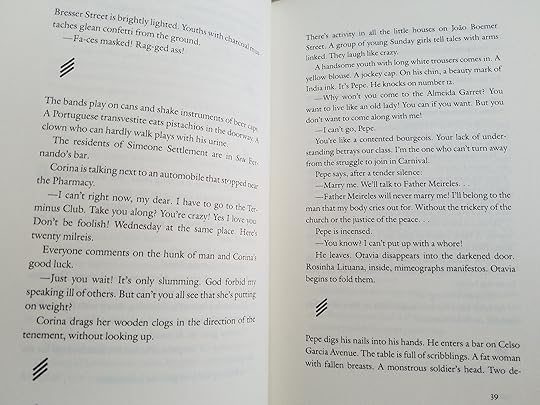
Pagu’s main theme of the book is the exploitation of people – mostly women in this book – by capitalism. Whether this is in the form of the factory worker who exists as a wage slave that can be summarily dismissed or whether it is in the form of prostitution where instead of scraping from paycheck to paycheck the women look for and assess man after man as “meal tickets”.
THE STATISTICS AND THE HISTORY OF THE HUMAN STRATUM THAT SUSTAINS THE INDUSTRIAL PARK OF SAO PAULO & SPEAKS THE LANGUAGE OF THIS BOOK, CAN BE FOUND, UNDER THE CAPITALIST REGIME, IN THE JAILS AND IN THE SLUM HOUSES, IN THE HOSPITALS & IN THE MORGUES.
(from the author’s Preface to the book)
While books that drive any particular agenda are not something I usually enjoy, the style in this one kept me interested until the end. The lack of description and lack of explanatory wording made reading the book into something like a quest to find what potential meanings Pagu contracted into her short paragraphs.
I also thoroughly recommend the books afterword which explores Pagu’s life and work in a little more detail. I was not surprised to learn that she wrote this book before she had the opportunity to travel to the Soviet Union in the 1930s. I was even less surprised that upon returning from various travels, Page felt disillusionment with the communist cause she so passionately argued for previously. Despite this, she still maintained her enthusiasm for the socialist cause and reflected this in her journalism.
On personal level, I also enjoyed the Sao Paulo setting. Between 1895 and the late 1920s, my family was based in Sao Paulo, and reading about the city – even in the tinted light of Pagu’s writing – was just as interesting as reading up on the civil unrest in Sao Paulo (and the wider Brazilian) society at the time, which I had so far only heard about in stories handed down to me through various generations.
Review first posted on my blog:
https://brokentuneblog.com/2021/07/03...
The novel is set in Sao Paulo in the early 1930s and tells of the lives of mostly factory workers struggling make a living in a world in which people are expendable cogs in the machine of greed and profitability.
The story has an agenda. It’s a call to arms to people to join the communist movement and rise against the bourgeoisie. As such, there is a repeated message of “all private industry is bad” and that “only communism can make things better for the workers”.
Whatever one makes of the message, I found the book fascinating.
There are several really interesting aspects about the novel that I had not expected but that made me read the book in only two sittings:
Of course, I had to read the novel in the English translation, but if the translation was close to the original, then this was a great example of the literary version brutalist art. I really found the writing style fascinating because even though sentences are ended abruptly, characters exist mainly through short descriptions of actions and thoughts, and every thing – descriptions and words – are kept to a minimum, Pagu still managed to create vignettes of life full of strive, compassion, hurt, humour, destitution, and hope.
It’s difficult to describe what I am talking about so here is an example:
Pagu’s main theme of the book is the exploitation of people – mostly women in this book – by capitalism. Whether this is in the form of the factory worker who exists as a wage slave that can be summarily dismissed or whether it is in the form of prostitution where instead of scraping from paycheck to paycheck the women look for and assess man after man as “meal tickets”.
THE STATISTICS AND THE HISTORY OF THE HUMAN STRATUM THAT SUSTAINS THE INDUSTRIAL PARK OF SAO PAULO & SPEAKS THE LANGUAGE OF THIS BOOK, CAN BE FOUND, UNDER THE CAPITALIST REGIME, IN THE JAILS AND IN THE SLUM HOUSES, IN THE HOSPITALS & IN THE MORGUES.
(from the author’s Preface to the book)
While books that drive any particular agenda are not something I usually enjoy, the style in this one kept me interested until the end. The lack of description and lack of explanatory wording made reading the book into something like a quest to find what potential meanings Pagu contracted into her short paragraphs.
I also thoroughly recommend the books afterword which explores Pagu’s life and work in a little more detail. I was not surprised to learn that she wrote this book before she had the opportunity to travel to the Soviet Union in the 1930s. I was even less surprised that upon returning from various travels, Page felt disillusionment with the communist cause she so passionately argued for previously. Despite this, she still maintained her enthusiasm for the socialist cause and reflected this in her journalism.
On personal level, I also enjoyed the Sao Paulo setting. Between 1895 and the late 1920s, my family was based in Sao Paulo, and reading about the city – even in the tinted light of Pagu’s writing – was just as interesting as reading up on the civil unrest in Sao Paulo (and the wider Brazilian) society at the time, which I had so far only heard about in stories handed down to me through various generations.
Review first posted on my blog:
https://brokentuneblog.com/2021/07/03...

Read
April 8, 2022e o nosso suor se transforma diariamente no champanhe que eles jogam fora.

November 22, 2011
Feminist minimalist portrait of class struggle in 1930s Brazil. Captures a wide-angled group image of factory life and interconnected community, all rendered down to the barest essences of sentences and dialogues. Elegant in its way, but its total focus on leftist rhetoric makes it a rather narrow and heavy-handed experience, like the Soviet socialist-realist writing being prescribed by the communist leadership halfway across the world at the time. Incidentally, Galvao returned from a post-writing visit to the U.S.S.R. quite disillusioned with the realities of Stalinism, but the hard social truths rendered here still stand up on their own in the broader labor movement.

June 3, 2023
MEU QUE INCRÍVEL VOU ME OBCECAR PELA PAGU CARA UM ROMANCE MARXISTA QUE SE PASSA NO BRÁS ELA FALA DA RUA DA MOOCA CARAAAAAAA TÔ MALUCA

August 22, 2020
Carolina Maria de Jesus versão proletária

October 9, 2023
Li o livro para o encontro extra do Clube de Ficcionistas em homenagem à homenageada da Flip 2023.
É um livro bem curto e a edição da Cia. das Letras é muito bem feita. Até onde pesquisei é o único romance de Pagu (que produziu também uma autobiografia e muitos artigos jornalísticos). Foi escrito quando a escritora tinha 22 anos e no começo dos anos 1930. É bastante tributário do movimento modernista em sua forma: frases curtas, linguagem coloquial, cenas enxutas, personagens que mais agem que refletem, cortes secos, enfim, fragmentação que foi imitada, com maior ou menos sucesso, ao longo do século 20 e 21. Em termos de conteúdo, não somente busca lançar luz sobre a situação social da época (efervescência operária, como muitos o fizeram), mas também lança um inédito (ou pelo menos incomum) foco dela sobre a condição feminina.
É um livro que deveria ser incluído nas listas de novelas e romances da primeira fase do Modernismo brasileiro, embora ele apareça tardiamente (já quando a forma se adensa). E, embora tenha uma certa aparência de realismo socialista (até pela filiação da autora ao PC), dificilmente poderia ser canônico nesse sentido: seja porque a prescrição do PC URSS data de mais tarde (1934), seja porque a tratativa da linguagem (aquilo que atualmente se chama de "dicção") dificilmente agradaria ao comitê central stalinista da época (o que não impede uma certa provocação bem deslocada à oposição de esquerda lá pro final do livro).
De todo modo, o livro entrega o que promete: um retrato do "parque industrial" que é a São Paulo da época. Esse caráter de "retrato", claro, chapa a complexidade e nuances dos personagens e os aprisiona em papéis e momentos mais ou menos típicos e, mesmo quando apresentam um certo arco, ele é mais lançado do que desenvolvido. Mas, como disse, não parece ser o objetivo da autora atentar para nuances de personalidade (qualquer crítica feita nesse sentido tem menos a ver com a intenção da autora que com os desejos dos crítico). Certamente, também não se deve julgar todos os termos e expressões usados no livro à luz da sensibilidade atual, pois com certeza Pagu não se sairia melhor que qualquer outro escritor da época em termos de ofensividade aos diversos grupos sociais atuais. Igualmente, há não poucas situações "panfletárias", o que não é um problema em si, mas que hoje (e afinal todo livro é lido numa determinada época), quase cem anos após, parecem bastante inocentes. A História apronta das suas com bastante frequência.
O Encontro Extra do Clube de Ficcionistas acontecerá sábado, dia 28 de outubro, às 16h, presencialmente no Café Colombiano (Alameda Eduardo Prado, 493, São Paulo, SP). Uma realização conjunta com a Livraria Na Nuvem. Apresentação de Monique Bonomini e Jéssica Figueiredo.
É um livro bem curto e a edição da Cia. das Letras é muito bem feita. Até onde pesquisei é o único romance de Pagu (que produziu também uma autobiografia e muitos artigos jornalísticos). Foi escrito quando a escritora tinha 22 anos e no começo dos anos 1930. É bastante tributário do movimento modernista em sua forma: frases curtas, linguagem coloquial, cenas enxutas, personagens que mais agem que refletem, cortes secos, enfim, fragmentação que foi imitada, com maior ou menos sucesso, ao longo do século 20 e 21. Em termos de conteúdo, não somente busca lançar luz sobre a situação social da época (efervescência operária, como muitos o fizeram), mas também lança um inédito (ou pelo menos incomum) foco dela sobre a condição feminina.
É um livro que deveria ser incluído nas listas de novelas e romances da primeira fase do Modernismo brasileiro, embora ele apareça tardiamente (já quando a forma se adensa). E, embora tenha uma certa aparência de realismo socialista (até pela filiação da autora ao PC), dificilmente poderia ser canônico nesse sentido: seja porque a prescrição do PC URSS data de mais tarde (1934), seja porque a tratativa da linguagem (aquilo que atualmente se chama de "dicção") dificilmente agradaria ao comitê central stalinista da época (o que não impede uma certa provocação bem deslocada à oposição de esquerda lá pro final do livro).
De todo modo, o livro entrega o que promete: um retrato do "parque industrial" que é a São Paulo da época. Esse caráter de "retrato", claro, chapa a complexidade e nuances dos personagens e os aprisiona em papéis e momentos mais ou menos típicos e, mesmo quando apresentam um certo arco, ele é mais lançado do que desenvolvido. Mas, como disse, não parece ser o objetivo da autora atentar para nuances de personalidade (qualquer crítica feita nesse sentido tem menos a ver com a intenção da autora que com os desejos dos crítico). Certamente, também não se deve julgar todos os termos e expressões usados no livro à luz da sensibilidade atual, pois com certeza Pagu não se sairia melhor que qualquer outro escritor da época em termos de ofensividade aos diversos grupos sociais atuais. Igualmente, há não poucas situações "panfletárias", o que não é um problema em si, mas que hoje (e afinal todo livro é lido numa determinada época), quase cem anos após, parecem bastante inocentes. A História apronta das suas com bastante frequência.
O Encontro Extra do Clube de Ficcionistas acontecerá sábado, dia 28 de outubro, às 16h, presencialmente no Café Colombiano (Alameda Eduardo Prado, 493, São Paulo, SP). Uma realização conjunta com a Livraria Na Nuvem. Apresentação de Monique Bonomini e Jéssica Figueiredo.

December 2, 2025
gobelins
tugúrios
nodosas
jérsei
valhacouto
ventarolas
imberê
fonola
dessous
onanista
padiola
engazopar
foxtrote
arminho
ráfia
chanfalhos
poules
tísica
caudilhismo
piriteira
cáften
zefir
"- Que importa morrer de bala em vez de morrer de fome!" (Página 26)
"- Nós não temos tempo de conhecer os nossos filhos!" (Página 27)
"As crianças burguesas se amparam desde cedo, ligadas pelo cordão umbilical econômico." (Página 59)
"Que importa! Se em todos os países do mundo capitalista ameaçado há um Brás..." (Página 87)
"Beijam-se subitamente sexualizados." (Página 102)
tugúrios
nodosas
jérsei
valhacouto
ventarolas
imberê
fonola
dessous
onanista
padiola
engazopar
foxtrote
arminho
ráfia
chanfalhos
poules
tísica
caudilhismo
piriteira
cáften
zefir
"- Que importa morrer de bala em vez de morrer de fome!" (Página 26)
"- Nós não temos tempo de conhecer os nossos filhos!" (Página 27)
"As crianças burguesas se amparam desde cedo, ligadas pelo cordão umbilical econômico." (Página 59)
"Que importa! Se em todos os países do mundo capitalista ameaçado há um Brás..." (Página 87)
"Beijam-se subitamente sexualizados." (Página 102)

August 1, 2023
É interessante, apesar do clima meio ingênuo que paira nas descrições bem animadas do movimento operário. O interessante é a secura e a forma que o panorama urbano dos bairros de imigrantes surge por debaixo das descrições curtas que a Pagu emprega. O ensaio de um romance épico brasileiro, eu acho.

November 18, 2018
review of
Patrícia Galvão's Industrial Park
by tENTATIVELY, a cONVENIENCE - November 16-18, 2018
For the complete review go here: https://www.goodreads.com/story/show/...
I don't speak Spanish or Portuguese & I've never been further directly south of the US than the Bahamas & Tijuana. When I tell people that I've been to Tijuana they say "That's not really Mexico" — meaning, of course, that it's just the tourist version of Mexico. & even tho I once organized a Latin American festival & I have 35 bks listed on my Latin American shelf here on Goodreads (& have actually read at least twice that many Latin American bks) & I (d) composed a piece called "Lost in Translation" that's based around Latin American music & literature AND have a piece out on record called "Birds of Villa-Villa Lobos (after Michael Pestel)" that uses samples from Heitor Villa-Lobos & Brazilian birds, I still don't know shit about Latin America . Basically, I need to speak Spanish & Portuguese (& other native languages wd be preferable too) & I need to fucking go there & stay there & be active there — & that's not likely to happen.
SO, I'll have to settle for reading & reviewing bks such as this one to help inform myself. The cover of Industrial Park declares it to be "A PROLETARIAN NOVEL" & that caught my interest. The back cover caught my interest even more:
"The novel dramatizes the problems of exploitation, poverty, racial prejudice, prostitution, state repression, and neocolonialism, but it is by no means a doctrinaire tract. Glavão's ironic wit pervades the novel, aspiring not only to describe the teeming city but also to put art and politics in each other's service.
"Like many of her contemporaries, Galvão was a member of the Brazilian Communist Party. She attracted Party criticism for her unorthodox behavior and outspokenness. A visit to Moscow in 1934 disenchanted her with the communist state, but she continued to militate for change upon returning to Brazil. She was imprisoned and tortured under the Vargas dictatorship between 1935 and 1940. In the 1940s she returned to the public through her journalism and literary activities. She died in 1962."
The promotion of this as "by no means a doctrinaire tract" & the mention that "She attracted Party criticism for her unorthodox behavior and outspokenness." are enuf to deeply endear her to me. The thought that such a wonderfully intelligent, benevolent, & free spirit wd be "imprisoned and tortured under the Vargas dictatorship between 1935 and 1940" is horrifying. I know nothing about the dictatorships of Brazil so I looked online:
"Vargas' four-year term as President under the 1934 Constitution was due to expire in 1938, and he was barred from reelection. However, on November 10, 1937, Vargas made a national radio address denouncing the existence of a communist plot to overthrow the government, called the Cohen Plan (Plano Cohen). In reality, however, Plano Cohen was forged in the government with the objective of creating a favourable atmosphere for Vargas to stay in power, perpetuating his rule and assuming dictatorial powers.
"The Communists had indeed attempted to take over the Government in November 1935, in a botched coup attempt known as the Intentona Comunista (Communist Attempt). In the wake of the failed Communist uprising, Congress had already given greater powers to Vargas, and approved the creation of a National Security Tribunal (Tribunal de Segurança Nacional), established by a statute adopted on 11 September 1936.
"In his address of 10 November 1937, Vargas, invoking the supposed Communist threat, decreed a state of emergency and dissolved the Legislature. He also announced the adoption by Presidential fiat of a new, severely authoritarian Constitution that effectively placed all governing power in his hands. The 1934 Constitution was thus abolished, and Vargas proclaimed the establishment of a "Estado Novo" (New State). The short interval was further evidence that the self-coup had been planned well in advance.
"Under this dictatorial regime the powers of the National Security Tribunal were streamlined, and it focused on the prosecution of political dissenters. Also, the powers of the police were greatly enhanced, with the establishment of DOPS, a powerful political police and secret service. When created in 1936, the National Security Tribunal was supposed to be a temporary Court, and defendants could file appeals against its judgements to the Superior Military Court (Superior Tribunal Militar [pt]), Brazil's Court of Appeals for the Armed Forces, which was in turn subordinate to the Nation's Supreme Court. Thus, Communists and other defendants accused of plotting coups were judged by the military court-martial system (with the National Security Tribunal as the trial court of first instance for those cases), and not by the ordinary courts. With the advent of the Estado Novo regime, the National Security Tribunal became a permanent Court, and became autonomous from the rest of the Court system. It gained authority to adjudicate not only cases of Communist conspirators and other coup plotters, but it now tried anyone accused of being subversive or dangerous to the Estado Novo regime. Also, several extrajudicial punishments were inflicted by the police itself (especially by the DOPS political police), without trial."
- https://en.wikipedia.org/wiki/Vargas_Era
Does any of that sound familiar?
"The Reichstag fire (German: Reichstagsbrand,) was an arson attack on the Reichstag building (home of the German parliament) in Berlin on 27 February 1933, one month after Adolf Hitler was sworn in as Chancellor of Germany. Hitler's government stated that Marinus van der Lubbe, a Dutch council communist, was found near the building and attributed the fire to communist agitators in general—though in 1933, a German court decided that van der Lubbe had acted alone, as he claimed. After the fire, the Reichstag Fire Decree was passed. The Nazi Party used the fire as evidence that communists were plotting against the German government, and the event is considered pivotal in the establishment of Nazi Germany. The term Reichstag fire has come to refer to false flag actions perpetrated or facilitated by an authority to promote their own interests through popular approval of retribution or retraction of civil rights." - https://en.wikipedia.org/wiki/Reichst...
"On Sept. 11, terrorists flew planes into the World Trade Center, Pentagon and a field in Pennsylvania - and the EEOC" [Equal Employment Opportunity Commission] "was faced with its own unique traumas and challenges resulting from these attacks on America. The Commission's New York District Office (NYDO) at Seven World Trade Center was severely damaged in the attack, and all EEOC personnel were evacuated. It collapsed later in the day with no loss of life or injuries, but the office and all of its equipment, files, and records were destroyed." - https://www.eeoc.gov/eeoc/history/50t...
"The Patriot Act is a more than 300-page document passed by the U.S. Congress with bipartisan support and signed into law by President George W. Bush on October 26, 2001, just weeks after the September 11 terrorist attacks against the United States."
[..]
"According to the Department of Justice, the Patriot Act simply expanded the application of tools already being used against drug dealers and organized crime. The act aimed to improve homeland security by:
"allowing law enforcement to use surveillance and wiretapping to investigate terror-related crimes
"allowing federal agents to request court permission to use roving wiretaps to track a specific terrorist suspect
"allowing delayed notification search warrants to prevent a terrorist from learning they are a suspect
"allowing federal agents to seek federal court permission to obtain bank records and business records to aid in national security terror investigations and prevent money laundering for terrorism financing
"improving information and intelligence sharing between government agencies
"providing tougher penalties for convicted terrorists and those who harbor them
"allowing search warrants to be obtained in any district where terror-related activity occurs, no matter where the warrant is executed
"ending the statute of limitations for certain terror-related crimes
"making it harder for aliens involved in terrorist activities to enter the United States
"providing aid to terrorism victims and public safety officers involved in investigating or preventing terrorism or responding to terrorist attacks
"Many of the Patriot Act’s requirements were slated to expire in 2005. Whether to renew the act was passionately argued in the U.S. House of Representatives and the Senate.
"Despite continued civil liberties and privacy concerns, President Bush signed the USA Patriot and Terrorism Reauthorization Act on March 9, 2006."
[..]
"Despite the supposed noble intentions behind the Patriot Act, the law is still hotly debated. Civil rights groups have claimed it violates American citizens’ Constitutional rights and allows the government to spy on them without due process, search their homes without consent and increase the risk of ordinary citizens being accused of crimes without just cause.
"The federal government asserts the Patriot Act has safeguards to protect the rights of American citizens. Still, some parts of the law were found illegal by the courts. For instance, in 2015 the United States of Appeals for the Second Circuit found Section 215 of the Patriot Act could not be used to validate the bulk collection of Americans’ phone records."
- https://www.history.com/topics/21st-c...
The question continues to be: How many of these terrorist attacks that're used to justify stepping up authoritarian government are 'false flag actions' preplanned to con the public into accepting reduced or destroyed civil rights? The fact that Patrícia Galvão was "imprisoned and tortured under the Vargas dictatorship between 1935 and 1940" is an excellent indication of how power can be abused w/ insufficient checks & balances. I found the "Translators's Preface" to Industrial Park very useful:
"Stylistically, it bridged the years when many writers combined modernist experimentation with themes of social realism. Its treatment of race and class compared favorably with that of proletarian novels of the same period by Jorge Amado but added a valuable urban, feminist perspective that had not been available before. Scenes of raw anarchist and communist propaganda conveyed how deeply Pagu" [Patrícia Galvão] "was involved in promoting workers' political consciousness and revolt." - p VIII
"THE STATISTICS AND THE HISTORY OF THE HUMAN STRATUM THAT SUSTAINS THE INDUSTRIAL PARK OF São Paulo & SPEAKS THE LANGUAGE OF THIS BOOK, CAN BE FOUND, UNDER THE CAPITALIST REGIME, IN THE JAILS AND IN THE SLUM HOUSES, IN THE HOSPITALS & IN THE MORGUES." - p 5
Exactly. & that's a pretty good indication of what makes this an important bk.
"In the dirty latrines the girls spend a joyful minute stolen from the slave labor.
"—The Manager said that from now on we can only come two at a time!
"—Can you believe it? Did you see how much trash they wrote!
"—That's because before, this was the men's latrine!
"—But here's a dirty poem!
"—How awful! They should erase it. . .
"—What's the meaning of this word 'fascism'?
"—Dummy! It's that Mussolini thing.
"—Not on your life! Pedro said that here in Brazil there's fascism too." - p 10
When I think of things like controlled toilet breaks I think of the Triangle Shirtwaist Factory fire:
"The Triangle Shirtwaist Factory fire in New York City on March 25, 1911 was the deadliest industrial disaster in the history of the city, and one of the deadliest in US history. The fire caused the deaths of 146 garment workers – 123 women and 23 men – who died from the fire, smoke inhalation, or falling or jumping to their deaths. Most of the victims were recent Italian and Jewish immigrant women aged 14 to 23; of the victims whose ages are known, the oldest victim was 43-year-old Providenza Panno, and the youngest were 14-year-olds Kate Leone and "Sara" Rosaria Maltese.
"The factory was located on the eighth, ninth and tenth floors of the Asch Building, at 23–29 Washington Place in the Greenwich Village neighborhood of Manhattan."
[..]
"Because the owners had locked the doors to the stairwells and exits – a then-common practice to prevent workers from taking unauthorized breaks and to reduce theft – many of the workers who could not escape from the burning building jumped from the high windows."
- https://en.wikipedia.org/wiki/Triangl...
Yes, that was in the United States of America. We really don't need to go to those '3rd world countries' for exploited labor, now do we?!
"A pale young girl answers the call and stammers that it's impossible to finish the order for the next day.
"—What did you say? exclaims the seamstress nudging her into the inner workshop. Do you think that I'm going to displease mademoiselle just because of a few lazy tramps? Today there will be overtime until one in the morning.
"—I can't stay at night, Madame! Momma is sick. I have to give her medicine!
"—You're staying! Your mother won't die waiting a few hours.
"—But I have to!
"—Nothing doing. If you go, you're out.
"The proletarian returns to her place among her coworkers. She shudders at the idea of losing the job that had been so difficult to find." - p 15
Galvão sets the scene:
"—We don't have time to get to know our own children!
"Meeting of a regional labor union. Women, men, laborers of all ages. All colors. All mentalities. Aware. Unaware. Informers.
"Those who look to the union as the only way to satisfy their immediate demands. Those who are attracted by the union bureaucracy. The future men of the revolution. Revolters. Anarchists. Infiltrators." - p 21
"—We can't get to know our own children! We leave home at six in the morning. They are sleeping. We return at ten. They are sleeping. We don't have vacations. We don't have Sundays to rest!" - p 22
"—We build palaces and live worse than bourgeois dogs. When we're unemployed, we're treated like bums. If we only have a street bench to sleep on, the police arrest us. And ask why we don't move to the interior. They're ready to send us to die by the lash on the Laranjeira family's maté tea plantation!" - p 23
"—Poor people can't even be mothers! I dunno how I got this baby! I have to give him to someone, so the poor thing won't die of hunger. If I keep taking care of him how will I find a job? I have to give him up to take care of other people's children! I'll nurse the sons of the rich and I don't know how mine will get by." - p 74
These snippets are just that in comparison to the larger picture. Galvão tells it very well. One of the central narratives is of the marriage between Eleonora, working class, & Alfredo, ruling class. Eleonora is ecstatic to enter the life of luxury & hedonism & to escape the drudgery that she wd've otherwise been doomed to. Alfredo despises the class he was born into & wants to escape THAT & join in the revolution.
"Eleonora, contrary to what Alfredo had thought, is amazed. So much intelligence and so much elegance! She is courted. Insistent admirers. Luxury. Sparkling jewels. A punch more delicious than she had ever imagined existed. She becomes angry when Alfredo wants to leave, annoyed.
"He climbs in the automobile behind her, shouting:
"—I hate these people! These parasites. . . And I'm one of them!" - p 33
I'm sympathetic to both positions. Not every woman in the garment district is so lucky as to be well-treated by one of the parasite class.
"Corina reads a scrap of torn newspaper. Soft, sleepless eyelids. The lice and fleas nest on her slender body. The dirty mat thrown into a corner of the prison. The blue denim of her long skirt. Her shapely legs, barefoot, dark. She looks them over and crosses them, excited, dragging her long toenails along the protrusions of the wall. She feels her firm flesh. So pretty, she'll grow old alone, in prison." - p 59
Meanwhile, the parasite class actually commits crimes, instead of going to prison for trumped-up ones, behind the scenes.
"Automobile Club. Inside flies. The high-class Club asks for relief through the decadent pens of its press flunkies. Now it wants to dupe City Hall, selling it the building that the Club couldn't finish. It's the crisis. São Paulo's nascent capitalism turns its feudal and hairy belly up." - p 65
People kill lice & fleas & mousquitos — or at least try to get them off their body. It's a much harder task to try to get rid of the larger parasites & the system that enables them.
"The tiny voice of the revolutionary rises in the flushed faces of the rally.
"—Comrades! We can't remain silent in the midst of this struggle! We must be at the side of our men in the streets, as we are when we work in the factory. We have to fight together against the bourgeoisie that drain our health and turn us into human rags! They take from our breast the last drop of milk that belongs to our little ones to live on champagne and parasitism!
"At night, we don't even have the strength to warm our children who are left alone the whole day or shut up in filthy rooms without anyone to look after them! We must not weaken the strike with our complaints! We are behind in the rent and even go hungry, while our bosses who do nothing live in luxury and order the police to attack us! But this still will not make us slaves our whole lives!" - p 80
What nazism & fascism does is derail this class anger & direct it against ethnic groups, Jews & immigrants these days in the US & Europe. This is a ruling class tactic for deflecting criticism away from itself to people who're easily socially isolated into being targets.
"At twelve years of age she entered the cloth factory. The revolt against the exploiters and assassins. She discovered the union. She understood the class struggle.
"From the bars she leans against, she sees the soldiers' mess. At nine, from the other direction, the luxury train to Rio goes by. The Southern Cross. Each compartment costs four hundred milreis for one night. She earned two hundred a month, sometimes less." - p 85
Meanwhile, Alfredo is trying to do what he thinks is right.
"Alfredo? Could she believe it? Could her companions be wrong?
"She'll talk with him all her free hours to see if she can discover a false position, an opportunistic purpose, a shadow of bossism or opportunism. That great bourgeois from the Esplanada!
"Everyone tells her that his political line is perfect." - p 91
Ah, but the same Communist Party that criticized "her unorthodox behavior and outspokenness" (in other words, Galvão was a free thinker) turns against Alfredo:
"Octavia freezes. The accusers point out hard facts. Inconsistencies. Individualism. Errors. They all stare at her, given the concrete evidence. It's true. Alfredo had let himself be dragged into the bourgeois vanguard that disguises itself under the name 'leftist opposition' in proletarian organization. He's a Trotskyite. He connives and conspires with the most cynical traitors of the social revolution." - p 104
Once again, half truths at the service of dictatorship.
Patrícia Galvão's Industrial Park
by tENTATIVELY, a cONVENIENCE - November 16-18, 2018
For the complete review go here: https://www.goodreads.com/story/show/...
I don't speak Spanish or Portuguese & I've never been further directly south of the US than the Bahamas & Tijuana. When I tell people that I've been to Tijuana they say "That's not really Mexico" — meaning, of course, that it's just the tourist version of Mexico. & even tho I once organized a Latin American festival & I have 35 bks listed on my Latin American shelf here on Goodreads (& have actually read at least twice that many Latin American bks) & I (d) composed a piece called "Lost in Translation" that's based around Latin American music & literature AND have a piece out on record called "Birds of Villa-Villa Lobos (after Michael Pestel)" that uses samples from Heitor Villa-Lobos & Brazilian birds, I still don't know shit about Latin America . Basically, I need to speak Spanish & Portuguese (& other native languages wd be preferable too) & I need to fucking go there & stay there & be active there — & that's not likely to happen.
SO, I'll have to settle for reading & reviewing bks such as this one to help inform myself. The cover of Industrial Park declares it to be "A PROLETARIAN NOVEL" & that caught my interest. The back cover caught my interest even more:
"The novel dramatizes the problems of exploitation, poverty, racial prejudice, prostitution, state repression, and neocolonialism, but it is by no means a doctrinaire tract. Glavão's ironic wit pervades the novel, aspiring not only to describe the teeming city but also to put art and politics in each other's service.
"Like many of her contemporaries, Galvão was a member of the Brazilian Communist Party. She attracted Party criticism for her unorthodox behavior and outspokenness. A visit to Moscow in 1934 disenchanted her with the communist state, but she continued to militate for change upon returning to Brazil. She was imprisoned and tortured under the Vargas dictatorship between 1935 and 1940. In the 1940s she returned to the public through her journalism and literary activities. She died in 1962."
The promotion of this as "by no means a doctrinaire tract" & the mention that "She attracted Party criticism for her unorthodox behavior and outspokenness." are enuf to deeply endear her to me. The thought that such a wonderfully intelligent, benevolent, & free spirit wd be "imprisoned and tortured under the Vargas dictatorship between 1935 and 1940" is horrifying. I know nothing about the dictatorships of Brazil so I looked online:
"Vargas' four-year term as President under the 1934 Constitution was due to expire in 1938, and he was barred from reelection. However, on November 10, 1937, Vargas made a national radio address denouncing the existence of a communist plot to overthrow the government, called the Cohen Plan (Plano Cohen). In reality, however, Plano Cohen was forged in the government with the objective of creating a favourable atmosphere for Vargas to stay in power, perpetuating his rule and assuming dictatorial powers.
"The Communists had indeed attempted to take over the Government in November 1935, in a botched coup attempt known as the Intentona Comunista (Communist Attempt). In the wake of the failed Communist uprising, Congress had already given greater powers to Vargas, and approved the creation of a National Security Tribunal (Tribunal de Segurança Nacional), established by a statute adopted on 11 September 1936.
"In his address of 10 November 1937, Vargas, invoking the supposed Communist threat, decreed a state of emergency and dissolved the Legislature. He also announced the adoption by Presidential fiat of a new, severely authoritarian Constitution that effectively placed all governing power in his hands. The 1934 Constitution was thus abolished, and Vargas proclaimed the establishment of a "Estado Novo" (New State). The short interval was further evidence that the self-coup had been planned well in advance.
"Under this dictatorial regime the powers of the National Security Tribunal were streamlined, and it focused on the prosecution of political dissenters. Also, the powers of the police were greatly enhanced, with the establishment of DOPS, a powerful political police and secret service. When created in 1936, the National Security Tribunal was supposed to be a temporary Court, and defendants could file appeals against its judgements to the Superior Military Court (Superior Tribunal Militar [pt]), Brazil's Court of Appeals for the Armed Forces, which was in turn subordinate to the Nation's Supreme Court. Thus, Communists and other defendants accused of plotting coups were judged by the military court-martial system (with the National Security Tribunal as the trial court of first instance for those cases), and not by the ordinary courts. With the advent of the Estado Novo regime, the National Security Tribunal became a permanent Court, and became autonomous from the rest of the Court system. It gained authority to adjudicate not only cases of Communist conspirators and other coup plotters, but it now tried anyone accused of being subversive or dangerous to the Estado Novo regime. Also, several extrajudicial punishments were inflicted by the police itself (especially by the DOPS political police), without trial."
- https://en.wikipedia.org/wiki/Vargas_Era
Does any of that sound familiar?
"The Reichstag fire (German: Reichstagsbrand,) was an arson attack on the Reichstag building (home of the German parliament) in Berlin on 27 February 1933, one month after Adolf Hitler was sworn in as Chancellor of Germany. Hitler's government stated that Marinus van der Lubbe, a Dutch council communist, was found near the building and attributed the fire to communist agitators in general—though in 1933, a German court decided that van der Lubbe had acted alone, as he claimed. After the fire, the Reichstag Fire Decree was passed. The Nazi Party used the fire as evidence that communists were plotting against the German government, and the event is considered pivotal in the establishment of Nazi Germany. The term Reichstag fire has come to refer to false flag actions perpetrated or facilitated by an authority to promote their own interests through popular approval of retribution or retraction of civil rights." - https://en.wikipedia.org/wiki/Reichst...
"On Sept. 11, terrorists flew planes into the World Trade Center, Pentagon and a field in Pennsylvania - and the EEOC" [Equal Employment Opportunity Commission] "was faced with its own unique traumas and challenges resulting from these attacks on America. The Commission's New York District Office (NYDO) at Seven World Trade Center was severely damaged in the attack, and all EEOC personnel were evacuated. It collapsed later in the day with no loss of life or injuries, but the office and all of its equipment, files, and records were destroyed." - https://www.eeoc.gov/eeoc/history/50t...
"The Patriot Act is a more than 300-page document passed by the U.S. Congress with bipartisan support and signed into law by President George W. Bush on October 26, 2001, just weeks after the September 11 terrorist attacks against the United States."
[..]
"According to the Department of Justice, the Patriot Act simply expanded the application of tools already being used against drug dealers and organized crime. The act aimed to improve homeland security by:
"allowing law enforcement to use surveillance and wiretapping to investigate terror-related crimes
"allowing federal agents to request court permission to use roving wiretaps to track a specific terrorist suspect
"allowing delayed notification search warrants to prevent a terrorist from learning they are a suspect
"allowing federal agents to seek federal court permission to obtain bank records and business records to aid in national security terror investigations and prevent money laundering for terrorism financing
"improving information and intelligence sharing between government agencies
"providing tougher penalties for convicted terrorists and those who harbor them
"allowing search warrants to be obtained in any district where terror-related activity occurs, no matter where the warrant is executed
"ending the statute of limitations for certain terror-related crimes
"making it harder for aliens involved in terrorist activities to enter the United States
"providing aid to terrorism victims and public safety officers involved in investigating or preventing terrorism or responding to terrorist attacks
"Many of the Patriot Act’s requirements were slated to expire in 2005. Whether to renew the act was passionately argued in the U.S. House of Representatives and the Senate.
"Despite continued civil liberties and privacy concerns, President Bush signed the USA Patriot and Terrorism Reauthorization Act on March 9, 2006."
[..]
"Despite the supposed noble intentions behind the Patriot Act, the law is still hotly debated. Civil rights groups have claimed it violates American citizens’ Constitutional rights and allows the government to spy on them without due process, search their homes without consent and increase the risk of ordinary citizens being accused of crimes without just cause.
"The federal government asserts the Patriot Act has safeguards to protect the rights of American citizens. Still, some parts of the law were found illegal by the courts. For instance, in 2015 the United States of Appeals for the Second Circuit found Section 215 of the Patriot Act could not be used to validate the bulk collection of Americans’ phone records."
- https://www.history.com/topics/21st-c...
The question continues to be: How many of these terrorist attacks that're used to justify stepping up authoritarian government are 'false flag actions' preplanned to con the public into accepting reduced or destroyed civil rights? The fact that Patrícia Galvão was "imprisoned and tortured under the Vargas dictatorship between 1935 and 1940" is an excellent indication of how power can be abused w/ insufficient checks & balances. I found the "Translators's Preface" to Industrial Park very useful:
"Stylistically, it bridged the years when many writers combined modernist experimentation with themes of social realism. Its treatment of race and class compared favorably with that of proletarian novels of the same period by Jorge Amado but added a valuable urban, feminist perspective that had not been available before. Scenes of raw anarchist and communist propaganda conveyed how deeply Pagu" [Patrícia Galvão] "was involved in promoting workers' political consciousness and revolt." - p VIII
"THE STATISTICS AND THE HISTORY OF THE HUMAN STRATUM THAT SUSTAINS THE INDUSTRIAL PARK OF São Paulo & SPEAKS THE LANGUAGE OF THIS BOOK, CAN BE FOUND, UNDER THE CAPITALIST REGIME, IN THE JAILS AND IN THE SLUM HOUSES, IN THE HOSPITALS & IN THE MORGUES." - p 5
Exactly. & that's a pretty good indication of what makes this an important bk.
"In the dirty latrines the girls spend a joyful minute stolen from the slave labor.
"—The Manager said that from now on we can only come two at a time!
"—Can you believe it? Did you see how much trash they wrote!
"—That's because before, this was the men's latrine!
"—But here's a dirty poem!
"—How awful! They should erase it. . .
"—What's the meaning of this word 'fascism'?
"—Dummy! It's that Mussolini thing.
"—Not on your life! Pedro said that here in Brazil there's fascism too." - p 10
When I think of things like controlled toilet breaks I think of the Triangle Shirtwaist Factory fire:
"The Triangle Shirtwaist Factory fire in New York City on March 25, 1911 was the deadliest industrial disaster in the history of the city, and one of the deadliest in US history. The fire caused the deaths of 146 garment workers – 123 women and 23 men – who died from the fire, smoke inhalation, or falling or jumping to their deaths. Most of the victims were recent Italian and Jewish immigrant women aged 14 to 23; of the victims whose ages are known, the oldest victim was 43-year-old Providenza Panno, and the youngest were 14-year-olds Kate Leone and "Sara" Rosaria Maltese.
"The factory was located on the eighth, ninth and tenth floors of the Asch Building, at 23–29 Washington Place in the Greenwich Village neighborhood of Manhattan."
[..]
"Because the owners had locked the doors to the stairwells and exits – a then-common practice to prevent workers from taking unauthorized breaks and to reduce theft – many of the workers who could not escape from the burning building jumped from the high windows."
- https://en.wikipedia.org/wiki/Triangl...
Yes, that was in the United States of America. We really don't need to go to those '3rd world countries' for exploited labor, now do we?!
"A pale young girl answers the call and stammers that it's impossible to finish the order for the next day.
"—What did you say? exclaims the seamstress nudging her into the inner workshop. Do you think that I'm going to displease mademoiselle just because of a few lazy tramps? Today there will be overtime until one in the morning.
"—I can't stay at night, Madame! Momma is sick. I have to give her medicine!
"—You're staying! Your mother won't die waiting a few hours.
"—But I have to!
"—Nothing doing. If you go, you're out.
"The proletarian returns to her place among her coworkers. She shudders at the idea of losing the job that had been so difficult to find." - p 15
Galvão sets the scene:
"—We don't have time to get to know our own children!
"Meeting of a regional labor union. Women, men, laborers of all ages. All colors. All mentalities. Aware. Unaware. Informers.
"Those who look to the union as the only way to satisfy their immediate demands. Those who are attracted by the union bureaucracy. The future men of the revolution. Revolters. Anarchists. Infiltrators." - p 21
"—We can't get to know our own children! We leave home at six in the morning. They are sleeping. We return at ten. They are sleeping. We don't have vacations. We don't have Sundays to rest!" - p 22
"—We build palaces and live worse than bourgeois dogs. When we're unemployed, we're treated like bums. If we only have a street bench to sleep on, the police arrest us. And ask why we don't move to the interior. They're ready to send us to die by the lash on the Laranjeira family's maté tea plantation!" - p 23
"—Poor people can't even be mothers! I dunno how I got this baby! I have to give him to someone, so the poor thing won't die of hunger. If I keep taking care of him how will I find a job? I have to give him up to take care of other people's children! I'll nurse the sons of the rich and I don't know how mine will get by." - p 74
These snippets are just that in comparison to the larger picture. Galvão tells it very well. One of the central narratives is of the marriage between Eleonora, working class, & Alfredo, ruling class. Eleonora is ecstatic to enter the life of luxury & hedonism & to escape the drudgery that she wd've otherwise been doomed to. Alfredo despises the class he was born into & wants to escape THAT & join in the revolution.
"Eleonora, contrary to what Alfredo had thought, is amazed. So much intelligence and so much elegance! She is courted. Insistent admirers. Luxury. Sparkling jewels. A punch more delicious than she had ever imagined existed. She becomes angry when Alfredo wants to leave, annoyed.
"He climbs in the automobile behind her, shouting:
"—I hate these people! These parasites. . . And I'm one of them!" - p 33
I'm sympathetic to both positions. Not every woman in the garment district is so lucky as to be well-treated by one of the parasite class.
"Corina reads a scrap of torn newspaper. Soft, sleepless eyelids. The lice and fleas nest on her slender body. The dirty mat thrown into a corner of the prison. The blue denim of her long skirt. Her shapely legs, barefoot, dark. She looks them over and crosses them, excited, dragging her long toenails along the protrusions of the wall. She feels her firm flesh. So pretty, she'll grow old alone, in prison." - p 59
Meanwhile, the parasite class actually commits crimes, instead of going to prison for trumped-up ones, behind the scenes.
"Automobile Club. Inside flies. The high-class Club asks for relief through the decadent pens of its press flunkies. Now it wants to dupe City Hall, selling it the building that the Club couldn't finish. It's the crisis. São Paulo's nascent capitalism turns its feudal and hairy belly up." - p 65
People kill lice & fleas & mousquitos — or at least try to get them off their body. It's a much harder task to try to get rid of the larger parasites & the system that enables them.
"The tiny voice of the revolutionary rises in the flushed faces of the rally.
"—Comrades! We can't remain silent in the midst of this struggle! We must be at the side of our men in the streets, as we are when we work in the factory. We have to fight together against the bourgeoisie that drain our health and turn us into human rags! They take from our breast the last drop of milk that belongs to our little ones to live on champagne and parasitism!
"At night, we don't even have the strength to warm our children who are left alone the whole day or shut up in filthy rooms without anyone to look after them! We must not weaken the strike with our complaints! We are behind in the rent and even go hungry, while our bosses who do nothing live in luxury and order the police to attack us! But this still will not make us slaves our whole lives!" - p 80
What nazism & fascism does is derail this class anger & direct it against ethnic groups, Jews & immigrants these days in the US & Europe. This is a ruling class tactic for deflecting criticism away from itself to people who're easily socially isolated into being targets.
"At twelve years of age she entered the cloth factory. The revolt against the exploiters and assassins. She discovered the union. She understood the class struggle.
"From the bars she leans against, she sees the soldiers' mess. At nine, from the other direction, the luxury train to Rio goes by. The Southern Cross. Each compartment costs four hundred milreis for one night. She earned two hundred a month, sometimes less." - p 85
Meanwhile, Alfredo is trying to do what he thinks is right.
"Alfredo? Could she believe it? Could her companions be wrong?
"She'll talk with him all her free hours to see if she can discover a false position, an opportunistic purpose, a shadow of bossism or opportunism. That great bourgeois from the Esplanada!
"Everyone tells her that his political line is perfect." - p 91
Ah, but the same Communist Party that criticized "her unorthodox behavior and outspokenness" (in other words, Galvão was a free thinker) turns against Alfredo:
"Octavia freezes. The accusers point out hard facts. Inconsistencies. Individualism. Errors. They all stare at her, given the concrete evidence. It's true. Alfredo had let himself be dragged into the bourgeois vanguard that disguises itself under the name 'leftist opposition' in proletarian organization. He's a Trotskyite. He connives and conspires with the most cynical traitors of the social revolution." - p 104
Once again, half truths at the service of dictatorship.

August 19, 2017
14/11/17 Second read through and I still hate it. I’m holding onto the hope that discussing it will make it more likeable, but at this point nothing can redeem it.
18/08/17 My opinion is subject to change as I'm supposed to be using this book for a class later this year, but for now it wasn't an enjoyable read. I can see the historical importance of it, but as a novel it wasn't something I personally liked.
18/08/17 My opinion is subject to change as I'm supposed to be using this book for a class later this year, but for now it wasn't an enjoyable read. I can see the historical importance of it, but as a novel it wasn't something I personally liked.

June 10, 2024
A inocência é a assinutara da juventude da autora. No mais é um livro interessante de ser ler, saber que tipo de literatura era escrita em 30, bem curto qualquer um lê em um dia ou dois

April 8, 2025
Tiene altos y bajos. Igual me alegra tener un panorama de cómo funcionaba la cosa a principios del siglo pasado con respecto a los obreros y el trabajo en Brasil y poder compararlo con cómo era en el resto de América latina.
Por otro lado, disfruté mucho la forma, la escritura es sintética y fragmentaria, hay momentos en los que cada línea es una acción.
Qué alegría haber conocido a Pagú
Por otro lado, disfruté mucho la forma, la escritura es sintética y fragmentaria, hay momentos en los que cada línea es una acción.
Qué alegría haber conocido a Pagú

March 1, 2024
Como um panfleto é muito bom, tem aquela mensagem direta necessária e ainda consegue ser rico poeticamente. Amei que o livro é basicamente composto de frases descritivas curtíssimas em sequência!

April 7, 2024
sim.. o grande banger

April 22, 2024
pagu escrevendo essa rasteira aos 20 e poucos anos eu aos 20 e poucos tava chorando porque não conseguia entrar na faculdade aff
December 4, 2024
Dislike the style of this in more than one way, but I understand why it’s written like that. The fragmented, pictorial style just doesn’t work for me and the omniscient hyper-ideological Marxist narrator is a bit much - the latter especially is a style that often leaves a strange taste in my mouth. Nonetheless, as a piece of political writing and effective propaganda both of these choices work excellently - less so as a piece of fiction though.

Read
August 16, 2025nao preciso gostar pra entender bjsssss pagu divaaaa

July 26, 2023
Minha cabeça está fervilhando, é impressionante o que Pagu faz nesse livro!

January 17, 2026
3.5 🌟
"matam os operários, mas o proletário não morre."
"matam os operários, mas o proletário não morre."

April 9, 2026
Interessante visão do panorama do Brasil da época. Mas escrita panfletária e um pouco limitada.

October 27, 2011
An interesting and rather rare novel of 1930’s Brazilian proletariat awakening. The narrative is spare, sexy, and clearly points the finger at the rich as being the oppressors, but then a girl just wants to have fun too, so between scenes, more like flashes, of degrading and hard ass work, debilitating poverty, and trying to fight back against the rich, you have going to the movies, flirting, and more, with the panther-like boys, thinking about, and maybe even scoring, that new pair of sexy shoes. So yes, as ambiguous and questioning “as real life” this novel seems very black and white, except for all the exceptions and let’s us into the gray, where most everybody lives most all the time. Here is a little excerpt, 1st at the movies, then at the demo, then at a meeting, as it is printed in the novel:
“In the dark, Otavia wants to wrench from each still spectator’s head, from each silent arm, an allegiance to the emotional spasms that envelop her. She squeezes Alfredo’s hand. But a lot of people don’t wait for the end of the showing.
A group of young women go out lamenting loudly the ten cents wasted on a film without love.
They are unaware who weigh down the proletariat. Impressed by the image of the bourgeois regime, by the fascination of gowns that they can’t have but desire. By automobiles of every color, by the rackets and beaches. Fed on the imperialist opium of American films. Slaves tied to capitalist deception.
But in the front row, two young male workers are enthusiastic, absorbed in the proletarian drama being shown. One of them talked so loudly that Otavia could hear every word.
-----No one here understands this bombshell!
------------------------------------------------------------------
Groups demonstrate, waving crumpled crimson posters. The smudged ink of the printed bills demands more bread.
And the successive proletarian speakers take charge of the crowd that invades the streets of the factory district with fists raised.
The police advance, fire. A small woman lies on the ground, crying out with her leg shattered. Her blond Lithuanian hair flows smoothly over her sweaty forehead. Resembling Rosinha.
-----------------------------------------------------------------
--------Comrades!
Imperialism is resisting! Each imperialist sends his opium to deceive our unaware youth. They want to stifle the revolt that leads the exploited to fight. The United States sends cinema. England, soccer. Italy, priests. France, prostitution.
Alfredo smiles, delighted, in the noisy midst of the union.
------Is cunnilingus imperialism?
------Comrades, we need to be more serious. The struggle approaches.
Alfredo, who was making a joke, turns pale. A rustic proletarian denounces him for persistent bourgeois traits.
------A bourgeois will always be a bourgeois.
Otavia appears in the restless circle. She listens.
------------------------------------------------------------"
“In the dark, Otavia wants to wrench from each still spectator’s head, from each silent arm, an allegiance to the emotional spasms that envelop her. She squeezes Alfredo’s hand. But a lot of people don’t wait for the end of the showing.
A group of young women go out lamenting loudly the ten cents wasted on a film without love.
They are unaware who weigh down the proletariat. Impressed by the image of the bourgeois regime, by the fascination of gowns that they can’t have but desire. By automobiles of every color, by the rackets and beaches. Fed on the imperialist opium of American films. Slaves tied to capitalist deception.
But in the front row, two young male workers are enthusiastic, absorbed in the proletarian drama being shown. One of them talked so loudly that Otavia could hear every word.
-----No one here understands this bombshell!
------------------------------------------------------------------
Groups demonstrate, waving crumpled crimson posters. The smudged ink of the printed bills demands more bread.
And the successive proletarian speakers take charge of the crowd that invades the streets of the factory district with fists raised.
The police advance, fire. A small woman lies on the ground, crying out with her leg shattered. Her blond Lithuanian hair flows smoothly over her sweaty forehead. Resembling Rosinha.
-----------------------------------------------------------------
--------Comrades!
Imperialism is resisting! Each imperialist sends his opium to deceive our unaware youth. They want to stifle the revolt that leads the exploited to fight. The United States sends cinema. England, soccer. Italy, priests. France, prostitution.
Alfredo smiles, delighted, in the noisy midst of the union.
------Is cunnilingus imperialism?
------Comrades, we need to be more serious. The struggle approaches.
Alfredo, who was making a joke, turns pale. A rustic proletarian denounces him for persistent bourgeois traits.
------A bourgeois will always be a bourgeois.
Otavia appears in the restless circle. She listens.
------------------------------------------------------------"

September 25, 2023
Pagu compõe a cena da efervescência do Brás, um bairro operário na capital de São Paulo, tão operário quanto qualquer outro no mundo, em um romance rápido e instigante, ainda que com pouco desenvolvimento dos personagens (o que não parece uma falha, e sim, a intenção).
A sua linguagem é econômica, com frases curtas e muitos espaçamentos, bem condizente com a era modernista à qual pertence. A beleza e violência das imagens construídas, no entanto, não são superficiais.
"Revê o estremecimento agônico da coleguismo que se suicidara no ano passado, estatelada nos paralelepípedos da rua Formosa, depois do voo. O sangue da outra, a cabeça quebrada, os ossos esmagados."
"Madame, enrijecida de elásticos e borrada de rimel, fuma no âmbar da piteira o cigarro displicente. Os olhos das trabalhadoras são como os seus. Tingidos de roxo, mas pelo trabalho noturno."
Comumente acusam Pagu de ter escrito um romance panfletário, e por isso, menor. É inegável o caráter propagandista comunista da obra, mas isso não pode ser usado como motivo para o seu apagamento. A poesia e qualidade se mantém mesmo nos momentos de catequese comunista:
"Na grande penitenciária social os teares se elevam e marcham esgoelando."
"Muita gente caiu na rua de fome. Mas houve champanhe à beça no Municipal."
" Alimentadas pelo ópio imperialista das fitas americanas. Escravas amarradas à ilusão capitalista."
Por fim, é sempre bom lembrar que, por ser feita por pessoas, toda arte é ideológica, pois todos têm uma Ideologia. Se a Ideologia apresentada na obra for contra hegemônica, será acusada de panfletária. Do contrário, será aclamada como neutra e natural.
"O nosso suor se transforma diariamente no champanhe que eles jogam fora."
A sua linguagem é econômica, com frases curtas e muitos espaçamentos, bem condizente com a era modernista à qual pertence. A beleza e violência das imagens construídas, no entanto, não são superficiais.
"Revê o estremecimento agônico da coleguismo que se suicidara no ano passado, estatelada nos paralelepípedos da rua Formosa, depois do voo. O sangue da outra, a cabeça quebrada, os ossos esmagados."
"Madame, enrijecida de elásticos e borrada de rimel, fuma no âmbar da piteira o cigarro displicente. Os olhos das trabalhadoras são como os seus. Tingidos de roxo, mas pelo trabalho noturno."
Comumente acusam Pagu de ter escrito um romance panfletário, e por isso, menor. É inegável o caráter propagandista comunista da obra, mas isso não pode ser usado como motivo para o seu apagamento. A poesia e qualidade se mantém mesmo nos momentos de catequese comunista:
"Na grande penitenciária social os teares se elevam e marcham esgoelando."
"Muita gente caiu na rua de fome. Mas houve champanhe à beça no Municipal."
" Alimentadas pelo ópio imperialista das fitas americanas. Escravas amarradas à ilusão capitalista."
Por fim, é sempre bom lembrar que, por ser feita por pessoas, toda arte é ideológica, pois todos têm uma Ideologia. Se a Ideologia apresentada na obra for contra hegemônica, será acusada de panfletária. Do contrário, será aclamada como neutra e natural.
"O nosso suor se transforma diariamente no champanhe que eles jogam fora."

July 10, 2019
Após terminada a leitura, fico na dúvida se o livro é um manifesto, um tratado ou uma obra de ficção. Parece, na verdade, uma mistura de tudo isso, intercalando discursos de conscientização política e histórias ficcionais extremamente verossímeis e realistas - talvez por serem, de fato, histórias que vemos ainda hoje.
O que mais gostei no livro foi o protagonismo feminino, tão raro em livros dessa época, a nudez da linguagem, as frases curtas e secas, pontuando ritmamente toda a história. Fiquei um pouco incomodada com o modo talvez explícito demais com que a autora coloca seu ponto, mas de resto o livro é excelente.
O que mais gostei no livro foi o protagonismo feminino, tão raro em livros dessa época, a nudez da linguagem, as frases curtas e secas, pontuando ritmamente toda a história. Fiquei um pouco incomodada com o modo talvez explícito demais com que a autora coloca seu ponto, mas de resto o livro é excelente.

November 3, 2020
3.5
o marxismo é uma ideologia política obrigatoriamente esperançosa. a juventude também. dá pra sentir que esse livro foi escrito por uma comunista de 21 anos, mas isso também não é problema. gostei do enfoque no elenco feminino e a distinção necessária entre as feministas burguesas e as mulheres do proletariado.
o marxismo é uma ideologia política obrigatoriamente esperançosa. a juventude também. dá pra sentir que esse livro foi escrito por uma comunista de 21 anos, mas isso também não é problema. gostei do enfoque no elenco feminino e a distinção necessária entre as feministas burguesas e as mulheres do proletariado.

December 13, 2011
Através deste livro pode-se avaliar a importância de Patrícia Galvão. Sua inovação e ousadia é única.

July 18, 2017
Pagu escreveu este livro com vinte e um anos, em 1932. De caráter panfletário, fala da vida proletária e do movimento comunista no Brasil.
March 20, 2018
Retrato da cidade de São Paulo (bairro do Brás) que começa a se industrializar e seus personagens operários e burgueses.

November 27, 2019
"El dolor de los pobres es el dinero."

February 19, 2022
tô sem ar
Displaying 1 - 30 of 81 reviews