

What do you think?

Swordsman of Mars #2
The Outlaws of Mars
A man is transported to Mars and finds adventure, action, suspense, and romance. A true pulp fiction classic.
158 pages, Paperback
First published January 1, 1933
About the author
Otis Adelbert Kline
218 books23 followersA popular pulp era writer who served on the original Weird Tales editorial staff & appeared frequently in the magazine's early issues, Kline is perhaps best known for his novelistic feud with Edgar Rice Burroughs. He wrote "Planet of Peril" (1929) and two other novels set on the planet Venus and written in the storytelling form of the John Carter of Mars novels, prompting Burroughs to write his own stories set on Venus. In return, Kline wrote two novels set on Mars, as well as several jungle adventurers quite reminiscent of Burroughs's Tarzan.
In the mid-1930s Kline largely abandoned writing to concentrate on his career as a literary agent (most famously for fellow Weird Tales author Robert E. Howard, pioneer sword and sorcery writer and creator of Conan the Barbarian). Kline represented Howard from the Spring of 1933 until Howard's death in June 1936, and continued to act as literary agent for Howard's estate thereafter.
In the mid-1930s Kline largely abandoned writing to concentrate on his career as a literary agent (most famously for fellow Weird Tales author Robert E. Howard, pioneer sword and sorcery writer and creator of Conan the Barbarian). Kline represented Howard from the Spring of 1933 until Howard's death in June 1936, and continued to act as literary agent for Howard's estate thereafter.
Ratings & Reviews
Friends & Following
Create a free account to discover what your friends think of this book!
Community Reviews
Displaying 1 - 16 of 16 reviews

May 17, 2018
Those readers who had been charmed by Otis Adelbert Kline's swashbuckling sci-fi adventure "The Swordsman of Mars" would not have long to wait before they were treated to that novel's follow-up thrill ride. While that first interplanetary pastiche of author Edgar Rice Burroughs had appeared as a six-part serial in the January 7 to February 11, 1933 issues of the weekly "Argosy" magazine, the follow-up, "The Outlaws of Mars," appeared as a seven-parter, in that same pulp's 11/25/33 to 1/6/34 issues. As had been the case with the first novel, "The Outlaws of Mars" copped the cover illustration for that first issue of the run, again beautifully rendered by artist Robert A. Graef. This second novel would not be reprinted for a good 28 years, until Avalon books released it as a hardcover in 1961, and Ace, at the same time, released it as a 35-cent paperback...the edition that I was fortunate enough to lay my hands on. And if you are perchance wondering why I have insisted on twice referring to this second book as a "follow-up," rather than a "sequel," it is because "The Outlaws of Mars" seemingly poses the difficult question "When is a sequel not a sequel?" In this second installment, none of the major characters from the first book make an appearance--only three of the minor characters, one of whom is a pet animal--and the action, for the most part, transpires in a wholly different sector of Mars. What the two books happily do share, however, is a tremendously fast pace, breakneck action done with great panache, well-drawn Martian menaces (both human and animal), and two lovely beauties for our hero to contend with.
In that first book, you may recall, Terran scientist Dr. Richard Morgan had managed--with the assistance of Lal Vak, a Martian scientist who'd lived millions of years earlier--to send the spirit of a 20th century Earthman, Harry Thorne, into the body of a Martian in that far-distant past! But now, in book #2, it seems that Morgan and Vak have made some improvements on their original conception. When Morgan's nephew, Jerry Morgan, shows up at his mountain laboratory, in disgrace from the Army due to some vaguely hinted-at love triangle, the young man is asked if he would care to volunteer for a novel experiment. A breakthrough contraption has been completed, a combination spaceship and time machine, that will enable Jerry to travel to the Mars of long ago and start a brand-new life. Jerry of course agrees, and thus becomes the first person from Earth (or Dhu Gong, as the Martians refer to it) to visit the Red Planet in his own body. But no sooner does his time ship land on the roof of the palace of Numin Vil, the emperor of Mars' largest nation, Kalsivar (the first book had transpired in the smaller nation of Xancibar, you'll remember), than the troubles begin. Jerry deliberately slays a dalf (a tremendous otterlike creature) that he believed was attacking a young woman, little realizing that it is the Princess Junia with her beloved pet. Thus, Jerry is forcibly hauled into the emperor's court for punishment, only to be falsely accused, a short while later, of the murder of Junia's brother. And things get even more problematic for the young Earthman--I mean, Dhu Gongian--when Junia's cousin, the brown-skinned Thoor Movil, who is plotting against his uncle to usurp the throne, takes a dislike to Jerry; when Movil's sister, Nisha Novil, takes a hot-blooded fancy for the Earthman; and when the schemes of the desert-dwelling, golden-masked Sarkis the Torturer--who is fomenting a rebellion of all the black and brown-skinned races against the white--threaten to embroil the entire planet in a race war. Ultimately, Jerry escapes from the castle; becomes a slave (as had Harry Thorne) in a canal-digging crew; is captured by the Torturer; escapes again; becomes a kind of Martian Lawrence of Arabia, leading his army of thousands of desert dwellers; and engages in multiple battle royals against the forces of Numin Vil, Thoor Movil and the Torturer. Quite a lot to deal with, for a Dhu Gongian who's relatively fresh on the Martian scene....
As compared to the earlier book, "The Outlaws of Mars" seems a bit more tightly plotted, and its central conceit of a racial uprising may have been a startling one when the serial first ran 85 years ago. As in the first Mars novel, Kline peppers his book with all kinds of imaginative touches to make his scenario come alive. Thus, we are presented with "torfals," fungoid plants that grow in the Martian desert and supply a liquid form of nourishment; "tuzars," a weapon that the desert dwellers employ, consisting of a lance tipped with sharp tongs; "rodals," scaled (as in "having scales" and "climbable"!) bird/reptile creatures that those same desert dwellers ride like horses; "histids," a giant water lizard that almost makes a meal out of our hero; the unnamed horrors that arise from the ground and clamp blood-sucking tentacles onto their victims; and the "koroo" bird, a 40-foot-high aquatic monstrosity that is the cousin to the desert-dwelling "koree" bird of the first book. Into his relentlessly fast-moving narrative (it really is remarkable how much incident Kline can squeeze into four or five pages!) the author gives his readers any number of memorable scenes, including the deaths by giant magnifying glass that the Torturer inflicts on several of his victims, with the assistance of the slow-moving sun; the spectacle of Jerry and Junia going up against several of those aforementioned monstrosities one after the other; a suspenseful sequence as Jerry and Junia try to smuggle themselves via boat back into Kalsivar; and, of course, the final battle, with Jerry's winged and rodal-riding forces hurling improvised grenades against the Torturer's men. And, as in the first book, the action is culminated by a doozy of a sword fight between our hero and the archvillain. It is all pulpy, colorful fare, done to a turn in the finest ERB manner. I might add that besides Dr. Morgan and Lal Vak, that third recurring character is Neem, the dalf that had belonged to the Princess Thaine in book #1; in a nice touch, Morgan and Junia discover Thaine's marshland hideaway in Xancibar during the course of their travels, without even realizing the significance of where they are. But the reader does. Another nice touch here: the fact that Jerry, being on Mars in the flesh, must acclimate physically to his new environment, only to find later that he is now capable of unbelievable leaps and jumps due to the lesser gravity, giving him, in effect, a superpower of sorts.
But again, as in that first book, several problems crop up that prevent me from giving "The Outlaws of Mars" a higher grade. For one thing, Kline, despite all the detail that he throws at us, can be woefully inept when it comes to landscape descriptions. For example, he repeatedly makes reference to the planet's complex system of canals, terraces, channels and aqueducts, and every single time fails to draw a picture that this reader could properly visualize; his descriptions of the canal-digging operations are likewise impossible. The identity of the masked Torturer is meant to come as a surprise at the book's end, although that identity is ridiculously easy to guess, as it turns out. And then there is the unexplained matter of why the ferocious Neem stops in its tracks while attacking Jerry and Junia, and suddenly becomes docile, as if it recognizes them from before. And Kline is also guilty of what I suppose must be called sloppy writing, such as when Jerry uses a depilatory to remove his beard...and immediately afterward uses some dye to turn his beard black! And when a border guard, seated on a swinging chair while interrogating Jerry, is later said to "[sit] down heavily," although he'd already been sitting the entire time! Things like this can drive a sharp-eyed reader to distraction, although the majority of folks, I have a feeling, will be too caught up in the book's tremendous sweep to care much, or even notice. Quibbles aside, though, "The Outlaws of Mars" surely is quite an entertaining ride. OAK may not have been quite as accomplished a craftsman as ERB (who also, I have found, and in all fairness, was often guilty of those same kinds of writing flubs), but he sure did come close. Taken together, "The Swordsman of Mars" and "The Outlaws of Mars" make for splendid, two-part fare for all lovers of Golden Age sci-fi....
(By the way, this review originally appeared on the FanLit website at http://www.fantasyliterature.com/ ... a most ideal destination for all fans of Otis Adelbert Kline....)
In that first book, you may recall, Terran scientist Dr. Richard Morgan had managed--with the assistance of Lal Vak, a Martian scientist who'd lived millions of years earlier--to send the spirit of a 20th century Earthman, Harry Thorne, into the body of a Martian in that far-distant past! But now, in book #2, it seems that Morgan and Vak have made some improvements on their original conception. When Morgan's nephew, Jerry Morgan, shows up at his mountain laboratory, in disgrace from the Army due to some vaguely hinted-at love triangle, the young man is asked if he would care to volunteer for a novel experiment. A breakthrough contraption has been completed, a combination spaceship and time machine, that will enable Jerry to travel to the Mars of long ago and start a brand-new life. Jerry of course agrees, and thus becomes the first person from Earth (or Dhu Gong, as the Martians refer to it) to visit the Red Planet in his own body. But no sooner does his time ship land on the roof of the palace of Numin Vil, the emperor of Mars' largest nation, Kalsivar (the first book had transpired in the smaller nation of Xancibar, you'll remember), than the troubles begin. Jerry deliberately slays a dalf (a tremendous otterlike creature) that he believed was attacking a young woman, little realizing that it is the Princess Junia with her beloved pet. Thus, Jerry is forcibly hauled into the emperor's court for punishment, only to be falsely accused, a short while later, of the murder of Junia's brother. And things get even more problematic for the young Earthman--I mean, Dhu Gongian--when Junia's cousin, the brown-skinned Thoor Movil, who is plotting against his uncle to usurp the throne, takes a dislike to Jerry; when Movil's sister, Nisha Novil, takes a hot-blooded fancy for the Earthman; and when the schemes of the desert-dwelling, golden-masked Sarkis the Torturer--who is fomenting a rebellion of all the black and brown-skinned races against the white--threaten to embroil the entire planet in a race war. Ultimately, Jerry escapes from the castle; becomes a slave (as had Harry Thorne) in a canal-digging crew; is captured by the Torturer; escapes again; becomes a kind of Martian Lawrence of Arabia, leading his army of thousands of desert dwellers; and engages in multiple battle royals against the forces of Numin Vil, Thoor Movil and the Torturer. Quite a lot to deal with, for a Dhu Gongian who's relatively fresh on the Martian scene....
As compared to the earlier book, "The Outlaws of Mars" seems a bit more tightly plotted, and its central conceit of a racial uprising may have been a startling one when the serial first ran 85 years ago. As in the first Mars novel, Kline peppers his book with all kinds of imaginative touches to make his scenario come alive. Thus, we are presented with "torfals," fungoid plants that grow in the Martian desert and supply a liquid form of nourishment; "tuzars," a weapon that the desert dwellers employ, consisting of a lance tipped with sharp tongs; "rodals," scaled (as in "having scales" and "climbable"!) bird/reptile creatures that those same desert dwellers ride like horses; "histids," a giant water lizard that almost makes a meal out of our hero; the unnamed horrors that arise from the ground and clamp blood-sucking tentacles onto their victims; and the "koroo" bird, a 40-foot-high aquatic monstrosity that is the cousin to the desert-dwelling "koree" bird of the first book. Into his relentlessly fast-moving narrative (it really is remarkable how much incident Kline can squeeze into four or five pages!) the author gives his readers any number of memorable scenes, including the deaths by giant magnifying glass that the Torturer inflicts on several of his victims, with the assistance of the slow-moving sun; the spectacle of Jerry and Junia going up against several of those aforementioned monstrosities one after the other; a suspenseful sequence as Jerry and Junia try to smuggle themselves via boat back into Kalsivar; and, of course, the final battle, with Jerry's winged and rodal-riding forces hurling improvised grenades against the Torturer's men. And, as in the first book, the action is culminated by a doozy of a sword fight between our hero and the archvillain. It is all pulpy, colorful fare, done to a turn in the finest ERB manner. I might add that besides Dr. Morgan and Lal Vak, that third recurring character is Neem, the dalf that had belonged to the Princess Thaine in book #1; in a nice touch, Morgan and Junia discover Thaine's marshland hideaway in Xancibar during the course of their travels, without even realizing the significance of where they are. But the reader does. Another nice touch here: the fact that Jerry, being on Mars in the flesh, must acclimate physically to his new environment, only to find later that he is now capable of unbelievable leaps and jumps due to the lesser gravity, giving him, in effect, a superpower of sorts.
But again, as in that first book, several problems crop up that prevent me from giving "The Outlaws of Mars" a higher grade. For one thing, Kline, despite all the detail that he throws at us, can be woefully inept when it comes to landscape descriptions. For example, he repeatedly makes reference to the planet's complex system of canals, terraces, channels and aqueducts, and every single time fails to draw a picture that this reader could properly visualize; his descriptions of the canal-digging operations are likewise impossible. The identity of the masked Torturer is meant to come as a surprise at the book's end, although that identity is ridiculously easy to guess, as it turns out. And then there is the unexplained matter of why the ferocious Neem stops in its tracks while attacking Jerry and Junia, and suddenly becomes docile, as if it recognizes them from before. And Kline is also guilty of what I suppose must be called sloppy writing, such as when Jerry uses a depilatory to remove his beard...and immediately afterward uses some dye to turn his beard black! And when a border guard, seated on a swinging chair while interrogating Jerry, is later said to "[sit] down heavily," although he'd already been sitting the entire time! Things like this can drive a sharp-eyed reader to distraction, although the majority of folks, I have a feeling, will be too caught up in the book's tremendous sweep to care much, or even notice. Quibbles aside, though, "The Outlaws of Mars" surely is quite an entertaining ride. OAK may not have been quite as accomplished a craftsman as ERB (who also, I have found, and in all fairness, was often guilty of those same kinds of writing flubs), but he sure did come close. Taken together, "The Swordsman of Mars" and "The Outlaws of Mars" make for splendid, two-part fare for all lovers of Golden Age sci-fi....
(By the way, this review originally appeared on the FanLit website at http://www.fantasyliterature.com/ ... a most ideal destination for all fans of Otis Adelbert Kline....)

Read
June 24, 2020"The Outlaws of Mars", appeared as a seven-part serial in the the weekly Argosy pulp’s 11/25/33 to 1/6/34 issues. As had been the case with the first novel, "The Outlaws of Mars" received the cover illustration for that first issue of the run
Cover artist: Robert A. Graef.
This s novel would not be reprinted for a good 28 years.
"The Outlaws of Mars" is quite an entertaining ride. O.A.K. may not have been quite as accomplished a craftsman as E.R.B., but he was close.
Cover artist: Robert A. Graef.
This s novel would not be reprinted for a good 28 years.
"The Outlaws of Mars" is quite an entertaining ride. O.A.K. may not have been quite as accomplished a craftsman as E.R.B., but he was close.

March 8, 2011
For Kline's sword and sorcery novels, sometimes it feels like you're reading the same book over and over again. Each protagonist is a strikingly similar hero figure eerily good at swordfighting, and the theme of 'impressing the princess despite her initial resistance' runs through all stories, usually with a side dish of political intrigue or pursuit.
Then again, sometimes it feels like they're entirely unrelated and not part of a series at all. Ideas from one book are dropped and new ideas take their place. And in this case, travel by psychic exchange is replaced by physical travel, which I can't see the need for.
Then again, sometimes it feels like they're entirely unrelated and not part of a series at all. Ideas from one book are dropped and new ideas take their place. And in this case, travel by psychic exchange is replaced by physical travel, which I can't see the need for.

August 8, 2008
The second in Kline's Martian Sword and Planet series. Not as good as the first. I have a facsimile edition.

December 22, 2014
"Interplanetary adventure in the tradition of Edgar Rice Burroughs"
That blurb sums it up. A good fast read over a few hours on a Sunday afternoon. Much better than watching the Bears play...
That blurb sums it up. A good fast read over a few hours on a Sunday afternoon. Much better than watching the Bears play...
January 21, 2018
Solid planetary adventure romance in the vein of Edgar Rice Burroughs - this has all the cliches, Mars setting, Earth hero, princess in distress, political strife, sword fights, villains etc... But somehow it manages to be less than ERB's Barsoom tales.
Junia the princess is part of the reason I think - she is no Dejah Thoris. Yes she's a reluctant heroine but she is also quite passive, lacking spunk and the fighting sword and tongue of Dejah.
The world is this one is far more mechanised and steampunky than other tales of this ilk... but I don't know I really miss all the interesting creatures.
The other issue to modern readers is it's subtle racism - the villains are 'brown' skinned - Nisha Norvil keeps throwing herself at Jerry but he'll have none of her - Ok she is scheming, evil and persistent but she loves him and saves him many times. She's also far more interesting than Junia the white princess who he has fallen in love with pretty much on sight. Nisha is described as "no bigger than Junia, save for her darker colouring, much like her in appearance' - and it's interesting that he spurns the dark skinned princess in favour of her white skinned counterpart and that the villain, her brother, Thoor Movil is also dark skinned....
Overall I enjoyed this one as much as all the other planetary stories of this ilk, it hums along merrily enough but is far from the best, or most original of the genre.
Junia the princess is part of the reason I think - she is no Dejah Thoris. Yes she's a reluctant heroine but she is also quite passive, lacking spunk and the fighting sword and tongue of Dejah.
The world is this one is far more mechanised and steampunky than other tales of this ilk... but I don't know I really miss all the interesting creatures.
The other issue to modern readers is it's subtle racism - the villains are 'brown' skinned - Nisha Norvil keeps throwing herself at Jerry but he'll have none of her - Ok she is scheming, evil and persistent but she loves him and saves him many times. She's also far more interesting than Junia the white princess who he has fallen in love with pretty much on sight. Nisha is described as "no bigger than Junia, save for her darker colouring, much like her in appearance' - and it's interesting that he spurns the dark skinned princess in favour of her white skinned counterpart and that the villain, her brother, Thoor Movil is also dark skinned....
Overall I enjoyed this one as much as all the other planetary stories of this ilk, it hums along merrily enough but is far from the best, or most original of the genre.

January 25, 2016
It's an Edgar Rice Burroughs Barsoom tale, without the charm.
I gave up quickly on this one. I actually like cheesy science-fantasy, and I knew it was a Barsoomian-style adventure going in (that fact is emblazoned on the cover), and I figured it could be a lot of fun if handled correctly.
It wasn't, at least to start. Kline did nothing early on to convince me the book would get better, so I stopped reading.
I gave up quickly on this one. I actually like cheesy science-fantasy, and I knew it was a Barsoomian-style adventure going in (that fact is emblazoned on the cover), and I figured it could be a lot of fun if handled correctly.
It wasn't, at least to start. Kline did nothing early on to convince me the book would get better, so I stopped reading.

May 16, 2019
If I could put Kline in a bottle.
The Outlaws of Mars by Otis Adelbert Kline
Once more this is a book I read way back in my teens; and about the time that I was reading Edgar Rice Burroughs. An interesting story about these is that after Kline wrote his Venus stories, Edgar thought they were imitations of his Mars series and then Edgar wrote his own Venus series and then in retaliation Kline wrote two Mars stories. I'm not sure about that because the timeline of publication looks like Kline wrote his Mars books before Edgar wrote his Venus books. But it still makes for some lively discussion.
Where Burroughs wrote his early mars series in first person Kline chose to use a third person narrator to tell his stories. The stories back then are around 50K to 70K words so they are not long reads. The science once more is a bit dicey and even back when I read it the first time it required a bit of suspension if disbelief. And once again there is this striking love at first sight thing going. But the novel is relatively short and there just isn't the time for those long protracted slow brewing love stories. And the love is integral to these stories. This book is the second of the authors Mars series.
Jerry Morgan is at a crossroad in his life and is out to visit his uncle, Richard Morgan. Back then there were no cell phones and even landlines could be rare so Jerry expects that his visit will be a surprise. What he's not planning on is that he's the one that will be surprised. It doesn't appear that his uncle lives in the house he arrives at. When his uncle finally does arrive it seems as though he doesn't need cell phones because he might be telepathic. This is not too surprising when we later find that the ship that will take Jerry to Mars is powered be telekinetic power. Not only that but somehow it will take Jerry to a Mars of the past.
Jerry doesn't take much convincing, perhaps uncle Richard is taking advantage of his vulnerable condition, and within a short time they are preparing to send Jerry on an expedition to a far away place and time. It's all quite well planed out and the voyage doesn't seem to take much time, but there's a wrinkle when Jerry arrives and the expected person who will meet him is not there.
Jerry manages to stumble into a garden. Gardens are grown on rooftops of palace buildings. He meets the pretty young Martian woman and saves her from the jaws of a vicious beast. When he's taken prisoner for having murdered the Princess Junia's pet that begins the series of blunders he'll manage before his appointed tutor can teach him the language and customs. He takes well to the language, but customs are going to take some getting used to.
When someone tries to poison Jerry, he begins to believe it is Junia's cousin Thoor Novil who has displayed a dislike of him. Thoor's sister Nisha has a different yes still unhealth interest in Jerry, who by now has fallen deeply in love with Junia and can’t be tempted. And when it is believed that Junia's hot headed brother has been murdered, Jerry becomes a prime suspect. Though Jerry knows who the real killer is he also knows that the knowledge could cause war between the Martian. To save himself and keep the secret, he has to go on the run where he will be taken by the outlaws of Mars and begin the rough road to self preservation and redemption in order to win the heart of Junia, who now believes Jerry killed her brother.
And once again the main plot seems to be that the hero, Jerry, will do anything to win the heart of the woman he's fallen in love with. And though the story could almost be called the Lawrence of Arabia of Mars; this element of a romance between people of diverse cultures driving the story changes the character inner motives enough to make that analogy very thin to nonexistent.
Though I admit I have not revisited this novel as much as all the Edgar Rice Burroughs Mars novels there are some elements of the story that have stuck with me enough that I always have fond memories of the story and when I do reread it I find it just as enjoyable as it was back in the Sixties.
While John Carter of Mars seems often to be a larger than life character, Jerry Morgan seems easier to identify with though if we broke them down further we'd probably see that the two are very much the same based on the final analysis about their motives within the stories.
This is one more of the great Classic SFF with that small window through which we can examine some of the strange cultural notions that were prevalent in the early nineteen hundreds into the first quarter of that century.
Though this time I read this in e-book form I once again recommend those sensitive to grammar and spelling problems should stick to the older hard copies. The e-books seem to be derived from an ocr version that has flaws and any latter attempts to clean erroneous scan problems were ineffective.
Recommended for those SFF fans interested in getting a glimpse of where some of it all started.
J.L. Dobias
The Outlaws of Mars by Otis Adelbert Kline
Once more this is a book I read way back in my teens; and about the time that I was reading Edgar Rice Burroughs. An interesting story about these is that after Kline wrote his Venus stories, Edgar thought they were imitations of his Mars series and then Edgar wrote his own Venus series and then in retaliation Kline wrote two Mars stories. I'm not sure about that because the timeline of publication looks like Kline wrote his Mars books before Edgar wrote his Venus books. But it still makes for some lively discussion.
Where Burroughs wrote his early mars series in first person Kline chose to use a third person narrator to tell his stories. The stories back then are around 50K to 70K words so they are not long reads. The science once more is a bit dicey and even back when I read it the first time it required a bit of suspension if disbelief. And once again there is this striking love at first sight thing going. But the novel is relatively short and there just isn't the time for those long protracted slow brewing love stories. And the love is integral to these stories. This book is the second of the authors Mars series.
Jerry Morgan is at a crossroad in his life and is out to visit his uncle, Richard Morgan. Back then there were no cell phones and even landlines could be rare so Jerry expects that his visit will be a surprise. What he's not planning on is that he's the one that will be surprised. It doesn't appear that his uncle lives in the house he arrives at. When his uncle finally does arrive it seems as though he doesn't need cell phones because he might be telepathic. This is not too surprising when we later find that the ship that will take Jerry to Mars is powered be telekinetic power. Not only that but somehow it will take Jerry to a Mars of the past.
Jerry doesn't take much convincing, perhaps uncle Richard is taking advantage of his vulnerable condition, and within a short time they are preparing to send Jerry on an expedition to a far away place and time. It's all quite well planed out and the voyage doesn't seem to take much time, but there's a wrinkle when Jerry arrives and the expected person who will meet him is not there.
Jerry manages to stumble into a garden. Gardens are grown on rooftops of palace buildings. He meets the pretty young Martian woman and saves her from the jaws of a vicious beast. When he's taken prisoner for having murdered the Princess Junia's pet that begins the series of blunders he'll manage before his appointed tutor can teach him the language and customs. He takes well to the language, but customs are going to take some getting used to.
When someone tries to poison Jerry, he begins to believe it is Junia's cousin Thoor Novil who has displayed a dislike of him. Thoor's sister Nisha has a different yes still unhealth interest in Jerry, who by now has fallen deeply in love with Junia and can’t be tempted. And when it is believed that Junia's hot headed brother has been murdered, Jerry becomes a prime suspect. Though Jerry knows who the real killer is he also knows that the knowledge could cause war between the Martian. To save himself and keep the secret, he has to go on the run where he will be taken by the outlaws of Mars and begin the rough road to self preservation and redemption in order to win the heart of Junia, who now believes Jerry killed her brother.
And once again the main plot seems to be that the hero, Jerry, will do anything to win the heart of the woman he's fallen in love with. And though the story could almost be called the Lawrence of Arabia of Mars; this element of a romance between people of diverse cultures driving the story changes the character inner motives enough to make that analogy very thin to nonexistent.
Though I admit I have not revisited this novel as much as all the Edgar Rice Burroughs Mars novels there are some elements of the story that have stuck with me enough that I always have fond memories of the story and when I do reread it I find it just as enjoyable as it was back in the Sixties.
While John Carter of Mars seems often to be a larger than life character, Jerry Morgan seems easier to identify with though if we broke them down further we'd probably see that the two are very much the same based on the final analysis about their motives within the stories.
This is one more of the great Classic SFF with that small window through which we can examine some of the strange cultural notions that were prevalent in the early nineteen hundreds into the first quarter of that century.
Though this time I read this in e-book form I once again recommend those sensitive to grammar and spelling problems should stick to the older hard copies. The e-books seem to be derived from an ocr version that has flaws and any latter attempts to clean erroneous scan problems were ineffective.
Recommended for those SFF fans interested in getting a glimpse of where some of it all started.
J.L. Dobias

January 10, 2026
Review from my blog.
So says the Encyclopedia of Science Fiction , and who am I to argue with John Clute?
The best thing about this book is the look. I confess I really like the look of these old paperbacks. So much more character than most books now. I bought it for its cover, essentially. Regrettably, the artist is not credited.
Second best is its brevity. (Worst thing may be that it is complete and unabridged.) Regrettably, nothing else about this book holds up. Given it was written as a throwaway serial for a pulp magazine (Argosy) in the early 1930s, this does not come as a shock.
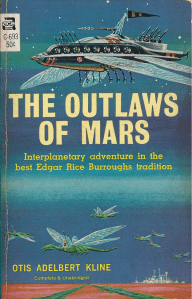
Earthman goes to some other place, beguiles local princess and soon finds himself ruling an empire/kingdom/planet. The genre was whipped into its definitive shape by Edgar Rice Burroughs, who is name-checked relentlessly on the cover and inside this book.
The comparison flatters Kline. Kline manages to make Burroughs look like a model of enlightenment, literary mastery, subtlety and human insight.
Robert E Howard and Burroughs both wrote, at times, stories containing explicit and implicit sexism and racism, though, perhaps, not always egregiously by the standards of their times. Both took for granted the superiority of the European. Both must be read with care today, and neither should be allowed to shape the attitudes of a young reader. But, they wrote rollicking, imaginative adventures, full of exotica and colour. They were true originals. They can still be read, albeit with an understanding of place and time in which they wrote. Even with such understanding, Kline is not worth reading. This book is derivative, racist and flat. The adventures are not alive enough to make up for the flaws. Sometimes, authors are forgotten for good reason.
Every character is described by skin colour -- colour is specified almost obsessively, as if it was a major concern for the author -- and some characters seem to have no other characteristic. The brown in general are the villains. (The conflict is virtually a race war.)
Much of the prose reads like first draft, some like précis or note to self:
Jerry Morgan is our hero. He travels magically to Mars. A princess inexplicably falls in love with him, and he has many adventures, all the time growing in power and influence. And so on. It is grist for the pulp mill, hacked out by lightly disguising John Carter as Jerry Morgan and hitting the same plot beats as Burroughs. You can readily imagine the author trying to work out just how closely he could afford to copy Burroughs. I mean, on Burroughs’s Barsoom generals are jeds, if I recall, and a king, a leader of leaders (jed of jeds), is a jeddack. Or something. In Kline, we have jels and, oh, I can’t recall, but a jel of jels is some other similarly derived word. Let’s say a jello, which is wrong but I cannot be bothered flicking through the book to check.
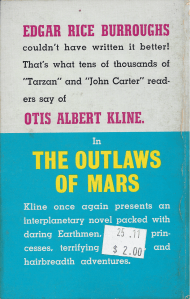
Oh, and on the back the author is called Otis Albert Kline, and the blurb inside the front cover is incorrect on at least one plot point, which wraps it up nicely – the publisher took about as much care as the author with the material…
Still I like the front cover, though.
Bah. No stars out of five.
Read it for free at FadedPage, for some unfathomable reason. (Assuming your country's copyright laws allow.)
Violently coloured, crudely racist and sniggeringly sexist, [Kline's] tales represent with considerable energy the worst impulses of fiction at its worst, while being at points compulsive reading.
So says the Encyclopedia of Science Fiction , and who am I to argue with John Clute?
The best thing about this book is the look. I confess I really like the look of these old paperbacks. So much more character than most books now. I bought it for its cover, essentially. Regrettably, the artist is not credited.
Second best is its brevity. (Worst thing may be that it is complete and unabridged.) Regrettably, nothing else about this book holds up. Given it was written as a throwaway serial for a pulp magazine (Argosy) in the early 1930s, this does not come as a shock.
Earthman goes to some other place, beguiles local princess and soon finds himself ruling an empire/kingdom/planet. The genre was whipped into its definitive shape by Edgar Rice Burroughs, who is name-checked relentlessly on the cover and inside this book.
The comparison flatters Kline. Kline manages to make Burroughs look like a model of enlightenment, literary mastery, subtlety and human insight.
Robert E Howard and Burroughs both wrote, at times, stories containing explicit and implicit sexism and racism, though, perhaps, not always egregiously by the standards of their times. Both took for granted the superiority of the European. Both must be read with care today, and neither should be allowed to shape the attitudes of a young reader. But, they wrote rollicking, imaginative adventures, full of exotica and colour. They were true originals. They can still be read, albeit with an understanding of place and time in which they wrote. Even with such understanding, Kline is not worth reading. This book is derivative, racist and flat. The adventures are not alive enough to make up for the flaws. Sometimes, authors are forgotten for good reason.
Every character is described by skin colour -- colour is specified almost obsessively, as if it was a major concern for the author -- and some characters seem to have no other characteristic. The brown in general are the villains. (The conflict is virtually a race war.)
Much of the prose reads like first draft, some like précis or note to self:
Numin Vil now believed the Earthman to be the murderer of his son, and even Junia was convinced by the evidence Thoor Movil had brought forth, Jerry heard.
Jerry Morgan is our hero. He travels magically to Mars. A princess inexplicably falls in love with him, and he has many adventures, all the time growing in power and influence. And so on. It is grist for the pulp mill, hacked out by lightly disguising John Carter as Jerry Morgan and hitting the same plot beats as Burroughs. You can readily imagine the author trying to work out just how closely he could afford to copy Burroughs. I mean, on Burroughs’s Barsoom generals are jeds, if I recall, and a king, a leader of leaders (jed of jeds), is a jeddack. Or something. In Kline, we have jels and, oh, I can’t recall, but a jel of jels is some other similarly derived word. Let’s say a jello, which is wrong but I cannot be bothered flicking through the book to check.
Oh, and on the back the author is called Otis Albert Kline, and the blurb inside the front cover is incorrect on at least one plot point, which wraps it up nicely – the publisher took about as much care as the author with the material…
Still I like the front cover, though.
Bah. No stars out of five.
Read it for free at FadedPage, for some unfathomable reason. (Assuming your country's copyright laws allow.)

August 12, 2020
It’s an okay Sword and Planet Novel. Definitely not as good as his first Mars book, the Swordsman of Mars.
It has some good action, some fun political intrigue and some inventive weapons. However, the writing in this one seems flimsier than the first. The pacing is kind of weird in the middle and the colloquial racism is fairly cringy.
It was a decent book but hard to recommend beyond diehard S&P fans and SF historians.
Also I wonder if it influenced Dun?. There’s a few aspects that make me wonder. Also I assume, since Lin Carter was in love with genre fiction, Jandar of Callisto is named after one of Jerry Morgan’s aliases in the Book. Jandar the Hunter.
It has some good action, some fun political intrigue and some inventive weapons. However, the writing in this one seems flimsier than the first. The pacing is kind of weird in the middle and the colloquial racism is fairly cringy.
It was a decent book but hard to recommend beyond diehard S&P fans and SF historians.
Also I wonder if it influenced Dun?. There’s a few aspects that make me wonder. Also I assume, since Lin Carter was in love with genre fiction, Jandar of Callisto is named after one of Jerry Morgan’s aliases in the Book. Jandar the Hunter.

February 9, 2019
Read this book years ago - just before the Burroughs Boom gave us Edgar Rice Burroughs' Mars, Venus and Pellucidar sagas. Otis Kline's OUTLAWS OF MARS is the book that introduced me to the Science Fantasy genre. And I still think it matches Burroughs' in just plain old fashion adventure writing.
More than Kline's earlier planetary sagas, his OUTLAWS OF MARS had some original scenes that made this one memorable. His best. Read once that he had started a third Martian novel, THE HUNTRESS OF MARS. Maybe someday...
More than Kline's earlier planetary sagas, his OUTLAWS OF MARS had some original scenes that made this one memorable. His best. Read once that he had started a third Martian novel, THE HUNTRESS OF MARS. Maybe someday...

October 11, 2021
Pulp fiction at its core. Loaded with racism, misogyny and works (hardly a surprise). But in the end the 2 stars come down to how bored I got at some points. The desperation to keeping it action-packed and eventful, with cliffhangers every chapter) really just got so transparent and felt like a distraction.

March 22, 2022
Do you like Edgar Rice Burroughs? Kline sure did.
Though an unashamedly ripped off version of Burroughs' Barsoom novels, the frenetic pace and likable hero make this a worthy, if not wholly necessary, addition to a library.
Though an unashamedly ripped off version of Burroughs' Barsoom novels, the frenetic pace and likable hero make this a worthy, if not wholly necessary, addition to a library.
December 26, 2016
Stilted and uninteresting
Hated it st from the era when a stiff drink would get the hero through any shock. Unlikely science, unconvincing put.
Hated it st from the era when a stiff drink would get the hero through any shock. Unlikely science, unconvincing put.
August 12, 2017
2 1/2 stars.

October 4, 2017
Read back in the 70s
Displaying 1 - 16 of 16 reviews