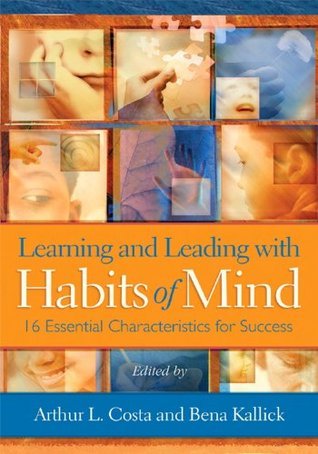
In Learning and Leading with Habits of Mind , noted educators Arthur L. Costa and Bena Kallick present a comprehensive guide to shaping schools around Habits of Mind. The habits are a repertoire of behaviors that help both students and teachers successfully navigate the various challenges and problems they encounter in the classroom and in everyday life. The Habits of Mind include
* Persisting
* Managing impulsivity
* Listening with understanding and empathy
* Thinking flexibly
* Thinking about thinking (metacognition)
* Striving for accuracy
* Questioning and posing problems
* Applying past knowledge to new situations
* Thinking and communicating with clarity and precision
* Gathering data through all senses
* Creating, imagining, innovating
* Responding with wonderment and awe
* Taking responsible risks
* Finding humor
* Thinking interdependently
* Remaining open to continuous learning This volume brings together--in a revised and expanded format—concepts from the four books in Costa and Kallick’s earlier work Habits of A Developmental Series . Along with other highly respected scholars and practitioners, the authors explain how the 16 Habits of Mind dovetail with up-to-date concepts of what constitutes intelligence; present instructional strategies for activating the habits and creating a “thought-full” classroom environment; offer assessment and reporting strategies that incorporate the habits; and provide real-life examples of how communities, school districts, building administrators, and teachers can integrate the habits into their school culture. Drawing upon their research and work over many years, in many countries, Costa and Kallick present a compelling rationale for using the Habits of Mind as a foundation for leading, teaching, learning, and living well in a complex world.
Arthur L. Costa is professor emeritus of education at California State University, Sacramento. He has served as a classroom teacher, a curriculum consultant, and assistant superintendent for instruction, and the direction of educational programs for the National Aeronautics and Space Administration.
an interesting bit of pedagogy, with varying levels of usefulness depending on your role in a school. For those in elementary or middle school, it is an excellent resource for approaching cognitive skills in students. Additionally, the text provides some examples for implementing the philosophy and using it to alter the culture of a school. This method is not useful for an individual teacher and is targeted at entire institutions. Depending on your role (I am a teacher), only a few sections of the book are immediately applicable and transferable to my experience. Nevertheless, it does provide some useful categories to conceptualize and converse with other teachers about the thinking abilities of students at any level and some of their social-emotional development. I would recommend this text for people in leadership roles in education, other roles may only find use from sections of this book. Thankfully, the text is well organized and with clear, well structured chapters that make picking and choosing relevant sections easy to find. Few people would benefit from a through read of the text.
Dit boek heeft mij een antwoord gegeven op een gemis in het onderwijs, buiten het kennisdomein. Wat is het meest waardevol wat je iemand kan meegeven in het leven? Dat zijn niet bepaalde feitjes (die kan je opzoeken) maar een (kritische) denkwijze die je leert om op verschillende manieren naar problemen te kijken en deze op te lossen. Art Costa en Bena Kallick hebben dit zeer kundig beschreven in dit boek. De Habits of Mind zijn niet bedacht, maar gedestilleerd uit het gedrag van succesvolle personen. De quote die daarbij het beste past bij de Habits of Mind is wat mij betreft: "Het residu van ons onderwijs; dat wat over is als de dingen die we geoefend en gememoriseerd hebben, al lang vergeten is." (Ted Sizer) Het boek geeft veel inzicht in wat de Habits of Mind zijn en op welke wijze dit gedachtengoed zou kunnen verinnerlijkt worden. Er is wat minder aandacht voor praktische tools en handvatten. Al met al heeft dit handboek mij een antwoord gegeven in mijn zoektocht om het onderwijs te verrijken. Ik raadpleeg het boek nog dikwijls en kan het zeker aanraden.
I feel like this could have been three books. Laying out the Habits....Leading the Habits...A Timeline for implementation....
And yet, the Habits themselves are so wonderful. I love seeing the way that our students are reflecting upon their own learning and habits as they grow.
This book gives you exactly what you need if you decide to delve into ways of introducing Habits of Mind. Well-structured, clear and thought-provoking.
Learning and Leading with Habits of Mind is a collection of pieces that collectively describe a wide ranging vision for education surrounded around teaching what the author's call thinking behaviors or Habits of Mind. In many ways, this book is the best articulation of how to implement a curriculum that fosters expert thinking, complex communication, and intrapersonal skills that I have ever read. It doesn't have all of the answers, but it provides enough background on everything from instruction, assessment, school culture, and leadership that it gives a place for any interested educator to give teaching towards thinking processes a place to start.
The organization of the book works well. Their are five sections. The first gives an overview of the Habits of Mind and the salient issues. The second section gives advice on how to operationalize the Habits of Mind through the culture of a school and instruction. The third section explores assessment and reporting. The fourth explores school leadership through the lens of the Habits of Mind. The fifth and final section gives case studies of schools and school systems that implemented the Habits of Mind.
While I don't think my school will likely, adopted the language of the Habits of Mind, Learning and Leading with Habits of Mind will be an invaluable resource as we continue to explore how to teach towards and assess expert thinking, complex communication, and intrapersonal skills.
The Habits of the Mind seem like they might be a valuable tool to help kids learn to think and learn. Unfortunately, this book isn't really about the Habits of the Mind; it's about implementing the habits of the mind in your school. Which is great if you already know what the habits of the mind are, and you work in a school, but not much good otherwise.
I would recommend incorporating these habits of mind into every classroom--our students desperately need direct instruction in how to be successful, life-long learners. This book provides the necessary guidance.
Goed boek waarin heel duidelijk beschreven wordt wat de habits of mind zijn en hoe ze te gebruiken en te implementeren zijn. Ook mooie praktijkvoorbeelden beschreven.