Nos dias de hoje, diante de uma vida atribulada, as pessoas pensam cada vez mais em comida, embora dediquem cada vez menos tempo ao preparo de suas refeições. Preocupam-se com a quantidade de calorias ingeridas e com a qualidade dos ingredientes, mas reservam mais horas para assistir aos programas de culinária na TV do que efetivamente passam dentro da cozinha. E enchem a despensa com produtos industrializados supostamente 'saudáveis'. Nesse cenário tão contraditório, o escritor Michael Pollan convida o leitor a redescobrir a experiência fascinante de transformar os alimentos. A partir dos quatro elementos da natureza - fogo, água, ar e terra -, ele nos mostra o calor ancestral do churrasco, o caldo perfumado dos assados de panela, a leveza dos pães integrais e a magia da fermentação de um chucrute. Ao relatar suas experiências pessoais com os processos de preparação da comida, Pollan mergulha numa história tão antiga quanto a da própria humanidade e propõe uma redescoberta de sabores e valores esquecidos. Cozinhar é, ao mesmo tempo, investigação científica e narrativa pessoal, guia pragmático sobre o preparo de alimentos e reflexão filosófica sobre a transformação da natureza. Partindo do trabalho de filósofos e antropólogos, Pollan ressalta que o ato de cozinhar é um dos fatores que definem a espécie humana. Ao aprender a usar o fogo para preparar alimentos, nossos ancestrais abriram caminho para o desenvolvimento da civilização. E ele alerta - precisamos reconquistar o território da cozinha. Com isso, reforçamos vínculos comunitários e familiares e, ao mesmo tempo, damos um passo importante para tornar nosso sistema alimentar mais saudável e sustentável.
Michael Pollan is an American author, journalist, activist, and professor of journalism at the University of California, Berkeley, where he is also the director of the Knight Program in Science and Environmental Journalism.
So as background, let me tell you a little bit about the day I started/gave up reading this book. I woke up in my tiny (494 sq ft) 1920s-era house in a walkable urban neighborhood. As I went outside to water my vegetable garden and take out the recycling, I saw my neighbor had returned my pie plate (I'd brought him the leftovers of my contribution to a pre-thanksgiving potluck) and also left me a mason jar of homemade spiked cider. Then I walked up the block to the coffee cart on the corner, where I got some organic pour-over coffee and homemade banana bread. By the time I got home, my taxi had arrived, so I loaded in my vintage 1970s carry-on that I got for a dollar at the Thursday Club rummage sale (a copy of McSweeney's Lucky Peach magazine in the side pocket) and went to the airport. I got on the plane, pulled out my iPad, and opened the eGalley of this book...which is all to say that
1) I am bougie as shit
2) if anyone should be the proper audience for this book, it is me
and 3) despite all that, by about page 8 all I wanted to say was:
Shut up, Michael Pollan. Just. Shut. Up.
*Disclaimer: I think Michael Pollan is great. I think slow food is great. I think local artisans and organic farms and healthy eating and sustainable everything and all of that is great. SO GREAT!!
But I am tired of being told, okay? I GET IT. I was looking forward to a cool book about his experiences making pickles or whatever, not another rehash of the same old thing. People who don't know about this stuff already can just read The Omnivore's Dilemma. It's still in print.
If you cannot trace your family back to immigrants or peasant stock then you are probably very well off and this book was certainly written for you. Otherwise.... read on!
1. Michael Pollan is a clever man, and a cheerful one. 2. MP does a lot of research. 3. MP is very wordy because he wants you to know the he is a clever man who does a lot of research and is a cheery chappy, not a depressive old so-and-so who edits his work down to the bone, 4. MP is very well off and thinks his readers are too and live in areas where there are lots of organic farms and farmers' markets because that's where he shops and you should too.
I got so bored reading this very worthy book that I started to note down nuggets of wisdom, or at least interesting stories. From just a day of that I deduced that it was one interesting bit for five pages of MP going on being clever showing his research and just what a convivial, family man he was etc. It would have been really good cut down but then it would have been a bit thin.
I do not agree with his premise that it was cooking meat that gave us a supply of more, easy to get calories that enabled our brains to grow and for us to become the brilliant humans we are. There are plenty of societies which are either vegetarian or only have meat rarely and they have the same size brains as the rest of us. Hunter gatherers in all parts of the world are not noted for being particularly thick and having only walnut-sized brains in their heads. The development of civilization is another strand of our humanity all together.
______________
In the real world most of us do not have access to farms that will butcher whole organically-raised cows and sell us just a pound of mince at a reasonable price. Farmers' markets trade on their names and the glow that goes along with the idea that everything is locally grown and free from pesticides unlike factory farm stuff you get in the supermarket, or at least so they say, but they also buy in from other farms who specialise in supplying farmers' market traders and might not be so fussy. .
When you are paying a lot of money for organic food in the supermarket have you ever stopped to think it doesn't matter how it was grown, it was transported in crates in an open truck up and down the highway, lots of fumes for the produce to breathe in? Or that the organic apples and other stored items had been gassed to make them ripen more slowly, that the refrigerated items might also have been gassed and fresh produce is often wrapped in bags that slow deterioration by changing the chemical consitutents in the gas, air, that surrounds them?
It's your choice who you support, but bathing in the warm glow of doing the best for your family by eating only locally-produced, non-transported organic food is only for the very well off who have a nice country home. Then they can poison themselves by commuting to the city for work.
Rather than concentrating on organic and local, maybe the easier to manage whole foods rather than processed would keep us healthier, after all that's what our poor immigrant or peasant families once ate. Whole foods, not much meat, that being a treat, home-cooked with no preservatives, lots of exercise in the open air, and sleep. It worked for them, it must have or we wouldn't be around. I know we are longer-lived now, but that is due more to the advances of medicine than it is to increase in nutrition from our wonderful preservative, sugar and fat based diet.
This is less a review of the book and more a response to other people's critiques of 'Cooked'. Anyone who tells you that this book is simply a rehash of 'The Omnivore's Dilemma' never made it past the second page. Having read 'Second Nature', 'Botany of Desire', 'The Omnivore's Dilemma' and 'In Defense of Food' (in that order), 'Cooked' reads much less like he is treading old ground and more like he is building on previous themes. One could argue that 'In Defense of Food' and 'Food Rules' are both a little too close to 'Dilemma' and were perhaps capitalizing on the then trendy subject of food politics. But 'Cooked' certainly is not, instead it does exactly what the dust jacket tells you it is going to do, it invites you into Pollan's kitchen while he experiments with and muses on dinner. And as a woman and a feminist, I didn't find a single thing in the second chapter (which tackles gender stereotypes in the kitchen) remotely sexist or anti-feminist. If a reader finds anything he says about either the feminist movement or the need for someone in the household to return to the kitchen offensive, they are surely looking for a bone to pick and consequently are doing only a cursory reading. Right now if you plug Pollan's name into Google you come up with a lot of splashy headlines: 'Is Michael Pollan a Sexist Pig?' 'Why Does Michael Pollan Romanticize Dinner?' and 'Why Does Michael Pollan Think Cooking Is an Escape From Corporations?'. Most of these articles concede that 'Cooked' is really a good book, a fun read, maybe a little flawed, but essentially on the same side as the authors of the previously named articles. Then why the attention grabbing headlines? Perhaps because it is easier to tear apart something that is both good and popular in order to ride it's coat tails than come up with something new. Or perhaps it is becoming 'uncool' to like Michael Pollan as he and his views are gathering a mainstream following. 'Cooked' is a good book, a fun read. It left me with the drive to get back in my garden, return to baking bread, maybe even take up cheese making. I learned a lot about the science of cooking. Pollan has a particular gift to take scientific material and translate it for the layman. The overly critical backlash against it should not keep anyone from picking it up and enjoying it.
You know that question readers sometimes get asked? The one about which three authors (living or dead) they'd like to have over for dinner? Well, I'll need to find a space at that table for Michael Pollan. Not just because I've loved all of his books so far, but because we are cut from the same cloth.
I taught myself to cook (properly, that is) after I left college and quickly fell in love. I started referring to cooking as a kind of magic because what you could create from all of the scattered, dissimilar ingredients became something so much more than the sum of its parts. Imagine my surprise when, right at the start of this book, Michael Pollan began using that EXACT LANGUAGE to describe the SAME THING. Great minds, as they say.
Cooked is a witty and charming exploration of the transformation of food from the stuff of the earth to stuff we can eat using the four traditional elements: fire, water, air, and earth. And Pollan does more than discuss - he participates. He makes barbeque with grill masters, sweats a mirepoix with a chef, whispers sweet nothings to a sourdough starter, and crafts raw milk cheese with nuns. The whole time, he marvels at what can be created with human hands and shakes his head at what all has been lost in the mass commercialization of cooking and food in the Western world.
If you're not a lover of cooking, Pollan's infectious curiosity and enthusiasm will likely rub off on you. If you're more like me, and already love spending time in the kitchen, you're much more likely to become obsessed with baking bread and/or fermenting kimchi. Prayers up for my husband, because I'm liable to pick up at least one of those habits here soon.
This was one of my favorite nonfiction books of the year ❤️
Click here to hear more of my thoughts on this book over on my Booktube channel, abookolive!
Michael Pollan, an author and journalist who writes about food, went on a three-year pilgrimage to learn about food associated with the four classical elements: fire, water, air, and earth. Along the way, Pollan consulted and cooked with masters in each field. In 'Cooked', Pollan shares culinary techniques he acquired, along with healthy doses of science, history, anthropology, and philosophy.
Michael Pollan
Packaged, processed, and fast foods have taken a toll on our well-being because these edibles contain large amounts of sugar, fat, and salt - as well as preservatives that aren't natural to our diet. To remedy the situation, Pollan posits that we should cook more, and notes that 'cooking is one of the most interesting and worthwhile things we can do.'
Fire
One way to prepare food with fire is to roast meat over burning wood. Traditional barbecue pork is prepared like this, from whole hogs roasted in pits. Pollan consulted some of the most skilled pitmasters in North Carolina - including the barbecue expert Ed Mitchell - and learned that the pigs are slowly roasted over oak and hickory coals. When the hogs are done, assistants wearing heavy gloves pull the meat apart with their hands - a hot and laborious process. The pulled pork can be served on plates or in sandwiches for a tasty meal.
Of course the earliest humans didn't cook their food. The English writer Charles Lamb (1775-1834) claims that all meat was eaten raw until the art of roasting was accidently discovered by a hapless Chinese boy named Bo-bo. Bo-bo liked to play with fire, and one day, when Bo-bo was home alone, he burned down the family cottage....incinerating a litter of piglets. Bo-bo - and then his family - tasted the burnt piglets, whose skin had crisped to delicious 'cracklings' - and they were good. After this, whenever the family sow farrowed, the cottage burned down - a practice that soon spread to all the neighbors. Eventually, a smarter head figured out that pigs could be roasted on a spit, and humans discovered the art of cooking.
The Scottish writer James Boswell (1740-1795) wrote that cooking is the 'defining human ability', the attribute that separates us from animals. Moreover, anthropologists postulate that cooking ALLOWED our proto-human ancestors to evolve into Homo sapiens because cooked food was easier to digest, and provided the large quantities of nutrients needed by our bigger brains.
Of course fire can be used to cook many things, and Pollan was especially impressed with Chef Victor Arguinzoniz at the Asador Etxebarri Restaurant in Spain. Chef Victor prepares everything on a grill, including dessert. The chef is known for his juicy prawns, chorizo tartare, and even his butter - which is eaten without bread, like a fine cheese. So if you're ever in Axpe, Spain, you know where to go.
Tasting Menu at Asador Etxebarri
Water
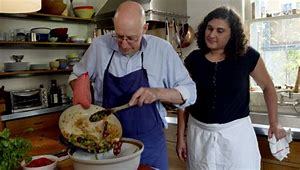
Cooking with water became possible when humans developed the ability to craft pots. Pollan - who lives in California - needed help to hone his braising skills, so he recruited a local Iranian-American chef and cookbook author, Samin Nosrat. Samin has big personality and a storehouse of food knowledge that she's happy to share. Samin says great cooking is about the three P's - patience, presence, and practice.
Michael Pollan and Samin Nosrat
Most braises start with sautéed onions, which must be chopped fine and cooked slowly to get things started. In fact onions (and garlic) contribute to the safety of food, because they contain powerful antimicrobial compounds that protect us from dangerous bacteria. After the onions comes the meat, which is seasoned with at least 'three to five times as much salt as you think you need.' This brings out the intrinsic flavors of the meat, and improves its texture and appearance. Once the meat is seared, everything goes into a covered pot with vegetables, spices, and braising liquid - which can be almost anything: wine, stock, puree, juice, milk, beer, dashi, tap water, and more - depending on the recipe and its cultural reference. The food is then slowly cooked until the meat is tender and (hopefully) delicious. Pollan writes, 'the one pot meal brings the family together, unlike individual microwave meals.'
Certain edibles - such as good stew - appeal to us because our 'tastes' have been selected by evolution for their survival value. The five 'flavors' human taste buds can detect are: sweetness - which directs us to sugar-rich foods that are good sources of energy; salty - because salt is an essential nutrient; bitter - so we don't eat toxic plants; sour - so we stay away from rotten food; and umami (the taste of savoriness) - so we'll consume nutritious proteins.
The revulsion we feel to bitter and sour foods can be overcome, however, and many people develop an 'acquired taste' for things like tea, coffee, dark chocolate, kale, grapefruit, 'stinky cheeses', and so on.
Air
Air, the element that 'puffs up' bread, helps convert wheat into usable energy. Pollan notes that he really loves good bread, and would rather eat a slice of fresh bread - with a rugged crust and a moist, tender, pocket-filled interior (called 'the crumb') - than a piece of cake. The gases in the crumb carry much of the 'roasty, yeasty, hazelnutty, and faintly alcoholic aroma' of the bread, which the author prefers to the smell of wine or coffee.
To become a home baker, Pollan decided to learn to make sourdough bread, which begins with a 'starter' - a leavening agent made from a flour-water mixture fermented by yeast and bacteria. For sourdough starter, bakers do not add microbes (such as store bought yeast), but depend on yeasts and bacteria in the flour, water, and air.
To perfect his starter Pollan consulted a number of bread experts, including Chad Robertson from San Francisco's Tartine Bakery - a bread guru renowned for his sourdough creations. Watching Chad shape his breads, Pollan saw a 'blur of fingers that looked like they were swaddling an endless row of infants at warp speed.' Pollan brought his starter to the Tartine Bakery in a Tupperware container, wanting to get some pointers on the care and feeding of the concoction - and hoping to secretly snag some microbes, because the bakery 'must be crawling with them.' 😊
Sourdough starter
Pollan also acquired flour milled from specially grown wheat, and - with much practice - made some very tasty loaves. It's important to use WHOLE WHEAT FLOUR - including the bran and germ - because this is where the vitamins and antioxidants are. Unfortunately for our ancestors, there was a historical preference for white flour, since it made bread that was sweeter and airier - but much less healthful. Because of this, the government requires nutrients to be put back into baked goods, which is why Wonder Bread and the like have a slew of artificial ingredients.
A 'whole grain' renaissance began in the 1960s, and many of today's artisanal bakers have embraced whole grains, so - even if you don't bake - healthy breads are easy to find (even on supermarket shelves).
Sourdough bread
Earth
Bacteria and fungi are everywhere, just waiting to decompose things. While organisms are alive, their cells are protected by membranes or walls, but - as soon as living things die - bacteria and fungi start to break them down. This is a good thing, because it keeps the planet from being covered with dead plants and animals, poop, debris, trash, and so on.
Bacteria are beneficial in many ways. In fact our bodies are largely composed of bacteria. Microbes in our gut are essential to life, since they maintain our intestinal wall, help us digest certain carbohydrates, crowd out harmful pathogens, produce antibiotic compounds, and activate the immune system. In the vagina, bacteria help maintain a pH low enough to resist pathogens. Moreover, bacteria evolve right along with us. For instance, Japanese people have specific microbes that help them digest seaweed.
Microbes also ferment foodstuffs - that is, they produce chemical changes that preserve foods and change their flavor. Early humans (probably accidently) learned to ferment foods, and people have been doing it ever since. The earliest impetus for 'pickling' (a word that refers to ALL vegetable ferments, not just pickles) was preservation. Until there was a way to preserve food, humans could not advance from hunting and gathering to agriculture.
Fermentation, along with smoking and drying, allowed farmers to survive the long months between harvests. As an additional bonus, fermentation creates useful molecules - like B vitamins, vitamin C, amino acids, and anti-cancer elements....AND breaks down chemical compounds that interfere with nutrient absorption. So fermentation has many advantages.
On the downside, fermented foods are a culturally specific 'acquired taste', so fermented foods of other ethnic groups often strike us as 'rotten.'
The list of items prepared via fermentation is impressive, and includes bread, coffee, pickles, sauerkraut, kimchi, beer, cheese, yogurt, soy sauce, kombucha, kefir, miso, natto, and more.
Pollan acquired pickling recipes from 'fermentation revivalist' Sandor Katz, who teaches fermentation workshops around the country. Katz is a 'fermento', a group of dedicated brewers, cheese makers, picklers, and 'post-Pasteurians' - people who fight for the right to drink unpasteurized milk and eat unpasteurized cheeses. One of the country's foremost raw-cheese makers is a nun, Sister Noella Marcellino, who helped the author learn the art of cheese creation. Sister Noella, who has a Ph.D. in microbiology, has government permission to use her old wooden implements rather than the stainless steel instruments mandated by law.
A VERY COMMON use of fermentation is the making of alcoholic beverages, which began at least 7,000 to 8,000 years ago. Wine, beer, or mead have been used in religious rituals for centuries, in the belief that 'intoxication' gives people access to the gods. Fermented drinks were beneficial to early humans because they were safer than water (since alcohol kills pathogens) and contain extra vitamins, minerals, and proteins.
Pollan relates that his first experiment with wine-making occurred when he was ten years old, and intrigued by alchemy. (He'd already tried to convert a lump of coal into a diamond. 😎) The youthful Pollan gathered grapes, squashed them up in an orange juice container, screwed the lid on tightly, and put it on a table in the living room. He apparently didn't notice the container starting to bulge.....and came home with his parents one night to find the living room smelling of wine and completely splattered with purple stains.
As an adult, Pollan and his son made beer - dubbed 'Pollan's Pale Ale' - which he says is quite drinkable.
Since completing research for this book, some of Pollan's culinary routines have fallen by the wayside. However, he still spends Sunday afternoons preparing braises for the family; makes ale once in a while; bakes bread every couple of weeks; and roasts a pig on his lawn every year - a ritual enjoyed by family, friends, and neighbors.
The book is long, and my review merely skims the top of what's inside - including tips for preparing a variety of foods and beverages. I enjoyed the narrative, though some of the philosophical musings are a bit overdone (IMO). Still, even if you're not a cook - or a foodie - there's a lot to enjoy here.
In Michael Pollan's latest book about food, he takes the reader on a personal journey as he learns first-hand about four different types of cooking. First, he takes a trip to the North Carolina, where he learns how to cook barbecue from a pit master. Pollan volunteers his time, and learns the subtleties of cooking a barbecue, and these subtleties are described in detail. Perhaps, a bit too much detail for my taste.
Then Pollan describes the art of making sourdough bread. In great detail. One very interesting factoid is that one can live off of bread, but the nutrition in flour alone is insufficient to sustain life. Pollan describes the chemical reactions involved in the making of bread, and it is these chemical reactions that are necessary to generate sufficient nutrition for living.
The book also goes into detail about fermented foods, especially cheese. He visits Mother Noella, the "Cheese Nun" who has a PhD in microbiology. She has used her understanding of chemistry, biology, and bacteria to perfect the making of cheese. A lot of evidence is cited, about the healthfulness of fermented foods. I found a new respect for fermented foods, and especially my favorite; pickles.
I am a vegan, so the sections on barbecue and making cheese are not exactly enticements to try cooking or eating these foods. Nevertheless, Pollan manages to make it all interesting to me, as he brings the master cooks to life.
There are no recipes in this book. While you cannot learn how to cook from this book, you can gain some insight into why cooking helps make us human. The book is an argument for taking the time to cook, instead of heating up pre-cooked dinners. Parts of the book wax poetic about the art of cooking, and about the people who have mastered the art of specialty cooking.
I wanted to love this book so badly and there are definite 5-star parts to it, but there are also 1-star parts. Parts that I, admittedly, skimmed through. I suppose that is to be expected in a book covering so many topics. The book is divided into 4 parts - earth, air, fire, and water - and I while I understand and can see the appeal of this, I oftentimes felt that the connections were tenuous, at best. For example, there is an obvious connection between roasting a pig and fire. However, the inclusion of alcohol fermentation in the "air" section felt really obtuse. I get that yeast is in the air, but....it felt contrived.
Part 1: Fire. OH MY GOD, if you can read these 100 pages and not want to go out and roast a pig in your backyard, or at the very least, drive down to the south for some authentic barbecue, then you should not read this book, because you don't love food. I loved the writing; I could almost taste and feel the barbecued pig while reading.
Part 2: Water. Simple braises are my MO in the kitchen, but I never realized how much temperature and cooking times can alter the flavor of a simple miripoix (carrots, onion, celery). I loved the focus on flavors and how to bring those out with different techniques.
Part 3: Air. I didn't love this chapter at all. In fact, I almost skipped the last 75 page of it completely, but I skimmed them. I don't eat bread, but I was fascinated by the focus on biology and what is going on when yeast combine with sugar and create those delicate little pockets of yeasty goodness. I worked at a bakery for years in high school, so that scent will always be with me.
Part 4: Earth. This was all about fermentation. I own and have read The Art of Fermentation and Wild Fermentation, and I am a regular vegetable pickler. However, I am more inclined to do the quick vinegar pickle which I was reminded isn't "real" pickling. I was inspired to get some veggies at the store to begin some real adventures in fermenting. I was not, however inspired to start fermenting beer. I'll leave that to the experts because some things are better as mysteries.
Overall, it was a good book, but much too long. I loved the biology and nerdy science parts; I think this is where Pollan's writing and attention to detail really excel. The history parts were interesting, and I read those sections with some interest. However, I found myself rolling my eyes and getting very annoyed during the far-too-long sections about philosophy/religion. Maybe that's just the scientist in me coming out.
Michael Pollan is one of my very favorited people. This is not my favorite of his books- however, it's still a good book. I think I would have enjoyed it more if I hadn't gotten on one of my OCD sprees last year and read everything I could about food. So this book for me was going over old ground.
I did like the BBQ (fire) chapters, except they made me hungry.
I loved the Bread (air) chapters, except they made me hungry.
I liked the brasing (water) chapters, they did make me hungry.
The fermentation chapters (earth) were great but yep..hungry.
Mr. Pollan is the reason that I started eating healthier and give alot more thought to what I put in my mouth. His writing is always easy to understand and very personal for me.
I've now read all of Pollan's book and I think I could do a really good parody at this point. I'd just have to compare a cheese curd to a dionysian struggle between our innate longing for romance and order. Or something like that. This book was a lot of fun. It gave me a new perspective on food and cooking and I learned a lot. Sometimes I get annoyed at the fermentation zealots out there now or the bread dudes and I wonder if they don't need to be reminded sometimes that we're just talking about food. People have very strong feelings about some of this stuff. I believe in everything he says in here, but I get annoyed when people use food preparation as a weapon of judgement. Maybe Pollan should write about that next--how much ego and identity has taken hold in our food tribes. Today's paleo, gluten-free, bread purists, kombacha cults sometimes sound like the prophets of the old testament talking about their food laws.
Not only was this book about transformations in cooking, it was a transformative book for me. After reading this book, I had an uncontrollable urge to bake bread (hello whole wheat hamburger buns!) and start fermenting my own cucumbers.
I picked this up at the library because of the title. I had never read a book by Michael Pollan, I had no idea he was one of Time magazines most influential people of the year back in 2010. Now I can see why. He certainly influenced me.
This is a well written book. Even if a person disagreed with him on matters of diet, he is a master of words and I hated having to put the book down. I'm sad it's over. I need more Michael Pollan!
He discusses cooking with all the elements - Fire, Water, Air, Earth.
Fire - BBQ. Authentic southern barbecue, made from the whole hog. Not much a BBQ fan myself, I was salivating reading through this section. It's not just about the joys of eating real food prepared slowly, it's also a social commentary with questions raised about the ethics of hog farms. It makes you think.
Water - Stews, Soups, Braises. This section was interesting, but I didn't become inspired to learn to make soffritto. It did make me want to spend more time in the kitchen, though.
Air - This was THE chapter. Bread. Bread made from wild yeast. I learned so much about sourdough starters and bacteria and yeast. I learned about wheat. I learned what we have done to our wheat. I learned how humans have evolved with wheat and the relationship we have to yeast. I just can't buy a processed bread product now. (I'm sure I'll eventually have to, but hopefully, not as much as I have been.)
Earth - Fermentation. Alcohol. Pickling naturally, without vinegar. I had no idea how hip and trendy fermenting is right now. It sounds earthy and fun. Yes, I'm a little leery of the microbes, but I think I'll steer clear of corning my own beef or making my own sausages (which wasn't touched in this book, but it was discussed in another book I read). Wine. Beer. Cheese. I had to go eat olives with seeds and good cheese and drink wine after this section. I learned about bacteria in our gut and how different studies are showing some very interesting things about our evolution with alcohol and fermented foods.
If I could, I'd change my entire diet right now. But I can't - some of this takes too much time, some of this costs too much money. And for some things, I just don't think I've the patience or the talent. But it started me thinking. I've discussed everything in this book with my husband every night with such enthusiasm he's laughing at me (in a good way!)
"Cooking puts several kinds of distance between the brutal facts of the matter (dead animals for dinner) and the dining room table set with crisp linens and polished silver."
Cooked was a book that for the most part, I found interesting. Pollan studies 4 classic elements: Fire, Water, Air, and Earth, and their impact on the creation of food and beverage. For me, the book read in descending order of interest: the fire and water chapters were better and kept my interest much more than air and earth. I took many more breaks in the second half.
I am admittedly not an expert in the kitchen. I'm a novice at best, and it's not a high priority of mine to achieve expert level - I get by. I think opinions will vary re: which sections of the book are most engaging, just based on personal preferences. I also loveddd The Omnivore's Dilemma, and Cooked, while interesting enough, just wasn't on the same level.
"Each of the different methods I learned for turning the stuff of nature into tasty creations of culture implies a different way of engaging with the world, and some are more sympathetic than others."
If you are already a Pollan fan and/or beyond novice level in the kitchen, I'm more likely to recommend "you" check Cooked out. If you're just considering any Pollan novel, choosing The Omnivore's Dilemma is an excellent choice to start with.
Another excellent and inspiring book by Michael Pollan. Every topic is heavily researched -apparently for the sheer joy of it- and Pollan's enthusiasm is highly infectious. I've got a 100% whole wheat sourdough started (rather than a mix of white & wh.w.) am determined to make my own kimchi and feel inspired to make homemade mozzarella again. As for home made beer, I have a hunch any batch would explode spectacularly in the Texas summer heat-in spite of AC-. A project for late fall perhaps. As I've already mentioned-this is a very inspiring book!
I'm a fan of Michael Pollan, both because of his fine writing and the food politics he espouses. In _Cooked_, he turns his attention to the four elements of cooking -- fire, air, earth, and water- -- and gives the reader a new look into the western food culture. The book is not only food memoir but also a heavy dose of philosophy, literary studies, history, and anthropology as Pollan illustrates the tangled cultural web of the food we eat. At times, this gets a bit ponderous though the point is well taken: Food doesn't exist in a cultural vacuum even though grocery stores and McDonald's might occasionally make us think it does.
This was an awesome read, and well worth the effort to borrow and devour.
Michael Pollan took a lesson from his last book - that if you eat whatever you make with your own two hands, you will be healthy - and applied it. Here, he takes the four elements of fire, water, air, and earth, and cooks four types of food with those elements. For fire, he apprenticed himself with a Carolina barbecue pit master. In the water section, he learned to braise from an Iranian immigrant who worked at Chez Panisse. Then he learned to bake bread from the owner of Tartine as a way to understand how to cook with hot air, and lastly he learned to pickle veggies and brew beer as a way of using the bacterias in earth to transform food.
At it's core, this book is an optimistic look at how cooking enriches not just our health, but our relationships with friends, loved ones, and strangers. There are parts of the book where he paints a scary picture of the food world we live in (in a rehashing of the basic principles of "In Defense of Food"), like how KFC marketed buckets of chicken as a second-wave feminism solution to the division of labor in American households, or how most Southern barbecue joints are owned by white men that underpay black pit masters to do the heavy lifting. But this book focuses more on how cooking heals than on how the lack of it hurts. It's hard not to smile a little when he describes having his best conversations with his teenage son Isaac while chopping vegetables because teenagers hate having real, face-to-face conversations, or how they spent quality father-son time brewing beer because the illicitness of the activity piqued Isaac's interest.
I love literate science and cultural micro-histories. I also love and health, growing my own veggies and cooking healthy meals. So I’ve been a huge Pollan fan since 2006, when my sister-in-law brought me The Omnivore's Dilemma for Christmas. Pollan hits on all cylinders.He’s a cultural critic, but unlike most cultural critics, his lense is food, not literature or pop-culture TV. movies or music, which makes him unique. He’s a food writer that doesn’t obsess about creating Michelin 5-star ingredients and esoteric food prep techniques, or present Bitman-esque reams of minimalist recipes.
Instead, Pollan uses his bully-pulpit to dissect the negative impact that industrial food companies have had on the health of Westerners. And that impact’s been horrible:increases in obesity, diabetes, the risk of heart disease, stroke, cancer, etc. He’s also scientific in his approach, citing research, but unlike many a science or pop-diet writers, refuses to take the easy, reductionist answer. He doesn’t focus on single-elements of a diet (like the Atkins ‘kill the carbs, eat meat’ nonsense). Not does he jump on the “superfoods” bandwagon, saying we should all eat kale (or whatever the superfood of the moment is) every day for breakfast, lunch and dinners. And he scoffs at things like the “paleo diet,” a marketing ploy that’s a quixotic tilting at wind turbines in the 21st century. In fact, he’s the only new agey type guru I know of who advises AGAINST taking dietary supplements, whether vitamins, minerals or extracted nutrients .
To Pollan, the good nutrition is more than a sum of vitamins, minerals and phytochemicals. Instead, whole foods create a holistic system that exploits our evolutionary machinery for turning foodstuffs into health. Due to ancillary phytochemicals, minerals, etc, a real apple contains, your body extracts more useable vitamin C from it than it can from a vitamin C tablet. Which is why he advocates eating diets of real, whole foods for optimal health.
Cooked continues Pollan’s top-shelf bibliography. In it, he traces four ways that humans cook food: fire, water, air and earth.
He starts with fire, apprenticing himself to a big-talking North Carolina pitmaster. There, he notes the Homeric and biblical similarities our modern barbeques, especially communal pig roasts, to their ancient cousins. Both are open-air, male-centric, extroverted celebrations of a successful hunt. He then moves onto the element water, where he learns to braise meats and stews in closed, domestic vessels. This practice is introverted, hearth-bound and feminine, but responsible for our most tasty, cherished and economical of dishes.
After tackling the big-two, the books rambles into the truly interesting… at least for me, since I seldom visit these realms. For the element air, Pollan learns the skills of artisan breadmaking. It turns out that there’s more to making bread than dumping yeast into a flour dough. In fact, for master-bakers, it’s an obsession that has them bringing their sourdough “starters,” a living culture of yeast and bacteria which give sourdough bread its unique taste, with them to the movies so they can “feed” the starter on schedule. Obsessive, for sure, but the results a tasty, often peerless loaf.
And then Pollan takes you into earth, the world of fermented food products. Pollan makes clear that fermentation is controlled rot. Think cabbage. But not the store-bought variety, often desiccated cabbage soured with vinegar, but how they make kraut in the old world. Shred the cabbage, put it in an airtight pot and let the bacteria present on the cabbage itself rot the cabbage to produce sauerkraut. Pollan’s “teachers of rot” include a half-cracked HIV-positive prophet of ingesting live bacteria named Sandor Katz, to a Catholic nun with a PhD in biochemistry who makes a traditional smelly-as-unwashed-feet French cheese for her convent. Pollan finishes playing basement brewmaster, lending an appreciation to the complexities of fermenting alcohol.
As always with Pollan, Cooked left me amazed by the breadth and depth of his insights. He’ll quote Nietzche, a contemporary archaeologist, a down-home pitmaster and then a scientific study on the health benefits of a whole food diet within the same page. Odd bedfellows, but Pollan has the knack for making the disparate hang together. Like a good cultural critic, he connects readers to heretofore unrealized deep traditions that hide in plain sight. Like a good food writer, he focuses on the artful preparation of food and understanding it’s histories. And like a top-flight science/ health writer, he highlights evidenced-based strategies we all can use to live healthier lives.
A rare, page-turner of a non-fiction book. Four-and-a-half stars, rounded up to five.
Cooked is Michael Pollan's love letter to food preparation. In our world of fast food, ubiquitous restaurants, frozen entrees and meal delivery, he wants to remind us of the good old days when we spent significant portions of our time getting food on the table. Pollan references the average family's daily time spent cooking and cleaning up - 27 minutes and 4 minutes, respectively - roughly half what it was when he was a boy in the 60s. Corporations have stepped in to make food preparation easy for us, freeing us [mostly women, historically] to do other things. While there are benefits to this progress, Pollan wants to advocate for an increased understanding of, appreciation for, and connection to what we eat.
Pollan approaches cooking from every angle he can: the history of food and what we know from tradition and archaeology, the chemistry of food transformation, the science of sustenance and nutrition, the history of various cooking methods and cultural practices, and the execution of cooking itself. He's found a clever organizing schema that will stick easily in readers' minds: Fire, Water, Air and Earth. He'll admit that the classical elements don't break down as cleanly as one might hope (cooking with water involves heating that water with fire, the air chapter involves the fungi we meet again in the earth chapter, we now have other ways of generating heat, and so forth), but I'll grant the clever mnemonic. For each category, he teams up with a professional and/or influential cook to ask questions, tell stories, and interactively learn their craft. For fire, it's a barbeque pitmaster. For water, it's a braising specialist. For air, it's breadmaking (I probably enjoyed this section the most). For earth, it's managing the tricky balance of fermentation and bacterial cultures.
Despite Pollan's general engagement, this book did feel somewhat like a formulaic, checklist-completion venture to me. I have a hard time putting my thumb on precisely what gave me this impression, but it just felt like Pollan gave himself an assignment, broke it logically into pieces, conducted the required research, gave interviews and signed up for experiences, and dutifully passed these elements along to us in often-florid prose. There's nothing particularly wrong with any of that, but it did throttle the sense of passion and spontaneity. I was reading this on vacation and didn't immediately drop everything to acquire my own bread starter, but if anything would inspire me to be a more active cook, it would probably be something like Cooked. At the very least, this gave me some sweet new knowledge with which to savor my meals, more respect for the food preparers in my life, and a renewed appreciation for the elaborate chemical processes and received knowledge harnessed in the effort.
I wanted to like this book, I really did, but in fact, I loathed it for reasons I can't quite put my finger on. The best I'd been able to come up with was the thought that each individual sentence had too much Béarnaise sauce, which meant I could not read it in my preferred fashion -- which is basically to lock myself in a room for three days and read it straight through. At a certain point, the complexity of Pollan's sentences started to make my eyes glaze over. Of course, one could argue that Pollan did not intend this book to be read in three days straight, that he wanted it to be -- well -- savored. That perhaps my inability to appreciate this book owed more to my inadequacies as a reader than to Pollan's inadequacies as a writer.
Nonetheless, when I finally finished the last intricately fashioned sentence in Cooked, I wanted to book the first flight to Oakland, hop on Bart, get off in Berkeley, hunt down Michael Pollan's house, show up in his kitchen, and bitch slap him.
For one thing, the central conceit of the book -- four elements corresponding to four styles of food preparation -- felt contrived. Yes, yes -- definite connection between fire and bbq, but baking bread and air? That's reaching.
I do totally agree with most of Pollan's conclusions about the relationship between food preparation and various dysfunctional elements in today's society, particularly the bits about the Insidious Microwave and how it splinters family dinners, which are the only times that most families have the opportunity to bond.
I suppose if I were editing Pollan, I'd recommend tuning down the articulation several notches. Making his sentences simpler and more direct: SUBJECT-VERB-OBJECT (period.) SUBJECT-VERB-OBJECT (period.) Framing the long, intricate sentences in simpler verbiage, perhaps with a ratio of 5:1. I think it would make this book considerably more readable.
+ The tenuous relationship each element has to the supposed cooking method. Fire = barbecue, for sure, but fire is also critical in boiling and, duh, baking. Pollan spends a lot of time and effort on sourdough bread in the baking section, but making the sourdough starter requires fermentation, which is under earth.
+ I don't recall TOD being this wordy. The sentences here are SO LONG, and listening on audiobook meant, I would wait forever in the car for Pollan to get to the end of a sentence.
+ Michael Pollan made a decent narrator, though LOL at some of his pronunciations. Coolinary for "culinary"? LOL.
+ I found myself drifting off numerous times as Pollan goes into great depths about fermentation and broiling and such. In fact, pretty much the entire Earth/Fermentation section was a bust for me (much like Hunting/Foraging was in TOD), which is a shame because BEER AND CHEESE PEEPS.
As 3 star ratings go, this is a high 3 stars, but still, it wasn't as enjoyable or insightful as TOD. And it just makes me more upset (OKAY JEALOUS) that I don't have the time or skill to bake every other night or spend all of Sunday chopping onions as Pollan does.
I have a funny relationship with Michael Pollan's books. I never actually want to read them. I can think of nothing more tedious than to examine in fine detail the aspects of food and the eating of it the way he does.
Yet, once I start reading I get so involved I cannot help but see myself, my family, my ancestors, the generations to follow me living in his narrative.
This holds so true for "Cooked." I started cooking at the age of 6 or 7 , but was probably born interested in it in ways I now see as going beyond the girly, mommy-type games of family care. It has always been tied up in family history, science and competition for me. I won 2nd place in a Council wide, 2 county Girl Scout bake off when I was 10 years old, with only the second came I had ever baked! Go me! I lost to a girl 3 years older than me with the remarkable name of Paisley Woodside.
So, anyway... I connected with most sections of Pollan's book, the parts about bread baking, cooking with water (braising), fermenting, but not the cooking with fire bits. In our family cooking with fire meant Daddy cremating a cut up fryer chicken on the grill until the skin was black, the inside was tough and he called it, for some unknown reason, pelican steak.
My mom made our bread every week, she pickled, canned and preserved anything edible that grew within a 5 mile range of our house, and although we never brewed beer, she did attempt sauerkraut once with my paternal grandfather's vintage Red Wing crock. It was a bust. The kraut may have been delicious, but nobody in our family liked sauerkraut then, although today I wouldn't eat a bratwurst without loads of it.
Pollan really gets into the evolution and history, the whys of how these methods of cooking are so much a part of our genetic soul.
The end of the book includes some of the recipes he learned in his journey toward understanding why cooking out food is so integral to our well being and survival.
We may once have been creatures that survived on a raw diet, but we are tens of thousands of years beyond those beings, with digestive systems that depend on cooking's role in breaking down our nourishment into a useable form.
Oh my. If there ever was a more tedious and odious exercise in navel gazing, I'd be impressed.
I must confess I am baffled by this book. Who is the audience? Is it local foodies who are already converted? In which case, why on earth must the author keep telling us again and again and again how awesome cooking is? We get it, we're the choir, quit your preaching.
Or perhaps the audience is the mass produced shrink-wrap microwave toting loner. In which case, hearing someone pontificate on and on and on about the joys of combining heat with edible things is also pointlessly preachy, and Mr Pollan does an abysmal sales job here.
The problem is that Mr Pollan has completely and totally run out of things to say. As a result, this book is basically reworking the same sentence over and over again using different combinations of words. So to save the hapless potential victim from having to wade through a few hundred pages of tedium, I'd suggest instead spending the next hour rearranging any subset of these words into as many variations as you can:
Hour over? You're welcome, I just saved you many more hours of your precious time. You can spend the remaining 5-6 you have left over from not reading this book staring blankly into space, it'll be more meaningful and more likely to result in food related insights.
This book includes two of my favorite things- philosophy and food. The first chapters are a bit off-putting- a bit too much philosophy, but starting with the chapter "Fire" I had a difficult time putting the book down. Food is such a complex part of our life- we need it, it takes our precious time to prepare it, if we choose the wrong food it can make us fat and unhealthy and yet...
Food preparation is a sensuous , zen-like necessary art. I'm not much of a meat eater, but Fire was something i wanted my husband to read. Water, Air and Earth made we want to try everything- except maybe cheese making- which I will leave to the more adventurous. I gained a new appreciation for the historical, biological, psychological, and sociological import of food. I have a new appreciation for sauerkraut and kimchi and pickles. I am reminded that we Americans are making vast waste lands of our bodies by over sanitizing and industrial processing of our food. I will continue to eat the yogurt of the country I am visiting. I am presently reading Alcohol and am happy to keep drinking it.
I guess I lean toward books that make me understand my world and myself better. This is definitely one of my favorite oF the past year
For readers familiar with Michael Pollan, his writing style will come as no surprise. It's true that this book goes into the specifics of four elements in cooking, but in each he spends considerable time on background and related topics. I'm not sure I should have listened to the audio because when it started to get repetitive I couldn't skim like I would in the print. I just had to take my time listening, which can be hard with a 3 mile commute, but I definitely learned some things. And man did this book make me hungry. It also made me want to go back to my baking projects like working through The Bread Baker's Apprentice: Mastering the Art of Extraordinary Bread and rejoining the Baking with Julia: Sift, Knead, Flute, Flour, And Savor... bake-along group. I do miss that intentional, multiple versions of a recipe until you get it right, process. I used to learn so much during that time.
I was surprised that Michael Pollan wasn't more of a cook to start out with, considering that he tends to write almost entirely about food. At the same time, he was working with absolute experts on barbecue, bread baking, and fermentation (the pot-on-the-stove section was a bit of a stretch). He brings in information about anthropology, ethics, and public health. There is something for everyone.
Despite my complaints of not being able to skim, I enjoyed the author's reading of his own work. He has a pleasant and interested voice, and this is clearly a subject that he is still interested in now, even after spending all this time on it. This will be a nice addition to our university library, because we have a wide spectrum of courses that touch on food. This will fit nicely within those ranges.
If someone had said to me last week, "You'll be up all night reading about flour!" I would have laughed.
Today, yawning- from tiredness not boredom, I put down "Cooked", a book so packed with entertaining information my brain felt like Creosote's stomach in the Monty Python sketch:
Maitre D: Oh sir... it's only *wafer* thin.
Mr Creosote: Look - I couldn't eat another thing. I'm absolutely stuffed. Bugger off.
Maitre D: Oh sir, just... just *one*...
Mr Creosote: Oh all right. Just one.
EXPLODES!!!
There is so much in this book it's a little hard to digest in one sitting (I was a pig). Thankfully it's thoroughly spiced with comic wit and sharp observations. I'll never forget the discussions with the nun about the erotic implications of disgust and cheese. Pollan obviously has a political agenda, but I never felt that I was being preached to. His personal anecdotes and gentle criticism of the more loony opinions of those he interviewed were warm and sympathetic and got me onside.
The structure of this book is a bit contrived- It's more like having the Stephen Fry of food over as a dinner guest - the conversation flies all over the place - History, Culture, Homer, Organic Chemistry, Evolutionary Biology, Politics, Ethics, God, Drugs, Slavery.... you really never know where he's going to take you next and that's part of the joy of it. After a while he even pokes fun at the books conceit of being organised into Fire, Water, Air and Earth (The drunken beer chapter characters point out beer uses all 4).
In the introduction he does apologize for perpetuating some stereotypes - and if he hadn't pointed this out I probably would have been a bit more critical of the western bias in this book... but it is what it is, and it certainly rambles over a lot of topics and gets its point across.
One on the best non fictions I've read in a while - and a lot to think about.
Rarely does a book make me look at the world, my life or myself in a different way. This book, as several others by this author, does just that.
In "Cooked" Pollen posits the theory that cooking not only allowed ancient humans to enlarge their diet as they changed from a hunter/gatherer society but to change the very humans themselves. By cooking, one way or the other, those ancestors managed to do part of the work of digestion outside their body so they, like our relatives the apes/monkeys don't have to spend hours every day chewing to get the nutrients they needed from their food.
The way he attacks the issue is to divide cooking into fire, water, air and earth. To illustrate each one, he finds an expert to teach him about the way those elements work. He learns to barbecue, braise, bake and brew and relates the usually self-mocking ways he does it wrong before he learns to do it right.
Along the way, he gives the reader a grounding in how each method of cooking has changed and what we have both lost and gained by the change. It's not a quick read but is surely is a good one.
In “Cooked,” Pollan returns to the multi-part, nature-meets-culture narrative style of his previous books, “The Botany of Desire” and “The Omnivore’s Dilemma.” Each section of the book tells of Pollan’s efforts to master a recipe using one of the four elements: fire, water, air, and earth. He learns the art of cooking with fire from a North Carolina pit master, and of water from a Chez Panisse–trained cook who teaches him how to braise. He learns how air transforms flour and water to make bread, and how brewers, cheesemakers, and picklers harness the power of fungi and bacteria to ferment foods. In the process of chronicling his culinary education, Pollan furthers his case for why preparing food by traditional methods is key to improving the American food system.
WOW this book took me forever to finish and I love it even still 💛. MP has been a hero of mine ever since I started following him after taking a World Foods Systems course in college and this book did not disappoint. At its surface, the book explores how the four elements—fire, water, air, earth—correspond to the principal methods humans have created/adapted for transforming nature into food. But of course, Michael Pollan explores so much more than that.
Across the 4 sections, MP weaves in his own experience learning how to make traditional whole-hog barbecue from North Carolina pit masters; proper sofrito, stews, stocks, and braises with Samin Nosrat (queen); sourdough and true whole-wheat bread; and his adventures with fermentation – exploring vegetable pickles like sauerkraut and kimchi, making his own cheese with a microbiologist nun (queen #2), and fermenting his own beer. While this would have been entertaining and interesting enough, Pollan manages to weave in scientific explanations of the chemical process behind each transformation, along with deeper cultural explanations.
This is what truly separates Pollan as a food writer for me. He writes about food and its connection to our culture and sociological evolution in a way that is both intimate and endearing, but also in a way that makes the reader reflect on our current political and economic systems. Put simply, he describes in the introduction that the book is “an invitation to alter, however slightly, the ratio between production and consumption in your life.”
He also describes a “cooking paradox” where “the amount of time spent preparing meals in American households has fallen by half since the mid-sixties… to a scant twenty minutes a day… yet at the same time we’re talking about cooking more—and watching cooking, reading about cooking, and going to restaurants designed so that we can watch the work performed live.” He talks about cooking as a way to escape our increasingly prescribed role as simply a consumer, stating that cooking gives us a chance to break free of the global economy for once and question “who makes this? where does it come from? how was it made?” - to remind ourselves that food is not simply a product, but something that has a story, a culture, and a people behind it. As Pollan says, “To brew beer, to make cheese, to bake a loaf of bread, to braise a pork shoulder, is to forcibly be forcibly reminded that all these things are not just products, in fact are not even really ‘things’…Eating and drinking especially implicate us in the natural world in ways that the industrial economy, with its long and illegible supply chains, would have us forget…The world becomes literally more wonderful (and wonderfully more literal) as soon as we are reminded of these relationships.”
Finally, this is one of my favorite quotes (that’s also in the Netflix series made after this book), that really speaks to how cooking (& gardening) makes me feel:
“To cook or not to cook thus becomes a consequential question. To cook a few more nights a week than you already do, or to devote a Sunday to making a few meals for the week, or perhaps to try every now and again to make something you only ever expected to buy – even these modest acts will constitute a kind of vote. A vote for what exactly? In a world where so few of us are obliged to cook at all anymore, to choose to do so is to lodge a protest against specialization. Against the total rationalization of life, against the infiltration of commercial interests into every last cranny of our life – to cook, for the pleasure, to devote a portion of our leisure too, is to declare our independence from the corporations seeking to organize our every waking moment, and to yet another occasion for consumption. Cooking has the power to transform more than plants and animals. Cooking, I found, gives us the opportunity so rare in modern life to work directly in our own support and in the support of the people we feed. In the calculus of economics, doing so may not always be the most efficient use of an amateur cook's time, it is beautiful, even so. For is there any practice, less selfish? Any labor less aliened, any time less wasted, than preparing something delicious and nourishing for the people you love?”
This was among my favorites by Pollan. It so simply lays out the myriad of benefits of cooking, while also keeping you engaged with a balance of scientific exposition and narrative. I think the best thing Pollan lays out is why cooking is so deeply human. My favorite quote from the book,
"For is there any practice less selfish, any labor less alienated, any time less wasted, than preparing something delicious and nourishing for people you love?"
Talk about hitting the nail squarely on the head, the publicity material for this thought-provoking book gets it right and sets the tone - more and more are we reading about/watching about food and cookery, it is easier and easier to get ingredients from anywhere in the world yet as a society we eat more and more processed foods and actually cook less. Reheating is not cooking.
The author considers the paradox that society seems to be preferring to think about and consume the art of cooking instead of undertaking the exact-same exercise. At the same time "we" tend to increasingly worry about the origin of ingredients, welfare of animals in our food chain and obsess about our health and diet, whilst shovelling down more and more processed foods. The author's solution is easier said than done: get cooking. This hardback book with an impenetrable academic-sounding title lets you sit on the author's shoulder, looking on as he rediscovers the art and love of cooking by getting out and about, cooking with and using the basic elements of fire, water, air and the earth. Recipes not included.
This is not a book that glorifies the celebrity chef world, it doesn't sit and lecture on the evils of factory-produced meals whilst talking up the world of small-scale artisan production. Instead it is a more back to basic, good and honest appreciation, drawing inspiration from many sources and possibly acting as a voyage of rediscovery along the way. It is not going to be a light read, despite it being written in a biography or diary style. It is text, text and more text. No action images of the author doing his stuff, no mouth-watering images, no scenic shots. For a first person book it is surprisingly ego-free too.
If you are prepared to put the time in with this book you will probably come away a more inspired, interested and possibly active cook. The book effectively demands participation without being so uncouth as to actually demand it. Inspires would be an insipid word. It just "does" but short of seeing the book for yourself, sharing in the belief and participating in the process you might not fully appreciate the possible enormity of the changes that may follow. Of course, you might still prefer to sit on the couch, watch a "cooking show", consume the culinary dream and convince yourself that you are part of the cooking craze or culture, before eating your supermarket-produced ready meal.
This book might be one of those lightbulb moments for you that can generate some life-changing moments. Or it might be something you consider is a waste of your money and abandon it in haste. There is probably no middle-ground and quite rightly so.
Cooked: A Natural History of Transformation, written by Michael Pollan and published by Allen Lane. ISBN 9781846147500, 468 pages. Typical price: GBP20. YYYY.
// This review appeared in YUM.fi and is reproduced here in full with permission of YUM.fi. YUM.fi celebrates the worldwide diversity of food and drink, as presented through the humble book. Whether you call it a cookery book, cook book, recipe book or something else (in the language of your choice) YUM will provide you with news and reviews of the latest books on the marketplace. //
It's difficult to rate a book which was very enjoyable to read, but fraught with quirks of Pollan's writing style and ideology. I'll write this review as a "compliment sandwich." To begin: The chapters on Barbeque (Fire) and Bread (Air) were particularly strong and interesting. I enjoyed the attention he gave to food research at UC Davis, and was glad to see him visit some interesting operations in Yolo County.
That being said...Pollan went on several rants only tenuously connected to his topics. Notably, his nostalgia for an agrarian/culinary past that, to use the phrase of Jello Biafra "never existed." Pollan seems oblivious to his own level of wealth and privelege. He emphasizes that he braises "cheap" pieces of meat. Has he compared the price of a brisket to chicken? bologna? a can of beans? He spends days at a time on breads, insisting that he can "get writing done" in between turns and rises. Not everyone is a freelance writer, buddy. Try making a braise and two sourdoughs a week working 9-5.
My final criticism is his love of "artisans" while scoffing at anything remotely automated. The problem is that for artisans (of food and everything else) it's a labor of love. An independent baker selling high-end sourdough might be carrying on a food tradition or whatever, but the forklift operator, truck driver, QC specialist, etc. at the Wonder-bread plant he's so quick to dismiss have mentally and physically demanding jobs, with some security, benefits, and disposable income that the starving artist-baker lacks. Does Pollan really envision a bucolic future of nothing but cottage industries? Who would have the income to buy his books?
The joke's on him, I took it out of the library.
In conclusion- Pollan is an entertaining and gripping writer who has sought out some very interesting characters in the American foodscape. Parts of this book rehash "Omnivore's Dilema," but hey. What can you do? If this were a bad book, I wouldn't have finished it. It's honestly good writing, somewhat choppy, and somewhat obsessive about certain details (raising dough) while ignoring others (Pollan's wealth, and location in the foodie Island of the Bay Area.)