In this ground-breaking and influential study Fredric Jameson explores the complex place and function of literature within culture. At the time Jameson was actually writing the book, in the mid to late seventies, there was a major reaction against deconstruction and poststructuralism. As one of the most significant literary theorists, Jameson found himself in the unenviable position of wanting to defend his intellectual past yet keep an eye on the future. With this book he carried it off beautifully. A landmark publication, The Political Unconscious takes its place as one of the most meaningful works of the twentieth century.
Fredric Jameson was an American literary critic, philosopher and Marxist political theorist. He was best known for his analysis of contemporary cultural trends, particularly his analysis of postmodernity and capitalism. Jameson's best-known books include Postmodernism, or, The Cultural Logic of Late Capitalism (1991) and The Political Unconscious (1981).
The "unconscious" to which Jameson speaks is "history" and its class conflicts. Like Freud's idea that dreams are "disguised wishes" which have been "hidden" within the "form" of the dream, likewise within literary productions are the hidden wishes for "utopia" which are "disguised" within the artistic form of the story, in which class conflicts and social contradictions are given expression but are "disguised" and decentered within the artwork.
This is because there are always contradictions at play within an artistic piece. The work of art is fueled in part by a desire for "utopia" (the unfullfilled wish), but at the same time "ideology" obtusicates this (ala Freud's "Dream Work"), muddles it, and hides it by pressing these urges to the sideline, where we are instead distracted by its "apparent" theme (manifest content) or a multiplicity of meanings (latent content), none of which truly satisfies our dream for utopian realized.
Jameson's idea of the unconscious also similar to Freud's: as that which has been repressed and hidden from view/ consciousness. There is nothing religious or mystical about it this ideas. Freud discussed this idea within the psyche of the individual; Jameson discussed this idea as within the social realm of discourse.
For Jameson all art is political, but this political aspect has been mostly relegated to subtext. The "master code" which can unlock a text's true meaning is "History," and reading historically, or, what jameson calls "dialectical criticism."
In effect, one can look to Zizek for help, and his useful distinction between the three levels of dreams: 1) manifest content, 2) latent content, and 3) the Dream Work (form). For dreams, and likewise for Jameson's idea of the work of art, the aim is not to discover the "latent meaning"-- for the latent meaning is often obvious and not terribly interesting, and doing so is often a distraction from what is really important, which is investigating the narratives "form." The search for latent meaning (what is the central theme?, what does the central metaphor represent?, etc), distracts us from the reality that the main character/ central metaphor is often just a prop used by the author to explore what is, for Jameson, more important-- the class, and social/ historical themes which are decentered and relegated as "unimportant" or sub-themes.
This is a brilliant book, and manages to subsume all other schools of literary theory (structuralism, deconstructionism, etc) under Marxism, somewhat as he did when he subsumed Postmodernism under Marxism in his book "Postmodernism, or, the Cultural Logic of Late Capitalism."
This book is probably THE most important work of Marxist literary theory in existence. Very hard, but worth working at. I struggled with this book for a while, starting and stopping and starting then again. If you read far and wide enough, and keep at it, one day you will crack this nut and it will indeed have been worth it.
On one level, I like Jameson a lot. I agree with him about a lot of important stuff: yes, most art contains hefty doses of ideology (lies we tell ourselves so we feel better about living in a crappy world) and utopian hope (desire to live in a better world than ours). Yes, to understand this you need to pay attention to history and not just the book/movie/painting/building/symphony. Yes, it's a nice idea to read stories as attempts to solve real world problems. But there's plenty not to like about this book. Primarily, Jameson treats the authors he writes about as naughty schoolboys who *never* tell the truth. Young Conrad, you keep telling me you're writing about the late-Victorian culture of honor, but I know better. Present thy buttocks for a class-war** caning! Whack! 'Lord Jim' is a proto-existentialist philosophy of the act, and you know it! Whack! This philosophy of the act demoralizes the capitalists and reveals to us, your reader, the omnipresence of class war! Whack! Why not say that Conrad had some frigging clue about what he was doing? Why not see that Lord Jim just is about the late-Victorian culture of honor, that it criticizes that culture, and then ask how that critique might fit in to an historical understanding of the time? Well, doing that wouldn't let Jameson spend endless pages constructing Greimasian structural-quadrilaterals that eliminate any sense that a plot moves. That wouldn't let him make pointless, ignorant arguments about the Bourgeois Subject. That wouldn't enable him to take random pot-shots at Henry James for believing that people think stuff sometimes. In short, he might have to admit that he's no cleverer than the authors he's reading. Let's do a Jamesonian reading of Jameson. The ideology is his insistence that structuralism and anti-humanism are somehow emancipatory, when experience (not to mention his reading of Adorno) should have taught him that they are deeply oppressive.*** Jameson's utopia, on the other hand, is his belief that literature matters to us, that it isn't just an autonomous formal jewel floating somewhere in the empyrean. Nice.
** His insistence on 'class war' as *the* structure of all history just seems silly in contrast to the ideology stuff, but it's important to note why: the only definition of class that can hold this kind of weight is Marx's. His definition is: the bourgeoisie owns the means of production, everyone else is a proletariat. The problem should be clear. Lawyers, for instance, don't own the means of production; nor do plastic surgeons. By contrast, the owners of small bookstores do. Now class obviously hasn't been eliminated. But in a post-industrial society, the bourgeois/proletariat model no longer makes any sense in political terms. So, the only model of class conflict that can be a prime-mover of history no longer makes sense in political terms. We need to re-think any reliance on 'class' as said prime-mover.
*** By which I mean, capital itself is structuralist and anti-humanist; the unreflective use of structuralism and anti-humanism as 'radical' theories is just bowing down before the thing you're trying to undermine.
Begins and ends with Durkheim. Also begins with "Always Be Historicizing" and ends with Benjamin's barbarism=civilization quote. Prettttttty pretty pretty pretty good. Marxism (Freedom defeats necessity, but not most of the time) is the best story ever told. Ideologemes are invented. Althusser and Lukacs shake hands. NorthFrye and VladPropp sing a duet. Balzac, Gissing, Conrad do a little dance to the tune of Dialectical Materialism. History as a Lévi-Straussian Savage Thinker: Greimas squares for everybody!
Good for the constitution to go through the embarrassing ordeal of reading a book that's too interesting to put down and past your pay grade at the same time.
The overall idea is surprisingly accessible: interpreting a narrative text inevitably leads you to a final horizon, what you could call history, but you have to be methodical in how you get there. Beneath the narrative's surface is the (at best partially conscious) working out of conflicting voices, and all social antagonisms that produce such psychic conflict are coordinated ultimately by the mode of production and class struggle. The way this is cashed out historically is fascinating to observe and goes through a string of (Western) texts that begins in the medieval romances and passes on to Cervantes and Balzac and down to the modernism/impressionism of Conrad. The overall picture is quite convincing despite the more confusing passages here and there. Need to come back to this one after getting a bit more erudite, very stimulating all the same. RIP to a real one.
A linchpin for the wind-tossed circus tent of Marxist lit crit. But Jameson is never only speaking of Marxism, literature, or criticism. His intellectual purview is simply immense, and part of the jouissance of reading his texts is the sublime realization that yes, everything is connected.
Džemsova tačka gledišta, koja nastaje kao protest i odbrana protiv opredmećenja, na kraju postaje moćan ideološki instrument za ovekovečenje jednog sve više subjektiviziranog i psihologizovanog sveta, sveta u kojem se društvo vidi kao potpuna relativnost monada koje koegzistiraju, i čiji je etos ironija i neofrojdovska teorija projekcije i prilagođavanja relanosti kao terapija. (272 str.)
As one of the few great Marxists left in the US, i.e. the world’s most capitalist country, reading Jameson today is imperative for any cultural critic.
Jameson adopts and expands upon the concept of “symptomatic reading” developed by Althusser in Reading Capital to apply it to literary criticism. The entire book in general is heavily indebted to Althusser, borrowing the idea that subjects are “always already” interpellated to say that a literary text is “always-already-read.” In other words, we never read texts “as they are” because the text is always hidden under layers of inherited interpretations and methodologies of reading. Therefore, the object of Jameson’s study is not so much the text itself, but rather these different layers that we are confronted with when we attempt to engage with a literary text. This new object of study is what Jameson thus terms: “the political unconscious.”
From here, Jameson spends the first and most interesting chapter of the book going through an analysis of structural Marxism, contrasting it with the causal presuppositions of orthodox Marxism and Hegelian Marxism in order to show why a structuralist Marxist Althusserian causality is necessary for a truly political Marxist hermeneutic. Borrowing Althusser’s proposition that history is “a process without a subject,” and thus, an “absent cause,” Jameson admirably thus repositions the purpose of a Marxist hermeneutic as one that aims for a collective reading. If history is indeed a process without a subject, then this means that a hermeneutics that simply acts as a psychology of the reified monadic subject is indeed besides the point because the “absent cause” lies elsewhere. Indeed, my favorite aspect of this book’s project is Jameson’s relentless focus on constructing a proper sociological vision in order to defetishize the bourgeois obsession with the psychological subject.
Skipping over to the last chapter (the chapters of actual literary criticism aren’t quite as enlightening as the more theoretical ones, but still worth reading), Jameson finally proposes an update to the traditional methodology of Marxist cultural analysis. Analysis can no longer simply be just a negative hermeneutic that attempts to uncover ideology, but also a positive hermeneutic that reveals the Utopian vision posited by the cultural work. In other words, the job of Marxism today is not only to reveal the ideological limits that “manage” and control the potentially revolutionary political impulses of a cultural work, but also to show what kind of image for the future the work is attempting to put forward. The vast majority of Marxist cultural criticism has indeed focused only on the former aspect, the negative hermeneutic, and Jameson’s real contribution here is to combine the notions of ideology and Utopia in analysis rather than to set them opposite to one another as is normally done.
Overall, great read that has definitely changed the way I approach hermeneutics for not only literature, but also history, economics, and philosophy. Indeed, Jameson’s final statement is that the methodology he has constructed can and should be extended to objects of analysis far beyond literature. A final note on the difficulty: the prose is definitely academic, but that does not mean difficult. As long as you have a basic grasp of Marxist, psychoanalytic, and Sausserian terminology, the text is incredibly lucid and not a particularly difficult read.
in the old days, I wold read 5 percent of a book like this and I would understand everything I read. Now I read the whole thing and I understand 5 percent. This book has some beautiful sentences, and intensely dense language.
I think it would be fair to say that Marxist reading is one of the most frequent objects of criticism and disavowal by practitioners of contemporary affect theory, reparative reading, and post-critique in general. Rita Felski frequently insists that post-critique shouldn't be strawmanned, that it isn't a reactionary cringing away from critique, but reading Jameson at work in The Political Unconscious makes it seem like Marxism, one of the three metonymic proper names in Ricoeur's triad of suspicious hermeneuts, has been very frequently strawmanned by those who would complain of its unceasing negativity and paranoia.
Everyone remembers the slogan which opens the preface – first as history, then as history! – which sounds like a simplistic program, indeed a "transhistorical" one, as Jameson literally immediately concedes in the second sentence. The book is full of similarly quotable and much more nuanced lines – "texts come before us as the always-already read" (ix), "The scandalous idea that the senses have a history is, as Marx once remarked [in the 1844 Manuscripts], one of the touchstones of our own historicity" (217) – none of which, I think, are really incompatible with the sophisticated literary scholarship that travels under the name of affect theory. Without getting too deep into this debate, it's easy enough to contrast the polemical misfire that is Eve Kosofsky Sedgwick's criticism of Jameson's historicising slogan in her "Paranoid Reading and Reparative Reading" essay (from Touching Feeling) with her own embrace of the careful work of historicising the body (historicising affect itself) in the 2008 preface to Epistemology of the Closet where she writes, for example, that "the dividing up of all sexual acts – indeed all persons – under the "opposite" categories of "homo" and "hetero" is not a natural given but a historical process" (xvi).
This is not to say that I think The Political Unconscious is a perfect book, or that post-critique is useless. I'd suggest that Jameson's conclusion is the most interesting section, and in it he explicitly outlines a "Marxist positive hermeneutics" which foils the negative hermeneutic of "ideological analysis," the exposure or decipherment which post-critics focus on as the single-minded drive to destroy/rewrite texts according to a unified metalanguage of structural oppression (286). This positive hermeneutics draws on the Marxist literature of the Utopian; not the Utopian castigated by Engels in Socialism: Utopian or Scientific, but rather the Utopia of Ernst Bloch, the "Marxist perspective on the future" outlined in Das Prinzip Hoffnung (1954–59) and his writings on fairy-tales (224).
As someone completely unfamiliar with Bloch's work this is a little opaque, and Jameson doesn't really give an exposition of the Blochian dimension of his project. This weakness is similar to the broader problem of the separation or independence of chapter one and the conclusion from chapters two to five. The weakness is that these chapters do not really develop the theoretical apparatus that Jameson constructs in chapter one (just as the concept of the Utopian is outlined but only drawn on sporadically in specific case studies). This apparatus consists in the idea of concentric hermeneutic circles or "distinct semantic horizons:" text as symbolic act / text as utterance of a class discourse or "ideologeme" / sign system as textual trace of mode of production (61–62). Instead, the central chapters of the work mostly serve to substantiate (without exhausting) Jameson's more overarching and original thesis: that there is such a thing as the political unconscious, or, perhaps more richly stated, that the unconscious is political, or that the political operates unconsciously. To be fair to Jameson, he develops throughout the body of the text his penchant for the Greimas semiotic rectangle, which is a concrete analytical procedure for staging the political unconscious that Jameson explicates in detail in chapter 1. The issue is that the case studies are not particularly systematically related, but are instead different examples of the form this political unconscious can take.
Besides the particular configurations described by the Greimas rectangle, the other popular form of the political unconscious on display in this work is ressentiment, which links chapters three, four, and five together as different angles on the thesis that the late-nineteenth-century novel's unconscious seems to be structured by a ressentiment that expresses itself in the insistent resentment (novelistically satirised or otherwise) of its characters. Jameson makes interesting and productive use of Nietzsche's methodological innovations throughout this text, including his account of ressentiment as a kind of nascent class dynamic (although for Jameson Nietzsche's criticism of the concept is effectively counterrevolutionary, just as it is for Conrad). However, in chapter five Jameson critically repoliticises him: these novels "betray their own inner dynamic: the concept of ressentiment being ... the product of the feeling in question;" that is to say, to posit resentment is to be motivated by resentment (258). Jameson writes earlier that the project of the transvaluation of value can itself be subjected to a kind of suspicious demystification and revealed as an attempt "to project an intellectual space from which one can study inner-worldly value as such, the whole chaotic variety of reasons and motives the citizens of a secular society have for pursuing the activities they set themselves. These ideals [Nietzsche's and Max Weber's] are implicit or explicit attempts to parry the powerful Marxist position, which sees intellectual activity as being historically situated and class-based" (237). The study, or the critique, of value, for Jameson, is only possible once traditional values have been fragmented, alienated, and either expunged or instrumentalised by capitalism: thus, in a neatly Nietzschean riposte, Jameson suggests that "the study of value is at one with nihilism, or the experience of its absence ... We must ponder the anomaly that it is only in the most completely humanised environment, the one most fully and obviously the end product of human labour, production, and transformation, that life becomes meaningless, and that existential despair first appears as such in direct proportion to the elimination of nature" (240–241). I'm sure this pondering would lead us directly to The Dialectic of Enlightenment.
The point of this detailed engagement with Nietzsche, which is a surprising and cool aspect of the book's approach, is to understand the way these late-nineteenth-century novels are caught up in the ressentiment that characterises their political unconscious and which was theorised (and perhaps exemplified) by Nietzsche's corpus. For Jameson this specific type of political unconscious is an important precursor to the political unconscious of modernism, which is outside the scope of the book, but which (perhaps problematically, because it isn't clear whether Jameson is thereby historicising and delimiting the very concept of the political unconscious) he describes as a "perfected poetic apparatus" that "represses History just as successfully as the perfected narrative apparatus of high realism did the random heterogeneity of the as yet uncentred subject;" because of this total repression, the political in modernism is "driven underground" and becomes "a genuine Unconscious" (270). I find this claim pretty plausible and interesting, but I don't know whether Jameson is suggesting that early-twentieth-century texts have a political unconscious which is now inaccessible to critical methods, or whether some kind of explicitly psychoanalytical midwifery is required. Indeed, this diagnosis of modernism, which would certainly flatten out the richness of the modernist repertoire, seems particularly vulnerable to certain post-critical moves.
In addition to the unexpected centrality of Nietzsche, I want to note in passing that, when this book was written, Gilles Deleuze and Felix Guattari's Anti-Oedipus (1972) was still a relatively recent and controversial work, and it is interesting to me that Jameson describes their argument as "very much in the spirit of the present work, for the concern of its authors is to reassert the specificity of the political content of everyday life and of individual fantasy-experience and to reclaim it from that reduction to the merely subjective" which Jameson identified as a feature of both the American psychiatric establishment and the French political scene (6). I like this even-handed and serious consideration of the Deleuzean conception of narrative as a socially symbolic act or system.
So, to summarise these points, some of the positive claims that animate The Political Unconscious are: the Marxist semantic horizons of chapter 1; the move from criticising the ideology of a text to extracting its Utopian vision of the future, pace Bloch, in the conclusion; the politicised ressentiment that unifies the central case studies, and the corresponding political engagement with Nietzsche; the Greimas semiotic rectangle as paradigmatically expressive of the political unconscious; and a generally Deleuzo-Guattarian commitment to "the construction of some new and more adequate, immanent or antitranscendent hermeneutic model" which will not compete with other critical methods so much as position itself as their "horizon," as an analytic perspective on the very intelligibility of different and conflicting interpretive methods in general (7, x).
I have some doubts about whether all these ideas hang together perfectly in this volume, but, to return to a reading that positions The Political Unconscious as a potential riposte to certain strains of the post-critical turn, it is its final pages which are the most important, because Jameson there reminds us that Marxism earns its place as the horizon of interpretive practice generally conceived because of its modest self-abnegating subservience to actual political praxis, which is the only real post-critique.
as might be implicit in the title, a synthesis of freudian and marxist insights, different than the synthesis of same in Deleuze & Guattari, both in terms of object and result. object here is literary theory, whereas object of D&G is more general.
I’ve had an immense admiration for Fredric Jameson since I read excerpts from Chapter One of The Political Unconscious in an undergraduate Literary Theory class. Right away, I felt the pull of Jameson’s intense rigor and erudition, his clear and unwavering political and intellectual commitments to Marxism, and the grandness of his core claims, which feel at once readily understandable and whose full significance demands minds stretched to their limits. Then I read Chapter One in full and the book’s Conclusion during my master’s, where I gained a fuller sense of the debates Jameson manages to cut through so deftly and convincingly, such that he became forevermore indispensable to my thinking about culture and history. Now, I’ve finally read the book cover to cover. In each visit to this work, I have felt the ground shift beneath my feet, felt the world go out of and come back into focus in a circuit of intellectual catharsis. Reading Jameson is challenging, mind-expanding work. I feel destined to be reading this book for the rest of my life.
“I will argue that this ostensible or manifest ‘theme’ of the novel is no more to be taken at face value than is the dreamer’s immediate waking sense of what the dream was about…our business as readers and critics of culture is to ‘estrange’ this overt theme in a Brechtian way, and to ask ourselves why we should be expected to assume, in the midst of capitalism, that the aesthetic rehearsal of the problematics of a social value from a quite different mode of production—the feudal ideology of honor—should need no justification and should be expected to be of interest to us. Such a theme should mean something else.”
A tourdeforce of analytical brilliance. Jameson’s conceptual toolkit is the most robust and diverse i have perhaps ever seen, without once losing sight of the nuanced and carefully elaborated dialectical materialism as sin qua non.
I can only imagine how much of a invigorating adrenaline-shot this was for the world of Marxist literary theory upon its release. His erudition is astounding, deftly flicking through thinkers from all backgrounds and disciplines without breaking a sweat, never once betraying anything less than a profound understanding of their work and relevance to his project.
Holding my attention (not to mention my fascination, my commitment) for 200 pages of meticulous literary analysis concerning texts i’ve never even read is no small feat… I’ll tell you that much.
Jameson details three levels at which we can approach the work of art, specifically narrative:
- a (narrow) historical level where the work is a symbolic act that imaginatively resolves a real contradiction, where the object of investigation is the text as a not-quite-autonomous, not-quite-determined "rewriting or restructuration of a prior historical or ideological subtext"; - a social level where the work takes place in the context of the class struggle, and is played out in the structural terms of 'langue' and 'parole' (de Saussure), where the object of investigation is the ideologeme: "the smallest intelligible unit of the essentially antagonistic collective discourses of social classes"; - a (broad) Historical level where the field of literary 'struggle' is taken as a totality, paralleling a certain mode of production, and where the object of investigation is (essentially formal) cultural revolution: "that moment in which the coexistence of various modes of production becomes visibly antagonistic, their contradictions moving to the very center of political, social, and historical life."
Arguing with and against Althusser, Jameson attempts to seek out History/necessity as the 'absent cause' in cultural production--History as the ultimately determining last instance that never arrives, but which remains crucially real--which Marxist textual criticism can and must reveal (but must never simply take for granted). Greimas’ "semiotic rectangle" is enlisted (against the designs of its creator) in order to "[map] the limits of a specific ideological consciousness and [mark] the conceptual points beyond which that consciousness cannot go,"—thereby revealing the limits of the text and casting History/totality in negative relief. So, although he shares Althusser's rejection of a schematic 'historicism' or theory of stages, he nonetheless succeeds in providing a practical outline for how one might carry out the dictum that opens the text: "Always historicize!"
In line with the rejection of schematism, Jameson maintains that analyses performed on the third (Historical) level must understand the manifestations of modes of production as diachronic (that is, no single society or work can be said to embody one mode purely or exclusively). As a result, the criticism of works of art seems then to offer some practical purpose: we can look at art to supplement our understanding of how modes of production 'hang together' and manifest alongside one another in specific instances and contexts. Historical materialists might find that to be useful even if they don't necessarily think of themselves as critics. Lastly for artists, Jameson clarifies the terms under which our work confronts the fields of history, class struggle, mode of production, giving us an opportunity to think through the problems posed by our work's relationship to revolutionary and reactionary culture—without relying on the oversimplifying force of 'context' or the immediate conditions of production. That is, we can deal with the work itself without checking politics at the door or totally subordinating aesthetics to externalities; moreover, we can't afford *not* to do so.
at its best, really interesting and compelling; at its worst, obtuse and regressive. the structure is a few essays of litcrit bookended by engagements with philosophical marxism. the latter i found generally pretty interesting in its engagements with questions of structure and social determination, and its efforts to scope out what a politically marxist approach to literature can consist of. the essays i found to be quite uneven both in terms of how valuable the argument was, or how well the essays supported the central thesis of the importance and deployment of historicization of ideology as a generic tool for literary analysis. i also always appreciate the reaffirmation, so rare today, of the value of politicization of art and its process of production.
i believe this is where his famous use of the greimas square originates, and i have to say i found the entire process a bit disappointing. whenever it showed up it felt more like it was occluding rather than expressing some important insight, like a kind of slight of hand. or maybe to put it more diplomatically, it feels like a schematic of an already derived result that obscures the effort of coming to the conclusion, which isnt really discussed.
another thought that occurred to me was to compare it to the prior generation's academic marxism, that of people like adorno and brecht and benjamin and lucaks, who all had to approach marxism as a real political force that required explication even in possible defeat. marxism, for jameson, seems to be essentially a fully academic enterprise, with few stakes or concerns with practiced mass politics. in this way it feels emblematic of a kind of retreat into the academic seclusion and eventual dissipation that amerikan philosophical marxism experienced in the second half of the 20th century. notably, a lot of the actual content of its contributions to philosophical debates around methods etc dont really seem to matter very much for how the fields developed in practice. liberalized post-kantianism (as gillian rose might have put it) has won out more or less by default, or else they are usurped by even more capital-friendly promethean accelerationists (latour im looking at you).
Tengo algunas dudas sobre las reflexiones finales sobre ideología y utopía, pero el primer capítulo me pareció una interesantísima discusión sobre el lugar de la cultura en el pensamiento marxista y sus diálogos con otras filosofías. Una versión muy superior de los intentos de Williams. Sin embargo, no entendí nada de los capítulos del medio, dedicados al análisis en profundidad de libros que no leí; mea culpa.
did not make for the best bedtime reading but worth it. for me, the most interesting takeaway was that the individual act of narration is ultimately a symbolic act unconsciously expressing a negotiation with dominant power structures. his other related ideas on reading class conflict and the historical dimension of modes of production in literature are important and well-articulated as well, just probably won’t have as profound of an impact on the way i read.
i feel like jameson’s hermeneutic approach is alrdy affecting how i approach fiction, and his ideas solidified my belief in narrative as not only a mouthpiece of the political unconscious but as perhaps the best (only) way to understand the interrelated layers of the personal and the social/historical!
I don't run in these circles, so I wonder how Marxists on the street contemplated the (recent) death of the author (Jameson, in this case). This text seems meant as a gift to them. Here the author promises to decommission the Semiotic square, which, we hear, was once quite naughty in the way it functioned as non plus ultra of a closed literary analysis (albeit, one wonders whether these reports of misbehavior haven't been exaggerated. . .) To open up this square as if it were a kind of present seems to be the objective here.
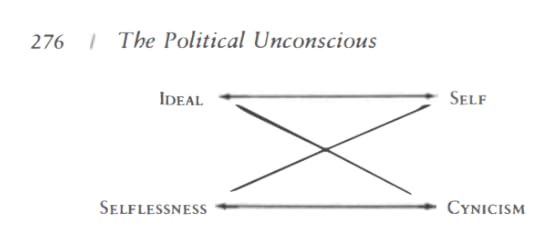
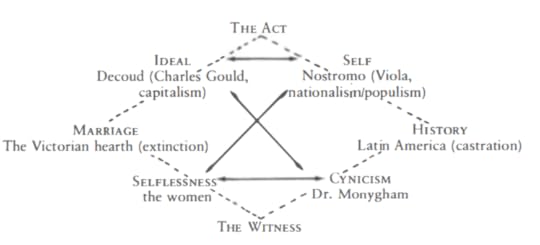
The author spells it out in the case study of Conrad's Nostromo (1904): Construed as a bourgeois novel with the central problem of humanist self-development, the vertices of the Greimas square become The Ideal (S1), The Self (S2), Selflessness (-S2), and Cynicism (-S1). We don't like the paucity of this square and its determinate enclosure (resulting from (the author's) reading of this novel as a limited bourgeois project). The author's upbuilding solution here is to add to this figure (above) four additional vertices implied by the acknowledgement of the Political-Unconscious: i.e. Marriage (between Ideal and Selflessness), The Act (between Ideal and Self), History (Between Self and Cynicism (anti-Ideal)), and The Witness (between Selflessness and Cynicism).
The subsequent figure (below) appears to satisfy our Marxist-Freudian needs, though only 'til one looks it aslant (askance). It takes tilting the head tilted forty-five degrees to recognize this new figure is also one of those (notorious) geometrical Squares with the addition, intolerable even to Marxists, that now one's analysis must always move between the vertices of History (Marx) and Marriage (Freud). So we haven't made it out of the old box after all; our author appears to be re-gifting it in new wrapping paper. In our generosity we are prepared to forgive much from family and fellow travelers, though the gift of this text (i.e. the new-found ability to convict various literary works of unconscious Historical-Materialist impieties) is severe (for which we forgive it) and yet (unforgivably) not very funny. (Aside: this appears to be the persistent Differance between this author and Slavoj Žižek . . .)
So, to circle back, one wonders whether Marxists greeted Jameson's passing the same way feminists greeted the death of Beauvoir: The sense was, "well, now we can (finally) get to work." (Though, in this case, among much mourning, one wonders when (and if) the next wave of Marxism is coming . . .) It's notable that Jameson's life came to an end when the modern maxim of Biopower has become, "make live or let die." This is a recognition that, with the technological resources of an intensive care setting, there is no theoretical limit to the prolongation of a vegetative life on-vent. In such circumstances, we might count every death a suicide (in the good sense; a tactful withdrawal). David Foster Wallace would call this act of departing the scene at the right time, "Suicide as a sort of Present."
An intermittently accessible book. The chapter on Conrad is superb.
After 2nd reading: FJ bends the stick away from the class line in the final chapter. He wants us to accept Poulantzes' idea of the state as an echelon of elites completing and collaborating. WTF?! Are we embracing C. Wright Mills after burying his middle class radicalism 60 years ago?
After third reading:
Chapter 1: On Interpretation: Literature as a Socially Symbolic Act
Political interpretation of literary texts Socially symbolic act Historicizing Modes of production Interpretation as allegory The political unconscious Ideological analysis Class struggle Cultural production Darstellung
Chapter 2: Magical Narratives: On the Dialectical Use of Genre Criticism
Romance as genre Utopian longings The political unconscious Genre criticism The dialogical Ideologeme Intertextuality The genealogy Cultural revolution Bleached writing
Chapter 3: Realism and Desire: Balzac and the Problem of the Subject
Narrative as a process The realistic novel The referent Libidinal investment Utopian wish-fulfillment The Biedermeier The hermeneutic code The signified The semiotic rectangle The symbolic
Chapter 4: Authentic Ressentiment: Generic Discontinuities and Ideologemes in the "Experimental" Novels of George Gissing
Ideologeme Narrative paradigm The angel of the hearth The political unconscious Naturalist narrative The experimental novel The Bathsheba archetype Ressentiment The alienated intellectual Bleached writing
Chapter 5: Romance and Reification: Plot Construction and Ideological Closure in Joseph Conrad
Modernism The break Mass culture The culture industry Strategies of containment The sea The senses Historicism The political unconscious Impressionism
Chapter 6: Conclusion: The Dialectic of Utopia and Ideology
Ideological analysis False consciousness Class bias Ideological programming Immanence The hermeneutic process The utopian impulse Class consciousness The collective The Asiatic mode of production
I find the first chapter of this book the most difficult, but I have re-read it several times. Dense with theory and abstract concepts, Jameson’s description of the kind of Marxist literary interpretation that is possible in a post-structuralist age is well argued and employs ideas from the works of thinkers and critics like Louis Althusser, Northrop Frye and Claude Levi-Strauss. In his discussion he comments on interpretation, historicization, and the relation of narrative to symbolic action. In later chapters, Jameson interprets the realism of Honore Balzac, the “high realism” of George Gissing, and the modernist impressionism of Joseph Conrad.
Acquired Jul 26, 2002 City Lights Book Shop, London, Ontario
Jameson wrote this influenced in a large part by Deleuze and Guattari's Anti-Oedipus... and while he understood AO enough to explode the idea so that the dominating structure of psychoanalysis no longer functioned to colonize material, he missed the way in which Marxist structure does the same thing -- he didn't apply the same critique to Marxism. But congruous to AO, D&G also did not apply the critique of Marx although they did apply it to other structures. As a result, AO has latent Marxist content within their exploration.
Much of Jameson's insight into literature and culture amounts to extrapolating the central difference from its context so that meaning can be understood as relying on the exploitation of one domain in order to be valorized in the context of another... very much the same dialectical structure as constructing Utopia by eliminating narrative distortion. In a sense, Jameson is reading one narrative structure against another (Marxism) although its threading occurs with Althusserian Ideological State Apparatus -- making this kind of read very much the same as what Zizek does. Perhaps in the early 80s this was a radical exploration of literature, but today in 2016 it seems quaint and naive in its genuine blindness.
Wouldn't be fair for me to critique this book. I don't know what avenue brought it to my reading list, but I didn't enjoy this book much at all. Maybe if I was more interested in the subject of Marxist literary critique I'd have been more patient with Jameson's excruciating, hyper-academic writing. Unpleasant to read, and I'd be skeptical of any author who deliberately uses such technical wordplay when an obvious, simple description would exist to say the same thing.
If the argument of the book is good, then I'll take someone's word for it.
I love reading Jameson not necessarily because of the content of his arguments (although they can be really generative and I've found genuine enlightenment in many a Jameson passage), but because of the form of their presentation. To reappropriate his own argument somewhere about Hemingway, it's as if the insights into marxism or psychoanalysis are simply a vehicle for the real substance which is the Jameson Sentence. Anyways, this was a fun read and i enjoyed finally understanding the griemas square. Five stars, and I should read it again when I'm smarter.
Hard to say anything about this book that hasn't already been said, but to reiterate that it is a book you should read. Now.
For those interested in MArxism, Jameson provides a wonderful review of powerful debates that shaped the engagement of its twentieth century thinkers. For those interested in literary criticism, it is hard not to fall in line with Jameson's proposed method of symptomatic reading.