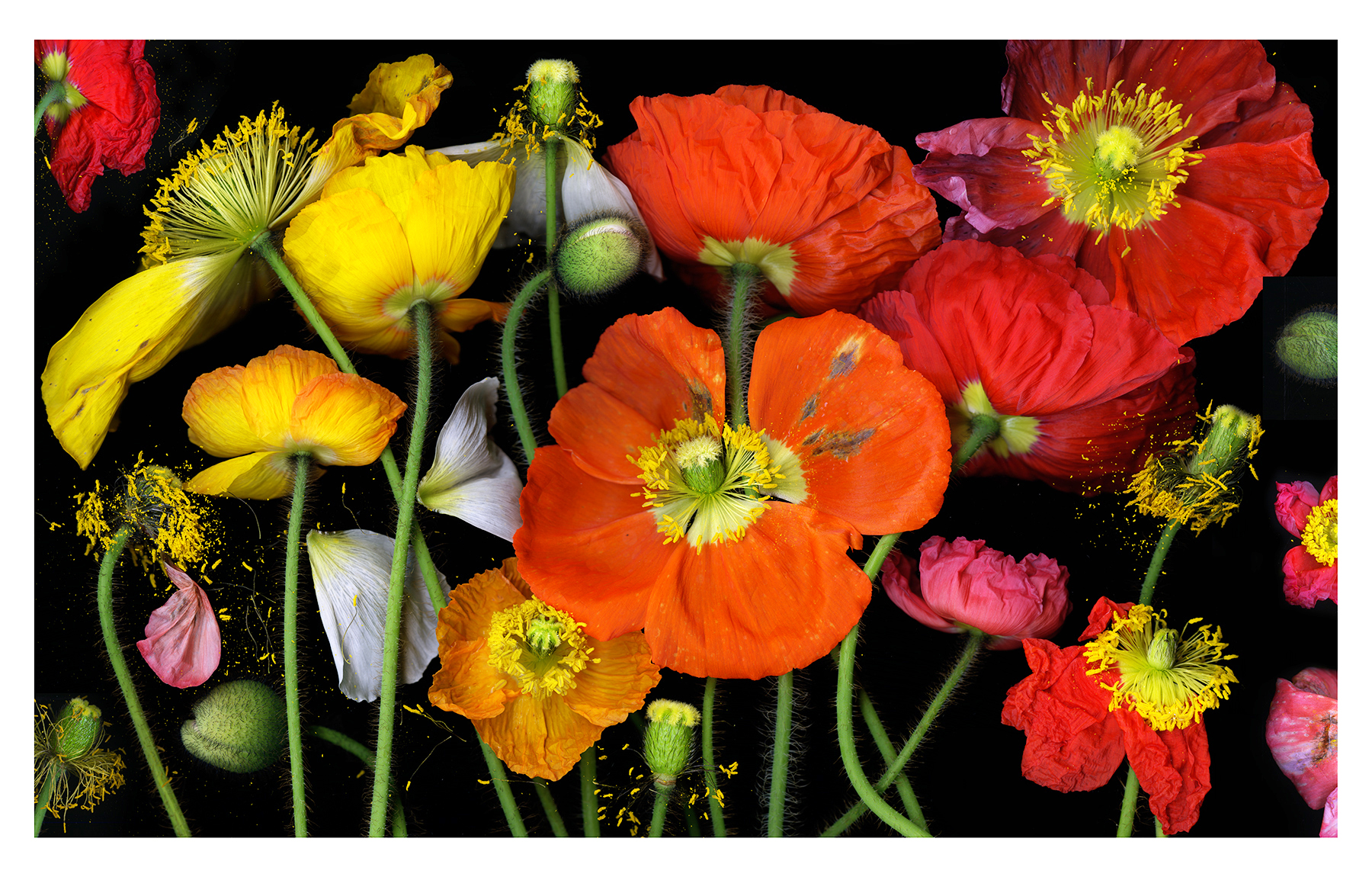
Cultural history at its best—the engaging, lively, and definitive story of the beauty, sexuality, ecology, myths, lore, and economics of the world’s flowers, written by a passionately devoted author and scientist, and illustrated with his stunning photographs.
Flowers, and the fruits that follow, feed, clothe, sustain, and inspire all humanity. They have done so since before recorded history. Flowers are used to celebrate all-important occasions, to express love, and are also the basis of global industries. Americans buy ten million flowers a day and perfumes are a worldwide industry worth $30 billion dollars annually. Yet, we know little about flowers, their origins, bizarre sex lives, or how humans relate and depend upon them.
Stephen Buchmann takes us along on an exploratory journey of the roles flowers play in the production of our foods, spices, medicines, perfumes, while simultaneously bringing joy and health. Flowering plants continue to serve as inspiration in our myths and legends, in the fine and decorative arts, and in literary works of prose and poetry. Flowers seduce us—and animals, too—through their myriad shapes, colors, textures, and scents. And because of our extraordinary appetite for more unusual and beautiful “super flowers,” plant breeders have created such unnatural blooms as blue roses and black petunias to cater to the human world of haute couture fashion. In so doing, the nectar and pollen vital to the bees, butterflies, and bats of the world, are being reduced. Buchmann explains the unfortunate consequences, and explores how to counter them by growing the right flowers. Here, he integrates fascinating stories about the many colorful personalities who populate the world of flowers, and the flowers and pollinators themselves, with a research-based narrative that illuminates just why there is, indeed, a Reason for Flowers.
Stephen Buchmann is an Adjunct Professor of Entomology and Ecology/Evolutionary Biology at the University of Arizona in Tucson, AZ. Stephen has published nearly 200 scientific articles and 11 books. His newest book is "What a Bee Knows" from Island Press (DC). He is a pollination ecologist known for his studies of buzz pollination, oil-producing flowers, and the conservation biology of native bees and their flowers. His books include "The Forgotten Pollinators" with Gary Paul Nabhan, "The Reason for Flowers," and his children's book: "The Bee Tree" (Lee & Low Books, NY). Buchmann also enjoys landscape and macrophotography along with creating small fine art bronzes. He's a frequent guest on NPR radio programs including All Things Considered and Science Friday. His literary awards include the IBPA Benjamin Franklin Award, and the NSTA Outstanding Science Trade Book for Students K-12.
This is a comprehensive look at the world of flowers, from their earliest known history and their constant interaction with humans dating from very ancient history, on to early civilizations of Egypt, Greece, Rome, China, The Mayans, etc. The author is an expert on flowers and bees and shares this expertise in the initial chapters, but most of the book is less scientific (though backed with scientific and/or statistical information).
The first step is to define flowers and their structure, explain how and why they appear as they do, how they have developed such elaborate means of procreation--making use of other species to assist in carrying on their lives: bees, bats, bugs, birds, the wind, and, of course, humans. Humans have now stepped in to virtually control the life cycle of many flowers.
Then there is the flower in culture--their place in various aspects of the human life cycle (and how this has changed over the centuries) as symbols and tokens of love, faith, purity, hope, remembrance. But these are not absolutes between cultures. We see the place of flowers in ceremonies--religious rituals, holidays, social rites--and how these vary between countries, or can be very similar or the same.
One of my favorite sections deals with flowers in art and literature in recent centuries. It caused me to think a bit differently about paintings I've viewed over the years. The love of flowers has been fairly consistent for millennia but the specifics of that love and its expression continue to evolve.
While there is some scientific information within this book, it is not a scientific treatise and may disappoint a reader looking for that. But for a generalist reader such as myself, this was a very interesting read, to be enjoyed slowly and savored.
Definitely recommended.
A copy of this book was provided by the publisher through NetGalley in return for an honest review.
This book started out so strong. I thought it would be one of my all time favorites. I ended up hating it. Since it had such a strong start, I had a false sense of its ability to make a comeback once it got boring and downright annoying. I really should have quit after Chapter Three or Four, but I kept thinking it would return to its initial glory. It didn't.
NGL this book was pretty boring and didn't impart any new information- or at least, not any interesting information- but it did its intended job (being a relaxing audiobook to fall asleep to). Meh.
Did you know that flowers are nature's advertisements? I'd never thought of it that way. Also, did you know that the stargazer lily was first invented/bred/whatever in 1978? I thought they had been around forever. Star Wars Episode IV: A New Hope is older than the stargazer lily.
This is informative and entertaining, but be aware that it is long. If you have the audiobook version, you may not want to listen to *fourteen hours* of flower trivia. I enjoyed it all, but in hindsight it might have been a good idea for me to skip the chapters about flowers in poetry and flowers in visual art. The author is a scientist, and I felt he did a much better job in the chapters based on science, though I admire the guy for trying.
This book discusses some interesting aspects of flowers; in particular, how flowers are pollinated and their relationships with pollinators (the author is an entomologist), flower breeding, the global flower business, flowers in cooking, floral essences in perfumes, flowers in culture and flowers in medicine. Many of these discussions are quite interesting. However, the book seems more a collection of parts, and I would have liked to see more coverage on the evolution of flowers.
As a florist, this book gave me millions of anecdotal trivia, which I hope to be able to recite at necessary times in the future. It is an all-encompassing look at how flowers have come into our lives, almost always for the better and, in the end, they are possibly using us as much as we are using them.
A wonderful, comprehensive book about flowers and their coexistence with us and other critters. At times, I wished there had been a narrower focus especially with arts and literature, but that is only due to my views and previous knowledge. Also, the book was kind of repetitive, saying the same sentences twice in close space, but there was always an additional information to the previous statements. Anyway, this is for those who want to know how flowers have impacted our lives and ponder the question that maybe they are the ones who have tamed us and not the other way around.
This book was utterly fascinating. Each page had something new to learn about flowers, their natural history, their place in evolutionary ecology, or their importance to human society and culture.
Buchmann writes beautifully, in both an engaging and informative manner, reminiscent of the best nature writers I've read. It is obvious he is passionate about the topic and eager to share with readers his love and enthusiasm.
Recommended for readers of Amy Stewart.
Review copy courtesy of the publisher via Netgalley
I listened to this book thanks to an app called Blinkist.
I am elated that I decided to dive into this. "The reason for flowers" is easily one of the most magnificent books I stumbled upon this year. It made me smile, it was so well written & I learned so much from it.
I definitely recommend it. And the cover is beautiful as well!
The subtitle of this book pretty much says it all: The Reason for Flowers is all about flowers, their history and how they evolved, how they are the essential element in the reproduction (and therefore the continued survival) of a species of plant, and - very importantly - how flowers affect human beings. Buchanan starts off with a sound scientific insight into flowers and their evolution, pollination and types of pollinators, and then goes onto how flowers have influenced and continue to influence human life. There are histories of gardens and gardening here, details about how flowers have been used for decoration, in religious ceremonies, in funerals and to honour the dead. There are interesting insights into the cultivation and trade in flowers; perfumes and how they're extracted (and produced); floral medicines; and food from flowers (edible flowers as well as ingredients like saffron, rose water and orange blossom water). Buchmann even discusses flowers in literature and art, as well as the exquisite botanical art that celebrates flowers.
I loved this book. There was a lot here that I hadn't known before (those flower auctions in The Netherlands? The glass flowers? The 30g built up by a madly whirring insect trying to shake pollen out of a stubbornly closed anther? Wow). There was much I hadn't stopped to think of, and there was a lot that made me go searching online for more.
On that note, though, I must point out one thing that, for me, lacked in this book: I thought there could have been more images. While there are a couple of illustrations (of a standard structure of a flower, for instance) and several striking photos of flowers, many things were described that I would have loved to see reproduced here. Some of the great gardens; the flower art, both paintings as well as the ancient depictions of flowers in, say, Egyptian murals. I so wished, too, that the glass flowers had been shown, even if only in a single photo, as also the work of Robert Cream, who creates artworks by layering flowers on a flatbed scanner.
Still, despite the somewhat disappointing paucity of supporting images, still an excellent book. If you are interested in flowers, this one's a must-read.
This is a useful book for anyone wanting to know more about the evolutionary history and pollination mechanisms of flowers. Buchmann is at his best in the chapters that deal closely with his expertise--flower biology and pollination (especially by bees). The chapters are uneven, however, because Buchmann tries to perform cultural history as well, and these portions end up being long lists of "well, this culture did this, and this culture did this," rather than synthesizing the information to the point of thesis. Still, I learned quite a lot about flower biology, and without having to read a biology textbook!
I really liked this book, but it won’t engage you if you’re not already interested in the specifics and minutiae of flowers. Some areas were very broad overviews and it covers a wide range of topics (some very briefly), but I learned a lot and liked it!
This man really decided to cover every single instance related to flowers in all of history and culture. Amazing. The breadth and depth of this subject is quite admirable. I think I missed quite a few details because I listened to this as an audio and there was just *so much.* A fascinating topic, and very well-handled. Recommended.
This book passionately covers flowers' "history, culture, biology and how they change our lives". There was a lot of information to absorb while I marvelled at Buchmann's research and lovely storytelling. I'd like to see the Ware Collection of Blaschka Glass Models of Plants at the Harvard Museum of Natural History.
شوفوا الياسمين جميل نعسان حلي له النوم على الاغصان بكل حنان تضمه الايد وبه تزدان صدور الغيد
في يوم من الأيام قالها بيرم التونسي، وغنتها كوكب الشرق العذب. الكتاب ملم بتاريخ الزهور منذ أول بذرة، وحتى الأزهار البلاستيكية المعاصرة، وما استحلبته من زبدة الكلام هو الآتي:
- للزهور استخدامات كثيرة أفادت البشرية عبر العصور، منها: قطاعي الأدوية، والتغذية. - للزهور تأثير روحي عميق، فهي تدعوا الإنسان -الذي بدوره يحن إلى الطبيعة الفطرية- إلى الاستمتاع والاسترخاء، بارجاعه إلى الطبيعة وجمالها. - الزهور تمثل بيوتا، وملتقيات تعارف، وملاذات آمنه لكل الحشرات تقريبا. - الزهور تتزاوج و تتكاثر عن طريق التلقيح الذي تتكفل به الفراشات والنحل، وتفرز الورود بعض الروائح لتلفت انتباه تلك الحشرات إلى موعد اللقاح.
الورود نباتات رائعة، واستثنائية. تدعوا إلى الهدوء والطمأنينة :)
The first word that comes to mind after finishing this book is "bloated". I cannot say for sure but I have a strong suspicion that the author recycled, poorly, several articles he has previously written. The book had excruciatingly long lists of things, from flowers to eat, flowers not to eat, poets that wrote about flowers, paintings about flowers, photographers that showcased flowers, etc. While examples to illustrate one's point are clearly helpful, they stop being so when they devolve into a list and become maddening when these lists appear constantly. The book certainly had interesting information about the evolution, cultural associations and even scientific uses of flowers but these were quite diluted in a sea of redundant examples that mired the reading experience.
-The reproduction of flowering plants is highly dependent on pollinators. -Flowers attract their pollinators and make the exchange worth their while. -In evolutionary terms, flowering plants are young but tremendously successful. -While humans have loved and cultivated flowers since ancient times, crossbreeding is relatively new. -Flowers provide us with food and perfumes. -Flowers have left their mark on human culture. -Plants sparked scientific discoveries and progress. -Nature, and flowers in particular, enhance our well-being.
I truly enjoyed this book. Well written and researched. Good background understanding. The Reason for Flowers is a great book to learn about why life is so connected. Us without them does not work. Good thought for the future of the Planet. Highly recommend.
This book started out by giving me hope. In the first few chapters, I thought, ah, yes, here we go. This is going to be one of those lively, illuminating books that takes a subject I like and opens it up in fresh ways. The overview of the world of pollinators and flowers was interesting, well explained, and easy to move through. Buchmann clearly knows his subject, and in those early pages I felt like I was in capable hands. He gives a solid introduction to the relationship between flowers and their pollinators, and he does it in a way that feels accessible rather than dusty. That part worked for me.
Unfortunately, that pleasant beginning turned out to be a bit of a bait and switch.
Once the book got past those opening chapters, it seemed to lose the plot, or perhaps more accurately, misplace the garden map entirely. What had started as a focused and engaging look at pollination slowly wandered off into a much broader and much less satisfying celebration of all things floral. It became less about a central idea and more like a loosely bundled bouquet of essays, all tied together with a ribbon that looked nice but did not actually hold much in place.
One minute we are talking about pollinators, which is what had me happily pulling up a chair in the first place. The next minute we are drifting into the global flower business, flowers in cooking, perfumes, flower culture, and flowers and medicine. Now, none of those topics are bad in themselves. In fact, several of them could have made for fascinating chapters in a stronger, more tightly organized book. But here, they felt scattered. The book kept moving from one floral side road to another, and I increasingly felt like I was trapped on a guided tour run by someone who kept saying, “And here’s one more delightful thing about flowers,” while I quietly muttered, “Yes, but where are we going?”
That was the main problem for me. The book simply lacked cohesion. It did not build a satisfying argument or even a clear narrative arc. Instead, it felt like a collection of essays that had all shown up to the same party but were not really speaking to each other. There is only so much time I want to spend hearing flowers praised from every possible angle before I start longing for a little structure, or at least a traffic cop.
And this is where my enjoyment really wilted.
I like books that have a strong sense of direction. I do not need every nonfiction book to march in military formation, but I do want some feeling that the author knows what the central mission is. Here, the mission seemed to shift from “Let me explain the remarkable relationship between flowers and pollinators” to “Aren’t flowers marvelous in literally every conceivable context?” That is a tougher sell. At a certain point, the whole thing started to feel like being cornered at a dinner party by an extremely enthusiastic gardener who will not let you leave until you also appreciate floral perfumes, edible blossoms, international flower markets, and the spiritual significance of begonias.
To be fair, Buchmann is clearly full of affection for the subject, and there is something admirable about that. His enthusiasm is genuine, and the book is not badly written. It is readable, often pleasant, and occasionally quite informative. He does know a great deal, and I never had the sense that I was in the hands of a lightweight. My issue was not a lack of knowledge. It was a lack of discipline. The book needed a firmer editorial hand, someone willing to say, “Stephen, my good man, the flower cannot simply do everything.”
In the end, I came away disappointed because this book seemed so close to being something I would have genuinely loved. The strongest material is right there at the beginning. That early focus on pollinators and flowers had clarity, momentum, and purpose. But instead of developing that into a compelling whole, the book drifted into a general love letter to flowers and never really recovered. I finished it feeling less enchanted than mildly exhausted, as if I had been force-fed a twelve-course floral tasting menu when all I had wanted was one really good meal.
So no, I did not enjoy this one very much. It had a promising start, a knowledgeable author, and moments of real interest. But as a complete book, it felt too meandering, too fragmented, and far too enamored with its own subject to notice that the reader might be lagging behind, somewhere around chapter six, clutching a wilted corsage and begging for a unifying theme.
For some time now, I have been considering what to do with my bedroom window’s ledge. My window is on the second floor and faces south, which means it gets a lot of sun - good in colder regions of the world perhaps, but not so good in a tropical country, where the goal is to create as much shade as possible. I have Venetian blinds, but they aren’t very ideal: either I close them to block out the sun and cut off ventilation to my bedroom, or I open them to let in the breeze, but then have to suffer from an excess of sunlight, which makes the room even warmer. The constant balancing act between shade and ventilation is of even greater importance during the summer, when both are vital to my comfort, but with Venetian blinds I have no choice but pick one or the other.
The most ideal solution would be to grow plants on the window ledge. This will create shade without interfering with ventilation, as well act as a privacy screen. A vine-type plant would be ideal; it can be coaxed to grow on the iron grating in front of my window, thus fulfilling my need for shade without sacrificing ventilation, as well as act as a privacy screen. I could even go with shrub-type plants: something with a tendency towards horizontal, as opposed to vertical, spread would provide excellent coverage and shade.
But aside from being a solution to temperature control and privacy concerns, I want plants on my window ledge because looking at them makes me feel better about myself, and about the world in general. In 2001 the American Psychological Association published an article showing the various benefits of even just looking at nature, which range from better focus and productivity to improved post-surgery recovery times. In 2009, a paper titled “Biophilia: Does Visual Contact with Nature Impact on Health and Well-Being?” confirmed previous research: just looking at nature brings about an overall improvement in both physical and mental well-being; actual contact with nature provides even more significant benefits.
Of course, flowers are a part of the above phenomenon. Looking at a beautiful green landscape is one thing, but flowers might be said to be in a class all their own, laden with their own cultural and symbolic significance. It is these connections, as well as their function and importance in nature, that Stephen Buchmann explores in The Reason for Flowers: Their History,Culture, Biology, and How They Change Our Lives.
The Reason for Flowers is divided into five parts. Part One, “Sexuality and Origins”, deals with how flowers evolved, and their role in plant sex. Part Two, “Growing, Breeding, and Selling”, tackles the practice of breeding plants for their blooms, as well as the economics of buying and selling not just cut flowers, but whole plants, as well. Part Three, “Foods, Flavors, Scents”, discusses what flowers are used for: that is to say, their use in perfumery and their involvement in the culinary arts. Part Four, “Flowers in Literature, Art and Myth”, does exactly what it says on the tin: tackles how flowers have been presented and used in various cultures all across the world. Finally, Part Five, “Flowers in the Service of Science”, explains how scientists have been using flowers in scientific research, and the various discoveries that have been made, and continue to be made.
The first thing a reader may notice about this book is just how broad its coverage is. The summary of contents I have given above is a clear indicator of just how much ground Buchmann covers in this book, which leads to some interesting questions. Can Buchmann really cover that much ground? Can he sustain his narrative voice throughout?
Unfortunately, the answer to both is “not quite”. The first flaw is Buchmann’s narrative voice. There is a certain lack of consistency to his writing that can be irritating for some readers, or at least those who expect a certain steadiness in an author’s narrative voice - particularly an author who is also a scientist. Consider this excerpt, which opens the Preface and, therefore, the entire book:
Most open by dawn’s first light or unfurl their charms as the day progresses. Others unwrap their diaphanous petals, like expensive presents, after dark, waiting for the arrival of beloved guests under a radiant moon. We know them as flowers.
While there is nothing much wrong with such language, I think it comes off as a bit more purple than I might like, at least for a book written in the twenty-first century and which purports to be more scientific than artistic.
On the other end of Buchmann’s occasional bouts of purple prose is a tendency to over-explain things:
Plants have not always had flowers. Certain plants, the angiosperms “invented” flowers and never turned back. They chose wisely. (As I hope is obvious, this is anthropomorphic shorthand for a complicated set of biological processes, for the plants did not make decisions; they tried everything, and natural selection [survival of the fittest] ensured that their genes were the result of the most successful “experiments” and were reproduced.)
While I have complained about authors who lack an ability to use small words when writing for laypeople (e.g. Richard C. Francis, in his book Domesticated), Buchmann is the exact opposite. For any well-educated adult, the quotation marks around the word “invented” are sufficient to point out Buchmann’s meaning; the subsequent parenthesised explanation is entirely superfluous. While I expect a certain amount of ease of reading from popular science books, I do not expect the author to dumb things down to the degree that Buchmann has. I like to think that my education (formal or otherwise) is sufficient enough to allow me to understand precisely what he is talking about without having to tell me (or his readers, for that matter) what natural selection is as if I were a child - and if ever there was anything I did not immediately understand, I like to think I have enough common sense to use Google and look for an explanation there.
This unevenness of tone extends to the overall content of the book. When writing about topics that are (so I must assume) familiar and enjoyable to him, Buchmann appears to be happy to go on at length and in great detail about them. However, when dealing with topics that (again, so I must assume) he is not so familiar with, he tends to treat them in a shorter, rather more curt manner. For example, his discussion of the history of gardens is quite lengthy, which is somewhat-unsurprising considering his background as a botanist and avid gardener. The language he uses is also rather lovely: rather like a ramble through a garden.
However, when he treats the topic of flowers in Renaissance art (or, really, any visual art in general), his text reads as shorter, more to-the-point than the lovely rambles in other parts of the book. I suppose part of it has to do with the way the sections within each chapter have been split up; I get the feeling that, if certain sections had been connected together instead of cut up, the narrative flow would have been a bit more even.
This brings me to the second flaw of this book: the number of topics Buchmann attempts to cover. Since the book tries to tackle so many of them, it does not really explore all of them with any great depth. Oh, to be sure, there are some parts where it manages to do so, particularly in the scientific aspects, but Buchmann’s treatment of other topics (particularly those in Part Four of the book) feels just a touch cursory. I think I would have been happier with this book if the scope had been a little narrower; it would provide some focus, at least, and mean that any topics discussed are discussed with the necessary amount of depth.
Overall, The Reason for Flowers might perhaps be considered a fair introduction to the subject of flowers, but I doubt that the readers that choose to pick it up are looking for an introduction. In fact, it would be fair to argue that this book’s intended audience consists of avid gardeners, floral enthusiasts, and laypeople with an established and fair knowledge of the topic at hand. Unfortunately, this book does not have the depth that such readers might be looking for - it tackles some topics at length, but not all. There are also inconsistencies in tone and narrative flow that readers who are sensitive to such things will likely notice, and which may diminish their enjoyment of the book. If the reader is looking for a deeper exploration of the subject of flowers, it might be better to look for another book entirely, or pick up any number of micro-histories currently available.
I can’t put my finger on why I didn’t like this book. If I were to describe it to someone, it sounds like exactly a kind of book I’d enjoy: a discursive look at the world of flowers, with chapters on subjects as varied as animal pollinators and depictions in art, to perfumes, medicines, and economics. Each chapter is broken down into digestible sections. I really should have enjoyed it.
But reading it was a bit like pulling teeth and I struggled to finish it.
I had some qualms with the prose and the formatting, but nothing that was that big of a deal, so I can’t really explain why I didn’t like it at all.
I understand why Buchmann always included the scientific name in parentheses after mentioning each flower (because some flowers have the same or similar common names even though they’re different species) but sometimes there were paragraphs that were like 60% greek and latin words in parentheses which really disrupted the rhythm of my reading.
I also wonder if I’m just not the target audience because I didn’t already know a fair amount about flowers. Buchmann is constantly talking about the appearance and characteristics of various flowers as though I should have any clue what he’s talking about. If I was independently wealthy with a lot more free time, I might’ve read the book with Google Image Search open on my computer to pause three times a page and look up the flowers that he references.
All in all, I would not recommend this book to a general reader or someone without an existing basic knowledge of flowers, gardening, or botany.
This was taking me SO LONG to read and I couldn't figure out why. Then my daughter picked up the book and read aloud a few lines, made a face, and said, "This is really boring."
I really hate to say it, but this book is kind of boring. Some areas went too in depth for me. Some sections seemed to skim the surface, but the skimming lasted for what felt like 50 pages.
Having said that, and maybe this is why no one should read my reviews, I came away from this book wanting to look at all of my flowers and just observe the way the bees and other pollinators collect the pollen and nectar. I wanted to look at the physical layout of each flower and wonder about how each one was perfectly created to take advantage of those pollinators. I started thinking more about the different tastes of honey (I've had a variety and I knew they all tasted different already, but I went out anyway and bought some local raw honey to add to our collection of non-local raw honey, just so I could taste them side by side.)
I've started smelling the flowers more.
I've always loved wildflowers and this book didn't change that. I honestly think, for me at least, this book would have made a better documentary than a book. The writing just wasn't my style. I guess I like more narration and less listing of facts. That isn't to say there was no narration at all, but a little more would have given me something of a plot. And even non-fiction nature books should still have something of a plot. (Maybe I just missed it.)
I never knew as much about flowers as I did now. The first half of the book, I was blushing because duh, flowers are sexual organs and Buchmann goes into detail of how this works. Each time I thought I couldn't possibly learn more about flowers, I did! This book is an exhaustive resource on social science, natural sciences and flowers. I think for me, the most interesting parts were how flowers evolved to attract the animals who pollinate them. The co-evolution is so perfectly in line, it's easy to see how humans are a blip on the timeline of earth, messing these perfectly balanced ecosystems up.
This took me a while to trudge through because of how much information there is out there for flowers. I recommend this book for citizen scientists, anyone looking for a resource on flowers and anyone interested in bugs.
LOVED this book! I learned so much about flower's relationships with pollinators, their role in art, culture, religion, medicine, their life cycle, a brief history of botanical illustration, the worldwide flower-selling industry, even the fascinating concept of the Biophilia Hypothesis, which is the idea that humans innately love nature and emotionally benefit from engaging with it. (Which, anyone's grandparents could have told you that, but in today's workaholic, screen-dominated world, it really needs to be said.) If you love flowers and want a great introduction to learning more about how they function in their world and ours, this book is a fascinating read. Highly recommend. It made me want to keep learning more & more, especially about the flower/pollinator relationships. They're so unique and intricate!
The encyclopedic reach of this book -- everything from paleobotany to flower arranging to international flower commerce to edible flowers and floral healing -- means that treatments of various topics are occasionally superficial, especially when dealing with oft-trodden paths of garden history. Book is most interesting when he delves into his own scientific interests in pollination and explores latest scientific research into chemistry of flower behavior and the complex array of human reactions to that chemistry. (smelling flowers reduces stress, wh is probably why they have always stood by sickbeds). I listened to it, but am very glad I have a hard copy as I often needed to go back and underline details I would have lost in narration.
You MUST have an interest in flowers and plants in order to be even mildly interested in reading this. I do have an interest and still found myself skimming whole portions just because it wasn't that interesting to me. That said, the author is PASSIONATE and that passion is manifest in every sentence. That he is able to put together a comprehensive survey of all things flowers is quite a feat. I'm glad I read it, though I definitely think this is very very very niche.