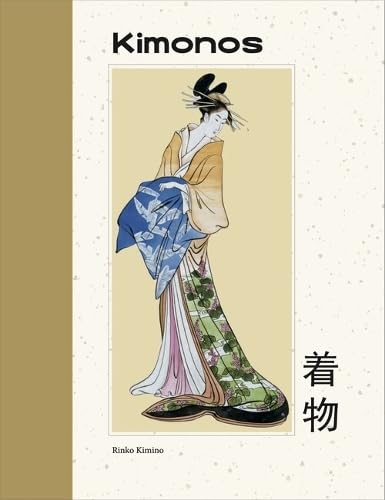
Thanks so much to NetGalley for the free Kindle book. My review is voluntarily given, and my opinions are my own.
I wasn't quite sure exactly what this book would be, but I am so glad that I decided to request it. There is so much history contained in here, and as I have never really read much about the history of Japan, this was almost all new information for me. Not only that, all of the photographs and illustrations are absolutely gorgeous.
There's spoilers, but if you're getting this book: you're not getting it for the plot.
I didn't realise that this was an author who I've read books before of. I think somewhere in boxes I still have one of her books as I'm in the process of unpacking from moving.
I would without a doubt buy this book. When I have the money. She is very well versed in the subject, from fabrics, to shapes, to sizes- everything she writes about is easy to understand and this is also a great reference book for people who want to know more about Kimonos. I love having a physical book and I also love that this exists. Whilst the copy I've gotten is an ebook, I'm hoping this means we are expecting an actual book to be released?
I have loved kimono and the history behind it since I was a young child, so having a book which encompasses the history, the styles, the fashion and the culture: this is absolutely one gem of a book to have if you have any interest in Japanese culture and the way of kimonos.
Furthermore, the exploration of how kimono's are constructed was very refreshing to see on paper for the first time in years. I haven't seen anything like that since I studied fashion so I think this would be a brilliant book also for fashion students. Including and referencing different time periods, addressing how Kimono's have changed over time, how they were worn over different time periods, the cultural adaptations, the changes- this is overall a neat book. I was a little fussed with myself when I realised the kimono I own is a formal houmongi, which I actually wear to bed, but honestly it covers me, it helps me not overheat, and it is a casual kimono but. The more you know. I think this is brilliant. I look forward to the release.
Also Shibori ? I still have my reference book for the art of shibori dying. This made me grin when I saw the mention. A beautiful collection of the history of kimono's with the inclusion of makeup and hair that goes alongside it. I'd love to see and read more books like this.
Thank you to netgallery and the publishers for a ecopy of this book in exchange for an honest review. So many gorgeous pictures. Very well done.
This entire review has been hidden because of spoilers.
Kimonos by Rinko Kimino is a lovely introduction to the history of the garment from the Yamato period (300CE) all the way to present day. It’s a beautifully constructed book with pages upon pages of photos and woodblock prints to pour over. The most exciting of which came early – the patterning from which kimonos were constructed, and it’s a great place to start from.
The naming of particular makers is one of my favourite elements of the book. They make for enjoyable little snapshots of history. They also serve to highlight some current artisans keeping crafts alive or having a hand in the evolution of the garments which I found a lovely touch.
The writing is simple and clear. The abundance of images makes it easy to understand. The tying of the obi is the only area where it wasn’t. Likewise it’s a pity that the images of artisans at work weren’t able to be named.
That said, it’s important to note that this is a tertiary source. There are no footnotes, no citations or references, which I would have much appreciated as someone who wants to continue engaging with the subject. Especially as readers developing a deeper understanding of kimonos is one of the writers goals.
Nonetheless, I really enjoyed reading it and intend to buy my own copy.
With thanks to Netgalley and Amber Books for this review copy.
I enjoyed the look into Japan's history, through the lens of the Kimono, charting how the rise and fall of various dynasties and outside cultures are reflected within this iconic garment. From the reason why certain patterns are used, from the deliberate choice of colour and design depending on the year, it is all covered within this book. I had no idea about so much of this and really enjoyed learning more.
This was very much a light overview of a subject that could run into dozens and dozens of books. It does not go into any real detail, because it simply cannot - almost every section, era, design choice, could be a book in of itself. There also isn't any real hint as where you could go to learn more, which is a shame because this book does inspire you to want to dig deeper.
I was gifted a digital copy for the purposes of this review, but this is a book that deserves to be read in a physical format. It is bursting with gorgeous photos of historic artwork and Kimonos throughout the ages that should be seen in all their detail rather than on a small kindle screen.
This would be a treasured item on anyone's coffee table.
~Thank you to NetGalley for the ARC in return for an honest review~
With thanks to Netgalley and the publisher for the ARC.
I have an interest in weaving and fabrics, so I was excited to check out this book. It gives a gorgeous overview of the history of the kimono, the different techniques needed to make one, and also the meaning behind common patterns.
I was already aware of the fact that traditionally, kimonos were washed by undoing the stitching and then restitching them, and I had hoped to discover more about this. I was a bit sad to only have this mentioned in passing as well. I'd liked to have seen more of the day to day experience with kimonos - how did it combine with child carrying? With pregnancy and breastfeeding? Some elements were briefly touched upon in the last chapter that gives a kimono themed overview of a life, but my personal curiosity was not satisfied. I also found it a bit dour to end the book on death.
One further point of criticism is that the images were sometimes far removed from the section discussing them.
Overall I'd recommend this book to anyone with an interest in Japan specifically or dress and clothing techniques in general.
This book is a very handy overview of the kimono and its history within Japanese culture. If you're interested in how the kimono has evolved over the centuries and the different types of modern kimono, as well as the fabrics, motifs, and techniques of dyeing and weaving, you'll find it all here. The illustrations are really beautiful, but not every type of listed kimono and pattern is illustrated (at least in the part of the book where the lists are found). I did find a couple of minor typos and errors, which hopefully will be dealt with in later editions. It would be a wonderful gift for someone interested in Japanese culture in general and kimonos in particular, but it doesn't have any notes or suggestions for further reading. All in all, it's a very impressive coffee-table book and a real treat for the eyes.
With thanks to NetGalley and the publisher for a pre-publication ebook.
This is a really interesting book, exploring the history and styles of kimonos in Japan. It is written with Western readers in mind, explaining how kimonos are made, and all the artistic techniques that went into making these garments in the past. The pictures are lovely and serve to illustrate the text pretty well, though I wish there had been more pictures. I also wish this book talked a bit more about obi sashes. As a Western reader, the necessity of the elaborately tied sashes with the fat bustle-like knots or folds in the back always puzzled me, and I was hoping this book would offer some explanation for why traditional obi are so long and why they are worn as they are, instead of just as a fancy tied belt. But, overall this was a great book, and I definitely recommend it.
This is a good overview of kimonos in Japanese culture and covers the different levels of formality, choosing an appropriate design for the season and provides a brief history of kimono styles from the early days of Japan in 500AD up to present day. As another reviewer has noted, there are no footnotes or recommended next readings so if anyone would like to use this as a source for research, they'll need to find another work. There are lots of images but again, caution is needed as some of these illustrations are from later periods that the subject matter being discussed.
Despite this, a nice read and a good orientation on kimono culture and style. I received an advance review copy for free, and I am leaving this review voluntarily.
Thank you to Amber Books and NetGalley for access to an arc of Kimonos.
This arc became available at the perfect time. I’m going to Tokyo in less than a week and have always thought kimonos are gorgeous. The book did an amazing job of explaining the history of kimonos and how the styles have changed over time. The book also went into detail about the meanings of different designs and was a perfect combination of descriptive writing and photo examples.
I definitely recommend this book if you have an interest in kimonos and Japanese history.
This book is SO COOL. Another book that I got to look at the pictures, but I ended up learning so much. Kimonos are made from specific materials and have certain patterns and designs and there were beautiful photos and artwork showing examples. I also learned history and culture, and one of the most fascinating things was seeing kimonos in modern photos where other family is wearing modern Western clothing. It's hard to believe this was so short because it has so much. Thanks to NetGalley for letting me read this ARC
thankyou NetGalley and the publisher for a early review copy of this book. This is a great book for people with a small knowledge of kimonos who want to learn more. i really enjoyed the photos as they were great examples of what was being written about. the explanations were clear and precise and were not confusing i thought it was the perfect balance. A great book for soemone who loves fashion.
Finally finished this book. I really grateful to read this kind of Japanese fashion history. Kimonos are not only just fabric to wear, but also represent family class, culture and their believes. You can find kimonos through times. How western fashion influence kimonos, world war as turning points and kimonos for life milestones. I recommend this book for everyone whom have interest to Japanese cultures. Thank you Netgalley for the ARC.
A really interesting look into such a wide known tradition. Specific history books like this one are full of niche knowledge and fun facts. I wanted to read it to better my art and understanding of kimono.
Beautiful photographs of kimonos, historical and modern, and fascinating information on the origins, history, types, and "rules" for wearing kimono and obi. Loved the inclusion of historical artwork and the tidbits about modern kimono makers. Would've loved even more photos, especially to specifically accompany different aspects that the book was discussing.