

What do you think?

Täie hooga. Jalgrattaga Iirimaalt Indiasse
Kui Dervla Murphy oli kümneaastane, kingiti talle jalgratas ja atlas ning juba paari päeva pärast kavandas ta salamahti reisi Indiasse. 1963. aastal asus ta kolmekümne ühe aastasena viimaks teele, ja see raamat põhineb päevikul, mida ta igapäevaselt pidas rattamatkal läbi Pärsia, Afganistani ning üle Himaalaja mägede Pakistani ja Indiasse.
Üksik naisterahvas jalgrattal (revolver püksitaskus) oli pea ennekuulmatu sündmus kõikjal, kuhu ta läks, äratades tohutut huvi. Ta ei lasknud end heidutada ehmatavatel lumekogustel, peletas oma 25-kaliibrilisega Bulgaarias näljaseid hunte ja Pärsias kiimalisi kurde, suhtus märkimisväärse leidlikkuse ja täieliku kartmatusega hädaohtudesse ning äärmistesse ebamugavustesse.
Kuna seitsmekümnendateski eluaastates on ta reisinud üsna samas stiilis, imetletakse teda tänaseni, ja kohtumine noore Dervlaga tema rändurielu alguses pakub tõelist naudingut.
Üksik naisterahvas jalgrattal (revolver püksitaskus) oli pea ennekuulmatu sündmus kõikjal, kuhu ta läks, äratades tohutut huvi. Ta ei lasknud end heidutada ehmatavatel lumekogustel, peletas oma 25-kaliibrilisega Bulgaarias näljaseid hunte ja Pärsias kiimalisi kurde, suhtus märkimisväärse leidlikkuse ja täieliku kartmatusega hädaohtudesse ning äärmistesse ebamugavustesse.
Kuna seitsmekümnendateski eluaastates on ta reisinud üsna samas stiilis, imetletakse teda tänaseni, ja kohtumine noore Dervlaga tema rändurielu alguses pakub tõelist naudingut.
240 pages, Paperback
First published January 1, 1965
About the author
Dervla Murphy
48 books286 followersDervla Murphy’s first book, Full Tilt: Ireland to India with a Bicycle, was published in 1965. Over twenty travel books followed including her highly acclaimed autobiography, Wheels Within Wheels.
Dervla won worldwide praise for her writing and many awards, including the Christopher Ewart-Biggs Memorial Prize, the Edward Stanford Award for Outstanding Contribution to Travel Writing and the Royal Geographical Award for the popularisation of geography.
Few of the epithets used to describe her – ‘travel legend’, ‘intrepid’ or ‘the first lady of Irish cycling’ – quite do justice to her extraordinary achievement.
She was born in 1931 and remained passionate about travel, writing, politics, Palestine, conservation, bicycling and beer until her death in 2022.
Dervla won worldwide praise for her writing and many awards, including the Christopher Ewart-Biggs Memorial Prize, the Edward Stanford Award for Outstanding Contribution to Travel Writing and the Royal Geographical Award for the popularisation of geography.
Few of the epithets used to describe her – ‘travel legend’, ‘intrepid’ or ‘the first lady of Irish cycling’ – quite do justice to her extraordinary achievement.
She was born in 1931 and remained passionate about travel, writing, politics, Palestine, conservation, bicycling and beer until her death in 2022.
Ratings & Reviews
Friends & Following
Create a free account to discover what your friends think of this book!
Community Reviews
Displaying 1 - 30 of 588 reviews

May 3, 2010
I really can't believe this woman. She goes on this crazy trip from Europe to India on a bicycle (leaving in the middle of winter), meets all sorts of sweet people (and a few jerks), lives on clover for days and nearly starves to death, gets sick and sunburnt multiple times, deals with nasty insects and bad sanitation and wild animals and human beaurocracies, climbs up and down mountains and drags her bike along (sometimes on her back) when the roads get bad, falls in and out of love with the cultures who take her in and the landscapes she passes by, and keeps the most upbeat attitude and sense of humor the entire time. Here's a typical way she describes one of the many intense events she experiences: "we crossed without difficulty, unless the agony of being two-thirds submerged in newly melted snow counts as a difficulty". Ho-hum, Dervla is so nonchalant- nothing fazes her- I LOVE her. Plus she finds the time to get her experiences down on paper under various lighting conditions and to throw in some meditations on cultural differences while she's at it (she is not always charitable- doesn't think much of Sikhs- and sometimes she seems to idealize, but this just adds to the feeling that I as a reader am getting the honest uncensored truth about her impressions). The book is supposedly taken straight from the letters she wrote home as she was on the journey, and while it made me a little jealous of the travels, it also made me feel like an utter weakling because I don't think I could ever so fearlessly throw myself into such a project. I stand in awe.

February 11, 2012
I have just re-read this book, originally read many years ago. I saw that first time round I gave it 4 stars, but I think that was done retrospectively, and based on the fact that Dervla Murphy is one of my favourite writers. Regrettably reading it a second time brought up quite a lot of issues for me, and this time round I have only given the book 2 stars.
I love the way the books starts. Here is the first sentence.
"On my tenth birthday a bicycle and an atlas coincided as presents and a few days later I decided to cycle to India.
Amazingly, in 1963, that is exactly what she did. She covered approximately 3000 miles - from Ireland to France, then moving on into Italy, Yugoslavia, Bulgaria, Turkey, Persia, Afghanistan and Pakistan.....and finally into India. She arrived at Delhi six months after leaving Ireland.
A lone woman making this journey on a bicycle is almost inconceivable to most of us. She took a gun, but only used it twice. Once to shoot a couple of wolves that were threatening her, and once to see off a man whose intentions were obviously hostile. Interestingly he was the only person who threatened her on the whole of her journey.
"This is perhaps the moment to contradict the popular fallacy that a solitary woman who undertakes this sort of journey must be ‘very courageous’. Epictetus put it in a nutshell when he said, ‘For it is not death or hardship that is a fearful thing, but the fear of death and hardship.’ And because in general the possibility of physical danger does not frighten me, courage is not required; when a man tries to rob or assault me or when I find myself, as darkness is falling, utterly exhausted and waist-deep in snow halfway up a mountain pass, then I am afraid – but in such circumstances it is the instinct of self-preservation, rather than courage, that takes over."
She's a truly unique human being. At the beginning of the journey she faced the coldest weather in Europe for eighty years - on this leg of her journey, she often had to hitch a ride with a bus or lorry, due to high banks of snow and black ice, but wherever she could cycle she would do so.
Things got better as she moved further south. Sometimes she would cycle over 100 miles a day. The country to completely bowl her over was Afghanistan...
"We left Kabul at 7 a.m. in perfect cycling weather with a brilliant, warm sun, a cool breeze behind us and the air crisp and clear. Beyond a doubt today’s run up the Ghorband valley was the most wonderful cycle-ride of my life. Surely this must have been the Garden of Eden – it’s so beautiful that I was too excited to eat the lunch my hostess had packed for me and spent the day in a sort of enchanted trance. High hills look down on paddy-fields and vivid patches of young wheat and neat vineyards; on orchards of apricot, peach, almond, apple and cherry trees smothered in blossom, and on woods of willows, ash, birch and sinjit, their new leaves shivering and glistening in wind and sun. Lean, alert youths, their clothes all rags and their bearing all pride, guard herds of cattle and nervous, handsome horses and donkeys with woolly, delicately tripping foals, and fat-tailed sheep with hundreds of bounding lambs, and long-haired goats whose kids are among the most delightful of young animals. At intervals there are breaks in the walls of sheer rock on either side and then one sees the more distant peaks of the Hindu Kush rising to 18,000 feet, their snows so brilliant that they are like Light itself, miraculously solidified and immobilised. The little mud villages remain invisible until you reach them, so perfectly do they blend with their background, and the occasional huge, square, mud fortresses, straddling hilltops, recall the cruel valour of this region’s past and have the same rigid, proud beauty as the men who built them. The ‘road’ – narrow and rough – alternately runs level with the flashing river and leaps up mountainsides to give unimpeded views for miles and miles along the valley. This is the part of Afghanistan I was most eager to see, but in my wildest imaginings I never thought any landscape could be so magnificent. If I am murdered en route it will have been well worth while! "
Whilst initially being quite critical of Pakistan, she soon met up with different people - often the families of senior army officers and diplomats - and she made some good friends. Her views upon arriving into India were also pretty critical, mainly I think because of the poverty she encountered. For instance she saw hundreds of starving cattle in the Punjab, and felt that the Hindu beliefs about the holiness of cows was largely behind their bad state of health. Overall I found her quite critical and dismissive of people and cultures - which is something I would never have said about her other books. I think this was perhaps because it was her first book, and it was largely written in instalments, as she travelled. She would fill out diaries, often after a hard day on the road, and then send them back to Ireland. She said these initial writings were virtually unchanged. In many ways the book's descriptions of people and situations is very much that of first impressions, and a lot of those impressions were quite harsh.
She also comes across as someone who is massively dismissive of modern western life. For instance she greatly admires the wild herdsmen of Afghanistan - who treat her as an honorary man, and with great generosity and kindness. Whilst being an extraordinarily independent woman herself, time and time again she suggests that the women she meets are happy to lead restricted lives, often living in women's quarters, with a severe lack of education. But she sees all of this as positive compared to the shallowness of life in the west.
The one aspect of the book that cannot be criticised is the amount of adrenalin you will experience whilst reading it. She has the most amazing and terrifying adventures, that will startle even the most laid back reader. In terms of stoicism and tenacity she is super-human.
So, in some ways a good read, but in others a bit below her usual standard.
I love the way the books starts. Here is the first sentence.
"On my tenth birthday a bicycle and an atlas coincided as presents and a few days later I decided to cycle to India.
Amazingly, in 1963, that is exactly what she did. She covered approximately 3000 miles - from Ireland to France, then moving on into Italy, Yugoslavia, Bulgaria, Turkey, Persia, Afghanistan and Pakistan.....and finally into India. She arrived at Delhi six months after leaving Ireland.
A lone woman making this journey on a bicycle is almost inconceivable to most of us. She took a gun, but only used it twice. Once to shoot a couple of wolves that were threatening her, and once to see off a man whose intentions were obviously hostile. Interestingly he was the only person who threatened her on the whole of her journey.
"This is perhaps the moment to contradict the popular fallacy that a solitary woman who undertakes this sort of journey must be ‘very courageous’. Epictetus put it in a nutshell when he said, ‘For it is not death or hardship that is a fearful thing, but the fear of death and hardship.’ And because in general the possibility of physical danger does not frighten me, courage is not required; when a man tries to rob or assault me or when I find myself, as darkness is falling, utterly exhausted and waist-deep in snow halfway up a mountain pass, then I am afraid – but in such circumstances it is the instinct of self-preservation, rather than courage, that takes over."
She's a truly unique human being. At the beginning of the journey she faced the coldest weather in Europe for eighty years - on this leg of her journey, she often had to hitch a ride with a bus or lorry, due to high banks of snow and black ice, but wherever she could cycle she would do so.
Things got better as she moved further south. Sometimes she would cycle over 100 miles a day. The country to completely bowl her over was Afghanistan...
"We left Kabul at 7 a.m. in perfect cycling weather with a brilliant, warm sun, a cool breeze behind us and the air crisp and clear. Beyond a doubt today’s run up the Ghorband valley was the most wonderful cycle-ride of my life. Surely this must have been the Garden of Eden – it’s so beautiful that I was too excited to eat the lunch my hostess had packed for me and spent the day in a sort of enchanted trance. High hills look down on paddy-fields and vivid patches of young wheat and neat vineyards; on orchards of apricot, peach, almond, apple and cherry trees smothered in blossom, and on woods of willows, ash, birch and sinjit, their new leaves shivering and glistening in wind and sun. Lean, alert youths, their clothes all rags and their bearing all pride, guard herds of cattle and nervous, handsome horses and donkeys with woolly, delicately tripping foals, and fat-tailed sheep with hundreds of bounding lambs, and long-haired goats whose kids are among the most delightful of young animals. At intervals there are breaks in the walls of sheer rock on either side and then one sees the more distant peaks of the Hindu Kush rising to 18,000 feet, their snows so brilliant that they are like Light itself, miraculously solidified and immobilised. The little mud villages remain invisible until you reach them, so perfectly do they blend with their background, and the occasional huge, square, mud fortresses, straddling hilltops, recall the cruel valour of this region’s past and have the same rigid, proud beauty as the men who built them. The ‘road’ – narrow and rough – alternately runs level with the flashing river and leaps up mountainsides to give unimpeded views for miles and miles along the valley. This is the part of Afghanistan I was most eager to see, but in my wildest imaginings I never thought any landscape could be so magnificent. If I am murdered en route it will have been well worth while! "
Whilst initially being quite critical of Pakistan, she soon met up with different people - often the families of senior army officers and diplomats - and she made some good friends. Her views upon arriving into India were also pretty critical, mainly I think because of the poverty she encountered. For instance she saw hundreds of starving cattle in the Punjab, and felt that the Hindu beliefs about the holiness of cows was largely behind their bad state of health. Overall I found her quite critical and dismissive of people and cultures - which is something I would never have said about her other books. I think this was perhaps because it was her first book, and it was largely written in instalments, as she travelled. She would fill out diaries, often after a hard day on the road, and then send them back to Ireland. She said these initial writings were virtually unchanged. In many ways the book's descriptions of people and situations is very much that of first impressions, and a lot of those impressions were quite harsh.
She also comes across as someone who is massively dismissive of modern western life. For instance she greatly admires the wild herdsmen of Afghanistan - who treat her as an honorary man, and with great generosity and kindness. Whilst being an extraordinarily independent woman herself, time and time again she suggests that the women she meets are happy to lead restricted lives, often living in women's quarters, with a severe lack of education. But she sees all of this as positive compared to the shallowness of life in the west.
The one aspect of the book that cannot be criticised is the amount of adrenalin you will experience whilst reading it. She has the most amazing and terrifying adventures, that will startle even the most laid back reader. In terms of stoicism and tenacity she is super-human.
So, in some ways a good read, but in others a bit below her usual standard.

August 3, 2012
There are very few occasions where my enjoyment of a book will depend on liking the protagonist of the story (or, in the case of nonfiction, the way the author portrays him- or herself). "Full Tilt" is such a case.
Dervla Murphy gives an account of her incredible journey, travelling from Ireland to India via bicycle (or rather, from Iran to India, because the first leg of the journey is dealt within the first twenty pages). She relies on her letters and diary entries, leaving them standing on their own, hardly ever structuring them into a narrative, because
For me, it didn't work. Dervla Murphy travels out of a liking for travelling by bike, and she picked her destination because it was the easiest to reach by bike at such a distance.
She's obviously a very pragmatic person, planning ahead and trying to stick to her plans. She doesn't linger on romantic observations, and she has a very clear idea about the countries she's going to (even though that might change with her mood and, on a few occasions, with the people she meets). All this makes her perfect for this journey.
All this also means that she is as distant a narrator as I could have asked for. When I travel, I love to learn about the history and "statistics" of a place beforehand, I love to imagine the lives of people there, I love to eat new food and describe in every detail the impressions it let on me. I see travelling as a means of getting to be somewhere else, which makes me a polar opposite to Dervla Murphy, who sees going to somewhere else as a means to travel.
I am in awe of what she did, truly, and I admire her for the strength to finish her journey despite all the problems that came her way. But I can't rate a travelogue on my admiration for the journey, I have to rate it for its "readability" and its connection with the reader. Which, for this, for me, was nonexistent.
----
Review can also be found at 238 books in 238 days.
Dervla Murphy gives an account of her incredible journey, travelling from Ireland to India via bicycle (or rather, from Iran to India, because the first leg of the journey is dealt within the first twenty pages). She relies on her letters and diary entries, leaving them standing on their own, hardly ever structuring them into a narrative, because
"the temptation to make myself sound more learned than I am, by gleaning facts and figures from an encyclopaedia and inserting them in appropriate places, has been resisted."This will be a real problem for some readers, and it certainly was for me, because it means that we only ever see whatever Dervla Murphy decided was noteworthy enough to write down that day. And when this is the case, you really need to feel a connection to the author to be able to fully experience the story.
For me, it didn't work. Dervla Murphy travels out of a liking for travelling by bike, and she picked her destination because it was the easiest to reach by bike at such a distance.
She's obviously a very pragmatic person, planning ahead and trying to stick to her plans. She doesn't linger on romantic observations, and she has a very clear idea about the countries she's going to (even though that might change with her mood and, on a few occasions, with the people she meets). All this makes her perfect for this journey.
All this also means that she is as distant a narrator as I could have asked for. When I travel, I love to learn about the history and "statistics" of a place beforehand, I love to imagine the lives of people there, I love to eat new food and describe in every detail the impressions it let on me. I see travelling as a means of getting to be somewhere else, which makes me a polar opposite to Dervla Murphy, who sees going to somewhere else as a means to travel.
I am in awe of what she did, truly, and I admire her for the strength to finish her journey despite all the problems that came her way. But I can't rate a travelogue on my admiration for the journey, I have to rate it for its "readability" and its connection with the reader. Which, for this, for me, was nonexistent.
----
Review can also be found at 238 books in 238 days.

November 2, 2012
She certainly is a tough and determined woman, Dervla Murphy. In appallingly cold conditions and the start of her journey, and equally difficult hot conditions at the end, she shows she is not one to give up easily.
Written in diary form, she advises in the introduction, she resisted the temptation to heavily edit the book and introduce facts and statistics. This perhaps takes out some of the facts around her journey, but concentrates the content on the people and places as she encounters them.
She doesn't suffer fools gladly (but then who should?), but is also not shy to share stories where she herself is made to look foolish. I always find her books entertaining.
An example of her determination (around pages 89-91 in this edition) - in northern Afghanistan, having sustained three broken ribs (from being hit accidentally by a rifle butt in a fight on a bus!), she is bitten on the toe by a scorpion, for which she is dosed up on a serum treatment, only to be bitten on the neck by a hornet the following day. To which she comments "Evidently the scorpion serum is still operating, as there were no ill effects, except for the immediate pain."
And her description of her brief camel ride when she met some Afghani traders in northern Pakistan (P203): "(1) The camel knelt down. (2) I sat on the saddle. (3) The camel stood up. (4) The camel took one step. (5) I fell off. Fortunately this was exactly what the camel owner expected me to do, and he caught me half way to the ground... A camel saddle is a preposterous thing, like a wooden pouffe balanced on the hump; doubtless there are ways of not falling off, but my Pushto was unequal to following the owner's instructions."
Written in diary form, she advises in the introduction, she resisted the temptation to heavily edit the book and introduce facts and statistics. This perhaps takes out some of the facts around her journey, but concentrates the content on the people and places as she encounters them.
She doesn't suffer fools gladly (but then who should?), but is also not shy to share stories where she herself is made to look foolish. I always find her books entertaining.
An example of her determination (around pages 89-91 in this edition) - in northern Afghanistan, having sustained three broken ribs (from being hit accidentally by a rifle butt in a fight on a bus!), she is bitten on the toe by a scorpion, for which she is dosed up on a serum treatment, only to be bitten on the neck by a hornet the following day. To which she comments "Evidently the scorpion serum is still operating, as there were no ill effects, except for the immediate pain."
And her description of her brief camel ride when she met some Afghani traders in northern Pakistan (P203): "(1) The camel knelt down. (2) I sat on the saddle. (3) The camel stood up. (4) The camel took one step. (5) I fell off. Fortunately this was exactly what the camel owner expected me to do, and he caught me half way to the ground... A camel saddle is a preposterous thing, like a wooden pouffe balanced on the hump; doubtless there are ways of not falling off, but my Pushto was unequal to following the owner's instructions."

February 27, 2020
UPDATE: Ha! Watching "The Residence" on Netflix — excellent murder mystery set in the White House, along the lines of Daniel Craig's "Knives Out" movies — and in a scene where the detective is basically hiding from civilzation in the Central American jungle somewhere, she is resupplied with canned food and a few books...including this one, (as well as — but harder to make out — a Penguin edition of Matthiessen's The Snow Leopard)!!
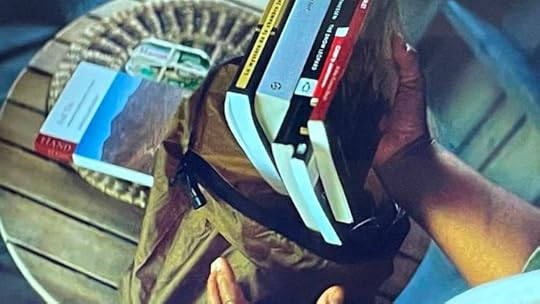
So kudos to those smart folks in Hollywood (or wherever) who acknowledge that there are smart folks out here as well — lovely bit of travel-lit trivia here, and a well-deserved nod to both Eland and the indestructible Ms. Murphy!
ORIGINAL REVIEW: So I have now finished Murphy's first three books in exactly backwards order, having read Tibetan Foothold, the immediately sequel to Full Tilt, back in 2018; and then The Waiting Land, the third book in what is in effect (but never actually described as) a trilogy, back in 2013, after an initial read in 1991! But reading them in reverse order in no way detracted from the delight of each book as a stand-alone — although if you're starting from scratch, I'd certainly recommend reading them chronologically.
The full title, Full Tilt: Ireland to India With a Bicycle, is technically true, but a bit misleading. Dervla is out of Ireland before she's even finished her Foreward — literally before page 1 — and finally arrives in India a mere nine pages before her story ends. So this is very much the diary of a journey, not a travel guide to a particular destination, (something which apparently counts for the bulk of this wonderful book's several 2-star reviews). But what a journey! Turkey to Iran to Afghanistan to Pakistan to India, equally fascinating and — in historical perspective — heartbreaking. Iran before the Revolution...a still-innocent Afghanistan where Russia and America were just starting to compete for influence, (including scenes of a pre-Taliban Bamian and its still-intact, millennia-old Buddhist statues)...Pakistan just starting to deal with the concept of an independent Bangladesh, (including a visit to a pre-bin Laden Abbottabad)...a genuinely epic, "slice in time" adventure featuring an unforgettable, indestructible and endlessly witty Irishwoman.
And then...she arrives in Delhi, falls sick, and the book ends — indeed jarringly, if you don't know the rest of the story. But Dervla picks up her tale literally the next day in Tibetan Foothold:
"My first week in the capital was spent recovering from heatstroke; then, putting aside all thoughts of cycling during the months ahead, I began to make tentative enquiries about the possibility of doing some volunteer social work until November's coolness came to the rescue and I could start cycling again."
That second book — her "Empire Strikes Back," as it were — takes her to the foothills of the Himalaya, where she immerses herself in dealing with the problems of the just beginning Tibetan refugee crisis, (similar in so many ways to what is happening in Syria today). And in doing so, the 33-year-old adventuress discovers a greater depth and wisdom, finishing her story by noting that "it's strange to think that when I left Ireland I was seeking only the satisfaction of adventure and discovery — but now, after spending the first half-year 'travelling hopefully', I have realised that it is far better 'to arrive'." She then promises to return to work with the Tibetans again in 1965 — which she does in The Waiting Land, although moving to Nepal now, where the refugee problem itself has relocated.
As with her other books, Full Tilt includes innumerable insightful and/or hilarious quotes and observations, ranging from the wise:
"This house reveals what some might describe as the poverty of Afghanistan, but what I prefer to call its simplicity, since poverty denotes a lack of necessities and simplicity a lack of needs."
...to the typically blasé:
"There's a small snake in the corner of this room but he also seems to be half asleep and, as I'm too exhausted to face the fuss and flap-doodle if I report his presence to the authorities, I'll chance his presence for the night: probably he's harmless anyway."
But overall, I suggest you read any of these books and find your own favorites, (although you can read a few pre-selected gems in my reviews of her other books at https://www.goodreads.com/review/show... and https://www.goodreads.com/review/show...).
So kudos to those smart folks in Hollywood (or wherever) who acknowledge that there are smart folks out here as well — lovely bit of travel-lit trivia here, and a well-deserved nod to both Eland and the indestructible Ms. Murphy!
ORIGINAL REVIEW: So I have now finished Murphy's first three books in exactly backwards order, having read Tibetan Foothold, the immediately sequel to Full Tilt, back in 2018; and then The Waiting Land, the third book in what is in effect (but never actually described as) a trilogy, back in 2013, after an initial read in 1991! But reading them in reverse order in no way detracted from the delight of each book as a stand-alone — although if you're starting from scratch, I'd certainly recommend reading them chronologically.
The full title, Full Tilt: Ireland to India With a Bicycle, is technically true, but a bit misleading. Dervla is out of Ireland before she's even finished her Foreward — literally before page 1 — and finally arrives in India a mere nine pages before her story ends. So this is very much the diary of a journey, not a travel guide to a particular destination, (something which apparently counts for the bulk of this wonderful book's several 2-star reviews). But what a journey! Turkey to Iran to Afghanistan to Pakistan to India, equally fascinating and — in historical perspective — heartbreaking. Iran before the Revolution...a still-innocent Afghanistan where Russia and America were just starting to compete for influence, (including scenes of a pre-Taliban Bamian and its still-intact, millennia-old Buddhist statues)...Pakistan just starting to deal with the concept of an independent Bangladesh, (including a visit to a pre-bin Laden Abbottabad)...a genuinely epic, "slice in time" adventure featuring an unforgettable, indestructible and endlessly witty Irishwoman.
And then...she arrives in Delhi, falls sick, and the book ends — indeed jarringly, if you don't know the rest of the story. But Dervla picks up her tale literally the next day in Tibetan Foothold:
"My first week in the capital was spent recovering from heatstroke; then, putting aside all thoughts of cycling during the months ahead, I began to make tentative enquiries about the possibility of doing some volunteer social work until November's coolness came to the rescue and I could start cycling again."
That second book — her "Empire Strikes Back," as it were — takes her to the foothills of the Himalaya, where she immerses herself in dealing with the problems of the just beginning Tibetan refugee crisis, (similar in so many ways to what is happening in Syria today). And in doing so, the 33-year-old adventuress discovers a greater depth and wisdom, finishing her story by noting that "it's strange to think that when I left Ireland I was seeking only the satisfaction of adventure and discovery — but now, after spending the first half-year 'travelling hopefully', I have realised that it is far better 'to arrive'." She then promises to return to work with the Tibetans again in 1965 — which she does in The Waiting Land, although moving to Nepal now, where the refugee problem itself has relocated.
As with her other books, Full Tilt includes innumerable insightful and/or hilarious quotes and observations, ranging from the wise:
"This house reveals what some might describe as the poverty of Afghanistan, but what I prefer to call its simplicity, since poverty denotes a lack of necessities and simplicity a lack of needs."
...to the typically blasé:
"There's a small snake in the corner of this room but he also seems to be half asleep and, as I'm too exhausted to face the fuss and flap-doodle if I report his presence to the authorities, I'll chance his presence for the night: probably he's harmless anyway."
But overall, I suggest you read any of these books and find your own favorites, (although you can read a few pre-selected gems in my reviews of her other books at https://www.goodreads.com/review/show... and https://www.goodreads.com/review/show...).

April 26, 2021
Dervla Murphy comes across as the sort of eccentric relative your 7 year old self is presented to in her parlour to listen to her stories. Fascination turns to discomfort and by the time your tenth birthday comes around you are feigning illness to avoid. Her trip of nigh on 60 years ago is truly amazing - shooting Balkan wolves in the depths of the coldest winter in 80 years, crossing glaciers, heat-stroke etc. But, there is something incongruous in her account - the romantic idealism of the noble peasant delighting in poverty and squalor or communist stoicism over the evils of the West's ' progress' is documented by someone who is clearly from a privileged European background on a machine spawned by that very progress Dervla decries. Still, its an immersive read and highly recommended if you can ignore the attitudes and language belonging from 60 years ago.
January 6, 2023
Full Tilt a mid Twentieth century bicycle excursion across South Asia
I have mixed feelings about this book. I was excited to read it. It makes me sad that countries like Iran, Afghanistan and Pakistan are unwise for me to visit. I was looking forward to the virtual tour.
The travel writing is excellent, but some of the author's choices and opinions are ones that I profoundly disagree with. She is brave but somewhat reckless and she gets into real trouble sometimes, including rape attempts and getting lost on glaciers. She freely expresses her opinion about the countries she visits. I wish she had more solidarity with women in Afghanistan and Pakistan. She is privileged as a visitor to socialize with men who keep their wives and daughters in seclusion. Sometimes I agree with her opinions about what she sees, but frequently I don't.
It is clear from her narrative just how different the mid Twentieth century was from the twenty first. It is interesting to cross borders with her into Iran under the Shah and post partition Pakistan and India. But I am not sure we could be friends.
I have mixed feelings about this book. I was excited to read it. It makes me sad that countries like Iran, Afghanistan and Pakistan are unwise for me to visit. I was looking forward to the virtual tour.
The travel writing is excellent, but some of the author's choices and opinions are ones that I profoundly disagree with. She is brave but somewhat reckless and she gets into real trouble sometimes, including rape attempts and getting lost on glaciers. She freely expresses her opinion about the countries she visits. I wish she had more solidarity with women in Afghanistan and Pakistan. She is privileged as a visitor to socialize with men who keep their wives and daughters in seclusion. Sometimes I agree with her opinions about what she sees, but frequently I don't.
It is clear from her narrative just how different the mid Twentieth century was from the twenty first. It is interesting to cross borders with her into Iran under the Shah and post partition Pakistan and India. But I am not sure we could be friends.

January 15, 2012
Finished....oh thank goodness! I'm so glad that I'm done this book. The only thing that kept me pushing through was the fact that I was reading it for a class.
I thought that Dervla's adventures were interesting, and that she was incredibly eager to get into the craziest situations, but I'm not a fan of her form of storytelling...at all. I understand it's in diary form, but I would have much preferred the focus to be on the environment, the different things that she describes as being beautiful, so basically the things she sees. We get the most extraneous details on her meals, and on the people she stays with. The food part would have been good if she'd just described the crazy dishes, but for the most part she eats eggs, which honestly, really isn't interesting...I can eat eggs, too. She describes how everything stinks, but when she sees something beautiful she says it's beautiful and doesn't really elaborate, at least not as much as I would have liked. If I'm going to endure reading through a book where I'm told everything she eats, I would at the very least like to have the amazing things she's seen described...as those are the actual details that I'd want to hear about.
Also, I didn't really like Dervla. I know I don't know her, and I feel like I'm kind of being mean by saying that. However, I'm talking about her as the narrator, and as this is her travel "diary" I'm taking most of what she says at face value, and some of her comments I found to be incredibly judgmental, or I felt like they seriously underplayed certain situations. In fact, she seemed more sympathetic with the starving animals than she did with the starving people half of the time, and when she gives her food to a starving man she actually says she wishes she hadn't given it to him because then she didn't have food. So she missed one meal, and this man is starving, yet she still wishes she hadn't shared. This wouldn't be so bad if she hadn't been getting basically everything free in her travels. In most of the countries she travels through they don't let their guests pay for anything, so she gets free food, free shelter, free bicycle repairs...and even free cigarettes, but she can't share one measly meal with a starving man without regret...I'm sorry, but that's just awful. There were also some comments that just seriously rubbed me the wrong way. It's probably a good thing people don't share their every thought in every day life because when you're being honest as Dervla seemed to be in this book...you say some things that really don't make you look good.
So, I didn't like this book. In fact, my prof said he didn't even like this book...at least not the first time he read it, but personally, I won't be giving it another chance. While Dervla is an amazing traveler, and I'm sure she's the life of the party, I don't think she's all that great at writing about it. If you really like travel writing, and don't mind maybe reading a book a few times you'll probably like this way more than I did, but for me...it was definitely a miss.
I thought that Dervla's adventures were interesting, and that she was incredibly eager to get into the craziest situations, but I'm not a fan of her form of storytelling...at all. I understand it's in diary form, but I would have much preferred the focus to be on the environment, the different things that she describes as being beautiful, so basically the things she sees. We get the most extraneous details on her meals, and on the people she stays with. The food part would have been good if she'd just described the crazy dishes, but for the most part she eats eggs, which honestly, really isn't interesting...I can eat eggs, too. She describes how everything stinks, but when she sees something beautiful she says it's beautiful and doesn't really elaborate, at least not as much as I would have liked. If I'm going to endure reading through a book where I'm told everything she eats, I would at the very least like to have the amazing things she's seen described...as those are the actual details that I'd want to hear about.
Also, I didn't really like Dervla. I know I don't know her, and I feel like I'm kind of being mean by saying that. However, I'm talking about her as the narrator, and as this is her travel "diary" I'm taking most of what she says at face value, and some of her comments I found to be incredibly judgmental, or I felt like they seriously underplayed certain situations. In fact, she seemed more sympathetic with the starving animals than she did with the starving people half of the time, and when she gives her food to a starving man she actually says she wishes she hadn't given it to him because then she didn't have food. So she missed one meal, and this man is starving, yet she still wishes she hadn't shared. This wouldn't be so bad if she hadn't been getting basically everything free in her travels. In most of the countries she travels through they don't let their guests pay for anything, so she gets free food, free shelter, free bicycle repairs...and even free cigarettes, but she can't share one measly meal with a starving man without regret...I'm sorry, but that's just awful. There were also some comments that just seriously rubbed me the wrong way. It's probably a good thing people don't share their every thought in every day life because when you're being honest as Dervla seemed to be in this book...you say some things that really don't make you look good.
So, I didn't like this book. In fact, my prof said he didn't even like this book...at least not the first time he read it, but personally, I won't be giving it another chance. While Dervla is an amazing traveler, and I'm sure she's the life of the party, I don't think she's all that great at writing about it. If you really like travel writing, and don't mind maybe reading a book a few times you'll probably like this way more than I did, but for me...it was definitely a miss.
May 4, 2014
I just finished this book, and am really torn about it.
On the one hand, Murphy is clearly to be admired for her take-no-prisoners approach to bike touring. She does more with less than most of us could possibly dream of. I would have been a worried mess in a lot of the situations she describes. She does an excellent job of describing the scenery and environment she passes through using simple but evocative imagery.
On the other hand, I find many of her attitudes to be annoying, if not downright loathsome. She complains that the Iranians suffer from "hundreds of years of inbreeding." Later, she wonders why anyone would bother trying to institute literacy in Kashmir when, in her opinion, nobody has ever shown it to be useful to the poor and ignorant. She is freely given the vast majority of her food, lodging, transportation ( when she's not riding ) and then complains that she regretted missing a meal when she gave some eggs to a man who was literally starving. She has some sort of "noble savage" fetish where she constantly complains of how western society is ruining the countries she's passing through by their insistence on building hospitals, roads, railways, and so on. She engages in bizarre double-think where she praises the practice of purdah because she thinks it makes the women happy to know their place, and yet never seems to realize that if she were in that position she would never be allowed to engage in the travel she's clearly enjoying. And so on.
She describes the book as being essentially a lightly-edited diary, and as such, it's really quite well done. She clearly pulls no punches in describing her thoughts and feelings. And that's really the crux of the problem, I really, really dislike her as a person. Honestly, the only reason I continued with the book was to see what sort of ridiculous or oblivious social observation she would come up with next, and she never failed to disappoint in that regard.
My approach to travelogues is to imagine that I'm alongside the author as they go on their adventures. As such, it requires a certain amount of empathy and affection for them. In this case, I feel as if I would have thrown up my hands in disgust and gone on alone as soon as we left Europe.
On the one hand, Murphy is clearly to be admired for her take-no-prisoners approach to bike touring. She does more with less than most of us could possibly dream of. I would have been a worried mess in a lot of the situations she describes. She does an excellent job of describing the scenery and environment she passes through using simple but evocative imagery.
On the other hand, I find many of her attitudes to be annoying, if not downright loathsome. She complains that the Iranians suffer from "hundreds of years of inbreeding." Later, she wonders why anyone would bother trying to institute literacy in Kashmir when, in her opinion, nobody has ever shown it to be useful to the poor and ignorant. She is freely given the vast majority of her food, lodging, transportation ( when she's not riding ) and then complains that she regretted missing a meal when she gave some eggs to a man who was literally starving. She has some sort of "noble savage" fetish where she constantly complains of how western society is ruining the countries she's passing through by their insistence on building hospitals, roads, railways, and so on. She engages in bizarre double-think where she praises the practice of purdah because she thinks it makes the women happy to know their place, and yet never seems to realize that if she were in that position she would never be allowed to engage in the travel she's clearly enjoying. And so on.
She describes the book as being essentially a lightly-edited diary, and as such, it's really quite well done. She clearly pulls no punches in describing her thoughts and feelings. And that's really the crux of the problem, I really, really dislike her as a person. Honestly, the only reason I continued with the book was to see what sort of ridiculous or oblivious social observation she would come up with next, and she never failed to disappoint in that regard.
My approach to travelogues is to imagine that I'm alongside the author as they go on their adventures. As such, it requires a certain amount of empathy and affection for them. In this case, I feel as if I would have thrown up my hands in disgust and gone on alone as soon as we left Europe.

November 28, 2021
It’s one of those sad things in life that so few people have heard of Dervla Murphy, I went around mentioning her to people at work and not one person knew her name and when I explained her achievements a couple of people didn’t believe me. If you want to get an idea of what sort of person Murphy is then this is perfect book for you to read, the introduction describes how she got a bicycle and an atlas for her tenth birthday and it was there and then that she decided she was going to cycle all the way to India, this is a crazy idea for an adult let alone a 10 year old girl…this book is her bringing that dream to light.
In 1963 Murphy was 31 years old and her bike was called “Roz”, she comes across as planning the bare minimum and also taking with her the least amount of stuff she would need. During the trip she was to face her fears about strangers, face wolves and fight the elements (extreme cold, insane heat, sand storms and the Monsoon). I found it incredible what she was able to endure, the lack of food in the mountains, the lack of water in the desert, the lice/flies/fleas/bed bugs and the intense smell in some of the areas, this is most assuredly not an adventure for me. By far the most interesting thing to come out of this book is the trip would have been impossible without the generosity of the people she met on the way, anybody she met was willing to chat and feed her and put her up for the night with nothing wanted in return. She met some very interesting people, both rich and poor and the treatment was the same no matter their station.
The book is not really your standard travel book, Murphy wrote a journal and this book is that collection put together with no further elaboration, it did take me a while to into this style, most of Europe gets missed out with the focus being on Afghanistan and Pakistan. Each section has been written at the end of a long day’s ride and how much you get told all depends on how that day went, there is plenty about the scenery which from these pages sounded stunning, what is lacking is the people. She shares her overall opinion of the village but only really goes into detail about those she stayed with a few nights…I’m guessing this was mostly down to pretty much being a figure passing in the night as she had many early starts (another thing to put me off this trip…up at 4am to ride my bike, no thank you).
I think what Dervla Murphy achieved in this book was incredible, a woman on her own in these countries where you are only told the bad things that happen, it blows my mind what she did, I was constantly shaking my head at how well she handled each situation. She is one of my heroes no doubt about that.
Blog review: https://felcherman.wordpress.com/2021...
In 1963 Murphy was 31 years old and her bike was called “Roz”, she comes across as planning the bare minimum and also taking with her the least amount of stuff she would need. During the trip she was to face her fears about strangers, face wolves and fight the elements (extreme cold, insane heat, sand storms and the Monsoon). I found it incredible what she was able to endure, the lack of food in the mountains, the lack of water in the desert, the lice/flies/fleas/bed bugs and the intense smell in some of the areas, this is most assuredly not an adventure for me. By far the most interesting thing to come out of this book is the trip would have been impossible without the generosity of the people she met on the way, anybody she met was willing to chat and feed her and put her up for the night with nothing wanted in return. She met some very interesting people, both rich and poor and the treatment was the same no matter their station.
The book is not really your standard travel book, Murphy wrote a journal and this book is that collection put together with no further elaboration, it did take me a while to into this style, most of Europe gets missed out with the focus being on Afghanistan and Pakistan. Each section has been written at the end of a long day’s ride and how much you get told all depends on how that day went, there is plenty about the scenery which from these pages sounded stunning, what is lacking is the people. She shares her overall opinion of the village but only really goes into detail about those she stayed with a few nights…I’m guessing this was mostly down to pretty much being a figure passing in the night as she had many early starts (another thing to put me off this trip…up at 4am to ride my bike, no thank you).
I think what Dervla Murphy achieved in this book was incredible, a woman on her own in these countries where you are only told the bad things that happen, it blows my mind what she did, I was constantly shaking my head at how well she handled each situation. She is one of my heroes no doubt about that.
Blog review: https://felcherman.wordpress.com/2021...

July 9, 2023
Interesting learning about a region that I have only really heard about on the news.
November 29, 2022
Not the most beautifully written travel book, nor the most insightful about the people or the nations she visited, but still an interesting record of a traveller's journey through Iran, Afghanistan and (then, West) Pakistan in 1963, with just a bit about Yugoslavia, Bulgaria and India.
I noted the mention of the statues of the Buddha in Afghanistan destroyed by ISIS.
Could this journey be undertaken today?
Her physical fortitude, her resistance to exhaustion, disease, bugs, "stink" and poor food and her enthusiasm and amazing ability to survive with and befriend people so different from herself make this well worth the read.
I noted the mention of the statues of the Buddha in Afghanistan destroyed by ISIS.
Could this journey be undertaken today?
Her physical fortitude, her resistance to exhaustion, disease, bugs, "stink" and poor food and her enthusiasm and amazing ability to survive with and befriend people so different from herself make this well worth the read.
August 5, 2015
This book left me with mixed feelings.
The high points are, the awesome journey, the grittiness of the lady and the authentic feel of the trip through day-to-day fluctuating emotions/thoughts. It surely gave a good picture of the 1960s in the middle east, Afghanistan and Pakistan and her non-judgemental attitude (which sometimes is a bit too patronizing) made the reading enjoyable.
The low points are: Near empty description about her journey in Europe and India (the Indian part of journey was very short, though), the many open ends left open and lack of description of the beauty she enjoyed (to her credit, she did emphasize that this is near verbatim diary entries; though not explicit in the title and in descriptions). May be some photos could have helped.
So people are going to enjoy and well as dislike this book. You will like it, if you are someone who will enjoy someone's writing if you adore that person. You will not if you are looking for a great travel on cyle book through two continents. I guess, I'm somewhere in the middle.
As far deciding on Dervla's writing, I need to look at her other books to comment.
The high points are, the awesome journey, the grittiness of the lady and the authentic feel of the trip through day-to-day fluctuating emotions/thoughts. It surely gave a good picture of the 1960s in the middle east, Afghanistan and Pakistan and her non-judgemental attitude (which sometimes is a bit too patronizing) made the reading enjoyable.
The low points are: Near empty description about her journey in Europe and India (the Indian part of journey was very short, though), the many open ends left open and lack of description of the beauty she enjoyed (to her credit, she did emphasize that this is near verbatim diary entries; though not explicit in the title and in descriptions). May be some photos could have helped.
So people are going to enjoy and well as dislike this book. You will like it, if you are someone who will enjoy someone's writing if you adore that person. You will not if you are looking for a great travel on cyle book through two continents. I guess, I'm somewhere in the middle.
As far deciding on Dervla's writing, I need to look at her other books to comment.

March 12, 2024
This woman is bonkers. How she didn’t die on this trip is beyond me. A thoroughly enjoyable read.
I was generously gifted this book by Paul of Half Man Half Book blog so big thanks to him.
I was generously gifted this book by Paul of Half Man Half Book blog so big thanks to him.
May 9, 2026
La idea de partida es potentísima: los años 60, una mujer en bicicleta y una ruta para llegar desde Irlanda a la India. Desde luego tiene todos los alicientes para que un libro así me enganche.
Pues ha pasado todo lo contrario. Ha sido una gran decepción. Desde el principio, donde falta un contexto adecuado (quién es Dervla Murphy? cuáles son sus inquietudes para realizar este viaje, cuáles sus capacidades, su experiencia, cuáles los preparativos) y se pasa casi de puntillas por Europa, para continuar ya en Asia, sin ofrecer tampoco una visión geopolítica mínima de aquellos años. Que parece que se mete en Irán como quién va al Ikea a por una estantería para el salón.
También he echado mucho de menos más detalle de la bici que llevaba, sus peculiaridades, averías, arreglos...Esta mujer se plantea una ruta de 5000 kms sin apenas herramientas de bici y yo salgo con la MTB 45 kms y lleno una mochila pequeña, y cada dos semanas me toca limpiar, engrasar, etc...Y lo mismo digo de la logística alimenticia, tan exigente para el esfuerzo realizado.
Y lástima también que no haya ni una sola fotografía, por muy poca calidad de las que tomó. Sólo con éso, ya habría subido una estrella de puntuación.
Me gustaría saber mucho más y sólo intuyes ciertas cosas.
Aún así, no deja de tener interés, porque como ya decía, es una aventura extraordinaria. No con el glamour y erudición de Patrick Leigh Fermor y su viaje a pie hasta Constantinopla, pero con un valor indiscutible.
Y ya está por hoy, que tengo preparada la bici estática y un documental de la 2 para verlo mientras pedaleo. Quién no se embarca en aventuras épicas es porque no quiere.
Pues ha pasado todo lo contrario. Ha sido una gran decepción. Desde el principio, donde falta un contexto adecuado (quién es Dervla Murphy? cuáles son sus inquietudes para realizar este viaje, cuáles sus capacidades, su experiencia, cuáles los preparativos) y se pasa casi de puntillas por Europa, para continuar ya en Asia, sin ofrecer tampoco una visión geopolítica mínima de aquellos años. Que parece que se mete en Irán como quién va al Ikea a por una estantería para el salón.
También he echado mucho de menos más detalle de la bici que llevaba, sus peculiaridades, averías, arreglos...Esta mujer se plantea una ruta de 5000 kms sin apenas herramientas de bici y yo salgo con la MTB 45 kms y lleno una mochila pequeña, y cada dos semanas me toca limpiar, engrasar, etc...Y lo mismo digo de la logística alimenticia, tan exigente para el esfuerzo realizado.
Y lástima también que no haya ni una sola fotografía, por muy poca calidad de las que tomó. Sólo con éso, ya habría subido una estrella de puntuación.
Me gustaría saber mucho más y sólo intuyes ciertas cosas.
Aún así, no deja de tener interés, porque como ya decía, es una aventura extraordinaria. No con el glamour y erudición de Patrick Leigh Fermor y su viaje a pie hasta Constantinopla, pero con un valor indiscutible.
Y ya está por hoy, que tengo preparada la bici estática y un documental de la 2 para verlo mientras pedaleo. Quién no se embarca en aventuras épicas es porque no quiere.
March 2, 2025
It's always fun following Dervla the dervish on her madcap adventures and being vicariously devoured by lice, vicariously put up by peasants and potentates, breaking vicarious bones and eating nothing but vicarious eggs and mulberries for days on end. But what struck me reading this, her debut adventure, after three of her later ones, is that she seems to have been fully-formed Dervla from day one. There's no evolution in her style or, seemingly, in her person between this 1963 trip around Afghanistan and northern Pakistan and her 1977 exploration (now with her young daughter) of Baltistan in the same neck of the woods, and the rigours of age and accumulated hardships are only barely discernible in her trips to Cameroon and Transylvania in the early 90's. Her interests and preoccupations (anti-globalist, skeptical of Western do-gooding, etc.); her style of travel (pragmatism, unquenchable optimism, and masochism bordering on martyrdom); her writing style (luminous descriptions of people and places with scrupulous eschewal of cliché and pretension): all this is incredibly consistent over time. I'm not complaining, it just seems odd. But she was a wonderfully odd person.

May 18, 2021
This is an AO Year 12 preread.
If I could give this book 10 stars, I would. How completely fascinating! Imagine being a young woman in the 1960s and riding your bike from Ireland to India! This true story is completely captivating. Having to employ her pistol, pulling over to sleep in the open whenever she needed, sun burns and heatstroke, and being completely starved to the point of eating glaciers! Throughout her journey she gives us glimpses of the cultures along the way. She sympathizes with the father who is trying to hold on to tradition amidst western influences, learns about the consequences of adultery in the country as she finds a man dead on her path, and experiences more hospitality than not along the way. This was an excellent read!
If I could give this book 10 stars, I would. How completely fascinating! Imagine being a young woman in the 1960s and riding your bike from Ireland to India! This true story is completely captivating. Having to employ her pistol, pulling over to sleep in the open whenever she needed, sun burns and heatstroke, and being completely starved to the point of eating glaciers! Throughout her journey she gives us glimpses of the cultures along the way. She sympathizes with the father who is trying to hold on to tradition amidst western influences, learns about the consequences of adultery in the country as she finds a man dead on her path, and experiences more hospitality than not along the way. This was an excellent read!

August 30, 2015
I love the nonchalant way Dervla describes what was an incredibly challenging bike journey across Europe, and Central and South Asia in the 1960s. After reading her descriptions of the utter generosity of the Afghan and Pakistani people and the beauty of the landscapes, you'll be left with an appreciation for a region whose reputation has been sadly and unfairly marred post-9/11. While the very occasional racist terminology prevalent in the 60s might jar modern readers, her open and thoughtful personality overshadows these moments. I read this book at a slow pace, but was glad I stayed with her through India. An inspiring story of human capabilities.

July 22, 2014
What an amazing journey. I kept having to remind myself that this was 1963 and not the age of internet, GPS and Google maps. This was a young girl from Ireland on a bike on her own. She must have made a lot of preparations as she did meet some influential people. She certainly got into a few scrapes which luckily she was able to get out of.
With all that I was not completely engaged with the book. It was not your typical travelogue which is not such a bad thing but still felt a little lightweight on description.
With all that I was not completely engaged with the book. It was not your typical travelogue which is not such a bad thing but still felt a little lightweight on description.

March 13, 2021
A fascinating journey. Not too anthropological, which was reassuring. Interesting to read an account of Afghanistan before the Taliban.

March 4, 2025
Such mixed feelings on this book. One thing for sure, I loved her travel writing. I had previously thought of Afghanistan and Pakistan as brutal landscapes, I now can see the beauty of their mountains, rivers, valleys and flowers. She also clearly describes the brutality of the environment, and how sometimes she was incredibly powerful to tame it on her bike, and how it often overcame all human capabilities. The most difficult part of reading this was in trying to overcome my Western bias, as I thought she was so stupid to undertake such a solo journey in such a violent society. I never got past being aghast at her attempts to push her bike through sand and snow at elevations over 12,000 feet, or eating food infested with flies, or sharing rooms with people so pungent that you could barely stand it, or drinking water mixed with sewage. I couldn't get past feeling her foolishness despite knowing that for the local population, this was just normal life. She loved the Afghans and the Pakistanis, and this probably kept her alive. And it certainly helped that she spent significant time recovering in the homes of the wealthiest and most powerful people in between her most dangerous and devastating travel segments. This was 1963, and maybe women such as Dervla were fascinating anomalies, and this made her a local celebrity. I cannot imagine Dervla or any solo woman (or man) cyclist surviving the trip today.
September 8, 2020
I recently finished Full tilt and found it a nice book .As I considered myself a moderate nature trekker by doing some trekking routes inside the country and abroad and submitting our highest peak " damavand" and few other mountains. I am from Iran or persia .
I really admire Mrs Murphy and I saw her very stubborn, powerful minded by doing such a big cycling adventure several decades ago, in a time which I am sure very few people dire to do in the countries in her route. She is of course fearless in writing her book and expressing opinion.
The book itself was nice and influential but i was unable to make a connection between my mind and the writer's characteristics. This is normal and I mentioned it as a cross cultural thing. Raised As an oriental man I saw some of her way of thinking very ungrateful towards people and nations in her route . She was accepted as a guest in almost all the journey without paying for hotel or even maintainice of her bike.but mentioning and remembering unfavourables from the same persons who helped her was nauseous. For example, a caravan who helped her in babusar pass considered low IQ men because of lacking a true way of thinking to cross the horses over a glacier or when orangzip in Pakistan, her royal and rich host invited her to a photography exhibition, she couldn't let her not writing her opinion about the ugliness and cheap quality of that free offer!
But about my country, iran and our nation the book and Mrs Murphy were totally biased i think. Relating most of the bads and disgustings to Persians, especially Persians before the revolution was invidious while she was not engaged with the people fully same as Afghanistan and didn't sleep in Iranian homes except a few nights and spent most of the time in gendarmeries. Disappearing a little amount of money was not robbery in Harat for sure but missing out a pocket of cigarette was for sure a robbery in persia! Breaking her ribs was normal in an afghan bus and it may be occurred in irland but trying to rob her bike by 3 poor peasants in persia was considered a true violence.
I never think that persian are low dignity, moronic, all begger and low quality people. They try to connect themselves with their history, literature and special mysticism of their own which is largely as same as Afghanistan's. they try to use poem and proverb in their speaking and thinking of them as fool to make a conversation without knowing a language is not true. I don't think there is very much differences between Persians, Afghans and keshmiri people which are depicted largely different in this book. I am sure there is so many deficiencies in our society and social behaviour and it is largely due to dilapidated educational system installed specially after revolution but it is not true that we are low quality, none hospitable and begger and so on.
Furthermore, the writer's path in iran was not included all the country. We have a very big and profound culture and persia is very incongruous.
Finally I think some bad incidents which occurred for Mrs Murphy in iran , at the top of them in ardabil and around, left a very deep and painful mental impact on her that is reflected in the pages. Mrs Murphy in the book was magnificent but largely " Afghanitic" and deeply " Anti- Persian ".i wish her intellectual mind has changed over the years and thinks and researchs about persia again.
I really wished to write these lines for herself but I didn't find trustable means of contact directed to her . Hope she see my comment someday
I really admire Mrs Murphy and I saw her very stubborn, powerful minded by doing such a big cycling adventure several decades ago, in a time which I am sure very few people dire to do in the countries in her route. She is of course fearless in writing her book and expressing opinion.
The book itself was nice and influential but i was unable to make a connection between my mind and the writer's characteristics. This is normal and I mentioned it as a cross cultural thing. Raised As an oriental man I saw some of her way of thinking very ungrateful towards people and nations in her route . She was accepted as a guest in almost all the journey without paying for hotel or even maintainice of her bike.but mentioning and remembering unfavourables from the same persons who helped her was nauseous. For example, a caravan who helped her in babusar pass considered low IQ men because of lacking a true way of thinking to cross the horses over a glacier or when orangzip in Pakistan, her royal and rich host invited her to a photography exhibition, she couldn't let her not writing her opinion about the ugliness and cheap quality of that free offer!
But about my country, iran and our nation the book and Mrs Murphy were totally biased i think. Relating most of the bads and disgustings to Persians, especially Persians before the revolution was invidious while she was not engaged with the people fully same as Afghanistan and didn't sleep in Iranian homes except a few nights and spent most of the time in gendarmeries. Disappearing a little amount of money was not robbery in Harat for sure but missing out a pocket of cigarette was for sure a robbery in persia! Breaking her ribs was normal in an afghan bus and it may be occurred in irland but trying to rob her bike by 3 poor peasants in persia was considered a true violence.
I never think that persian are low dignity, moronic, all begger and low quality people. They try to connect themselves with their history, literature and special mysticism of their own which is largely as same as Afghanistan's. they try to use poem and proverb in their speaking and thinking of them as fool to make a conversation without knowing a language is not true. I don't think there is very much differences between Persians, Afghans and keshmiri people which are depicted largely different in this book. I am sure there is so many deficiencies in our society and social behaviour and it is largely due to dilapidated educational system installed specially after revolution but it is not true that we are low quality, none hospitable and begger and so on.
Furthermore, the writer's path in iran was not included all the country. We have a very big and profound culture and persia is very incongruous.
Finally I think some bad incidents which occurred for Mrs Murphy in iran , at the top of them in ardabil and around, left a very deep and painful mental impact on her that is reflected in the pages. Mrs Murphy in the book was magnificent but largely " Afghanitic" and deeply " Anti- Persian ".i wish her intellectual mind has changed over the years and thinks and researchs about persia again.
I really wished to write these lines for herself but I didn't find trustable means of contact directed to her . Hope she see my comment someday

January 4, 2016
Mõnus lugu vahva naise seiklustest! Autor kirjutas meie-vormis, pannes mind alguses mõtlema, kes on ta salapärane reisikaaslane, kuni sain aru, et see on ju ustav jalgratas Roz!
Üldse oli tegu väga õpetliku lugemisega. Mõned näited, mille võrra targemaks sain:
+ ära mine talvel jalgrattamatkale
+ saada ette vaadatud marsruudile varurehvid juba ette ootama
+ Aasias ei vaata juhid kunagi, kuhu sõidavad
+ Afganistanis ei tunta kella: eilne on möödas, tänast tuleb sekeldusteta nautida ja mis homsesse puutub - tulevikku plaanida on patune
+ USA ja NSVL sillutasid võidu Afganistanis teid
+ afgaanid kaevavad ratta alla augu, kui vaja rehvi vahetada
+ täiuslikke maid pole olemas
+ kuuma ilma puhul peaks jooma mahla, teed, piima jne soolaga
Lugedes tekkis ka mitmeid küsimusi. Kõige sügavamalt jäin juurdlema selle üle, kuidas ikkagi oleks kõige õigem viis maha jäänud riike aidata. USA ja NSVL tegid küll palju Afganistani järele aitamiseks, aga riik lõpetas ikkagi Talibani võimu all. Tore oli lugeda, kuidas Kabulis vanasti kord oli, võrreldes seda eelmisel aastal loetud afgaani naise memuaaridega 30 aastat hilisemast perioodist "Röövitud nägu: kahekümneaastasena Kabulis".
Ainus, millest lugedes puudust tundis olid pildid. Autor pidevalt rääkis, kuidas ta tegi sellest või teisest asjast pilti, hiljem küll kurtes, et ükski välja ei tulnud. Enda jaoks loo illustreerimiseks otsisin vahepeal kohanimede järgi googlest pilte juurde. Asupaikade järgi oli jutt õnneks väga detailne ning sai ka juures olevat kaarti näpuga järgitud.
Üldse oli tegu väga õpetliku lugemisega. Mõned näited, mille võrra targemaks sain:
+ ära mine talvel jalgrattamatkale
+ saada ette vaadatud marsruudile varurehvid juba ette ootama
+ Aasias ei vaata juhid kunagi, kuhu sõidavad
+ Afganistanis ei tunta kella: eilne on möödas, tänast tuleb sekeldusteta nautida ja mis homsesse puutub - tulevikku plaanida on patune
+ USA ja NSVL sillutasid võidu Afganistanis teid
+ afgaanid kaevavad ratta alla augu, kui vaja rehvi vahetada
+ täiuslikke maid pole olemas
+ kuuma ilma puhul peaks jooma mahla, teed, piima jne soolaga
Lugedes tekkis ka mitmeid küsimusi. Kõige sügavamalt jäin juurdlema selle üle, kuidas ikkagi oleks kõige õigem viis maha jäänud riike aidata. USA ja NSVL tegid küll palju Afganistani järele aitamiseks, aga riik lõpetas ikkagi Talibani võimu all. Tore oli lugeda, kuidas Kabulis vanasti kord oli, võrreldes seda eelmisel aastal loetud afgaani naise memuaaridega 30 aastat hilisemast perioodist "Röövitud nägu: kahekümneaastasena Kabulis".
Ainus, millest lugedes puudust tundis olid pildid. Autor pidevalt rääkis, kuidas ta tegi sellest või teisest asjast pilti, hiljem küll kurtes, et ükski välja ei tulnud. Enda jaoks loo illustreerimiseks otsisin vahepeal kohanimede järgi googlest pilte juurde. Asupaikade järgi oli jutt õnneks väga detailne ning sai ka juures olevat kaarti näpuga järgitud.
October 14, 2014
This is an incredible book - a wonderful description of cycling from Ireland to India, but specifically through Afghanistan and Pakistan. Some of Dervla's feats had my mouth hanging open as I read, and the scenery she describes is utterly fantastic - making me very sad that it's unlikely I'll be able to take such a trip in my lifetime! Having read some of Dervla's later works first I also found it really interesting how her thoughts moved on over time, for example on women in traditional Islamic households. Her views in this book (which is v. anti-west, anti-globalisation and also anti-modernisation) are very different from those in her most recent book, A Month by the Sea, in which, in Gaza, Dervla is very much opposed to women having to cover their hair, arranged marriages, lack of female education etc etc. She is an incredible woman, an inspiring woman, and I really, really enjoyed this book (especially as someone who loves cycling!)
July 5, 2018
The grit of the author is incredible. An amazing feat of travel across borders by a woman who seems incapable of fear. Even when faced with wolves and near starvation. However, the book ended rather abruptly and it still reads like a diary that needs a bit of editing.
Did Not Finish
December 9, 2024Okay, this is rare for me, but I didn't finish this one. I admire Murphy's courage for embarking on such a trip; I just found her account of the journey a bit tedious. Sorry Backlisted. I love your podcast and most of your recommendations, just not this one.

April 25, 2019
A fascinating account from one of my favourite travel writers. He later work is a bit overly political but this is her first and its her journal entries she made this crazy trip.
March 15, 2025
A remarkable account of a remarkable adventure.
In 1963, Dervla Murphy travels from Dublin to Delhi, almost entirely by bicycle. Along the way, she’s attacked by wolves, breaks three ribs, carries her bicycle through chest-high snow and up mountain trails, nearly starves to death, and ends up with dysentery. None of it gets her down. Rather, her descriptions of what she sees and experiences are suffused with unbreakable optimism and awe. (It’s probably worth noting that her journey is a success in large part thanks to the continual hospitality, and occasional armed escort, provided to her by the local population wherever she goes.)
I cannot imagine any contemporary writer attempting this journey. And I cannot imagine any contemporary writer creating an account of it so marvelously written and so free of navel-gazing.
That said, there are some aspects of this account which are jarring and off-putting. Murphy frequently generalizes about entire countries and ethnicities, choosing either total romanticization and idealization (Pashtuns) or total detestation and contempt (Persians). Her black-and-white thinking leads her to romanticize the lives of people she meets. She gives an occasional nod to the downsides of poverty, illness, and patriarchal oppression, then blankets it over immediately with a big heap of that brash optimism. There are many passages that I found infuriating to read for this reason, and many scenes where Murphy comes across as utterly obnoxious. However, I think these traits – optimism that veers toward callousness, confidence that veers toward arrogance -- are probably inextricable from being the type of person who would undertake a journey like this in the first place.
Despite the flaws, I enjoyed the book very much and have downloaded a bunch of her others for when I’m in the mood for adventure.
In 1963, Dervla Murphy travels from Dublin to Delhi, almost entirely by bicycle. Along the way, she’s attacked by wolves, breaks three ribs, carries her bicycle through chest-high snow and up mountain trails, nearly starves to death, and ends up with dysentery. None of it gets her down. Rather, her descriptions of what she sees and experiences are suffused with unbreakable optimism and awe. (It’s probably worth noting that her journey is a success in large part thanks to the continual hospitality, and occasional armed escort, provided to her by the local population wherever she goes.)
I cannot imagine any contemporary writer attempting this journey. And I cannot imagine any contemporary writer creating an account of it so marvelously written and so free of navel-gazing.
That said, there are some aspects of this account which are jarring and off-putting. Murphy frequently generalizes about entire countries and ethnicities, choosing either total romanticization and idealization (Pashtuns) or total detestation and contempt (Persians). Her black-and-white thinking leads her to romanticize the lives of people she meets. She gives an occasional nod to the downsides of poverty, illness, and patriarchal oppression, then blankets it over immediately with a big heap of that brash optimism. There are many passages that I found infuriating to read for this reason, and many scenes where Murphy comes across as utterly obnoxious. However, I think these traits – optimism that veers toward callousness, confidence that veers toward arrogance -- are probably inextricable from being the type of person who would undertake a journey like this in the first place.
Despite the flaws, I enjoyed the book very much and have downloaded a bunch of her others for when I’m in the mood for adventure.

March 23, 2025
Travelling on bike for such a long distance and seeing all the people and geography first hand, must have been a wonderful thing to experience. But it’s a shame for this reader sitting on a couch, that experience doesn’t translate over the pages of diary entries. I likely needed to learn more about these countries’ histories and anthropology a bit more, before I can evaluate Murphy’s personal opinions on the cultures she had experience. There were some insights that resonated with me, but I’m not sure my worldview is enriched the same way hers was through the experience. Maybe the point of travel books is always to inspire the reader to take on travelling themselves.
December 23, 2025
Love this book as a glimpse into a bygone era of Central Asia. Murphy underwent her epic journey at the perfect time to capture the polarization of life in this part of the world. While some areas were gripped in the wheels of progress, others were blissfully unaware and going about life as it had been for centuries.
My only qualms are the occasional confusions that arise from the fact that this novel is a compilation of her journals. I found myself wishing there were maps included and maybe the occasional foot note to explain her connection to some of the reoccurring characters or themes.
My only qualms are the occasional confusions that arise from the fact that this novel is a compilation of her journals. I found myself wishing there were maps included and maybe the occasional foot note to explain her connection to some of the reoccurring characters or themes.
Displaying 1 - 30 of 588 reviews