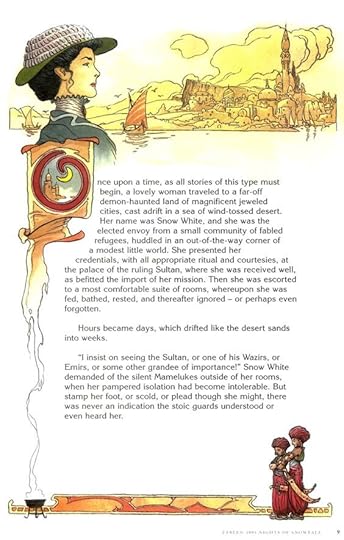
Fables is a series I enjoyed a great deal back in my university days, though it's also one of those books I'm not sure I'd want to go back to and read from the start--I have a feeling it maybe hasn't aged very well, or that I'm just not in the same place to enjoy it that I was a decade or so ago. This book, though, was a nice trip down memory lane. The connecting thread is that Snow White, at some indeterminate point in the past, has been captured by the sultan of the Arabian Fables in Exiles, and she stays alive by intriguing him with stories. While there's some attempt at discussion of the stories after, it's reasonably clear that there's usually no direct thematic connection between her stories and her situations; although to be fair, that was true for the original 1001 Arabian Nights too. (Although for the later, that's more because they were a lot of stories by different authors put together.) So what we get are a few stories that fill in the gaps between characters, and introduce a few more through vignettes.
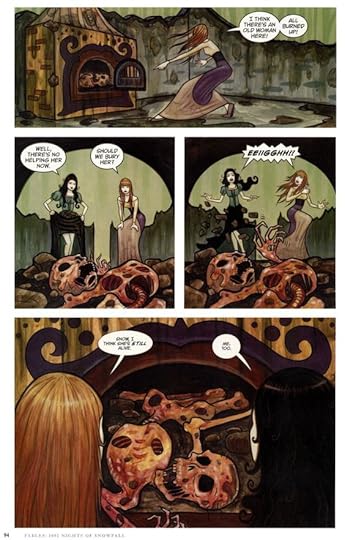
Mostly, we get a lot of stories set just before the Advesary invades, or during the invasion. We get the early days of Snow White's marriage and a rather dark version of her life with the dwarves, Reynard tricking a set of goblins, origin stories for the Frog Prince, Bigby, and the town's witch character, and a nice story about Mayor Cole pre-Fabletown that explains a bit more how he came to be in his position, as well as a few two page intros to various characters. There's some very unpleasant gender dynamics at work in many of the stories--Snow's initial imprisonment, mentions of rape, the witch's story and spurning. It's not gratuitous, and it's clearly a consequence of the war time and savage nature of the fairy tale world, but at the same time, it comes up often enough that it feels fatiguing to me rather than effective. (YMMV.) Early Fables leaned a little too heavy on making the Fables "modern" and different from their traditional depictions by virtue of having them act really mean and vicious and dwelling on the violence a lot more than the original (which had their fair share of violence too), and I feel like the book dips into that well too. It's also, despite the intro, probably a book more for the fans, as the meat of it is filling in the past of characters we already appreciate.
The art is amazing. It's a smorgasbord of different artists, generally one or two for each story. The relative brevity of the story, and the book's nature as a one shot, means it's free to go to artists who focus on work that's a little slower paced than a monthly 22 page comic, and so we get a lot of artists known for album and comic covers. Their backgrounds give the stories a bit of a static feeling at times, but that fits very well with Willingham's technique here, that these are stories being told to a third party. None of the stories felt entirely essential, that I was seeing a radically new or significant part of Fable lore. But it was a component book, and I wasn't disappointed going back to it.