

What do you think?

When Dinosaurs Ruled the Earth
Reconstructing the lives and anatomy of dinosaurs is an exciting and puzzling business. Dinosaurs - literally "terrible lizards" - dominated the Earth for 140 million years, and our visions of what each kind looked like and how they lived and evolved are changing as new fossils are found all over the world. This book reveals fascinating details and peculiarities of the dinosaurs themselves, and also of how the scientists find and piece together clues to their existence. Important arguments, such as why dinosaurs disappeared, and whether or not they were warm-blooded creatures, are discussed from all sides. A glossary translates the names of many of the most famous dinosaurs, and a pronunciation guide is included to make sure even the longest dinosaur name comes out right. This is a remarkable book for the dinosaur enthusiast.
80 pages, Hardcover
Published September 1, 1985
About the author
David Norman
125 books13 followersDavid Bruce Norman is a British paleontologist, currently the main curator of vertebrate paleontology at the Sedgwick Museum, Cambridge University. From 1991 to 2011, Norman has also been the Sedgwick Museum's director.
There is more than one author with this name.
There is more than one author with this name.
Ratings & Reviews
Friends & Following
Create a free account to discover what your friends think of this book!
Community Reviews
Displaying 1 - 3 of 3 reviews

June 2, 2025
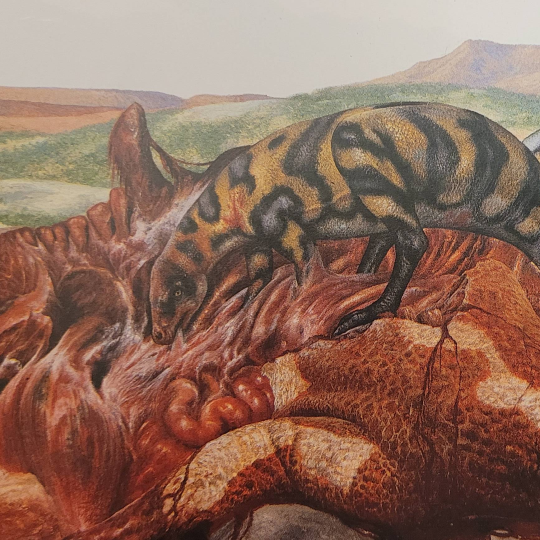
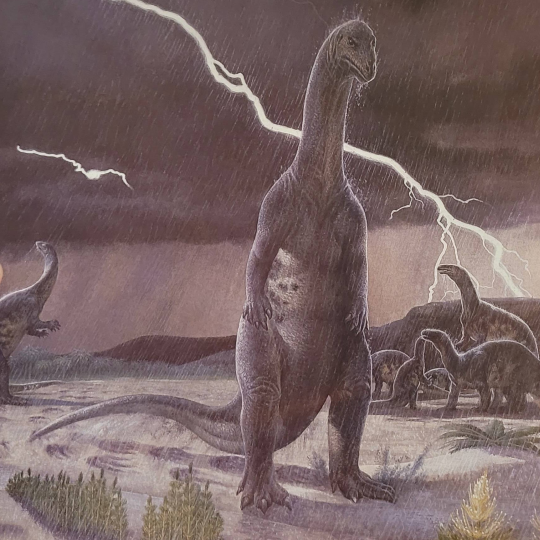
Based on the volcano-induced forest fire T. rex deathmatch cover, I thought this book would be sillier than it is. While the illustrations do have some very gory images, there are enough peaceful images to balance it out. It's about capturing the full spectrum of life, and being illustrated entirely by one artist gives it a cohesive feel. The text is quite sober, and more on a general interest level than a children's book.
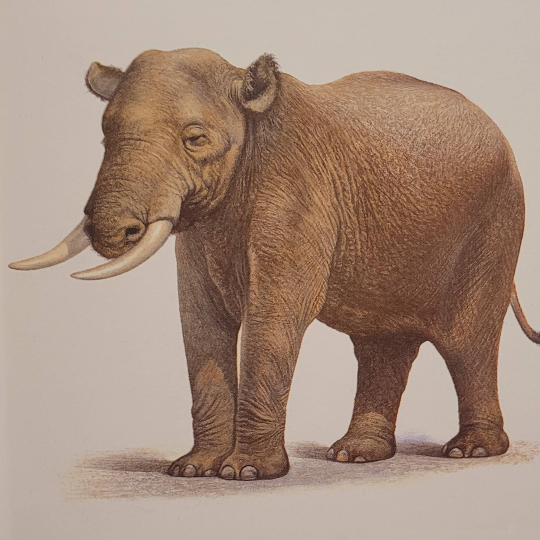
There's a strong focus on ambiguity and the uncertainty of dinosaurian theories. An illustration of a trunkless and small-eared elephant is used to illustrate the limits of skeletally-based reconstructions, in a proto-All Yesterdays move.
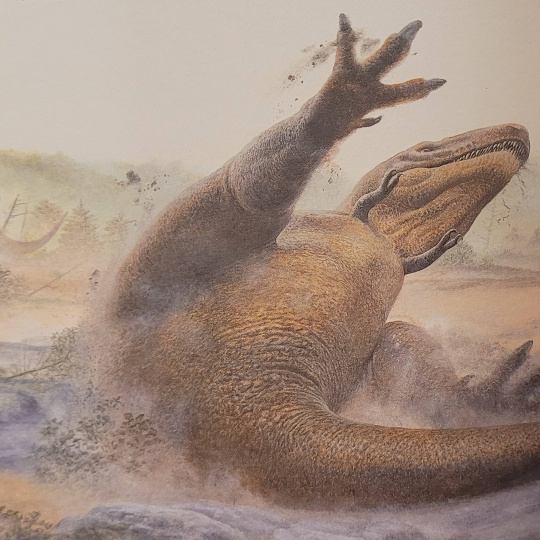
It's also got this hilarious image of a T. rex tripping
August 28, 2020
Surprisingly great/awesomebro ( www.amazon.com/review/RJ6H99FGIW6CC/r... ): 5/5
Short version: Norman's "When Dinosaurs Ruled the Earth" (henceforth Earth) is 1) his best/most awesomebro children's book, & 2) 1 of the then-best/most awesomebro children's natural histories of dinos ( https://web.archive.org/web/201312160... ). I recommend reading Earth in conjunction with other, more recent books (E.g. Naish/Barrett's "Dinosaurs: How They Lived and Evolved").
Long version: Read on.
Many Norman books are OK, but not great. There are 3 main reasons for why I think that is: 1) They're mixed bags in terms of paleoart (Quoting Miller: "I bought the book expecting a more technical discussion of the animals discussed therein[...]but was surprised to find beautiful paintings of questionably-restored dinosaurs"); 2) They're confusing messes in terms of organization; 3) They're dry & esoteric in terms of writing.* Thus, Norman wasn't the 1st person who came to mind when I thought of great/awesomebro dino books, but he might be now that I've read Earth. In this review, I list the 2 main reasons why that is.
1) Vincent's Earth review ( https://chasmosaurs.blogspot.com/2014... ) sums up most everything you need to know about Sibbick's paleoart in Earth. However, I'll add my own thoughts as well:
-In reference to the cover art, Symbion pandora put it best when she said, "Great cover, or Greatest cover?? Fire, random volcanoes, the obligate pterosaur AND a T-rex viciously killing something-- what more could you ask from an '80's kids' dinosaur book?" ( http://symbion-pandora.blogspot.com/2... ). Is there any dino book cover more awesomebro (& accurate for the time) than that?
-In reference to the interior art, Hartman put it best when he said, "I was also impressed with the gritty realism of John Sibbick’s illustrations in David Norman’s When Dinosaurs Ruled the Earth" ( http://prehistoricbeastoftheweek.blog... ). The keyword there is "gritty". All of Sibbick's paleoart is "hyper-realistic", but only his Earth work combines that hyper-realism with "gritty" awesomeness. This is especially apparent when you compare the large, green, front-facing ceratopsian in Earth ( https://web.archive.org/web/202609030... ) to those in the "Normanpedia" ( https://chasmosaurs.blogspot.com/2012... ) & "Creatures of Long Ago: Dinosaurs" ( https://chasmosaurs.blogspot.com/2012... ).
-If Sibbick's "Creatures of Long Ago: Dinosaurs" work is mostly accurate for the time & his "Normanpedia" work is mostly not-so-accurate for the time, then his Earth work is semi-accurate for the time. This is especially apparent in the Deinonychus part of Vincent's review. My only other gripe is the "Dinosaur names" section (which includes non-dino names without clarifying that they're non-dino names).
2) Dry & esoteric writing works in technical books, but not in popular ones. Likewise, confusing organization doesn't work in any book. Fortunately, Earth doesn't have those problems. It helps that Earth is a natural history of dinos & thus the best kind of non-encyclopedic dino book. More specifically, Earth "is designed to be read from start to finish as the developing story of a remarkable group of animals[...in a...]direct, clear written style" ( www.amazon.co.uk/Natural-History-Muse... ).** This is especially apparent in the Introduction (See the Norman quote).
*In reference to "dry", not as plain-toast as many Benton books ( www.goodreads.com/review/show/3490240441 ), but dry nonetheless. In reference to "esoteric", it doesn't help that they lack glossaries.
**See Joseph's "For Love of Stories" for why it's important that ancient history books are designed that way: https://artsci.washington.edu/news/20...
Quoting Norman: "Introduction
The last dinosaurs walked this Earth 64 million years ago[...]an almost unimaginably long time. They were members of a great group of reptiles that had dominated the Earth for 140 million years. Yet because the remains of these long-dead animals have been preserved as fossils it has proved possible, by painstaking work of excavation and scientific study, to learn much about their anatomy, way of life and evolutionary history[...]in fact to almost bring them back to life.
The purpose of this book is to introduce the enthusiast to most of the better-known dinosaurs. This is done by combining accurate life-like colour illustrations with careful discussion of what is presently known about dinosaur biology. In this way the reader should learn a great deal, not only about individual dinosaurs, but also of the world they inhabited and their position in the much greater history of life on Earth."
Short version: Norman's "When Dinosaurs Ruled the Earth" (henceforth Earth) is 1) his best/most awesomebro children's book, & 2) 1 of the then-best/most awesomebro children's natural histories of dinos ( https://web.archive.org/web/201312160... ). I recommend reading Earth in conjunction with other, more recent books (E.g. Naish/Barrett's "Dinosaurs: How They Lived and Evolved").
Long version: Read on.
Many Norman books are OK, but not great. There are 3 main reasons for why I think that is: 1) They're mixed bags in terms of paleoart (Quoting Miller: "I bought the book expecting a more technical discussion of the animals discussed therein[...]but was surprised to find beautiful paintings of questionably-restored dinosaurs"); 2) They're confusing messes in terms of organization; 3) They're dry & esoteric in terms of writing.* Thus, Norman wasn't the 1st person who came to mind when I thought of great/awesomebro dino books, but he might be now that I've read Earth. In this review, I list the 2 main reasons why that is.
1) Vincent's Earth review ( https://chasmosaurs.blogspot.com/2014... ) sums up most everything you need to know about Sibbick's paleoart in Earth. However, I'll add my own thoughts as well:
-In reference to the cover art, Symbion pandora put it best when she said, "Great cover, or Greatest cover?? Fire, random volcanoes, the obligate pterosaur AND a T-rex viciously killing something-- what more could you ask from an '80's kids' dinosaur book?" ( http://symbion-pandora.blogspot.com/2... ). Is there any dino book cover more awesomebro (& accurate for the time) than that?
-In reference to the interior art, Hartman put it best when he said, "I was also impressed with the gritty realism of John Sibbick’s illustrations in David Norman’s When Dinosaurs Ruled the Earth" ( http://prehistoricbeastoftheweek.blog... ). The keyword there is "gritty". All of Sibbick's paleoart is "hyper-realistic", but only his Earth work combines that hyper-realism with "gritty" awesomeness. This is especially apparent when you compare the large, green, front-facing ceratopsian in Earth ( https://web.archive.org/web/202609030... ) to those in the "Normanpedia" ( https://chasmosaurs.blogspot.com/2012... ) & "Creatures of Long Ago: Dinosaurs" ( https://chasmosaurs.blogspot.com/2012... ).
-If Sibbick's "Creatures of Long Ago: Dinosaurs" work is mostly accurate for the time & his "Normanpedia" work is mostly not-so-accurate for the time, then his Earth work is semi-accurate for the time. This is especially apparent in the Deinonychus part of Vincent's review. My only other gripe is the "Dinosaur names" section (which includes non-dino names without clarifying that they're non-dino names).
2) Dry & esoteric writing works in technical books, but not in popular ones. Likewise, confusing organization doesn't work in any book. Fortunately, Earth doesn't have those problems. It helps that Earth is a natural history of dinos & thus the best kind of non-encyclopedic dino book. More specifically, Earth "is designed to be read from start to finish as the developing story of a remarkable group of animals[...in a...]direct, clear written style" ( www.amazon.co.uk/Natural-History-Muse... ).** This is especially apparent in the Introduction (See the Norman quote).
*In reference to "dry", not as plain-toast as many Benton books ( www.goodreads.com/review/show/3490240441 ), but dry nonetheless. In reference to "esoteric", it doesn't help that they lack glossaries.
**See Joseph's "For Love of Stories" for why it's important that ancient history books are designed that way: https://artsci.washington.edu/news/20...
Quoting Norman: "Introduction
The last dinosaurs walked this Earth 64 million years ago[...]an almost unimaginably long time. They were members of a great group of reptiles that had dominated the Earth for 140 million years. Yet because the remains of these long-dead animals have been preserved as fossils it has proved possible, by painstaking work of excavation and scientific study, to learn much about their anatomy, way of life and evolutionary history[...]in fact to almost bring them back to life.
The purpose of this book is to introduce the enthusiast to most of the better-known dinosaurs. This is done by combining accurate life-like colour illustrations with careful discussion of what is presently known about dinosaur biology. In this way the reader should learn a great deal, not only about individual dinosaurs, but also of the world they inhabited and their position in the much greater history of life on Earth."
Read
June 8, 2009JEDINO-Nor
Displaying 1 - 3 of 3 reviews