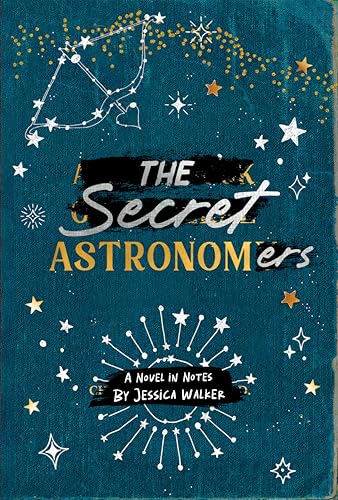
Two anonymous girls. One ancient astrophysics textbook. A decades-old secret.
A fascinating, highly illustrated, epistolary novel perfect for fans of Rainbow Rowell and Alice Oseman.
When a recent transfer student starts keeping her diary in the oldest textbook at the Green Bank High School library, the last thing she expects is to receive a response. Thus begins a sweeping tale of unlikely friendship and long-buried secrets between two secret pen pals at a rural West Virginia high school.
Copernicus is adrift and searching for answers after the sudden death of her mother, and leaving her cosmopolitan life in San Francisco behind. Kepler is a small-town girl with straight A's and big plans to be the first person in her family to go to college, despite her family's modest means. The two girls are so different from one another but united in their goal to solve a mystery that has riddled Green Bank for decades.
Meticulously hand-drawn by debut author Jessica Walker across the pages of an actual ancient astrophsyics textbook, The Secret Astronomers is a story of friendship, family, crop circles, secret crushes, giant telescopes, life in Appalachia, and two girls discovering new ways to connect across any divide that separates them.
Quick synopsis: two high school students (code names Copernicus and Kepler) are using the same physics textbook every day in the library. One is using it to study, and another is drawing inside it. They start leaving each other notes, and the story becomes about their anonymous friendship through the pages. At the same time, they’re uncovering a mystery hidden in the beginning of the book.
Okay so I didn’t like this one!
I surprised myself by really struggling with the format of the book, which is told wholly in letters written inside of an old physics textbook. There are post it notes, drawings, and scraps of paper, and while I thought it was really cool, it also really jumbled my brain. I kept forgetting which person was speaking because the only way of differentiating was by the paper they wrote on. However, I have the ARC which is in black and white, so I’m curious to see what the colour version looks like!
Since the friendship between the students is kept anonymous, they use code names to refer to themselves. This was cool, but there were also so many other code names to keep track of and it made me so confused. For example, Kepler refers to her dad as “Sirius,” her crush as “Orion,” her other crush as “Aquarius,” and etc etc.
The book surprisingly tackled a lot of important topics including colonization and stolen land, identity, and disability, which I thought was great. My only issue with this was that sometimes it felt like the author was starting to write an essay on these topics, rather than the writing coming from the POV of two teenagers writing notes to each other.
With regard to the notes, I sort of don’t understand how it works? I know they write in the book when they’re at school, but how do they keep coming into the library at separate times to write in it but never run into each other? Also the responses were always immediate so were they going to the library multiple times a day? I’m just not sure.
The mystery element of the book was very anticlimactic. Nothing crazy happened, but the characters were constantly in absolute shock of all their discoveries which I found to be mostly mediocre.
To end with some positive, I thought it was really beautiful to see their friendship blossom out of the blue. Kepler and Copernicus are obviously two very different people, and it was heartwarming to see them brought together by this random book.
Thank you Penguin Teen Canada for giving me a copy of this book to read!!
This is YA but don’t let that stop you from picking up this totally unique read. I love an epistolary novel and this one is so cool with two teenage girls writing back and forth to one another in an old physics text book. The text book is filled with their drawings and letters written on post it notes, index cards and right on the pages of the text itself. Jessica Walker’s premise is great and the execution is brilliant! Highly recommend!
The Secret Astronomers is an illustrated, epistolary novel following two teen girls as they pass notes and drawing back and forth in an old library book. Copernicus is new to the small Appalachian town and struggling after her mother died. Kepler is born and raised in the town and has plans to be the first person in her family to go to university. Together, they team up to solve a mystery featuring crop circles and secret crushes.
This was a really fun book! I adore epistolary novels and the art in this one was so beautiful and intriguing. I loved the concept of the book. The notes passed back and forth were so interesting and I loved the discussions that were brought up. Grief, disability, acceptance, judgment, family, and friendship were such poignant topics the author discussed so well. The mystery element was also teased really well and while I guessed the ending, I still really enjoyed it.
Copernicus and Kepler are such opposites, but their friendship was so lovely. Their discussions of their family and feelings felt so realistic and relatable. I loved the support they had for each other. Copernicus’s relationship with Ray outside of the notes sounded so sweet and wholesome.
Overall, if you like coming of age novels with a mystery element or are always excited to read epistolary books like me, you’ll definitely enjoy this one!
Solid – definitely judged the book by its cover. De kleurrijke pagina's, afbeeldingen en unieke manier om een verhaal te vertellen waren erg leuk. Het verhaal op zichzelf was niet super sterk of verrassend, maar was wel vermakelijk. Leuk!
AN EPISTOLARY WHICH ACTUALLY COMMITS TO BEING AN EPISTOLARY!!! WHO CHEERED!! (IT'S ME!!)
I had so much fun with this book. The fact it was set in the West Virginia Radio Silence area + a character getting the codename Kepler gave me major TAZ:A flashbacks, although obviously that's a coincidence.
The characters are flawed in a way I find good narratively. Even when one would call out the other on some bad habit of theirs, it wasn't immediately fixed. Which like. Would be frustrating if I was really friends. But it felt realistic in a way I enjoyed.
It definitely was too on the nose at some points, but I still had a great time
I thought this was a sweet and captivating read. The mixed media was fun and the story kept me intrigued. It dragged just a bit in the middle but then rebounded. I really loved the lessons taught and learned by the girls. Definitely recommend!
I love visual/epistolary stories like Illuminae and Cathy's Book, so this was perfect! Copernicus is very relatable for me and I found both girls very developed. Copernicus is very vocal about social injustices and her dislike of the "hillbilly" folk of Green Bank. Kepler understands there's issues in her rural town and can't wait to escape to a good college, but is proud of her home and quick to defend it. I found their disagreements so refreshing, it was a healthy back and forth where each person was willing to change their opinion. I also love Copernicus's notes on her cochlear implant and the law around accommodations. We love accurate representation and all we can learn from her!!
The story feels like it falls off the tracks a little as Copernicus and Kepler become closer and I wasn't too sure about the sudden alien vibe, but trust the ride, it does all come together. It's a fast read for me, and I did really enjoy it. I loved the flaws in each girl and how their own arcs unfolded. I loved the codenames for everyone too! Copernicus's art is fun and I enjoyed what it added to the story.
The ending was satisfying in numerous ways. I really enjoyed it and I recommend it to anyone looking for a quick read who loves stars, friendship despite incredible differences, fun drawings and layout, and a little mystery. There's a little teenage angst, rebellion, love, and full of young opinions, and I really loved every bit of it. It's authentic and you can understand both sides. I'm glad my library has this book and I hope more people check it out!
Ever since the days of "Amelia's Journal", I have been a sucker for mixed-media books. I'm always going to be drawn to them. This book was fun, and I especially liked the art work that is included through Copernicus' view points. The author did a great job creating two very distinct characters with only what could be written back and forth in notes, and I felt like I knew both of the characters well. I think my issue was that I wanted MORE. I'm unsure if this is going to be a standalone novel, but I would certainly read more from these characters. It kind of felt like the story was just getting going when it ended.
Thanks to Penguin Young Authors Group, Viking Books, and Netgalley for the ARC of this book.
This was such a fun read. The characters were beautifully human and incredibly, terminally teenaged. I love the complexity of all the characters, and how it’s reflected in their community as a whole. The message Kepler directed towards the reader made me really emotional. I figured out some of the mystery pretty quickly, but there were other parts I didn’t get until they were revealed. And the back of the book, one of the first things you look at, has the final piece of the puzzle. It felt like a little gift for finishing the book. Highly highly recommend!!!!!
This entire review has been hidden because of spoilers.
Thank you, Penguin Teen for the physical arc - I ended up reading the digital arc version given that I wanted to experience the full colors of the book as the physical arc was in black and white.
Told in the form of epistolary notes in an ancient astronomy textbook, this novel brings about an unlikely friendship between two girls who could not be more different and a mystery surrounding one of their parents.
Copernicus just moved into a small town in West Virginia to live with her maternal grandparents after the death of her mother. She is looking to solve a mystery about her mum and wanting to know more about her mum’s teen years as her mum never talks about her past. Her discovery leads to her finding her mum’s old note in an ancient astronomy textbook which she doodles her journal notes on. Unexpectedly, Kepler discovers her notes when she was looking for an astronomy book to reference in her college application essays. Kepler was born and raised in this small town. Having to discover they enjoyed writing notes to each other, they dubbed themselves members of the Secret Astronomers Club to solve the mystery of Copernicus’s mum and their mysteries surrounding their small town including teenage drama and crushes.
|People with disabilities get used to standing out when it’s the last thing on Earth we’d choose to do. To others we can seem like we’re complaining or being difficult when all we’re doing is trying to hear|
The girls could not be more different as they grew up in different backgrounds. The notes allowed them some form of anonymity as they got to know each other’s different perspectives and also respect it despite not always agreeing with each other. Topics tackled are family ties and its complexities, the pains of growing up in a teen world, grief, disability, friendship, love and acceptance throughout it all. The discussions are so relatable and their support for each other is genuine. I do find the plot somewhat predictable as the story muddles through, making it an easy and digestible read.
|We have to be open to all different frequencies just in case a signal comes through that we weren’t expecting|
I could find myself relating to Copernicus as she has a hearing disability and would find myself nodding as she describes the struggles she goes through in her everyday life.
While the mystery element is simple and can easily be guessed, the book deserves a read as it focuses on the complexities of friendship. I also love the illustrations peppered throughout the book making this a visual and fun read.
The Secret Astronomers is definitely a multilayered experience. While I was originally pulled in by the premise of a story told in notes, I was really firmly sold after getting a glimpse inside of this title. The idea of a story told in notes between strangers is one that will easily grab me every time. It’s alluring, mysterious, the temptation of being seen and understood down to your core, the quaint human connection of a relationship held entirely through written word. There’s something intimate and base level about that that I will always give a shot. Who doesn’t want to pull a random library book off of your library shelf and not only unearth a real life mystery, but better yet, make a whole new friend? The deeper ~mystery~ that our characters are trying to solve, and the one that initially brought one of our participants to this old and neglected title, is a lot less interesting than the human level exploration of the two high school students writing back and forth. One is revealed to be (spoilers) deaf partway through, one is struggling with incarcerated family, and the two of them handle topics like addiction and grief through the pages of this book together. Most interesting of all was the interwoven exploration of social politics, and an outsider coming in full fledged judgmental and condescending to a really rural tight knight community. That was intriguing to read through the two points of view attempting to coexist harmoniously. Overall, there was both a lot happening here, and nothing at all. Nothing ultimately dove too deep, or hit too hard. However the presentation of this being art and collage pieces, notes left behind, textbook graffiti, etc. made this a worthwhile quick read. I would love to hear the feedback of a younger audience, because I could see this being a reread on a loop, ultimate favorite, or entirely uninteresting to them piece. I find the work as a whole a worthwhile addition to a YA library collection. It’s a different format that might engage different types of readers. It’s visually stunning and will keep your attention in that way throughout. Would love to see more books like this.
I’m guessing on the start date. From the first time I saw this book I was enamored by the physical presentation. It’s about 2 girls who write each other notes in an old astronomy textbook in the library. (Think Dash & Lily). They write the notes on post its and torn out sheets of notebook paper and tape them in the book and one character draws on it. They also tape stuff in. It looks like a junk journal or something and is visually just so cool.
I liked how Walker showed the positive and the negative sides of two different worldviews. These two girls believed two completely different things about a lot of things and they straight called each other out on it all the time. But — and here’s the thing — they remained friends. They didn’t insult each other meanly. It was like “you’re being judgmental and hurtful” and then they moved on and remained friends.
Imagine if the world was like that?
There was also a fun little mystery the girls were trying to figure out, and the book didn’t shy away from heavy topics like grief, generational trauma, racism. The short notes make it a quick read and one reluctant readers might enjoy. I meant to do other stuff last night, but nope — just read this book all night instead.
Ok. To begin my review, I only got this book for free from a bookstore, since I got the free Advanced Readers Copy from Penguin Teen.
I was mainly drawn to this book because of the cover and the vague 2 sentences for a summary on the back. This captured my attention and made me very excited to start reading it.
When I did start reading it, it was very…interesting. I couldn’t say I didn’t enjoy the story. How the author captured each character and their story was unique…but you can definitely tell this was very liberal and Christianity hating. I completely understand if you aren’t a Christian, and don’t think that the right is great, but man, this book is about Astronomy, not the politics and beliefs! For example (and skip over this if you don’t want to much info) but on page 115, and I quote “Just imagine for a moment that some girls might like to ask other girls to the dance (ah, the shock!). And…wait for it…boys might want to ask other boys (the horror). But I’m sure those DEVILISH gender politics haven’t crossed anyone’s mind at GBHS.”
When did we have to bring “Gender Politics” into a book about mystery and space? There is absolute no reason. Call me whatever you want. But if you’re giving this to a child (ages 12 and up it says right on the front page) shouldn’t you give a warning about this? Ridiculous! So if you’re a Conservative Christian like me, stay clear of this.
But, otherwise from the insane perspective and not a great group of words (lots and lots of swearing, and words such as f***, s**, and many others) aside those major issues, the storyline was interesting, and I did like the idea of the conversation being on notes.
So was this book for me? No. But because it was free, I gave it a chance. I literally didn’t want to continue reading it so I just finished it in 2 days. Is this book for you? Maybe. Honestly, as much as I hate being politics into my books I write and the reviews I leave, it’s pretty simple. If your a leftist Democrat, where love is love, and anything goes by because we just want “peace” but you shut down any actual truth, and you want kids to “figure out their gender” because obviously the gender assigned at birth wasn’t enough, be my guess. But if your like me, where you can definitely see that there are major issues in the book, and your a Christian who cares about their country and wants the best for it. Do not read this.
This was such an interesting way to tell a story!! Though obviously not written for me, I can appreciate how it was written and the different stories that it told within. We follow our two main characters, Kepler and Copernicus, as they communicate with each other through an old astronomy textbook and solve a personal mystery along the way.
I really enjoyed how both of the characters made the other think about not only how they grew up, but also how they live their life. Are their beliefs moral? Is it hypocritical to question how people grew up when you haven't lived their life? This book asks a lot of questions like this, but in a way that is digestible to most readers.
I would recommend this book to people who are looking for a contemporary, but want to get through it relatively (ha! get it?) quickly. The book is told through letters and notes, so reads pretty fast.
Also, the book is GORGEOUS. Reading it was super fun and the drawings made it super intriguing.
The Secret Astronomers was such a cool read. I gobbled up this story, told via notes left in an old library book, about two girls in rural West Virginia. The story-telling through notes and pictures "left" in a library book is so cool and totally unique. Was I FAR FAR older than the target demographic? Yes. Did I figure out the "mystery" about halfway through? Also, yes. Did either of those things bother me? Not in the least.
I HIGHLY recommend this one to both YA readers and adults who like a fast paced, interesting read. You MAY (as I did) end up down the rabbit hole reading about Green Bank, WV, where modern technology is banned!
As I often do, I leave you with some quotes that stood out to me.
"If history has a smell, it's the deep musty grit that's been gathering on a Confederate soldier's uniform since the 1800's."
"LOLITL" (Laugh Out Loud In The Library)
"Everyone assumes she's gay because she doesn't fit your general description of what a West Virginia schoolteacher looks like with her trendy glasses and blue hair."
"There ARE messages in the stars, hidden in plain sight, and we just don't know how to read them yet."
"The teenage years represent an event horizon that defines a part of who we are forever."
I will admit, I was a bit skeptical about this book at first. I have a bad habit of judging a book by its cover—in a positive way.
If a book has an interesting cover and title, I'll tend to read it and give it a try. Do I read the little synopsis? No, but I should start doing that. Regardless, when I saw the style of this book and how it was written, I wondered if this would hold my attention.
It did and I absolutely enjoyed it! After getting used to how its formatted, I found it interesting and unique how it was done. It's a quick read and I think it's a good one to use as a palette cleanser. It's been a while since I personally gave a book five stars so I'm happy to give it to this one.
This was a really sweet dual POV story about two teens from very different backgrounds (one born and raised in rural West Virginia who uses she/her pronouns, the other recently relocated after a parents' death from San Francisco who uses she/they pronouns - though this only came up once and wasn't a focus of the story), told in an illustrated, epistolary format. There are references to queer characters and challenges to the pre-conceived notions of both characters. The mystery they were solving was more personally significant than a big explosive reveal that impacted the whole town. Just a quiet, quick read that hits at the heart of so many topics relevant to today's teens.
firstly, i really loved the multimedia style-- but i think both the author and i realized pretty quickly that writing the ENTIRE book in this format was very limiting.
i think the story would have benefitted from this being used as a device- interspliced between the narration of the characters to fuel the story. i say this bc the growth of the characters is hard to grasp based on what they're writing.
and a lot of this book is about them living in a small town, which i get being a large driving force in the plot, but if they lived in such a small town, how would kepler not have been able to find out copernicus's identity from the fact that she's new and deaf? like in a small town, that knowledge would spread.
AND kepler's growth just being getting into college and then deciding to date aquarius instead of orion felt so flat. also the secret felt anticlimactic- it didn't really CHANGE their lives.
but again, i love how cozy it feels. solving mysteries, drawing in an old astronomy textbook with your pen pal, meeting all these characters in a small town- but only if we hadn't relied so heavily on the multimedia when its such a limited tool.
the story wasn’t anything new or shocking to the genre, but still a beautiful one of two teenagers finding themselves + each other. i really love books set in + about appalachia, and the unique history (and struggles) that it involves. also, the way this was told through notes in an old textbook?? right up my alley for epistolary-type novels. the art was cute and really enhanced an otherwise pretty average story.
I grabbed an ARC of The Secret Astronomers at work and I cannot WAIT to see this in full color. I thoroughly enjoyed my time reading this book for so many reasons. The format was extremely unique, and as much as I love epistolary stories, I think The Secret Astronomers put a new spin on a novel written in letters. Overlaying the notes as well as drawings, photos, etc. on top of the text within the textbook the characters were communicating through created a fun and engaging reading experience. I really liked the mystery storyline that was happening behind the scenes, and I wish that had been explored a little more. Overall, I liked getting to see Copernicus and Kepler get to know one another and themselves better, while still discussing some weighty topics with open minds.
The plot kind of drags on, and it feels like some of the story is pointless as the reader. The art and vibe of the book is wonderful and charming. However, the main character was insufferable at times and felt like a gross exaggeration of what people view liberals from California to be. The message was nice at the end, I did appreciate that.
A story told entirely in notes written back and forth in the oldest book in a West Virginia high school library. I really enjoy a good epistolary novel, and this one had an interesting mystery involved as well. Some of it was easy to figure out, but that may be down to the fact that I’m an adult reading a ya book. It also didn’t keep it from being fun to read. :)
I was lucky enough to receive an ARC of this book and I absolutely love it! I couldn’t wait to turn every page and see what was next. This is a very creative book with a lovely low-stakes story. So excited to see when this gets printed in full color!