Widely considered the father of Op Art, the Hungarian-born artist Victor Vasarely (1906-1997) was instrumental not only in provoking a school of thought based on the relationship between art and science, but in creating some of the most striking geometric paintings in the history of late Modernism. This book, which gathers together a generous selection of his most significant works, celebrates his immense intelligence, passion, and artistry. First coming to prominence in Europe, Vasarely's work was included in the groundbreaking 1965 exhibition "The Responsive Eye" at the Museum of Modern Art in New York. In the years following this exhibit, Vasarely rose to international attention, opening art and culture to an imagery shaped by digital applications and creating, with his optical icons, a new direction for art. Robert C. Morgan's text provides fresh insight into Vasarely's startlingly precise and hallucinatory images, discussing the evolution of the artist's career and of the ideas that shaped his work. Considering Vasarely's work from today's perspective, Professor Morgan sees the artist as the innovator behind many of the most radical ideas in design, architecture, and painting at the turn of the last century. Vasarely - published on the occasion of a retrospective of the artist's work at the Naples Museum of Art in Florida - recognises his achievement as an artist and as the visionary who gave art to the computer.
This handsome coffee table book by Gaston Diehl on the art and life of Hungarian-French artist Victor Vasarely (1906-1997) is a real find. The quality of seventy Vasarely prints (nearly all displayed on a full page and in color) is excellent. Also, art historian Gaston Diehl provides an insightful twenty-page overview of Vasarely's artistic evolution from a successful graphic artist in his twenties, an artist who, to use Vasarely's own words, went down the wrong track by producing works in the styles of the day - cubism, expressionism, futurism, symbolism, surrealism - until age forty, the time when he found his true creative self and hit his visual stride in geometric abstract art, or, what has come to be known as Op Art. Victor Vasarely also became a pioneer in the field of Kinetic Art.
Diehl provides detail of how the artist developed a unique geometric style over many years of trial and error. We read: "To accomplish harmonious compositions and unique constructive solutions, he constantly attempts to situate forms and colors on the plane surface; to purify both in order to obtain an economy of means and a total simplification, which are not however an impoverishment, as he emphasizes in his reflections; and lastly, to organize a rhythmic, balanced concatenation which suggests both a different space and a movement in gestation."
From my own experience, this is what I see when looking at Vasarely's geometrical shapes: purity and rhythm and balance as the clear forms and vivid colors seem to play with one another; it is as if I am transported to a completely free, completely open, non-temporal visual realm. If this sounds mystical, there’s good reason, it is mystical. As Diehl explains, Valarely engaged in "transformation of the external vision into an internal vision".
Here is another quote from Diehl underscoring the transcendent quality of Vasarely's geometric art: "The subtle dislocations arranged, and the numerous sharp angles, give the composition an appearance that is intermediate between pure spirituality and nature; that is: they lead to a geometry made all the more vivid by the fact that the force of the contrasts emphasizes its radiating luminosity."
I recall viewing an exhibition of Vasarely art and sculpture at the Philadelphia Museum of Art some years back. I didn't want to leave. The combinations of colors and forms were so powerful and magnetic my eyes couldn't get enough Here are my brief comments on works from two prints in the book:
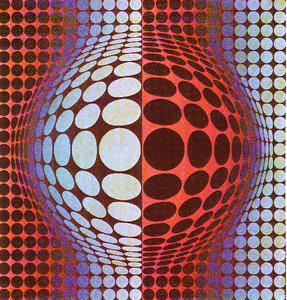
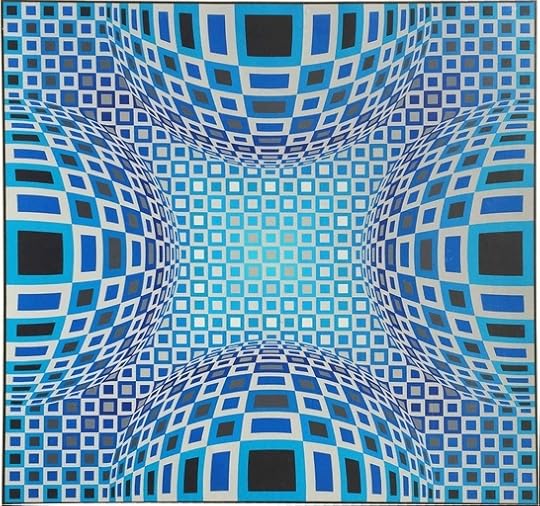
VEGA-WA-3 We have the geometry of circles, twenty-three circles on the vertical and twenty-two on the horizontal for a total of five-hundred-and-six circles, but these circles are not simply static, rather, the circles bulge out at the center, as if the vinyl canvas is a flexible rubber sheet and a ball is being pushed from the rear toward the viewer creating the illusion of three-dimensionality. The circles on the left are black on a burnt orange background and the circles on the right are light gray on a black background and as the shapes change via the pushed ball so the color of both the circles and background change into one another - a unique metamorphosis, the cross-transformation of both color and form.
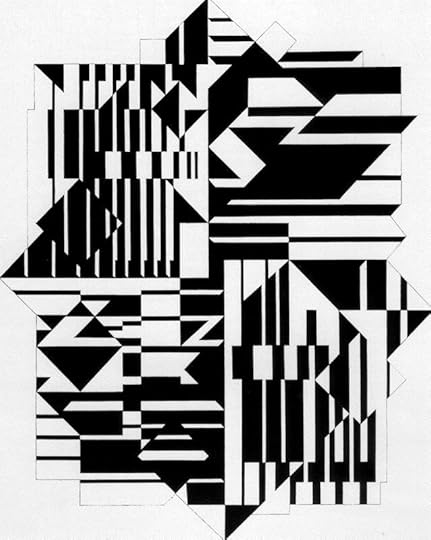
TAYMIR A study in black-and-white, the artist has rectangles, triangles, parallelograms and squares overlapping one another in dazzling combinations, the overlap changing the shapes from white to black and from black to white or enlarging or shrinking the black-and-white design. Many of the squares are actually diamonds, standing on one of their corners. How many overlaps and combinations? Dozens and dozens and dozens. If you enjoy art of this type, you will find something new and fascinating with every viewing.
I don't know if I will ever have the opportunity to go to one of the Victor Vasarely museums in France or Hungary, but meanwhile there are a number of excellent books, including this one published by Crown Art Library.
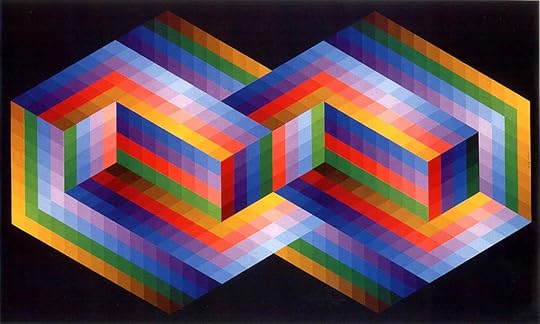
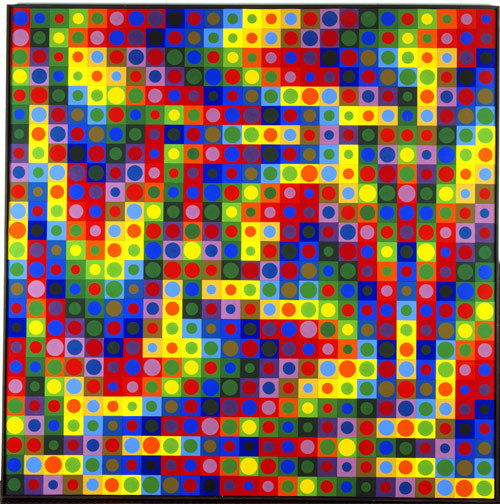
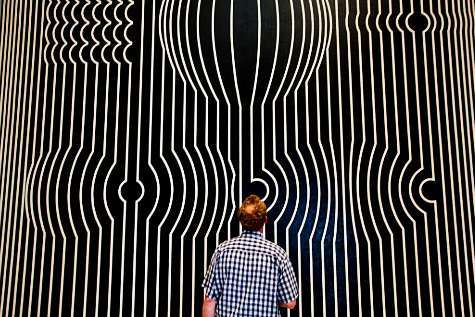
Just for the fun of it, more art from this spectacular artist:
Victor Vasarely was a Hungarian-French artist, the Father of Op Art Movement: his work entitled Zebra is one of the earliest example of op art.
He tirelessly developed his style of geometric abstract art, experimenting with techniques and art trends in order to find his unique style. He was a key figure of kinetic art, and discovered that artworks don’t need actual movement to be kinetic – he created the illusion of movement.
He believed that art is not only for the privileged but for everyone.
He never stopped improving himself. He said, “I realised that I mustn’t carry on with pictoral works, because then I would be a good painter, but I wouldn’t do anything new,” so he created a color-plastic alphated, starting serial art.
You can find Vasarely paintings in galleries all over the world, and there are two Vasarely museums in Hungary: one is in Pécs, his birthtown, the other one is in Budapest. Seeing his paintings in real life is a stunning experience: they have power, concept and playfulness, and a lot more I can’t identify…
This book nicely wraps up the life and art periods of Vasarely with many color photos of his paintings.
It is, of course, possible that these books are written for advanced artists and discuss concepts that I simply don't have the background for. However, the early books in this collection don't have the problem of being incomprehensible, which leads me to believe books like this are BS made in defense of artwork which lacks the substance and depth of earlier artists. Just a suspicion or possibility.