

What do you think?

Tidewater: A Novel of Pocahontas and the Jamestown Colony
In 1607, three ships arrive on the coast of Virginia to establish Jamestown Colony. One girl’s life—and the lives of her people—are changed forever.
To Pocahontas and her people, the 'TIDEWATER' is the rightful home of the Powhatan tribe. To England, it is Virginia Territory, fertile with promise, rich with silver and gold. As Jamestown struggles to take root, John Smith knows that the only hope for survival lies with the Powhatan people. He knows, too, that they would rather see the English starve than yield their homeland to invaders. In the midst of this conflict, Pocahontas, the daughter of the great chief, forges an unlikely friendship with Smith. Their bond preserves a wary peace—but control can rest only in one nation’s hands. When that peace is broken, Pocahontas must choose between power and servitude—between self and sacrifice—for the sake of her people and her land.
RUNNING TIME ➼ 17hrs. and 55mins.
©2015 Libbie Hawker (P)2015 Brilliance Audio, all rights reserved.
To Pocahontas and her people, the 'TIDEWATER' is the rightful home of the Powhatan tribe. To England, it is Virginia Territory, fertile with promise, rich with silver and gold. As Jamestown struggles to take root, John Smith knows that the only hope for survival lies with the Powhatan people. He knows, too, that they would rather see the English starve than yield their homeland to invaders. In the midst of this conflict, Pocahontas, the daughter of the great chief, forges an unlikely friendship with Smith. Their bond preserves a wary peace—but control can rest only in one nation’s hands. When that peace is broken, Pocahontas must choose between power and servitude—between self and sacrifice—for the sake of her people and her land.
RUNNING TIME ➼ 17hrs. and 55mins.
©2015 Libbie Hawker (P)2015 Brilliance Audio, all rights reserved.
485 pages, Kindle Edition
First published May 19, 2015
About the author
Libbie Hawker
38 books506 followersLibbie was born in Rexburg, Idaho and divided her childhood between Eastern Idaho's rural environs and the greater Seattle area. She presently lives in Seattle, but has also been a resident of Salt Lake City, Utah; Bellingham, Washington; and Tacoma, Washington. She loves to write about character and place, and is inspired by the bleak natural beauty of the Rocky Mountain region and by the fascinating history of the Puget Sound.
After three years of trying to break into the publishing industry with her various books under two different pen names, Libbie finally turned her back on the mainstream publishing industry and embraced independent publishing. She now writes her self-published fiction full-time, and enjoys the fact that the writing career she always dreamed of having is fully under her own control.
Libbie's writerly influences are varied, and include Vladimir Nabokov, Hilary Mantel, Annie Dillard, George R. R. Martin, songwriter Neko Case, and mixed-media storyteller Chris Onstad, to name but a few.
She previously wrote under the pen name L.M. Ironside (historical fiction).
After three years of trying to break into the publishing industry with her various books under two different pen names, Libbie finally turned her back on the mainstream publishing industry and embraced independent publishing. She now writes her self-published fiction full-time, and enjoys the fact that the writing career she always dreamed of having is fully under her own control.
Libbie's writerly influences are varied, and include Vladimir Nabokov, Hilary Mantel, Annie Dillard, George R. R. Martin, songwriter Neko Case, and mixed-media storyteller Chris Onstad, to name but a few.
She previously wrote under the pen name L.M. Ironside (historical fiction).
Ratings & Reviews
Friends & Following
Create a free account to discover what your friends think of this book!
Community Reviews
Displaying 1 - 30 of 360 reviews

July 17, 2014
The story of Pocahontas has become part of American mythology. The legend of the Indian princess who befriended the colonists of Jamestown, Virginia and saved the life of John Smith has been depicted in numerous books and films, usually in a highly romanticized way. In the animated Disney movie, as in many other portrayals, Pocahontas and John Smith were in love, star-crossed by their incompatible cultures.
It all makes for a great story, but these tales bear little resemblance to the history. In Tidewater, Libbie Hawker puts some of the historical back in historical fiction with a novel that sticks much closer to the actual events but turns out to be more interesting than the idealized version.
Pocahontas (a nickname meaning “Mischief”) was actually a child when she first met John Smith and certainly not a love interest. She was adept with languages, as was Smith, helping the colonists communicate with her father, the most important chief of the tribes in the region. Hawker uses Powhatan words unapologetically but naturally, adding to the sense of this unusual linguistic partnership of a Native American child and an English settler.
Pocahontas and Smith were both a little out of step with their respective people. Their mutual feeling of not quite fitting in formed another basis for their bond. Pocahontas unfortunately shared a weakness with the colonists as well, a hubris that came of overestimating abilities and underestimating challenges. Though more excusable in a child, the mistakes of all involved had devastating consequences that often erupted into violence. The constant threat of starvation coupled with the colonists’ fundamental misunderstanding of the native tribes sowed the seeds of conflict that would be passed on for generations.
Hawker creates a story that is by necessity much darker than the Disney version. Her research gives the novel authenticity, but it is woven into the story and the characters. Their decisions and interactions are plausible based on the time and circumstances. While some questions will never be fully answered by history, it could have gone like this.
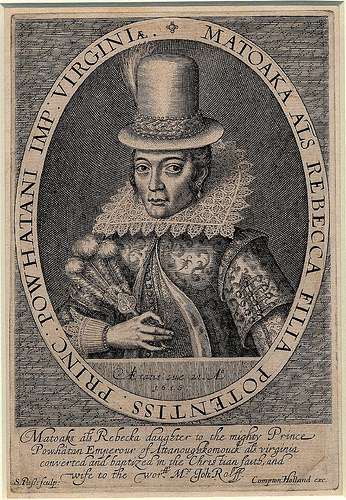
Pocahontas (1616) (Image: Wikipedia)
It all makes for a great story, but these tales bear little resemblance to the history. In Tidewater, Libbie Hawker puts some of the historical back in historical fiction with a novel that sticks much closer to the actual events but turns out to be more interesting than the idealized version.
Pocahontas (a nickname meaning “Mischief”) was actually a child when she first met John Smith and certainly not a love interest. She was adept with languages, as was Smith, helping the colonists communicate with her father, the most important chief of the tribes in the region. Hawker uses Powhatan words unapologetically but naturally, adding to the sense of this unusual linguistic partnership of a Native American child and an English settler.
Pocahontas and Smith were both a little out of step with their respective people. Their mutual feeling of not quite fitting in formed another basis for their bond. Pocahontas unfortunately shared a weakness with the colonists as well, a hubris that came of overestimating abilities and underestimating challenges. Though more excusable in a child, the mistakes of all involved had devastating consequences that often erupted into violence. The constant threat of starvation coupled with the colonists’ fundamental misunderstanding of the native tribes sowed the seeds of conflict that would be passed on for generations.
Hawker creates a story that is by necessity much darker than the Disney version. Her research gives the novel authenticity, but it is woven into the story and the characters. Their decisions and interactions are plausible based on the time and circumstances. While some questions will never be fully answered by history, it could have gone like this.
Pocahontas (1616) (Image: Wikipedia)

November 24, 2021
This is not a romantic historical fiction. It seems to have been written to set the record straight in lew of the Disney movie. Pocahontas was my sister's favorite Disney movie and I started this as a sort of remembrance of her. But the joke was on me as Libbie Hawker made it plain that the movies romance was false and even added her own motivations to the characters. This greatly affected my feelings on the novel.
Pocahontas is one of the most well known native Americans of all time and her life is mostly myth taken from English accounts. This gave Hawker some lead way with the non fictional character. She is portrayed pretty well but is full of alot of modern american ambition that stretched my belief. Don't get me started on John Smith i think Hawker got a little crush on the braggadocious Smith after reading his journals which many historians dismiss and mostly self serving propaganda. Smith is a bad guy stealing food and committing what today would be called war crimes, and still Hawker tries to paint him as a hero. That was one of my MANY DNF moments. I'm not going to get all poor native american on you because the course of human event are replete with the same story. England itself has been invaded at least three time by the Romans, Saxons, and Normans and that's an island so this is just the way of humans work. The major flaw is that hawker includes too many POV characters if she would have just stayed on Pocahontas it would have stayed a shorter and more concise history of her life. Also there are weird time gaps that break up the flow one minuet we hear in minute detail how Pocahontas goes through a ritual (all made up by the author) on how to become a woman then the next it's just stated she has a child. that's just one example of this. Also there is alot of talk about native costumes and English clothing but it seems wasted somehow since there's no romance at all. those things seem to go together in my mind. Hard to have one without the other. but like Libbie Hawker I'm rambling time to wrap this up! I almost DNF this many times and was mostly frustrated.
I cannot recommend this to anyone. To put it bluntly this is a historical fiction written by a independent author who never finished high school. It's not fun or exciting enough to gloss over the cultural inaccuracy. I hope that tells you all you need to know!
Pocahontas is one of the most well known native Americans of all time and her life is mostly myth taken from English accounts. This gave Hawker some lead way with the non fictional character. She is portrayed pretty well but is full of alot of modern american ambition that stretched my belief. Don't get me started on John Smith i think Hawker got a little crush on the braggadocious Smith after reading his journals which many historians dismiss and mostly self serving propaganda. Smith is a bad guy stealing food and committing what today would be called war crimes, and still Hawker tries to paint him as a hero. That was one of my MANY DNF moments. I'm not going to get all poor native american on you because the course of human event are replete with the same story. England itself has been invaded at least three time by the Romans, Saxons, and Normans and that's an island so this is just the way of humans work. The major flaw is that hawker includes too many POV characters if she would have just stayed on Pocahontas it would have stayed a shorter and more concise history of her life. Also there are weird time gaps that break up the flow one minuet we hear in minute detail how Pocahontas goes through a ritual (all made up by the author) on how to become a woman then the next it's just stated she has a child. that's just one example of this. Also there is alot of talk about native costumes and English clothing but it seems wasted somehow since there's no romance at all. those things seem to go together in my mind. Hard to have one without the other. but like Libbie Hawker I'm rambling time to wrap this up! I almost DNF this many times and was mostly frustrated.
I cannot recommend this to anyone. To put it bluntly this is a historical fiction written by a independent author who never finished high school. It's not fun or exciting enough to gloss over the cultural inaccuracy. I hope that tells you all you need to know!

May 29, 2015
Some part of me feels as if I have been waiting years for this book. Let's be clear: I didn't know this book existed until a few months ago, and even then I was skeptical. 500+ pages? Yikes. But as soon as I dived into the story, I didn't want to surface again until I'd finished it. Libbie Hawker chooses the most beautiful words to tell her story, and I hated any time I had to put this down in favor of real-life things -- eating, sleeping, working, you know. Those "basic needs" sorts of things. But I always came right back to this, and fell right back into the wilds of pre-colonized Virginia, and it was such a wonderful feeling. I'm actually still amazed I finished this as quickly as I did, considering its size and how crazy busy I've been lately. But it flowed so smoothly that there was barely any effort put into staying focused on the story or making sure I got through X-amount of pages each day. Great, great story, and I can't wait to read more of her work -- I've actually got The Sekhmet Bed on my Amazon Cloud Reader, so I may start on that pretty soon. Also hoping to read the potential sequel she mentioned in the author's note!
Bottom line: If you grew up loving the 1995 Disney movie, or you love history, definitely read this.
Bottom line: If you grew up loving the 1995 Disney movie, or you love history, definitely read this.

July 8, 2023
Tidewater: A Novel of Pocahantas and the Jamestown Colony is an historical fiction book about the establishment of the Jamestown Colony when three ships, the Susan Constant, the Godspeed, and the Discovery arrived on the coast of Virginia in 1607 after months at sea. These adventurers had been dispatched by the Virginia Company of London, England. This Virginia Territory is fertile with promise for a settlement as it was rich with silver and gold. However, Tidewater is the rightful home of Powhatan people. As Jamestown struggles to become established, John Smith comes to know that the only hope for survival is with the Powhatan people but he also knows that they would rather see the English starve than relinquish their homeland. Pocahantas, the lovely daughter of the great chief, forges an unlikely friendship with John Smith.
Since much of the novel is the story of the Powhatan characters and written from their perspective, the attached Glossary is invaluable as it gives the definition of the Powhatan word. The Kindle edition provides a link to the word in the text that was helpful throughout the book. I found this to be an enjoyable historical fiction narrative about Pocahantas and the founding of the Jamestown Colony. The life of Powahatan native people was interesting although there is a sense of dread as one knows what the settlement of their lands portends in the future for their people.
"The men of Jamestown were weary, but they did not hunger. As their stores depleted, Pocahantas came again, bearing her gifts and greetings from her father, and the most precious gift of all she gave to John Smith alone: knowledge of her people's language, of their customs and ways."
Since much of the novel is the story of the Powhatan characters and written from their perspective, the attached Glossary is invaluable as it gives the definition of the Powhatan word. The Kindle edition provides a link to the word in the text that was helpful throughout the book. I found this to be an enjoyable historical fiction narrative about Pocahantas and the founding of the Jamestown Colony. The life of Powahatan native people was interesting although there is a sense of dread as one knows what the settlement of their lands portends in the future for their people.

June 3, 2015
A gorgeously written book... it puts you right in time with Pocahontas, Powhatan, and John Smith. You walk beside them, an invisible spectator to the events that are happening. Miss Hawker has done a beautiful job of bringing this period and people to life. They leap off the page at you and demand you to lose yourself in the story.
It was easy for me to fall into the story... I knew some of the history surrounding Pocahontas and John Smith but not very much. You can tell she did her research and was passionate about the subject.
There's no black or white here, each side thinks they are right and willing to do anything to ensure their survival.
The life of the tribe was fascinating to me, I couldn't get enough of seeing how they lived, their customs and traditions.
While I didn't approve of some of the choices they made, I could understand in a way where each side was coming from. Not sure what I would do or how brave I would be in those situations.
So why the three stars? While I loved the story, I wasn't 'in love' if that makes sense... it dragged for me after one part in the novel even though the writing didn't lag in any way. I can't quite put my finger on it really.
I would still recommend it, it's definitely worth your time and energy :). Pocahontas in another person from history I would love to meet.
It was easy for me to fall into the story... I knew some of the history surrounding Pocahontas and John Smith but not very much. You can tell she did her research and was passionate about the subject.
There's no black or white here, each side thinks they are right and willing to do anything to ensure their survival.
The life of the tribe was fascinating to me, I couldn't get enough of seeing how they lived, their customs and traditions.
While I didn't approve of some of the choices they made, I could understand in a way where each side was coming from. Not sure what I would do or how brave I would be in those situations.
So why the three stars? While I loved the story, I wasn't 'in love' if that makes sense... it dragged for me after one part in the novel even though the writing didn't lag in any way. I can't quite put my finger on it really.
I would still recommend it, it's definitely worth your time and energy :). Pocahontas in another person from history I would love to meet.

July 31, 2015
ETA: Oh I forgot this. The Native American names can be a little hard to keep track of. There are many characters. To make it even more difficult the natives change their name at important turning points of their lives. In addition the author throws in LOTS of Native American terms. Most often you can decipher their meaning from the context and it builds atmosphere. Not really a problem, but sometimes I was confused. (Maybe the paper book has a word list?) Maps would be handy too.
*************************
This book was just OK for me. I will explain why. What irritated me may be exactly what you are looking for.
I am rating the written book, not the audiobook version. I detested the audiobook narration. There are three narrators - Scott Merriman, Angela Dawe and Luke Daniels. Each of these read separate chapters. The chapters switch between those seen from the female Native Americans and Pocahontas, the male Native Americans or the British settlers’ views. The three different narrators each took a different group. The setting is the Jamestown Colony in Virginia, the start date 1607. A six month sojourn in London is also covered. The story continues through Pocahontas' death. There is a "historical note" at the end which consists of words from the author, sources and finally information on what happens to the main characters after Pocahontas' death. The last is read by Angela Dawe. She has the largest portion of the narration. The voices further emphasize the cinematic tone of the lines and events. Many people enjoy such dramatization; I do not. Many want to feel they are at a movie. They like sentimentality and melodrama. I can do without both. In my view the words of the female narrator sounded at times cartoonish! Dawe's narration drove me nuts, but I am not letting this reduce my rating of the book. That I am keeping separate. Unfortunately what I disliked about the book was further exaggerated by the narration.
Now what did I think of the book? There is the writing, the lines, how things are described. Libbie Hawker does a marvelous in describing tribal traditions, customs, clothes, hairstyles, dances, rites, foods. I enjoyed tremendously her use of metaphors. She explains how things happened or looked or were experienced by comparing them to animals and scenery and fauna intrinsic to life there in the wild. To give you a feel, here are a few examples:
-metallic like stars in water
-like an osprey diving
-chatted like a blackbird in a marsh
-it was dark and shiny as a blackbird wing
-like an eddy in the river
These metaphors fit perfectly and thus the reader sees the Native American world as they themselves saw it and experienced it. This was cleverly done.
However, I disliked the dialogs and other than those metaphors the lines are ordinary, excessively action-filled, meant to excite or make you feel sentimental. Childish one minute adult the next. Quite simply, the writing on the whole was without nuance. No adverbs, nope not here! Let me add that at the end in the author's so-called "historical notes", Hawker goes on and on about her talent and speed. She wrote 160.000 words in 119 days.......but I am not impressed. I am really not interested in word counts. I don't value speed over quality. What hubris! She brags of her ability to write and self-publish a book without a high school education. Remember the lack of adverbs?! Well, I believe in education. There is a fundamental difference of opinion between the author and me.
I had another major problem. For the most part the author follows historical events....as they are known. For the most part she works within feasible possibilities, and I am fine with that. However the myth that Pocahontas saved is today considered just that, myth, not fact. She admits in the "historical notes" that she chose to stick to the myth even though today it is not considered to be true. I would have preferred that she had woven a story around the truth! On completing the book I was compelled to turn to Wiki to separate fact from fiction.
Concerning the division between fact and fiction - Pocahontas was pubescent when the story unfolds. An alternative explanation for her behavior, rather than Disney's famed love story, is offered by the author. I buy this, except that it is exaggerated. Maybe Pocahontas was quite simply a curious, intelligent child that was drawn in by the events rather than
Well, those were the problems I have had with this novel. Now if you love exciting, cinematic, melodramatic writing based mostly on fact, you may just love this.
***********************************
I liked the beginning, but halfway through this is becoming so cheap, cinematic and written to excite. You like that? I don't. Jeez, now the English are thick in the battle screaming swear words such as fuck. These are not the words of that time. They wouldn’t be used in this manner. I no longer believe what I am being told.
The metaphors so cleverly used in the beginning of the novel have gone down the drain now in the author's battle scenes.
The audiobook narration further over-dramatizes the cinematic tone.
What I have liked, in the earlier sections, was how the author showed the mistrust and misunderstanding between the English and the Native Americans. This felt real.
*************************
This book was just OK for me. I will explain why. What irritated me may be exactly what you are looking for.
I am rating the written book, not the audiobook version. I detested the audiobook narration. There are three narrators - Scott Merriman, Angela Dawe and Luke Daniels. Each of these read separate chapters. The chapters switch between those seen from the female Native Americans and Pocahontas, the male Native Americans or the British settlers’ views. The three different narrators each took a different group. The setting is the Jamestown Colony in Virginia, the start date 1607. A six month sojourn in London is also covered. The story continues through Pocahontas' death. There is a "historical note" at the end which consists of words from the author, sources and finally information on what happens to the main characters after Pocahontas' death. The last is read by Angela Dawe. She has the largest portion of the narration. The voices further emphasize the cinematic tone of the lines and events. Many people enjoy such dramatization; I do not. Many want to feel they are at a movie. They like sentimentality and melodrama. I can do without both. In my view the words of the female narrator sounded at times cartoonish! Dawe's narration drove me nuts, but I am not letting this reduce my rating of the book. That I am keeping separate. Unfortunately what I disliked about the book was further exaggerated by the narration.
Now what did I think of the book? There is the writing, the lines, how things are described. Libbie Hawker does a marvelous in describing tribal traditions, customs, clothes, hairstyles, dances, rites, foods. I enjoyed tremendously her use of metaphors. She explains how things happened or looked or were experienced by comparing them to animals and scenery and fauna intrinsic to life there in the wild. To give you a feel, here are a few examples:
-metallic like stars in water
-like an osprey diving
-chatted like a blackbird in a marsh
-it was dark and shiny as a blackbird wing
-like an eddy in the river
These metaphors fit perfectly and thus the reader sees the Native American world as they themselves saw it and experienced it. This was cleverly done.
However, I disliked the dialogs and other than those metaphors the lines are ordinary, excessively action-filled, meant to excite or make you feel sentimental. Childish one minute adult the next. Quite simply, the writing on the whole was without nuance. No adverbs, nope not here! Let me add that at the end in the author's so-called "historical notes", Hawker goes on and on about her talent and speed. She wrote 160.000 words in 119 days.......but I am not impressed. I am really not interested in word counts. I don't value speed over quality. What hubris! She brags of her ability to write and self-publish a book without a high school education. Remember the lack of adverbs?! Well, I believe in education. There is a fundamental difference of opinion between the author and me.
I had another major problem. For the most part the author follows historical events....as they are known. For the most part she works within feasible possibilities, and I am fine with that. However the myth that Pocahontas saved is today considered just that, myth, not fact. She admits in the "historical notes" that she chose to stick to the myth even though today it is not considered to be true. I would have preferred that she had woven a story around the truth! On completing the book I was compelled to turn to Wiki to separate fact from fiction.
Concerning the division between fact and fiction - Pocahontas was pubescent when the story unfolds. An alternative explanation for her behavior, rather than Disney's famed love story, is offered by the author. I buy this, except that it is exaggerated. Maybe Pocahontas was quite simply a curious, intelligent child that was drawn in by the events rather than
Well, those were the problems I have had with this novel. Now if you love exciting, cinematic, melodramatic writing based mostly on fact, you may just love this.
***********************************
I liked the beginning, but halfway through this is becoming so cheap, cinematic and written to excite. You like that? I don't. Jeez, now the English are thick in the battle screaming swear words such as fuck. These are not the words of that time. They wouldn’t be used in this manner. I no longer believe what I am being told.
The metaphors so cleverly used in the beginning of the novel have gone down the drain now in the author's battle scenes.
The audiobook narration further over-dramatizes the cinematic tone.
What I have liked, in the earlier sections, was how the author showed the mistrust and misunderstanding between the English and the Native Americans. This felt real.

November 23, 2015
There was no clear story here, no moral message, not even a single character whose tale she could follow. It was nothing more than a parade of riches, crude in its ostentation.
I was lured into purchasing this book because it is cheap on Amazon, the cover is beautiful, and the idea of a novel about Pocahontas intrigued me. Two out of three marks is bad when the substance of a thing is lacking.
This isn't a book about Pocahontas. This is a book about the Jamestown colony. In itself, that's not a reason to bypass the book, but the reason I bought it was that Pocahontas was blatantly advertised. I would not have cared to read about John Smith and company.
For much of the book -- 60%, roughly, according to my kindle -- Pocahontas is treated as a secondary character. There was some lip service paid to Pocahontas having dreams and ambitions of becoming a female sub-chief (like a governor), but the character's agency is determined by the men around her. She lives to serve the goals of men: from Powhatan to Opechancanough to John Smith to Thomas (her son). If that is the story Hawker wanted to tell, that is fine, but I object to touting Pocahontas as a seventeenth century feminist when she was a puppet of the men around her. In Hawker's portrayal, Pocahontas was no different from the other women around her, American or English.
The plot of the story is repetitive. The English arrive on American soil. Their stores are inadequate. They attempt trade. The Americans want the guns. The English won't give them guns. The Americans attack. The English attack. A supply ship arrives. Their stores are inadequate. The English attempt trade. The Americans want guns. The English won't give them guns. The Americans attack. The English attack. A supply ship arrives. Their stores are inadequate. The English attempt trade....
Do you get the idea?
If the historical record is repetitive, I present to you the fact that Hawker is not a historian, and I don't think that she would argue that she is. She is a writer of fiction. A talented author of fiction -- even a talented historian -- is able to make a repetitive historical record seem to be fresh when similar events happen time and again. (Helen Castor handles this beautifully in Blood & Roses: the Paston Family and the Wars of the Roses.) Hawker tells the same series of events by rote with little to no variation for 500 pages.
Hawker loves her similes. She does this in an attempt to describe feelings and objects. Rather than use the wealth of adjectives and adverbs that the English language offers, she compares one thing to another ad nauseam. I decided to highlight every simile in one chapter:
There are ten similes in a seventeen-page chapter. (For the sake of brevity, I didn't include the metaphors.) It's clear that similes are Hawker's preferred descriptors, but, to use language that Hawker would appreciate, reading all the "like"s is like listening to a gaggle of middle schoolers talk about meeting Harry Styles.
1. It cling to Pocahontas like a shroud. (p. 475)
2. Patches of thin grass reached like an old, worn buckskin fringe between the cracks of paving stones. (p. 476)
3. It smelled wan and thin as an overused cloth. (same paragraph, p. 476)
4. A small dog with a coat like moth-eaten wool trotted down the lane... (p. 477)
5. ... a blushing, quiet girl named Abigail with hair as fine and pale as corn silk. (p. 479)
6. ... the secret of the tassantassas clutched in her hand like a shining fish in an osprey's talons. (p. 484)
7. ... she could not help feeling the weight of London pressing all around her like a bodice laced far too tight. (p. 488)
8. But it smelled like certainty -- like a future. (p. 489)
9. It was as if the majesty he carried in the temples of Tsenacomoco had been wretched from him like an arrowhead ripped from wounded flesh. (p. 492)
10. In the stark light of London, the powerful young priest looked as broken as an old pot discarded by the river. (same paragraph, p. 492)
I am probably wrong about this, but Hawker writes as though she has not seen the Virginia coast or London with her own eyes. To be sure, I have not been to the sixteenth century myself (it's on my list for when the Timelord in a blue box arrives), but her writing has a certain vagueness, a detached, everyday quality, that made me feel that she was describing something secondhand. I think, even if she were to have visited a replica of the settlements, her writing would have possessed more of a surety. To me, I read the book as though Hawker described a photograph she had seen once, not a place she had actually been.
(I don't mean to seem mean-spirited. I'm not criticizing a woman's lack of traveling in the same way I criticized her dependency on similes. It is just a vibe that I had while reading. To be sure, I have not been to Virginia myself to even know. Maybe if I had visited Virginia and Jamestown, my mind would have enhanced her metaphors with my memory. Descriptions of London were generic.)
I refuse to read an author's note that begins, "I wrote Tidewater in record time . . . . How can it be that I could write a novel of this scope with relative ease . . .?" It screams of arrogance. "Oh, haha, George R. R. Martin needs years to write a book? What an amateur."
If this book trimmed the repetitiveness and similes, I'm sure it would be about 200 pages. If that.

July 18, 2014
When I was child, my favourite Disney film of all time was Pocahontas. Naturally, I poked about with the few resources I had access to and knew that Disney had Got It Wrong on many levels. But I still loved that film like crazy and, though I was never tempted to do more thorough research as I got older and the Internet became a thing, I still found myself quietly fascinated in the story of Pocahontas.
Nearly ten years after Disney released Pocahontas, Libbie Hawker has written and published Tidewater, a novel that explores the Jamestown colony and British settlement in the land that is now better known as Virginia through the eyes of not only John Smith and Pocahontas, but Opechancanough, the embittered and war-hungry brother of Powhatan.
Tidewater offers an altogether more accurate take on events. Not that it isn't easy, really, when one considers the liberties Disney took with the storyline. Additionally, Hawker's attempts to capture the culture of the Real People (the native Americans ruled by Powhatan) and her integration of the "Powhatan language" into her story add to a greater feeling of authenticity.
Readers of Hawker's earlier historical fiction novels, written under the pseudonym L. M. Ironside, will recognise this feeling of authenticity and "realness" as one of her strengths as an author. Whether it is the tidewater of Virginia, the alien England or Smith's memories of Constantinople, each location is captured beautifully, adding weighty atmosphere to the story Hawker weaves.
One might also recognise Ironside's strengths with the depth of characterisation found in her characters. No one is too idealised, whether it is the selfish and ambitious Pocahontas, the outcast and pragmatic Smith or the war-mongering and harsh Opechancanough. I will admit to disliking Pocahontas at times because she could be so selfish, treating others horribly and believing that they'd continue to treat her kindly. That said, the arc Hawker gave to Pochontas did much to redeem her in the end.
Though a historical fiction novel, Tidewater sometimes reads as a horror story or a tragedy. It is a very bleak, very dark story, as the history demands it to be. It is a story about the struggle for survival, the brutality and inevitability of colonisation, of the sacrifices people make in the vain hope of peaceful co-existence and the futility of resistance to the British Empire.
I am not American and know little of that country's history, but I believe America and Australia are not too dissimilar when it comes to our appalling treatment of our indigenous peoples, both in the past and now in the present. I was grateful that Hawker did not shy away from presenting the brutality of colonisation and white settlement, but did not fall into the trap of making the Real People into a bunch of noble savages – Powhatan, Opechancanough, Pocahontas and all of the Real People came across as very real, flawed people who were ultimately very human.
It's hard to know how to sum up this book. It's an incredible, difficult read and one that will stay with me for a long time. I would highly recommend it.
Nearly ten years after Disney released Pocahontas, Libbie Hawker has written and published Tidewater, a novel that explores the Jamestown colony and British settlement in the land that is now better known as Virginia through the eyes of not only John Smith and Pocahontas, but Opechancanough, the embittered and war-hungry brother of Powhatan.
Tidewater offers an altogether more accurate take on events. Not that it isn't easy, really, when one considers the liberties Disney took with the storyline. Additionally, Hawker's attempts to capture the culture of the Real People (the native Americans ruled by Powhatan) and her integration of the "Powhatan language" into her story add to a greater feeling of authenticity.
Readers of Hawker's earlier historical fiction novels, written under the pseudonym L. M. Ironside, will recognise this feeling of authenticity and "realness" as one of her strengths as an author. Whether it is the tidewater of Virginia, the alien England or Smith's memories of Constantinople, each location is captured beautifully, adding weighty atmosphere to the story Hawker weaves.
One might also recognise Ironside's strengths with the depth of characterisation found in her characters. No one is too idealised, whether it is the selfish and ambitious Pocahontas, the outcast and pragmatic Smith or the war-mongering and harsh Opechancanough. I will admit to disliking Pocahontas at times because she could be so selfish, treating others horribly and believing that they'd continue to treat her kindly. That said, the arc Hawker gave to Pochontas did much to redeem her in the end.
Though a historical fiction novel, Tidewater sometimes reads as a horror story or a tragedy. It is a very bleak, very dark story, as the history demands it to be. It is a story about the struggle for survival, the brutality and inevitability of colonisation, of the sacrifices people make in the vain hope of peaceful co-existence and the futility of resistance to the British Empire.
I am not American and know little of that country's history, but I believe America and Australia are not too dissimilar when it comes to our appalling treatment of our indigenous peoples, both in the past and now in the present. I was grateful that Hawker did not shy away from presenting the brutality of colonisation and white settlement, but did not fall into the trap of making the Real People into a bunch of noble savages – Powhatan, Opechancanough, Pocahontas and all of the Real People came across as very real, flawed people who were ultimately very human.
It's hard to know how to sum up this book. It's an incredible, difficult read and one that will stay with me for a long time. I would highly recommend it.

August 13, 2014
I've loved reading Tidewater, and yes Libbie Hawker (if you ever read this review) It would be great to see you re-visit this world with the book suggestion you mentioned in your author's note.
I was wary to begin with, purely because I've always greatly enjoyed the two adaptations of the Pocahontas story that I know so well (Disney version and The New World film). It's always a bit scary meeting a re-imagined version of a character when you feel like you already know them so well I think. Thankfully I had no reason to be worried, Tidewater's Pocahontas became as dear to me as I'd hoped she would.
As I read through this book I couldn't help comparing it to Sacajawea by Anna Lee Waldo, which I read half of earlier last year and had to eventually give up on. In Tidewater I found characters with heart, something that I feel Sacajawea completely lacked. Both stories follow a young Native American girl dealing with difficult, life-altering events, but I cared so much more for Pocahontas and that can only be down to the writing.
It was also nice to read about the events from a point of view other than our well known characters. I had never heard of Pocahontas' uncle Opechancanough so it was refreshing to get some new insights. Despite initially being worried that a third narrator would put me off, I really enjoyed his parts of the book.
I would highly recommend Tidewater to any lover of Pocahontas and early American history or someone simply looking for a beautifully written story about a girl becoming a woman and learning lessons about life, love and loyalty during challenging and turbulent times.
I was wary to begin with, purely because I've always greatly enjoyed the two adaptations of the Pocahontas story that I know so well (Disney version and The New World film). It's always a bit scary meeting a re-imagined version of a character when you feel like you already know them so well I think. Thankfully I had no reason to be worried, Tidewater's Pocahontas became as dear to me as I'd hoped she would.
As I read through this book I couldn't help comparing it to Sacajawea by Anna Lee Waldo, which I read half of earlier last year and had to eventually give up on. In Tidewater I found characters with heart, something that I feel Sacajawea completely lacked. Both stories follow a young Native American girl dealing with difficult, life-altering events, but I cared so much more for Pocahontas and that can only be down to the writing.
It was also nice to read about the events from a point of view other than our well known characters. I had never heard of Pocahontas' uncle Opechancanough so it was refreshing to get some new insights. Despite initially being worried that a third narrator would put me off, I really enjoyed his parts of the book.
I would highly recommend Tidewater to any lover of Pocahontas and early American history or someone simply looking for a beautifully written story about a girl becoming a woman and learning lessons about life, love and loyalty during challenging and turbulent times.

April 23, 2015
NOTE: Received as an ARC for review from Netgalley.
Unlike the Disney version, the real Pocahontas was a little girl, not a teenager, when she took on the task of translator between the English in Jamestown and the Real People. Although she and John Smith had more in common than might be expected (he was not an English gentleman, and she was not a princess), they formed a tenuous but lasting friendship--nothing more. The idea that it was ambition, not romance, that initially drove her to be the liaison between the English and the Real People was completely new to me and is what hooked me. No one's motives are completely pure in this fascinating novel, not even Pocahontas's, which makes the characters and story all the more believable and interesting.
Unlike the Disney version, the real Pocahontas was a little girl, not a teenager, when she took on the task of translator between the English in Jamestown and the Real People. Although she and John Smith had more in common than might be expected (he was not an English gentleman, and she was not a princess), they formed a tenuous but lasting friendship--nothing more. The idea that it was ambition, not romance, that initially drove her to be the liaison between the English and the Real People was completely new to me and is what hooked me. No one's motives are completely pure in this fascinating novel, not even Pocahontas's, which makes the characters and story all the more believable and interesting.

September 20, 2014
This book just blew me away. I have to admit being in a rather small minority in that I knew nothing about Pocahontas before reading the book, other than that she existed, she was famous for some reason, and there was a cartoon about her. I bought the book purely on the strength of this author's other books (writing as L M Ironside), set in ancient Egypt. I gave all of those 5 stars so I was intrigued and delighted to see that she had tackled a different era.
I wasn't disappointed. Far from it. While I thought the Egyptian books were excellent, I also thought that Hawker's writing had taken a quantum leap since her last book. This is a writer of genuine skill. She was able to evoke an era that I knew nothing about and put me right there to such an extent that now I feel like I know all about it.
Because of the cartoon I wasn't sure what to expect, but this isn't a cartoon story. This is the story of the collision of two cultures and the inevitable bloodshed that follows. It's the story of the connection between two people (too complex to be called a love story) which develops into a fascinating account of two intertwined lives.
I would recommend this book to everyone, whether you think you know the story of Pocahontas or not.
I wasn't disappointed. Far from it. While I thought the Egyptian books were excellent, I also thought that Hawker's writing had taken a quantum leap since her last book. This is a writer of genuine skill. She was able to evoke an era that I knew nothing about and put me right there to such an extent that now I feel like I know all about it.
Because of the cartoon I wasn't sure what to expect, but this isn't a cartoon story. This is the story of the collision of two cultures and the inevitable bloodshed that follows. It's the story of the connection between two people (too complex to be called a love story) which develops into a fascinating account of two intertwined lives.
I would recommend this book to everyone, whether you think you know the story of Pocahontas or not.

August 26, 2014
I wish I could double my Stars to Ten
As a discerning reader, Tidewater took my breath away; as a writer, it left me humbled. Language is our extraordinary ability so often squandered and defiled these days. With Tidewater: A Novel of Pocahontas and the Jamestown Colony, Libbie Hawker has restored this precious gift to her readers. Those who might shy away from the word “lyrical” will sadly be missing out.There are a number of similes and at some time, I wondered if they would become a detractor; but soon, just like "Il Postino" craving the poet Pablo Neruda's metaphors, I savored the trompe l'oeil Hawker created for my mind.
I am not prone to gushing. But this is by far one of the most beautiful, expressive novels I have read in quite a while. It is long; it demands care and attention. But the reward is deep involvement, from the natural settings to the people’s lives. You can feel the wind bite into bare skin, smell the last fragrant berries being harvested, and sense dark eyes ghosting through dense woods.
As the well-adapted ‘Naturals’ and the befuddled English settlers struggle against nature and each other, their survival becomes the focal point of the novel. Without unnecessary gore or heroics, you are placed squarely into the middle of their conflict, rooting for one then the other, wishing that none of it should have to be. Both sides need to stay true to their own culture. It was the only way they knew; their only way to live; their only way to die.
Tidewater is a novel I shall read again, if not for its story then for the enjoyment of its writing. As both are fused into this masterful novel, I will find new insights.
I cannot recommend this book highly enough. It is truly an outstanding example of the best writing there is.
As a discerning reader, Tidewater took my breath away; as a writer, it left me humbled. Language is our extraordinary ability so often squandered and defiled these days. With Tidewater: A Novel of Pocahontas and the Jamestown Colony, Libbie Hawker has restored this precious gift to her readers. Those who might shy away from the word “lyrical” will sadly be missing out.There are a number of similes and at some time, I wondered if they would become a detractor; but soon, just like "Il Postino" craving the poet Pablo Neruda's metaphors, I savored the trompe l'oeil Hawker created for my mind.
I am not prone to gushing. But this is by far one of the most beautiful, expressive novels I have read in quite a while. It is long; it demands care and attention. But the reward is deep involvement, from the natural settings to the people’s lives. You can feel the wind bite into bare skin, smell the last fragrant berries being harvested, and sense dark eyes ghosting through dense woods.
As the well-adapted ‘Naturals’ and the befuddled English settlers struggle against nature and each other, their survival becomes the focal point of the novel. Without unnecessary gore or heroics, you are placed squarely into the middle of their conflict, rooting for one then the other, wishing that none of it should have to be. Both sides need to stay true to their own culture. It was the only way they knew; their only way to live; their only way to die.
Tidewater is a novel I shall read again, if not for its story then for the enjoyment of its writing. As both are fused into this masterful novel, I will find new insights.
I cannot recommend this book highly enough. It is truly an outstanding example of the best writing there is.

April 21, 2015
I loved this book. The writing was beautiful and immersed me so easily into the story. It seems very well researched as well. The landscape and the setting were wonderfully created and the characters well-developed. I feel like this story has been longing to be told, the more real life version, not the Disney version that we all seem to know. While moments were enjoyable, clearly much was distressing as well but that is history and it's important to know about it. I understand we can't truly know what happened then but I have a feeling that Libbie Hawker gives us a pretty close account. I have a new respect for Pocahontas and she was wonderful. This is the version I'd like my daughter to read.
The author mentions that she might consider writing a sequel about Opechancanough and I hope she does! I feel like we still have so much to learn and read about from this story.
The author mentions that she might consider writing a sequel about Opechancanough and I hope she does! I feel like we still have so much to learn and read about from this story.

October 6, 2019
This was phenomenal. A richly layered historical novel that meditated on what happens when two cultures compete for the same 'evolutionary niche'. There's a good chance that if someone asked you to name a historical figure of Native American origins that you would pick Pocahontas. Whether you're a Disney fan or not, her mythology is widespread in the Western influenced world. That's what it is of course - mythology. In reality there was no romance between her and 16th C explorer John Smith. Pocahontas would have been about eleven years old while Smith was around twenty-six. Nor was Pocahontas a princess. While she was the daughter of Powhatan, her birth was miserably low - her people measured status matrilinearly so it was her mother's blood which conferred status, or lack thereof. Hawker explores how these myths came to be whilst also acknowledging the fully rounded, flawed and very human characters who stood at this pivot point in history. The novel is told from three POVs - Pocahontas, John Smith and Opechencanough (Pocahontas' uncle). This gives a very balanced view of both cultures and the person who sought to form a bridge between them.
The writing is beautiful with many of the descriptions feeding directly in the the characters' mindsets. It is by turns violent, gentle, poignant and humourous. The research is meticulous and where Hawker has adhered to the legend rather than the fact, it's understandable in the context of this story. The operative word in the term 'historical fiction' is of course 'fiction' and while writers have a duty to research well and present a plausible version of the truth (or at least make it clear why they are not doing so), a historical novel is not designed to be a factual account. That's what non-fiction is for. The advantage with fiction is that opinion can become story and character can be ascribed to people we will never know of fully understand. Good histfic manages to make you understand the mindset of people who were very different in outlook to a modern reader. This is one of the finest historical fiction novels I have ever read. Hawker does not soften the atrocities of the English but she does present a full picture - the fact that there were protests in England against the Virginia Company, for instance, because many English people believed it was wrong to take the Native's land away from them. The Native Americans are also given fully formed characters. Hawker avoids both the propaganda of 'violent savages' and the insulting 'noble savage' trope (which Disney most certainly did not!) Both of which are hideous erasures of a sophisticated, intelligent, complex and occasionally warlike and calculating culture. Powhatan, for instance, was most definitely a shrewd politician and a ruthless adversary in his attempt to maintain his own power. In a word, Hawker allows all her historical figures to be 'real'. Men are not automatically violent rapists; women are not automatically meek subservients. This is what we need in historical fiction. I applaud every histfic author who digs past the received and partial truth (usually written by one gender and one ethnic perspective) and attempts to reconstruct something a bit closer to what was most plausibly the case at the time.
As to the story, in many ways Pocahontas is not an entirely likeable character at the beginning of this story - which means her character journey from selfishness to selflessness and love for her people is immensely satisfying. Similarly, Smith does terrible things and makes them the least terrible he can, and yet he is aware that these are acts he cannot ever absolve himself for. Because of the circumstances of his life, his character arc is very truncated. There's another story for certain. In fact all of the characters are very compelling. I really want to believe John Rolfe was as Hawker portrays him.
Final thoughts - be aware that in Pocahontas' culture, people change their names at great moments in their lives so Pocahontas ( a nickname meaning 'Little Wanton' or 'Mischief maker') changes her name four times during the course of this rather long book. This is a sad story in many ways, a poignant meditation on the oncoming death of a way of life. It made me think of the death of the Highland way of life and the suppression of the clans in Ireland (both amongst my own ancestors) so that provided an extra poignancy for me personally, although even the cultural cleansing there cannot compare to the ultimate genocide of the Native Americans. Despite this there are moments of transformative hope here too, the darkness is balanced with light.
I really do want Hawker to write her proposed follow on novel about Opechencanough and his daughter, even knowing it will be very traumatic.
The writing is beautiful with many of the descriptions feeding directly in the the characters' mindsets. It is by turns violent, gentle, poignant and humourous. The research is meticulous and where Hawker has adhered to the legend rather than the fact, it's understandable in the context of this story. The operative word in the term 'historical fiction' is of course 'fiction' and while writers have a duty to research well and present a plausible version of the truth (or at least make it clear why they are not doing so), a historical novel is not designed to be a factual account. That's what non-fiction is for. The advantage with fiction is that opinion can become story and character can be ascribed to people we will never know of fully understand. Good histfic manages to make you understand the mindset of people who were very different in outlook to a modern reader. This is one of the finest historical fiction novels I have ever read. Hawker does not soften the atrocities of the English but she does present a full picture - the fact that there were protests in England against the Virginia Company, for instance, because many English people believed it was wrong to take the Native's land away from them. The Native Americans are also given fully formed characters. Hawker avoids both the propaganda of 'violent savages' and the insulting 'noble savage' trope (which Disney most certainly did not!) Both of which are hideous erasures of a sophisticated, intelligent, complex and occasionally warlike and calculating culture. Powhatan, for instance, was most definitely a shrewd politician and a ruthless adversary in his attempt to maintain his own power. In a word, Hawker allows all her historical figures to be 'real'. Men are not automatically violent rapists; women are not automatically meek subservients. This is what we need in historical fiction. I applaud every histfic author who digs past the received and partial truth (usually written by one gender and one ethnic perspective) and attempts to reconstruct something a bit closer to what was most plausibly the case at the time.
As to the story, in many ways Pocahontas is not an entirely likeable character at the beginning of this story - which means her character journey from selfishness to selflessness and love for her people is immensely satisfying. Similarly, Smith does terrible things and makes them the least terrible he can, and yet he is aware that these are acts he cannot ever absolve himself for. Because of the circumstances of his life, his character arc is very truncated. There's another story for certain. In fact all of the characters are very compelling. I really want to believe John Rolfe was as Hawker portrays him.
Final thoughts - be aware that in Pocahontas' culture, people change their names at great moments in their lives so Pocahontas ( a nickname meaning 'Little Wanton' or 'Mischief maker') changes her name four times during the course of this rather long book. This is a sad story in many ways, a poignant meditation on the oncoming death of a way of life. It made me think of the death of the Highland way of life and the suppression of the clans in Ireland (both amongst my own ancestors) so that provided an extra poignancy for me personally, although even the cultural cleansing there cannot compare to the ultimate genocide of the Native Americans. Despite this there are moments of transformative hope here too, the darkness is balanced with light.
I really do want Hawker to write her proposed follow on novel about Opechencanough and his daughter, even knowing it will be very traumatic.

June 8, 2015
My copy of this book was provided by the publisher through Netgalley in exchange for my review.
I have always been fascinated by other cultures, and among the first that I sought out information on when I was in elementary school were the Native Americans. Growing up in America I was told the story of Pocahontas and John Smith numerous times in my life, but it wasn't until I was an adult that I found out that Pocahontas and John Smith were never in love, nor were they ever lovers. There is so much mythology and fairy tale attached to their story, that it is a true find to come across a book that tells a more likely, and to my mind likable, story of the two. Tidewater: A Novel of Pocahontas and the Jamestown Colony by Libbie Hawker is just such a book. When I saw it being offered for review, I knew I had to read it, whether I was awarded the ARC or not.
The first thing that I noticed was that the book begins with the arrival of John Smith and his cohorts from the Virginia Company in America and their decision of where to set up the colony of Jamestown. In fact, although Pocahontas definitely plays a role in the first third of the book, the author mainly focuses on the developing relationship between the colonists at Jamestown and the Powhatan Indians. Pocahontas' father Powhatan, her uncle Opechanacanough, John Smith, and various other colonists are the main characters for this part of the story. Score one for both the book and the author. As the story progressed, I was very impressed with the way that the author peppered the story with the actual names and customs of the Powhatan Indians. In addition, she was meticulous in her descriptions of the colonists and the actual roles that each of them played, reminding us that John Smith was not the "leader" or president of the Jamestown colony at the time that he met Pocahontas.
As the story unfolds, we get to the part where Pocahontas saves John Smith from death and the resulting development of their relationship. At this point in the book, Pocahontas takes on a more central role, as she most likely did in real life. Although the book at this point details her relationship with John Smith and, in the last third, her life in the colony, conversion to Christianity, marriage to John Rolfe, and eventual trip to England, the author does a great job of continuing to let us know what is happening with the other characters, most notably, John Smith, Powhatan, and his brother. Through all of this, we get an excellent picture of Pocahontas, her true role in the Jamestown story, and her eventual life as a Christian and Englishwoman.
The one thing that struck me throughout this book, and perhaps my favorite thing about it, was the amount of detail and realism that the author included in this book. It was apparent from the beginning that she had done a lot of research, not only on Pocahontas her self, but on the Powhatan Indians in general along with the actual inhabitants of the Jamestown colony. I was definitely pleased, although not really surprised, when I came to the end of the book and found listed there the titles of several non-fiction books that the author used to research and develop her story. I definitely intend to check a few of them out.
I ended up giving this book 5 out of 5 stars and am including it on my highly recommended list. It is a true gem and I will am thankful to Libbie Hawker for this more realistic glimpse of this interesting woman who was caught up in history. I still love my fairy tale stories of princesses, but this book is so rich with great characters and interesting details that it is a must read for anyone interested in this time period. It is my first book by this author, but it will not be my last!

September 25, 2014
This was a powerful read, it brought life to the people who have previously been animated characters in movies and children’s stories. Even with a known ending, you are continuously compelled forward toward the tragic ending you know is coming. It is the life in these characters that gives you hope that maybe this time it will be different..

August 16, 2014
Tidewater, Libbie Hawker
Review from jeannie zelos book reviews
Everyone knows of the Disney version, prettied up, saccharined and glossed over and without the harsh realities that was life then. This book tells it as it was. Its a fictional account but Libbie Hawker has done careful research and included many excepts of reports of the time that could have happened. John Smith was real, and he wrote many sensationalized accounts of his time there, so its difficult to assess what's genuine and what has been “souped up” – rather like the media celebrity reports and biographies today!!
Its a wonderful story, where we meet Pocahontas and the Real People while she is still a young child. She’s curious when the first English boats land, and acts as a link between them and the others of her family. she’s got a talent for languages, and quickly becomes able to come and go as she pleases, taking back to her father reports of what is happening. Naturally they are cautious of the English plans, and how they will affect them. They know little of the English and don’t know how many more may come. There are disputes within the People on how best to deal with the problem. From a tentative start things quickly go downhill through misunderstandings, pride on both sides, an unwillingness to learn from the People and source food among the gentry that comprise most of the first people there. They see the People as uneducated savages, and won’t acknowledge they could learn from them. John Smith knows they need to learn from the Natives about surviving in this harsh land, but most of the others see manual work as demeaning to their station and are content to do the minimum to get by, waiting for supplies from England. They won’t take notice of Smith, seeing him as just a Commoner so uneducated. That’s where Pocahontas acts as a link to Smith, teaching and learning languages of both parties and telling him about their lifestyle. He’s alone though in wanting to make this work, the others seem to feel the People will just accept English rule and bow down...and of course they don’t. It amazes me how arrogant we were in taking over other countries, and sadly I feel much the same would happen now if the circumstances were to arise.
Its a great tale, showing us some of the Peoples traditions, their day to day life style and how they gathered food, worshipped their God, depended on the seasons and the land for food. Its not all one sided though with People good, English bad, there’s double dealing on both sides, treachery within ranks, and some horrific cruelties perpetuated on both sides.
Pocahontas is in a unique position, but as she has been all her life she’s slightly apart from the others, and this continues with her links with the English. She went from a precocious child to a young adult who was trying hard to do what was right for her people, even when that came at great sacrifice to herself.
Its a wonderful tale, very emotional and moving, and its a book to savour, to mull over, to think what would happen if....
Stars: Five, its a fictional but realistic account of the time.
ARC supplied via Netgalley and publishers.
Review from jeannie zelos book reviews
Everyone knows of the Disney version, prettied up, saccharined and glossed over and without the harsh realities that was life then. This book tells it as it was. Its a fictional account but Libbie Hawker has done careful research and included many excepts of reports of the time that could have happened. John Smith was real, and he wrote many sensationalized accounts of his time there, so its difficult to assess what's genuine and what has been “souped up” – rather like the media celebrity reports and biographies today!!
Its a wonderful story, where we meet Pocahontas and the Real People while she is still a young child. She’s curious when the first English boats land, and acts as a link between them and the others of her family. she’s got a talent for languages, and quickly becomes able to come and go as she pleases, taking back to her father reports of what is happening. Naturally they are cautious of the English plans, and how they will affect them. They know little of the English and don’t know how many more may come. There are disputes within the People on how best to deal with the problem. From a tentative start things quickly go downhill through misunderstandings, pride on both sides, an unwillingness to learn from the People and source food among the gentry that comprise most of the first people there. They see the People as uneducated savages, and won’t acknowledge they could learn from them. John Smith knows they need to learn from the Natives about surviving in this harsh land, but most of the others see manual work as demeaning to their station and are content to do the minimum to get by, waiting for supplies from England. They won’t take notice of Smith, seeing him as just a Commoner so uneducated. That’s where Pocahontas acts as a link to Smith, teaching and learning languages of both parties and telling him about their lifestyle. He’s alone though in wanting to make this work, the others seem to feel the People will just accept English rule and bow down...and of course they don’t. It amazes me how arrogant we were in taking over other countries, and sadly I feel much the same would happen now if the circumstances were to arise.
Its a great tale, showing us some of the Peoples traditions, their day to day life style and how they gathered food, worshipped their God, depended on the seasons and the land for food. Its not all one sided though with People good, English bad, there’s double dealing on both sides, treachery within ranks, and some horrific cruelties perpetuated on both sides.
Pocahontas is in a unique position, but as she has been all her life she’s slightly apart from the others, and this continues with her links with the English. She went from a precocious child to a young adult who was trying hard to do what was right for her people, even when that came at great sacrifice to herself.
Its a wonderful tale, very emotional and moving, and its a book to savour, to mull over, to think what would happen if....
Stars: Five, its a fictional but realistic account of the time.
ARC supplied via Netgalley and publishers.

November 8, 2014
Libbie Hawker can write. There's no doubt about it. She has a way of putting sentences together in the most haunting way. This was a very good story, although I found it a little dry at times. I'm sure some historical fiction readers would argue with me about that statement. There are so many kinds of historical fiction and so many kinds of historical fiction readers! Me, I prefer more drama and angst.
This one didn't provide a ton of either throughout the majority of the book. The ending was 5 star for sure. Other readers will enjoy the description, the solid historical detail, etc. And don't get me wrong! It's not that I didn't enjoy it...I just didn't feel my heart pound, my heart break, or my stomach clench as much as I need to in order to give a book 5 stars.
I would definitely recommend this book to anyone who enjoys descriptive historical fiction, which spends a lot of time on drawing an accurate picture of life in Jamestown and for the Real People. She did an excellent job of painting that world for me, and will for anyone who snaps this book up.
This one didn't provide a ton of either throughout the majority of the book. The ending was 5 star for sure. Other readers will enjoy the description, the solid historical detail, etc. And don't get me wrong! It's not that I didn't enjoy it...I just didn't feel my heart pound, my heart break, or my stomach clench as much as I need to in order to give a book 5 stars.
I would definitely recommend this book to anyone who enjoys descriptive historical fiction, which spends a lot of time on drawing an accurate picture of life in Jamestown and for the Real People. She did an excellent job of painting that world for me, and will for anyone who snaps this book up.

September 21, 2014
Good god, this was a perfectly gut-wrenching read. I just wrote out a bunch of nonsensical, glowing paragraphs and then deleted them because; nonsensical. But this is one of those novels that is a fucking experience. So much emotional verisimilitude, three-dimensional characters, extensive research, social justice-conscious but steering clear of condescendingly saccharine stereotypes. I'm from Virginia and the gorgeous, gorgeous scenery and setting depictions struck me as deeply true. This is the kind of work I'm always hoping for in historical fiction and so rarely get.
(Aaargh I still need to write my reviews of this author's The She-King: The Complete Saga)
(Aaargh I still need to write my reviews of this author's The She-King: The Complete Saga)

September 2, 2018
I love finding a great new author!
I "read" the Audible version and besides the wonderful production of the novel in audio form, I was taken by the beautiful style, the gritty, raw story of figures who have been "Disney-fied". This was real, very well-researched (read: believable, authentic), exceptionally well-written and generally well plotted. The plot and pace might be the only things that leave me wanting. The story was becoming dangerously boring with the many visits from John Smith and the tricks played on him. Twice, okay. Three times, yawn. Four times, and five times and six times... it becomes like watching a ping-pong match. Truth is, I was so invested in the characters I continued because I wanted to know what would happen and was well rewarded. Highly recommended for anyone who loves darned good, unsentimental historical fiction.
I "read" the Audible version and besides the wonderful production of the novel in audio form, I was taken by the beautiful style, the gritty, raw story of figures who have been "Disney-fied". This was real, very well-researched (read: believable, authentic), exceptionally well-written and generally well plotted. The plot and pace might be the only things that leave me wanting. The story was becoming dangerously boring with the many visits from John Smith and the tricks played on him. Twice, okay. Three times, yawn. Four times, and five times and six times... it becomes like watching a ping-pong match. Truth is, I was so invested in the characters I continued because I wanted to know what would happen and was well rewarded. Highly recommended for anyone who loves darned good, unsentimental historical fiction.
November 21, 2017
I loved this? Growing up with the Disney film and revisiting it as an adult, it's not hard to see it's ridiculously far from the truth. Hawker's novel is so much closer, and you can tell she really cared about "doing it right". She strengthened my love for Pocahontas and taught me so much, she made John Smith... oddly loveable? (I adored Smith and Pocahontas' relationship in this! Not at all cheapened by Disney-esque romance) And she drove home the horrors of colonization. Such a strong novel with beautiful prose, I devoured it :)

May 25, 2015
ARC courtesy of the author and publisher via NetGalley in exchange for an honest review.
Genre: Historical Fiction>Colonial America
Three ships arrive on the shore of the Virginia Territory to found Jamestown village in 1607. The English Virginia Territory is also known as Tidewater, home of the powerful Powhatan tribe. The natives are a proud and graceful people.
John Smith knows the only hope for Jamestown's survival lies within the Powhatan people. He also knows, they would rather see the English starve than yield their homeland to an invader.
Chief Powhatan quote to his tribal Council Chiefs: "Before we commit to taming the white dog, we must learn more about them. How many are there? What are their habits, their strengths, their weaknesses? Learn what their failings are. Learn how we may control them."
John Smith quote to his fellow colonists of the Virginia Company: "We don't know a wholesome berry from a poisonous one. Come to that, we don't know a friendly Indian from a hostile one. We don't know their weaknesses, how they can be subdued. We need them-we must learn about them, learn their ways. If we don't, we will die. Mark my words."
Pocahontas was only a child when she met John Smith. Her nickname was "Mischief". She became adept with the English language and helped the colonists communicate with her father, Chief Powhatan. The constant threat of starving along with a fundamental misunderstanding of the native people sowed the seeds of conflict that would last for generations. Pocahontas was torn between the ancient ways of her people and the strange customs of the new visitors. She came to realize her way of life and culture would change and disappear. The legend of Pocahontas endures to this day. The friendship forged between John Smith and Pocahontas will save the English colonists and eventually doom the natives.
The author handled a difficult time period in our history with grace and tenderness. The native people were portrayed as neither ignorant savages nor blood-thirsty killers. The settlers were described with their few redeeming qualities along with all the character flaws and mistakes. This is a sad story of real people trying to make peace and survive in a harsh environment. It is also a story of two very different cultures that ultimately could not co-exist.
Libbie Hawker told this story from both the Jamestown point view and the native Indian point of view. The weaving back and forth between the two cultures made it easy to have empathy for both sides. Great historical detail was paid to clothes, tools, food and rituals. I could visualize the beautiful surroundings and images of life at the time of Colonial America. The author was excellent at painting a picture of our historical past. I highly recommend this book.
Genre: Historical Fiction>Colonial America
Three ships arrive on the shore of the Virginia Territory to found Jamestown village in 1607. The English Virginia Territory is also known as Tidewater, home of the powerful Powhatan tribe. The natives are a proud and graceful people.
John Smith knows the only hope for Jamestown's survival lies within the Powhatan people. He also knows, they would rather see the English starve than yield their homeland to an invader.
Chief Powhatan quote to his tribal Council Chiefs: "Before we commit to taming the white dog, we must learn more about them. How many are there? What are their habits, their strengths, their weaknesses? Learn what their failings are. Learn how we may control them."
John Smith quote to his fellow colonists of the Virginia Company: "We don't know a wholesome berry from a poisonous one. Come to that, we don't know a friendly Indian from a hostile one. We don't know their weaknesses, how they can be subdued. We need them-we must learn about them, learn their ways. If we don't, we will die. Mark my words."
Pocahontas was only a child when she met John Smith. Her nickname was "Mischief". She became adept with the English language and helped the colonists communicate with her father, Chief Powhatan. The constant threat of starving along with a fundamental misunderstanding of the native people sowed the seeds of conflict that would last for generations. Pocahontas was torn between the ancient ways of her people and the strange customs of the new visitors. She came to realize her way of life and culture would change and disappear. The legend of Pocahontas endures to this day. The friendship forged between John Smith and Pocahontas will save the English colonists and eventually doom the natives.
The author handled a difficult time period in our history with grace and tenderness. The native people were portrayed as neither ignorant savages nor blood-thirsty killers. The settlers were described with their few redeeming qualities along with all the character flaws and mistakes. This is a sad story of real people trying to make peace and survive in a harsh environment. It is also a story of two very different cultures that ultimately could not co-exist.
Libbie Hawker told this story from both the Jamestown point view and the native Indian point of view. The weaving back and forth between the two cultures made it easy to have empathy for both sides. Great historical detail was paid to clothes, tools, food and rituals. I could visualize the beautiful surroundings and images of life at the time of Colonial America. The author was excellent at painting a picture of our historical past. I highly recommend this book.

February 3, 2022
For more reviews, go to www.Wolfmantula.com
This story has 3 narrators, Scott Merriman, Angela Dawe and Luke Daniels, to voice Pocahontas, John Smith and the rest of the indigenous characters. I love that there are multiple narrators because it helps to get immersed within the story a lot better.
As someone who loves history and historical fiction books, this was a story that I was very interested to read when I stumbled upon it on Amazon last year. When #FebruarySheWrote came up this year, I knew I wanted to add this to that list. All I knew about Pocahontas was from the 90’s animated movie, so I was ready to dip my feet into the water and learn more about this time in our countries life.
“The alternative to what we do is not love, but war.”
With that said, this is not the story of the Pocahontas in love with John Smith and singing Colors of the Wind, yes, I had to make that joke. Through research, the author was able to weave together an emotional story that dove into the lives of the indigenous people of the land, as well as the lives of the men in Jamestown. The author takes us on a journey of the life that these people lived trying to survive in a new place and trying to survive having new men in their territory, a story of a young woman’s courage to help her people survive, and a story of a man trying to make a name for himself.
“It seemed that even on the open sea, blood counted for more than brains.”
The world building was done phenomenally, the tribes homes, the details in the Powhatan tribes inner workings of how things were done, and how they lived. Jamestown was not left out of this, although much of the story is told in the villages so it does somewhat take a backseat in its intricacies. She also does a tremendous job diving into the characters. We get to learn a lot about Pocahontas, her tribe, John Smith and several men of Jamestown. One of the most interesting things I learned is that Pocahontas was a nickname meaning “mischievous” and that they changed their names during major life events, which is why Amonute was known by a few different names. I may have to read more books by this author now, because of the research that she put in to make this an accurate portrayal. If you’re wanting to learn some history while also getting a great story, I would definitely suggest starting here!
This story has 3 narrators, Scott Merriman, Angela Dawe and Luke Daniels, to voice Pocahontas, John Smith and the rest of the indigenous characters. I love that there are multiple narrators because it helps to get immersed within the story a lot better.
As someone who loves history and historical fiction books, this was a story that I was very interested to read when I stumbled upon it on Amazon last year. When #FebruarySheWrote came up this year, I knew I wanted to add this to that list. All I knew about Pocahontas was from the 90’s animated movie, so I was ready to dip my feet into the water and learn more about this time in our countries life.
“The alternative to what we do is not love, but war.”
With that said, this is not the story of the Pocahontas in love with John Smith and singing Colors of the Wind, yes, I had to make that joke. Through research, the author was able to weave together an emotional story that dove into the lives of the indigenous people of the land, as well as the lives of the men in Jamestown. The author takes us on a journey of the life that these people lived trying to survive in a new place and trying to survive having new men in their territory, a story of a young woman’s courage to help her people survive, and a story of a man trying to make a name for himself.
“It seemed that even on the open sea, blood counted for more than brains.”
The world building was done phenomenally, the tribes homes, the details in the Powhatan tribes inner workings of how things were done, and how they lived. Jamestown was not left out of this, although much of the story is told in the villages so it does somewhat take a backseat in its intricacies. She also does a tremendous job diving into the characters. We get to learn a lot about Pocahontas, her tribe, John Smith and several men of Jamestown. One of the most interesting things I learned is that Pocahontas was a nickname meaning “mischievous” and that they changed their names during major life events, which is why Amonute was known by a few different names. I may have to read more books by this author now, because of the research that she put in to make this an accurate portrayal. If you’re wanting to learn some history while also getting a great story, I would definitely suggest starting here!

April 8, 2020
I always thought that Pocahontas was a fictional character- some American Indian legend. I remember reading her tale as a kid in some bedtime stories book which was so sugarcoated that it was nothing less than a fairytale. This book though part fiction has been an eye-opener. Written from the perspective of both the indigenous tribes and the English colonists, I am glad that the author has not romanticized the story. It's beautifully penned esp the traditional practices, the way of life of the natives is described in such detail and the vivid descriptions of the landscape suck you right into the story.
Unlike the popular belief, Pocahontas was not a Princess. She was indeed the daughter of Powhatan (Chief) but the inheritance in the tribe was matrilineal and her mother was an ordinary woman. She became famous because of her association with the colonists and they called her princess considering the English laws.
Tidewater shows the most turbulent time of Native American history, the beginning of the end of the native tribes and the colonization by the English.
The English came to America believing that the land is rich in gold & silver, they had the impression that the tribes will want to be civilized and will be grateful for religion. They set up their first permanent settlement 'Jamestown' and start exploring. However, due to harsh weather, lack of food/water, swampy wilderness, and tribal attacks the colony almost perished. There was a mutual mistrust and the natives just wanted them to leave their lands. It was John Smith who was able to build some ties. His friendship with Pocahontas and survival instincts saved the colony which ultimately grew and flourished. The popular romantic relationship between Smith and Pocahontas is completely fictionalized by Disney. In fact, she was a child when she met Smith.
I truly admire the author for bringing out the story as real as possible. It's a wonderful read, though long 500+ pages, I thoroughly enjoyed it.
Unlike the popular belief, Pocahontas was not a Princess. She was indeed the daughter of Powhatan (Chief) but the inheritance in the tribe was matrilineal and her mother was an ordinary woman. She became famous because of her association with the colonists and they called her princess considering the English laws.
Tidewater shows the most turbulent time of Native American history, the beginning of the end of the native tribes and the colonization by the English.
The English came to America believing that the land is rich in gold & silver, they had the impression that the tribes will want to be civilized and will be grateful for religion. They set up their first permanent settlement 'Jamestown' and start exploring. However, due to harsh weather, lack of food/water, swampy wilderness, and tribal attacks the colony almost perished. There was a mutual mistrust and the natives just wanted them to leave their lands. It was John Smith who was able to build some ties. His friendship with Pocahontas and survival instincts saved the colony which ultimately grew and flourished. The popular romantic relationship between Smith and Pocahontas is completely fictionalized by Disney. In fact, she was a child when she met Smith.
I truly admire the author for bringing out the story as real as possible. It's a wonderful read, though long 500+ pages, I thoroughly enjoyed it.
November 10, 2015
Readers of historical fiction won't be disappointed by this exquisite treatment of the culture wars that took place between the English of early Jamestown and the Algonquian Indian tribes of the eastern seaboard, who watched their lands being systematically taken over by 17th century Europeans. Libbie Hawker is a powerful writer with the ability to drill down into the deeper philosophical underpinnings of the events of the day and through her choice of scenes and character, lets us compare and contrast the world views of these vastly different peoples, which is where the necessary tension lies in the story. She skillfully juggles three POVs and a cast of powerful historical characters and offers the universal application without seeming to try to.
Hawker's skill at nature descriptives is superb, offered to readers through the POV of the character of the Indian girl Pocahontas, and it's these heartbreakingly beautiful descriptions of the pristine wilderness that was the American continent that will touch readers as they live the Indians' loss and readers understand how the natural world was the heartbeat of their existence. Her research into the customs, beliefs and even fashion and hair treatment of the Algonquin Indians is impressive, and skillfully interwoven throughout the narrative and dialogue, giving readers so much to chew on and learn from. This is an epic-length novel that will hold interest to the end. A sad, bold story extremely well told.
Hawker's skill at nature descriptives is superb, offered to readers through the POV of the character of the Indian girl Pocahontas, and it's these heartbreakingly beautiful descriptions of the pristine wilderness that was the American continent that will touch readers as they live the Indians' loss and readers understand how the natural world was the heartbeat of their existence. Her research into the customs, beliefs and even fashion and hair treatment of the Algonquin Indians is impressive, and skillfully interwoven throughout the narrative and dialogue, giving readers so much to chew on and learn from. This is an epic-length novel that will hold interest to the end. A sad, bold story extremely well told.

May 30, 2015
Listen -- Libbie Hawker is a phenomenal writer, and this book is a phenomenal read. This isn't to say it's warm and fuzzy, because it isn't. (And to be true to history, it really *couldn't* be.) But rather that Hawker's description, her mastery of the period and the cultures, sucks you down into her vision of this past that we've all romanticized, and doesn't let you go. It's haunting and heartbreaking, complex and nuanced and it rings with truth. Traditional heroes are not always heroic, or even the slightest bit heroic at all, but neither are they wholly irredeemable villains. They're just PEOPLE. And when tackling a legendary moment in history and the larger than life figures who shaped their time, it's refreshing to see that kind of grounding of character -- an accomplishment all its own.
Definitely this is worth a read, and I'd be lying if I said I wasn't eager for the sequel Hawker suggests she'd like to write in the Historical Note.
(also reviewed here: https://www.goodreads.com/review/show...)
Definitely this is worth a read, and I'd be lying if I said I wasn't eager for the sequel Hawker suggests she'd like to write in the Historical Note.
(also reviewed here: https://www.goodreads.com/review/show...)

August 1, 2014
interesting reworking of the pocahontas and the jamestown colony which shows the reality of the harshness and ambitions of the players involved and not the disney fantasy which most people view this story of the start of the road of modern day America. thanks for the publisher and netgalley for allowing me a free copy to read

November 23, 2016
Tidewater by Libbie Hawker is beautiful but not romanticized, stunning in its detail, unflinching in its exploration of an American tragedy. One of the best books I've read this year.
October 10, 2025
This was a heartbreaker. Tidewater first came on my radar when I started reading up on Pocahontas and Jamestown over the summer. I don’t read a lot of fiction, and when I do, I don’t normally get so emotional. But I cried my eyes out at the end of this one, and I found myself wishing, however fruitlessly, that things would end differently—that she would survive and live out the rest of her life with her family back in Virginia, but also that her son would be able to make the trip back across the sea, that his father wouldn’t die before they were reunited, that the fragile peace between the colonists and Indians would hold, and that the world Pocahontas knew wasn’t about to end for good. But of course, this is still history, even if it is fictionalized, and there is no changing the past.
There’s some beautiful prose here, and Hawker doesn’t shy away from writing flawed characters (something which is especially noteworthy given how most historians and anthropologists tend to idealize Pocahontas). Of the three POV characters, Opecancanough is probably the best-written in this respect, despite having the fewest chapters. There’s something compelling and even sympathetic about the man, even knowing the many terrible deeds he’ll one day commit. (Hopefully Hawker will one day write that sequel about him. If I had to guess why she hasn’t yet, it’s probably because this book came out right around when the sentiment that writers should only write about characters of the same race and ethnicity as themselves was taking hold. If that’s the case, then it’s a true shame.) Hawker clearly put in a huge amount of research about the Powhatan and their way of life, and it allows you to feel as if you’re really there in Werewocomoco with them.
Her portrayal of Pocahontas and John Smith is a bit more mixed. I love when historical fiction writers are able to come up with plausible explanations for why people behaved the way that they did, and I thought Hawker’s decision to have Pocahontas be driven by a desire for status and importance within her tribe was very clever. That said, it was a bit heavy-handed, at least in the first half. Rather than letting actions speak for itself, lots of people tell Pocahontas that she’s selfish and greedy and that no one likes her. Smith, a commoner among gentlemen, says things like “it’s because I’m common, isn’t it?” in nearly every chapter. Smith was the weakest part of the story for me, in part because his chapters felt like a detour from the main story about Pocahontas and her family, but also because I’m still not quite sure what his motivation was. Aside from a throwaway line about achieving greatness, it wasn’t clear why Smith was doggedly determined to see through a mission that he admitted he hated, nor appeared to hold any reward for him. Smith’s extreme actions are justified by his determination to save his men, with the only issue being that he loathes pretty much all of them, and half of them want him dead anyway (unfortunately, Hawker falls into the David Price trap of portraying Smith as basically the only settler pre-time skip with a brain).
I appreciated the author’s determination to depict Pocahontas’ relationship with Smith as one that was explicitly non-romantic, but something about it still felt a little off to me, almost a bit icky even. Their bond is written as fraternal, but the idea that they had a deep soulful connection, and understood each other better than anyone else in the world (another Price interpretation) was just odd. The people who actually played a much greater role in Pocahontas’ life, including both of her husbands and her son, were given much less reverence. I found myself relieved when Smith finally departed Virginia and I no longer had to read any more of their painfully awkward conversations.
Looking at Hawker’s bibliography, it appears that most of her stories about historical figures were trilogies, and I think Tidewater would have worked better as a duology than a standalone novel. As the author herself admitted, this is a long book, but there’s also a sharp tonal difference between the first two-thirds of the story and the last third. The first two-thirds are split between the three POVs and are a very meticulous account of a short period—at times painfully so. While I can appreciate Hawker’s faithfulness to history, the constant wagering and back-stabbing became very repetitive, and it made the Powhatan look foolish for continuing to work with Smith after he betrayed them time and time again. The last third, post time-skip, is almost entirely about Pocahontas and her integration with Jamestown. Pocahontas’ personality changes significantly between the two sections, and Hawker frames this as Pocahontas having chosen to give up on her childish ambitions and greediness and think of her people instead, with the irony being that doing so is what eventually earns her the fame and fortune she once craved. Pocahontas blames her ambition for the English’s continued presence in Virginia, and thinks of her marriage to John Rolfe as a sacrifice to bring peace to the region. Despite the solemnity, this is some faulty logic: as we know (and as Pocahontas herself eventually realizes) the English would have come back whether Jamestown survived or not, and Pocahontas’ “sacrifice” is essentially her consenting to wearing stuffy clothing. The other stuff—like living in a nice house, having a lighter workload, and being married to a dreamy guy who adores her—doesn’t really seem like much of a sacrifice, if we’re being perfectly honest.
Unfortunately, we don’t get to see much of this part of her life: after her wedding to Rolfe, the story skips forward again to right before they depart for London. We get to see the Powhatan and the English in their separate homelands, but not at the meeting point, the inception of what would become the United States, Jamestown. This became more of a sticking point towards the end of the book, when Pocahontas considers staying in London because it might be safer for her son (most accounts agree she wanted to stay longer in England, but usually because she wanted to do more exploring, not because she feared an English invasion). It was heartbreaking to read about Pocahontas’ fears, her pain over seeing her people diminished, and her confession that she’d rather Thomas have no recollection of Tsenacomoco than for him to see his people destroyed as she was. This, combined with having watched Pocahontas grow up from childhood, is part of what makes her death so devastating, especially since we know what’s coming.
And yet. . . Thomas wouldn’t really be affected by an English invasion in the same way Pocahontas was, because the Powhatan weren’t really his people—nor, for that matter, were the English. He was born in the Virginia settlement, and so would have grown up among a motley group of immigrants (mostly English, but also from a handful of other countries), indentured servants (black and white), Indians who decided to take up residence in the town, and a growing number of people like him, born in the colonies. And sure enough, that was the world he decided to return to upon reaching adulthood. The Americas changed because of the colonists, but the colonists were also changed by the Americas, and just from the reading I’ve done, it's clear that some settlers were already beginning to view themselves as a separate people from the homeland they left, 150 years before the Revolution.
In her long but very informative author’s note, Hawker expresses her discomfort with the idealized “noble savage” trope, but that is ultimately what she falls back on in the end. The things she condemns Chief Powhatan for—among them wiping out entire tribes, forcing young women to marry him, and separating his children from their mothers—are glossed over in the story (curiously, Pocahontas never spares a thought for her own mother besides lamenting that she too was common). For whatever reason, almost no writer wants to acknowledge just how rampant slavery already was pre-contact. Ratcliffe’s grisly death is omitted, and Wowinchopunck’s wife is sexually assaulted before being murdered in this retelling—something that, as far as I’ve seen, no historian has ever claimed happened. Hawker also acknowledges that she had to consolidate some characters for simplicity’s sake. This works for the most part, but there are a few characters that I don’t think should have been cut. One is Thomas Dale, the governor who, more so than Smith, was responsible for whipping Jamestown into shape through a brutal regime. The other, much bigger omission are the “English boys” who lived among the Indians in order to learn their language and act as interpreters. One of the boys, Thomas Savage, pops up briefly, but no mention is made of him living among the Powhatan. Omitting the boys makes Pocahontas and Smith’s relationship more “special” as the only interpreters, I suppose, but it also makes the world smaller and works against humanizing the colonists.
Anyway, I could go on for ages, but this review, like most of my Jamestown reviews, is much too long already. Long story short, Tidewater was good, at times excellent, but there was still room for improvement. I plan on checking out more of Hawker's work soon.
There’s some beautiful prose here, and Hawker doesn’t shy away from writing flawed characters (something which is especially noteworthy given how most historians and anthropologists tend to idealize Pocahontas). Of the three POV characters, Opecancanough is probably the best-written in this respect, despite having the fewest chapters. There’s something compelling and even sympathetic about the man, even knowing the many terrible deeds he’ll one day commit. (Hopefully Hawker will one day write that sequel about him. If I had to guess why she hasn’t yet, it’s probably because this book came out right around when the sentiment that writers should only write about characters of the same race and ethnicity as themselves was taking hold. If that’s the case, then it’s a true shame.) Hawker clearly put in a huge amount of research about the Powhatan and their way of life, and it allows you to feel as if you’re really there in Werewocomoco with them.
Her portrayal of Pocahontas and John Smith is a bit more mixed. I love when historical fiction writers are able to come up with plausible explanations for why people behaved the way that they did, and I thought Hawker’s decision to have Pocahontas be driven by a desire for status and importance within her tribe was very clever. That said, it was a bit heavy-handed, at least in the first half. Rather than letting actions speak for itself, lots of people tell Pocahontas that she’s selfish and greedy and that no one likes her. Smith, a commoner among gentlemen, says things like “it’s because I’m common, isn’t it?” in nearly every chapter. Smith was the weakest part of the story for me, in part because his chapters felt like a detour from the main story about Pocahontas and her family, but also because I’m still not quite sure what his motivation was. Aside from a throwaway line about achieving greatness, it wasn’t clear why Smith was doggedly determined to see through a mission that he admitted he hated, nor appeared to hold any reward for him. Smith’s extreme actions are justified by his determination to save his men, with the only issue being that he loathes pretty much all of them, and half of them want him dead anyway (unfortunately, Hawker falls into the David Price trap of portraying Smith as basically the only settler pre-time skip with a brain).
I appreciated the author’s determination to depict Pocahontas’ relationship with Smith as one that was explicitly non-romantic, but something about it still felt a little off to me, almost a bit icky even. Their bond is written as fraternal, but the idea that they had a deep soulful connection, and understood each other better than anyone else in the world (another Price interpretation) was just odd. The people who actually played a much greater role in Pocahontas’ life, including both of her husbands and her son, were given much less reverence. I found myself relieved when Smith finally departed Virginia and I no longer had to read any more of their painfully awkward conversations.
Looking at Hawker’s bibliography, it appears that most of her stories about historical figures were trilogies, and I think Tidewater would have worked better as a duology than a standalone novel. As the author herself admitted, this is a long book, but there’s also a sharp tonal difference between the first two-thirds of the story and the last third. The first two-thirds are split between the three POVs and are a very meticulous account of a short period—at times painfully so. While I can appreciate Hawker’s faithfulness to history, the constant wagering and back-stabbing became very repetitive, and it made the Powhatan look foolish for continuing to work with Smith after he betrayed them time and time again. The last third, post time-skip, is almost entirely about Pocahontas and her integration with Jamestown. Pocahontas’ personality changes significantly between the two sections, and Hawker frames this as Pocahontas having chosen to give up on her childish ambitions and greediness and think of her people instead, with the irony being that doing so is what eventually earns her the fame and fortune she once craved. Pocahontas blames her ambition for the English’s continued presence in Virginia, and thinks of her marriage to John Rolfe as a sacrifice to bring peace to the region. Despite the solemnity, this is some faulty logic: as we know (and as Pocahontas herself eventually realizes) the English would have come back whether Jamestown survived or not, and Pocahontas’ “sacrifice” is essentially her consenting to wearing stuffy clothing. The other stuff—like living in a nice house, having a lighter workload, and being married to a dreamy guy who adores her—doesn’t really seem like much of a sacrifice, if we’re being perfectly honest.
Unfortunately, we don’t get to see much of this part of her life: after her wedding to Rolfe, the story skips forward again to right before they depart for London. We get to see the Powhatan and the English in their separate homelands, but not at the meeting point, the inception of what would become the United States, Jamestown. This became more of a sticking point towards the end of the book, when Pocahontas considers staying in London because it might be safer for her son (most accounts agree she wanted to stay longer in England, but usually because she wanted to do more exploring, not because she feared an English invasion). It was heartbreaking to read about Pocahontas’ fears, her pain over seeing her people diminished, and her confession that she’d rather Thomas have no recollection of Tsenacomoco than for him to see his people destroyed as she was. This, combined with having watched Pocahontas grow up from childhood, is part of what makes her death so devastating, especially since we know what’s coming.
And yet. . . Thomas wouldn’t really be affected by an English invasion in the same way Pocahontas was, because the Powhatan weren’t really his people—nor, for that matter, were the English. He was born in the Virginia settlement, and so would have grown up among a motley group of immigrants (mostly English, but also from a handful of other countries), indentured servants (black and white), Indians who decided to take up residence in the town, and a growing number of people like him, born in the colonies. And sure enough, that was the world he decided to return to upon reaching adulthood. The Americas changed because of the colonists, but the colonists were also changed by the Americas, and just from the reading I’ve done, it's clear that some settlers were already beginning to view themselves as a separate people from the homeland they left, 150 years before the Revolution.
In her long but very informative author’s note, Hawker expresses her discomfort with the idealized “noble savage” trope, but that is ultimately what she falls back on in the end. The things she condemns Chief Powhatan for—among them wiping out entire tribes, forcing young women to marry him, and separating his children from their mothers—are glossed over in the story (curiously, Pocahontas never spares a thought for her own mother besides lamenting that she too was common). For whatever reason, almost no writer wants to acknowledge just how rampant slavery already was pre-contact. Ratcliffe’s grisly death is omitted, and Wowinchopunck’s wife is sexually assaulted before being murdered in this retelling—something that, as far as I’ve seen, no historian has ever claimed happened. Hawker also acknowledges that she had to consolidate some characters for simplicity’s sake. This works for the most part, but there are a few characters that I don’t think should have been cut. One is Thomas Dale, the governor who, more so than Smith, was responsible for whipping Jamestown into shape through a brutal regime. The other, much bigger omission are the “English boys” who lived among the Indians in order to learn their language and act as interpreters. One of the boys, Thomas Savage, pops up briefly, but no mention is made of him living among the Powhatan. Omitting the boys makes Pocahontas and Smith’s relationship more “special” as the only interpreters, I suppose, but it also makes the world smaller and works against humanizing the colonists.
Anyway, I could go on for ages, but this review, like most of my Jamestown reviews, is much too long already. Long story short, Tidewater was good, at times excellent, but there was still room for improvement. I plan on checking out more of Hawker's work soon.
This entire review has been hidden because of spoilers.

March 28, 2024
A straightforward, easy-to-fall-into novelization of what MIGHT have happened in the early 1600s, in the lives of Pocahontas and John Smith.
Picture, if you will, a swampy bog near Washington DC. The year is 1600mumble mumble. The English - rancidly smelly in their rancid ass wool - have just disembarked in the shittiest part of what-is-to-become-Virginia and are seeking (1) GOLD, (2) A PASSAGE TO INDIA, and (3) GOLD? Meanwhile, you, dear reader, are a feisty, ambitious prepubescent hellion named Amonute - you do NOT smell like rancid ass wool, but are instead super cool and interesting and fun, running around your pretty damn idyllic Tidewater/Tsenacomoco/world.
This book is a vivid portrayal of what life may have been like. I keep emphasizing the "might" and "may" because I actually felt a little uneasy about Libbie Hawker (sorry, Libbie Hawker) cuz I was like, wait, are you Native American? wait, are you a historian? wait, ahem, what gives you the right? But, after doing some extremely minimal googling, I was satisfied that this was, if anything, well-intentioned, reasonably well-informed (?), and, above all, REASONABLE. Like, obviously we don't have access to Pocahontas's inner life, and John Smith's diaries are all apparently like "and they were just jealous and I was awesome again and everyone clapped", but we do know the commonly-agreed on facts: Pocahontas's 3 names (Amonute, Mataoka, Rebecca), her conversion to Christianity and her visit to England. And just the popularity of her myth is telling; something about her left a deep impression on the English.
I found the story itself very beautiful and sad. I was reminded, just like after reading Charles Mann's 1491 and Kim Stanley Robinson's The Years of Rice and Salt, of what an enormous, unforgivable loss the Columbian exchange was: an entire hemisphere of culture that was almost entirely wiped out. I just wanted to learn more about Tsenacomoco, and Pocahontas's realization and pain when she visited London - and what a dystopian nightmare that felt like!! - was so, so acute. I really felt for her. And I wish we (the white/Euro settlers of the New World) could have better integrated into this indigenous world.
In fact. An aside on colonialism. After finishing this book and crying for a bit, I then asked ChatGPT about the differences between the colonization of the New World vs. the Indian subcontinent. Like, today, indigenous Americans live on reservations, a tiny fraction of their previous populations, their culture very very marginalized. Meanwhile, South Asian culture is thriving and has, indeed, deeply influenced the UK (wonderful British-Asian literature, food, etc). WHY? ChatGPT gave me garbage vanilla answers. I thought if it was maybe Acemoglu and Robinson's institutionalist theories: that is, extractive colonies vs. inclusive colonies. But the latter - inclusive colonies - basically meant, "we'll (Euros) come and build and stay". Which may have led to, indeed, better GDP outcomes for these eventual colony-countries than the extractive colony-countries, but at tremendous cost - the near-extinction of indigenous societies? e.g. USA, Canada, Australia, etc...
Anyway, as you can see, this got me thinking. The book itself is much more human-sized and it's very touching and, tbh, I loved all the characters and really felt for them. Pocahontas was one of those people who stood at the intersection of history and really, frickin, just SAW IT ALL. What an amazing life.
Picture, if you will, a swampy bog near Washington DC. The year is 1600mumble mumble. The English - rancidly smelly in their rancid ass wool - have just disembarked in the shittiest part of what-is-to-become-Virginia and are seeking (1) GOLD, (2) A PASSAGE TO INDIA, and (3) GOLD? Meanwhile, you, dear reader, are a feisty, ambitious prepubescent hellion named Amonute - you do NOT smell like rancid ass wool, but are instead super cool and interesting and fun, running around your pretty damn idyllic Tidewater/Tsenacomoco/world.
This book is a vivid portrayal of what life may have been like. I keep emphasizing the "might" and "may" because I actually felt a little uneasy about Libbie Hawker (sorry, Libbie Hawker) cuz I was like, wait, are you Native American? wait, are you a historian? wait, ahem, what gives you the right? But, after doing some extremely minimal googling, I was satisfied that this was, if anything, well-intentioned, reasonably well-informed (?), and, above all, REASONABLE. Like, obviously we don't have access to Pocahontas's inner life, and John Smith's diaries are all apparently like "and they were just jealous and I was awesome again and everyone clapped", but we do know the commonly-agreed on facts: Pocahontas's 3 names (Amonute, Mataoka, Rebecca), her conversion to Christianity and her visit to England. And just the popularity of her myth is telling; something about her left a deep impression on the English.
I found the story itself very beautiful and sad. I was reminded, just like after reading Charles Mann's 1491 and Kim Stanley Robinson's The Years of Rice and Salt, of what an enormous, unforgivable loss the Columbian exchange was: an entire hemisphere of culture that was almost entirely wiped out. I just wanted to learn more about Tsenacomoco, and Pocahontas's realization and pain when she visited London - and what a dystopian nightmare that felt like!! - was so, so acute. I really felt for her. And I wish we (the white/Euro settlers of the New World) could have better integrated into this indigenous world.
In fact. An aside on colonialism. After finishing this book and crying for a bit, I then asked ChatGPT about the differences between the colonization of the New World vs. the Indian subcontinent. Like, today, indigenous Americans live on reservations, a tiny fraction of their previous populations, their culture very very marginalized. Meanwhile, South Asian culture is thriving and has, indeed, deeply influenced the UK (wonderful British-Asian literature, food, etc). WHY? ChatGPT gave me garbage vanilla answers. I thought if it was maybe Acemoglu and Robinson's institutionalist theories: that is, extractive colonies vs. inclusive colonies. But the latter - inclusive colonies - basically meant, "we'll (Euros) come and build and stay". Which may have led to, indeed, better GDP outcomes for these eventual colony-countries than the extractive colony-countries, but at tremendous cost - the near-extinction of indigenous societies? e.g. USA, Canada, Australia, etc...
Anyway, as you can see, this got me thinking. The book itself is much more human-sized and it's very touching and, tbh, I loved all the characters and really felt for them. Pocahontas was one of those people who stood at the intersection of history and really, frickin, just SAW IT ALL. What an amazing life.
Displaying 1 - 30 of 360 reviews