This work examines the Provos, from 1969, when the IRA was effectively dead and buried, to within a few short years, when it had resurrected to become the most feared and sophisticated terrorist organization in the world. The book is based on in-depth interviews with key personalities in the Army, Police, British and Irish governments, giving first-hand accounts of the key events. Based on the author's television series on the IRA, this book traces the group's history and relationship with Sinn Fein.
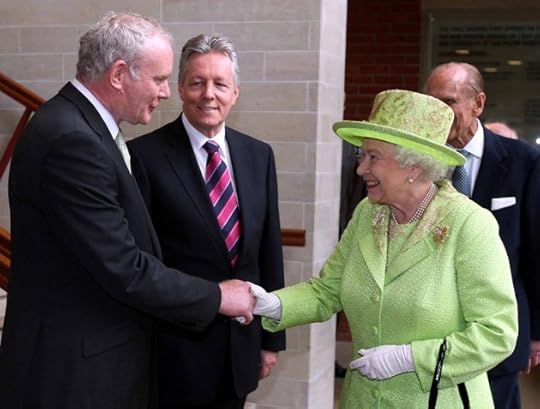
The man on the left would have killed the woman on the right at any time in the 1970s.
So this is remarkable. The Queen visited Northern Ireland and shook hands with Martin McGuinness today. And as you can see she gave him a great beaming smile. McGuinness was at the top of the leadership of the Provos (with Gerry Adams) when they assassinated Lord Mountbatten, who was the Queen's husband's uncle, in 1979. They thought they'd get a few more royals than they did, they were disappointed.
In 1973 Martin McGuinness was convicted by the no-jury Special Criminal Court, after being caught with a car containing 250 lb of explosives and nearly 5,000 rounds of ammunition. He got six months imprisonment.
Wiki says that in court, "he declared his membership of the Provisional Irish Republican Army without equivocation: 'We have fought against the killing of our people... I am a member of Óglaigh na hÉireann and very, very proud of it'.
Mountbatten was the last Viceroy of India and was a very big bigwig. On 27 August 1979 he was 79 and he was in his boat on the Irish coast along with a radio-controlled fifty-pound bomb. The perpetrators were never caught. Mountbatten was fatally wounded; his elder daughter's 14-year-old son, and a 15-year-old youth who was a crew member were also killed; another family member died from her injuries the following day. Others were seriously injured.
The provisional wing of the IRA issued a statement, saying:
The IRA claim responsibility for the execution of Lord Louis Mountbatten. This operation is one of the discriminate ways we can bring to the attention of the English people the continuing occupation of our country.
Gerry Adams said:
The IRA gave clear reasons for the execution. I think it is unfortunate that anyone has to be killed, but the furore created by Mountbatten's death showed up the hypocritical attitude of the media establishment. As a member of the House of Lords, Mountbatten was an emotional figure in both British and Irish politics. What the IRA did to him is what Mountbatten had been doing all his life to other people; and with his war record I don't think he could have objected to dying in what was clearly a war situation. He knew the danger involved in coming to this country. In my opinion, the IRA achieved its objective: people started paying attention to what was happening in Ireland.
Wiki reminds us also that on the day Mountbatten was assassinated the IRA ambushed and killed eighteen British Army soldiers at Warrenpoint, County Down.
For me this handshake is an emotional thing. You probably know I'm not any kind of royalist. But here's a woman shaking hands with a guy who would have killed her and her family if he had the chance only a few years ago. I think it's really quite wonderful. You really can beat swords into ploughshares sometimes.
One of the objectives I had when I sought a book about the Troubles was that it had to be as unbiased as possible, which is no small order given the nature of the conflict in Northern Ireland. Peter Taylor, a British journalist widely recognized as one of the best chroniclers of the sectarian violence that gripped the Six Counties and beyond, fits the bill. He takes an even-handed approach in his tireless research of the Troubles and his insider access to the clandestine groups involved is incredible. A very well-written journalistic work on a very difficult subject.
What a book. An in depth, unbiased historical book, which argues for all sides involved to deliver a great read. Beware this is a long slog (it was for me at least). At just shy of 400 pages but small font, at first glance I didn’t realise what I was setting myself up for. However, covering such monumental changes in the history of Ireland as an island, it is impossible to read this quickly. The task of the next two books (Loyalists and Brits- books on the same era from their prospective points of view) are ones I doubt I will commence reading soon, as I still feel somewhat overwhelmed. The awards abs accolades Taylor have revived for his coverage over the decades are clear from his writing.
Excellent, thorough, and even-handed. It probably goes without saying that this is a topic not to be half-heartedly examined, but Taylor does a really excellent job not only contextualizing the history behind the conflict but also maneuvering between the various splits, dissension, and espionage of the modern (at the time of writing) developments. An excellent read for Irish or international readers curious about the conflict in the north, that doesn't sugar coat anything.
I have finished reading “The Provos: The IRA and Sinn Fein” by Peter Taylor. “Our Struggle has reached a defining moment” Gerry Adams to the IRA Convention in 2005.
The split from the main (Official) Irish Republican Army (IRA) to form the Provisional IRA, known as the Provos, was sparked by the violent start of The Troubles. Nationalists, those in Northern Ireland who yearned for Irish unity, chose to protest in civil rights campaigns for their rights provoking Unionist/Loyalist reactions. Violence from the Northern Irish security forces and Loyalist militias provoked a debate within the Republican movement. The leadership of the IRA wanted to move away from armed struggle to far left political engagement. Those who became the Provisionals saw defenceless nationalists attacked in the street and agitated to have the IRA pursue it’s traditional role; using it’s arms in defence of it’s community. The divisions proved irreconcilable and the Provos were born, soon leaving the Officials to wither away.
The Provisional IRA’s fortunes and moral changed as the times did. The early deployment of British troops heralded a “wait and see” period that gave way to all out assault on the ‘occupiers’, with the first British soldier shot by the Provos in 1971. Bloody Sunday led to a propaganda bonanza for the group, leading them to believe they could conquer all before them. However, the group was less sure of itself during tactical truces and ceasefires. The mid-1970s truce led to an existential crisis within the Provos leading to a group of Young Turks in the Maze Prison in Cage 11 to plot a new course for the group. Most prominent among this group was Gerry Adams.
Gerry Adams is probably the most influential figure in the Provos history, regardless of how you feel about his methods (many are alleged). Alongside his paramilitary partner Martin McGuinness in Derry he helped lay the course for the Republican movement’s ‘Long War’ military doctrine as well as the “Armalite and Ballot Box” political doctrine. The latter very simply justified the re-entry of the Republican Movement into formal politics as a supportive structure to the armed struggle. Sinn Fein (ourselves alone), as the political wing of the Provos underwent a process of reforming and becoming the shop window of Irish Republicanism. However, it was not long until the armed campaign and the political campaigns could not coincide neatly beside each other. It is highly likely that this was the intention of those behind the “Armalite and Ballot Box” strategy all along.
It is easily forgotten how violent the 1990s were in terms of The Troubles. The Republican movement was already in two minds about being fully committed to the Peace Process. UK PM John Major, under pressure from the NI Unionists, applied pressure on their behalf leading to the 1994 ceasefire to collapse temporarily. Eventually the Republicans came back to the table. It is taken for granted nowadays how big an achievement the 1998 Good Friday Agreement was. There was drama right up until the end of the progress.
Overall, I enjoyed this book. Given the subject matter it is clearly written to allow it to be accessible to both those familiar to The Troubles and Irish Republicanism and newcomers. It was well considered in terms of structure and conveying the Irish Republican’s point of view. Their worldview needs to be seen in the context of Irish Republican folklore and first hand experiences of living in Northern Ireland as a state which has long been oppressive to them. Fortunately, that is now widely accepted to be no longer the case. The book did well to convey the drama in the negotiation room and the violence and strife outside during the Good Friday Agreement negotiations. It seemed at times that the ceasefires on both the Republican and Loyalist sides were hanging by a thread. The fact that they hung at all is testament to the fact that both sides knew that they staked too much on the Peace Process to let it fail. There also seemed to be a recognition on the Provisional IRA’s Army Council that militarily they were fought to a stalemate at best. In some ways it is frustrating that this book’s timeline only extends a little way beyond the Good Friday Agreement, but the reward was for the above focus. I would welcome a second edition of this book covering the period from this point and beyond the Provisional IRA’s decommissioning in 2005.
This entire review has been hidden because of spoilers.
It was the show Say Nothing on Hulu that kicked off my latest intense and short-lived obsession. Like most people, I’m guessing, I always had a fascination with the IRA followed by a headache each time I tried to understand who was who. The loyalists, the unionists, the republicans (not THOSE Republicans!), the Ulster Volunteer Force - kick-ass or on the “wrong side”? etc.…
This is a great book that helped even my muddled mind gain a little understanding about a conflict that had seemingly few wins and endless losses. It’s hard to imagine a quarter century street-to-street conflict like this taking place New York City or Detroit in the 1970s and 80s. But so it was and Taylor, who was there, captured perfectly the feeling of day to day existence in this battle without end. He also does a great job making clear exactly who was fighting for or defending what. The IRA, if nothing else, is inspiring due to its unshakable dedication to a cause rooted in freedom and willingness to endure all the tragedy man can inflict on man.
A great piece of informative journalism but was a little too dense for my liking. Being a non-humanities student I appreciate being constantly reminded of the wider context when reading History books and for me Taylor's 'Provos' failed to do this enough. I felt as if I was being bombarded with facts, figures and dates at times and struggled to see how it all fitted together. That being said I feel much more informed about a period of British history that continues to be relevant today.
An excellent history of the Provisional IRA and Sinn Fein. The author was a respected journalist with decades of experience reporting on Northern Ireland. He writes with a good degree of sympathy for the participants on all sides, including for some of those who carried out murders and bombings. I guess some people might find this a little hard to take. But as an objective history I think this will be hard to beat.
Very informative, unbiased, and educational. Definitely broadened my understanding of the troubles and the establishment of the provos and Sinn Fein.
I got the idea of reading this book from listening to Free State podcast hosted by Dion Fanning and Joe Brolly. The author appeared on the podcast speaking about his new book. Definitely worth a listen.
Excellent book which shows the connection and the pathways that both bodies made. The greatest unknown to me at the time was the connection between the two bodies and the strategies that they used to attempt to achieve their goals. This book answered some of those unknowns. Well waited and engaging book.
Great narrative form that's fact based. One point off only because the author's loyalist sympathies come out too often to destroy the otherwise factual retelling.
This book took me quite a while to get through, but it was definitely worth it! This looks at 'the troubles' in Northern Ireland, focusing especially on Sinn Féin and the IRA, although it does include interviews with other key players. This is the first book in a three book series by Peter Taylor, with the other two focusing on the unionists (and loyalists) and the British. Overall, I found this to be a really thoughtful and fairly objective account of the 'the troubles'. I did know a bit about the conflict before reading this book, although most of this knowledge came from documentaries I had watched on YouTube. This book did a good job of deepening my knowledge about the conflict and giving me a more general understanding of the situation. This book, of course, focuses on the republican and nationalist point of view and actions, so I am assuming even more can be learned from the other two books in the series. This wasn't an easy book to read, some of the events that took place during this time period were very hard to read about. I think it is an important book, perhaps for that very reason. I find that 'the troubles' can oftentimes be oversimplified in the media and this book does a great job of demystifying the situation.
An excellent introduction to the troubles for the layman
Irish history, like the history of any other nation, cannot be pigeon holed into neat black and white categories. It's complex, at times messy, and provides the scholar with no easy answers to why things happened as they did.
Impartial, near unbiased, and written with journalistic analysis, Taylor provides the reader with one of the best books I've read on the subject (and I've read many!)
The brevity of this review may infuriate some, but I prefer to let the pages speak for themselves. A long winded review from me indicates a particular problem with a book. The shorter the review, the better the book!
A thorough overview of the years of the Provos which is only occasionally gripping. A lot of the time it's a fairly dry recounting of events and leadership struggles within the IRA. It also does not provide that much insight into Sinn Fein past or present.
Most interesting is reading about the high profile assassinations and the massive London bombings. It's hard to imagine that this level of warfare was common on the islands if you were born in the eighties like myself.
I came to this book knowing very little about the IRA and the Irish independence movement. It's a great introduction and is as fast-paced and enthralling as any novel. I really enjoyed the interviews and quotes throughout; it was great to hear the stories told from folks who experienced it.