

What do you think?

For Art and for Life
Few artists' letters are as self-revelatory as Vincent van Gogh's. From the humanistic inspiration behind The Potato Eaters to his long-time obsession with painting the vision that eventually became The Starry Night, the letters in this selection paint an intense personal narrative of his artistic development and creative process across the years. They reveal a man of great spiritual and emotional depths who – in his own words – did everything ‘for art and for life itself’.
176 pages, Paperback
Published April 11, 2025
About the author
Vincent van Gogh
713 books2,414 followersVincent Willem van Gogh (30 March 1853 – 29 July 1890) was a Dutch Post-Impressionist painter who is among the most famous and influential figures in the history of Western art.
Van Gogh, for whom color was the chief symbol of expression, was born in Groot-Zundert, Holland. The son of a pastor, brought up in a religious and cultured atmosphere, Vincent was highly emotional and lacked self-confidence.
Between 1860 and 1880, when he finally decided to become an artist, van Gogh had had two unsuitable and unhappy romances and had worked unsuccessfully as a clerk in a bookstore, an art salesman, and a preacher in the Borinage (a dreary mining district in Belgium), where he was dismissed for overzealousness. He remained in Belgium to study art, determined to give happiness by creating beauty. The works of his early Dutch period are somber-toned, sharply lit, genre paintings of which the most famous is "The Potato Eaters" (1885). In that year van Gogh went to Antwerp where he discovered the works of Rubens and purchased many Japanese prints.
In 1886 he went to Paris to join his brother Théo, the manager of Goupil's gallery. In Paris, van Gogh studied with Cormon, inevitably met Pissarro, Monet, and Gauguin, and began to lighten his very dark palette and to paint in the short brushstrokes of the Impressionists. His nervous temperament made him a difficult companion and night-long discussions combined with painting all day undermined his health. He decided to go south to Arles where he hoped his friends would join him and help found a school of art. Gauguin did join him but with disastrous results. In a fit of epilepsy, van Gogh pursued his friend with an open razor, was stopped by Gauguin, but ended up cutting a portion of his ear lobe off. Van Gogh then began to alternate between fits of madness and lucidity and was sent to the asylum in Saint-Remy for treatment.
In May of 1890, he seemed much better and went to live in Auvers-sur-Oise under the watchful eye of Dr. Gachet. Two months later he was dead, having shot himself "for the good of all." During his brief career he had sold one painting. Van Gogh's finest works were produced in less than three years in a technique that grew more and more impassioned in brushstroke, in symbolic and intense color, in surface tension, and in the movement and vibration of form and line. Van Gogh's inimitable fusion of form and content is powerful; dramatic, lyrically rhythmic, imaginative, and emotional, for the artist was completely absorbed in the effort to explain either his struggle against madness or his comprehension of the spiritual essence of man and nature.
Van Gogh, for whom color was the chief symbol of expression, was born in Groot-Zundert, Holland. The son of a pastor, brought up in a religious and cultured atmosphere, Vincent was highly emotional and lacked self-confidence.
Between 1860 and 1880, when he finally decided to become an artist, van Gogh had had two unsuitable and unhappy romances and had worked unsuccessfully as a clerk in a bookstore, an art salesman, and a preacher in the Borinage (a dreary mining district in Belgium), where he was dismissed for overzealousness. He remained in Belgium to study art, determined to give happiness by creating beauty. The works of his early Dutch period are somber-toned, sharply lit, genre paintings of which the most famous is "The Potato Eaters" (1885). In that year van Gogh went to Antwerp where he discovered the works of Rubens and purchased many Japanese prints.
In 1886 he went to Paris to join his brother Théo, the manager of Goupil's gallery. In Paris, van Gogh studied with Cormon, inevitably met Pissarro, Monet, and Gauguin, and began to lighten his very dark palette and to paint in the short brushstrokes of the Impressionists. His nervous temperament made him a difficult companion and night-long discussions combined with painting all day undermined his health. He decided to go south to Arles where he hoped his friends would join him and help found a school of art. Gauguin did join him but with disastrous results. In a fit of epilepsy, van Gogh pursued his friend with an open razor, was stopped by Gauguin, but ended up cutting a portion of his ear lobe off. Van Gogh then began to alternate between fits of madness and lucidity and was sent to the asylum in Saint-Remy for treatment.
In May of 1890, he seemed much better and went to live in Auvers-sur-Oise under the watchful eye of Dr. Gachet. Two months later he was dead, having shot himself "for the good of all." During his brief career he had sold one painting. Van Gogh's finest works were produced in less than three years in a technique that grew more and more impassioned in brushstroke, in symbolic and intense color, in surface tension, and in the movement and vibration of form and line. Van Gogh's inimitable fusion of form and content is powerful; dramatic, lyrically rhythmic, imaginative, and emotional, for the artist was completely absorbed in the effort to explain either his struggle against madness or his comprehension of the spiritual essence of man and nature.
Ratings & Reviews
Friends & Following
Create a free account to discover what your friends think of this book!
Community Reviews
Displaying 1 - 30 of 52 reviews
June 24, 2025
so damn lovely! a selection of letters from Vincent to mainly his brother Theo but also others. found some of the quotes pulled by a major museum who was a client of mine a few years ago when they reached out for prints supporting the first exhibition of his Olive Trees series ever in the states, & loved seeing them in context of the full letters!!
there is also a detailed biographical outline & the letters are separated into three parts (Becoming an Artist, The Best Days, & Towards the End) with focuses on where van Gogh wrote them… originally selected by Ronald de Leeuw. a bit disappointing that translators are not named anywhere, only a translation copyright of Sdu Publishers (1997) — cannot recommend this enough! to all! (& these Penguin Archive books are truly so very beautiful as objects too!)
I want to pull so many quotes from this & put them here for my own reference, but also don’t want to feed the ai machines (even if my gr profile is private at the moment), so here is only a couple (& did I mention you should pickup this little book‽:)
*
Well, even in these depths of misery I felt my energy revive & said to myself, I shall get over it somehow, I shall set to work again with my pencil, which I had cast aside in my deep dejection, & I shall draw again, & ever since I have had the feeling that everything has changed for me, & now I am in my stride & my pencil has become slightly more willing & seems to be getting more so by the day. My over-long & over-intense misery had discouraged me so much that I was unable to do anything. (7)
*
What am I in the eyes of most people—a nonentity, an eccentric, or an unpleasant person—somebody who has no position in society and never will have, in short, the lowest of the low.
All right, then—even if that were absolutely true, then I should one day like to show by my work what such an eccentric, such a nobody, has in his heart.
That is my ambition, based less on resentment than on love malgré tout*, based more on a feeling of serenity than on passion.
Though I am often in the depths of misery, there is still calmness, pure harmony and music inside me. I see paintings or drawings in the poorest cottages, in the dirtiest corners. And my mind is driven towards these things with an irresistible momentum. (20) * in spite of everything
*
Painting and fucking a lot don't go together, it softens the brain. Which is a bloody nuisance.
The symbol of St Luke, the patron saint of painters, is, as you know, an ox. So you just be patient as an ox if you want to work in the artistic field. Still, bulls are lucky not to have to work at that foul business of painting.
But what I wanted to say is this: after the period of melancholy is over you will be stronger than before, you will recover your health, and you will find the scenery round you so beautiful that you will want to do nothing but paint. (69)
there is also a detailed biographical outline & the letters are separated into three parts (Becoming an Artist, The Best Days, & Towards the End) with focuses on where van Gogh wrote them… originally selected by Ronald de Leeuw. a bit disappointing that translators are not named anywhere, only a translation copyright of Sdu Publishers (1997) — cannot recommend this enough! to all! (& these Penguin Archive books are truly so very beautiful as objects too!)
I want to pull so many quotes from this & put them here for my own reference, but also don’t want to feed the ai machines (even if my gr profile is private at the moment), so here is only a couple (& did I mention you should pickup this little book‽:)
*
Well, even in these depths of misery I felt my energy revive & said to myself, I shall get over it somehow, I shall set to work again with my pencil, which I had cast aside in my deep dejection, & I shall draw again, & ever since I have had the feeling that everything has changed for me, & now I am in my stride & my pencil has become slightly more willing & seems to be getting more so by the day. My over-long & over-intense misery had discouraged me so much that I was unable to do anything. (7)
*
What am I in the eyes of most people—a nonentity, an eccentric, or an unpleasant person—somebody who has no position in society and never will have, in short, the lowest of the low.
All right, then—even if that were absolutely true, then I should one day like to show by my work what such an eccentric, such a nobody, has in his heart.
That is my ambition, based less on resentment than on love malgré tout*, based more on a feeling of serenity than on passion.
Though I am often in the depths of misery, there is still calmness, pure harmony and music inside me. I see paintings or drawings in the poorest cottages, in the dirtiest corners. And my mind is driven towards these things with an irresistible momentum. (20) * in spite of everything
*
Painting and fucking a lot don't go together, it softens the brain. Which is a bloody nuisance.
The symbol of St Luke, the patron saint of painters, is, as you know, an ox. So you just be patient as an ox if you want to work in the artistic field. Still, bulls are lucky not to have to work at that foul business of painting.
But what I wanted to say is this: after the period of melancholy is over you will be stronger than before, you will recover your health, and you will find the scenery round you so beautiful that you will want to do nothing but paint. (69)
August 18, 2025
“Though I am often in the depths of misery, there’s a still calmness, pure harmony and music inside me. I see paintings or drawings in the poorest cottages, in the dirtiest corners. And my mind is driven toward these things with an irresistible momentum.” - Van Gogh

June 14, 2025
I knew it was going to break my heart yet I read it anyway, now I’ve turned the last page and I’m sitting here with the shattered pieces in my hands.
You can see the shift in his character in his own writing from youthful, hopeful and determined, to confident in himself and his creativity, to timid and wracked with anxiety until the end. I took so much wisdom from everything that he said and did, whilst remembering that he was just experiencing life for the first time too.
I wish he could have known that his artistic abilities flowed not only through his paintbrush but also through his voice and his pen.
You can see the shift in his character in his own writing from youthful, hopeful and determined, to confident in himself and his creativity, to timid and wracked with anxiety until the end. I took so much wisdom from everything that he said and did, whilst remembering that he was just experiencing life for the first time too.
I wish he could have known that his artistic abilities flowed not only through his paintbrush but also through his voice and his pen.
June 20, 2025
Covering the point from which he decided he wanted to be an artist to his final letter, these letters, mostly to his brother Theo, are revealing, inspiring, and profoundly moving
August 18, 2026
this was so thought provoking, so interesting and inspiring to see a little into his mind. makes you really feel for him, and his pictures as he calls them! although his end was very sad, i think he is also a very inspiring person and i honestly will cherish this little book of letters
June 16, 2025
oh, vincent... tak by som ťa objala...
July 21, 2026
(Still processing)
August 6, 2025
Absolutely magical.
It is so clear how deeply artistry and creativity were ingrained within Van Gogh. His writing, even these private day to day letters, is stunning in my opinion. Having the chance to briefly view the world through his eyes was incredible.
Vincent Van Gogh mindset showed that of a passionately dedicated artist. He took the time to practice and really study his craft, which if it wasn’t already abundantly clear from his artwork, is now repeatedly shown through his writing. It is no surprise that his paintings have lasted throughout history when you learn that he lived and breathed creativity. While reading, I occasionally would look at the paintings he was talking about in some passages. It was intriguing to get an added sense of what was going through Van Gogh’s mind and what is intentions were for the paintings. This served really well to create another layer to his work.
Van Gogh was clearly an extremely knowledgeable man, who put incredible thought into not just his own work but also the broader world around him, and work by the impressionists at large. His letters showed me how intertwined the impressionist artists were in reality. They were not just a group that were posthumously grouped together by academics.
I found this short collection a bit difficult to critique in the same way I would a normal novel. Given that these letters weren’t really intended for a public audience it feels wrong to try and search for pitfalls in some greater message. While it took me some time to really sink into the letters at the beginning, that again probably lies in the fact that they weren’t written with the intention to entertain the masses. The editor who compiled the letters also did a good job. Each grouping of letters accurately reflecting the mood of each section of the collection.
I would absolutely recommend this book. It’s a touching insight into sibling relationship, and a man who viewed the world as art itself.
It is so clear how deeply artistry and creativity were ingrained within Van Gogh. His writing, even these private day to day letters, is stunning in my opinion. Having the chance to briefly view the world through his eyes was incredible.
Vincent Van Gogh mindset showed that of a passionately dedicated artist. He took the time to practice and really study his craft, which if it wasn’t already abundantly clear from his artwork, is now repeatedly shown through his writing. It is no surprise that his paintings have lasted throughout history when you learn that he lived and breathed creativity. While reading, I occasionally would look at the paintings he was talking about in some passages. It was intriguing to get an added sense of what was going through Van Gogh’s mind and what is intentions were for the paintings. This served really well to create another layer to his work.
Van Gogh was clearly an extremely knowledgeable man, who put incredible thought into not just his own work but also the broader world around him, and work by the impressionists at large. His letters showed me how intertwined the impressionist artists were in reality. They were not just a group that were posthumously grouped together by academics.
I found this short collection a bit difficult to critique in the same way I would a normal novel. Given that these letters weren’t really intended for a public audience it feels wrong to try and search for pitfalls in some greater message. While it took me some time to really sink into the letters at the beginning, that again probably lies in the fact that they weren’t written with the intention to entertain the masses. The editor who compiled the letters also did a good job. Each grouping of letters accurately reflecting the mood of each section of the collection.
I would absolutely recommend this book. It’s a touching insight into sibling relationship, and a man who viewed the world as art itself.
August 11, 2025
So profoundly moving and inspiring are these letters by Van Gogh. Absolutely devastating that he died penniless, mentally unwell, and without knowing he would become the most recognised and popular painter in history.
There were so many things that he wrote in these letters that are worthy of quoting, but I think this struck me the most:
“The world concerns me only in so far as I owe it a certain debt and duty, so to speak, because I have walked this earth for 30 years, and out of gratitude would like to leave some memento in the form of drawings and paintings — not made to please this school or that, but to express a genuine human feeling.
So that work is my aim — and when one concentrates on this idea, everything one does is simplified, in that it is not muddled but has a single objective.”
Despite the lack of success, despite the poverty, despite the depression and the illness, despite it all… the dude just kept painting. Genuinely awe-struck at the sheer force of will of the man, in the face of such suffering.
I think I’ll pop one last quote here, not from the book but from an episode of Dr Who, believe it or not! When the Doctor asks Bill Nighy’s character, an art curator, where he thinks Van Gogh rates in the history of art:
“Big question, but, to me Van Gogh is the finest painter of them all. Certainly the most popular, great painter of all time. The most beloved, his command of colour the most magnificent. He transformed the pain of his tormented life into ecstatic beauty. Pain is easy to portray, but to use your passion and pain to portray the ecstasy and joy and magnificence of our world, no one had ever done it before. Perhaps no one ever will again. To my mind, that strange, wild man who roamed the fields of Provence was not only the world's greatest artist, but also one of the greatest men who ever lived.”
If you’ve not seen the clip on YouTube it’s on BBC’s channel. I’d highly recommend it. Makes me tear up every time.
There were so many things that he wrote in these letters that are worthy of quoting, but I think this struck me the most:
“The world concerns me only in so far as I owe it a certain debt and duty, so to speak, because I have walked this earth for 30 years, and out of gratitude would like to leave some memento in the form of drawings and paintings — not made to please this school or that, but to express a genuine human feeling.
So that work is my aim — and when one concentrates on this idea, everything one does is simplified, in that it is not muddled but has a single objective.”
Despite the lack of success, despite the poverty, despite the depression and the illness, despite it all… the dude just kept painting. Genuinely awe-struck at the sheer force of will of the man, in the face of such suffering.
I think I’ll pop one last quote here, not from the book but from an episode of Dr Who, believe it or not! When the Doctor asks Bill Nighy’s character, an art curator, where he thinks Van Gogh rates in the history of art:
“Big question, but, to me Van Gogh is the finest painter of them all. Certainly the most popular, great painter of all time. The most beloved, his command of colour the most magnificent. He transformed the pain of his tormented life into ecstatic beauty. Pain is easy to portray, but to use your passion and pain to portray the ecstasy and joy and magnificence of our world, no one had ever done it before. Perhaps no one ever will again. To my mind, that strange, wild man who roamed the fields of Provence was not only the world's greatest artist, but also one of the greatest men who ever lived.”
If you’ve not seen the clip on YouTube it’s on BBC’s channel. I’d highly recommend it. Makes me tear up every time.

January 21, 2026
Van Gogh is a talented writer — in his letters he is communicating the process and necessity of art better than any ‘art book’. I think it helps immensely that these are genuine letters to fellow artists or loved ones and thus lack the intrinsic pretension and performance of writing for publication. This is writing-about-painting done by a painter, not a writer, and is much the better for it.
His way of seeing the world translates on paper to pure poetry — everything is colour and everything is beautiful.
It’s impossible to really see what he sees, but equally impossible to avoid glimpses it through his descriptions.
Loved it. Surprised to have loved it so much, too!
Beautiful reflections on life and the depths of feelings, and surprisingly, inspiringly, optimistic and determined to live and celebrate life.
“A warm handshake. What days these are, not because of what is happening, but because I feel so strongly that you and I are not in decline, nor done for yet, nor are we going to be. […]
With a handshake, and for now,
Ever yours,
Vincent”
P.95
“The inevitability of suffering and despair – well, here I am, bucked up again for a time – and I thank him for it.”
P.131
“Well, here I am, at it again. But I won’t give in, and shall try once more on a new canvas., I could almost believe that I have a new spell of lucidity before me.”
P.132
His way of seeing the world translates on paper to pure poetry — everything is colour and everything is beautiful.
It’s impossible to really see what he sees, but equally impossible to avoid glimpses it through his descriptions.
Loved it. Surprised to have loved it so much, too!
Beautiful reflections on life and the depths of feelings, and surprisingly, inspiringly, optimistic and determined to live and celebrate life.
“A warm handshake. What days these are, not because of what is happening, but because I feel so strongly that you and I are not in decline, nor done for yet, nor are we going to be. […]
With a handshake, and for now,
Ever yours,
Vincent”
P.95
“The inevitability of suffering and despair – well, here I am, bucked up again for a time – and I thank him for it.”
P.131
“Well, here I am, at it again. But I won’t give in, and shall try once more on a new canvas., I could almost believe that I have a new spell of lucidity before me.”
P.132

September 16, 2025
reading van gogh’s letters gave me a window into his intense dedication to art – how much he sacrificed emotionally, financially & socially to pursue something he felt deeply called to. 🖌️✨
the letters show how closely he observed the world: nature, light, people, and beauty in everyday things. theres something both admirable and tragic in how fully he gave himself to painting, often at the cost of personal stability.
what stood out most was how much he thought, felt and wrestled with meaning – not just in art, but in life. his passion, his anxieties, his loneliness & his ideals are all laid bare. its not always an easy or consistently gripping read but its very human and real.
⭐️⭐️⭐️/5 as i thought it would be more complete if they feature the drawings as well. so !!!! would recommend a good companion to this which would be the drawings of vincent van gogh by christopher lloyd – seeing his visual development adds a powerful layer to what he describes in the letters. together, they offer a fuller picture of van gogh who saw the world in a way that still resonates.
in the end, its a quiet reminder of how deeply art can be tied to the human soul – not as a product, but as a way of seeing, feeling & existing in the world. even in his struggle, van gogh found meaning in beauty and theres something incredibly moving about that. 💫
the letters show how closely he observed the world: nature, light, people, and beauty in everyday things. theres something both admirable and tragic in how fully he gave himself to painting, often at the cost of personal stability.
what stood out most was how much he thought, felt and wrestled with meaning – not just in art, but in life. his passion, his anxieties, his loneliness & his ideals are all laid bare. its not always an easy or consistently gripping read but its very human and real.
⭐️⭐️⭐️/5 as i thought it would be more complete if they feature the drawings as well. so !!!! would recommend a good companion to this which would be the drawings of vincent van gogh by christopher lloyd – seeing his visual development adds a powerful layer to what he describes in the letters. together, they offer a fuller picture of van gogh who saw the world in a way that still resonates.
in the end, its a quiet reminder of how deeply art can be tied to the human soul – not as a product, but as a way of seeing, feeling & existing in the world. even in his struggle, van gogh found meaning in beauty and theres something incredibly moving about that. 💫

July 13, 2026
wow I really really enjoyed van Gogh's letter. He was definitely not only gifted with a brush, but also with words.
It is honestly inspiring to read him talk about art; he lived and breathed for it, was basically obsessed. He painted and painted despite thinking so little of his own work. Reading his letters just feel so tragic, because you feel his passion for creating works of art and nature especially but you also know how his life ends and you get an insight into how plagued by illness he really was. Still, despite everything, he kept on painting.
I will definitely have to read a longer collection of his letters someday, they're just an amazing read I love them so much! My heart hurts for him :(
It is honestly inspiring to read him talk about art; he lived and breathed for it, was basically obsessed. He painted and painted despite thinking so little of his own work. Reading his letters just feel so tragic, because you feel his passion for creating works of art and nature especially but you also know how his life ends and you get an insight into how plagued by illness he really was. Still, despite everything, he kept on painting.
I will definitely have to read a longer collection of his letters someday, they're just an amazing read I love them so much! My heart hurts for him :(

October 31, 2025
How can I rate the letters of a man who went through so much suffering, but still was in love with all the beauty in the world? Somebody, who pushed on through his pain to create?
I was truly moved by this book, and it made me realize that I need to know more about van Gogh.
"This is how I regard myself, as having to accomplish in a few years something full of heart and love, and to do it with a will."
I was truly moved by this book, and it made me realize that I need to know more about van Gogh.
"This is how I regard myself, as having to accomplish in a few years something full of heart and love, and to do it with a will."

December 10, 2025
I think I have cried over van Gogh so many times at this point. On a recent trip to Paris I saw some of his paintings at Musee D'Orsay, and then had to buy this in the gift shop. I read this mostly on the plane right home, and the last few letters were devastating. He was so human and tortured and such an artist. I think my favorite bits were the way he talks about art and his passion, and the begging his brother for my art supplies. Lovely and tragic.
November 29, 2025
ily Vincent 😢☹️☹️☹️
March 13, 2026
"... Which isn't any good, as our way lies - forwards - and retracing our steps is both impossible and impermissible. In other words one can think about the past without being swamped by an over-melancholic nostalgia."
Read
March 20, 2026“…and what touches us as human beings more directly and personally than meadows and clouds.”
van gogh will forever have a special place in my heart
van gogh will forever have a special place in my heart
March 5, 2026
Beautifully written letters, very touching insights
June 23, 2026
As beautiful as his paintings, the deep emotional, artistic and philosophical depths carries through these letters with such beautiful style and use of the pen. He was able to consciously touch on the key pillars of life and struggle that we all go through - and at times arriving at this consciousness through accident (patience, openness, criticisms etc.,).
An arguement he made that struck me most was that everybody must have principles. These principles are only good however if they lead to action, thus strengthening and objectifying these principles. An unconscious dialectician.
It was also incredible to see his praise of Zola and Zola's influence over his early painters, including my personal favourite of the potato eaters.
As a side note, I would not recommended using this particular (white) edition in a heat wave for it does not stand up to the elements very well.
An arguement he made that struck me most was that everybody must have principles. These principles are only good however if they lead to action, thus strengthening and objectifying these principles. An unconscious dialectician.
It was also incredible to see his praise of Zola and Zola's influence over his early painters, including my personal favourite of the potato eaters.
As a side note, I would not recommended using this particular (white) edition in a heat wave for it does not stand up to the elements very well.
April 19, 2026
Dear little thing!
June 12, 2026
"I cannot help it that my pictures do not sell.
The day will come, however, when people will see they are worth more than the price of the paint and my living expenses, very meagre on the whole, which we put into them."
"I should one day like to show by my work what such an eccentric, such a nobody, has in his heart."
The day will come, however, when people will see they are worth more than the price of the paint and my living expenses, very meagre on the whole, which we put into them."
"I should one day like to show by my work what such an eccentric, such a nobody, has in his heart."
June 25, 2025
An intensely beautiful and passionate man, living through a cruel struggle. Theo’s kindness seemed to be the best medicine.
November 30, 2025
Until reading this collection, I had never fully appreciated how well-rounded Van Gogh was. His writing moves you as you read it, where a simple letter begging for money can be complemented with adroit turns of phrase ('poverty is a small beginning') to surprising metaphors, where ideas are likened to sheep: if you can get one to cross over, the rest will follow. He read voraciously, and his generosity of spirit, his unabashed praise of other artists, something which runs through the book, finds voice in the first letter as he praises both Shakespeare and Dickens. In fact, he even chastises the writer of an article that lauds him because he feels the writer didn't take enough time to talk about his influences. Without Paul Gauguin, Vincent believes, his painting would be second-rate.
As a side note, the evolution of their friendship is heartbreaking, from Vincent's excitement at Gauguin's arrival in Arles, where he was obsessively decorating the house and guest bedroom, to Gauguin's increasingly dry letters in the years after the ear incident.
This lust for life cannot be contained, and it expresses itself in a multitude of ways. He walked 80 km to Courrières, and it is here that his sadness and dispirited disposition are very relatable - after suffering cold, hunger, rain, and after sleeping in haystacks, most people would feel miserable. Yet, he finds beauty in the rugged denizens of this mining town, acknowledging that not many would see the goodness and nobility in their humble lives. And his great sense of mission and drive is always active as he commits the workers to sketches and memory, preparing for future canvases.
This celebration of the humble speaks to two of his impulses: a socialist one that finds form in later hopes for a collective of artists, where the greats like Monet would allow their great fees to trickle down the painting pyramid; and his celebration of authenticity, as he opines that a peasant girl is already more honest and lovely that a wealthy woman, and that even if the former dressed as the latter, it wouldn't suit her natural state.
The letters twin the prosaic with the magical. After a handful of lines complaining about his living conditions, he will explain that artists should not copy the masters but instead find new ideas.
When he visits a cafe for artists, he is unimpressed by the murals inside.
Vincent is like a proto-travel writer as he describes sailors escaping brothels in Belgium, a girl smiling like a hyena on a beach, and people ravaged by smallpox. He is a man of firm opinions. Paired with that was the painful realisation that most people saw him as a misfit, but he hoped his art would touch people and make him integrated in society.
He had a keen sense that he had four or five good years of painting ahead of him, before his body gave in. (His strange beliefs about 'good' and 'bad' blood make for curious reading in these passages.) He subsisted on biscuits so he could pay models, and he ignored the possibility of love as he felt his passion had to be completely focused on art. What is more, he felt the world could be so beautiful, that he owed it something in return, a great painting or two. Manifesting this wish was not always easy, with inspiration drying up and tiredness afflicting him. To solve these problems, he either waited for the malaise to pass or alternated between figure and landscape painting to keep things fresh.
He was obviously close to his brother, Theo, and the relationship is quite tender. One Sunday, he writes about taking a break from painting and feeling far from his brother, when, by chance, a letter from Theo arrived to him, and the beautiful part was that the letter contained descriptions of things Vincent had dreamt about, so in that moment, he felt doubly connected to his brother. Later in the collection, we see his genuine happiness for Theo's marriage and son's birth, and Theo's wife, Jo, even writes to Vincent after the two brothers had fallen out over money, explaining that he was not to worry, Theo really did understand that, Vincent was making a huge effort to work and make money.
There are bittersweet throughlines throughout the collection.
On one hand, he drops classic painting into letters, these little pearls that are fun for the reader. His comments on his ultimate dream of painting Starry, Starry Night, and he wonders whether the painting is better left in his mind's eye, where it is already perfect. The Night Cafe, we are told, is done in such a way that it makes you feel drunk when looking at it, and open to the possibility of anything occurring. The Potato Eaters should be, he advises Theo, framed in gold to offset the earthy tones of the scene.
On the other hand, sparse editor notes bluntly intercede into a collection. After two seemingly normal letters, we learn that Vincent has cut off his ear and, two years later, has shot himself in the chest. We know it would end like this, yet finishing this book fills you with a sense of tragedy and pain for Vincent.
This is why he endures - his painting prowess and his humanity. And this is why this book is essential reading. It is short, but it packs a punch to all your senses.
As a side note, the evolution of their friendship is heartbreaking, from Vincent's excitement at Gauguin's arrival in Arles, where he was obsessively decorating the house and guest bedroom, to Gauguin's increasingly dry letters in the years after the ear incident.
This lust for life cannot be contained, and it expresses itself in a multitude of ways. He walked 80 km to Courrières, and it is here that his sadness and dispirited disposition are very relatable - after suffering cold, hunger, rain, and after sleeping in haystacks, most people would feel miserable. Yet, he finds beauty in the rugged denizens of this mining town, acknowledging that not many would see the goodness and nobility in their humble lives. And his great sense of mission and drive is always active as he commits the workers to sketches and memory, preparing for future canvases.
This celebration of the humble speaks to two of his impulses: a socialist one that finds form in later hopes for a collective of artists, where the greats like Monet would allow their great fees to trickle down the painting pyramid; and his celebration of authenticity, as he opines that a peasant girl is already more honest and lovely that a wealthy woman, and that even if the former dressed as the latter, it wouldn't suit her natural state.
The letters twin the prosaic with the magical. After a handful of lines complaining about his living conditions, he will explain that artists should not copy the masters but instead find new ideas.
When he visits a cafe for artists, he is unimpressed by the murals inside.
Vincent is like a proto-travel writer as he describes sailors escaping brothels in Belgium, a girl smiling like a hyena on a beach, and people ravaged by smallpox. He is a man of firm opinions. Paired with that was the painful realisation that most people saw him as a misfit, but he hoped his art would touch people and make him integrated in society.
He had a keen sense that he had four or five good years of painting ahead of him, before his body gave in. (His strange beliefs about 'good' and 'bad' blood make for curious reading in these passages.) He subsisted on biscuits so he could pay models, and he ignored the possibility of love as he felt his passion had to be completely focused on art. What is more, he felt the world could be so beautiful, that he owed it something in return, a great painting or two. Manifesting this wish was not always easy, with inspiration drying up and tiredness afflicting him. To solve these problems, he either waited for the malaise to pass or alternated between figure and landscape painting to keep things fresh.
He was obviously close to his brother, Theo, and the relationship is quite tender. One Sunday, he writes about taking a break from painting and feeling far from his brother, when, by chance, a letter from Theo arrived to him, and the beautiful part was that the letter contained descriptions of things Vincent had dreamt about, so in that moment, he felt doubly connected to his brother. Later in the collection, we see his genuine happiness for Theo's marriage and son's birth, and Theo's wife, Jo, even writes to Vincent after the two brothers had fallen out over money, explaining that he was not to worry, Theo really did understand that, Vincent was making a huge effort to work and make money.
There are bittersweet throughlines throughout the collection.
On one hand, he drops classic painting into letters, these little pearls that are fun for the reader. His comments on his ultimate dream of painting Starry, Starry Night, and he wonders whether the painting is better left in his mind's eye, where it is already perfect. The Night Cafe, we are told, is done in such a way that it makes you feel drunk when looking at it, and open to the possibility of anything occurring. The Potato Eaters should be, he advises Theo, framed in gold to offset the earthy tones of the scene.
On the other hand, sparse editor notes bluntly intercede into a collection. After two seemingly normal letters, we learn that Vincent has cut off his ear and, two years later, has shot himself in the chest. We know it would end like this, yet finishing this book fills you with a sense of tragedy and pain for Vincent.
This is why he endures - his painting prowess and his humanity. And this is why this book is essential reading. It is short, but it packs a punch to all your senses.

March 26, 2026
So my sister borrowed me her book comprised of Vincent Van Gogh's letters to his brother Theo (among others, but mainly to him). I know I'll be sad, but this is just profound level of sad. In his letters, Vincent politely, and humbly asked money for painting materials to his younger brother. He's ashamed that he couldn't sell but resolute to paint as much as he can while he's alive (he assume he wouldn't live longer than 10 years from that time, or over 40) so there's nothing to fuss about, keep on working to leave a legacy in this world 🥲 once there was a writer who admired his use of color, and he humbly asked other painters to also be referred 🥲 he wanted to build a studio for young poor painters (like him) so they don't have to worry much about money, but he fought with Gauguin and had one of his mental breakdown. Things proceed to be somber and sad afterwards although he still painted some of his masterpieces. Do you know that the Reaper is about death? But death in vivid golden color? 😭 Vincent wrote a final letter, very pragmatic, asking for paint colors etc etc, before died 5 days later due to self inflicted wound in the arms of his brother Theo. Theo also died not long after out of syphilis and then I thought, who then brought his paintings to the world? It's actually Theo's wife of 2 years Jo, who is empathetic to Vincent and Theo's dream of having his brother's paintings sold, who worked afterwards to make sure Vincent work is known. Until it came to us.
Sometimes i feel it's so unfair how Vincent didn't get recognized compared to Pollock for example (whom i didn't like). But that's just part of Vincent's lore and tragedy I guess. I wish he'd knew people built museum just for him, people queue to see and get pictures of starry night, and he kept on inspiring till today. Rest in peace, Vincent. If you're in heaven, I wish for you to spent eternity leisurely walk around Nuenen, with unlimited paint for whichever you choose.
Sometimes i feel it's so unfair how Vincent didn't get recognized compared to Pollock for example (whom i didn't like). But that's just part of Vincent's lore and tragedy I guess. I wish he'd knew people built museum just for him, people queue to see and get pictures of starry night, and he kept on inspiring till today. Rest in peace, Vincent. If you're in heaven, I wish for you to spent eternity leisurely walk around Nuenen, with unlimited paint for whichever you choose.

November 17, 2025
“Now, hope is vaguely beckoning on the horizon again, that flickering hope which used sometimes to console my solitary life. I should so much like to imbue you with a large share of my faith that we shall succeed in starting something that will endure.” I’ve read a collection of Vincent van Gogh’s letters before, but For Art and for Life offers up a different and more potent distillation of them, one that rings with the artist’s prescience about his own life and work, as well as his gift for language, to render the aesthetic, the visual world around him, into words. “The walls are pale violet. The floor - is red tiles. The wood of the bed and the chairs is the yellow of fresh butter, the sheet and the pillows very light lime green. The blanket scarlet. The window green. The washstand orange, the basin blue. The doors lilac. And that’s all - nothing of any consequence in this shuttered room. The sturdy lines of the furniture should also express undisturbed rest.” Reading his letters I am always struck less by the pain than by the resolute hopefulness that thrums through his correspondence with his brother, a hopefulness that kept him alive and working for as long as it could. Like many, I’m sure, van Gogh was the first artist to make me think that maybe visual art was something I was interested in, something that meant something even to my word-oriented brain. “I cannot help it that my pictures do not sell. The day will come, however, when people will see they are worth more than the price of the paint and my living expenses, very meagre on the whole, which we put into them.” I’m glad he was at least proved right in the end. Thanks again to Maria and Penguin for another Penguin Archive book!
August 8, 2025
Reading Van Gogh’s letters to Theo (his brother) has been such a good way to understand who he was, how he grew as an artist, how he was broke, their relationship, how he admired life, nature, light… and how he kind of regretted, at the end of his life, choosing giving ALL for his art over maybe having a family, or over some more health/mental stability.
I looooved seeing how passionate he was about art, what was influencing the way he would do things, other artists and how he shared with his brother everything he admired, expositions he knew about and so. How can all these people know each other at that time where you wouldn’t travel that much or text or whatever? it’s not even the 1900s, but they knew what was going on!
I think reading his letters has been better than reading a biography, you can see him more, I guess. It’s not that it’s interesting all the time, but you see his life, thoughts, worries, happiness, sadness and passions.
I’ve been thinking about this quote for weeks: “The feeling for things themselves, for reality, is of greater importance than the feeling for painting; anyway it is more productive and more inspiring.”
I looooved seeing how passionate he was about art, what was influencing the way he would do things, other artists and how he shared with his brother everything he admired, expositions he knew about and so. How can all these people know each other at that time where you wouldn’t travel that much or text or whatever? it’s not even the 1900s, but they knew what was going on!
I think reading his letters has been better than reading a biography, you can see him more, I guess. It’s not that it’s interesting all the time, but you see his life, thoughts, worries, happiness, sadness and passions.
I’ve been thinking about this quote for weeks: “The feeling for things themselves, for reality, is of greater importance than the feeling for painting; anyway it is more productive and more inspiring.”
March 25, 2026
"Thus, as I've already told you, I'm going to paint my own bed. There will be 3 subjects on it. Perhaps a nude woman, I haven't decided, perhaps a cradle with a child, I don't know, but I'm going to take my time." (letter 534, to Theo in 1888) Six weeks later:
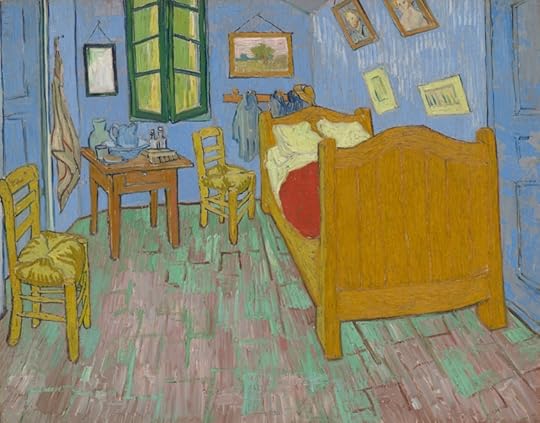
Oh, Vincent.
Most of these letters were written as an excuse to ask for money from Theo. (Thank heavens for Theo.) I really enjoyed witnessing Vincent going from a "dabbling artist" who is learning to use his tools, to a (fairly) confident one - though his most confident periods do smell of mania. These periods are also when (perhaps) all of his great works were made.
You wouldn't think reading Vincent van Gogh's letter to his brother, stating that he has run out yellow paint, would be quite so moving 138 years later, but it was.
With a good handshake,
C
Oh, Vincent.
Most of these letters were written as an excuse to ask for money from Theo. (Thank heavens for Theo.) I really enjoyed witnessing Vincent going from a "dabbling artist" who is learning to use his tools, to a (fairly) confident one - though his most confident periods do smell of mania. These periods are also when (perhaps) all of his great works were made.
You wouldn't think reading Vincent van Gogh's letter to his brother, stating that he has run out yellow paint, would be quite so moving 138 years later, but it was.
With a good handshake,
C

July 19, 2026
Really beautiful collection of letters between Vincent Van Gogh and his brother, Theo. It is always cool to get a glimpse into the life of a such a famous mind through a primary source. This was a quick and easy read. What I found most surprising was how Van Gogh really survived off of very little and was constantly asking his brother (who would sell his art) for more money. He really had no control over his own finances. They say that a large portion of discussions in relationships today are about money, and it was no different centuries ago. He did a lot with very little, which I would like to copy in my own life.
This entire review has been hidden because of spoilers.
October 30, 2025
Archive #30
A lovely man and a lovely painter but getting a glimpse into his personal dealings didn’t do a huge amount for me. Some of the letters they included I really didn’t feel needed to be there. A lot of organisational discussions with his brother that made me glaze over a little!
Still there were very nice lines, and as I’m already endeared to him through his art, I could never give it fewer than 3 stars.
A lovely man and a lovely painter but getting a glimpse into his personal dealings didn’t do a huge amount for me. Some of the letters they included I really didn’t feel needed to be there. A lot of organisational discussions with his brother that made me glaze over a little!
Still there were very nice lines, and as I’m already endeared to him through his art, I could never give it fewer than 3 stars.

June 3, 2026
It was a brilliant way to get into the head and feeling Vincent had during the last years of his life and how fragile people can be. I was very impressed with the fact that he had a supportive family who funded his passion and so sad that these artists have to do die for their work to get famous. It would have been a nice touch to add and imagine of the painting he was describing in the book to really enjoy the way he describes his work.
Displaying 1 - 30 of 52 reviews