

What do you think?

The Story of Science: Einstein Adds a New Dimension
In volume three, students will look over Albert Einstein's shoulder as he and his colleagues develop a new kind of physics. It leads in two to knowledge of the vast universe and its future (insights build on Einstein's theories of relativity), and to an understanding of the astonishingly small subatomic world (the realm of quantum physics). Students will learn why relativity and quantum theory revolutionized our world and led to the most important ideas in modern science, maybe of all time.
In the three-book The Story of Science series, master storyteller Joy Hakim narrates the evolution of scientific thought from ancient times to the present. With lively, character-driven narrative, Hakim spotlights the achievements of some of the world's greatest scientists and encourages a similiar spirit of inquiry in readers. The books include hundreds of color photographs, charts, maps, and diagrams; informative sidebars; suggestions for further reading; and excerpts from the writings of great scientists.
In the three-book The Story of Science series, master storyteller Joy Hakim narrates the evolution of scientific thought from ancient times to the present. With lively, character-driven narrative, Hakim spotlights the achievements of some of the world's greatest scientists and encourages a similiar spirit of inquiry in readers. The books include hundreds of color photographs, charts, maps, and diagrams; informative sidebars; suggestions for further reading; and excerpts from the writings of great scientists.
480 pages, Hardcover
First published November 1, 2007
About the author
Joy Hakim
142 books85 followersI've just updated A HISTORY OF US to include some new stories, especially those on people who haven't had their full story told, like Native Americans and African Americans. I've been astounded by some of what I've learned, I think you will be too.
My husband and I live most of the year in Colorado. I grew up in Rutland, Vermont and graduated from Rutland High School. I earned a bachelor's degree in government at Smith College, a master's degree in education from Goucher College, as well as an honorary doctorate from Goucher.
I've been a teacher: in Syracuse, New York; Omaha, Nebraska; and Virginia Beach, Virginia. And I've taught in elementary school, middle school, high school, and in a community college.
I've also been a newspaper woman: a general reporter, a business reporter, and an associate editor and editorial writer at Norfolk's Virginian-Pilot.
We have three children and five grandchildren.
from: http://www.joyhakim.com/biography.html
My husband and I live most of the year in Colorado. I grew up in Rutland, Vermont and graduated from Rutland High School. I earned a bachelor's degree in government at Smith College, a master's degree in education from Goucher College, as well as an honorary doctorate from Goucher.
I've been a teacher: in Syracuse, New York; Omaha, Nebraska; and Virginia Beach, Virginia. And I've taught in elementary school, middle school, high school, and in a community college.
I've also been a newspaper woman: a general reporter, a business reporter, and an associate editor and editorial writer at Norfolk's Virginian-Pilot.
We have three children and five grandchildren.
from: http://www.joyhakim.com/biography.html
Ratings & Reviews
Friends & Following
Create a free account to discover what your friends think of this book!
Community Reviews
Displaying 1 - 29 of 29 reviews

May 10, 2019
Einstein Adds a New Dimension
is my absolute favorite book in this trilogy. While it explains the research, principles of discoveries and inventions of the last decade, it touches on the humanitarian aspects of the scientists and the all over status/climate in world affairs or political crisis along the way that influenced and changed scientific studies and outcomes. In this particular book, the most influential situations were WWI & WWII, with emphasis on the Manhatten Project and the Space Race.
Despite the title including German-born theoretical physicist/mathematician and inventor Albert Einstein, this text included many other influential scientists and leaders of its time. Some of the other ground working achievers mentioned were Roentgen, Rutherford, Maxwell, Bolzman, Milikan, Planck, Bohr, Joliot-Curie, Heisenberg, Gamow, Bose, Schroedinger, de Broglie, Oppenheimer, Shapley, Hubble, Chandrasekhar, Wheeler, Bethe, Hawking, and many, many others.
With background information from jolly upbringings, failures in school, his work at the patent office to his success, marital life, religious background and move to the United States, this book used Einstein to lead into all the subjects touched and discussed. As so many others in the scientific community fled Europe in anticipation of WWII and an effort to save scientific knowledge.
The different subject matters and discoveries are well explained for anyone to understand and follow. You may even have some Eureka moments if there was a disconnect in knowledge as to how did we get from there to here?! It is very interesting to see how different theories were born and different leads studied, abandoned or succeeded. There were some big sacrifices made along the way and without the technology that we have today, a lot of thinking led to theoretical work so that some of the scientists never actually became witness to their proven theory or winning a Nobel Price after they had passed away.
This book is worth a read and reread. I am not a scientist and physics isn't a strong suit of mine, but this text makes the basic principles engaging and interesting. A great primer or overview of what is to come in classes studied. Mainly this would be great for Middle graders or Highschoolers as it builds a timeline of events, and that is always good to know and serves as something to put your hat on. The edition of this text that I read is from 2007 and there were great visuals included. Yes, more progress has been made since then, but you cannot change the timeline of events and achievements, so I find it still a great book to introduce the subject or read out of curiosity. I have had vague knowledge about many of the things discussed in here but gained a renewed clarity of the efforts, the why's and hows.
Some of the materials and scientific behaviors covered and explained in this book are Quarks, Rays, Waves, Light, Photons, Atoms, elements, basic chemistry, Quantum Leaps, Time, Fission, Electrodynamics, Relativity, Dimensions, Gravity, Space Warps, Inflation, Expansion, Black Holes, Stars, and Spacetime.
"Einstein is looking for a way to put quantum theory int an overarching explanation of the cosmos. He wants to bring that theory of the small into harmony with theories of time and space and the greater universe. he is searching for a theory of everything."
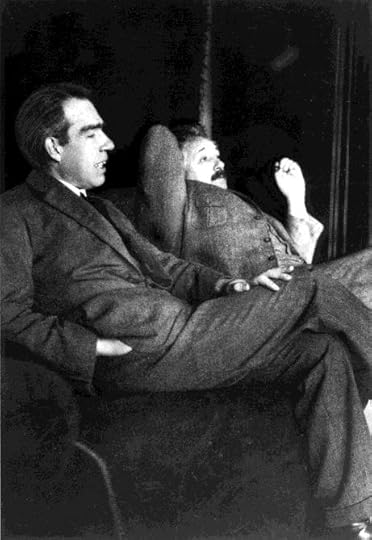
(Bohr and Einstein relaxing at Ehrenfest's home in Leiden, Netherlands)
To me, their friendship and "leisure conversing" about their different views is Physics in their spare time was very interesting! At times, they missed train stops while engrossed in their topics riding the tain!
The illustrations and photos in this book are great. Again, a few years old, but still relevant. The chapters are interspersed with little nuggets of info or tiny chapters in-between to delve into certain aspects just a bit more or gain more background info. One could skip those...but why? It all meshes up very well.
This book is a keeper for me. I really, really enjoyed it and will reread that series again. If you are a baffled newbie like me or have a general interest, perhaps guide a pre-teen into scientific topics, this book will be a great fit. I cannot recommend it enough!
Happy Reading!
More of my reviews can be found here:
https://scarlettreadzandrunz.com/
Despite the title including German-born theoretical physicist/mathematician and inventor Albert Einstein, this text included many other influential scientists and leaders of its time. Some of the other ground working achievers mentioned were Roentgen, Rutherford, Maxwell, Bolzman, Milikan, Planck, Bohr, Joliot-Curie, Heisenberg, Gamow, Bose, Schroedinger, de Broglie, Oppenheimer, Shapley, Hubble, Chandrasekhar, Wheeler, Bethe, Hawking, and many, many others.
With background information from jolly upbringings, failures in school, his work at the patent office to his success, marital life, religious background and move to the United States, this book used Einstein to lead into all the subjects touched and discussed. As so many others in the scientific community fled Europe in anticipation of WWII and an effort to save scientific knowledge.
The different subject matters and discoveries are well explained for anyone to understand and follow. You may even have some Eureka moments if there was a disconnect in knowledge as to how did we get from there to here?! It is very interesting to see how different theories were born and different leads studied, abandoned or succeeded. There were some big sacrifices made along the way and without the technology that we have today, a lot of thinking led to theoretical work so that some of the scientists never actually became witness to their proven theory or winning a Nobel Price after they had passed away.
This book is worth a read and reread. I am not a scientist and physics isn't a strong suit of mine, but this text makes the basic principles engaging and interesting. A great primer or overview of what is to come in classes studied. Mainly this would be great for Middle graders or Highschoolers as it builds a timeline of events, and that is always good to know and serves as something to put your hat on. The edition of this text that I read is from 2007 and there were great visuals included. Yes, more progress has been made since then, but you cannot change the timeline of events and achievements, so I find it still a great book to introduce the subject or read out of curiosity. I have had vague knowledge about many of the things discussed in here but gained a renewed clarity of the efforts, the why's and hows.
Some of the materials and scientific behaviors covered and explained in this book are Quarks, Rays, Waves, Light, Photons, Atoms, elements, basic chemistry, Quantum Leaps, Time, Fission, Electrodynamics, Relativity, Dimensions, Gravity, Space Warps, Inflation, Expansion, Black Holes, Stars, and Spacetime.
"Einstein is looking for a way to put quantum theory int an overarching explanation of the cosmos. He wants to bring that theory of the small into harmony with theories of time and space and the greater universe. he is searching for a theory of everything."
(Bohr and Einstein relaxing at Ehrenfest's home in Leiden, Netherlands)
To me, their friendship and "leisure conversing" about their different views is Physics in their spare time was very interesting! At times, they missed train stops while engrossed in their topics riding the tain!
The illustrations and photos in this book are great. Again, a few years old, but still relevant. The chapters are interspersed with little nuggets of info or tiny chapters in-between to delve into certain aspects just a bit more or gain more background info. One could skip those...but why? It all meshes up very well.
This book is a keeper for me. I really, really enjoyed it and will reread that series again. If you are a baffled newbie like me or have a general interest, perhaps guide a pre-teen into scientific topics, this book will be a great fit. I cannot recommend it enough!
Happy Reading!
More of my reviews can be found here:
https://scarlettreadzandrunz.com/

February 21, 2017
A Letter to the Head of Smithsonian Books from a school leader, writing about the three volume The Story of Science:
The books are fantastic.
I have been teaching for 25 years with experience in an Ivy League University and a variety of very competitive prep schools. As a former prep school History Department chair (at Landon School) who made it a habit to teach everything in our department, I have probably used 20 different textbooks, including ones for courses in AP U.S. History, AP European History, AP Economics, AP Government, Latin American History, Civil Rights, Constitutional Law, World History, the History of the South. I go to conferences and scout around for the best texts, because they can play a critical role in the value of the course for the students.
Joy Hakim's work is the best I can find... She emphasizes narrative and tries to tell compelling stories about historical figures, with particular attention to their youth...My students like her stories and it is easy for me to get these not-always-eager readers to do so when it's one of her books.
...She has made the study of the history of science incredibly approachable for a great target audience: middle schoolers. It would work equally well, however, for high school [and freshman college] students. The sophistication of the material, at times, is really beyond our students, but I think it's best to be ambitious with them and teach it since it is so compelling.
There are two traits to the series that make it so good. First, as far as I know, she is the sole writer. Texts are typically written by committees, and often handed down and revised through the years. This makes for prose that reads as if it's been written, well, by a committee. I can't remember ever reading anything written by a group and thinking, "that's fantastic."
Second, she must be working her tail off to find the right stories to tell. This is actually obvious by virtue of the images she chooses to highlight her work. When I use her U.S. History series, I know the iconic pictures I want to show the students. When I used to teach with other texts, I had to go out and find them. Hakim's books seem to have virtually all of them there. She is a compelling storyteller, she knows what interests young people, and she creates enthusiasm for history and all its associated subjects.
Todd Barnett
Head of School
Field School
Charlottesville, VA
The books are fantastic.
I have been teaching for 25 years with experience in an Ivy League University and a variety of very competitive prep schools. As a former prep school History Department chair (at Landon School) who made it a habit to teach everything in our department, I have probably used 20 different textbooks, including ones for courses in AP U.S. History, AP European History, AP Economics, AP Government, Latin American History, Civil Rights, Constitutional Law, World History, the History of the South. I go to conferences and scout around for the best texts, because they can play a critical role in the value of the course for the students.
Joy Hakim's work is the best I can find... She emphasizes narrative and tries to tell compelling stories about historical figures, with particular attention to their youth...My students like her stories and it is easy for me to get these not-always-eager readers to do so when it's one of her books.
...She has made the study of the history of science incredibly approachable for a great target audience: middle schoolers. It would work equally well, however, for high school [and freshman college] students. The sophistication of the material, at times, is really beyond our students, but I think it's best to be ambitious with them and teach it since it is so compelling.
There are two traits to the series that make it so good. First, as far as I know, she is the sole writer. Texts are typically written by committees, and often handed down and revised through the years. This makes for prose that reads as if it's been written, well, by a committee. I can't remember ever reading anything written by a group and thinking, "that's fantastic."
Second, she must be working her tail off to find the right stories to tell. This is actually obvious by virtue of the images she chooses to highlight her work. When I use her U.S. History series, I know the iconic pictures I want to show the students. When I used to teach with other texts, I had to go out and find them. Hakim's books seem to have virtually all of them there. She is a compelling storyteller, she knows what interests young people, and she creates enthusiasm for history and all its associated subjects.
Todd Barnett
Head of School
Field School
Charlottesville, VA

December 7, 2017
From electrons to Einstein at a train station, the content of "The story of Science Einstein Adds a New Dimension," has an abundance of facts and mind blowing details. Joy Hakim has a profusion of ways to retain the reader's attention. She asks many questions to get the reader thinking, and the author also puts in humorous stories about Einstein and his colleagues that make you engaged in the book. Another one of Joy Hakim's strategies is many times she would say,” as explained later in the book,” this would preserve my interest in the book.
At first, I thought this book would not be the right fit for me because it seemed as if it was going to cover subjects that are very intricate: however, Joy Hakim has her ways of referring such complex ideas straightforwardly. Although this book was fascinating, I would have to disagree with some of the reviews on Goodreads as many readers say it is one of their favorites. I will agree with the readers of this book that it was a slower read for the simple reason that there was superfluous information on the pages. Many of the Goodreader users that wrote reviews on this book state that Joy Hakim did a fantastic job of conveying very convoluted abstractions with right words.
I would recommend this book to anyone who has even the slightest interest in the world of science. Everyone learns how things work, not why things work the way they do. After reading this book, the reader will have lots of background knowledge about why stuff works the way it does. Joy Hakim will get you not to want to put this book down even if science is not your asset. Some of the points portrayed in "Einstein Adds a New Dimension," are eye-opening. If you are not a science geek, you will still enjoy this book.

Read
May 2, 2025I just have to say, toward the end, this book got VERY sci-fi and difficult to understand 🤪
May 26, 2019
Middle to upper grade history text -- a great look at how physics has influenced and charted the way into the 20th century (and toward the future). Helps make relativity and quantum dynamics accessible to the student and links it to the history of its day.

July 21, 2020
Informative, fairly easy to read and understand, textbook. For school.

January 19, 2011
I couldn't put this book down, nor any of the other 2 in this series. I'm actually thinking of eventually buying the set so i can go back and read again to see how much i absorbed the first time around. The author does a great job of progressing through ideas and somewhat difficult concepts and presenting them with just enough detail to get the wheels in your head spinning and asking for more, will filling that thirst for more in the very next page.
The only odd thing about the books is that they're presented in what i would call an encyclopedia style, where you do have some core sections to read through but the pages are surrounded by dozens of dozens of facts so you end up reading about 20-30 factoids between the next page turn. DIfferent, but it didn't ultimately take away from the materials presented. Just made them that much more intriguing. For me, it was a slower read than normal because i couldn't stop reading all the additional content.
The only odd thing about the books is that they're presented in what i would call an encyclopedia style, where you do have some core sections to read through but the pages are surrounded by dozens of dozens of facts so you end up reading about 20-30 factoids between the next page turn. DIfferent, but it didn't ultimately take away from the materials presented. Just made them that much more intriguing. For me, it was a slower read than normal because i couldn't stop reading all the additional content.
June 10, 2020
The whole "Story of Science" series is fabulous! The books are rich in illustrations, interesting information, and visual representations of tough concepts. This last book is very physics- and astronomy-focused and I learned more about physics from this book than I did in high school or college. Hakim masterfully takes complicated concepts and explains them clearly, simply, and elegantly. She makes each step of scientific progress fascinating. I highly recommend this series for kids and adults!

August 29, 2011
If science textbooks were all this interesting, I think we would have many more scientists.
September 14, 2026
After reading all three books in this series, I cannot tell who she is writing for. The first book was very elementary in it's writing style and prose. The second book felt a lot better. And out of necessity, the third book was quite complicated (she was dealing with some very complex scientific concepts and theories) but sometimes she would still define words to us like we were those same elementary kids from the first book. So... I couldn't really tell if her audience was supposed to grow with the books or elementary school kids who still need fairly ordinary words defined for them were supposed to understand who explanations of the special theory of relativity, etc.
I do like these books, but as an adult, I feel like I am be extremely patronized in the first book - plus she has no patience for religion, especially Christianity. I enjoyed the second book the best. I feel like she got over her bias (or just didn't have a chance or chose to bring it up as much) and the writing style was more comfortable. But I had to stop reading the third book aloud to my almost 12 year old because the concepts and writing were just way over his head - until she started defining words like "lecture." (I can't remember the exact word/definition that made me pause, but it DID make me pause and wonder who, in fact, her audience was supposed to be.)
I will probably keep this set because as a history of scientific development and thought, it is very good. She doesn't seem to understand medieval thought - which is not a sin, and if it was it would almost be a near universal one for those so steeped in Enlightenment thinking that they ironically forgot how to ask questions or not just accept at face value what those before them have professed to be true. So that's kind of annoying. But it's also totally understandable because our culture is what it is and it's a waste of time to expect everyone to be an expert on everything.
I do like these books, but as an adult, I feel like I am be extremely patronized in the first book - plus she has no patience for religion, especially Christianity. I enjoyed the second book the best. I feel like she got over her bias (or just didn't have a chance or chose to bring it up as much) and the writing style was more comfortable. But I had to stop reading the third book aloud to my almost 12 year old because the concepts and writing were just way over his head - until she started defining words like "lecture." (I can't remember the exact word/definition that made me pause, but it DID make me pause and wonder who, in fact, her audience was supposed to be.)
I will probably keep this set because as a history of scientific development and thought, it is very good. She doesn't seem to understand medieval thought - which is not a sin, and if it was it would almost be a near universal one for those so steeped in Enlightenment thinking that they ironically forgot how to ask questions or not just accept at face value what those before them have professed to be true. So that's kind of annoying. But it's also totally understandable because our culture is what it is and it's a waste of time to expect everyone to be an expert on everything.
May 8, 2026
For any age, this book brings alive the backstory of some of the most monumental scientific discovery. As a read-aloud for middle schoolers, it is a fun and engaging journey for students--starting with a 15-year old Einstein who hates school, young readers/listeners are captured immediately. Before long, we are all wishing we'd been part of famous meet-ups and collabs up to par with today's YouTube clans. Hakim's history of science is thorough and accessible without letting us forget anyone who came earlier or was less known. Above all, the Story of Science includes us in the good and the dangers, the genius and the average, of science and scientists.
May 30, 2023
As a science/history book, there is a lot of truth that is presented. I'm not going to argue whether or not certain theories are true or not, but the author definitely has a bias. The book was a part of a curriculum I chose for my kids to teach the history of science. This comes from a secular view point. I neither loved nor hated this book. There were several times that my kids and I had discussions over what we read to reconcile how her words matched our own thought and other teachings.
May 15, 2023
While we thoroughly enjoyed the readability of the first two and a half books of this series, the end of this book got really muddled up in the relativity of ideas. Maybe it was the subject matter we reacted to but it did not make our favorites list.
June 20, 2023
It was quite interesting, but also really hard to understand unless you're really into science.

June 20, 2023
8th grade is completed!!!! Great book, many concepts we struggled to comprehend but we did power through and continue to be excited about science and new discoveries.
May 10, 2025
I read this with my daughter as part of her 8th grade curriculum. We learned so much! She really liked Einstein's perspective on learning. This was her favorite book of this series.

May 17, 2025
The best history textbook I have come across!
June 12, 2026
Solid but less engaging than the Newton and Aristotle books in this series.
October 3, 2014
I picked this book up at the library on a whim. It turns out to be almost like a high school textbook, but for a class that is sadly unlikely ever to be taught: the history of science and scientists. It also turns out that this is the third book in a series. So, I skipped to the end of the story, I suppose.
Nevertheless I can highly recommend this book. The book covers the history of physics (both large and small) from the late 19th century to a few years ago, which is inarguably a time of massive leaps in understanding of the universe. It is fascinating to realize that just a few years after scientists came to accept that matter is made up of atoms, we had developed the sophisticated ideas of quantum mechanics, relativity, and nuclear fission. In just a few decades, we went from the Wright Brothers to the Apollo program.
Joy Hakim brings all of this to a reader using an eminently readable style, skipping the complicated and intimidating mathematics, but without skirting around the mind-blowing and difficult ideas. I had never heard of Joy Hakim before reading this, but I will be checking out more of her books.
Nevertheless I can highly recommend this book. The book covers the history of physics (both large and small) from the late 19th century to a few years ago, which is inarguably a time of massive leaps in understanding of the universe. It is fascinating to realize that just a few years after scientists came to accept that matter is made up of atoms, we had developed the sophisticated ideas of quantum mechanics, relativity, and nuclear fission. In just a few decades, we went from the Wright Brothers to the Apollo program.
Joy Hakim brings all of this to a reader using an eminently readable style, skipping the complicated and intimidating mathematics, but without skirting around the mind-blowing and difficult ideas. I had never heard of Joy Hakim before reading this, but I will be checking out more of her books.

July 24, 2011
The Story of Science: Einstein Adds a New Dimension: Einstein Adds a New Dimension
by Joy Hakim
the mystery and science that has help paved society. This book focuses on Einstein how his theories and ideas have shaped modern science. He was more influencial then the formula we all know, E = M C Squared.
looking at each of the modern thories, and how they stand with and against what Einstein believed. this is a great book for introduction of modern science, allowing you to know the names of predominately unknown scientist that created the modern age, and our ideas of the universe. a great resource for schools and teachers, and an interest books for scientist and writers.
by Joy Hakim
the mystery and science that has help paved society. This book focuses on Einstein how his theories and ideas have shaped modern science. He was more influencial then the formula we all know, E = M C Squared.
looking at each of the modern thories, and how they stand with and against what Einstein believed. this is a great book for introduction of modern science, allowing you to know the names of predominately unknown scientist that created the modern age, and our ideas of the universe. a great resource for schools and teachers, and an interest books for scientist and writers.
December 29, 2012
The Story of Science by Joy Hakim is a great and fun series if you like science or even if you just want to read something interesting. Me and my family read all three books together and now have a broader understanding of general world history and also now more about science that you won't get in a classroom setting. In this particular book Joy talks about many of my favorite subjects, from black holes to extraterrestrial life, to quantum theory which just boggles my mind to many many more things that will give you a new prospective to the universe.
August 9, 2010
I am just not smart enough for these science books. This one is even for Middle School age kids. I did learn from about the first half of the book. Then I think my brain just got too full and couldn't hold any more.
January 8, 2014
I enjoyed what I read of it, but it reads more like a textbook than anything else, and there were many things that I couldn't really understand, so after 177 pages I decided to set it aside. Bill Bryson's A Short History of Nearly Everything was much more to my liking and ability level.
May 27, 2009
This was the best one of the series! I think I enjoyed it the most because it was talking about more current science. I learned more from this book than I ever did in a science class.
February 18, 2010
So well explained! I totally understood what it was talking about!!

Want to Read
September 23, 2013Y509 HAK
October 27, 2014
Really appreciate Joy Hakim's dedication and commitment to produce quality work. Helps me understand some of the things my son is interested in.

September 4, 2022
This was a great series to use as a complete overview of the history of scientific advances.
Currently Reading
August 4, 2017In my opinion this is a book should be given to a 9th grader who asks his teacher if gravity does exist or is just electromagnatic reactions between atoms
Displaying 1 - 29 of 29 reviews