

What do you think?

The Impossible Planet
"The Impossible Planet" arrived together with "Adjustment Team" at the SMLA on Feb 11, 1953 and was published later that year in Imagination (Oct 1953). It was selected by Rich & Cowan publishers in the UK for inclusion in the first PKD collection, A HANDFUL OF DARKNESS (1955). Almost 20 years went by before it could be found again in Brian Aldiss’ SPACE ODYSSEYS (1974). Then into THE COLLECTED STORIES, Vol.2 in 1987.
"The Impossible Planet" was originally titled by PKD as "Legend."
"The Impossible Planet" tells the story of a little old rich lady who wishes to see Earth before she dies. An unscrupulous spaceship captain agrees to take her there even though the planet Earth is now only a legend. So he searches his computers for the most likely place and takes her there. But is it Earth? Or is he just taking her money and running? Well, that’s why Phil wrote the story.
Once again Philip K. Dick comes up with a new angle on the old science fiction idea of the lost planet of origin of a future galactic empire. This is a great little story because it shows clearly how Dick creates his characters to perfectly fit the story. In "The Impossible Planet" There are four main characters: the opportunistic captain, his partner with moral qualms, the little old lady so wasted that she has to lean on her ‘robant’ servant, the fourth of the group. With these characters PKD, in a few thousand words, manages to create the image of a galactic empire in its totality.
"The Impossible Planet" was originally titled by PKD as "Legend."
"The Impossible Planet" tells the story of a little old rich lady who wishes to see Earth before she dies. An unscrupulous spaceship captain agrees to take her there even though the planet Earth is now only a legend. So he searches his computers for the most likely place and takes her there. But is it Earth? Or is he just taking her money and running? Well, that’s why Phil wrote the story.
Once again Philip K. Dick comes up with a new angle on the old science fiction idea of the lost planet of origin of a future galactic empire. This is a great little story because it shows clearly how Dick creates his characters to perfectly fit the story. In "The Impossible Planet" There are four main characters: the opportunistic captain, his partner with moral qualms, the little old lady so wasted that she has to lean on her ‘robant’ servant, the fourth of the group. With these characters PKD, in a few thousand words, manages to create the image of a galactic empire in its totality.
9 pages, Unknown Binding
First published October 1, 1953
About the author
Philip K. Dick
1,942 books23.3k followersPhilip Kindred Dick was a prolific American science fiction author whose work has had a lasting impact on literature, cinema, and popular culture. Known for his imaginative narratives and profound philosophical themes, Dick explored the nature of reality, the boundaries of human identity, and the impact of technology and authoritarianism on society. His stories often blurred the line between the real and the artificial, challenging readers to question their perceptions and beliefs.
Raised in California, Dick began writing professionally in the early 1950s, publishing short stories in various science fiction magazines. He quickly developed a distinctive voice within the genre, marked by a fusion of science fiction concepts with deep existential and psychological inquiry. Over his career, he authored 44 novels and more than 100 short stories, many of which have become classics in the field.
Recurring themes in Dick's work include alternate realities, simulations, corporate and government control, mental illness, and the nature of consciousness. His protagonists are frequently everyday individuals—often paranoid, uncertain, or troubled—caught in surreal and often dangerous circumstances that force them to question their environment and themselves. Works such as Ubik, The Three Stigmata of Palmer Eldritch, and A Scanner Darkly reflect his fascination with perception and altered states of consciousness, often drawing from his own experiences with mental health struggles and drug use.
One of Dick's most influential novels is Do Androids Dream of Electric Sheep?, which served as the basis for Ridley Scott's iconic film Blade Runner. The novel deals with the distinction between humans and artificial beings and asks profound questions about empathy, identity, and what it means to be alive. Other adaptations of his work include Total Recall, Minority Report, A Scanner Darkly, and The Man in the High Castle, each reflecting key elements of his storytelling—uncertain realities, oppressive systems, and the search for truth. These adaptations have introduced his complex ideas to audiences well beyond the traditional readership of science fiction.
In the 1970s, Dick underwent a series of visionary and mystical experiences that had a significant influence on his later writings. He described receiving profound knowledge from an external, possibly divine, source and documented these events extensively in what became known as The Exegesis, a massive and often fragmented journal. These experiences inspired his later novels, most notably the VALIS trilogy, which mixes autobiography, theology, and metaphysics in a narrative that defies conventional structure and genre boundaries.
Throughout his life, Dick faced financial instability, health issues, and periods of personal turmoil, yet he remained a dedicated and relentless writer. Despite limited commercial success during his lifetime, his reputation grew steadily, and he came to be regarded as one of the most original voices in speculative fiction. His work has been celebrated for its ability to fuse philosophical depth with gripping storytelling and has influenced not only science fiction writers but also philosophers, filmmakers, and futurists.
Dick's legacy continues to thrive in both literary and cinematic spheres. The themes he explored remain urgently relevant in the modern world, particularly as technology increasingly intersects with human identity and governance. The Philip K. Dick Award, named in his honor, is presented annually to distinguished works of science fiction published in paperback original form in the United States. His writings have also inspired television series, academic studies, and countless homages across media.
Through his vivid imagination and unflinching inquiry into the nature of existence, Philip K. Dick redefined what science fiction could achieve. His wor
Raised in California, Dick began writing professionally in the early 1950s, publishing short stories in various science fiction magazines. He quickly developed a distinctive voice within the genre, marked by a fusion of science fiction concepts with deep existential and psychological inquiry. Over his career, he authored 44 novels and more than 100 short stories, many of which have become classics in the field.
Recurring themes in Dick's work include alternate realities, simulations, corporate and government control, mental illness, and the nature of consciousness. His protagonists are frequently everyday individuals—often paranoid, uncertain, or troubled—caught in surreal and often dangerous circumstances that force them to question their environment and themselves. Works such as Ubik, The Three Stigmata of Palmer Eldritch, and A Scanner Darkly reflect his fascination with perception and altered states of consciousness, often drawing from his own experiences with mental health struggles and drug use.
One of Dick's most influential novels is Do Androids Dream of Electric Sheep?, which served as the basis for Ridley Scott's iconic film Blade Runner. The novel deals with the distinction between humans and artificial beings and asks profound questions about empathy, identity, and what it means to be alive. Other adaptations of his work include Total Recall, Minority Report, A Scanner Darkly, and The Man in the High Castle, each reflecting key elements of his storytelling—uncertain realities, oppressive systems, and the search for truth. These adaptations have introduced his complex ideas to audiences well beyond the traditional readership of science fiction.
In the 1970s, Dick underwent a series of visionary and mystical experiences that had a significant influence on his later writings. He described receiving profound knowledge from an external, possibly divine, source and documented these events extensively in what became known as The Exegesis, a massive and often fragmented journal. These experiences inspired his later novels, most notably the VALIS trilogy, which mixes autobiography, theology, and metaphysics in a narrative that defies conventional structure and genre boundaries.
Throughout his life, Dick faced financial instability, health issues, and periods of personal turmoil, yet he remained a dedicated and relentless writer. Despite limited commercial success during his lifetime, his reputation grew steadily, and he came to be regarded as one of the most original voices in speculative fiction. His work has been celebrated for its ability to fuse philosophical depth with gripping storytelling and has influenced not only science fiction writers but also philosophers, filmmakers, and futurists.
Dick's legacy continues to thrive in both literary and cinematic spheres. The themes he explored remain urgently relevant in the modern world, particularly as technology increasingly intersects with human identity and governance. The Philip K. Dick Award, named in his honor, is presented annually to distinguished works of science fiction published in paperback original form in the United States. His writings have also inspired television series, academic studies, and countless homages across media.
Through his vivid imagination and unflinching inquiry into the nature of existence, Philip K. Dick redefined what science fiction could achieve. His wor
Ratings & Reviews
Friends & Following
Create a free account to discover what your friends think of this book!
Community Reviews
Displaying 1 - 30 of 39 reviews

December 22, 2017
First published in Imagination (October 1953), “The Impossible Planet” is a Dick classic. Its theme—an earth made unrecognizable through military, industrial, and ecological disaster—is a common one, and the story itself has none of the outrageous imaginative twists and turns that often characterize Dick’s work. It succeeds for another reason: it is as simple and powerful as a myth. No folktale could be told with less adornment; if the prophet Jeremiah wrote short stories, they might have turn out like this.
Mrs. Gordon, 350 years old, deaf, and near death, has one last request: she wants to purchase a ticket to Earth, the planet from which the life of the galaxy sprang, the planet from which her grandfather traveled to Riga many centuries ago. The crew of the space ship tries to reason with her, for everybody knows that Earth is a myth, a legendary place of origin with no proof of existence. But the old lady insists, and she has plenty of money, so the pilot does a little research and decides to take her to the nearest and closest destination he can find: Emphor III, a planet with one moon, the third of nine, orbiting around a single sun. But it is not the paradise Mrs. Gordon was anticipating; its surface has been ravaged by years of strip mining and other commercial operations.
The ending is perhaps a little too pat, but it doesn’t take away from the haunting impression left by the tale itself, the fate of the old lady and the fate of her robot servant.
Required reading for all Dick fans.

February 12, 2020
Impossible Planet is a very short story by Philip K. Dick, which was written in 1953. It is the third story in the collection “Philip K. Dick’s Electric Dreams”, compiled in 2017, after the television series of the same name. Impossible Planet was adapted for filming by David Farr.
The story is set in the far-off future, when the idea of Earth is dismissed as a myth. Space tourism is a popular activity, for those who can afford it. The idea of the story is very simple. A very old, profoundly deaf woman, and the robot who cares for her, approach two space tourism guides, Norton and Captain Andrews. She is asking to be taken to visit Earth. The guides, like everyone else at that time, believe Earth never existed and wouldn’t know where to look for it if it had. But they are greedy, and the old woman, Irma Louise Gordon, has saved long and hard. She is able to offer them far more money than they have ever received before. It would be so easy to look up the legends, and find a place which would fit. What harm could it do?
The adaptation differs in a few parts, although the essential story is the same. The old woman is desperate to visit Earth before she dies and the two bored space tourism guides are cynical enough and willing enough to trick her and take her money. It is worth five years salary each to them.
This is in keeping, and it expands the story, but adds little to it.
Impossible Planet is merely a wisp of a story in a way, yet it has all the hallmarks of a classic. It has both heart and soul, and is timeless. There are metaphors: the “dark birds” a pterodactyl-like embodiment of a moral forecast. This story deals with loss, the past, memory, nostalgia, and our fears that the present is not only ephemeral, but possibly doomed.
“The ruined face. Salt ash and debris. The broken line of crumbling hills. And the silence. The eternal silence. Nothing but the wind and the lapping of the thick stagnant water. And the dark birds overhead.”
We have moved on getting on for 70 years since this story was written. Already we can see that future generations may yearn for a “lost paradise”.
We are more reliant on machines and gadgets than ever before, and it is escalating. Some already consider that this leads to less caring people, with debased human interactions. Is it then, such an outrageous idea that a robot, or synthetic organism, could in effect have more compassion than a human? The actions of the “robant”, who “moves gently” in taking Irma Louise Gordon’s arm, are more emotionally loyal than those of the humans. Philip K. Dick has cleverly ensured that all the communications are necessarily done by proxy, because the old woman is deaf.
Best of all, it seems prescient indeed, in terms of what literally happened to the planet “Emphor III”.
The irony of the ending is just perfect. Impossible Planet is a cautionary tale indeed.
The story is set in the far-off future, when the idea of Earth is dismissed as a myth. Space tourism is a popular activity, for those who can afford it. The idea of the story is very simple. A very old, profoundly deaf woman, and the robot who cares for her, approach two space tourism guides, Norton and Captain Andrews. She is asking to be taken to visit Earth. The guides, like everyone else at that time, believe Earth never existed and wouldn’t know where to look for it if it had. But they are greedy, and the old woman, Irma Louise Gordon, has saved long and hard. She is able to offer them far more money than they have ever received before. It would be so easy to look up the legends, and find a place which would fit. What harm could it do?
The adaptation differs in a few parts, although the essential story is the same. The old woman is desperate to visit Earth before she dies and the two bored space tourism guides are cynical enough and willing enough to trick her and take her money. It is worth five years salary each to them.
This is in keeping, and it expands the story, but adds little to it.
Impossible Planet is merely a wisp of a story in a way, yet it has all the hallmarks of a classic. It has both heart and soul, and is timeless. There are metaphors: the “dark birds” a pterodactyl-like embodiment of a moral forecast. This story deals with loss, the past, memory, nostalgia, and our fears that the present is not only ephemeral, but possibly doomed.
“The ruined face. Salt ash and debris. The broken line of crumbling hills. And the silence. The eternal silence. Nothing but the wind and the lapping of the thick stagnant water. And the dark birds overhead.”
We have moved on getting on for 70 years since this story was written. Already we can see that future generations may yearn for a “lost paradise”.
We are more reliant on machines and gadgets than ever before, and it is escalating. Some already consider that this leads to less caring people, with debased human interactions. Is it then, such an outrageous idea that a robot, or synthetic organism, could in effect have more compassion than a human? The actions of the “robant”, who “moves gently” in taking Irma Louise Gordon’s arm, are more emotionally loyal than those of the humans. Philip K. Dick has cleverly ensured that all the communications are necessarily done by proxy, because the old woman is deaf.
Best of all, it seems prescient indeed, in terms of what literally happened to the planet “Emphor III”.
The irony of the ending is just perfect. Impossible Planet is a cautionary tale indeed.
![Profile Image for [ J o ].](https://i.gr-assets.com/images/S/compressed.photo.goodreads.com/users/1673171874i/4639825._UY200_CR4,0,200,200_.jpg)
April 12, 2018
Oh, I like this one. This one fuels the imagination, makes you feel things and has your questioning the future of earth. Especially these days considering people like Elon Musk.
It's relatively simple, which seems a hallmark of Dick's short efforts. Simple works sometimes, often doesn't. Here it really does. You can tell from one sentence that Norton is a conniving little layabout, and that Andrews has a romantic streak to him.
What more can be said. Almost perfection but it did not make me feel quite like The Sea and Little Fishes did.
It's relatively simple, which seems a hallmark of Dick's short efforts. Simple works sometimes, often doesn't. Here it really does. You can tell from one sentence that Norton is a conniving little layabout, and that Andrews has a romantic streak to him.
What more can be said. Almost perfection but it did not make me feel quite like The Sea and Little Fishes did.

December 29, 2020
Short and poignant story about an old little lady that wants to see Earth once before she dies.
The planet however is considered to only be a legend at this point. A myth. There is no one that can confirm it ever existed.
Doesn’t matter. The lady got the money. Therefore, an unscrupulous captain of a spaceship agrees to take her there. Wherever there is.
The story could have been a little longer for my liking. But it was quite touching. I really felt for the little old lady.
The Electric Dreams episode tells pretty much the same story and has the added benefit of some nice visuals. It never quite manages to evoke the same emotions, however. And it also adds another angle to the story that gets explored in a wholly unsatisfactory way. It had some promise. But the nonsense ending kinda ruined it for me. That is particularly unfortunate, since the original story had quite a good ending. A case of wasted potential, I’m afraid.
The PKD short story: 4/5
The Electric Dreams Episode: 5/10

The planet however is considered to only be a legend at this point. A myth. There is no one that can confirm it ever existed.
Doesn’t matter. The lady got the money. Therefore, an unscrupulous captain of a spaceship agrees to take her there. Wherever there is.
The story could have been a little longer for my liking. But it was quite touching. I really felt for the little old lady.
The Electric Dreams episode tells pretty much the same story and has the added benefit of some nice visuals. It never quite manages to evoke the same emotions, however. And it also adds another angle to the story that gets explored in a wholly unsatisfactory way. It had some promise. But the nonsense ending kinda ruined it for me. That is particularly unfortunate, since the original story had quite a good ending. A case of wasted potential, I’m afraid.
The PKD short story: 4/5
The Electric Dreams Episode: 5/10

January 25, 2018
Rating: 3.5* of five
Maybe 10 pages of text and then it's over...but the trip was fun. I wasn't all that impressed by the characters but I like PKD's take on the survival of myth/fact as legend. But more than anything else, the nature of belief in legends, myths, stories, as ways of understanding and organizing one's life, is the heart of this heartful tale. It's a genuine pleasure to read a PKD story that's not cynical...and I'm saying that about a story of a con man conning a dying old lady out of a lot of money!
But believe me when I tell you, the older I get the more I understand why rich old people pay young and pretty cons for the chance to relive a past long dead. Irma, our old lady victim, isn't...she's taking control of her death, she's seeing what she wants and making sure she pays everyone involved to keep her illusions intact. No one knows for sure what's on The Other Side but we're damned sure that you can't take it with you. She wanted to die on Earth. She died, and she got to think it was Earth.
Remember the ending of Planet of the Apes?
The episode of Electric Dreams based on this story is just fine. I've seen whining and bitching about its ambiguous ending, which is different from the story's, but really now! Ambiguity is what the best kind of story leaves you with.
My cavil with the episode is the mismatch of stories the leads are acting in: Geraldine Chaplin is a right old tart, Jack Reynor is a gormless lump of protoplasm.
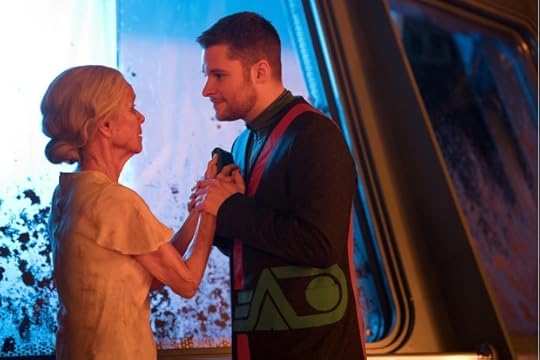
I can't see how either of these people got into any kind of relationship with the other. The age difference be damned, the lad's unbaked. It was a problem for me every step of the way. I couldn't make the performances match at all. The story gets a level higher in its details, there's no question. There's more room in 45 minutes than there is in 10 pages. A lot of what got added wasn't a surprise by any means. I'm fine with that.
But someone needs to tell me why the robant (robot servant is there at all, why it had nothing to do, why the robant could sometimes talk to the deaf woman without the clunky text-translator she uses with her boy-toy, why it has emotions....
So three and a half stars because the central questions make so much sense to me.
Maybe 10 pages of text and then it's over...but the trip was fun. I wasn't all that impressed by the characters but I like PKD's take on the survival of myth/fact as legend. But more than anything else, the nature of belief in legends, myths, stories, as ways of understanding and organizing one's life, is the heart of this heartful tale. It's a genuine pleasure to read a PKD story that's not cynical...and I'm saying that about a story of a con man conning a dying old lady out of a lot of money!
But believe me when I tell you, the older I get the more I understand why rich old people pay young and pretty cons for the chance to relive a past long dead. Irma, our old lady victim, isn't...she's taking control of her death, she's seeing what she wants and making sure she pays everyone involved to keep her illusions intact. No one knows for sure what's on The Other Side but we're damned sure that you can't take it with you. She wanted to die on Earth. She died, and she got to think it was Earth.
Remember the ending of Planet of the Apes?
The episode of Electric Dreams based on this story is just fine. I've seen whining and bitching about its ambiguous ending, which is different from the story's, but really now! Ambiguity is what the best kind of story leaves you with.
My cavil with the episode is the mismatch of stories the leads are acting in: Geraldine Chaplin is a right old tart, Jack Reynor is a gormless lump of protoplasm.
I can't see how either of these people got into any kind of relationship with the other. The age difference be damned, the lad's unbaked. It was a problem for me every step of the way. I couldn't make the performances match at all. The story gets a level higher in its details, there's no question. There's more room in 45 minutes than there is in 10 pages. A lot of what got added wasn't a surprise by any means. I'm fine with that.
But someone needs to tell me why the robant (robot servant is there at all, why it had nothing to do, why the robant could sometimes talk to the deaf woman without the clunky text-translator she uses with her boy-toy, why it has emotions....
So three and a half stars because the central questions make so much sense to me.

April 22, 2011
Eine traumhafte Sammlung von 29 Kurzgeschichten bzw. kleinen Meisterwerken. Das ist schon sehr ungewöhnlich wenn mir von 29 Geschichten nur die ersten zwei nicht gefallen.
Wie üblich setzt sich Dick im Gewand der Science Fiction mit typischen menschlichen Eigenschaften auseinander und setzt sie in Gegenzatz zum Ausserirdischen bzw. Androiden um die Kritik an menschlicher Ethik und unseren Werten zu modellieren. Da werden Konsumsucht, Ressourcenausbeutung, Kriegstreiberei, Politik, politische und gesellschaftliche Utopien, Religion, unmenschliches Verhalten gegenüber Kindern und Tieren, typische menschliche Paranoia etc. aufs Korn genommen und in sehr spannende Short Stories verpackt.
Einige der Geschichten kennt man sogar aus Hollywoodfilmen wie Minority Report, Total Recall etc. wobei Dicks Originale erstens total anders und zweitens viel besser sind.
Fazit: Unbedingt lesen! Ist nicht nur etwas für Science Fiction Fans sondern auch für Leute, die gehobene Literatur mögen.
Wie üblich setzt sich Dick im Gewand der Science Fiction mit typischen menschlichen Eigenschaften auseinander und setzt sie in Gegenzatz zum Ausserirdischen bzw. Androiden um die Kritik an menschlicher Ethik und unseren Werten zu modellieren. Da werden Konsumsucht, Ressourcenausbeutung, Kriegstreiberei, Politik, politische und gesellschaftliche Utopien, Religion, unmenschliches Verhalten gegenüber Kindern und Tieren, typische menschliche Paranoia etc. aufs Korn genommen und in sehr spannende Short Stories verpackt.
Einige der Geschichten kennt man sogar aus Hollywoodfilmen wie Minority Report, Total Recall etc. wobei Dicks Originale erstens total anders und zweitens viel besser sind.
Fazit: Unbedingt lesen! Ist nicht nur etwas für Science Fiction Fans sondern auch für Leute, die gehobene Literatur mögen.

November 6, 2020
I finished this collection a while back but have been in-and-out of Goodreads for several months, enmeshed in and often stymied by the uncertainty facing all of us in the COVID world. Anyway, these are fantastic stories, all of them utterly strange and beguiling. Start reading one and immediately you're plunged into the world of the uncanny, into a world much like that of the The Twilight Zone (the original TV series from the late 1950s and 1960s). Great stuff. What an imaginative vision Dick possessed--and was no doubt possessed by! I obviously read these in German (weird, I know) for my continued language learning, which made my experience with the stories all the more enjoyable and fulfilling. Next time I'll read the collection in English.
April 26, 2018
Memory, the Place of Home
Charlton Heston’s exploits on the “Planet of the Apes”, based on Pierre Boulle’s 1963 novel Le Planéte des singes, is so well-known today that it would be rather unfair to dismiss PKD’s short story The Impossible Planet, written in the early fifties, as predictable and unoriginal on the grounds that its ending no longer comes as a surprise to the modern reader.
But should readers in the fifties even have been able to guess that the interstellar backwater Emphor III is in fact the very legendary planet Earth, which is rumoured to be the place where humanity originated, still this little story would have had its power to fascinate and provoke thought. PKD’s criticism of politics and the economy is obvious here because what was once a blue planet, teeming with life and offering everything in terms of favourable conditions, was ravaged and exhausted by ruthless exploitation of resources and finally almost destroyed by a war between humans and Centaurons. Unless we take care, the narrator seems to urge, our planet will one day not only be a memory of the past but be thrown onto the ash-heap of history itself. And yet, there is little hope of humans behaving in a less egoistic and profit-oriented way, as is shown by Captain Andrews, who does not find it below himself to take advantage of a very old woman and promises, with a view to filthy lucre, to take her to a planet whose existence he does not believe in.
At the same time, this so pessimistic story does not decry science, technology and the idea of progress as such, which becomes clear when we consider that whereas the human captain is an unscrupulous liar, the old lady’s robant (i.e. a robot servant) really seems to be endowed with human feelings of care and empathy. In one scene, we even witness him leading the old woman “gently [!] to the launch” of the spacecraft.
The Impossible Planet not only serves as a warning to take more care of our home planet but also demonstrates to the reader that if we follow the path of destruction too far, we will not even leave so much as a footnote in history.
Charlton Heston’s exploits on the “Planet of the Apes”, based on Pierre Boulle’s 1963 novel Le Planéte des singes, is so well-known today that it would be rather unfair to dismiss PKD’s short story The Impossible Planet, written in the early fifties, as predictable and unoriginal on the grounds that its ending no longer comes as a surprise to the modern reader.
But should readers in the fifties even have been able to guess that the interstellar backwater Emphor III is in fact the very legendary planet Earth, which is rumoured to be the place where humanity originated, still this little story would have had its power to fascinate and provoke thought. PKD’s criticism of politics and the economy is obvious here because what was once a blue planet, teeming with life and offering everything in terms of favourable conditions, was ravaged and exhausted by ruthless exploitation of resources and finally almost destroyed by a war between humans and Centaurons. Unless we take care, the narrator seems to urge, our planet will one day not only be a memory of the past but be thrown onto the ash-heap of history itself. And yet, there is little hope of humans behaving in a less egoistic and profit-oriented way, as is shown by Captain Andrews, who does not find it below himself to take advantage of a very old woman and promises, with a view to filthy lucre, to take her to a planet whose existence he does not believe in.
At the same time, this so pessimistic story does not decry science, technology and the idea of progress as such, which becomes clear when we consider that whereas the human captain is an unscrupulous liar, the old lady’s robant (i.e. a robot servant) really seems to be endowed with human feelings of care and empathy. In one scene, we even witness him leading the old woman “gently [!] to the launch” of the spacecraft.
The Impossible Planet not only serves as a warning to take more care of our home planet but also demonstrates to the reader that if we follow the path of destruction too far, we will not even leave so much as a footnote in history.
This entire review has been hidden because of spoilers.

March 5, 2018
It's interesting to see the original stories that made up the TV series Electric Dreams. There's really nothing to the first three stories except a glimmer of an idea.

March 27, 2021
The Impossible Planet [1953] - ★★★★
This short story was first published in the magazine Imagination in 1953. In a very distant future, a three hundred and fifty year-old woman has her dying wish - to see and visit planet Earth. She is one of the original settlers of the Riga inter-planetary system. Only there is a problem: there is no such planet in existence ("it's a myth, and this has been proven a thousand times"). Planet Earth is considered to be simply "the legendary birthplace of the human race", and not a scientific fact. However, in return for her wish, the elderly lady offers a considerable amount of money to some space officers who finally decide to help the woman, or do they? This story may be under ten pages, but it is an enjoyable cautionary tale nevertheless. Philip K. Dick can always be counted on when it comes to delivering sci-fi wonder mixed with irony and mind-boggling paradoxes.
This short story was first published in the magazine Imagination in 1953. In a very distant future, a three hundred and fifty year-old woman has her dying wish - to see and visit planet Earth. She is one of the original settlers of the Riga inter-planetary system. Only there is a problem: there is no such planet in existence ("it's a myth, and this has been proven a thousand times"). Planet Earth is considered to be simply "the legendary birthplace of the human race", and not a scientific fact. However, in return for her wish, the elderly lady offers a considerable amount of money to some space officers who finally decide to help the woman, or do they? This story may be under ten pages, but it is an enjoyable cautionary tale nevertheless. Philip K. Dick can always be counted on when it comes to delivering sci-fi wonder mixed with irony and mind-boggling paradoxes.

July 9, 2019
En el futuro lejano, una anciana llega a una agencia de turismo y pide que la lleven a la Tierra. Los viajes intergalácticos son una realidad cotidiana; el único problema es que ya nadie sabe dónde está la Tierra. O siquiera si existe. El consenso científico dice aparentemente que la supuesta cuna de la humanidad es nada más que un mito, y que las personas aparecieron en forma simultánea en distintos planetas (una propuesta análoga a la hipótesis multirregional, o poligénica, sobre el origen del Homo sapiens). Los guías no tienen la menor idea de dónde encontrar la Tierra, pero llevados por la codicia aceptan la propuesta de la anciana y eligen un destino que más o menos se ajusta los parámetros del planeta legendario (el tercer planeta de un sistema de nueve, con una luna, etcétera).
“The Impossible Planet” es el cuento #3 de Electric Dreams
Anterior: “The Commuter”
Siguiente: “The Hanging Stranger”
“The Impossible Planet” es el cuento #3 de Electric Dreams
Anterior: “The Commuter”
Siguiente: “The Hanging Stranger”

November 22, 2022
In the distant future, an old woman arrives at a tourist agency and asks to be taken to Earth. Intergalactic travel is a daily reality; the only problem is that nobody knows where the Earth is anymore. Or even if it exists. The scientific consensus apparently says that the supposed cradle of humanity is nothing more than a myth, and that people appeared simultaneously on different planets (an analogous proposition to multiregional, or polygenic, hypothesis about the origin of Homo sapiens). The guides have no idea where to find Earth, but, out of greed ,they accept the old woman's proposal and choose a destination that more or less fits the parameters of the legendary planet (the third planet in a system of nine, with a moon, etc.)
“The Impossible Planet” is story #3 of Electric Dreams
Previous: “The Commuter”
Next: “The Hanging Stranger”
“The Impossible Planet” is story #3 of Electric Dreams
Previous: “The Commuter”
Next: “The Hanging Stranger”

January 20, 2025
Have you ever heard of Monkey Planet? Me neither. But it became the seed for the franchise Planet of the Apes, and that has been around longer than Star Wars, but not with as many iterations.
Monkey Planet was first published in 1963. The Impossible Planet was first published in 1953, 10 years earlier. And I'm not saying the Impossible Planet is Monkey Planet. There are no monkeys on Emphor III. Nor are there robants on the Monkey Planet (well, there weren't in Planet of the Apes and I doubt I'm going to get around to reading 1960s French sci fi any time soon). But both stories grew from the same seed. And I am starting to notice when I see something like that, Dick got there first. He wasn't inspired by reading Monkey Planet, as it didn't exist. But Pierre Boulle could have read Impossible Planet and been inspired to write La Planete des Singes.
So, to be absolutely fair, the Wikipedia style online reference library Andrews uses in Impossible Planet could have been born conceptually from the Galactic Encyclopedia so important / irrelevant in Foundation, because that came out 1951. Credit where credit is due people.
Monkey Planet was first published in 1963. The Impossible Planet was first published in 1953, 10 years earlier. And I'm not saying the Impossible Planet is Monkey Planet. There are no monkeys on Emphor III. Nor are there robants on the Monkey Planet (well, there weren't in Planet of the Apes and I doubt I'm going to get around to reading 1960s French sci fi any time soon). But both stories grew from the same seed. And I am starting to notice when I see something like that, Dick got there first. He wasn't inspired by reading Monkey Planet, as it didn't exist. But Pierre Boulle could have read Impossible Planet and been inspired to write La Planete des Singes.
So, to be absolutely fair, the Wikipedia style online reference library Andrews uses in Impossible Planet could have been born conceptually from the Galactic Encyclopedia so important / irrelevant in Foundation, because that came out 1951. Credit where credit is due people.

January 24, 2024
"The Impossible Planet" by Philip K. Dick takes readers on a brief yet captivating journey into another world, expertly crafted by the imaginative mind of the author. While the narrative may follow a predictable trajectory, Dick's creative construction of this alternate reality adds a layer of wonder to the story. The depth within the narrative suggests that, upon closer examination, more nuances and thought-provoking elements may emerge, inviting readers to contemplate the complexities beneath the surface. In its essence, the story appears to be a subtle nod to the limitations of human knowledge and a suggestion to reconsider the paths we, as humankind, tread upon. Dick's ability to infuse profound themes into a concise narrative shines through, making "The Impossible Planet" a compelling exploration of imagination, certainty, and the uncharted territories of our understanding.

August 19, 2018
“The Impossible Planet”: Deeply nostalgic story. Having been published in 1953, is the likely inspiration for the French novel 'Planet of the Apes' (1963) adapted into the mega-hit franchise we now have. ****
...
Behind Norton came a withered old woman. Beside her moved a gleaming robant, a towering robot servant, supporting her with his arm. The robant and the tiny old woman entered the control room slowly...
"Irma Vincent Gordon," Andrews murmured. He glanced up. "Is that right?"
The old woman did not move.
"She is totally deaf, sir," the robant said.
...
Behind Norton came a withered old woman. Beside her moved a gleaming robant, a towering robot servant, supporting her with his arm. The robant and the tiny old woman entered the control room slowly...
"Irma Vincent Gordon," Andrews murmured. He glanced up. "Is that right?"
The old woman did not move.
"She is totally deaf, sir," the robant said.

November 3, 2018
Well it's hard to review this very short tale without revealing major spoilers, but...
This was a nice change of pace. It had a plot, a beginning a middle and an end, and it told a cohesive story. Sorry if that sounds sarcastic, but I've only ever read Do Androids Dream of Electric Sheep and a handful of short stories. Mostly I've been disappointed by this SF legend. I find half of Dick's stories to be on the ridiculous side, and many of them with major plot problems.
I read the The Electric Ant last year and was unimpressed.
This was a nice change of pace. It had a plot, a beginning a middle and an end, and it told a cohesive story. Sorry if that sounds sarcastic, but I've only ever read Do Androids Dream of Electric Sheep and a handful of short stories. Mostly I've been disappointed by this SF legend. I find half of Dick's stories to be on the ridiculous side, and many of them with major plot problems.
I read the The Electric Ant last year and was unimpressed.

February 19, 2026
2.5/5
Interesting concept set in a futuristic setting where earth is merely a myth.
Concepts of greed, dominance, deception and grief. Boy were they loud.
In such short story, a lot is shown about how the destruction of earth resides with its consumerist behaviour mirroring ecological concern. The true light bulb moment at the end to really place the reader in the dominant role!
I got to read this as part of my studies on story structuring - ‘simple’ yet effective and very progressive storytelling
Interesting concept set in a futuristic setting where earth is merely a myth.
Concepts of greed, dominance, deception and grief. Boy were they loud.
In such short story, a lot is shown about how the destruction of earth resides with its consumerist behaviour mirroring ecological concern. The true light bulb moment at the end to really place the reader in the dominant role!
I got to read this as part of my studies on story structuring - ‘simple’ yet effective and very progressive storytelling

August 27, 2026
Yes, the author is correctly. Eventually, for reasons unknown, our own home planet and it's original inhabitant civilization will be nothing but Dust in the Wind (my favorite song)... why? because all things dynamic eventually maximize entropy (heat death)? I'd say instead that each time we think about one of the many rusty old Babylonian like civilization, we should image once that they thrived... like people thrive... and in the way of the Universe they dynamically spin-down (die) and their elements blow away in the wind. And the old lady of the story likely wanted to join them And leave.
March 19, 2025
"The impossible planet deals with loss, the past, memory, and our terror that life on Earth is ephemeral and possibly doomed. It questions what it is to be human, and has a robot who may be more emotionally loyal than either of its moral protagonists. In doing so it questions what it is to have a soul."

September 27, 2017
Although The Impossible Planet is set deep into our own future, the tale openly projects familiar social affairs such as human manipulation, financial corruption, and irony which are all laid out with a masterful and natural fluidity.

September 24, 2017
A great little short. Manipulative, but fun

March 1, 2018
How PKD can throw a twist into a twist into a twist into a twist--in a 6-page story!!!
Sometimes I will get dizzy reading how clever of an adventure PKD takes me on.
Sometimes I will get dizzy reading how clever of an adventure PKD takes me on.

April 8, 2018
A story with themes ranging from loss, memory, human fallibility and frailty and concerns about the continuation of life on earth.

February 22, 2022
As an english reader, i didn't understand the ending until i googled the latin term.
It gives Planet of the Ape vibes - minus the apes!
It gives Planet of the Ape vibes - minus the apes!

January 26, 2024
A bittersweet and clever short story. I can tell why it was adapted for the TV show. This is one of his most film-able ideas with a straightforward, satisfying plot.

February 19, 2024
3.5 stars

February 13, 2025
That was tea

March 13, 2025
Quirky short story that makes you think

May 6, 2025
Lectura entretenida y rápida.
Displaying 1 - 30 of 39 reviews