

What do you think?

Film Studies for Dummies
Film Studies From Hollywood to Bollywood, explore the fantastic world of filmWhether you're preparing to study film at university or you simply have a passion for cinema, you're bound to enjoy this book. Here's where you'll learn how people communicate ideas in films, how the industry works and who's on the team, the impact of film on popular culture, the different genres and styles, film theory, the joys of animation and so much more. Explore far-reaching effects - examine the narrative, artistic, cultural, economic and political implications of cinema Compare and contrast film and reality - explore conceptual frameworks for a film's relationship to reality Find out just how they do it - discover how stories are developed in movies and how a storyline is related to broader issues in society Work out what it's all about - get to grips with avant-garde cinema and find out what such films really offer Take the incredible world tour - sample the unique styles of cinema in Europe, Japan, India and other countries Go larger than life - learn about greats in the industry, venture into film analysis and look at the transitions into 21st century cinemaOpen the book and How people tell stories in film Ways film is used to explore current issues and attitudes Responsibilities of cinema tographers and producers The mysteries of mise-en-scene All about digital-age animation Auteurs from the 1930s to today What poststructuralism and postmodernism really mean Ten must-watch movies
408 pages, Kindle Edition
First published January 23, 2015
About the author
James Cateridge
2 books3 followersDr James Cateridge is Senior Lecturer in Film Studies at Oxford Brookes University. He had such a good time studying film as an undergraduate at Warwick University that he went back to do an MA and a PhD at the University of East Anglia. In between he worked for Columbia Tristar and the Arts Council of England. Now as a very lucky film scholar he gets to research and write about the films that he loves, as well as subjecting unfortunate students to his personal taste in movies. These are mostly British, but he doesn't discriminate. His film geek obsessions include but are no means limited to: 90s Brit flicks, Hammer horrors (especially those starring Oliver Reed), and trying to figure out why film tourists visit Oxford.
Ratings & Reviews
Friends & Following
Create a free account to discover what your friends think of this book!
Community Reviews
Displaying 1 - 7 of 7 reviews

September 22, 2017
I’ve read two of these For Dummies ™ guides before and you have to accept that the author has been told by the publishers to throw in a few phrases now and then to show he’s down with the kids. So in this one on page 1 of chapter 1 Mr Cateridge says
Studying films requires time and effort. And put on your leggings, like the kids from Fame (1980), cos right here’s where you start paying. In sweat.
Or, much later,
I know this argument sounds completely nuts, right?
But he doesn’t do that too much. Mostly he doesn’t do it at all. So everything chugs along smooth & easy with JC rattling on about best boys and star culture and mise-en-scene, Hollywood, Bollywood, genre, Pixar, blah blah blah, no problem, everything sweet as a nut, until page 263, the aptly numbered thirteenth chapter, which is about FILM THEORY.
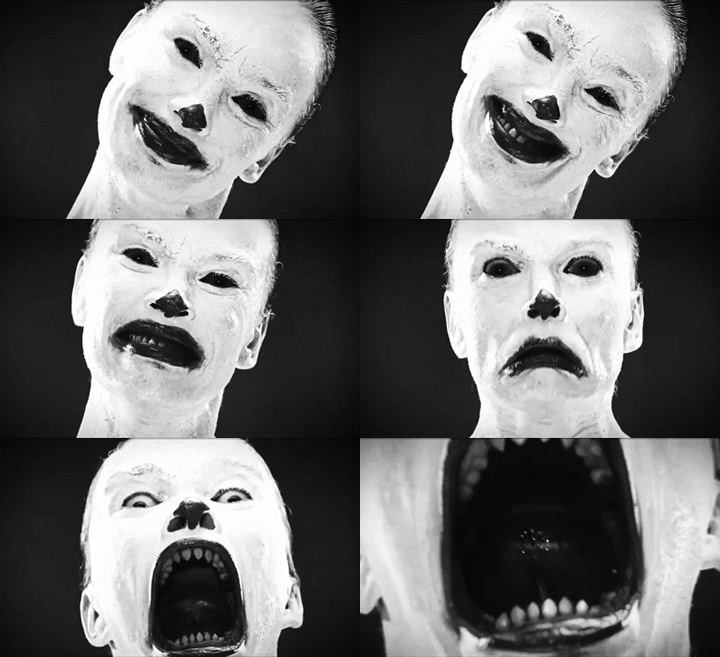
Aieeeeee – run! Run like the very hounds of hell are after you! And the hounds are barking in a French accent!
JC says
I’m going to be upfront with you : film theory isn’t easy. Most theory involves outdated, jargon-laden language, and even after you decode the written style the central concepts can be tricky to get your head around. Add to that the fact that many of the important film theory books and articles take part in a philosophical conversation with other complex, jargon-heavy ideas that you’ve probably never heard of, and you have a recipe for giving up.
I feel there may be a twinge of autobiography about that paragraph. So, Pandora’s Box is opened and out come the droning djinns Althusser, Baudrillard, Barthes, Saussure, Levi-Strauss, Metz, Lacan and Uncle Tom Foucault and all. Reception theory, structuralism, deconstruction, semiotics, the male gaze, queer theory, wow, what a lot of competing ideas all hollering the odds like barkers at the Summer Fair of Utter Profundity. JC explains on p 278 how to apply Levi-Strauss’s binary oppositions of nature/civilisation, men/women and good/bad in three genres of film. Then he points out that
these mythic structures operate at an unconscious level, and so bear in mind that storytellers aren’t necessarily aware of why they use them or why audiences enjoy them
and you may be sure that the audience isn’t pondering Levi-Strauss’s binary opposites either so it appears everyone except Levi-Strauss and his jolly crew are operating at an unconscious level, a little bit like the level I was operating at when I came to the end of this chapter.
JC simply cannot keep a lid on the irritation he feels for some of these (mostly French) theorists. Speaking of Lacan he says
Tell me that Lacan doesn’t have a point. Even if it’s buried beneath layers of interminable psychobabble.
And later, in general
Film theory often performs bizarre leaps of logic and offers eloquent but unsupported conclusions.
Fail! See me after class Baudrillard and Lacan!
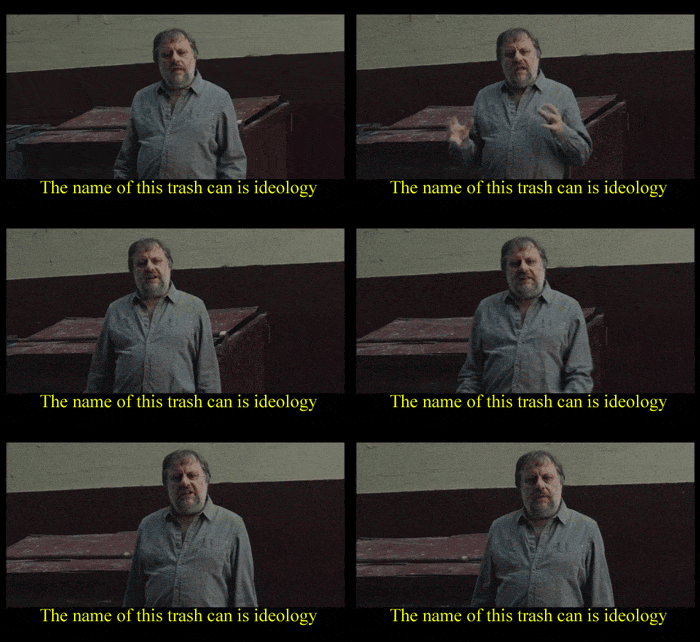
It’s real fun to see James Cateridge having to deal with FILM THEORY and writing about it through GRITTED TEETH. When he’s left Zizek and Stam and Rombes and Lyotard behind he seems like a much happier guy. And so was I.
Recommended. These For Dummies ™ books look pretty silly and have an occasionally naff forced style but all three I’ve read have been solid.
Studying films requires time and effort. And put on your leggings, like the kids from Fame (1980), cos right here’s where you start paying. In sweat.
Or, much later,
I know this argument sounds completely nuts, right?
But he doesn’t do that too much. Mostly he doesn’t do it at all. So everything chugs along smooth & easy with JC rattling on about best boys and star culture and mise-en-scene, Hollywood, Bollywood, genre, Pixar, blah blah blah, no problem, everything sweet as a nut, until page 263, the aptly numbered thirteenth chapter, which is about FILM THEORY.
Aieeeeee – run! Run like the very hounds of hell are after you! And the hounds are barking in a French accent!
JC says
I’m going to be upfront with you : film theory isn’t easy. Most theory involves outdated, jargon-laden language, and even after you decode the written style the central concepts can be tricky to get your head around. Add to that the fact that many of the important film theory books and articles take part in a philosophical conversation with other complex, jargon-heavy ideas that you’ve probably never heard of, and you have a recipe for giving up.
I feel there may be a twinge of autobiography about that paragraph. So, Pandora’s Box is opened and out come the droning djinns Althusser, Baudrillard, Barthes, Saussure, Levi-Strauss, Metz, Lacan and Uncle Tom Foucault and all. Reception theory, structuralism, deconstruction, semiotics, the male gaze, queer theory, wow, what a lot of competing ideas all hollering the odds like barkers at the Summer Fair of Utter Profundity. JC explains on p 278 how to apply Levi-Strauss’s binary oppositions of nature/civilisation, men/women and good/bad in three genres of film. Then he points out that
these mythic structures operate at an unconscious level, and so bear in mind that storytellers aren’t necessarily aware of why they use them or why audiences enjoy them
and you may be sure that the audience isn’t pondering Levi-Strauss’s binary opposites either so it appears everyone except Levi-Strauss and his jolly crew are operating at an unconscious level, a little bit like the level I was operating at when I came to the end of this chapter.
JC simply cannot keep a lid on the irritation he feels for some of these (mostly French) theorists. Speaking of Lacan he says
Tell me that Lacan doesn’t have a point. Even if it’s buried beneath layers of interminable psychobabble.
And later, in general
Film theory often performs bizarre leaps of logic and offers eloquent but unsupported conclusions.
Fail! See me after class Baudrillard and Lacan!
It’s real fun to see James Cateridge having to deal with FILM THEORY and writing about it through GRITTED TEETH. When he’s left Zizek and Stam and Rombes and Lyotard behind he seems like a much happier guy. And so was I.
Recommended. These For Dummies ™ books look pretty silly and have an occasionally naff forced style but all three I’ve read have been solid.

March 26, 2018
You get a whole picture of what to watch, what to read and how to’s about whom in a nutshell. Its an easy read for a beginner and packed with information and explanations. If you are into films like me and kinda perplexed about why some films, makers and books are hallowed, you will love this one :)
March 30, 2015
An easy-to-read book about film theories. He writes eloquently on a subject he's passionate about.

August 13, 2019
I learned so much, it was very interesting and solidified my cinephilia.

April 19, 2020
A fantastic start for film studies for any cinéphile in the world.


August 15, 2023
Doctor James Cartridge published the American British version of Film Studies for Dummies in 2015. James Cartridge is a Senior Lecturer of Film Studies at Oxford Brookes University in the British city of Oxford. I read the book on the Kindle. Cartridge’s book, Film Studies for Dummies was a great introduction to the field of film studies. The book is a little old (Cartridge 35, 198). Cartridge's book has twenty chapters. The book covers a lot of ground. The book has five sections. Section 1 is an introduction to film studies. Section 2 is on “genres, modes, and style” (Cartridge 88). Section 3 is on “Global Cinema” (Cartridge 175). Section 4 is on film theories and on film technology in the 21st Century as of 2015. Section 5 is on how to develop as a student of film studies including activities to become a better student of the field. Cartridge in this section recommends certain writers to read, films to watch, and filmmakers to gain a better understanding of the field. Cartridge is a personality in his book (Cartridge 214). The book includes illustrations of several stills from several films. I thought James Cartridge’s book Film Studies for Dummies was a well-done older overview of the field of Film Studies.
Displaying 1 - 7 of 7 reviews