

What do you think?

Star Wars Legends: Novels
Shadows of the Empire: Star Wars Legends
Here is the untold story of the events that took place between the movies The Empire Strikes Back and Return of the Jedi: a novel in which Darth Vader still lives--and battles a villain as powerful and evil as himself.
SHADOWS OF THE EMPIRE
It is a time of crisis. Han Solo, frozen in carbonite, is being taken to the vile gangster Jabba the Hutt. As Princess Leia mounts a rescue mission including Luke Skywalker, Lando Calrissian, and a brilliant young pilot, Darth Vader pits himself against a cunning and ruthless rival. Xizor is the leader of a powerful crime syndicate who seeks to supplant Vader for the favor of their mutual master, the dreaded Emperor. Their target: Luke Skywalker. Suddenly Luke finds himself the potential prize of the two most evil entities in the galaxy--one who wants him alive...and one who wants him dead.
SHADOWS OF THE EMPIRE
It is a time of crisis. Han Solo, frozen in carbonite, is being taken to the vile gangster Jabba the Hutt. As Princess Leia mounts a rescue mission including Luke Skywalker, Lando Calrissian, and a brilliant young pilot, Darth Vader pits himself against a cunning and ruthless rival. Xizor is the leader of a powerful crime syndicate who seeks to supplant Vader for the favor of their mutual master, the dreaded Emperor. Their target: Luke Skywalker. Suddenly Luke finds himself the potential prize of the two most evil entities in the galaxy--one who wants him alive...and one who wants him dead.
416 pages, Paperback
First published May 1, 1996
About the author
Steve Perry
310 books378 followersLibrarians note: There is more than one author in the Goodreads database with this name.
Steven Carl Perry has written over fifty novels and numerous short stories, which have appeared in various magazines and anthologies. Perry is perhaps best known for the Matador series. He has written books in the Star Wars, Alien and Conan universes. He was a collaborator on all of the Tom Clancy's Net Force series, seven of which have appeared on the New York Times Bestseller list. Two of his novelizations, Star Wars: Shadows of the Empire and Men in Black have also been bestsellers. Other writing credits include articles, reviews, and essays, animated teleplays, and some unproduced movie scripts. One of his scripts for Batman: The Animated Series was an Emmy Award nominee for Outstanding Writing.
Perry is a member of the Science Fiction and Fantasy Writers of America, The Animation Guild, and the Writers Guild of America, West
Steven Carl Perry has written over fifty novels and numerous short stories, which have appeared in various magazines and anthologies. Perry is perhaps best known for the Matador series. He has written books in the Star Wars, Alien and Conan universes. He was a collaborator on all of the Tom Clancy's Net Force series, seven of which have appeared on the New York Times Bestseller list. Two of his novelizations, Star Wars: Shadows of the Empire and Men in Black have also been bestsellers. Other writing credits include articles, reviews, and essays, animated teleplays, and some unproduced movie scripts. One of his scripts for Batman: The Animated Series was an Emmy Award nominee for Outstanding Writing.
Perry is a member of the Science Fiction and Fantasy Writers of America, The Animation Guild, and the Writers Guild of America, West
Ratings & Reviews
Friends & Following
Create a free account to discover what your friends think of this book!
Community Reviews
Displaying 1 - 30 of 826 reviews

January 29, 2008
I recall this book perfectly connected the times between Empire and Return of the Jedi. Boba Fett versus bounty hunters, the sinister Black Sun org, and Bothan spies! At last, all the classic characters set up for the big moment at Jabba's palace.
So... is this still canon? Why not? I do understand that post-Disney most of the EU had to be thrown away if we are to have the new films, but why disregard the period before that...
As far as I'm concerned, everything which predates that should remain canon. Then, after the Battle of Endor the timeline was split between two different New Republic era alternate realities.
Shadows of the Empire therefore still counts, dammit.
So... is this still canon? Why not? I do understand that post-Disney most of the EU had to be thrown away if we are to have the new films, but why disregard the period before that...
As far as I'm concerned, everything which predates that should remain canon. Then, after the Battle of Endor the timeline was split between two different New Republic era alternate realities.
Shadows of the Empire therefore still counts, dammit.

May 2, 2023
This is one of the few stories that are worthy of the original trilogy and would have made a fantastic Star Wars film.
If you're not familiar with it, in a nutshell, this is the story set between Empire Strikes Back and Return of the Jedi where Luke, Leia and co are trying to rescue Han from Boba Fett. The story ends when they're about to infiltrate Jabba's palace.
The development of Darth Vader's character in this is especially fantastic, as you get to see more into his mind than you do in the films.
It's a great story, and I'd definitely recommend any Star Wars fans to read it if they haven't already!
If you're not familiar with it, in a nutshell, this is the story set between Empire Strikes Back and Return of the Jedi where Luke, Leia and co are trying to rescue Han from Boba Fett. The story ends when they're about to infiltrate Jabba's palace.
The development of Darth Vader's character in this is especially fantastic, as you get to see more into his mind than you do in the films.
It's a great story, and I'd definitely recommend any Star Wars fans to read it if they haven't already!

June 9, 2013
"Book, you have the right to a speedy trial" review
THE DEFENSE
- Author does a great job portraying the battle between the Dark Side and the Light Side of the Force - I just reread that sentence...I'm starting to think it's possible that I might be a... GEEK! :o
- Personalities of the classic Star Wars characters are captured very well...particularly Lando! - Me, a geek? I always thought I was as suave and sophisticated as Lando as I strut around in my dress shirt and Scooby-Doo tie!
- Fills in the gaps between "The Empire Strikes Back" and "Return of the Jedi" nicely - So if you're like me and ever wondered where Leia got her bounty hunter costume from "Jedi"...oh mygod Lucas, who asks questions like that?!? I AM A GEEK!!!
- Action sequences flow nicely...especially the exciting dogfights between the spaceships - If only there been some indication I may be turning into a geek at my high school prom when I spent the whole night sitting in the corner reading comic books...oh, okay, now I get it!
- Xizor and Guri make very compelling adversaries for both the Rebel Alliance and the Empire - Know what? If enjoying Star Wars makes me a geek, then I'm perfectly happy being a geek! (Which is good, since fate already made that decision for me a long time ago in a galaxy far, far away!)
THE PROSECUTION
- Princess Leia spends a little too much time in the "damsel in distress" role - Realizing that instead of kicking butt, Leia was going to spend several chapters sitting in a prison cell? I believe Darth Vader said it best when he said, "NOOOOOOOOOOOOOOOO!!!"
- Some of the Darth Vader POV felt a little...off! - Reading things like, "Vader sighed"...Vader NEVER sighs! That sound wasn't a sigh, dammit, it was him choking the life out of the inept Imperial commander who would have made a lesser villain sigh!!! The Dark Lord of the Sith DOES NOT SIGH!(Easy, Dave, compose yourself...)
- Dash Rendar just might be the most annoying Star Wars character ever...

Alright...second most annoying Star Wars character ever...
*SIGH* (See that, I can sigh, but not Vader...NEVER Vader!) Let's just say Dash Rendar is in the Top Ten Most Annoying Star Wars characters list and leave it at that!
THE VERDICT
An entertaining adventure that captures most of the magic of Star Wars (as well as a few of the missteps), this book is a fun romp for anyone who's already watched the movies and wants more Star Wars!
FULL REVIEW TO COME
THE DEFENSE
- Author does a great job portraying the battle between the Dark Side and the Light Side of the Force - I just reread that sentence...I'm starting to think it's possible that I might be a... GEEK! :o
- Personalities of the classic Star Wars characters are captured very well...particularly Lando! - Me, a geek? I always thought I was as suave and sophisticated as Lando as I strut around in my dress shirt and Scooby-Doo tie!
- Fills in the gaps between "The Empire Strikes Back" and "Return of the Jedi" nicely - So if you're like me and ever wondered where Leia got her bounty hunter costume from "Jedi"...oh my
- Action sequences flow nicely...especially the exciting dogfights between the spaceships - If only there been some indication I may be turning into a geek at my high school prom when I spent the whole night sitting in the corner reading comic books...oh, okay, now I get it!
- Xizor and Guri make very compelling adversaries for both the Rebel Alliance and the Empire - Know what? If enjoying Star Wars makes me a geek, then I'm perfectly happy being a geek! (Which is good, since fate already made that decision for me a long time ago in a galaxy far, far away!)
THE PROSECUTION
- Princess Leia spends a little too much time in the "damsel in distress" role - Realizing that instead of kicking butt, Leia was going to spend several chapters sitting in a prison cell? I believe Darth Vader said it best when he said, "NOOOOOOOOOOOOOOOO!!!"
- Some of the Darth Vader POV felt a little...off! - Reading things like, "Vader sighed"...Vader NEVER sighs! That sound wasn't a sigh, dammit, it was him choking the life out of the inept Imperial commander who would have made a lesser villain sigh!!! The Dark Lord of the Sith DOES NOT SIGH!(Easy, Dave, compose yourself...)
- Dash Rendar just might be the most annoying Star Wars character ever...
Alright...second most annoying Star Wars character ever...
*SIGH* (See that, I can sigh, but not Vader...NEVER Vader!) Let's just say Dash Rendar is in the Top Ten Most Annoying Star Wars characters list and leave it at that!
THE VERDICT
An entertaining adventure that captures most of the magic of Star Wars (as well as a few of the missteps), this book is a fun romp for anyone who's already watched the movies and wants more Star Wars!
FULL REVIEW TO COME

July 22, 2012
I can easily guess why George Lucas never went on to make his planned third trilogy (Episodes 7-9)* by perusing the sci-fi section of any bookstore: he didn't need to. There are a slew of other writers who have carried on the Star Wars mythos. Probably better than Lucas's movies would have been, in my opinion. I have read a small handful of the Star Wars novels, and some are better than others.
Back in the mid-'90s, best-selling sci-fi author Steve Perry jumped on the Star Wars bandwagon with his novel "Shadows of the Empire", a continuation of the events of Episode V: The Empire Strikes Back, before the events of Episode VI: Return of the Jedi.
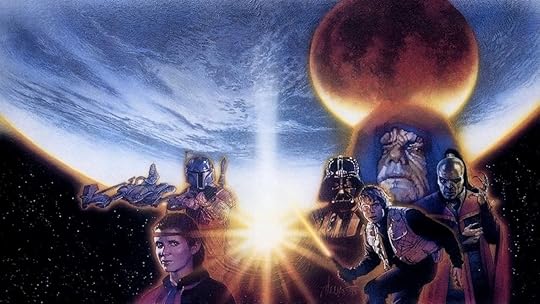
It's basically a filler novel, completely superfluous, but entertaining nonetheless. It's also one of the better Star Wars novels I have read, second only to the terrific Timothy Zahn three-book series.
Perry's book does several things well:
1) It develops Darth Vader's character by giving us insight into his reasons for wanting Luke Skywalker alive, at first for strategic reasons (bringing Luke to the Dark Side would make the Empire more powerful) and gradually for more familial reasons (deep deep down, Vader truly does love his son), leading to his eventual redemption in ROTJ.
2) It helps to explain Leia's inexplicable turn-around in TESB from being completely indifferent to Han to falling in love with him, as we see a fully-developed independent woman who thinks she knows what she wants in a man, until she meets the ruggedly charming Han Solo, who throws her whole world-view out of whack.
3) It also foreshadows Leia's own powers of the Force, which Vader begins to pick up on.
Perry also knows how to write action/adventure and keep the pace at break-neck speed. A good read for uber-geeks like me who love Star Wars.
*5/4/2025 addendum: He was waiting for J.J Abrams to do it for him.
Back in the mid-'90s, best-selling sci-fi author Steve Perry jumped on the Star Wars bandwagon with his novel "Shadows of the Empire", a continuation of the events of Episode V: The Empire Strikes Back, before the events of Episode VI: Return of the Jedi.
It's basically a filler novel, completely superfluous, but entertaining nonetheless. It's also one of the better Star Wars novels I have read, second only to the terrific Timothy Zahn three-book series.
Perry's book does several things well:
1) It develops Darth Vader's character by giving us insight into his reasons for wanting Luke Skywalker alive, at first for strategic reasons (bringing Luke to the Dark Side would make the Empire more powerful) and gradually for more familial reasons (deep deep down, Vader truly does love his son), leading to his eventual redemption in ROTJ.
2) It helps to explain Leia's inexplicable turn-around in TESB from being completely indifferent to Han to falling in love with him, as we see a fully-developed independent woman who thinks she knows what she wants in a man, until she meets the ruggedly charming Han Solo, who throws her whole world-view out of whack.
3) It also foreshadows Leia's own powers of the Force, which Vader begins to pick up on.
Perry also knows how to write action/adventure and keep the pace at break-neck speed. A good read for uber-geeks like me who love Star Wars.
*5/4/2025 addendum: He was waiting for J.J Abrams to do it for him.

February 14, 2023
3.5 Stars
This was an interesting time period to read because it was set between the second and third movie in the original trilogy. It has some good character moments but it wasn't the most interesting story.
This was an interesting time period to read because it was set between the second and third movie in the original trilogy. It has some good character moments but it wasn't the most interesting story.

July 24, 2010
"Stand back. Let's see if it will stop a lightsaber."
Han Solo is locked in carbonite, in the possession of Boba Fett. Luke, Lando, Leia, and Chewie are desperately searching for the bounty hunter, in the hopes of rescuing Han. Meanwhile, Prince Xizor of the Black Sun is angling to destroy his rival and destroyer of his family, Darth Vader.
NOTE: Based on the audiobook and what I remember of the novel I read years ago.
I Liked:
Steve Perry is given a difficult task: bridge the gap between The Empire Strikes Backand Return of the Jedi. This is difficult because he has to write an interesting book, yet keep continuity. Most authors just have to write a plausible future Luke, Leia, and Han; this job is far more difficult. And for the most part, Perry does an impressive job.
The characters were fairly strong, namely Luke and Leia. I liked how Perry lead Luke into being the sedate Jedi we see in Return of the Jedi, making him grow from the brash apprentice in Empire Strikes Back. One moment I particularly was fond of was Luke returning to Obi-Wan's hovel to build his lightsaber. I loved this little bit of continuity. Leia was also well done, conflicted about her feelings to Han, wondering how he felt, nervous, yet still strong even in the face of Prince Xizor's advances (which were fine to me as he was using pheromones on her--in fact, I thought it made her look stronger to be able to withstand his biological advances).
As for our bad guys, we rarely get to see Darth Vader in the helmet, and at the time, this novel was novel (har har) in that we got a Vader point of view. Since most Bantam books were strictly post-Jedi, Vader got omitted completely, which was a shame, as he was such an interesting character. Here, I enjoyed how Perry had Vader try to use the Dark Side to heal himself, but always fail, as his joy for being healed won out.
Lastly, I oddly liked how it was unclear whether or not Prince Xizor died (at least, that's the way I heard it).
I Didn't Like:
The first thing I didn't like was how much Dash Rendar was like Han Solo. Now, I've heard that the character was created for the game, so maybe Perry had very little choice in how Dash was supposed to be. Okay, I understand that. But still, couldn't Perry have tried a wee bit harder to make Dash unique and not so much like Han? I couldn't help but wince when I read him in a scene.
Xizor is often uplifted as this really great villain, and I am just unsure why. Sure, he plots and schemes in this book, but, partly because he is doomed to fail, nothing happens of it. All he does is exercise, change clothes, and seduce women. I wish Perry had allowed Xizor some way of winning something, just so I could be assured he was a real threat, instead of a dandified playboy. And I almost didn't even want to start reading the novel when Xizor miraculously knows that Vader is Anakin Skywalker. No one knows that! How does he?
Another problem I have is how this book feels like filler. Other than a few nice tie-ins (Leia getting the Boushh costume, the thermal detonator, Luke's lightsaber, the Bothan spies), the whole book is just filler. We all know the outcome, there is little suspense, there is little to engage us. It doesn't help when circumstances keep repeating themselves (Leia gets kidnapped to lure Luke to Coruscant, like done in Empire, Dash Rendar returns to help like Han returned to help Luke in A New Hope, Luke and Lando hide in a surprisingly dense asteroid field, and so on).
My last complaint is about Perry's writing style. I found it quite juvenile, filled with simple, embarrassing sentences. Here is one such example:
[Luke:] "Stand back. Let's see if it will stop a lightsaber."
The door would not stop a lightsaber. They went through and continued to climb.
Not only does the above excerpt contain an unnecessary and embarrassing line of dialogue made of pure cheese, the narration is boring, uninspired, and uninteresting. I have no idea how Luke sliced the door, where, if he cut a chunk or the whole thing off, if there were people right behind him or anything. In fact, all this scene does is give us filler, more padding to drag out the big escape.
Dialogue/Sexual Situation/Violence:
Light to none spattering of mild profanity.
Prince Xizor fancies himself a player and makes the moves on Leia.
We have space battles, attempted murders, lightsaber battles, rescues, kidnappings, etc.
Overall:
One of the better Star Wars novels out there, Shadows of the Empire is entertaining but not hugely memorable. Not a bad book to put on your reading list, but I wouldn't rush out to read it anytime soon.
Han Solo is locked in carbonite, in the possession of Boba Fett. Luke, Lando, Leia, and Chewie are desperately searching for the bounty hunter, in the hopes of rescuing Han. Meanwhile, Prince Xizor of the Black Sun is angling to destroy his rival and destroyer of his family, Darth Vader.
NOTE: Based on the audiobook and what I remember of the novel I read years ago.
I Liked:
Steve Perry is given a difficult task: bridge the gap between The Empire Strikes Backand Return of the Jedi. This is difficult because he has to write an interesting book, yet keep continuity. Most authors just have to write a plausible future Luke, Leia, and Han; this job is far more difficult. And for the most part, Perry does an impressive job.
The characters were fairly strong, namely Luke and Leia. I liked how Perry lead Luke into being the sedate Jedi we see in Return of the Jedi, making him grow from the brash apprentice in Empire Strikes Back. One moment I particularly was fond of was Luke returning to Obi-Wan's hovel to build his lightsaber. I loved this little bit of continuity. Leia was also well done, conflicted about her feelings to Han, wondering how he felt, nervous, yet still strong even in the face of Prince Xizor's advances (which were fine to me as he was using pheromones on her--in fact, I thought it made her look stronger to be able to withstand his biological advances).
As for our bad guys, we rarely get to see Darth Vader in the helmet, and at the time, this novel was novel (har har) in that we got a Vader point of view. Since most Bantam books were strictly post-Jedi, Vader got omitted completely, which was a shame, as he was such an interesting character. Here, I enjoyed how Perry had Vader try to use the Dark Side to heal himself, but always fail, as his joy for being healed won out.
Lastly, I oddly liked how it was unclear whether or not Prince Xizor died (at least, that's the way I heard it).
I Didn't Like:
The first thing I didn't like was how much Dash Rendar was like Han Solo. Now, I've heard that the character was created for the game, so maybe Perry had very little choice in how Dash was supposed to be. Okay, I understand that. But still, couldn't Perry have tried a wee bit harder to make Dash unique and not so much like Han? I couldn't help but wince when I read him in a scene.
Xizor is often uplifted as this really great villain, and I am just unsure why. Sure, he plots and schemes in this book, but, partly because he is doomed to fail, nothing happens of it. All he does is exercise, change clothes, and seduce women. I wish Perry had allowed Xizor some way of winning something, just so I could be assured he was a real threat, instead of a dandified playboy. And I almost didn't even want to start reading the novel when Xizor miraculously knows that Vader is Anakin Skywalker. No one knows that! How does he?
Another problem I have is how this book feels like filler. Other than a few nice tie-ins (Leia getting the Boushh costume, the thermal detonator, Luke's lightsaber, the Bothan spies), the whole book is just filler. We all know the outcome, there is little suspense, there is little to engage us. It doesn't help when circumstances keep repeating themselves (Leia gets kidnapped to lure Luke to Coruscant, like done in Empire, Dash Rendar returns to help like Han returned to help Luke in A New Hope, Luke and Lando hide in a surprisingly dense asteroid field, and so on).
My last complaint is about Perry's writing style. I found it quite juvenile, filled with simple, embarrassing sentences. Here is one such example:
[Luke:] "Stand back. Let's see if it will stop a lightsaber."
The door would not stop a lightsaber. They went through and continued to climb.
Not only does the above excerpt contain an unnecessary and embarrassing line of dialogue made of pure cheese, the narration is boring, uninspired, and uninteresting. I have no idea how Luke sliced the door, where, if he cut a chunk or the whole thing off, if there were people right behind him or anything. In fact, all this scene does is give us filler, more padding to drag out the big escape.
Dialogue/Sexual Situation/Violence:
Light to none spattering of mild profanity.
Prince Xizor fancies himself a player and makes the moves on Leia.
We have space battles, attempted murders, lightsaber battles, rescues, kidnappings, etc.
Overall:
One of the better Star Wars novels out there, Shadows of the Empire is entertaining but not hugely memorable. Not a bad book to put on your reading list, but I wouldn't rush out to read it anytime soon.

August 1, 2013
A Quickie Review
Shadows of the Empire was probably the biggest non-movie Star Wars event up to that point. Though no film was made, a CD soundtrack was released, and there was a video/computer game for the Nintendo 64 and PC based on the book. However, even all that promotion doesn't take away from the actual novel's lackluster feel. Though not terrible, it's merely mediocre, and the Expanded Universe has much better fare to offer than this. Only read this if you love absolutely everything related to Lucas' space opera, or have an insatiable curiosity about this much-promoted book.
Content Concerns: As usual, there is violence, though none of it is bloody or graphic. More notable is the sexual content, where new villain Xizor attempts to seduce Princess Leia. Additionally, gambling gets a few mentions, and profanity is implied.
Score: 2.75/5
EDIT: I enjoyed it more the second time.
Shadows of the Empire was probably the biggest non-movie Star Wars event up to that point. Though no film was made, a CD soundtrack was released, and there was a video/computer game for the Nintendo 64 and PC based on the book. However, even all that promotion doesn't take away from the actual novel's lackluster feel. Though not terrible, it's merely mediocre, and the Expanded Universe has much better fare to offer than this. Only read this if you love absolutely everything related to Lucas' space opera, or have an insatiable curiosity about this much-promoted book.
Content Concerns: As usual, there is violence, though none of it is bloody or graphic. More notable is the sexual content, where new villain Xizor attempts to seduce Princess Leia. Additionally, gambling gets a few mentions, and profanity is implied.
Score: 2.75/5
EDIT: I enjoyed it more the second time.

June 28, 2022
La creación de esta novela y todo lo que tuvo a su alrededor tiene más jugo que la novela en sí. Cuando el Universo Expandido de Star Wars empezó a tener el éxito que tuvo a comienzos de los noventa. Con la salida de todos los libros, comics y videojuegos y el juego de rol que empezaron a agrandar y profundizar aún más las películas originales. Lucasfilm decidió realizar un proyecto potente que aunara las tres principales herramientas que tenía el UE ya mencionados. Se realizarían una novela, esta que reseño, una serie de comics, y un videojuego. Y en cada uno se contaría una parte de una historia que se complementan entre si y que igualmente puede ser disfrutada por separado. Con la buena voluntad de George Lucas que dio el visto bueno y el cual le entusiasmo tanto la idea, y como buen hombre de negocios que es, decidió aumentar la importancia de este proyecto, canonizando la historia que se narraba en este proyecto e incluso reconoció que era una historia que le hubiera encantado filmar. Si, el mismo que luego renegó de todo lo que se hizo cuando Disney compro Lucasfilm e hizo su borrado del UE, como cambian las cosas amigos.
Vaya que este proyecto se vendió como una película de Star Wars, sin haber una película siquiera. Por tener, tiene hasta una banda sonora, en mi opinión mucho mejor que el libro en si jaja. En fin, que la historia sucede entre el Imperio Contrataca y el Retorno del Jedi. Luke, Leia, Chewbacca y Lando van en busca de Han Solo, que está encerrado en carbonita y es transportado por Boba Fett que pretende entregárselo a Jabba el Hutt. Darth Vader pretende hacer todo lo posible para que su hijo se una a él en el Lado Oscuro y juntos derroquen al Emperador, o entregárselo al Emperador si se niega. Pero un oponente se le presenta, el Príncipe Xizor, el líder de la mayor trama mafiosa de la Galaxia, el Sol Negro. Una organización criminal tan poderosa y antigua que rivaliza casi con el mismo Imperio Galáctico en peligro. Este personaje, Xizor, tiene unas aspiraciones estratosféricas, y cree poder sustituir a Vader como mano derecha del Emperador, este no le impide sus caprichos políticos puesto que le encantan probar la valía de su aprendiz en el juego de tronos. Además Xizor tiene una inquina personal con el Señor Oscuro del Sith por un acontecimiento de su pasado. Todo esto desentrañara una nueva aventura que afectara a todas las partes del juego, a los héroes y al villano.
Ahora, que ya está todo presentado, procedo a la reseña de la historia. Meh, así se resumiría todo, en un gran meh. No es una mala historia, pero tampoco es una buena historia. Es entretenida, pero al mismo tiempo muy predecible y sencilla. Se ha quedado algo anticuada y tiene mucho relleno para lo que quiere contar. Se lee rápido sin duda, y debo reconocer que tener un villano que es un trasunto entre el Padrino y un “galán” espeluznante tiene su punto. Pero queda al final como un personaje demasiado caricaturizado por su autor, perfecto en casi todo y al mismo tiempo no muy memorable en nada. En lo único memorable al menos para mí es el autor de la novela que recurre a su raza exótica para traernos escenas que no pretenden ser graciosas pero que a mí me han hecho gracia en el mal sentido. Para aclarar este punto, Xizor, que es un alienígena de la raza Falleen, una raza humanoide reptiliana, es capaz de soltar feromonas que atraen a los humanoides del sexo contrario. ¿Porque menciono esto? Porque Xizor es un bribón que está obsesionado con la belleza, sobretodo femenina. Obviamente usara esta herramienta para atraer a la Princesa Leia en su juego, en una escena tan tórrida como ridícula a día de hoy. No digo que no sea una idea descabellada, total, en el universo de Star Wars se ha visto de todo, no es algo que desentone de magos espaciales y demás parafernalia. Pero como está escrito en papel, no deja de ser un recurso muy noventero que al menos a mí me ha sacado alguna sonrisita tonta y a otros seguramente le sacara de la historia y les provocara rechazo. No les culpo, pero vaya que el problema de la novela no es esa solamente, en general es un libro que fuera de la nostalgia y del impacto que tuvo en su día todo este proyecto, ha quedado relegado al olvido. Hay historias dentro de la franquicia Star Wars mucho mejores, creedme.
Tiene cosas buenas sin duda, rellena datos entre películas que no llegamos a ver. Como a Luke creando su sable de luz verde. Él porque el Emperador decidió filtrar los planos de la segunda Estrella de la Muerte, y los bothanos que murieron para que esta información llegara a manos de la Alianza Rebelde. Los capítulos de Darth Vader están graciosetes, aunque sea un Vader descafeinado. Toda la trama criminal del Sol Negro y lo que aporto al UE.
Pero las cosas negativas superan a las positivas. Como un personaje femenino llamado Guri, que es un androide perfectamente irreconocible de un ser humano, al estilo Blade Runner. No solo desentona totalmente con el Universo Star Wars que exista estos androides (que yo sepa nunca se ve uno igual en otras historias), si no que el personaje no tiene mucho más. Una androide guardaespaldas de Xizor que es una rubia que está muy buena (en la historia siempre se menciona esto xD), y que lucha y mata de una manera muy letal. Luego esta Dash Rendar, un personaje a lo Han Solo que es eso, un Han Solo sin gracia y estereotipado. Con una historia de su pasado de lo más ridícula que solo esta porque es el personaje de acción metido con calzador y porque es el protagonista del videojuego de este proyecto multimedia.
Y para un personaje que me hubiera gustado ver más, como es el cazarrecompensas Boba Fett, personaje muy molón del UE que ha sido tristemente machacado y acribillado por Disney en la decepcionante serie de El Libro de Boba Fett, convertido en un memo y patético “señor del crimen” de AliExpress. Yo que quería limpiarme el mal sabor de boca respecto a cómo han tratado al personaje últimamente y ver como tuvo que zafarse de la competencia de asesinos, cazarrecompensas y demás ralea que quería el cuerpo de Han como botín. Van y esa historia está en el comic (que paso de leer), no en la novela, aquí solo aparece de refilón una vez. Que se piren hombre.
En conclusión, una historia memorable la creación de este megaproyecto conjunto, que aporto mucho en su día al Universo Expandido, pero que a día de hoy ha sido superada en todos los ámbitos.
Vaya que este proyecto se vendió como una película de Star Wars, sin haber una película siquiera. Por tener, tiene hasta una banda sonora, en mi opinión mucho mejor que el libro en si jaja. En fin, que la historia sucede entre el Imperio Contrataca y el Retorno del Jedi. Luke, Leia, Chewbacca y Lando van en busca de Han Solo, que está encerrado en carbonita y es transportado por Boba Fett que pretende entregárselo a Jabba el Hutt. Darth Vader pretende hacer todo lo posible para que su hijo se una a él en el Lado Oscuro y juntos derroquen al Emperador, o entregárselo al Emperador si se niega. Pero un oponente se le presenta, el Príncipe Xizor, el líder de la mayor trama mafiosa de la Galaxia, el Sol Negro. Una organización criminal tan poderosa y antigua que rivaliza casi con el mismo Imperio Galáctico en peligro. Este personaje, Xizor, tiene unas aspiraciones estratosféricas, y cree poder sustituir a Vader como mano derecha del Emperador, este no le impide sus caprichos políticos puesto que le encantan probar la valía de su aprendiz en el juego de tronos. Además Xizor tiene una inquina personal con el Señor Oscuro del Sith por un acontecimiento de su pasado. Todo esto desentrañara una nueva aventura que afectara a todas las partes del juego, a los héroes y al villano.
Ahora, que ya está todo presentado, procedo a la reseña de la historia. Meh, así se resumiría todo, en un gran meh. No es una mala historia, pero tampoco es una buena historia. Es entretenida, pero al mismo tiempo muy predecible y sencilla. Se ha quedado algo anticuada y tiene mucho relleno para lo que quiere contar. Se lee rápido sin duda, y debo reconocer que tener un villano que es un trasunto entre el Padrino y un “galán” espeluznante tiene su punto. Pero queda al final como un personaje demasiado caricaturizado por su autor, perfecto en casi todo y al mismo tiempo no muy memorable en nada. En lo único memorable al menos para mí es el autor de la novela que recurre a su raza exótica para traernos escenas que no pretenden ser graciosas pero que a mí me han hecho gracia en el mal sentido. Para aclarar este punto, Xizor, que es un alienígena de la raza Falleen, una raza humanoide reptiliana, es capaz de soltar feromonas que atraen a los humanoides del sexo contrario. ¿Porque menciono esto? Porque Xizor es un bribón que está obsesionado con la belleza, sobretodo femenina. Obviamente usara esta herramienta para atraer a la Princesa Leia en su juego, en una escena tan tórrida como ridícula a día de hoy. No digo que no sea una idea descabellada, total, en el universo de Star Wars se ha visto de todo, no es algo que desentone de magos espaciales y demás parafernalia. Pero como está escrito en papel, no deja de ser un recurso muy noventero que al menos a mí me ha sacado alguna sonrisita tonta y a otros seguramente le sacara de la historia y les provocara rechazo. No les culpo, pero vaya que el problema de la novela no es esa solamente, en general es un libro que fuera de la nostalgia y del impacto que tuvo en su día todo este proyecto, ha quedado relegado al olvido. Hay historias dentro de la franquicia Star Wars mucho mejores, creedme.
Tiene cosas buenas sin duda, rellena datos entre películas que no llegamos a ver. Como a Luke creando su sable de luz verde. Él porque el Emperador decidió filtrar los planos de la segunda Estrella de la Muerte, y los bothanos que murieron para que esta información llegara a manos de la Alianza Rebelde. Los capítulos de Darth Vader están graciosetes, aunque sea un Vader descafeinado. Toda la trama criminal del Sol Negro y lo que aporto al UE.
Pero las cosas negativas superan a las positivas. Como un personaje femenino llamado Guri, que es un androide perfectamente irreconocible de un ser humano, al estilo Blade Runner. No solo desentona totalmente con el Universo Star Wars que exista estos androides (que yo sepa nunca se ve uno igual en otras historias), si no que el personaje no tiene mucho más. Una androide guardaespaldas de Xizor que es una rubia que está muy buena (en la historia siempre se menciona esto xD), y que lucha y mata de una manera muy letal. Luego esta Dash Rendar, un personaje a lo Han Solo que es eso, un Han Solo sin gracia y estereotipado. Con una historia de su pasado de lo más ridícula que solo esta porque es el personaje de acción metido con calzador y porque es el protagonista del videojuego de este proyecto multimedia.
Y para un personaje que me hubiera gustado ver más, como es el cazarrecompensas Boba Fett, personaje muy molón del UE que ha sido tristemente machacado y acribillado por Disney en la decepcionante serie de El Libro de Boba Fett, convertido en un memo y patético “señor del crimen” de AliExpress. Yo que quería limpiarme el mal sabor de boca respecto a cómo han tratado al personaje últimamente y ver como tuvo que zafarse de la competencia de asesinos, cazarrecompensas y demás ralea que quería el cuerpo de Han como botín. Van y esa historia está en el comic (que paso de leer), no en la novela, aquí solo aparece de refilón una vez. Que se piren hombre.
En conclusión, una historia memorable la creación de este megaproyecto conjunto, que aporto mucho en su día al Universo Expandido, pero que a día de hoy ha sido superada en todos los ámbitos.

June 11, 2010
I'd heard good things about SoTE, had fond memories of the game, and honestly thought the plot sounded pretty good in summary. Unfortunately, Steve Perry's execution of it was terrifically worthless. He includes not one but two Gary Stus - Dash Rendar and Prince Xizor. This is generally a bad way to design characters. However, the real problem with SoTE is that Perry never escapes the tropes of the SW universe. I realize there is a fine line between repetitious, predictable tropes and the archetypes and mythological patterns that are central to SW, but it seems like the editors could have kept this piece of clumsy fan-fiction grade writing off the shelves.
Every character is motivated by murdered family members, everyone is a played-out stereotype of a character with a few major traits that are turned up to the max, and all the action occurs in bursts of stereotyped scenes - chase scenes, fight scenes, etc, which all end predictably and follow the patterns. Nor are the plot arcs really developed in a way that emphasizes their relative importance. The Suprosa bit, crucial to setting up ROTJ, came out of nowhere, went by quickly and without much attention, and didn't give me any reason to care about the Bothan pilots. So what if half the squadron died, and they were rookies? If it had been a larger battle, and they'd been members of a no-name random x-wing squadron, they'd never get mentioned again.
Another reviewer made some comment to the effect that, if you're picking a star wars novel, you can't be expecting "existential philosophy." But fortunately, many authors have recently raised the bar in SW to the point that I do now have high expectations of SW novels. The KOTOR games, Matthew Stover's novels, as well as select other novels written by people who care and know how to write, and also including the excellent essential guides and rpg sourcebooks written by people who care as much or more, have done great things for the quality of new Star Wars stories. Enjoy one of them, and don't bother with SoTE. Read a summary instead.
Every character is motivated by murdered family members, everyone is a played-out stereotype of a character with a few major traits that are turned up to the max, and all the action occurs in bursts of stereotyped scenes - chase scenes, fight scenes, etc, which all end predictably and follow the patterns. Nor are the plot arcs really developed in a way that emphasizes their relative importance. The Suprosa bit, crucial to setting up ROTJ, came out of nowhere, went by quickly and without much attention, and didn't give me any reason to care about the Bothan pilots. So what if half the squadron died, and they were rookies? If it had been a larger battle, and they'd been members of a no-name random x-wing squadron, they'd never get mentioned again.
Another reviewer made some comment to the effect that, if you're picking a star wars novel, you can't be expecting "existential philosophy." But fortunately, many authors have recently raised the bar in SW to the point that I do now have high expectations of SW novels. The KOTOR games, Matthew Stover's novels, as well as select other novels written by people who care and know how to write, and also including the excellent essential guides and rpg sourcebooks written by people who care as much or more, have done great things for the quality of new Star Wars stories. Enjoy one of them, and don't bother with SoTE. Read a summary instead.

March 16, 2019
Here we go- One of the more noteworthy novels from Star Wars Legends, Steve Perry's Shadows of the Empire.
Also, an ENORMOUS thank you to my goodreads pal Crystal Starr Light - she sent me an AUTOGRAPHED BY STEVE PERRY COPY of this book and I am so happy to have it as part of my collection!
Anyways, on to the book itself. "Shadows of the Empire" is much more than just another tie-in star wars novel from the original Expanded Universe. This was an entire multimedia project created by Lucasfilm in 1996- with collaboration between Bantam Books, Lucasarts, and Dark Horse Comics to create a massive but intimately woven story that chronicles the gap between The Empire Strikes Back and Return of the Jedi. Different parts of this story are told in the various pieces of media that are part of it. The comic is about Boba Fett and the Bounty Hunters, while the N64 video game stars new character Dash Rendar. The book, which I am reviewing here, showcases the central characters of the Original Trilogy and what they were going through during this time- as well as how they were dealing with the absence of Han Solo.
THE STORY: Han Solo has been captured by Boba Fett, and the Rebel Alliance has suffered a crushing defeat at the hands of the Galactic Empire. Luke Skywalker, Leia Organa, and Lando Calrissian work to get the rebels back on their feet, as well as to find and rescue Han. Leia decides to seek out the Black Sun criminal syndicate for help, but gets far more than what she was bargaining for in its leader, Prince Xizor. The team also enlists Dash Rendar for an extra blaster.
Meanwhile, Prince Xizor has greater ambitions (and a thirst for revenge) as he plots to take Darth Vader's place by killing Luke Skywalker and humiliating him. At the same time, Darth Vader continues his quest to capture Luke alive and turn him to the Dark Side- as well as show Xizor who's boss.
THE BAD: Shadows of the Empire is a bit of a mixed bag, so lets get the bad stuff out of the way first.
I was not a fan of any of the new characters created for the novel and/or the SotE multimedia project. Starting with Dash Rendar, I found him to be pretty stereotypical and cliche. I've heard plenty of complaints that Dash was a Han Solo stand in/copy, and now after reading this book I can really see why. He is written here as an even more extreme version of Han: another smart-mouthed rogue who is even more selfish and even more about the money, taking out the traits that made Han more complex and just dialing up the more unlikeable traits to 11. Maybe Dash Rendar works better as a protagonist for the video game, but here he just clutters up the story.
Guri is a character that isn't just bland, she doesn't even feel like Star Wars. I've been willing to accept quite a few concepts that have been strange and "out there" for star wars, but the human replica droid is the first that seemingly falls within all the rules established in this universe but still doesn't quite fit. She feels more like something out of Star Trek or Blade Runner than she does Star Wars. Even if she weren't a human replica droid, Guri is not interesting at all, and quite a Mary Sue- the book emphasizes her impeccable beauty, unwavering loyalty, and unbeatable strength without giving her any sort of flaws.
And Xizor.... uuggghh, he was pretty annoying. Perry writes him as such a Gary Stu to the point where it's ridiculous, on top of a cringeworthy subplot where he has the hots for Leia. He would have been a better character had Perry written him with more restraint, but I think he tried to hard to make Xizor intimidating by telling us how unbeatable he is in every regard.
The writing works well in most places, but I recommend skimming if not outright skipping between roughly pages 250-270; I don't remember ever cringing any more than what I had to endure with those scenes, to the point where I almost threw up at how sickening it was. I'm not sure whether I was supposed to feel aroused or dirty, but... GAHH! The shower scene in Solo was more erotic! Heck, I'd probably have a better chance of feeling uncomfortable in the right way reading 50 shades of Grey! You know what, I need to move on here, because the sooner I forget about what I had to suffer through there, the better. YUCK!
THE GOOD: Despite the glaring problems, Steve Perry does an incredible job on many of the other aspects of the book.
The best parts of this novel are easily the familiar characters. Perry's portrayals of Luke, Leia, Lando, and Vader are all spot on- and fairly nuanced. With all of these characters, their personalities are perfectly in line with the Original Trilogy, and Perry does a fantastic job addressing everything that has happened to them in A new Hope and Empire Strikes Back.
Luke has been shaken by his encounter with Darth Vader, and his confidence in himself is been shattered. Luke's little journey in this book as he tries to reconnect with the force and strengthen his bond with it is both highly compelling and very interesting to read about. I loved the bit where he works to build himself a new lightsaber. It may be outdated because of how The Clone Wars series, even before the canon reset, changed how building a lightsaber is done (especially the nature of the lightsaber crystal) but I can forgive that here because this book was written over a decade before those episodes of The Clone Wars came out. I also liked how vulnerable Perry made Luke here, allowing for the situations he gets into feel much more dangerous and exciting for the reader even though we know he will survive.
Leia is done especially well, and is probably the best character in the book. The loss of Han Solo has deeply affected her and has left her in a highly vulnerable emotional state. As disgusting as the scenes between Leia and Xizor ended up being, Leia's portrayal was compelling, and serves to increase the complexity of her character. That strong will we associate with Leia is there, but she's not infallible, and Perry strikes a perfect balance. I also highly commend Perry for addressing Leia's complicated feelings for Luke. Given the revelations about Leia in Return of the Jedi, it makes the attraction between Luke and Leia in New Hope and Empire look... awkward to say the least. But Perry addresses it here during the sections where Leia has her point of view, without worrying about it coming off as incestuous. In the end, I thought Perry handled it quite gracefully.
Lando works great here, and I wish they didn't also team up with Dash Rendar because of it. Lando serves as a Han Solo stand-in like Dash when it comes to the team dynamic, but I think he's written much better. Lando is used as the snarky sidekick to Leia and Luke the way Han was in A New Hope, but unlike Dash, he doesn't feel like a Han Solo clone- I feel like I'm seeing Lando Calrissian in the sections he's featured in. I also like how Perry doesn't just throw in a snarky line from Lando in every single conversation (something that I felt like happened with Dash), but when he does, it feels like something that distinctly Lando would say. Also, not every line from Lando is intended to be a funny one-liner; although when he DOES throw a comedic one-liner, it almost always sticks the landing.
I really liked Darth Vader in this book. He doesn't get as much page time as the other familiar characters, but when he does, it's a treat. Vader's characterization is in line with what we know of him in the original trilogy; badass and evil. Perry also does a surprisingly good job making you feel the fear that Vader's comrades feel when they are in his presence. However, I think the emotional baggage is handled perfectly- it increases the complexity in Vader as a character without getting in the way of his intimidating side. Perry puts quite a bit of focus on Vader's desire to please his master, as well as his frustrations of dealing with a rival in Prince Xizor.
Other supporting characters from the original trilogy are handled well in this book too. Chewie is fun, and Perry does a good job with giving him some personality that stays consistent with what we know from Chewie in epsisodes 4, 5, and 6. R2-D2 and C-3PO get a pretty funny bit towards the end with the Millenium Falcon, but it was also fun to see Wedge Antilles. All of these characters were compelling and consistent with their portrayals in the Original Trilogy.
For the most part, Steve Perry does a good job with the writing. There isn't that strong of a central story here, but he manages to weave all of the characters' individual stories together into a fairly cohesive narrative that effectively and compellingly showcases what was going on in between episodes 5 and 6. The action scenes were also quite enjoyable- Perry is able to write action that has enough to provide a basic idea of what is happening but still manages to make the sequences feel fast paced. There's plenty of action scenes to be had in these pages, and pretty much all of them are highlights of the novel.
THE CONCLUSION: Final rating is 3.5 stars.
Shadows of the Empire has many problems and doesn't fully hold up, but the stuff that's actually good is truly fantastic. The classic characters are fairly compelling and the action scenes are a lot of fun, even if the new characters ranged from mediocre to terrible. The stuff with Leia and Xizor is truly painful to get through, but if you can stomach that the rest of the book is a fast and easy read. I haven't experienced the entire multimedia project for Shadows of the Empire but this novel feels self contained enough that I think it can be enjoyed without playing the N64 game or reading the comic. I would definitely skip the sections with Leia and Xizor between page 250-270 or so, but I would recommend the rest of the book to those who are interested in exploring the legends continuity.
Also, an ENORMOUS thank you to my goodreads pal Crystal Starr Light - she sent me an AUTOGRAPHED BY STEVE PERRY COPY of this book and I am so happy to have it as part of my collection!
Anyways, on to the book itself. "Shadows of the Empire" is much more than just another tie-in star wars novel from the original Expanded Universe. This was an entire multimedia project created by Lucasfilm in 1996- with collaboration between Bantam Books, Lucasarts, and Dark Horse Comics to create a massive but intimately woven story that chronicles the gap between The Empire Strikes Back and Return of the Jedi. Different parts of this story are told in the various pieces of media that are part of it. The comic is about Boba Fett and the Bounty Hunters, while the N64 video game stars new character Dash Rendar. The book, which I am reviewing here, showcases the central characters of the Original Trilogy and what they were going through during this time- as well as how they were dealing with the absence of Han Solo.
THE STORY: Han Solo has been captured by Boba Fett, and the Rebel Alliance has suffered a crushing defeat at the hands of the Galactic Empire. Luke Skywalker, Leia Organa, and Lando Calrissian work to get the rebels back on their feet, as well as to find and rescue Han. Leia decides to seek out the Black Sun criminal syndicate for help, but gets far more than what she was bargaining for in its leader, Prince Xizor. The team also enlists Dash Rendar for an extra blaster.
Meanwhile, Prince Xizor has greater ambitions (and a thirst for revenge) as he plots to take Darth Vader's place by killing Luke Skywalker and humiliating him. At the same time, Darth Vader continues his quest to capture Luke alive and turn him to the Dark Side- as well as show Xizor who's boss.
THE BAD: Shadows of the Empire is a bit of a mixed bag, so lets get the bad stuff out of the way first.
I was not a fan of any of the new characters created for the novel and/or the SotE multimedia project. Starting with Dash Rendar, I found him to be pretty stereotypical and cliche. I've heard plenty of complaints that Dash was a Han Solo stand in/copy, and now after reading this book I can really see why. He is written here as an even more extreme version of Han: another smart-mouthed rogue who is even more selfish and even more about the money, taking out the traits that made Han more complex and just dialing up the more unlikeable traits to 11. Maybe Dash Rendar works better as a protagonist for the video game, but here he just clutters up the story.
Guri is a character that isn't just bland, she doesn't even feel like Star Wars. I've been willing to accept quite a few concepts that have been strange and "out there" for star wars, but the human replica droid is the first that seemingly falls within all the rules established in this universe but still doesn't quite fit. She feels more like something out of Star Trek or Blade Runner than she does Star Wars. Even if she weren't a human replica droid, Guri is not interesting at all, and quite a Mary Sue- the book emphasizes her impeccable beauty, unwavering loyalty, and unbeatable strength without giving her any sort of flaws.
And Xizor.... uuggghh, he was pretty annoying. Perry writes him as such a Gary Stu to the point where it's ridiculous, on top of a cringeworthy subplot where he has the hots for Leia. He would have been a better character had Perry written him with more restraint, but I think he tried to hard to make Xizor intimidating by telling us how unbeatable he is in every regard.
The writing works well in most places, but I recommend skimming if not outright skipping between roughly pages 250-270; I don't remember ever cringing any more than what I had to endure with those scenes, to the point where I almost threw up at how sickening it was. I'm not sure whether I was supposed to feel aroused or dirty, but... GAHH! The shower scene in Solo was more erotic! Heck, I'd probably have a better chance of feeling uncomfortable in the right way reading 50 shades of Grey! You know what, I need to move on here, because the sooner I forget about what I had to suffer through there, the better. YUCK!
THE GOOD: Despite the glaring problems, Steve Perry does an incredible job on many of the other aspects of the book.
The best parts of this novel are easily the familiar characters. Perry's portrayals of Luke, Leia, Lando, and Vader are all spot on- and fairly nuanced. With all of these characters, their personalities are perfectly in line with the Original Trilogy, and Perry does a fantastic job addressing everything that has happened to them in A new Hope and Empire Strikes Back.
Luke has been shaken by his encounter with Darth Vader, and his confidence in himself is been shattered. Luke's little journey in this book as he tries to reconnect with the force and strengthen his bond with it is both highly compelling and very interesting to read about. I loved the bit where he works to build himself a new lightsaber. It may be outdated because of how The Clone Wars series, even before the canon reset, changed how building a lightsaber is done (especially the nature of the lightsaber crystal) but I can forgive that here because this book was written over a decade before those episodes of The Clone Wars came out. I also liked how vulnerable Perry made Luke here, allowing for the situations he gets into feel much more dangerous and exciting for the reader even though we know he will survive.
Leia is done especially well, and is probably the best character in the book. The loss of Han Solo has deeply affected her and has left her in a highly vulnerable emotional state. As disgusting as the scenes between Leia and Xizor ended up being, Leia's portrayal was compelling, and serves to increase the complexity of her character. That strong will we associate with Leia is there, but she's not infallible, and Perry strikes a perfect balance. I also highly commend Perry for addressing Leia's complicated feelings for Luke. Given the revelations about Leia in Return of the Jedi, it makes the attraction between Luke and Leia in New Hope and Empire look... awkward to say the least. But Perry addresses it here during the sections where Leia has her point of view, without worrying about it coming off as incestuous. In the end, I thought Perry handled it quite gracefully.
Lando works great here, and I wish they didn't also team up with Dash Rendar because of it. Lando serves as a Han Solo stand-in like Dash when it comes to the team dynamic, but I think he's written much better. Lando is used as the snarky sidekick to Leia and Luke the way Han was in A New Hope, but unlike Dash, he doesn't feel like a Han Solo clone- I feel like I'm seeing Lando Calrissian in the sections he's featured in. I also like how Perry doesn't just throw in a snarky line from Lando in every single conversation (something that I felt like happened with Dash), but when he does, it feels like something that distinctly Lando would say. Also, not every line from Lando is intended to be a funny one-liner; although when he DOES throw a comedic one-liner, it almost always sticks the landing.
I really liked Darth Vader in this book. He doesn't get as much page time as the other familiar characters, but when he does, it's a treat. Vader's characterization is in line with what we know of him in the original trilogy; badass and evil. Perry also does a surprisingly good job making you feel the fear that Vader's comrades feel when they are in his presence. However, I think the emotional baggage is handled perfectly- it increases the complexity in Vader as a character without getting in the way of his intimidating side. Perry puts quite a bit of focus on Vader's desire to please his master, as well as his frustrations of dealing with a rival in Prince Xizor.
Other supporting characters from the original trilogy are handled well in this book too. Chewie is fun, and Perry does a good job with giving him some personality that stays consistent with what we know from Chewie in epsisodes 4, 5, and 6. R2-D2 and C-3PO get a pretty funny bit towards the end with the Millenium Falcon, but it was also fun to see Wedge Antilles. All of these characters were compelling and consistent with their portrayals in the Original Trilogy.
For the most part, Steve Perry does a good job with the writing. There isn't that strong of a central story here, but he manages to weave all of the characters' individual stories together into a fairly cohesive narrative that effectively and compellingly showcases what was going on in between episodes 5 and 6. The action scenes were also quite enjoyable- Perry is able to write action that has enough to provide a basic idea of what is happening but still manages to make the sequences feel fast paced. There's plenty of action scenes to be had in these pages, and pretty much all of them are highlights of the novel.
THE CONCLUSION: Final rating is 3.5 stars.
Shadows of the Empire has many problems and doesn't fully hold up, but the stuff that's actually good is truly fantastic. The classic characters are fairly compelling and the action scenes are a lot of fun, even if the new characters ranged from mediocre to terrible. The stuff with Leia and Xizor is truly painful to get through, but if you can stomach that the rest of the book is a fast and easy read. I haven't experienced the entire multimedia project for Shadows of the Empire but this novel feels self contained enough that I think it can be enjoyed without playing the N64 game or reading the comic. I would definitely skip the sections with Leia and Xizor between page 250-270 or so, but I would recommend the rest of the book to those who are interested in exploring the legends continuity.

May 28, 2026
A more-than-solid book that fills in a lot of the story between The Empire Strikes Back and Return of the Jedi. Perry's characterization was strong in this one - especially in the further development of Luke - and created a few memorable side characters not in the movies. I particularly enjoyed the Darth Vader POVs and a few of the set pieces. While the story itself was fine, it was more about what Perry did with this story that made this a great read.

January 18, 2012
I lasted through 40 pages or so of this novel. The concept sounded interesting; a rival vs Darth Vader for the affections of the Emperor.
But the problem is that the concept wasn't fully mined nor not even partially enough to make it interesting enough. Furthermore, every other chapter jumped to the Star Wars characters in which they rehashed stuff from the movies just like the crime lord character who was opposed to Vader. I get that he hates Vader but do I have to hear it for pages and pages of internal thoughts? Moreover, half of what Vader and the Emperor talk about is . . . wait for it . . . from the movies! No thank you.
WHEN READ: January to February 2012
OVERALL GRADE: C minus.
But the problem is that the concept wasn't fully mined nor not even partially enough to make it interesting enough. Furthermore, every other chapter jumped to the Star Wars characters in which they rehashed stuff from the movies just like the crime lord character who was opposed to Vader. I get that he hates Vader but do I have to hear it for pages and pages of internal thoughts? Moreover, half of what Vader and the Emperor talk about is . . . wait for it . . . from the movies! No thank you.
WHEN READ: January to February 2012
OVERALL GRADE: C minus.

August 11, 2015
Rated by my SO, who likes it because Xizor makes a pretty awesome villain, and Dash Rendar is all kinds of awesome. It answers some questions, fills up some lost time between Empire and Return, and features most of the SW movie cast.

August 25, 2021
Pretty good book, average by SW standards. I enjoyed Luke learning to be a Jedi quite a bit, and R2 and Threepio flying the Falcon was super funny. Damn this book was horny though, the Xizor seducing Leia scene made me very uncomfortable.

March 15, 2022
I don’t know why this app, which is owned by Amazon, is so deficient. It logged my 2025 reading activity then is defaulting to a 2022 review. Nonsense I say!
So 2025 review: enjoyed it more this time than in 2022.
So 2025 review: enjoyed it more this time than in 2022.
June 3, 2022
“Cold allowed precision, heat threw caution aside and plunged in rampantly. Cold was the process of deliberation and planning, heat the result of unbridled passion. Passion was fine, but only when controlled and channeled properly.”
The story takes place before The Return of the Jedi. It's pretty much a big rescue mission when it boils down to it. Luke, Leia, Chewie and Lando are on a mission to rescue Solo prior to ending up at Jabba's Palace. Not good, not bad. I'm going to give some of the new canon novels a go that have received great reviews.
The story takes place before The Return of the Jedi. It's pretty much a big rescue mission when it boils down to it. Luke, Leia, Chewie and Lando are on a mission to rescue Solo prior to ending up at Jabba's Palace. Not good, not bad. I'm going to give some of the new canon novels a go that have received great reviews.

December 15, 2018
Wanted to read some garbage fiction as an escape from my academic reading load. This was perfect. It’s trash.

July 15, 2015
I wasn't sure about this one because some reviews said it was 'a must for all Star Wars fans!' and others said 'only for the die-hard fan.' I would say it's somewhere in between. If you're into Star Wars fiction, it's worth a read, but I do think the quality is on the mediocre scale.
The story itself is fun, and they get enough content in there to make it its own story, not just a 'filler'. The villain, Prince Xizor, head of the Black Sun crime syndicate, is interesting, and I liked his rivalry with Vader (because it makes Vader more interesting), but Xizor's bits did tend to be long-winded. His POV sections and monologues could have been paired down a lot.
There is a Han substitute, since he's currently frozen in carbonite, in the form of Dash Rendar -a cocky smuggler/pirate/mercenary/ace pilot who 'only cares about getting paid'. It was made a little less irksome because Luke and Leia are constantly comparing him to Han, so their similarities are noted, and he was kind of fun, but I honestly would have liked it better if the twist was he genuinely only cared about getting paid. As it stood, it felt rather like a carbon copy.
Speaking of Han, one thing I really liked is Leia struggling with this question of what might happen after they -if they ever- free Han. She loves him. She's head over heels in love with him. She told him so. And he said 'I know.' Does that mean he loves her too? Or...or... I just loved this, because it's completely genuine.
And speaking of feelings, Perry had fun messing with readers. This is before Luke and Leia are twins, right? And Luke still totally has a crush on Leia, right? And Leia cares about Luke, but not the same way she cares about Han, and why are feelings so COMPLICATED?! I laughed and I winced. (But don't worry; there was no more kissing.)
The story is full of hints and events leading into Return of the Jedi, right down to the Bothans gaining 'critical information' that Luke is sure he'll be briefed on soon enough.
The best part about this book by far was getting inside Darth Vader's head, even for a little bit. There are tidbits and tiny, tiny hints about how RotJ is going to end, without making him sympathetic. I loved that they were so subtle it did not ruin his eventual turn.
On that note, I do wish Perry had given us one final hint at the end. It seemed like the perfect opportunity, and it was completely passed up. This novel supposedly shows the events between Empire Strikes Back and Return of the Jedi, where Luke goes from 'NOOOOOOOOOOO!' of finding out Darth Vader is his dad to 'I can still sense the good in him.' It didn't occur to me until I was reading this book, which has Luke still dealing with this revelation, that this transition of his was kind of...sudden. I felt this would have been the perfect time for Luke to sense something still good in Vader, because in this story Vader admits to himself that a part of Anakin has survived in him -and he's determined to destroy it. He realizes a part of the Jedi is still alive inside and that it's keeping him from fully embracing the dark side. For the last 50 pages I was waiting and waiting for Luke to sense this in Vader, to have this realization, but no. A perfect moment squandered. *sigh*
Like I said, it's worth a read if you like the Star Wars fiction, because if nothing else, it helps you to embrace the universe and, as you can see, really deepens your appreciation for it by getting you to analyze and question all the little details.
The story itself is fun, and they get enough content in there to make it its own story, not just a 'filler'. The villain, Prince Xizor, head of the Black Sun crime syndicate, is interesting, and I liked his rivalry with Vader (because it makes Vader more interesting), but Xizor's bits did tend to be long-winded. His POV sections and monologues could have been paired down a lot.
There is a Han substitute, since he's currently frozen in carbonite, in the form of Dash Rendar -a cocky smuggler/pirate/mercenary/ace pilot who 'only cares about getting paid'. It was made a little less irksome because Luke and Leia are constantly comparing him to Han, so their similarities are noted, and he was kind of fun, but I honestly would have liked it better if the twist was he genuinely only cared about getting paid. As it stood, it felt rather like a carbon copy.
Speaking of Han, one thing I really liked is Leia struggling with this question of what might happen after they -if they ever- free Han. She loves him. She's head over heels in love with him. She told him so. And he said 'I know.' Does that mean he loves her too? Or...or... I just loved this, because it's completely genuine.
And speaking of feelings, Perry had fun messing with readers. This is before Luke and Leia are twins, right? And Luke still totally has a crush on Leia, right? And Leia cares about Luke, but not the same way she cares about Han, and why are feelings so COMPLICATED?! I laughed and I winced. (But don't worry; there was no more kissing.)
The story is full of hints and events leading into Return of the Jedi, right down to the Bothans gaining 'critical information' that Luke is sure he'll be briefed on soon enough.
The best part about this book by far was getting inside Darth Vader's head, even for a little bit. There are tidbits and tiny, tiny hints about how RotJ is going to end, without making him sympathetic. I loved that they were so subtle it did not ruin his eventual turn.
On that note, I do wish Perry had given us one final hint at the end. It seemed like the perfect opportunity, and it was completely passed up. This novel supposedly shows the events between Empire Strikes Back and Return of the Jedi, where Luke goes from 'NOOOOOOOOOOO!' of finding out Darth Vader is his dad to 'I can still sense the good in him.' It didn't occur to me until I was reading this book, which has Luke still dealing with this revelation, that this transition of his was kind of...sudden. I felt this would have been the perfect time for Luke to sense something still good in Vader, because in this story Vader admits to himself that a part of Anakin has survived in him -and he's determined to destroy it. He realizes a part of the Jedi is still alive inside and that it's keeping him from fully embracing the dark side. For the last 50 pages I was waiting and waiting for Luke to sense this in Vader, to have this realization, but no. A perfect moment squandered. *sigh*
Like I said, it's worth a read if you like the Star Wars fiction, because if nothing else, it helps you to embrace the universe and, as you can see, really deepens your appreciation for it by getting you to analyze and question all the little details.

September 27, 2018
A rather charming satire of that confusing but important event for Catholics - Vatician II. It playfully describes the struggle between Neo Scholasiticsm and the modernist Nouvelle Théologie for dominance over Catholic theology and the Papacy. The book's Starwars setting makes what would otherwise be a technical and dry matter quite fun. Hence you have Yves Cognar represented by Xizor (who literally runs a criminal organisation named the Black Sun) battling for influence and control against a Reginald Garrigou-Lagrange Darth Vader with a focus on the Liturgy which is cleverly represented by Luke Skywalker.
This means you get things like Cognar's famous rebuke of a conservative priest at the council being transformed into Xizor beating up a muscle-bound assassin and Garrigou-Lagrange's blistering critique of modernist theology in the Humani generis being shown as a space battle which destroys the palace of modernism.
Of course whilst this all well and good Perry has taken some liberties and suffered from a few holes - notably with Garrigou-Lagrange presence and probably would have benefited from Cardinal Cognars Journals which were published a few years after this was written. Still a quirky satire that is worthwhile if only for its novelty whilst still being an acceptable read to those who dont have an interest in the development of Catholic theology or ecclesiastical politics .
This means you get things like Cognar's famous rebuke of a conservative priest at the council being transformed into Xizor beating up a muscle-bound assassin and Garrigou-Lagrange's blistering critique of modernist theology in the Humani generis being shown as a space battle which destroys the palace of modernism.
Of course whilst this all well and good Perry has taken some liberties and suffered from a few holes - notably with Garrigou-Lagrange presence and probably would have benefited from Cardinal Cognars Journals which were published a few years after this was written. Still a quirky satire that is worthwhile if only for its novelty whilst still being an acceptable read to those who dont have an interest in the development of Catholic theology or ecclesiastical politics .

October 5, 2014
Star Wars: Shadows of the Empire is a story from the pre-Disney Legends continuity.
Telling the story of events that transpire between The Empire Strikes Back and Return of the Jedi, it follows Luke, Leia, Lando and Chewie in their adventures to recover Han Solo from the clutches of Boba Fett before the bounty hunter can deliver his prisoner to Jabba the Hutt. They are joined by the Corellian smuggler Dash Rendar, who shares suspiciously similar characteristics to Han Solo, except he has an even bigger ego, and a slightly newer ship.
On the opposing side is Darth Vader, still obsessed with finding young Skywalker and seducing him to the Dark Side of the Force. Also joining the ranks of Star Wars villains is Prince Xizor, the Falleen leader of the Black Sun crime syndicate, who believes that he is a rival to Vader for the Emperor’s favour, and who has a personal vendetta against the Dark Lord of the Sith.
My history with this book goes back to 1996, when it was one of the earliest of the second wave of Expanded Universe novels (that began with Heir to the Empire). Shadows of the Empire was conceived as a “multimedia” project, to encompass a full symphonic CD soundtrack, a videogame on PC and N64, a graphic novel, and this novel. I bought the PC version of the game, but my computer was too underpowered to play it (I lacked a 3D accelerator!), so I never got to play it. I thus had to settle with just the novel and the soundtrack. (Actually, I’m pretty sure I bought and read the book before I tried the game, but it’s more than twenty years ago and no-one reading this will give a damn!)
This book is ... not as good as I remember it being. It is tremendously clichéd, and feels almost like a ‘paint by numbers’ space adventure. That’s not to say that there isn’t stuff to enjoy. The plot moves at a fair pace, and there are action scenes aplenty that satisfy my Star Wars craving (after recently having read Star Wars: Queen’s Shadow which has zero action, it was good to get back to ‘proper’ (!) Star Wars storytelling). However, it suffers from early-expanded-universe-itis—by which I mean that he author’s creativity is severely circumscribed by only really relying on the original trilogy of movies as a source of inspiration. This is not completely the writer’s fault, as there were no doubt constraints due to the nature of the project, but it does end up making the universe feel more cramped than, for example, the Thrawn trilogy or the X-Wing series. Still, we do get a nice evocation of Coruscant, way before we’d even seen it in the Special Editions, let alone The Phantom Menace.
This is the least of the book’s problems. First of all, and reading it as a middle-aged man in 2019, it is striking how much the book has ‘male gaze’ written all over it. No opportunity to describe a woman in terms of physical attractiveness is missed, and that is exemplified in the form of the android (gynoid?), Guri, who is clearly the author’s favourite kind of woman—flawlessly beautiful in a conventional American way, and utterly obedient and characterless. Star Wars meets the Stepford Wives.
Too often Leia is treated as luggage, or as a prize to be won, or as a problem to be solved. This is done by both the heroes and the villains, making it a writing problem. To all those that criticise George Lucas’s writing, he always wrote Leia as a powerful personality who took control of her destiny. This is not on show here—like Dave Wolverton before him, Steve Perry has a fundamental misunderstanding of what makes Leia a compelling character: the force of her personality and her unwavering determination to fight for what she believes in, not how beautiful she looks in a frock.
I’m going to ignore the rapey implications of Xizor’s seduction techniques—he’s a pantomime villain, so that’s to be expected. But no, actually I can’t ignore it—Leia deserves a better opponent than someone who just sees a beautiful woman and wants to grab them by the pussy. At least she gets to give him a good kick in the gonads.
Beyond the portrayal of women, there are other negatives that should be mentioned. The characterisation of Luke is all wrong—he acts more like Wormie from the original Star Wars novel, not like the Jedi Knight-in-training who learnt from Yoda and survived a duel with Darth Vader. There is a world of difference between a naïve 19 year old boy who’s never set foot off Tatooine and the 23 year old maimed war veteran that Luke is during this story’s timeframe. In some passages Luke’s internal monologue is more like a tween than a grown adult. It is hard to credit that this is supposed to be the character who, in less than a year, will show maturity enough to resist the pull of the Dark Side when facing the Emperor.
The portrayal of the Emperor also feels off—Palpatine shouldn’t be so easily manipulated by a duplicitous villain as obvious as Xizor. Further—the Emperor seems to be written as if he is some sort of hippy youth group leader. Sample dialogue, “Lord Vader. How are things there?” It doesn’t really have quite the grandeur of Palpatine’s typical speech patterns.
It’s not all bad, but every time, just as I’m settling down to enjoy the story, the author comes up with a fresh way to irritate me.
Example A: we are introduced to a side character who has two features described, 1. He is bald. 2. He has teeth made of polished black chrome. I don’t know about other readers, but for me the teeth are by far the more interesting and distinguishing feature. Yet, from that point forward, the author refers to the character as “Baldy”. This is both lazy and a juvenile attempt at a slur, and unnecessarily mean-spirited.
Example B: I’m not sure that a sensible writer these days would create a species called ‘Epicanthix’, and then compare them negatively to a blonde, blue-eyed character as being ‘ethnic’. Hmm. Especially considering the character mentioned later called Mayli Weng, who represents the Exotic Entertainers Union—the author is wearing stereotypes on his sleeves for all to see.
It’s not all bad, though. The scene of Vader inside his hyperbaric chamber using the Dark Side to heal his injuries is a great concept that really gets to the heart of who Darth Vader is—powerful enough to restore himself, but still Anakin enough to feel elation and joy at the rejuvenation, which paradoxically breaks the Dark Side spell and returns him to his ruined state.
Also, while Xizor is a totally hokey villain, he is also really enjoyable as someone with Olympian levels of self-confidence who is happy to crush all opposition with a fat wad of cash and a sexy android. He fits into Star Wars well, given its origins in the Flash Gordon/Buck Rogers style that inspired George Lucas. He is certainly refreshing after having Hutts as the bog-standard gangster in every other Star Wars tale.
Still, the good points of the story aren’t enough to add it to the pantheon of Legends must-reads. It is far too flawed for that.
The character of Dash Rendar, the Han Solo stand-in, was necessitated by whole Shadows of the Empire media project. He is a character who needs to be plausibly incredible at all the various skills a Star Wars hero should have because he is the player’s avatar in the game world. This makes him a great videogame protagonist, but an insufferable character in a novel.
The much vaunted Bothan spy network makes an appearance, sending a secret message to Leia secured with the almost inconceivably difficult-to-guess password: “Alderaan”. No wonder so many of them died bringing news of the second Death Star if that is all the cunning they can muster.
A further thought—towards the end of the novel there is a scene where Rogue Squadron show up, and three of them are described as being distraught or disabled, and Perry writes Wedge as totally unbothered. I guess nameless X-wing pilots don’t matter in this story. It certainly is a difference from the X-wing novels where Wedge (quite rightly) agonises over every loss to his squadron. Star Wars books can be tonally weird.
So, enjoyable despite some eye-rollingly bad moments. Not a trainwreck, but certainly not a triumph. Recommended for fans of Star Wars, as well as fans of space opera in general.
Telling the story of events that transpire between The Empire Strikes Back and Return of the Jedi, it follows Luke, Leia, Lando and Chewie in their adventures to recover Han Solo from the clutches of Boba Fett before the bounty hunter can deliver his prisoner to Jabba the Hutt. They are joined by the Corellian smuggler Dash Rendar, who shares suspiciously similar characteristics to Han Solo, except he has an even bigger ego, and a slightly newer ship.
On the opposing side is Darth Vader, still obsessed with finding young Skywalker and seducing him to the Dark Side of the Force. Also joining the ranks of Star Wars villains is Prince Xizor, the Falleen leader of the Black Sun crime syndicate, who believes that he is a rival to Vader for the Emperor’s favour, and who has a personal vendetta against the Dark Lord of the Sith.
My history with this book goes back to 1996, when it was one of the earliest of the second wave of Expanded Universe novels (that began with Heir to the Empire). Shadows of the Empire was conceived as a “multimedia” project, to encompass a full symphonic CD soundtrack, a videogame on PC and N64, a graphic novel, and this novel. I bought the PC version of the game, but my computer was too underpowered to play it (I lacked a 3D accelerator!), so I never got to play it. I thus had to settle with just the novel and the soundtrack. (Actually, I’m pretty sure I bought and read the book before I tried the game, but it’s more than twenty years ago and no-one reading this will give a damn!)
This book is ... not as good as I remember it being. It is tremendously clichéd, and feels almost like a ‘paint by numbers’ space adventure. That’s not to say that there isn’t stuff to enjoy. The plot moves at a fair pace, and there are action scenes aplenty that satisfy my Star Wars craving (after recently having read Star Wars: Queen’s Shadow which has zero action, it was good to get back to ‘proper’ (!) Star Wars storytelling). However, it suffers from early-expanded-universe-itis—by which I mean that he author’s creativity is severely circumscribed by only really relying on the original trilogy of movies as a source of inspiration. This is not completely the writer’s fault, as there were no doubt constraints due to the nature of the project, but it does end up making the universe feel more cramped than, for example, the Thrawn trilogy or the X-Wing series. Still, we do get a nice evocation of Coruscant, way before we’d even seen it in the Special Editions, let alone The Phantom Menace.
This is the least of the book’s problems. First of all, and reading it as a middle-aged man in 2019, it is striking how much the book has ‘male gaze’ written all over it. No opportunity to describe a woman in terms of physical attractiveness is missed, and that is exemplified in the form of the android (gynoid?), Guri, who is clearly the author’s favourite kind of woman—flawlessly beautiful in a conventional American way, and utterly obedient and characterless. Star Wars meets the Stepford Wives.
Too often Leia is treated as luggage, or as a prize to be won, or as a problem to be solved. This is done by both the heroes and the villains, making it a writing problem. To all those that criticise George Lucas’s writing, he always wrote Leia as a powerful personality who took control of her destiny. This is not on show here—like Dave Wolverton before him, Steve Perry has a fundamental misunderstanding of what makes Leia a compelling character: the force of her personality and her unwavering determination to fight for what she believes in, not how beautiful she looks in a frock.
I’m going to ignore the rapey implications of Xizor’s seduction techniques—he’s a pantomime villain, so that’s to be expected. But no, actually I can’t ignore it—Leia deserves a better opponent than someone who just sees a beautiful woman and wants to grab them by the pussy. At least she gets to give him a good kick in the gonads.
Beyond the portrayal of women, there are other negatives that should be mentioned. The characterisation of Luke is all wrong—he acts more like Wormie from the original Star Wars novel, not like the Jedi Knight-in-training who learnt from Yoda and survived a duel with Darth Vader. There is a world of difference between a naïve 19 year old boy who’s never set foot off Tatooine and the 23 year old maimed war veteran that Luke is during this story’s timeframe. In some passages Luke’s internal monologue is more like a tween than a grown adult. It is hard to credit that this is supposed to be the character who, in less than a year, will show maturity enough to resist the pull of the Dark Side when facing the Emperor.
The portrayal of the Emperor also feels off—Palpatine shouldn’t be so easily manipulated by a duplicitous villain as obvious as Xizor. Further—the Emperor seems to be written as if he is some sort of hippy youth group leader. Sample dialogue, “Lord Vader. How are things there?” It doesn’t really have quite the grandeur of Palpatine’s typical speech patterns.
It’s not all bad, but every time, just as I’m settling down to enjoy the story, the author comes up with a fresh way to irritate me.
Example A: we are introduced to a side character who has two features described, 1. He is bald. 2. He has teeth made of polished black chrome. I don’t know about other readers, but for me the teeth are by far the more interesting and distinguishing feature. Yet, from that point forward, the author refers to the character as “Baldy”. This is both lazy and a juvenile attempt at a slur, and unnecessarily mean-spirited.
Example B: I’m not sure that a sensible writer these days would create a species called ‘Epicanthix’, and then compare them negatively to a blonde, blue-eyed character as being ‘ethnic’. Hmm. Especially considering the character mentioned later called Mayli Weng, who represents the Exotic Entertainers Union—the author is wearing stereotypes on his sleeves for all to see.
It’s not all bad, though. The scene of Vader inside his hyperbaric chamber using the Dark Side to heal his injuries is a great concept that really gets to the heart of who Darth Vader is—powerful enough to restore himself, but still Anakin enough to feel elation and joy at the rejuvenation, which paradoxically breaks the Dark Side spell and returns him to his ruined state.
Also, while Xizor is a totally hokey villain, he is also really enjoyable as someone with Olympian levels of self-confidence who is happy to crush all opposition with a fat wad of cash and a sexy android. He fits into Star Wars well, given its origins in the Flash Gordon/Buck Rogers style that inspired George Lucas. He is certainly refreshing after having Hutts as the bog-standard gangster in every other Star Wars tale.
Still, the good points of the story aren’t enough to add it to the pantheon of Legends must-reads. It is far too flawed for that.
The character of Dash Rendar, the Han Solo stand-in, was necessitated by whole Shadows of the Empire media project. He is a character who needs to be plausibly incredible at all the various skills a Star Wars hero should have because he is the player’s avatar in the game world. This makes him a great videogame protagonist, but an insufferable character in a novel.
The much vaunted Bothan spy network makes an appearance, sending a secret message to Leia secured with the almost inconceivably difficult-to-guess password: “Alderaan”. No wonder so many of them died bringing news of the second Death Star if that is all the cunning they can muster.
A further thought—towards the end of the novel there is a scene where Rogue Squadron show up, and three of them are described as being distraught or disabled, and Perry writes Wedge as totally unbothered. I guess nameless X-wing pilots don’t matter in this story. It certainly is a difference from the X-wing novels where Wedge (quite rightly) agonises over every loss to his squadron. Star Wars books can be tonally weird.
So, enjoyable despite some eye-rollingly bad moments. Not a trainwreck, but certainly not a triumph. Recommended for fans of Star Wars, as well as fans of space opera in general.

January 9, 2012
by Steve Perry, published in 1996.
This Star Wars novel, ‘Shadows of the Empire’, fits exactly between the Star Wars movies ‘The Empire Strikes Back’ and ‘Return of the Jedi’ and is even sanctioned by that Lucas guy. As you recall Han is kinda frozen, Luke is not quite done his training and Lando has possession of the Falcon and Leia is, well Leia and Chewie still snarls a lot.
What this novel does well is set a good fast pace of activities in the Star Wars universe and really fill in how Luke built his new light saber and what Leia and Chewie and Lando did between movies. And as far as that goes a pretty decent job was done.
But, since Han is frozen in carbonite sitting pretty in Jabba’s throne room, I guess the author felt the readers really needed another Han and so created Dash Rendar . . . Yeah, that’s what I thought to. I thought the Clone Wars were long over . . .
Perhaps the neatest creation, to give the author some credit back, is Xizor the head of Black Sun the evil underground crime network of the Star Wars Universe - if you are a super geek you will also know that there was a plastic model kit made of Xizor, an actual full length movie soundtrack and other marketing goodies just like it was an actual movie release.
So, back to Xizor. Pretty decent character as far as evil characters go; ruthless, charming and reptilian with a juiced up pheremone system to drive all the humanoid ladies wild when he so chooses - no really. And you can guess that at some point in the novel Leia gets to sample his scent, but I won’t spoil it for you here.
The actual writing itself left me a bit annoyed. The sentences are too damn short. And repetitive. And too melodrama. Just too much. Way too much. Really too much, it was. If you follow me.
Still, the writing style aside, the story is pretty decent and we get to see Darth Vader pitted against Xizor in a competition to win the Emperor’s favours. Good rivalry there for sure and yeah, since you’ve seen ‘Return of the Jedi’ you can guess which evil villain wins.
Overall a worthwhile bit of time spent with your favourite Star Wars characters. I really would have liked to not see Dash Rendar though - the Han Solo clone. You do get to see how and where Leia gets her funky bounty hunter suit though and how the Emperor let the rebels get the new Death Star plans - It’s a trap!
I leave it up to you. If you are a Star Wars geek you will likely need to read this book since it ties up a bunch of activities between movies and is treated as official Star Wars Universe stuff. If you just like the movies (the first three produced, not the last three) you can skip this book and never knew it existed.
May the . . .
Nope, not gonna do it.
This Star Wars novel, ‘Shadows of the Empire’, fits exactly between the Star Wars movies ‘The Empire Strikes Back’ and ‘Return of the Jedi’ and is even sanctioned by that Lucas guy. As you recall Han is kinda frozen, Luke is not quite done his training and Lando has possession of the Falcon and Leia is, well Leia and Chewie still snarls a lot.
What this novel does well is set a good fast pace of activities in the Star Wars universe and really fill in how Luke built his new light saber and what Leia and Chewie and Lando did between movies. And as far as that goes a pretty decent job was done.
But, since Han is frozen in carbonite sitting pretty in Jabba’s throne room, I guess the author felt the readers really needed another Han and so created Dash Rendar . . . Yeah, that’s what I thought to. I thought the Clone Wars were long over . . .
Perhaps the neatest creation, to give the author some credit back, is Xizor the head of Black Sun the evil underground crime network of the Star Wars Universe - if you are a super geek you will also know that there was a plastic model kit made of Xizor, an actual full length movie soundtrack and other marketing goodies just like it was an actual movie release.
So, back to Xizor. Pretty decent character as far as evil characters go; ruthless, charming and reptilian with a juiced up pheremone system to drive all the humanoid ladies wild when he so chooses - no really. And you can guess that at some point in the novel Leia gets to sample his scent, but I won’t spoil it for you here.
The actual writing itself left me a bit annoyed. The sentences are too damn short. And repetitive. And too melodrama. Just too much. Way too much. Really too much, it was. If you follow me.
Still, the writing style aside, the story is pretty decent and we get to see Darth Vader pitted against Xizor in a competition to win the Emperor’s favours. Good rivalry there for sure and yeah, since you’ve seen ‘Return of the Jedi’ you can guess which evil villain wins.
Overall a worthwhile bit of time spent with your favourite Star Wars characters. I really would have liked to not see Dash Rendar though - the Han Solo clone. You do get to see how and where Leia gets her funky bounty hunter suit though and how the Emperor let the rebels get the new Death Star plans - It’s a trap!
I leave it up to you. If you are a Star Wars geek you will likely need to read this book since it ties up a bunch of activities between movies and is treated as official Star Wars Universe stuff. If you just like the movies (the first three produced, not the last three) you can skip this book and never knew it existed.
May the . . .
Nope, not gonna do it.

August 15, 2025
Probably the best Star Wars book I have read, and even still, not worth reading
Tie-in fiction has fascinated me since I was a teenager, and I have read a lot of it in the past few years. I am finally cured of the wish to read any more. It was a helpful exercise to learn what makes bad writing bad, but that's about it.
If anyone knows of a book that I am missing out on by closing this door, please tell me...
Tie-in fiction has fascinated me since I was a teenager, and I have read a lot of it in the past few years. I am finally cured of the wish to read any more. It was a helpful exercise to learn what makes bad writing bad, but that's about it.
If anyone knows of a book that I am missing out on by closing this door, please tell me...

January 22, 2012
***SPOILERS ABOUND***
The 3-stars on this review should be taken as 3-stars for a Star Wars book, not for just any book.
I don't think that it's fair to read these puffed up pieces of fan-fiction as actual books and the rating reflects this.
I have known about Shadows of the Empire since it was released in 1996. I was in middle school and I totally bought in to the marketing. I collected Star Wars figures at the time, and despite not having read the central piece in the media onslaught, I got figures for Xizor, Dash Rendar, and even Chewbacca in his transvestite bounty hunter disguise.
For the past 16 years, I had just assumed that this was a rather epic story centered around Dash Rendar, and that the quality control was comparatively higher than other, less promoted Star Wars novels.
I was wrong.
The first thing that struck me was how weak the writing in the initial chapters is. I'm not sure if the writing improves as the novel progresses, or if I simply became accustomed to it. Regardless, the writing is not fantastic.
I also found the characterization to be rather poor. Darth Vader stands out in particular. Take this scene, for example. Xizor supplies the Empire with the location of an unguarded Rebel base, to which Vader replies "I'll have my agents check it out." He'll WHAT?? I cannot imagine Vader ever saying "check it out". How about "I'll send my agents to investigate" or...ANYTHING but "check it out". Vader's dialogue was constantly off-key.
Also, Dash Rendar's existence baffles me. He was left completely one-dimensional, given very little "screen-time", and the roles he fulfills could have been accomplished by Wedge or another one of the already existing side characters who also appear in the book. ***SPOILER*** His sudden death and the emotional weight we're apparently supposed to feel was, at most, shrug-worthy. Why was this character created? The most obvious answer is to sell merchandise. Hell, I bought the toy. The design of the toy was infinitely cooler than his portrayal in the book.
To wrap things up, I also didn't like the way they shoe-horned in connections to Return of the Jedi. The Bothan acquisition of the Death Star plans, Leia and the Boushh suit, and...probably some other things. I didn't think the inclusion of these connections was clever. Moreover, they took me out of the fantasy and served as a reminder that there were human hands guiding the story.
Was Shadows of the Empire entertaining? Sure. But given the push behind it, I expected more. Most of my satisfaction comes from finally reading this piece of Star Wars history. If you aren't interested in that, I'd say skip it.
The 3-stars on this review should be taken as 3-stars for a Star Wars book, not for just any book.
I don't think that it's fair to read these puffed up pieces of fan-fiction as actual books and the rating reflects this.
I have known about Shadows of the Empire since it was released in 1996. I was in middle school and I totally bought in to the marketing. I collected Star Wars figures at the time, and despite not having read the central piece in the media onslaught, I got figures for Xizor, Dash Rendar, and even Chewbacca in his transvestite bounty hunter disguise.
For the past 16 years, I had just assumed that this was a rather epic story centered around Dash Rendar, and that the quality control was comparatively higher than other, less promoted Star Wars novels.
I was wrong.
The first thing that struck me was how weak the writing in the initial chapters is. I'm not sure if the writing improves as the novel progresses, or if I simply became accustomed to it. Regardless, the writing is not fantastic.
I also found the characterization to be rather poor. Darth Vader stands out in particular. Take this scene, for example. Xizor supplies the Empire with the location of an unguarded Rebel base, to which Vader replies "I'll have my agents check it out." He'll WHAT?? I cannot imagine Vader ever saying "check it out". How about "I'll send my agents to investigate" or...ANYTHING but "check it out". Vader's dialogue was constantly off-key.
Also, Dash Rendar's existence baffles me. He was left completely one-dimensional, given very little "screen-time", and the roles he fulfills could have been accomplished by Wedge or another one of the already existing side characters who also appear in the book. ***SPOILER*** His sudden death and the emotional weight we're apparently supposed to feel was, at most, shrug-worthy. Why was this character created? The most obvious answer is to sell merchandise. Hell, I bought the toy. The design of the toy was infinitely cooler than his portrayal in the book.
To wrap things up, I also didn't like the way they shoe-horned in connections to Return of the Jedi. The Bothan acquisition of the Death Star plans, Leia and the Boushh suit, and...probably some other things. I didn't think the inclusion of these connections was clever. Moreover, they took me out of the fantasy and served as a reminder that there were human hands guiding the story.
Was Shadows of the Empire entertaining? Sure. But given the push behind it, I expected more. Most of my satisfaction comes from finally reading this piece of Star Wars history. If you aren't interested in that, I'd say skip it.

May 6, 2020
Steve Perry is good at writing tense, exciting action sequences. He also does a good job writing entertaining (if shallow) characterizations for most of the main characters: Luke, Lando, Chewie, C-3PO and R2-D2.
The only word I can come up with for Leia's portrayal in this story, though, is "insulting." Insulting to the character, who constantly makes the worst possible choices for poorly explained reasons, and insulting to the reader who is expected to go along with any of it.
Vader, also, is done a disservice. Every time he does something we get a little window into his head, where he explains his motivation with either a proverb that could have been written by a grade schooler or some equivalent of "the dark side is like that ain't it." The new bad guy, Prince Xizor, is just too stupid to live for like the second half of the book.
I did like the new "rogue" character Dash Rendar. He reminded me of Han Solo if he was played by a smirking, overconfident James Marsden or something. Too bad he SPOILER ALERT gets blown up at the end, after the big battle is over, for no real reason.
Anyway, the main feeling I have after finishing this novel is the desire to read a better Star Wars book.
POSTSCRIPT: Boba Fett is prominently featured on the cover, and not really in the book at all, which was a letdown.
The only word I can come up with for Leia's portrayal in this story, though, is "insulting." Insulting to the character, who constantly makes the worst possible choices for poorly explained reasons, and insulting to the reader who is expected to go along with any of it.
Vader, also, is done a disservice. Every time he does something we get a little window into his head, where he explains his motivation with either a proverb that could have been written by a grade schooler or some equivalent of "the dark side is like that ain't it." The new bad guy, Prince Xizor, is just too stupid to live for like the second half of the book.
I did like the new "rogue" character Dash Rendar. He reminded me of Han Solo if he was played by a smirking, overconfident James Marsden or something. Too bad he SPOILER ALERT gets blown up at the end, after the big battle is over, for no real reason.
Anyway, the main feeling I have after finishing this novel is the desire to read a better Star Wars book.
POSTSCRIPT: Boba Fett is prominently featured on the cover, and not really in the book at all, which was a letdown.
May 5, 2014
This was my first foray into reading a genre book from a franchise. I've been watching the original Star Wars films with my daughter. We haven't watched Return of the Jedi yet and, somehow, during some Web meandering, I discovered this book was written in the '90s to fill some narrative gaps between the TESB & RotJ. I like to try things I wouldn't normally do and reading a Star Wars book is definitely one of them. The writing was all over the place in quality, in my opinion. There'd be passages where the content masked the simplistic writing, but once the story was mired down in an action sequence, the whole thing just got ridiculous. I don't think I'd ever seen exclamation points outside of dialogue in a book that wasn't aimed at children. "Luke's lightsaber blocked the thrust!"
One interesting character was introduced (Prince Zixor) and one absolutely shameless, ridiculous ersatz Han Solo character was introduced (Dash Rendar). All in all, I don't regret reading it, but don't think I'll come back to the SW literary galaxy anytime soon.
One interesting character was introduced (Prince Zixor) and one absolutely shameless, ridiculous ersatz Han Solo character was introduced (Dash Rendar). All in all, I don't regret reading it, but don't think I'll come back to the SW literary galaxy anytime soon.

December 31, 2008
Good solid airplane fun reading. The usual Star Wars cliches and weaknesses apply, but what were you expecting from a Star Wars novel, existential philosophy? It's fun seeing Luke, Leia et. al. during their original series prime, and Luke as a Jedi in training is more entertaining than his omnipotent later incarnations. The characters are a bit more vulnerable and human than in other books (this book has more "adult situations" than all the others combined, but that isn't saying much), so it's certainly worthwhile if you're a Star Wars fan.

February 5, 2011
For a book set in a pivotal gap between "Empire Strikes Back" and "Return of the Jedi", it is less than the sum of its parts. Izor is a character made up of 100% cardboard, either over the top in his deviousness, or downright dull. Luke's journey through his final training steps doesn't have the sense of urgency it SHOULD have, and the entire novel is held together only by the power of the relationship between Vader & Palpatine. It could have been so much more...

July 13, 2020
For 2020, I decided to reread (in publication order) all the Bantam-era Star Wars books that were released between 1991 and 1999; that shakes out to 38 adult novels and 5 anthologies of short stories & novellas.
This week’s focus: Shadows of the Empire by Steve Perry.
SOME HISTORY:
Star Wars: Shadows of the Empire was conceived as a multimedia project, telling one interconnected story through a novel, comic series, video game, trading cards, soundtrack, and toy line: essentially, "a movie project without the movie.” With the release of the Special Editions and Episode One pushed back to 1997 and 1999 respectively, Shadows served as a pilot for the wave of materials that were to come. The novel of Shadows of the Empire made it to number five on the New York Times bestseller list for the week of May 5, 1996, and was on the NYT list for six weeks.
MY RECOLLECTION OF THE BOOK:
I remembered some of the original characters—Dash Rendar, Xizor, and Guri—but little of the plot. To be honest, I think I got the plot of the Nintendo 64 game confused with the plot of the novel, and the game is both heavily Dash-centric and covers a much wider span of time.
A BRIEF SUMMARY:
Han Solo is trapped in carbonite, and Leia, Luke, and Lando need to track down Boba Fett before they can rescue him. Meanwhile, Prince Xizor of the Black Sun criminal syndicate conspires to replace Darth Vader as the Emperor’s right hand man by killing Luke Skywalker...
THE CHARACTERS:
I felt like Perry had a pretty good grasp of our main trio! Luke is still struggling with the revelation about Vader, but he’s also growing and maturing as a Jedi. He builds his own lightsaber, and he gains new understanding of the Force. Leia is conflicted—she loves Han and wants him back at any cost, but Luke is still her best friend. So when it becomes obvious that someone’s trying to kill him, for better or worse she heads to Black Sun for intel. (This decision clearly falls on the side of “for worse.”) Lando fills in for Han, yet remains a distinctly different character. He’s smart, he’s suave, and he’s a little cranky about Han’s wonky upgrades to the Falcon.
But Han isn’t here, so Perry introduces a Han substitute: Dash Rendar. He’s a Corellian, he’s from a wealthy family that was kicked off Coruscant by the Emperor, he was thrown out of the Imperial Academy, he has a fancy fast ship and he’s a really good shot. Everyone says that Dash is such a great pilot, and if only he would help the Rebellion! He seems to be in direct competition with Han Solo, but he also feels a bit unnecessary. We don’t need a budget Han Solo, and I would rather have the trio feeling Han’s loss than a hasty substitute smuggler inserted to fill the gap.
I liked Perry’s depiction of Vader. He wants to bring Luke over to the Dark Side, but he still has enough free time to dig into Xizor’s stratagems—and very deviously destroy him. The Emperor is hovering in the background, manipulating the situation like a puppet master. Perry seems to imply, though, that leaking the Death Star II plans to the Bothans is originally Xizor’s idea, and I very much doubt that.
Xizor is royalty, he’s hugely wealthy, he’s the third most prominent person in the Empire, but he’s also independent from all that? Idk. I don’t like Xizor, because outside of his unsettling subplot with Leia, he’s boring. He doesn’t really do anything. I can appreciate he’s an intelligent schemer, but I am very glad that he’s (presumed) dead at the end.
Guri is a human replica droid, the Star Wars equivalent to Blade Runner’s replicants. I liked her as a character, because it’s fun to have a powerful woman running around, but I felt like she was potential rather than an actual fleshed-out character. The existence of a droid that can pass for a human opens up so many ethical and philosophical questions that Perry doesn’t touch on at all. And Xizor boasts that he paid 9 million credits for Guri. That...doesn’t sound like very much? Was she on sale??
ISSUES:
Because Shadows is an interquel, filling the gap between The Empire Strikes Back and Return of the Jedi, Perry relies a bit too heavily on flashbacks/memories from ESB. The prologue shows us the scene between Vader and Palpatine in ESB, but from the perspective of Xizor. In the first chapter, Leia has a nightmare that retells the carbonite scene and Luke remembers the cave on Dagobah in great detail while walking on a tightrope. Limited use of flashbacks are helpful to get the reader situated, but these are overly lengthy and ultimately unnecessary.
Perry offers up the backstory behind some elements from RotJ, like Leia’s Boushh disguise and Luke’s black Jedi garb. But the explanations behind them aren’t particularly intriguing. Guri gives Leia the Boushh costume so she can sneak into Coruscant, and Leia keeps it. Dash gets Luke some new clothes on Coruscant, and I guess Luke liked them so much that he kept wearing them into the next film. I guess I’m annoyed because Leia and Luke didn’t actively acquire these items; heck, her Boushh disguise gets a more interesting backstory in the Forces of Destiny cartoon! (S2 E6: Bounty Hunted)
There's also a weird disconnect at times. Leia has to don a disguise to sneak onto Coruscant, but Luke & Lando and then Dash just...hide behind a freighter? And apparently everyone knows this trick? I thought that Coruscant had planetary shields and floating attack stations and all that! Knowing that the Millenium Falcon and the Outrider and Rogue Squadron were duking it out in the skies of Coruscant years before the New Republic tried to retake the planet strikes me as improbable, to say the least.
One of the problems here is that despite Perry’s decent characterizations and exciting action sequences, the story is remarkably static. Despite their best efforts, we know that Han isn’t rescued until RotJ, and that Luke won’t face Vader again for a while. So in a sense, you know how everything is going to end, and Xizor and Black Sun don’t feel like much of a viable threat. (Not to mention that Lando absolutely trashes Xizor’s Palace, and then Vader blows up his skyhook. I think Black Sun will be out of the running for a while…)
But my biggest issue was the following: I think one of the main reasons I never reread Shadows is because the Xizor & Leia plotline deeply unsettled me. Essentially, Xizor is a rich and powerful man who has never been told no. But it goes beyond that: he sexually harasses Leia, but he also attempts to remove her agency. Xizor is a Falleen, and apparently they can give off pheromones that can completely overpower someone’s will. So it’s not enough that Leia has to fend off the advances of a creep, but she has to attempt to do so while she’s drugged. Leia is a strong lady, and she gets her mind back and fights him off, but these scenes were so uncomfortable that I almost abandoned the book. When I read Star Wars books, I’m usually looking for escapism, not nightmare fuel.
IN CONCLUSION:
Shadows is a decent Star Wars story, with some thrilling action scenes at the climax. Perry has a good handle on the canon characters, and it fills in the gap adequately between two pieces of existing canon. Unfortunately, Dash is a disappointing character who can’t match up to Han’s legacy, and Xizor makes me really uncomfortable. It’s worth a read, though, if not a reread.
Next up: Wedge's Gamble by Michael A. Stackpole.
My YouTube review: https://youtu.be/52nVYMD14bc
This week’s focus: Shadows of the Empire by Steve Perry.
SOME HISTORY:
Star Wars: Shadows of the Empire was conceived as a multimedia project, telling one interconnected story through a novel, comic series, video game, trading cards, soundtrack, and toy line: essentially, "a movie project without the movie.” With the release of the Special Editions and Episode One pushed back to 1997 and 1999 respectively, Shadows served as a pilot for the wave of materials that were to come. The novel of Shadows of the Empire made it to number five on the New York Times bestseller list for the week of May 5, 1996, and was on the NYT list for six weeks.
MY RECOLLECTION OF THE BOOK:
I remembered some of the original characters—Dash Rendar, Xizor, and Guri—but little of the plot. To be honest, I think I got the plot of the Nintendo 64 game confused with the plot of the novel, and the game is both heavily Dash-centric and covers a much wider span of time.
A BRIEF SUMMARY:
Han Solo is trapped in carbonite, and Leia, Luke, and Lando need to track down Boba Fett before they can rescue him. Meanwhile, Prince Xizor of the Black Sun criminal syndicate conspires to replace Darth Vader as the Emperor’s right hand man by killing Luke Skywalker...
THE CHARACTERS:
I felt like Perry had a pretty good grasp of our main trio! Luke is still struggling with the revelation about Vader, but he’s also growing and maturing as a Jedi. He builds his own lightsaber, and he gains new understanding of the Force. Leia is conflicted—she loves Han and wants him back at any cost, but Luke is still her best friend. So when it becomes obvious that someone’s trying to kill him, for better or worse she heads to Black Sun for intel. (This decision clearly falls on the side of “for worse.”) Lando fills in for Han, yet remains a distinctly different character. He’s smart, he’s suave, and he’s a little cranky about Han’s wonky upgrades to the Falcon.
But Han isn’t here, so Perry introduces a Han substitute: Dash Rendar. He’s a Corellian, he’s from a wealthy family that was kicked off Coruscant by the Emperor, he was thrown out of the Imperial Academy, he has a fancy fast ship and he’s a really good shot. Everyone says that Dash is such a great pilot, and if only he would help the Rebellion! He seems to be in direct competition with Han Solo, but he also feels a bit unnecessary. We don’t need a budget Han Solo, and I would rather have the trio feeling Han’s loss than a hasty substitute smuggler inserted to fill the gap.
I liked Perry’s depiction of Vader. He wants to bring Luke over to the Dark Side, but he still has enough free time to dig into Xizor’s stratagems—and very deviously destroy him. The Emperor is hovering in the background, manipulating the situation like a puppet master. Perry seems to imply, though, that leaking the Death Star II plans to the Bothans is originally Xizor’s idea, and I very much doubt that.
Xizor is royalty, he’s hugely wealthy, he’s the third most prominent person in the Empire, but he’s also independent from all that? Idk. I don’t like Xizor, because outside of his unsettling subplot with Leia, he’s boring. He doesn’t really do anything. I can appreciate he’s an intelligent schemer, but I am very glad that he’s (presumed) dead at the end.
Guri is a human replica droid, the Star Wars equivalent to Blade Runner’s replicants. I liked her as a character, because it’s fun to have a powerful woman running around, but I felt like she was potential rather than an actual fleshed-out character. The existence of a droid that can pass for a human opens up so many ethical and philosophical questions that Perry doesn’t touch on at all. And Xizor boasts that he paid 9 million credits for Guri. That...doesn’t sound like very much? Was she on sale??
ISSUES:
Because Shadows is an interquel, filling the gap between The Empire Strikes Back and Return of the Jedi, Perry relies a bit too heavily on flashbacks/memories from ESB. The prologue shows us the scene between Vader and Palpatine in ESB, but from the perspective of Xizor. In the first chapter, Leia has a nightmare that retells the carbonite scene and Luke remembers the cave on Dagobah in great detail while walking on a tightrope. Limited use of flashbacks are helpful to get the reader situated, but these are overly lengthy and ultimately unnecessary.
Perry offers up the backstory behind some elements from RotJ, like Leia’s Boushh disguise and Luke’s black Jedi garb. But the explanations behind them aren’t particularly intriguing. Guri gives Leia the Boushh costume so she can sneak into Coruscant, and Leia keeps it. Dash gets Luke some new clothes on Coruscant, and I guess Luke liked them so much that he kept wearing them into the next film. I guess I’m annoyed because Leia and Luke didn’t actively acquire these items; heck, her Boushh disguise gets a more interesting backstory in the Forces of Destiny cartoon! (S2 E6: Bounty Hunted)
There's also a weird disconnect at times. Leia has to don a disguise to sneak onto Coruscant, but Luke & Lando and then Dash just...hide behind a freighter? And apparently everyone knows this trick? I thought that Coruscant had planetary shields and floating attack stations and all that! Knowing that the Millenium Falcon and the Outrider and Rogue Squadron were duking it out in the skies of Coruscant years before the New Republic tried to retake the planet strikes me as improbable, to say the least.
One of the problems here is that despite Perry’s decent characterizations and exciting action sequences, the story is remarkably static. Despite their best efforts, we know that Han isn’t rescued until RotJ, and that Luke won’t face Vader again for a while. So in a sense, you know how everything is going to end, and Xizor and Black Sun don’t feel like much of a viable threat. (Not to mention that Lando absolutely trashes Xizor’s Palace, and then Vader blows up his skyhook. I think Black Sun will be out of the running for a while…)
But my biggest issue was the following: I think one of the main reasons I never reread Shadows is because the Xizor & Leia plotline deeply unsettled me. Essentially, Xizor is a rich and powerful man who has never been told no. But it goes beyond that: he sexually harasses Leia, but he also attempts to remove her agency. Xizor is a Falleen, and apparently they can give off pheromones that can completely overpower someone’s will. So it’s not enough that Leia has to fend off the advances of a creep, but she has to attempt to do so while she’s drugged. Leia is a strong lady, and she gets her mind back and fights him off, but these scenes were so uncomfortable that I almost abandoned the book. When I read Star Wars books, I’m usually looking for escapism, not nightmare fuel.
IN CONCLUSION:
Shadows is a decent Star Wars story, with some thrilling action scenes at the climax. Perry has a good handle on the canon characters, and it fills in the gap adequately between two pieces of existing canon. Unfortunately, Dash is a disappointing character who can’t match up to Han’s legacy, and Xizor makes me really uncomfortable. It’s worth a read, though, if not a reread.
Next up: Wedge's Gamble by Michael A. Stackpole.
My YouTube review: https://youtu.be/52nVYMD14bc

September 24, 2023
What a nice little character Xizor. Oh well.
This includes a bit of spoilers but it's predictable since this book is set between the Empire Strikes Back & Return of the Jedi. So you already know what is going to happen. Why did Luke "gave away" the droids, why Leia is a bounty hunter, why chewie is chain why Lando is a troop of the Hut and why Skywalker is a "badass".
This is a story that explains a bit on why it took them some time to save Han (1 year I think) but at the same time provided a new character Prince Xizor and his machinations to become the Emperor servant while the same time eliminate Darth Vader as number 2.
And to be honest that's the most interesting part of the story. Everything else was boring, from Leia to Chewie to Lando aHan Dash. this last character is the copy of hand, same traits, same way of speaking. If the writer swap the name nobody would have figure it out. Interestingly he puts Leia saying, do all people like Han behave like that? Is there a school? lol it's quite funny.
So why 6.5 Stars? Round to 7. Well because of Xisor and the last one hundreds pages that were good. Everything else was a bit boring. Again, the best parts were Xisor. Darth Vader & Emperor were also nice, but apart from that , no.
IT was nice to see Leia a bit different from high and mighty she looks like in empire strikes back and even doing stuff out of her character.
I had higher expectations for Xisor, but unfortunately we all know how it would end, after all in return of Jedi there wasn't any mention of it.
Another thing that upsets me is Luke. Everyone wants to convert , well Darth wants but I don't see the power he sees in him. He isn't powerful at all. I think Darth is kidding himself. He just don't want to kill his son. If they had killed Luke when they had the change, the Empire would survive. It's sometimes this badly written stuff that upsets me. Face palm situation. If the Emperor forseen everything, why didn't he forseen that.
This includes a bit of spoilers but it's predictable since this book is set between the Empire Strikes Back & Return of the Jedi. So you already know what is going to happen. Why did Luke "gave away" the droids, why Leia is a bounty hunter, why chewie is chain why Lando is a troop of the Hut and why Skywalker is a "badass".
This is a story that explains a bit on why it took them some time to save Han (1 year I think) but at the same time provided a new character Prince Xizor and his machinations to become the Emperor servant while the same time eliminate Darth Vader as number 2.
And to be honest that's the most interesting part of the story. Everything else was boring, from Leia to Chewie to Lando a
So why 6.5 Stars? Round to 7. Well because of Xisor and the last one hundreds pages that were good. Everything else was a bit boring. Again, the best parts were Xisor. Darth Vader & Emperor were also nice, but apart from that , no.
IT was nice to see Leia a bit different from high and mighty she looks like in empire strikes back and even doing stuff out of her character.
I had higher expectations for Xisor, but unfortunately we all know how it would end, after all in return of Jedi there wasn't any mention of it.
Another thing that upsets me is Luke. Everyone wants to convert , well Darth wants but I don't see the power he sees in him. He isn't powerful at all. I think Darth is kidding himself. He just don't want to kill his son. If they had killed Luke when they had the change, the Empire would survive. It's sometimes this badly written stuff that upsets me. Face palm situation. If the Emperor forseen everything, why didn't he forseen that.

August 6, 2025
One of the better Star Wars novels I've read. Thoroughly entertaining.
Displaying 1 - 30 of 826 reviews