Crooked Cross is at its heart a love story, but it is also an extraordinarily prescient account of the rise of the Nazi regime in Germany seen through the eyes of the fictional Kluger family. The only daughter, Lexa Kluger, is engaged to be married to Moritz Weissmann, a young doctor with a bright future ahead of him – or so it seems on Christmas Eve 1932…
Reprinted to mark the 80th anniversary of the end of World War Two, Crooked Cross is one of the best accounts we’ve read of why some young men who feel disaffected, lost or ignored turn towards authoritarian governments.
I’m amazed this book fell out of print and remained that way for decades, and very grateful to Persephone for rescuing it from obscurity.
Lots of books have been written about 1930s Germany, the rise of fascism, and the devastating events of the Holocaust, but Carson-- as someone who regularly spent time with friends in Germany --shows how an ideology wormed its way inside the minds of young people, especially disaffected and aimless young men who were looking for someone, anyone, to give them direction and purpose.
These young men were seduced rapidly by the Nazi party, which offered them jobs and a renewed sense of masculinity. Those who were friends with Jews first chose to shrug off Nazi antisemitism with "it doesn't mean anything, nothing will change" then "it's just an unfortunate consequence of necessary changes" then "well, they probably deserved it anyway".
Carson sets her story in Bavaria and uses the Kluger family, and the love between Lexi Kluger and Morris Weissmann, to portray the rapid normalization of hate, the allure of authoritarianism, and the fracturing of families. She shows how eager young people can be to adopt a new ideology that gives them purpose, and how quickly they allow civil rights to be eroded.
In 2025 it's hard not to notice parallels between the story and the equally disaffected young men of today who turn to repulsive online figures to help them make sense of their hopelessness. Fascism thrives on insecurity, and male emasculation is one of its most reliable sources. I can only hope we learn something from history.
It seems like a perfect Bavarian Christmas as people merrily leave church, greeting friends, amid fluttering snow, against a backdrop of pine-clad mountains. “A time for the knitting together of personal happiness and completing the magic circle of their family.”
Image: Frozen lake at Schliersee, inspiration for the town of Kranach (Source)
But it’s 1932, and money is tight for the close-knit Klugers (father, mother, and young adult children Helmy, Lexa, and Erich): neither son has regular work, and Lexa has given up her library job to prepare for her summer wedding to Moritz (a young doctor, beloved by all). There’s a passing mention of Helmy’s picture of Hitler, on the piano.
Each section starts with the idyllic landscape and pretty town (before turning darker): “The willow trees in the Market Place began to throw out their long shadows over the dusty cobbles; the inns put up coloured awnings. Skis were put away… Even the swimming pool had opened… in a burst of glorious sunshine.”
The novel ends at Midsummer 1933, having covered the six months in which Hitler became chancellor, the Nazis took control of the Reichstag, Dachau was opened, and Jews and communists were increasingly arrested, disappeared, and murdered. The story is entirely set in the small town, where people's knowledge of these events comes mainly from Nazi-controlled media.
It’s domestic realism, with a love story, and political backdrop. Not usually my thing. But the insights are profound, and the time and place create a hypnotic expectation of horrors to come: like seeing a tree falling on the road ahead, helpless to do anything other than brake, honk one’s horn, and hope.
Image: A tree, fallen on the road, just in front of a small car (Source)
“The historian will tell you what happened. The novelist will tell you what it felt like.” EL Doctorow
Sally Carson, a regular visitor to Bavaria, wrote this almost in real time: it was published in 1934, with sequels in 1936 and 1938. She saw through the “lethargy and indifference” she notes in many Germans, and the ridicule of many Brits. She knew some of the evil to come, and analysed the mindset of those who embrace or acquiesce to populism and fascism: how patriotism can be hijacked to appeal to young men in particular - those who don’t see much of a future for themselves.
It’s mostly told conventionally, by an omniscient narrator, in the past tense, but it occasionally switches to the direct immediacy of the present tense, and the second person (addressed to Lexa). It’s very effective.
“The country was like a person tossing in a frightened sleep, half conscious yet half unconscious of the nightmare into which, on awaking, it was to be so abruptly plunged.”
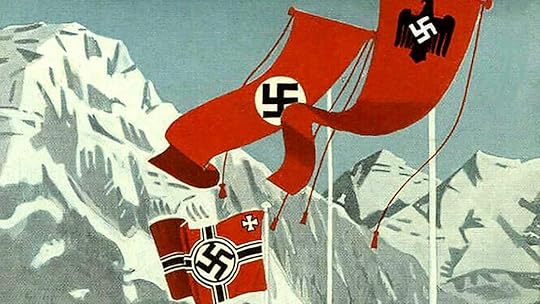
Image: Propaganda poster including flags bearing the “crooked cross” (Source)
Carson had foresight. We have hindsight. It’s a warning for today. But she died of cancer in 1941, leaving young children, just as Germany invaded Russia.
Story - no spoilers
It emerges early on that although Moritz is a practising Catholic (as was his late mother, and most people in town), he has a Jewish surname. His future, and thus Lexa’s, is immediately uncertain, and things change rapidly during six months.
Carson dissects the mindsets of the Klugers and their immediate friends like an anthropologist-cum-psychologist. Each character walks a different route, via a different combination of rejection, unease, acceptance, excitement, fear, evangelism, sacrifice, and defiance. Her own views are clear, and mostly channelled through Lexa’s evolving insight (but also Michael, a young Brit, who hopes to become a diplomat), for example, noting things she dare not discuss: “The disappearance of logic, individuality, of freedom itself.”
But her brothers now have jobs, prospects, and smart uniforms. One is fully committed, whereas the other is plagued by doubts, because he hates to see anyone upset, but he soon comes to believe it can’t be helped and Jews are Jews.
When Lexa hears Moritz called “a filthy Jew”, she is shocked. Hatred of Jews (and Moritz isn’t even Jewish) becomes concrete and personal, which makes her ponder: “Appalling optimism… their terrifying unconsciousness of what was to come.”
Quotes
• “In quiet homes like the Klugers it began to be difficult to ignore the political situation.”
• “Hitler was to them [young Nazis] like some splendid deliverer, a god.”
• “Many of them believed that anything could be done in the name of Hitler or patriotism.”
• “That fervour, that greed for truth [in Communists], was the same flame which burned in Helmy’s own heart.”
• “Young Nazis whose assurance began to grow out of all proportion to their sense and their maturity.”
“Like a gigantic operation the work of rejuvenating Germany began…There was to be a boycott of Jews beginning on April Ist: there were to be new passport regulations; fresh censorship on newspapers. There were to be murders. The bursting accumulation of frantic energy, held in leash so long, was to be set loose. It could no longer be controlled. Patriotism must run its course. All was open and free for it.”
Sally Carson’s novel first appeared in 1934 yet it’s a startingly topical, immensely disturbing reminder of just how quickly a society can fall apart and a pernicious brand of authoritarianism can take hold. Clear-eyed, refreshingly unsentimental, it covers six months in the life of a small German town close to the Austrian border. Kranach, known for its picturesque mountains and lakes, is a version of popular holiday destination Schliersee, not far from Munich. A place Carson visited several times during the early 1930s. Her experiences there inspired her novel. It opens in December 1932, snow-covered Kranach resembles scenes from a festive Hallmark movie. The Kluger family are excitedly preparing their seasonal celebration, one of the small pleasures that help this close-knit group cope with everyday anxieties. Like so many in Depression-era Germany, money’s tight, work’s scarce. But this Christmas is special, Lexa Kluger is newly engaged, eagerly anticipating her wedding, set for the coming June. She’s due to marry Moritz an up-and-coming, Catholic doctor, whose father is a close family friend. The Kluger home’s filled with greenery, even the photograph of Hitler has been covered with foliage. The picture belongs to Helmy, Lexa’s brother, unemployed for three years, he’s been a committed Nazi since 1929.
As elections loom and Hitler’s victory seems certain, Helmy takes steps to make sure Lexa understands the dangers of associating with Moritz. In the past, Helmy’s had no issues with Moritz. But now, at least for Helmy, it’s simple, Moritz’s surname is Weissman, a name which marks him out as Jewish, someone the “new Germany” can’t and won’t tolerate. As the countdown to the election speeds up, so does the violence. Just out of frame, Jews are being brutally assaulted, Communists and fascists are caught up in furious street fights. Moritz loses his job and can’t find another one. But Lexa finds it difficult to understand exactly what’s happening and why. Naïve, bouncily energetic, Lexa resembles a character from a vintage girls’ school story ruthlessly transplanted into a tale of star-crossed lovers and mounting horrors.
In early 1933 Hitler takes power, Communists and anyone else deemed left-wing or hostile to the regime, are killed or “unspeakably” tortured, survivors dispatched to newly-created camps like Dachau. Among them is Hermann once part of Lexa’s circle, an overnight pariah because he refused to join in with the Hitler salutes. And slowly Lexa starts to understand that her world has totally changed. But Carson doesn’t depict this revolutionary shift in melodramatic terms. What she captures so brilliantly is how easily the unthinkable becomes the taken-for-granted. The casual compartmentalisation that means Lexa’s brother Erich can go out to oversee the lynching of Jews then arrive home in time for tea and their mother’s homemade soup. This splitting, this division of reality, reminded me of Apartheid-era South Africa or the American South during Jim Crow; neighbours slaughtering neighbours in Rwanda; the atrocities that took place during the Balkan Wars.
Carson doesn’t offer her readers easy or comforting explanations. Her Nazis aren’t inherently evil, radically different from the rest of us, most of her characters aren’t even Nazis. They’re mostly men, and women, caught up in, or taking advantage of unfolding events. A few like Erich are fervent believers, others like Helmy are seeking an income, a status and recognition otherwise denied them. Others just want to avoid sticking out or see the likely benefits of supporting Hitler. Carson doesn’t hesitate to highlight the terrifying consequences of men like Helmy’s choices. But she also highlights the damage these choices can inflict on men like him; such as the young Nazi who takes part in the murder of an elderly Jewish man, who’s later overwhelmed with guilt and grief. Carson’s interested in how the economic and the political intersect with the cultural: destructive forms of masculinity, poverty, scapegoating, exclusionary nationalisms, exploited by politicians whose relentless propaganda campaigns hold out the promise of an idyllic future. My sense is that, alongside sounding the alarm over Germany, Carson was issuing a warning about England’s possible future – the far-right were already on the rise. Unfortunately it’s a warning that’s increasingly relevant today. Carson may have been writing in and about the early 1930s but the scenario is uncomfortably familiar. With minimal tweaking, a 1934 review of Carson’s haunting novel could be describing growing movements within Trump’s America:
“The irrational doctrine of racial hatred embraces in its brutal activity the innocent as well as the guilty… And when one comes to think of it, the very title, "Crooked Cross," is a parable in itself; suggestive of the caricature of Christianity, which the Nazi movement would establish; which is just as much a distortion of the Gospel of Jesus Christ as the swastika symbol is of His Cross.”
Crooked Cross opens on Christmas Eve in 1932, celebrating with an ordinary German family; the parents, and 3 siblings. Lexa, their daughter is engaged to Moritz, a young doctor, with very good prospects, unfortunately, although he has been raised Catholic, he has a Jewish surname. Her two brother have joined 'the party', having found it difficult to find much work. Eric, her younger brother, is on his way to becoming a prominent nazi.
It is set during a time of great change; Hitler is about to become Chancellor, and over the next six months, this has huge impacts on the family and their circle of friends.I
Essentially, this is a family drama, and a love story, but with that setting, I read with an impending sense of doom, however the plot propelled me forward, I just had to know what was going to happen.
What was remarkable about this book was that it was published in 1934. Sally Carson had spent some time in Germany in the early 1930's, so was able to see first hand where things were going. It is interesting to see how much was known about what was happening, especially poignant as I finished this around the 'VE day celebrations, and have been listening in the radio to some of the broadcasts from 1945, when the true horrors had started to become clear.
There are 2 sequels, which I hope can also be republished some day.
I first read about Crooked Cross in a Guardian/Observer article in early Feb 2025, mere days after Trump was elected, and already an authoritarian state was taking hold. They wrote, “Sally Carson was not an oracle or a prophet, just a young woman from Dorset, born in 1901. Yet she foresaw a dark and violent future for Europe and gave voice to those fears in a 1934 novel that is now being hailed as “an electrifying masterpiece”. Carson died in 1941 never knowing how very prescient her book was. The morning I read the review, I went straight online and booked a ticked for the launch event at Persephone Books in Bath. It was perhaps the most intelligent, meaningful, important book event I’ve ever attended, which is saying something. The discussion was between Fran Beauman, Editor and Owner of Persephone Books and Laura Freeman, Chief Art Critic from the Times, who wrote the preface. Not needing to spell it out, they discussed the importance of reprinting this book now, during this particular time in history, and the value of telling the story of the fictionalised Kluger family, making it impossible not to relate to the impact of the rise of nazism, especially through the eyes of Lexa, the main protagonist. Also in attendance, were three decendents of Sally Carson, who had come from Canada especially, never met her and hadn’t yet read the book. They spoke of family and filled in some blanks, but had only recently discovered Sally themselves. It was a small gathering and questions were asked that various people were able to answer: when does one know when to leave (the boiling frog analogy)? What were the Jews & communists met with when they did escape? How much did regular people really know? It was a spine-tingling talk. I finished the book last night and I think it will take a very long time to sift and settle, if ever, because history is repeating itself, and it horrifying.
It was Christmas 1932, in a fictional Bavarian town, in the foothills of the Alps. The Kluger family is celebrating decorating the tree, singing songs, having a joyous time. It is the mother and father, their three grown children.. Helmy, Lexa, and Erich.. the aunt and cousins.. and Lexa’s fiance Moritz Weisman. Everything decorated beautifully, Helmy’s picture of Hitler on the piano. In six months time, the close family is fallen apart . As the Nazi party has grown.. young men who were unemployed for so long joined the Party and had purpose, Helmy and Erich among them. Moritz is a Roman Catholic, with his Jewish last name. Lexa and he have been together for several years he is a doctor, the wedding was supposed to be in the near future… now it is not safe for her to be seen with him and you see how the brothers turn against him as they become more entrenched in the nazi party. The story of a family.. fractured by the nazi party, when it was supposed to be the promise of a better country/a better life.
This story is remarkable in the fact that it was written in 1933 and published in 1934. She wrote ..already in 1933….. “People had a way of suddenly disappearing, no trial, no explanation”; “prisoners were half-starved, bullied, inhumanly treated”. before she even knew where/how this “Hitlerism” would end. Such a timely read. I’m so glad that Persephone books currently rereleased this book.. and it’s part of a trilogy which Peresphone will release the second book…”The Prisoner” in April/2026. A must read!
Excellent and gripping story that takes place over 6 months in 1933, about an ordinary family in a small German town. It follows the rise of the Nazi party and the impact it has on this family and circle of friends, as some welcome Hitler and some resist. The main character is Lexa who is engaged to be married to Moritz, who is Jewish and assimilated. The book was published in 1934 and so its writing is nearly contemporary with events. Perhaps for that reason it is particularly astute and chilling about how fascism takes over a town, a society, a people. Sally Carson is brilliant at portraying variously the fear, the enthusiasm, the numbness, the boredom, the accumulating losses as great changes slowly unveil the future. Parts of this mirror with startling exactitude our current state of change as institutions collapse around us, norms are overturned, dread and confusion become the dominant mood—right now, right here in 2025.
Crooked Cross tells the story of a normal German family during the spread of Nazi influence and rapid rise of fascist authoritarianism in Germany.
Hitler was elected chancellor of Germany in 1933. Crooked Cross was published in 1934. Sally Carson wrote a novel about the time in which she currently was living. She lived in the UK, but spent long months in the Bavarian countryside with friends.
Crooked Cross, a poignant, full, exact novel about a young German woman, Lexa, coming of age during this chaotic time in Germany, engaged to Mortiz, a young Jewish physician, was followed by two other novels to form a trilogy, all published prior to 1938. (Mind you, WW2 started in 1939.)
This book stands alone as a lovely novel about longing, forbidden love, and strong family ties. It serves as a beautiful landscape of Germany, mostly set in Bavaria. It’s thrilling and page turning, even for a rather long-sentenced nearly hundred year old novel.
It’s impossible to read this novel as a citizen of the US without seeing striking similarities in what’s happening now in the current US (and world) political climate. There are striking similarities between the fully fleshed stereotype of the young German men characters being swept up by the Nazi party and the current plague of the “loneliness epidemic” in young Republican men in the United States in 2025. You feel the political noise get louder and louder as Nazis take over streets and news outlets, as the politics take over every day conversation, and how families schism along fierce lines because of it. That’s what fascism does—it works systematically to tear apart the foundations of a society until all that is left is the state and its subjects. There are fierce reflections here of the current state of America in how a German family divides as fascism descends—often it seems to be one family member seeing it all for what it is, surrounded by others frustrated but more ambivalent at the obviousness of the surroundings. It’s so easy for a group in privilege to write off the thoughtful, bleeding heart. Moreover, the division between Lexa and her brothers who join the Nazi party—all of whom more and more ardently condemn her engagement to Moritz.
What’s even more striking about this novel is, though it never sympathizes with Nazis, it sympathizes with the men who join the party. It never tries to dehumanize them as they sell their souls to Hitler.
We all know how that went. Well, I say we do. Maybe -we- don’t.
As Lexa begins to witness violence against Jews in multiple places in her day to day life, as more of her Jewish friends or those who are deemed “communist” by the state disappear from life, never to be heard from again, she worries more and more about Moritz. The emotional register of the novel shoots upward and higher until a thrilling, spiraling, terrifying ending.
Again, this was published at the time during which it was set. Sally Carson, a British author, had a vantage point on German politics both with broad view as a non-German, and as someone with German friends with whom she spent time in the country. It’s not like what was happening in Germany was justified by everyone, easily looked past. And it’s not like the rest of the world was unaware it was going on. It was done legally, democratically, and enthusiastically by what appeared to be some sort of a majority of support—until it was far too gone, and those who were quiet or in support had built Nazi Germany, the holocaust, and the deadliest conflict in human history.
If you’re an American who finds yourself fooled or ambivalent or wishing for quiet currently, I don’t think you’ll get to have it for much longer. You can’t be the kind of person who understands that history repeats itself, that it echoes, and not apply the nuance needed to see it happening before yourself.
Crooked Cross is a brilliant, readable warning that should be read widely in the US. I highly recommend downloading the audiobook on librofm or Audible—it’s a great listen with memorable characters and brilliant, easy to follow prose and dialogue. The narrator is excellent. If you’d like a hardcopy, you can order from the UK at Persephone Books, but the easiest way to get ahold of a copy in the US is on eBay currently.
By some lucky chance, one of my libraries on Libby purchased this and I’m so glad they did. This was fantastic and heartbreaking. Lexa and her family and fiancé show all the different views and sides to what was occurring, show how these things happened so quickly. Carson wrote this within a year of the events and you can see what’s coming. I want a hard copy to add to Manja and The Oppermanns for books that could see what was happening so early in the nazis rule. Reading this now, with everything happening, is a bit chilling. I hope the two sequels are republished at some point as I’m so curious how it all plays out for these people. I’m so glad Persephone republished this.
This is a stand-out masterpiece. I’m astonished that a book of this power ever went out of print, let alone was forgotten. I’m indebted to Persephone Books for finding it!
What a central character to admire and embody. Somebody that doesn’t get swept along into racism or everyday cruelty that for the whole town is becoming exciting and normalised. She feels utterly contemporary and courageous.
I feel that the book was written by a writer with an urgent vocation to warn as many everyday people what creeping horror had occurred in Germany with the rise of the Nazi party. Importantly it makes you ask yourself, how would my own family be affected by the same situation?
I do not remember how this book got on my radar. It was published in 1934, and the female author passed away in 1941 at age 38. The talent in this book is mind-boggling. The writing style switches between third and second person in the only book I’ve truly seen this work in. Usually it sounds like a mistake. This makes you feel like the main character, like sometimes you are watching her and sometimes you are her. It’s slow but so powerful. I was hooked. I cannot believe it was written before WWII and the author didn’t even live thru the war. This book is tragically brilliant in so many ways.
One day, you wake up and hear the news headlines: the choice is already made, the country has already shifted: extremist rhetoric creeping into mainstream politics, weakening democratic norms, increasingly partisan courts, and hate groups getting bolder.
We let it happen, assuming someone else would step in.
After finishing Crooked Cross, I had to just sit with it for a moment. It’s one of those quietly powerful books that creeps up on you.
First published in 1934 (and then lost to time until Persephone Books brought it back), this novel feels eerily ahead of its time. It’s set in a small Bavarian town in early 1933, and follows a single family as Hitler rises to power. Two brothers get swept up in the promises of the Nazi Party - all “bread and freedom” - while their sister Lexa watches the world around her shift, especially when her Catholic boyfriend Moritz, who has a Jewish surname, starts to be quietly pushed out of public life.
The story starts off gently, almost too gently, if I’m honest, but once it finds its rhythm, it becomes completely absorbing. I wasn’t expecting to get so emotionally drawn in, but by the final pages, I was completely invested and not quite ready to let go.
Deeply unsettling and beautifully written, it's one I'll be thinking about for a long time. If you like quiet, character-driven novels with a historical edge, this is absolutely worth picking up.
The most important book I’ve read recently along with Story of a Secret State by Jan Karski. Sally Carson published her book in 1934 in England when Nazi power was growing and fast. God help us be vigilante and active against the rise of facsism right now in the USA.
I do love an abrupt final line. The tension that builds throughout is insane, and manages to turn it up to 11 at the drop of a hat. What gets me most is I had to keep reminding myself throughout that this book was published in 1934, not retrospectively after the war.
Edit: just reread the final two chapters and bumping this up to a 5 star read. Desperately need someone to publish the sequels pronto
A book that follows a family and their lives in the beginning of the Nazi regime, Crooked Cross shows how easily and totally people gave in to these ideologies, and the power trips that came with it. Delivered with captivating prose, it is almost page for page reflective of the current global political climate.
One thing that really stood out to me about this book was the constant switch between third person and second person point of view for a lot of the emotionally charged moments. It really adds to the feeling of dissociation that Lexa experiences in those moments. Reading this was an enraging but worthy experience.
This book is set over merely six months (1933) but it is a defining period in German history. The reader is thrust straight into the heart of a Bavarian family, the Klugers who, it seemed to me were the archetype of Kinder, Kuche, Kirche. What is extraordinary is this was written by an English woman practically contemporaneous with events. Originally published in 1934.
As the book opens the Nazi party is infiltrating German society, as we learn that Lexa, the daughter of the house is planning her wedding to a Jewish doctor. As a reader we have the benefit of hindsight knowing what the Nazi regime did, Carson instinctively grasps the situation of the moment, understanding this movement was scaling up and was not going to be contained. How heads and hearts were turned from post First World War poverty and unemployment into authoritarianism.
I found the book totally compelling and could only wonder at how the book was received, whether British readers took note or whether she, like Cassandra was not believed.
Crooked Cross is a haunting read that takes place from Christmas 1932 through to June 1933 as the Nazi Party sweeps to power in Germany. What is particularly remarkable about this book – and what elevates it significantly - is that it was written in 1934 after the author (who was English) had visited Germany. It absolutely captures the mood of the time and the realities of how rapidly life was changing.
The Kluger family live in a village in the mountains near Munich. They’re a close family and their three children are in their early 20s. Helmy and Erich have been struggling to find work due to the recession, while Lexa the middle child is engaged to Moritz, a young Catholic doctor.
But Moritz’s surname is Weissmann and in the eyes of the Nazi party he is Jewish.
Over the next six months Moritz’s rights are increasingly restricted. First he loses right to a passport, then he loses his job, then the ability to use public facilities like the library. As Helmy and Erich get involved with the party, they pressure Lexa to end her relationship with Moritz and end all contact with him.
It’s easy to understand what the allure of the Nazi Party was to young men like Helmy and Erich who had been struggling without work, without a sense of pride in their country, without optimism. But Lexa’s unease and despair remind us that not everyone felt that way.
Meanwhile there is a vacuum of information. The media don’t report on what is happening. Villagers know that dissenters are being sent to Dachau Concentration Camp and there are rumours about what it’s like there, but no one really knows.
Reading Crooked Cross now of course we know about the terrible events still to come, but the author had no knowledge of that when she wrote it. It’s a truly impactful read.
Crooked Cross is an absolutely compelling look at a German family, from Christmas Eve 1932 to Midsummer Night 1933, that crumbles under Nazism. Each character in the family is an individual with individual choices to make, but their choices affect everyone else in the family. I found Carson's writing prescient (written in 1934) and the story unforgettable. I mean, who could forget those final chapters?
Though it's entirely in the background, Crooked Cross is mapped onto the liturgical year, the darkest point of the year (Christmas) to the brightest (Nativity of John the Baptist). "He must become greater, I must become less." "The light shines in the darkness, and the darkness has not overcome it." A stubborn note of hope even in this story of a nation's descent into madness.
Eagerly awaiting the sequels!
Content warnings: violence, concentrated toward the end of the book
-----
"Lexa too, carried away by the thrill of it all, did not know that Helmy's triumphant shout at the door--so spontaneous and joyful as it had been--was the signal for the upheaval of the country, for the disappearance of logic, individuality, of freedom itself." (73)
"She did not know, nor did Helmy, that the simple words he cried were to announce a spring not only of buds and warm winds but of violence, bloodshed, and foolhardy actions of stupidity which were to make the rest of Europe recoil from the friendship she had felt reviving in her for Germany." (73)
"Germany had awoken. Hitler had spoken. And Hitler was now the rightful spokesman and leader for Germany. What matter if the peace of Europe was threatened? What matter if brain and genius were driven away while Germany played at schoolboy tricks with loaded toy guns?" (73-74)
"Now the Nazi Party with Hitler at its head and the bulk of the nation behind it could march to triumph. The stage was set for a fresh game; the press was silenced; ears were deafened to foreign voices of protest." (74)
"Like a gigantic operation the work of rejuvenating Germany began; a blindfold surgeon began to cut at her behind closed doors, chopping away everything he thought unfit, with no thought for her future life, her future vitality, with no idea that the horrible scars on her body would be noticed by her best friends--never forgotten, probably." (74)
"For the first time Elsa was finding it hard to feel her newly found principles fighting against her affections. The only thing was to cling to the principles, to be hard over the whispers of her heart." (243)
"Now it is lying flat, the blood on the leather has turned black, the arms are spread, and the body is thin and flat...and red...red...and the laughing....Hadn't something like this happened to another Jew somewhere before--a long time ago?" (293)
I would imagine by law this 1934 novel has to be described as 'prescient'. And thanks to Carson and her description of those incremental steps towards totalitarianism the novel serves as a clear warning so that we can spot and prevent such a progression from ever happening aga... oh bollocks.
I would give this more than 5 stars if I could. Written in the 1930s a tale of the rise of the Nazis as it impacts a small Bavarian village the book does not have the perspective of what is going to happen next! This book just covers 1932 and 1933. It really shows how and why Hitler managed to speak to many Germans through his promises of Bread jobs and freedom. It’s easy to forget the levels of poverty and unemployment that existed in Germany after the limitations imposed by the Allies after the end of the Great War . The Kluger family have 2 sons Erich and Helmy each of whom respond to the changes at different speeds and for different reasons but the brutalising of the boys can so easily be tracked. Their sister Alexa was engaged to a young doctor and was expecting to be married mid 1933. However Lena had not really realised that Moritz was Jewish….it was not a fact that impacted on their life until Moritz was sacked from the clinic where he worked and then could not find other work. But in the period of one year life is thrown upside down. This is a very disturbing book and should be read now as a reminder of how easy it can be for extremists to come into power when the mainstream does not appear to be in tune with the people!
A beautifully written, contemporaneous story of 1933 and family life/romance amid the Nazi rise - at least as good as the accounts by Leon Feuchtwanger or Christopher Isherwood. Have scoured book dealers for the 2 follow on novels. Will Persephone be re-publishing them soon?
Crooked Cross was written partly in Germany and partly back in England, in the wake of Carson's frequent visits to Bavaria during the brief period of the Weimar Republic (1919-1933). It is astonishingly prescient. She was only in her early thirties when the book was published, and yet she perceived with disconcerting clarity that — ironically — Nazism was destroying what it sought to promote: love of country, and love of family.
She does so by depicting the impact of Hitler's growing power on one family, over the course of six months from Christmas 1932 to Midsummer's Eve 1933. Today, of course, we read it in the light of history. Carson wrote it when neither she nor her characters could have known the full horror of what lay in store. (She mentions, for example, a character reading Stefan Zweig, but while we know what happened to him, Carson's readers would have known him only as a very popular Austrian author whose stories were widely translated. By the time her book was published in 1934, Carson might have known that he fled to Britain in that year, but that was after she wrote the book and she could not have foreseen the tragic end to his life.)
The family consists of a traditional hausfrau devoted to her family; a cranky father old before his time because of post WW1 poverty and hardships; two brothers — Erich is a fervent Nazi while Helmy is less so but grateful to have a job at last after years of unemployment. The only daughter Lexa is engaged to Moritz, a Catholic German doctor with a Jewish surname... who suddenly loses his job and so their marriage plans are shelved.
It's actually a distressing book to read because it shows how easily public indifference to 'politics' allows the hate to insinuate itself into everyday life and to be accepted both as true and necessary. When Hermann, one of these siblings' peer group, is deported to the Dachau Concentration camp, even Helmy thinks it'ss a necessary evil to rid the country of communists. Only Lexa speaks up for him, declaring that he is their friend, and that he just thinks differently, that is all. But her courage makes no difference to what happens to Hermann, nor to her friends' acceptance of it.
And they do not concern themselves with unexplained disappearances, though they know of arbitrary killings which (if reported at all) are reported as occurring because the victim was 'trying to escape' or was 'shot while endangering the life of a Nazi.'
In Chapter 9, Lexa begins to think deeply about her choices, while at the same time Carson's more distant authorial perspective analyses how propaganda flourishes. Separated from Moritz because her family thinks it's safer, Lexa thinks that there are simple people like her would-be suitor Otto — he likes the certainties offered by the slogans; while more imaginative people reject the appeal of certainty in favour of an awareness that the soul of the country is at stake.
After reading this in a whirlwind in one day, I am still thinking about it. It is wild this was written even four years before Kristallnacht, because the author writes so eerily accurately about the beginnings of the Holocaust. This book is valuable (and still very relevant today) because it portrays the ease with which regular people can be sucked into harmful ideologies and how these can not only shatter families, but also friendships, romances, towns, and a country itself.
It was very interesting to get an up-close view of a small-town rural German family, with the father Hans a bit disillusioned with the world since his participation in WWI, the mother Rosa who just wants her kids to be safe and happy, the sons Erich and Helmy who are struggling to make a life and meaning for themselves in a post-war Germany that offered them no jobs and no dignity, who then easily get sucked into the Nazi party as it promises them both of these things, and the daughter Lexa whose dreams of marrying and settling down with her lover, the doctor Moritz, are destroyed in just a few months due to his Jewish name.
This intimate portrait of a family and each person's hopes for their life contrasted with the increasing violence and hatred of their community pushed this book towards its haunting conclusion. Lexa's bravery and self awareness held fast throughout the novel, as she refused to see Moritz any differently and refused to become numb to violence. The Nazi ideology was represented in different ways in her brothers- one can easily see the violence in pig-headed Erich who was always quick to insult and tease, and who loved the success the party provided him, but the creeping hatred that instilled itself in Helmy, who was more cautious and thoughtful by nature, showed that even a more passive adherence to hateful ideas breeds violence and cowardice in critical moments.
This book really left me thinking about the spread of fascist ideas and the influence of fear and one's community.