Thought-provoking book, a classic, on the central problem facing humanity: How to curb the exponential growth in population size and industrial production?
The problem is a mathematical one: within a finite system (the universe, the planet) exponential growth will lead to collapse. Due to our success in mastering the world through science, technology and capitalism, and bettering our existence on many accounts, we have created a culture of techno-optimism. That is, we see technology as the solution to all our problems.
This blinds us to the fact that certain problems are insoluble through technological means. Some problems are social problems, moral problems.
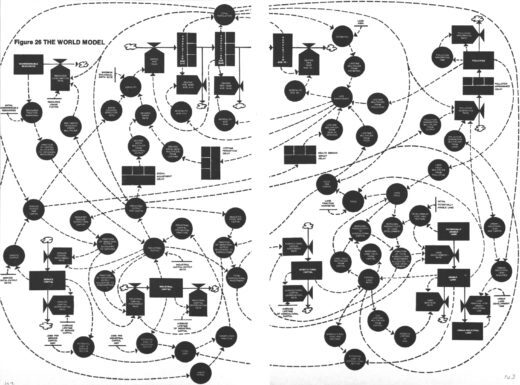
The authors of Limits to Growth argue that only by curbing the growth of population and industrial production can we avoid a collapse of the world system. Both processes are intrinsically tied to physical substrates: people need food, production requires resources, and both food production and industry require the Earth to absorb pollution. Land, resources and pollution-absorption are physical, finite factors. That is, they constrain the amount of people and production.
This is inevitable - it's cold hard logic. The only question is: Do we willingly curb our birth rates and material consumption? Or does the planet itself enforce its boundaries on us? In the first case, we can improve society (based on a state of equilibrium instead of growth). In the last case, humanity will suffer a brutal fate.
Ultimately, the problem is a political one. And it requires a political solution. Unfortunately the Left has captured these themes and politicized them heavily, while also acting as guardians for the current destructive model of society. For example, the authors note (correctly) that all increases in productivity due to technological developments have been absorbed by population growth and increased production.
The Netherlands, for example, is a country that has grown by 2.5 million people in just over 25 years - mostly due to mass migration. During this time, wages remained pretty much the same, while productivity soared sky high. And as mentioned, it is the political Left that is actively promoting this mass migration policies.
The lesson, of course, is you can't have your cake and eat it. You can't criticize the political Right for their capitalism and exploitation of common citizens while at the same time acting as guardians of that exact same system.
We need to have fewer people, work fewer hours, consume fewer material goods. At the same time we need to spend more time on our social relationships, on consuming services (such as education, sports and art). This is possible, it's just a matter of political choice. Both Left and Right obviously don't want this improved state of affairs. Why?
To show it is possible, I will quote Bertrand Russell at length (from his In Praise of Idleness). His brilliant insights speak for themselves:
Suppose that, at a given moment, a certain number of people are engaged in the manufacture of pins. They make as many pins as the world needs, working (say) eight hours a day. Someone makes an invention by which the same number of men can make twice as many pins as before. But the world does not need twice as many pins. Pins are already so cheap that hardly any more will be bought at a lower price. In a sensible world, everybody concerned in the manufacture of pins would take to working four hours instead of eight, and everything else would go on as before. But in the actual world this would be thought demoralizing. The men still work eight hours, there are too many pins, some employers go bankrupt, and half the men previously concerned in making pins are thrown out of work. There is, in the end, just as much leisure as on the other plan, but half the men are totally idle while half are still overworked. In this way it is insured that the unavoidable leisure shall cause misery all around instead of being a universal source of happiness. Can anything more insane be imagined?