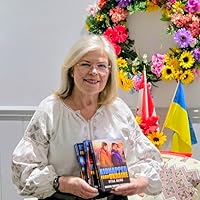
I will die, I will die. And nobody will know my grave. And nobody will come and remember, Only the nightingale will sing. Inspired by a real-life story, Black Sunflowers illuminates one of the darkest times in Ukrainian the Holodomor or "death by hunger."
The book begins in 1928, in Soviet-occupied Ukraine, where Veronika and her family live on their farm in the close-knit village of Kuzmin. Life is good, despite the Soviet occupation, but soon everything they have known and loved is not just altered, but demolished.
Told in two voices — Veronika's and her father, Janek's — Black Sunflowers is a vivid account of the brutal realities of life in Ukraine under Stalin. Veronika and Janek's story is a haunting, yet uplifting testimony to the strength and humanity of the people of Ukraine.
This story is both heart-wrenching and uplifting—an inspiring testament to the resilience of the human spirit in the face of harrowing existential threats. I was deeply impressed by how vividly it brought characters to life, capturing their optimism and love of life while exposing the corrosive evil of minds warped by dictatorships. Tracing the story from the Holodomor to the Holocaust serves as a stark and necessary reminder that these horrors are not just history—they can and do repeat.
Reading this book feels especially timely as I watch people once again falling in line behind autocrats leaders who now threaten democracy. This is a powerful and important book.
Inspired by real life, this story takes place in Soviet occupied Ukraine from 1929 to 1945. We follow Veronika, and her family through heartbreak as the Soviets take control of everyone’s farms and form a collective. Under the brutal rule of Stalin, Ukrainian people toil, receiving little food for their work. So begins the cruel Holodomor – death by hunger. Every day they witness the horrors of starvation and watch in terror as family members are deported. This important, revealing story, portrays the suffering, but also the strength and resilience, of the Ukrainian people. The young girl in this book, later in her life, moved to the community of Leduc Alberta.
This is a true account of a young Ukrainian girl and her family that lived through the Stalin regime of the 1930s and the Nazi invasion of the 1940s. The hardships these people went through due to these regimes is heartbreaking. During the Holodomor famine, the Soviet government starved the Ukrainian people by taking their grain and food. Somehow this family survived that period only to be taken over by another savage government. This story is at once disturbing and heartwarming due to the love and strength of this family. Though we are supposed to learn from history’s mistakes, this history is being repeated for the people of Ukraine today.
Black Sunflowers is a first novel by Cynthia LeBrun. Based on a true story, it follows a Polish family through the post-World War One and Holodomor period into the early part of the second World War. As such, it helps to provide a context for understanding the current conflict between Ukraine and Russia and it stands as an important addition to the growing collection of historical fiction novels set in Eastern Europe. I'm very much looking forward to the sequel!
I thought this book was historical fiction until the photos at the end and then my heart hurt a little more. It was awful, but phenomenal. The ending is misleading though, as it implies Veronika is going to slave labor and off to her death, when in reality she survives. While it would have been outside the scope of the book, I would love to know what happened next and where Veronika ended up. Otherwise, an accurately devastating depiction of life under occupation.
Black Sunflowers is a powerful and deeply moving historical novel that brings an important chapter of history to life with remarkable emotional depth. The dual perspectives create a compelling narrative, and the characters' resilience in the face of unimaginable hardship is truly unforgettable. Cynthia LeBrun's vivid storytelling makes this both an educational and emotionally impactful read. A beautifully written novel that will stay with readers long after the final page.
Amazing story and documentary based on true facts. Cynthia Lebrun weaves the story of her mother in laws growing up and survival during the Soviet dictatorship and murder of innocent people during the Holodomor. I could not put this book down…. Waiting patiently for the second book and continuation of Veronika’s story. Never forget. 🖤🌻
very good. I had no idea what the Ukraine went through during the time of Stalin and communism, as well as the start of the WW II and the Nazi invasion. Well written thru the eyes of young Veronika. Waiting patiently for book 2.
Cynthia LeBrun's immersive first novel reveals one family's struggle to survive the Holodomor, Stalin's death-by-starvation plan to wipe out Ukrainians. Inspired by her family's experience, Black Sunflowers gives context to Russia's current genocidal war.
Book Review: Black Sunflowers by Cynthia LeBrun Rating: ★★★★☆ (4.2/5)
Overview Cynthia LeBrun’s Black Sunflowers is a hauntingly evocative historical novel that illuminates the Holodomor, the Soviet-engineered famine that devastated Ukraine in the 1930s. Told through the dual perspectives of Veronika, a young girl fighting for survival, and her father Janek, the narrative weaves personal tragedy with broader historical atrocity. Inspired by real events, the novel balances brutal realism with moments of tenderness, offering a poignant exploration of resilience, memory, and the enduring human spirit.
Themes and Content
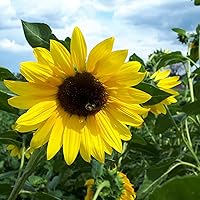
The novel grapples with: -Historical Trauma: LeBrun unflinchingly depicts the horrors of the Holodomor, exposing the political machinations and human costs of the famine. -Family and Survival: Veronika and Janek’s relationship anchors the story, showcasing how love and duty collide in extremis. -Memory and Legacy: The title’s symbolic “black sunflowers”—a metaphor for both death and resilience—underscore themes of remembrance and cultural endurance. -Dual Narratives: The alternating voices enrich the narrative, juxtaposing a child’s innocence with a parent’s desperation.
Writing Style and Structure LeBrun’s prose is lyrical yet stark, with vivid descriptions that immerse readers in the Ukrainian landscape and its suffering. The dual-perspective structure effectively amplifies emotional stakes, though Janek’s sections occasionally lack the immediacy of Veronika’s voice. The pacing is deliberate, with tension building through quiet moments of dread rather than action. Historical details are woven seamlessly into the narrative, though some readers may crave deeper contextual footnotes.
Strengths and Weaknesses
Strengths: -Emotional Depth: Veronika’s voice is achingly authentic, capturing both vulnerability and stubborn hope. -Historical Integrity: The novel avoids sensationalism, honoring survivor stories with nuance and respect. -Symbolism: The recurring motif of sunflowers—traditionally symbols of joy twisted into emblems of mourning—elevates the thematic weight.
Weaknesses: -Pacing: Mid-sections drag slightly, with repetitive cycles of hunger and despair. -Limited Scope: Focused tightly on one family, the broader geopolitical context occasionally feels underexplored.
Section Scoring Breakdown (0–5) -Historical Accuracy: 4.5/5 – Meticulously researched, though some gaps in broader context. -Narrative Craft: 4/5 – Dual voices excel, but pacing stumbles at times. -Emotional Resonance: 5/5 – Unforgettable and deeply moving. -Thematic Depth: 4/5 – Powerful, though some metaphors verge on heavy-handed. -Reader Engagement: 4/5 – Compelling, but requires patience for historical fiction enthusiasts.
Final Verdict Black Sunflowers is a vital contribution to Holocaust and Holodomor literature, marrying historical rigor with intimate storytelling. While its grim subject matter demands emotional fortitude, LeBrun’s compassion and Veronika’s indomitable voice make it a rewarding read. A must for those seeking to understand lesser-discussed 20th-century atrocities.
★★★★☆ (4.2/5) – A luminous, if harrowing, testament to survival.
Thank you to NetGalley and the author, Cynthia LeBrun, for providing a copy of this book in exchange for an honest review.
This well written and researched book tells the tale of the author’s mother-in-law. It is written in a novelized form so reading is much like a novel as opposed to a biography. I enjoyed reading this book even though some of the content is hard to hear. There is despair but also joy and especially love. Very much love. A great read.
I absolutely loved this book. It told about the history or the Ukraine in a very personal manner focusing on one family and how the three immediate members survived the Holodomor only to find the Nazi regime was no different than the Soviets
For someone like myself who is not familiar with war history, this was an easy read to follow along Veronika's journey but to also learn as well. This book was incredibly sad to read through but enjoyed every page.