A disarmingly personal account of the new science of memory manipulation by one of today’s leading pioneers in the field
As a graduate student at MIT, Steve Ramirez successfully created false memories in the lab. Now, as a neuroscientist working at the frontiers of brain science, he foresees a future where we can replace our negative memories with positive ones. In How to Change a Memory, Ramirez draws on his own memories—of friendship, family, loss, and recovery—to reveal how memory can be turned on and off like a switch, edited, and even constructed from nothing.
A future in which we can change our memories of the past may seem improbable, but in fact, the everyday act of remembering is one of transformation. Intentionally editing memory to improve our lives takes advantage of the brain’s natural capacity for change.
In How to Change a Memory, Ramirez explores how scientists discovered that memories are fluid—they change over time, can be erased, reactivated, and even falsely implanted in the lab. Reflecting on his own path as a scientist, he examines how memory manipulation shapes our imagination and sense of self. If we can erase a deeply traumatic memory, would it change who we are? And what would that change mean anyway? Throughout, Ramirez carefully considers the ethics of artificially controlling memory, exploring how we might use this tool responsibly—for both personal healing and the greater good.
A masterful blend of memoir and cutting-edge science, How to Change a Memory explores how neuroscience has reached a critical juncture, where scientists can see the potential of memory manipulation to help people suffering from the debilitating effects of PTSD, anxiety, Alzheimer’s, addiction, and a host of other neurological and behavioral disorders.
I'm certainly biased, because I already know the wonderful person Steve is, but this was a very earnest, raw, and entertaining account of Dr. Ramirez's amazing scientific work and his moving experience working through the grief of his close friend and scientific partner's passing. We need more scientists like Steve who are dedicated to open collaboration, communication, and motivated by the hope that their work will make the world a better place rather than their own egos.
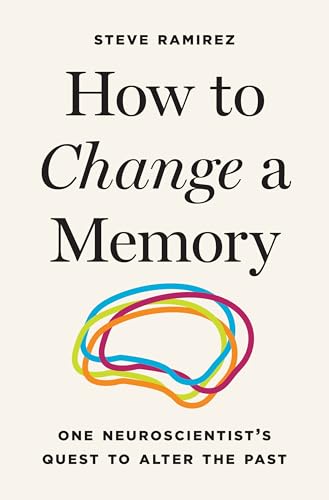
E foarte greu si o dovada de vulnerabilitate sa poti sa scrii despre descoperirile pe care le faci ca neurocercetator si, in acelasi timp, despre cum le traiesti in traumele si dramele vietii tale personale. Steve Ramirez reuseste asta, cu o candoare pe care viata de om de stiinta nu i-a rapit-o. O carte la care am sa revin, mai ales pentru partea stiintifica. Pe scurt, in cuvintele autorului: ‘Sa reactivezi amintiri era ‘atat de 2012’, sa creezi amintiri false era ‘atat de 2013’, iar sa amesteci emotiile atasate unei amintiri era deja ‘atat de 2014’. Asteptam cu nerabdare inca un an in care sa colaboram si ne puneam acum intrebarea daca manipularea memoriei putea fi folosita in tratarea afectiunilor psihiatrice.’ Mi-au venit cateva idei despre cum pot fi utilizate - neinvaziv - aceste principii in psihoterapie. Dar asta cere un articol mai elaborat (pe blog). Iar coperta - minunata pentru ce vrea cartea sa transmita. M-urile alea ma vor urmari multa vreme.
I've been collecting memory books for years (Schacter, Kandel, Squire) and this one hit differently. Ramirez's work is something I've cited in my own research, so I was familiar with the headline findings: memories can be turned on with light, false memories can be implanted, positive memory reactivation can have therapeutic effects. Reading about these experiments in context, though, reminded me why I got into this field.
The book moves between hard neuroscience and deeply personal narrative without ever feeling forced. But the emotional core is the relationship with Xu Liu. Their partnership, their shared excitement, and later Ramirez's grief transforms this from a science book into something more profound.
If you work in memory research, this is essential reading. If you're just curious about how your brain creates and reconstructs your past, this will change how you think about yourself.
A winning book that combines a clear summary of the development of the part of neuroscience focusing on the mechanics of memory with the story of how Ramirez, the son of immigrants from El Salvador, followed the path to his own breatkthrough research. Much of that story has to do with his profound working and personal relationship with Chinese neuroscientist Xu Liu, whose tragic death was an immense loss to Ramirez and the field of research.
As is the case with most of the popular (which is to say non-technical) science books I read, I would have liked a bit more detail about the neuroscience at some points, but more than with most, the personal story and the scientific story reenforce each other, so the narrative never really feels like a digression.
On the scientifc level, the book focuses on just how we can create, suppress or change memories in ways that point (as Ramirez acknowledges) into the strange turf charted by science fiction writers like Philip K. Dick. Ramirez is basically hopeful that the dystopian scenarios are less likely than those that offer the hope for effective treatements of trauma, depression and anxiety. Whatever your feelings about those issues, How to Change a Memory will provide you with a clearer sense of what memory is and how it works.
I really thought his live lecture was so much more interesting than this book. There was something about the way this book was organized that did not appeal to me. I appreciate his candor about his personal life, and especially his relationship with his mentor, Xu. I do hope his research will lead to more direct treatments that can help people suffering from PTSD, anxiety, and depression. Not that we will erase memories, but that we can create new neural pathways of resilience that can help strengthen our brain’s ability to overcome mental illness.
Interesting information in a narrative way, not bad. I listened to the audiobook read by the author and I have to admit, I think it was worse that way. I found his reading a bit dull.
Good interweaving of Steve's personal story and relationship with Xu and the account of the pioneering work they've done with regards to how memories work in the brain. There is promise (and danger as with any powerful technology) in learning how to manipulate memories. This book is a good reminder of why science and scientific thinking is important but also that its performed by humans and isn't a dry subject. As a child of immigrant parents I also appreciate Steve's family history.
I personally bring up positive memories from my past when passing time and I think it makes me a happier person.
At first, I found this an unusual science book because most of its early chapters were narratives regarding family, lab work, his research partner, and assorted anecdotes. It is not really a How-to book either. What made this book worth its price for me was reading Chapter 7, in which Ramirez writes about his alcohol addiction and recovery in light of his neuroscience experience. He uses the Ship of Theseus extensively in this chapter as an extended metaphor for how biology is predicated upon constant change, and the truism appears, addition becomes subtraction.
Un bellissimo viaggio nel mondo delle neuroscienze e delle emozioni umane, capace di catturare anche chi non è del settore. Perché, in fondo, la memoria ci riguarda tutti: influenza chi siamo, come viviamo il presente e come immaginiamo il futuro.
E forse è proprio qui che risiede la parte più bella di questo libro: la possibilità di riscrivere il nostro rapporto con il passato per aprirci a un futuro migliore.
Come scrive l’autore: «La speranza consiste nell’utilizzare la memoria per immaginare un futuro migliore».
I was expecting a more scientific book than it actually was. The author and his mentor Mr. Xu work on engrams which are the physical or biological traces of memories in the brain. Unfortunately Mr. Xu dies and this book is an opportunity to deal with the grief after such a loss. It is a very personal and emotional story of the author's life.
Masterclass in weaving together narrative autobiographical storytelling with lay explanations of hard as hell neuroscience. I only wish there were more words dedicated to the implications of memory manipulation. Still, so glad to read and grateful for the insight on his beautiful friendship.
Mamma mia! È un intensissimo percorso scientifico psicologico che l’autore ti fà fare. Scritto con semplicità e linearità di contenuti. Non spaventatevi dal l’argomento trattato. Sembra di leggere una favola. Lo consiglio.
Much of the complicated science of the brain's memories and how to positively manipulate bad memories were softened by Steve Ramirez sharing his own life's struggles and demons he had to overcome. His loving friendship with XU and his closeness to his mom, dad, and extended family was heartwarming. Got me past the complicated parts! Impressed with all his family worked through to give their children the chance for an educated life.
Charming because of the improbable arc of the author's life from poverty to cutting edge neuroscience research and because of his sincere passion for science, friendship and family.
Frustrating because of the skeletal treatment of the scientific details. The author does not even care to define the term memory. Is it only the fuzzy remembrance of times past, or is it also the low level memory the brain needs to recognize anything from phonemes and syllables to words, sentences, stories, arguments, concepts? Why treat human remembrance of past events as somehow special and not just a continuum of things that the brain can recognize and assign meaning to? This failure to define memory points to another glaring hole in the book: the author does not posit a model for how the brain works. At times, it seems that he relies on the predictive brain model, but this is never explicitly stated or explained. Even the term engram central to the author's research is never properly defined and remains fuzzy until the end.
In large part, the book is a memoir with the science often taking second place. This could be disconcerting if you approached this book with a view to understanding the science. For rough comparison, Nobel laureate Eric Kandel's "In Search of Memory" is another book in the same general field. It also has some biographical content, but it is 10% memoir and 90% science rather than the other way around.