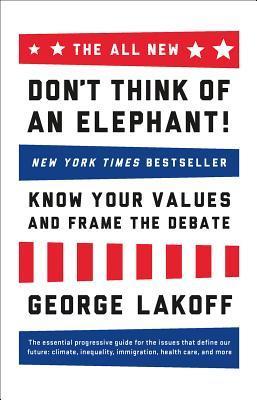
I read the original version of this when it first came out. I was working as an industrial officer in a trade union at the time and the idea we needed to start finding a way to reframe the debate to make social justice more relevant seemed pretty urgent. I don't remember being all that impressed with the book to be honest. But I think I'm much more impressed with it now. I've a feeling that is because I've read much more by the author and now know he isn't just a 'self-help' kind of author, although, because this book is clearly written for a general audience, it almost seems like that, and certainly that was how I've thought of it since.
The main argument here is that the right have been much more effective at getting their message across to their constituency than the left have been. After three-and-a-half decades of 'neoliberalism' - that is, an obsession with selling off government assets, reducing programs designed to help the poor, savage attacks on public schools, hospitals, and endless wars that have reduced entire regions to barely functioning hell-holes for the sake of sucking out their oil and natural resources (think Libya, Iraq, Afghanistan), and while this has been supported by both sides of politics in the Anglophone nations of the world - there is barely a left voice left in politics.
The right has been fighting a culture war and they have been winning. That we now have someone of the stature of Trump groping wildly at the international body politic shows the depth of the problem we face. It feels like sanity itself has been grabbed by the pussy - that that is a joke I can make about the 'leader of the free world' beggar's belief.
The problem for the left identified in this book is one of framing. But I think this is the wrong word. Framing has a feel about it that seems to imply 'lying'. It implies 'spin'. And really, the left doesn't need spin, it doesn't need to be caught distorting the truth to make its message sound appealing, in fact, I feel the exact opposite is what is needed. What the left needs is to speak its values. For too long the left has sought 'the sensible middle' and this has meant the debate has moved further and further to the right. It is impossible to motivate your constituency when they struggle to see any difference between the candidate on your side and the one on the other side. The problem isn't spin, the problem is the left has stopped talking about the things that differentiate them from the right, and so people support the side they know believes what they are saying, rather than the mealy-mouthed who don't say anything just in case they offend corporate investors or Rupert Murdoch or white supremacists or god knows who else.
It is only by being prepared to shift the debate to our values that there is some hope of some form of passion being reintroduced into the political debate. In fact, it is only if we start stressing our values that there is some hope of us causing divisions in the right itself. Michael Apple talks about this in his Educating the Right Way - that the left doesn't think about the natural divisions that exist in the right between conservatives, managerialists, fundamentalist Christians, libertarians. There are issues that the left might well be able to struggle around and then unite with each of these groups over, even though they are fundamentally opposed by other sections of the right - but the left has proven remarkably ineffective at doing this. Unity never seems to be the left's strong suit. And it is not just ideological purity that is the problem. The problem is also an inability forthrightly construct issues so as to present left-values clearly enough to make those values more generally appealing. Like I said, we are more likely to be mealy-mouthed than forthright.
As Lakoff says, if you try to win an argument with facts alone you lose. This is because people don't judge arguments on the basis of facts, but on the basis of their values. And if the facts don't fit their values, then the facts are ignored.
The mistake that might be taken from this idea is to think that since people's values are fixed, there isn't really any way to shift people. We tend to think people are either progressive or conservative, and therefore essentially separate species. As someone who thinks of himself as on the far end of the spectrum of this condition, I'm somewhat prone to thinking in binary ways like this too - but really there are many people who don't fall into the right/left binary at all. In fact, most people (and it grieves me to say this) fall somewhere in the middle. That means that how an issue is framed for them can be enough to tip them one way or the other - and for decades the left has allowed how issues are framed to match right wing passions, rather than those of the left. This is often because the right have been much more likely to stress fear and selfishness - and, as Bynug-Chul Hun says somewhere, no is always louder than yes.
An interesting phenomenon, I hadn't noticed until it was pointed out at a lecture I attended recently, is that Jeremy Corbyn and Bernie Sanders are aging, baby-boomer, white guys. The point being that since the left allowed itself to die at some stage around 1980 the only people left who remember left-wing rhetoric are 'of a certain age'. This is probably putting the case a bit more strongly than it really should be put - but it illustrates the point I want to make - both men have shown that what might be termed traditional left-wing policies has an audience, and that audience is prepared to listen. When the best on offer to combat Trump is Clinton (hey, I can be as bloody nasty as any man, Killary), then, god help us. Don't get me wrong, I would have voted for her if I could vote in the US election - but if that is as good as the choice gets, then we need to change the rules.
I think, ultimately, this book is saying that we need to go back to speaking from our own values and that that is the only way we can have any hope of countering the values laden vision of the right. That is, you don't counter their vision with facts, you don't counter their vision with compromise - you counter their vision with your vision.
A big part of the point of this book is to encourage the left to stop using the language (and I would also say the policies too) of the right. Because, when you do use that language, and you might even be speaking against it, you are reinforcing the system of values that produced that language in the first place. That is, we need to start speaking of the future as if we believed in our vision for that future. Climate change is an interesting case in point. The right should be terrified of the climate change debate, but it is almost as if it is the left that is terrified. I mean, humanity is removing the basis upon which life on this planet depends - and we are doing that so that a couple of already absurdly wealthy men can become marginally more wealthy. That is, we are destroying life on the planet for everyone to improve the life of a couple of billionaires in ways they won't even notice. The utter absurdity of the situation is what we need to stress, as well as the fact that if we do something now we might actually leave a planet worth living in for our kids but if we don't, we won't.
Now look, I get it, there are lots of people who think Jesus is going to come down from the clouds and wave his magic cross and put all the trees back on the hills and all the coal back in the ground - and those people are morons and there's not a lot we can do for them. I know, it's sad, but some people are beyond help. But I believe most people would rather do something to clean a stream than to shit in it and hope their sky god will clean it up afterwards. I think there is a natural revulsion to the idea we are killing the planet. The point isn't to convince the most rabid climate change denier that he is a moron, but rather to give the majority of people some hope that they can do something that will mean they will be able to breathe clean air or swim in the ocean and that these things shouldn't be cast aside as the 'price of progress'.
After decades of the right-wing ascendancy, the time for the left to start stating their values has come. It's urgent, there is NO TIME otherwise.