

What do you think?

Unabridged: The Thrill of (and Threat to) the Modern Dictionary
From the author of the New York Times bestseller Word Freak, a vibrant, lively, and illuminating journey through the exotic world of Merriam-Webster, dictionaries, and language, at a time of rapid-fire change in the way we create, consume, define, and use words
Words are the currency of culture—and never more than today. From selfie to doomscrolling to rizz, our hyper-connected digital world coins and spreads new words with lightning speed and locks them into mainstream consciousness with unprecedented influence. Journalist and bestselling author Stefan Fatsis embedded as a lexicographer-in-training at America’s most famous dictionary publisher, Merriam-Webster, to learn how words get into the dictionary, where they come from, who decides what they mean, and how we write and think about them. In so doing, as he recounts in Unabridged, he discovered the history and fascinating subculture of the dictionary and of those who curate and revere “one of the most basic features of our collective humanity.”
Fatsis reveals the little-known story of how the brothers George and Charles Merriam acquired Noah Webster’s original American dictionary and reshaped the business of language forever. Merriam-Webster became America’s most successful and enduring compendium of words, withstanding intense competition and cultural controversies—only to be threatened by the power of Google and artificial intelligence today.
Delving into Merriam’s legendary archives and parsing its arcane rules, Fatsis learns the painstaking precision required for writing good definitions. He examines how the dictionary has handled the most explosive slurs and the revolutionary change in pronouns. He votes on the annual Word of the Year, travels to the legendary Oxford English Dictionary, and visits the world’s greatest private dictionary collection in a Greenwich Village apartment stuffed with more than 20,000 books. Fatsis demonstrates how words are weaponized in our polarized political culture—from liberal to woke to DEI—and, in a time of insurrections and pandemics, how they can be a literal matter of life and death. Along the way, he manages to write a few definitions that crack the code and are enshrined in the pixelated dictionary.
“I fell in love with the dictionary on my eleventh birthday,” Fatsis writes about the full-color college lexicon he received on that day. “The dictionary projects permanence, but the language is Jell-O, slippery and mutable and forever collapsing on itself.” Unabridged takes readers to the heart of an industry in flux, celebrating as it does the sheer thrill and wonder of words.
Words are the currency of culture—and never more than today. From selfie to doomscrolling to rizz, our hyper-connected digital world coins and spreads new words with lightning speed and locks them into mainstream consciousness with unprecedented influence. Journalist and bestselling author Stefan Fatsis embedded as a lexicographer-in-training at America’s most famous dictionary publisher, Merriam-Webster, to learn how words get into the dictionary, where they come from, who decides what they mean, and how we write and think about them. In so doing, as he recounts in Unabridged, he discovered the history and fascinating subculture of the dictionary and of those who curate and revere “one of the most basic features of our collective humanity.”
Fatsis reveals the little-known story of how the brothers George and Charles Merriam acquired Noah Webster’s original American dictionary and reshaped the business of language forever. Merriam-Webster became America’s most successful and enduring compendium of words, withstanding intense competition and cultural controversies—only to be threatened by the power of Google and artificial intelligence today.
Delving into Merriam’s legendary archives and parsing its arcane rules, Fatsis learns the painstaking precision required for writing good definitions. He examines how the dictionary has handled the most explosive slurs and the revolutionary change in pronouns. He votes on the annual Word of the Year, travels to the legendary Oxford English Dictionary, and visits the world’s greatest private dictionary collection in a Greenwich Village apartment stuffed with more than 20,000 books. Fatsis demonstrates how words are weaponized in our polarized political culture—from liberal to woke to DEI—and, in a time of insurrections and pandemics, how they can be a literal matter of life and death. Along the way, he manages to write a few definitions that crack the code and are enshrined in the pixelated dictionary.
“I fell in love with the dictionary on my eleventh birthday,” Fatsis writes about the full-color college lexicon he received on that day. “The dictionary projects permanence, but the language is Jell-O, slippery and mutable and forever collapsing on itself.” Unabridged takes readers to the heart of an industry in flux, celebrating as it does the sheer thrill and wonder of words.
416 pages, Hardcover
First published October 14, 2025
About the author
Stefan Fatsis
4 books67 followersStefan Fatsis is an author, reporter and familiar voice to public-radio listeners nationwide.
Ratings & Reviews
Friends & Following
Create a free account to discover what your friends think of this book!
Community Reviews
Displaying 1 - 30 of 125 reviews
July 28, 2025
One of my most anticipated books of the year! An enlightening foray into the mutability of the English language and the skilled lexicographers who labor to chart its evolution.
Interesting observations, FUN FACTS (💡), and WORD LIST below. 👇
CONTENTS
Love that the dedication, table of contents, and chapter titles are words paired with their definition.
INTRO
💡 In 1961, the four-inch-thick, 13 1/2 lb, 2,700 pg Webster's Dictionary sold for $47.50—about $500 today.
CHP 01 TRAIN
There's a very amusing bit in here about the complexities of defining the slang meaning for Dutch oven. 🤣
Wonderful quote from OED backer Richard Chenevix (1851): "Many a single word also is itself a concentrated poem, having stores of poetical thought and imagery laid up in it."
CHP 02 HISTORY
💡 Noah Webster's newspaper announcement that he'd be creating a "Dictionary of the American Language" appeared above an ad for a lost cow with "a white face and large teats". 😂
💡 Webster supported Benjamin Franklin's 1768 proposal to regularize spelling by replacing the letters C, J, Q, W, X, and Y with six new ones Franklin created. (Obvs this never happened.)
💡 Webster sold his 1828 dictionary for $20—about $660 today.
👉 Okay, so this is interesting: The creators of Webster's earliest dictionaries were primarily elitist, racist white men who viewed the dictionary as the definitive judge of whether a word was improper or incorrect.
This changed when Philip Babcock Gove became lead editor for the Third edition. Gove decided that speech should guide usage, and the dictionary should be a record of word usage. He added the classifications, standard and nonstandard and cut back on labeling words as slang.
Some highbrow dictionary users were OUTRAGED by Gove's changes. They couldn't believe he'd included words like ain't, irregardless and finalize.
I find this amusing because so few people today know that the dictionary's definition does not dictate word usage; rather, it records word usage, which is in a constant state of evolution. Just as many people were outraged to learn the function of the dictionary in the 1960s, so too are many outraged today when they learn the dictionary is not the definitive judge of proper word usage. 🤭
CHP 03 BUSINESS
💡 The 1988 edition saw 50,000 new words added, including bodice-ripper, ghetto blaster, minivan, and Jazzercise.
This chapter charts Merriam-Webster's struggle to be the leading source for definitions online when the internet came into being, a task made more challenging by two tech entrepreneurs buying dictionary.com before they could.
CHP 04 DEFINE
💡 In 2012, Oxford added vajazzle to its free online dictionary. The word, which means to "adorn the pubic area (of a woman) with crystals, glitter, or other decoration" was assumed to be a fad that would quickly fade; however, it was still in use a decade later.
CHP 05 CORPUS
This chapter gives a brief history of Wordnik, an online dictionary and lexicographical tool that collects words & data from various sources. One modern challenge Wordnik faces is ensuring that servers are programmed to draw only from human writing (rather than text generated by AI).
👉 Some amusing words in this chapter: fucupcakes, floetry, cinnamontography.
CHP 06 NEOLOGISM
^ The word thobber draws from the initial letters of three words: think + opinion + belief.
CHP 07 SLIP
💡Due to concerns about obscenity, it took many years to get the definition of fuck added to the dictionary.
It seems odd to mention Kory Stamper without also mentioning her incredible book, Word by Word: The Secret Life of Dictionaries.
CHP 08 COLLECTION
This chapter tells the story of Madeline Kripke, an American book collector who amassed one of the largest collections of dictionaries. By the end of her life, her collection filled 856 white banker's boxes.
CHP 09 SLUR
In which Fatsis digs deep into the complicated history of defining words like the n-word or redskin, along with whether words are defined as merely slang or as derogatory.
CHP 10 PRONOUN
💡 In 1884, a lawyer named Charles Crozat Converse proposed a gender-neutral third-person singular pronoun: thon (derived from mixing the first letters of they with one).
CHP 11 ENTRY
Fatsis devotes this chapter to the challenges faced in defining words like safe space, microaggression, and alt-right.
CHP 12 SOCIAL MEDIA
CHP 13 NEWS
Really interesting chapter here on perjoration; meaning, "the development of a less favourable meaning or of less pleasant connotations for a word or expression." As an example, Fatsis explores the word woke.
He then discusses how COVID reshaped language drastically in a short amount of time, touching on words like social distancing and lockdown.
CHP 14 ARTIFICIAL INTELLIGENCE
In short, AI can't define words with the same nuance and finesse of lexicographers (yet), but it can muster up something "good enough".
CHP 15 FUTURE
CHP 16 END
.
.
.
.
✍️ WORD LIST ✍️
- cheugy: (slang) something outdated, trying too hard to be trendy
- agglutinating: sticking together to form a mass
- leetspeak: internet slang that replaces letters w/ numbers or symbols that visually resemble them (e.g., H3ll0 for "hello")
- picayune: petty, worthless
- scuttlebutt: rumors, gossip
- fluffer: a worker on set of a porn film who arouses a male actor in prep for a scene 🫣
- postprandial: the period after dinner or lunch
- slewfoot: (hockey term) kicking the skates of another player from behind
- decleat: (football term) hitting a player so hard the hit-ee leaves the ground
- pom-pom girl: prostitute
- cribbed: copy another person's work without acknowledgement
- hagiographical: biography of a saint
- promptitude: acting quickly and without delay
- boffo: successful
- fistnote: note in a printed text marked by a symbol of a fist with a pointing index finger
- philologist: person who studies history of languages
- paradigmatic: a typical example of something
- tatterdemalion: something/one that's ragged or unkempt
- quixotic: exceedingly unrealistic
- vicissitudes: change of circumstances or fortune (typically unfortunate)
- cromulent: acceptable, adequate
- officious: assertive of authority in an annoying way
- nonce: coined/used for one occasion
- corpus: collection of written texts
- collocations: habitual juxtaposition of a word with another word w/ frequency greater than chance
- gramrel: short for "grammatical relationships"
- munificent: generous gift of money that's larger than usual
- picaroon: pirate, rogue
- hapax legomenon: word or form that occurs only once in the recorded corpus of a given language
- neologism: a newly coined word or expression
- meatmare: a nightmare experienced by a vegetarian in which they're forced to eat meat
- quisling: a traitor who collaborates with enemy forces occupying their territory
- pusillanimously: do something in a cowardly manner
- zydeco: a kind of American dance music originally from southern Louisiana
- bobbasheely: a very close friend
- pudjicky: sullen, grouchy, or peevish
- whoopensocker: something extraordinary of its kind
- epicene: having but one form to indicate either sex
- supererogation: act of performing more than is required
- parodic: intentionally copying the style of someone famous
- logorrheic: excessive and often incoherent talkativeness or wordiness
- fascicles: separately published installments of a book or printed work
- sinecure: position requiring little or no work but giving the holder status
...
ORIGINAL POST 👇
This sounds like Word by Word: The Secret Life of Dictionaries by Kory Stamper (which I LOVED), so naturally this strikes me as a must read. 😏📙
Interesting observations, FUN FACTS (💡), and WORD LIST below. 👇
CONTENTS
Love that the dedication, table of contents, and chapter titles are words paired with their definition.
INTRO
💡 In 1961, the four-inch-thick, 13 1/2 lb, 2,700 pg Webster's Dictionary sold for $47.50—about $500 today.
Two days after the 2020 presidential election, the most frequent lookups on Merriam's website were fascism, coup, sycophant, and sedition; the same list four years later included suffrage, gaslighting, democracy, narcissist, and, again, fascism.
CHP 01 TRAIN
There's a very amusing bit in here about the complexities of defining the slang meaning for Dutch oven. 🤣
Wonderful quote from OED backer Richard Chenevix (1851): "Many a single word also is itself a concentrated poem, having stores of poetical thought and imagery laid up in it."
CHP 02 HISTORY
💡 Noah Webster's newspaper announcement that he'd be creating a "Dictionary of the American Language" appeared above an ad for a lost cow with "a white face and large teats". 😂
💡 Webster supported Benjamin Franklin's 1768 proposal to regularize spelling by replacing the letters C, J, Q, W, X, and Y with six new ones Franklin created. (Obvs this never happened.)
💡 Webster sold his 1828 dictionary for $20—about $660 today.
In the archives of Yale, I found a handwritten sheet of paper titled "Time spent in editing Webster, ed. of 1864." The labor of the two dozen men who are listed—all of them working on the dictionary as a side gig—totaled 26.17 years.
👉 Okay, so this is interesting: The creators of Webster's earliest dictionaries were primarily elitist, racist white men who viewed the dictionary as the definitive judge of whether a word was improper or incorrect.
This changed when Philip Babcock Gove became lead editor for the Third edition. Gove decided that speech should guide usage, and the dictionary should be a record of word usage. He added the classifications, standard and nonstandard and cut back on labeling words as slang.
Some highbrow dictionary users were OUTRAGED by Gove's changes. They couldn't believe he'd included words like ain't, irregardless and finalize.
I find this amusing because so few people today know that the dictionary's definition does not dictate word usage; rather, it records word usage, which is in a constant state of evolution. Just as many people were outraged to learn the function of the dictionary in the 1960s, so too are many outraged today when they learn the dictionary is not the definitive judge of proper word usage. 🤭
If you're going to try to define every word, you might as well try to lasso every star in the galaxy.
CHP 03 BUSINESS
💡 The 1988 edition saw 50,000 new words added, including bodice-ripper, ghetto blaster, minivan, and Jazzercise.
This chapter charts Merriam-Webster's struggle to be the leading source for definitions online when the internet came into being, a task made more challenging by two tech entrepreneurs buying dictionary.com before they could.
CHP 04 DEFINE
💡 In 2012, Oxford added vajazzle to its free online dictionary. The word, which means to "adorn the pubic area (of a woman) with crystals, glitter, or other decoration" was assumed to be a fad that would quickly fade; however, it was still in use a decade later.
CHP 05 CORPUS
This chapter gives a brief history of Wordnik, an online dictionary and lexicographical tool that collects words & data from various sources. One modern challenge Wordnik faces is ensuring that servers are programmed to draw only from human writing (rather than text generated by AI).
👉 Some amusing words in this chapter: fucupcakes, floetry, cinnamontography.
CHP 06 NEOLOGISM
Our current anti-science, anti-intellectual age could benefit from the revival of thobber (1959), "a person who prefers guess-work to investigation and reinforces his beliefs by reasserting them frequently."
^ The word thobber draws from the initial letters of three words: think + opinion + belief.
CHP 07 SLIP
💡Due to concerns about obscenity, it took many years to get the definition of fuck added to the dictionary.
It seems odd to mention Kory Stamper without also mentioning her incredible book, Word by Word: The Secret Life of Dictionaries.
CHP 08 COLLECTION
This chapter tells the story of Madeline Kripke, an American book collector who amassed one of the largest collections of dictionaries. By the end of her life, her collection filled 856 white banker's boxes.
CHP 09 SLUR
In which Fatsis digs deep into the complicated history of defining words like the n-word or redskin, along with whether words are defined as merely slang or as derogatory.
CHP 10 PRONOUN
💡 In 1884, a lawyer named Charles Crozat Converse proposed a gender-neutral third-person singular pronoun: thon (derived from mixing the first letters of they with one).
Using they/their/them/themselves with a singular antecedent of unspecified gender goes back centuries. The OED dates first use to 1375 in the Middle English translation of a French romance novel, William of Palerne, aka William and the Werewolf.
Noah Webster left a bunch of singular theys in his 1833 revision of the King James Version of the Bible: "So likewise shall my heavenly Father do to you, if ye from your hearts forgive not every one of his brother their trespasses."
More fundamentally, pronouns and their validation as words with fluctuating meanings matter because of what they represent to their users—"a sense of agency and autonomy and freedom and expression," Kirby Conrad, the Swarthmore linguist, said. "That goes beyond, 'Don't misgender me' but 'See me in some specific way.' And that's important."
CHP 11 ENTRY
Fatsis devotes this chapter to the challenges faced in defining words like safe space, microaggression, and alt-right.
This was the lexicographer's dilemma. They are instructed to set aside biases, use data, be thorough, logical, and impartial—but there's a reason no bylines, avatars, or teeny headshots sit next to entries in the dictionary. Objectivity is an illusion best served anonymously.
CHP 12 SOCIAL MEDIA
The common thread through the decades is an abject, though understandable, failure to comprehend the function and operation of a dictionary, that is, to cull from carefully edited publications evidence of the way words are actually used in written and spoken English.
But lexicographers aren't concerned with what the Bible tells you, or your political convictions, or your opinion that, if only certain words were removed from the dictionary, the world would live as one. All they care about is portraying the meanings of words clearly and accurately based on the available evidence.
The dictionary's job is to be an unbiased arbiter of language and its evolution, one of the last apolitical authorities standing.
CHP 13 NEWS
Really interesting chapter here on perjoration; meaning, "the development of a less favourable meaning or of less pleasant connotations for a word or expression." As an example, Fatsis explores the word woke.
He then discusses how COVID reshaped language drastically in a short amount of time, touching on words like social distancing and lockdown.
CHP 14 ARTIFICIAL INTELLIGENCE
In short, AI can't define words with the same nuance and finesse of lexicographers (yet), but it can muster up something "good enough".
CHP 15 FUTURE
In a 2004 "On Language" column in the New York Times Magazine, Erin McKean guesstimated that, excluding scholarly dictionaries, there were around two hundred full-time working lexicographers in the United States; as I finish this book, the number was under fifty, probably closer to thirty.
CHP 16 END
The dictionary projects permanence, but the language is Jell-O, slippery and mutable and forever collapsing on itself.
.
.
.
.
✍️ WORD LIST ✍️
- cheugy: (slang) something outdated, trying too hard to be trendy
- agglutinating: sticking together to form a mass
- leetspeak: internet slang that replaces letters w/ numbers or symbols that visually resemble them (e.g., H3ll0 for "hello")
- picayune: petty, worthless
- scuttlebutt: rumors, gossip
- fluffer: a worker on set of a porn film who arouses a male actor in prep for a scene 🫣
- postprandial: the period after dinner or lunch
- slewfoot: (hockey term) kicking the skates of another player from behind
- decleat: (football term) hitting a player so hard the hit-ee leaves the ground
- pom-pom girl: prostitute
- cribbed: copy another person's work without acknowledgement
- hagiographical: biography of a saint
- promptitude: acting quickly and without delay
- boffo: successful
- fistnote: note in a printed text marked by a symbol of a fist with a pointing index finger
- philologist: person who studies history of languages
- paradigmatic: a typical example of something
- tatterdemalion: something/one that's ragged or unkempt
- quixotic: exceedingly unrealistic
- vicissitudes: change of circumstances or fortune (typically unfortunate)
- cromulent: acceptable, adequate
- officious: assertive of authority in an annoying way
- nonce: coined/used for one occasion
- corpus: collection of written texts
- collocations: habitual juxtaposition of a word with another word w/ frequency greater than chance
- gramrel: short for "grammatical relationships"
- munificent: generous gift of money that's larger than usual
- picaroon: pirate, rogue
- hapax legomenon: word or form that occurs only once in the recorded corpus of a given language
- neologism: a newly coined word or expression
- meatmare: a nightmare experienced by a vegetarian in which they're forced to eat meat
- quisling: a traitor who collaborates with enemy forces occupying their territory
- pusillanimously: do something in a cowardly manner
- zydeco: a kind of American dance music originally from southern Louisiana
- bobbasheely: a very close friend
- pudjicky: sullen, grouchy, or peevish
- whoopensocker: something extraordinary of its kind
- epicene: having but one form to indicate either sex
- supererogation: act of performing more than is required
- parodic: intentionally copying the style of someone famous
- logorrheic: excessive and often incoherent talkativeness or wordiness
- fascicles: separately published installments of a book or printed work
- sinecure: position requiring little or no work but giving the holder status
...
ORIGINAL POST 👇
This sounds like Word by Word: The Secret Life of Dictionaries by Kory Stamper (which I LOVED), so naturally this strikes me as a must read. 😏📙

April 25, 2025
ARC for review. To be published October 7, 2025.
4.5 stars, happily rounded to 5.
Fatsis embedded himself at storied Merriam-Webster where he saw how words are created….or at least how words make the dictionary. He takes a deep dive into the history of dictionaries, especially in the U.S. through looking at the history of Merriam-Webster and its archives, learned how one writes good definitions, how slurs and pronouns are handled and, basically, where words come from and who decides what they mean. He writes some definitions himself and votes on the Word of the Year, which sounds like such fun, and much more during his foray into the world of lexicographers.
Oh, this made my little word nerd heart sing! Fatsis wrote WORD FREAK, a book about competitive Scrabble players which is one of my all-time favorites, so I fully expected to live this and I wasn’t disappointed. I could have marked hundreds of interesting little tidbits to include in a review, but if you are the least bit interested in this, you just need to enjoy it for yourself. I found that it was best to read smaller bits at a time, to savor. And it has a hundred pages of end notes that look nearly as fascinating as the book itself! Oh, Stefan, thank you so much for this! Bonus fun fact for reading my review: word most often searched for on MW online? Paradigm.
4.5 stars, happily rounded to 5.
Fatsis embedded himself at storied Merriam-Webster where he saw how words are created….or at least how words make the dictionary. He takes a deep dive into the history of dictionaries, especially in the U.S. through looking at the history of Merriam-Webster and its archives, learned how one writes good definitions, how slurs and pronouns are handled and, basically, where words come from and who decides what they mean. He writes some definitions himself and votes on the Word of the Year, which sounds like such fun, and much more during his foray into the world of lexicographers.
Oh, this made my little word nerd heart sing! Fatsis wrote WORD FREAK, a book about competitive Scrabble players which is one of my all-time favorites, so I fully expected to live this and I wasn’t disappointed. I could have marked hundreds of interesting little tidbits to include in a review, but if you are the least bit interested in this, you just need to enjoy it for yourself. I found that it was best to read smaller bits at a time, to savor. And it has a hundred pages of end notes that look nearly as fascinating as the book itself! Oh, Stefan, thank you so much for this! Bonus fun fact for reading my review: word most often searched for on MW online? Paradigm.
September 9, 2025
This was a giveaway nook that I was lucky enough to win. I will say that it is very well written and can be entertaining if you are someone who enjoys words.

Read
January 5, 2026UNABRIDGED: adj. Too long, containing all the tangents, factoids, personal details, and such that should have been cut out.
DNF. I love dictionaries, but I would rather open one up and look at that instead of finishing this book.
In the chapter on the future, this is a {shortened} sample passage: "When the first edition of the OED was put to bed at the end of 1927, [...] one of the book's top editors wasn't in Oxford to celebrate. William A. Craigie was a small, shy Scotsman with a short, pointy goatee and tiny oval glasses. He joined the OED in 1897, alongside James Murray and a self-educated phililogist named Harry Bradley, ... ."
I appreciate that the author did a lot of research to be able to write 300 pages of this stuff, but I'm sorry, I just don't care!!!
DNF. I love dictionaries, but I would rather open one up and look at that instead of finishing this book.
In the chapter on the future, this is a {shortened} sample passage: "When the first edition of the OED was put to bed at the end of 1927, [...] one of the book's top editors wasn't in Oxford to celebrate. William A. Craigie was a small, shy Scotsman with a short, pointy goatee and tiny oval glasses. He joined the OED in 1897, alongside James Murray and a self-educated phililogist named Harry Bradley, ... ."
I appreciate that the author did a lot of research to be able to write 300 pages of this stuff, but I'm sorry, I just don't care!!!
November 4, 2025
Three general takeaways:
* Each word is a little story
* Dictionaries are windows into culture.
* Words follow the culture
Stefan Fatsis’s Unabridged is an engaging look into the inner workings of dictionary-making, and it reminds us why language is one of our most powerful cultural forces. Rather than treating dictionaries as dusty relics, Fatsis takes us inside Merriam-Webster, where lexicographers debate, research, and shape the very words we use to understand the world. The book helps readers to appreciate the dictionary not as a static authority, but as a living record of who we are and how we speak.
Fatsis weaves together history, personal observation, and interviews to show how dictionaries evolve alongside society. From slang to pronouns to the impact of digital culture and AI, the book addresses timely, sometimes contentious questions about who gets to define meaning and why it matters. Anyone interested in language, culture, or the way ideas take shape will find themselves captivated.
This book is a celebration of words, of the people who preserve them, and of language as a constantly changing force in our culture. Whether you are a teacher, writer, student, or simply someone who loves language, this book is a good choice because you get to see how dictionaries come to be, where they are now, and where they are going.
* Each word is a little story
* Dictionaries are windows into culture.
* Words follow the culture
Stefan Fatsis’s Unabridged is an engaging look into the inner workings of dictionary-making, and it reminds us why language is one of our most powerful cultural forces. Rather than treating dictionaries as dusty relics, Fatsis takes us inside Merriam-Webster, where lexicographers debate, research, and shape the very words we use to understand the world. The book helps readers to appreciate the dictionary not as a static authority, but as a living record of who we are and how we speak.
Fatsis weaves together history, personal observation, and interviews to show how dictionaries evolve alongside society. From slang to pronouns to the impact of digital culture and AI, the book addresses timely, sometimes contentious questions about who gets to define meaning and why it matters. Anyone interested in language, culture, or the way ideas take shape will find themselves captivated.
This book is a celebration of words, of the people who preserve them, and of language as a constantly changing force in our culture. Whether you are a teacher, writer, student, or simply someone who loves language, this book is a good choice because you get to see how dictionaries come to be, where they are now, and where they are going.

November 27, 2025
Not as good as Kory Stamper's wonderful 2017 book, Word by Word: The Secret Life of Dictionaries, but Stamper is a trained lexicographer and Stefan Fatsis is a journalist who basically did a temporary internship at Merriam-Webster. IIRC, Stamper kept her focus pretty narrowly on the process of adding words to the dictionary, while Fatsis has a broader perspective, including the history of American English dictionaries, the impact of social media and AI, the politicization of words like "woke," and the 1959 debate over whether or not to include "fuck" in the Third Edition.
The author's ego is a little too healthy. I didn't need to know how many definitions he personally drafted or updated; there are no bylines in the dictionary. But his misplaced pride about his minor accomplishments is proof of the dictionary's continued allure and importance.
The author's ego is a little too healthy. I didn't need to know how many definitions he personally drafted or updated; there are no bylines in the dictionary. But his misplaced pride about his minor accomplishments is proof of the dictionary's continued allure and importance.

April 10, 2026
I read Word Freak: Heartbreak, Triumph, Genius, and Obsession in the World of Competitive Scrabble Players a million years ago and loved it. I already *liked* Scrabble, but it kickstarted a desire to substantially improve my game, and I've remembered bits and pieces of it since. So I had a feeling I was going to love Unabridged, and boy howdy did I ever.
Fatsis is clearly having the time of his life with the material. He is a beautiful, intelligent, funny nerd who cares deeply about learning and also sharing the fun stuff he's learnt. He also really wants to do right by it. This is not *just* a history of Merriam-Webster (and while I've called it Webster's usually, I can no longer discount the Merriam aspect now that I know what the Merriam brothers did for the brand). Fatsis gives an earnest go at being a lexicographer, doing his damndest to make his mark on the English language. (And he does!) I really enjoyed the process of learning how to define words. I've always said that the mark of understanding something is being able to explain it in other terms, but actually writing those definitions and making them comprehensive yet concise is a massive challenge. I do kind of feel like I missed a potential calling in life. (There's another universe where I am a one-hit-wonder pop writer, lexicographer, and forensic scientist. I like that timeline. Trump probably doesn't exist there.)
Not only is Unabridged informative but it's also entertaining and funny. I don't normally read through endnotes, but I would recommend doing so here -- there is a lot of fun information tucked away back there in addition to citations, including a shoutout to an Etsy store. Fatsis really seems like the kind of guy I'd just like to sit down with, drink a beer, and talk about something very dorky, and I mean that as the highest of compliments. If you love words, modern American English, and/or meeting quirky people with idiosyncratic passions, this is a really lovely and fun journey.
Fatsis is clearly having the time of his life with the material. He is a beautiful, intelligent, funny nerd who cares deeply about learning and also sharing the fun stuff he's learnt. He also really wants to do right by it. This is not *just* a history of Merriam-Webster (and while I've called it Webster's usually, I can no longer discount the Merriam aspect now that I know what the Merriam brothers did for the brand). Fatsis gives an earnest go at being a lexicographer, doing his damndest to make his mark on the English language. (And he does!) I really enjoyed the process of learning how to define words. I've always said that the mark of understanding something is being able to explain it in other terms, but actually writing those definitions and making them comprehensive yet concise is a massive challenge. I do kind of feel like I missed a potential calling in life. (There's another universe where I am a one-hit-wonder pop writer, lexicographer, and forensic scientist. I like that timeline. Trump probably doesn't exist there.)
Not only is Unabridged informative but it's also entertaining and funny. I don't normally read through endnotes, but I would recommend doing so here -- there is a lot of fun information tucked away back there in addition to citations, including a shoutout to an Etsy store. Fatsis really seems like the kind of guy I'd just like to sit down with, drink a beer, and talk about something very dorky, and I mean that as the highest of compliments. If you love words, modern American English, and/or meeting quirky people with idiosyncratic passions, this is a really lovely and fun journey.
March 18, 2026
an absolute treat. love the shockingly intense gonzo journalism approach of becoming an embedded lexicographer and modernizing Merriam from the inside. great insights about the changing business model and the evolution of dictionaries' significance in a world awash in data and impatient with authoritative knowledge. funny, reverent and thoughtful

October 4, 2025
Ok, yes, I'm that geek, the one who loves words and read Nicholas Basbanes' books and The Professor and the Madman etc..
This book fits nicely in with the others, following Fatsis' time at Merriam and his visits to other dictionary and word mavens. How new words get added to the dictionaries, how they get defined (or redefined, as the history of the n-word details) and how popular/widespread a word needs to be before inclusion were fascinating.
I used to do a unit with my students where I'd show them my high school dictionary (American Heritage, not M-W) and how words like "mouse" have changed from the 1970s to the 2000s -- they might not have been as excited as I was, but it did help them understand that reading older documents and books might include meanings that are not what a modern document might.
eARC provided by publisher via Netgalley.
This book fits nicely in with the others, following Fatsis' time at Merriam and his visits to other dictionary and word mavens. How new words get added to the dictionaries, how they get defined (or redefined, as the history of the n-word details) and how popular/widespread a word needs to be before inclusion were fascinating.
I used to do a unit with my students where I'd show them my high school dictionary (American Heritage, not M-W) and how words like "mouse" have changed from the 1970s to the 2000s -- they might not have been as excited as I was, but it did help them understand that reading older documents and books might include meanings that are not what a modern document might.
eARC provided by publisher via Netgalley.

July 7, 2026
A really enjoyable read, particularly for me as an English major who works in publishing. (Thinking about this, I'd say someone should write a similar book about The Chicago Manual of Style, but it doesn't have quite the same appeal or universality as a dictionary. But I would love it!) Fatsis is a sports journalist, but I remember him for Word Freak: Heartbreak, Triumph, Genius, and Obsession in the World of Competitive Scrabble Players. He embeds himself at Merriam-Webster, tries to get some words added to the dictionary, and immerses himself in dictionary culture.
It's a fascinating book. Fatsis focuses mostly on Merriam-Webster and American dictionaries, but naturally Samuel Johnson's dictionary and the Oxford English Dictionary come up quite a bit. Fatsis goes through the history of Merriam-Webster and the process for creating entries, some of which I was familiar with from having read multiple books (both fiction and nonfiction!) about the creation of the OED. The books is recent enough that Fatsis goes into depth about not only the effect of the Internet in general on dictionaries, but also AI and how it's progressed over the years and how dictionary publishers use social media to make money now that the sales of print dictionaries aren't what they were.
The book is also unabashedly political, which is interesting for a book about a dictionary. Fatsis goes into pronouns, including a lengthy discussion of the attempts and challenges to make gender-neutral pronouns happen (and, of course, the history of "they"). He writes about slurs and swears and the debate about how to include them in the dictionary, and how the definitions change over time. He discusses how politics affects language and evolution of words like "woke."
There's also descriptions of dictionary collections and the groups who choose the word of the year and conferences for professionals and enthusiasts. Fatsis's description of the world of dictionaries is well-done, all around. Recommend for word nerds.
(Side note: I was consistently blown away every time Fatsis mentioned how much it cost to produce these things. There are times I hyperventilate a bit over the production costs of the books I work on [Don't pirate books, people! We spend a bunch of money to make them!]; the amount it takes to make an unabridged dictionary is...mind-boggling, though actually understandable. Clearly these companies are doing it for the greater good, and God bless them for it.)
It's a fascinating book. Fatsis focuses mostly on Merriam-Webster and American dictionaries, but naturally Samuel Johnson's dictionary and the Oxford English Dictionary come up quite a bit. Fatsis goes through the history of Merriam-Webster and the process for creating entries, some of which I was familiar with from having read multiple books (both fiction and nonfiction!) about the creation of the OED. The books is recent enough that Fatsis goes into depth about not only the effect of the Internet in general on dictionaries, but also AI and how it's progressed over the years and how dictionary publishers use social media to make money now that the sales of print dictionaries aren't what they were.
The book is also unabashedly political, which is interesting for a book about a dictionary. Fatsis goes into pronouns, including a lengthy discussion of the attempts and challenges to make gender-neutral pronouns happen (and, of course, the history of "they"). He writes about slurs and swears and the debate about how to include them in the dictionary, and how the definitions change over time. He discusses how politics affects language and evolution of words like "woke."
There's also descriptions of dictionary collections and the groups who choose the word of the year and conferences for professionals and enthusiasts. Fatsis's description of the world of dictionaries is well-done, all around. Recommend for word nerds.
(Side note: I was consistently blown away every time Fatsis mentioned how much it cost to produce these things. There are times I hyperventilate a bit over the production costs of the books I work on [Don't pirate books, people! We spend a bunch of money to make them!]; the amount it takes to make an unabridged dictionary is...mind-boggling, though actually understandable. Clearly these companies are doing it for the greater good, and God bless them for it.)
November 1, 2025
I've read both fiction and non-fiction about dictionaries so this is not new territory for me.
I appreciate that Fatsis immersed himself at Merriam-Webster headquarters to get firsthand experience as a lexicographer. I also appreciate a book that shows an author who does comprehensive research. My issue here is there were too many details - if this book was half the length I likely would have liked it more. It was a barrage of dense information that didn't make the same impact on me as "The Professor and the Madman."
I appreciate that Fatsis immersed himself at Merriam-Webster headquarters to get firsthand experience as a lexicographer. I also appreciate a book that shows an author who does comprehensive research. My issue here is there were too many details - if this book was half the length I likely would have liked it more. It was a barrage of dense information that didn't make the same impact on me as "The Professor and the Madman."
May 28, 2025
Thank you to NetGalley for providing this ARC.
If you're a dictionary nerd, you'll love this and you shouldn't even need me to tell you that. Just go and read it.
If you're not a dictionary nerd, but have some curiousity about dictionaries or words in general, then I still think this will be a super fun read for you.
This book was exactly what I expected it to be in the best possible way and now I need to go back and read the other books this author has written.
If you're a dictionary nerd, you'll love this and you shouldn't even need me to tell you that. Just go and read it.
If you're not a dictionary nerd, but have some curiousity about dictionaries or words in general, then I still think this will be a super fun read for you.
This book was exactly what I expected it to be in the best possible way and now I need to go back and read the other books this author has written.

August 13, 2026
My second book about dictionaries read this summer. I feel like a nut. But enjoyed both of them. This was a really broad book about the history of dictionaries, especially American ones, and most especially Merriam-Webster. The author actually managed to make his way into M-W for a sort of residency and was able to write definitions for some newish words. Besides the text itself, the end notes have lots of extra material and are fun to read. Some information about how the dictionary companies are trying to navigate the post-print era, that’s a bit depressing. (The traditional companies mostly are having a hard time making ends meet, and the new companies don’t have the education and rigor one might hope for. )

August 21, 2026
I was motivated to read this after seeing the author speak at a local book festival, and the recounting of his experiences being "embedded" at Merriam-Webster. The true-life stories of how words are selected for inclusion in the dictionary, and the arduous tasks of gathering citations and writing definitions, were the most interesting part of the book. The discussion of modern language, and how quickly the dictionary should evolve, was fascinating, as was the debate about how AI will impact (kill?) the dictionary as we know it. A fun read for anyone interested in the written word and who decides which words comprise "official" English.

February 11, 2026
As I said to some coworkers, the fact that this book is narrated by Kevin R. Free (aka Murderbot) makes this book 15% more awesome than it would otherwise have been. But it was still pretty great on its own! It was not my first book about dictionaries (I still highly recommend Word by Word: The Secret Life of Dictionaries, whose author Fatsis mentions many times in this book), but it was my first book about dictionaries post-Trump, post-pandemic, post-AI and there is some very interesting information related to all that. All in all a great way to spend ten or so hours on a road trip!
November 17, 2025
I love words so it was easy to love this book.

December 24, 2025
If you love words, you’ll love this. It made me — and this is not hyperbole — deeply excited to get the new Merriam Webster Collegiate and read it.
February 25, 2026
Like the author (heard him discussing this book on a podcast), but it was super dry and drawn out. Found myself just skimming through whole sections of it.

August 17, 2026
an interesting read, and an engagingly written one. a little more modern-facing than i was anticipating.
January 21, 2026
Unabridged: The Thrill of (and Threat to) the Modern Dictionary by Stefan Fatsis chronicled the author’s time while working as a trainee lexicographer for Merriam-Webster. Fatsis travelled to Springfield, Massachusetts to embed himself inside the world of nerdy logophiles. In addition to writing about his own experiences learning how to research, edit and write definitions for the dictionary, the author also wrote a history of the company and how it changed from Webster to Merriam-Webster and from print to its evolving digital formats.
How I wished I was tailgating the author as he pored over the archives that housed the thousands upon thousands of citation slips that made up the oeuvre of Merriam-Webster dictionaries. I could see myself bent over a file drawer, and never moving, for days at a time. Fatsis spoke to various editors and dictionary staff, including Stephen Perrault, “the editor with the best title in this place or maybe any place–director of defining”. One of the author’s hopes while working within the sanctum of Webster was to write a definition that made it into the dictionary. Fatsis suggested words and expressions for possible inclusion and learned the skills to write unbiased definitions. He even submitted some possible future entries, which were welcomed, but susceptible to the editors’ palette of coloured pencils.
Controversial dictionary topics such as slurs were addressed. I will admit that before I even read the book I looked in the index for the worst of all racial epithets. Surely that word would be discussed in the book, especially within the chapter called slurs. Fatsis wrote that “definers would tinker with the entry as if defusing a bomb.” I was surprised not to find the word in the index, although there was an indexing for “nigga, definition and labeling of”. While Fatsis never used the most offensive term except in quoting others, I nevertheless wish he had used the full word in the index. It was not until I was over halfway through the book and thumbing through the index that I found it, at the end of the N’s, as “n-word, definition and labeling of”. If Fatsis was going to index the word that way, I would have placed the euphemism at the beginning of the N’s where it would have been easier to spot.
Fatsis and I will have to disagree on the subject of gender-neutral pronouns. I side with Merriam-Webster and editor Perrault who have so far not admitted such transient nonsense as xe or ze into the dictionary. The author listed so many examples of genderless third-person singular pronouns that no wonder the dictionary didn’t want to print any of them. They are unpronounceable, faddish and will disappear when this current wave of nonbinary hysteria dissipates. I am a disciple of the Camille Paglia branch of feminism where he, when viewed by that loud lesbian superwoman feminist, is considered totally fine as a third-person singular.
In spite of this viewpoint, as I have said before in past reviews and blog posts, I am fighting a losing battle in regards to the general acceptance of the interdental monstrosity they as a singular pronoun. I won’t go into my arguments here, but I do take issue with Fatsis when he wrote:
“While respondents of all ages generally accepted uses of singular they with generic antecedents (‘Every student tries to write their essay perfectly’), they were less tolerant of they used with proper names.”
No, I do not accept the usage of they in this way with singular antecedents. The example he provides with Every student is flawed. Use a plural subject instead, thus “(All) students try to write their essays perfectly.” which avoids the cacophony of having their tied to its singular antecedent. But I am soapboxing on a topic I just said that I wouldn’t delve into. Yet there were times while reading the chapter on pronouns when I felt my blood get a little too hot for my own veins.
Fatsis and I do indeed have more in common than what we disagree with, and I often laughed out loud while reading. I was reminded of a moment from what is now forty years ago when I read of the author’s time browsing through the Consolidated Files, which are the citation slips for entries collected between roughly 1900 and 1983. Fatsis wrote about the later slips:
“Early computer printouts with truncated tails on the g, j, p, q, and y, which reminded me of an annoyed college professor who, on a paper I submitted in the 1980s, underlined every last one.”
What rekindled so much laughter after four decades is my own university story about professorial pen-wielding. I have not dotted my i’s or j’s since I was about twelve years old. I submitted a paper, printed in my own hand (as opposed to written in cursive) to one of my French literature professors. When I got it back every single i or j was dotted–in red. The whole essay looked as if it was covered in blood droplets.
The final chapters were devoted to artificial intelligence the future of dictionaries. Many publishers have gone out of business or ceased publication in print, including Merriam-Webster for the latest unabridged edition, for example. I was not impressed with the trend now for crowdsourcing new words and definitions and the regard that anyone can be an editor. I confess that I had never seen many of the new words (like skibidi) or new meanings (demure or brat) that Fatsis cited from social media, YouTube or TikTok. Count that up for staying off the time-waster that is social media. But I do feel that professionalism and expertise in dictionary publishing is going downhill without a full-time staff of lexicographers devoted to working on authoritative print (and on-line) editions.
Unabridged contained 307 pages and 68 pages of endnotes, which the author advises “Whether you toggle back and forth from the text, read them chapter by chapter, or save them all for the end, I do hope that you will read them.” I decided to read them after finishing each chapter, and I do recommend that you read them for their wealth of information as well as humour. I wrote just as many personal notes from the endnotes as I did from the main text. Fatsis has given me so many more titles to look for and articles to seek on-line. I did find one typo, however. On page 333, the first note for page 100 misspells the German Jahres in “The government-sponsored Society for the German Language first picked a Wort des Yahres in 1971…”

November 13, 2025
An absolute classic
A must read for any logophiles lexiphiles what have you
Such a fun way to learn about what makes a word a word
A must read for any logophiles lexiphiles what have you
Such a fun way to learn about what makes a word a word

Did Not Finish
November 1, 2025I'm calling it at 50%. I guess I'm not as much of a word nerd as I thought I was, as I just can't bring myself to slog through this book about the history of the dictionary anymore. There were some really fun moments in these first seven chapters, but I found myself more and more reluctant to pick it up, and when my eyes started skimming down the page I knew it was time to stop forcing myself to read this. I'm sure there will be people who really love this book. Fatsis's research is truly above and beyond, and I'm glad it brought him so much joy. I think I would have loved a long-form article with the material.
September 7, 2025
My thanks to NetGalley and Grove Atlantic - Atlantic Monthly Press for an advance copy of this history of the Merriam-Webster dictionary, how it came to be created, the dictionary long path to acceptance, the numerous imitators, and the future of well anything that teaches us things in a world where stupid and AI seem to both accepted, and expected.
Growing up my family had I think, people have forgotten the proper title, or even where it came from, a red hardcover fully tabbed Webster New World Dictionary of the American Language. And I loved this book. One could look up near anything and find a definition, examples, sometimes even a little picture. In times that I wished to embiggen myself I would read a few pages, finding new words, how to use old words, and just worlds within words. This started a long time bug of mine, buying dictionaries when I saw them, no matter what they were. Scrabble, Crossword, music, and of course small, big pocket, and table sized dictionaries. The original Big Red One as we called it, did not survive my brother's time in college, lost in the detritus of moves, other moves and other things, and I still miss it. After reading this book I know why, and why I am not alone in my love of dictionaries, in words and in learning things. Even as we move steadily into a future that seems to care little about any of this. Unabridged: The Thrill of (and Threat to) the Modern Dictionary by Stefan Fatsis is a history, a biography of the author and those who helped in the creation of the dictionary, a look at what it takes to compile words, and what the future holds in a time when money is everything, algorithms control knowledge, and learning is something to be farmed out.
The book begins with a little bit about the author, how he loved words and grew to know the current team working at Merriam-Webster and their headquarters. Fatsis came up with an interesting idea. Fatsis would embed at the dictionary's headquarters, work at finding new works and definitions and try to understand the allure of lexicography, look it up, and the history behind it. Fatsis starts with Noah Webster, a man who seemed to bare a grudge against Samuel Johnson and his dictionary of English, and who wished to make something of American English. Webster started on a few books of words and grammar, before settling in and working a dictionary of his own. Webster did the work himself, compiling, looking up sources all in a room insulated from the noise of his family, first with sand, and later paneling. With the word 'Zygomatic' Webster completed his dictionary, but proved to be unwise in the ways of business. Webster's work might have faltered, if not for the Merriam Brothers who purchased the Webster Dictionary put their own name on the cover and started a new edition, cleaning up some words changing text to make the book more affordable and starting a tradition that has lasted over one hundred years. Fatsis looks at the people who helped created the dictionary, those known and known, and those who still work today, through changes in publishing, ownership, the rise of the Internet, and bad corporate decisions and eventual layoffs. Fatsis also looks to the future, which might not be so bright for dictionaries.
I loved this book. This is the second book by Fatsis I have read, and I really enjoy the way Fatsis writes and brings his narrative together. I never thought a book about a man sitting in a building working on words would be interesting, but it is fascinating. To see the changes, even in the short period of time in the business is sad. The layoffs, the changing of the guard, the uncertain future, the bad business decisions, this dictionary mirrors America in many ways. The writing is very good, the history melds weld with the current events. Fatsis has a lot of interesting tales about trying to get his words into dictionaries, though a few of them are probably best forgotten.
I leaned a lot, and was reminded of why I love to read and learn things. I envy Fatsis for what he got to do, and hang on to the fact that people still love to find out new things, and share them with others. This book was both illuminating and well to people like me a lot of fun. A book for people who love words, and who love to read about smart people doing smart things.
Growing up my family had I think, people have forgotten the proper title, or even where it came from, a red hardcover fully tabbed Webster New World Dictionary of the American Language. And I loved this book. One could look up near anything and find a definition, examples, sometimes even a little picture. In times that I wished to embiggen myself I would read a few pages, finding new words, how to use old words, and just worlds within words. This started a long time bug of mine, buying dictionaries when I saw them, no matter what they were. Scrabble, Crossword, music, and of course small, big pocket, and table sized dictionaries. The original Big Red One as we called it, did not survive my brother's time in college, lost in the detritus of moves, other moves and other things, and I still miss it. After reading this book I know why, and why I am not alone in my love of dictionaries, in words and in learning things. Even as we move steadily into a future that seems to care little about any of this. Unabridged: The Thrill of (and Threat to) the Modern Dictionary by Stefan Fatsis is a history, a biography of the author and those who helped in the creation of the dictionary, a look at what it takes to compile words, and what the future holds in a time when money is everything, algorithms control knowledge, and learning is something to be farmed out.
The book begins with a little bit about the author, how he loved words and grew to know the current team working at Merriam-Webster and their headquarters. Fatsis came up with an interesting idea. Fatsis would embed at the dictionary's headquarters, work at finding new works and definitions and try to understand the allure of lexicography, look it up, and the history behind it. Fatsis starts with Noah Webster, a man who seemed to bare a grudge against Samuel Johnson and his dictionary of English, and who wished to make something of American English. Webster started on a few books of words and grammar, before settling in and working a dictionary of his own. Webster did the work himself, compiling, looking up sources all in a room insulated from the noise of his family, first with sand, and later paneling. With the word 'Zygomatic' Webster completed his dictionary, but proved to be unwise in the ways of business. Webster's work might have faltered, if not for the Merriam Brothers who purchased the Webster Dictionary put their own name on the cover and started a new edition, cleaning up some words changing text to make the book more affordable and starting a tradition that has lasted over one hundred years. Fatsis looks at the people who helped created the dictionary, those known and known, and those who still work today, through changes in publishing, ownership, the rise of the Internet, and bad corporate decisions and eventual layoffs. Fatsis also looks to the future, which might not be so bright for dictionaries.
I loved this book. This is the second book by Fatsis I have read, and I really enjoy the way Fatsis writes and brings his narrative together. I never thought a book about a man sitting in a building working on words would be interesting, but it is fascinating. To see the changes, even in the short period of time in the business is sad. The layoffs, the changing of the guard, the uncertain future, the bad business decisions, this dictionary mirrors America in many ways. The writing is very good, the history melds weld with the current events. Fatsis has a lot of interesting tales about trying to get his words into dictionaries, though a few of them are probably best forgotten.
I leaned a lot, and was reminded of why I love to read and learn things. I envy Fatsis for what he got to do, and hang on to the fact that people still love to find out new things, and share them with others. This book was both illuminating and well to people like me a lot of fun. A book for people who love words, and who love to read about smart people doing smart things.
April 12, 2026
My third Fatsis book, and I really like his style. Funny, thorough, and shows contagious enthusiasm for words and all things dictionary. Even where our interests differ (e.g., I don't share his excitement about tracking down earlier and earlier usages of a term -- i know "selfie" is recently widespread and don't particularly care whether an isolated use can be found a few years before it exploded), the joy he takes in the search carried me along happily.
Main plot, such as it is, is his immersion at Merriam-Webster learning to be a lexicographer. He ends up getting some new words past editorial scrutiny and into the dictionary (alt-right, dogpile, microaggression, posterize ["to make a forceful and overpowering dunk shot over (an overmatched defensive player)" p. 300..........) or new meanings/senses for others already in dictionary (e.g., "run" meaning to toss from a game for complaining to refs too much or too profanely), and advanced the cause of others that someone else ended up defining (e.g., "adulting"). Gives a clear and compelling sense of the work involved in tracking down citations, concisely capturing the nuances, making the case to higher-ups that something has staying power and deserves to be in the dictionary, trying not to be unduly partisan in definition if it's a word that touches on politics, etc. etc.
There is also a great deal of history of dictionaries, economics of the business model, consideration of AI as a threat to the jobs of human lexicographers (well, more than threat; their numbers are already drastically decreased), and various personal profiles. All of it really well done. Confirmed along the way the adage that everyone is interconnected across surprisingly few links:
--to my knowledge I've never met the author, but he thanks in the acknowledgements three people I know from regular life
--chapter on Madeline Kripke, an extreme collector of historic dictionaries and related material, whose collection was bid on by several universities when she died, notes that she was the sister of the philosopher Saul Kripke and that she had a lot of money to spend on the collection because her parents had been great friends of Warren Buffett and had him manage their investments.
Even if you don't find the Kripke story fascinating from that capsule summary (and I suggest giving it a chance -- his interview/visit with her would make a great magazine story on its own), there is a lot more where that came from, veering in many directions from his central fascination with words. Very strongly recommend this book.
PS on the kind of thing it got me wondering about, one he didn't discuss much -- how is it decided when a phrase rather than single word ("safe space" and "range anxiety" come up as examples in this book) will be in dictionary? The list would be infinite if you incorporate everything that tends to get used together ("land of the free" "power hitter"....), but then some terms ("climate change") seem crucial to include even if in principle the meaning could be worked out by knowing the meaning of the individual words.
Main plot, such as it is, is his immersion at Merriam-Webster learning to be a lexicographer. He ends up getting some new words past editorial scrutiny and into the dictionary (alt-right, dogpile, microaggression, posterize ["to make a forceful and overpowering dunk shot over (an overmatched defensive player)" p. 300..........) or new meanings/senses for others already in dictionary (e.g., "run" meaning to toss from a game for complaining to refs too much or too profanely), and advanced the cause of others that someone else ended up defining (e.g., "adulting"). Gives a clear and compelling sense of the work involved in tracking down citations, concisely capturing the nuances, making the case to higher-ups that something has staying power and deserves to be in the dictionary, trying not to be unduly partisan in definition if it's a word that touches on politics, etc. etc.
There is also a great deal of history of dictionaries, economics of the business model, consideration of AI as a threat to the jobs of human lexicographers (well, more than threat; their numbers are already drastically decreased), and various personal profiles. All of it really well done. Confirmed along the way the adage that everyone is interconnected across surprisingly few links:
--to my knowledge I've never met the author, but he thanks in the acknowledgements three people I know from regular life
--chapter on Madeline Kripke, an extreme collector of historic dictionaries and related material, whose collection was bid on by several universities when she died, notes that she was the sister of the philosopher Saul Kripke and that she had a lot of money to spend on the collection because her parents had been great friends of Warren Buffett and had him manage their investments.
Even if you don't find the Kripke story fascinating from that capsule summary (and I suggest giving it a chance -- his interview/visit with her would make a great magazine story on its own), there is a lot more where that came from, veering in many directions from his central fascination with words. Very strongly recommend this book.
PS on the kind of thing it got me wondering about, one he didn't discuss much -- how is it decided when a phrase rather than single word ("safe space" and "range anxiety" come up as examples in this book) will be in dictionary? The list would be infinite if you incorporate everything that tends to get used together ("land of the free" "power hitter"....), but then some terms ("climate change") seem crucial to include even if in principle the meaning could be worked out by knowing the meaning of the individual words.

October 2, 2025
Merriam-Webster Unabridged is an online dictionary requiring a subscription. The roots of the dictionary go back to 1806 when Noah Webster published his first dictionary. In 1843, George and Charles Merriam bought the rights to the 1828 edition. Over the centuries, the Merriam-Webster Dictionary has been updated to reflect the ever evolving English language.
The school dictionary I used for a decade
Stefan Fatsis loves words thanks to a gifted dictionary when he was eleven. When he learned that Merriam-Webster was planning a full edit and expansion of the Unabridged, he asked if he would be a “journalist-in-residence/lexicographer-in-training” and write a book about it. He spent five years researching dusty archives for the dictionary’s history while also preparing new words for inclusion in the updated dictionary.
The history of Webster, the Merriams, and the Dictionary is entertaining and interesting.
Words follow culture. They don’t impose their use. from Unabridged by Stefan Fatsis
Things get really interesting for word lovers as Fatsis talks about how new words are added to dictionaries and the ways new words come into being and into general use. For example, Fatsis traces how ‘woke’ was born in Black culture: “Best stay woke,” Lead Belly warned on the 1940 recording of his song about the Scottsboro Boys.
Some words catch the public and spread like wildfire, becoming permanent fixtures in the language.
Merriam did not invent words, it merely defined them based on published evidence. from Unabridged by Stefan Fatsis
Determining word to add to the dictionary is a long and thoughtful process. Fatsis covers how objectionable words are handled. We learn how the dictionary became politicized during the first Trump administration, “holding public figures accountable for their words” when they misused or misspelled or misunderstood them–or even created new ones.
New technology has always generated new words. Fatsis considers the impact of AI and ChatGPT, comparing definitions they generated to his own.
It is a broader book than I had expected, opening my eyes to the marvels of our dynamic English language.
Thanks to the publisher for a free book through NetGalley.
The school dictionary I used for a decade
Stefan Fatsis loves words thanks to a gifted dictionary when he was eleven. When he learned that Merriam-Webster was planning a full edit and expansion of the Unabridged, he asked if he would be a “journalist-in-residence/lexicographer-in-training” and write a book about it. He spent five years researching dusty archives for the dictionary’s history while also preparing new words for inclusion in the updated dictionary.
The history of Webster, the Merriams, and the Dictionary is entertaining and interesting.
Words follow culture. They don’t impose their use. from Unabridged by Stefan Fatsis
Things get really interesting for word lovers as Fatsis talks about how new words are added to dictionaries and the ways new words come into being and into general use. For example, Fatsis traces how ‘woke’ was born in Black culture: “Best stay woke,” Lead Belly warned on the 1940 recording of his song about the Scottsboro Boys.
Some words catch the public and spread like wildfire, becoming permanent fixtures in the language.
Merriam did not invent words, it merely defined them based on published evidence. from Unabridged by Stefan Fatsis
Determining word to add to the dictionary is a long and thoughtful process. Fatsis covers how objectionable words are handled. We learn how the dictionary became politicized during the first Trump administration, “holding public figures accountable for their words” when they misused or misspelled or misunderstood them–or even created new ones.
New technology has always generated new words. Fatsis considers the impact of AI and ChatGPT, comparing definitions they generated to his own.
It is a broader book than I had expected, opening my eyes to the marvels of our dynamic English language.
Thanks to the publisher for a free book through NetGalley.

December 24, 2025
A wonderfully nerdy, word-drunk (yet also soberly aware of the fraught politics of defining) visit to an older and more hallowed subculture than the NFL, and one that's very much in danger of AI-fueled erasure/being supplemented by slop. As ever, Fatsis is incredibly interested in the minutiae of what people do, and he even gets some new words into the dictionary (microaggression, dogpile, alt-right, sheeple), which come with fascinating explorations of how you write definitions, which citations you choose and need (he gets into hot water when he includes a citation that indirectly doesn't adore Apple, which angers the cultists), and where and when you can/should/must editorialize. There are smart discussions of the fraught questions in how dictionaries and dictionary-makers have dealt with hate speech--which words do you include? how do you define them? do you want to include multiple other senses that some in-group members might use? And how is all of this inflected/limited by the kinds of people who end up working as lexicographers, which does not seem to be a markedly diverse field? He very much gives everyone involved the benefit of the doubt and conveys the sense that, especially now, the people who work, or worked, at dictionaries simply aims to do their best to capture language as it is.
The business history is smart, and the sociology of word-definers fun. (As in The Professor and the Madman, the literal minutiae, all those slips and scraps with handwritten scrawls and debates, remains fascinating.) There are bits about people who collect dictionaries (one of whom lived in a place literally teetering with books until, sadly, she died of COVID, after which U. Indiana won a small bidding war for the archive), and the kerfuffle from the early 60s about letting "ain't" and other not strictly grammatical words in, and the lexicographic debate over how to treat "irregardless." Plus a fun and actually politically valuable chapter about the long history of alternative gender-neutral pronouns, variations of which date to the late 19th century. (Would absolutely not have expected that.) Most of all, I appreciated the lively intelligence and real joy animating this whole project, which lived up to what I'd hoped it would be when I read an excerpt.
The business history is smart, and the sociology of word-definers fun. (As in The Professor and the Madman, the literal minutiae, all those slips and scraps with handwritten scrawls and debates, remains fascinating.) There are bits about people who collect dictionaries (one of whom lived in a place literally teetering with books until, sadly, she died of COVID, after which U. Indiana won a small bidding war for the archive), and the kerfuffle from the early 60s about letting "ain't" and other not strictly grammatical words in, and the lexicographic debate over how to treat "irregardless." Plus a fun and actually politically valuable chapter about the long history of alternative gender-neutral pronouns, variations of which date to the late 19th century. (Would absolutely not have expected that.) Most of all, I appreciated the lively intelligence and real joy animating this whole project, which lived up to what I'd hoped it would be when I read an excerpt.
December 17, 2025
Stefan Fatsis clearly recalls his family's copy of Webster's New World Dictionary. That mention took me back to my childhood because that was our go-to ("let's look it up") dictionary in the 1960's. Like Fatsis, I'm interested in words: definitions, uses, and etymology. It turns out that we have a lot of company.
"We are in a golden age for the study and appreciation of words," writes Fatsis in the introduction to his account of present-day lexicography. He spent time embedded at the Merriam headquarters in Springfield, Mass., drafting ninety definitions, some fifteen of which made it into the online Merriam. He attended a scholarly dictionary convention and participated in the Word of the Year judging. He recounts the history of the American dictionary from Noah Webster to the Merriams to Random House and American Heritage. He writes about challenges: prescriptive vs. descriptive; the uproar about "ain't" in the Third (Webster's Third International--the huge dictionary that my husband brought into our marriage); the F-word and most controversially the N-word.
The paper database still exists in the form of millions of cits (citations, pronounced "cites") still at Merriam HQ. Digital versions began early but a sustainable business model with commercial viability is a constant challenge.
"To lexicographers, words are like abstract expressionist paintings, complicated and demanding of quiet contemplation and analysis. Their power lies in their existence, not their deployment. To others, though, words are armaments in an endless war, the the dictionary is the manufacturer. Two hundred years of marketing have pushed that idea--the American dictionary as influencer, authority, power." (218)
"Studying and talking about words {is] endlessly, enormously, incredibly fun," he says (269). I agree!
"We are in a golden age for the study and appreciation of words," writes Fatsis in the introduction to his account of present-day lexicography. He spent time embedded at the Merriam headquarters in Springfield, Mass., drafting ninety definitions, some fifteen of which made it into the online Merriam. He attended a scholarly dictionary convention and participated in the Word of the Year judging. He recounts the history of the American dictionary from Noah Webster to the Merriams to Random House and American Heritage. He writes about challenges: prescriptive vs. descriptive; the uproar about "ain't" in the Third (Webster's Third International--the huge dictionary that my husband brought into our marriage); the F-word and most controversially the N-word.
The paper database still exists in the form of millions of cits (citations, pronounced "cites") still at Merriam HQ. Digital versions began early but a sustainable business model with commercial viability is a constant challenge.
"To lexicographers, words are like abstract expressionist paintings, complicated and demanding of quiet contemplation and analysis. Their power lies in their existence, not their deployment. To others, though, words are armaments in an endless war, the the dictionary is the manufacturer. Two hundred years of marketing have pushed that idea--the American dictionary as influencer, authority, power." (218)
"Studying and talking about words {is] endlessly, enormously, incredibly fun," he says (269). I agree!

January 12, 2026
I had a couple of emotional reactions to this book, and in a positive sense. One was just being fascinated by how hard it is to create a dictionary, both in deciding what to include and then defining it. But there is also real sadness in the loss of human power in doing this. Print dictionaries are obsolete, as, tragically, are the people who created them. Lexicographers are no longer being trained.
As Fatsis puts it, AI is merely good, and not as good as what intelligent humans can create.
I found the history of dictionaries interesting, starting with the first English one in 1604. I also was struck by how hard it is to create one. You are hitting a moving target since new words are appearing at an increasingly faster rate. The Oxford English Dictionary in 1933 included 59 million words in 21,370 pages (if my notes are correct) and the current existing word count for English is over a billion.
It had also not occurred to me how challenging some words are to deal with. Do you include the f-word? What about the n-word? And how can you define them in an unbiased way? I note that a few reviewers were displeased at what they see as political bias n the part of Fatsis, but I am not confident that can be avoided. Words are about culture and I am not confident there is an antiseptic way to approach them.
I've given the book a top rating, even though it drags a bit in the second half. I just feel this is a very hard book to write and Fatsis has done an admirable job. One reviewer mentioned that it is worth reading the 67 pages of end notes, but I'm afraid I lacked the stamina to take that on.
Reading the reviews on goodreads.com is fun, and it is reassuring to find a community of word-lovers like myself. I appreciate the similar books some readers have mentioned, and will look into them.
As Fatsis puts it, AI is merely good, and not as good as what intelligent humans can create.
I found the history of dictionaries interesting, starting with the first English one in 1604. I also was struck by how hard it is to create one. You are hitting a moving target since new words are appearing at an increasingly faster rate. The Oxford English Dictionary in 1933 included 59 million words in 21,370 pages (if my notes are correct) and the current existing word count for English is over a billion.
It had also not occurred to me how challenging some words are to deal with. Do you include the f-word? What about the n-word? And how can you define them in an unbiased way? I note that a few reviewers were displeased at what they see as political bias n the part of Fatsis, but I am not confident that can be avoided. Words are about culture and I am not confident there is an antiseptic way to approach them.
I've given the book a top rating, even though it drags a bit in the second half. I just feel this is a very hard book to write and Fatsis has done an admirable job. One reviewer mentioned that it is worth reading the 67 pages of end notes, but I'm afraid I lacked the stamina to take that on.
Reading the reviews on goodreads.com is fun, and it is reassuring to find a community of word-lovers like myself. I appreciate the similar books some readers have mentioned, and will look into them.

April 24, 2026
Reading a book about dictionaries ... okay. I do love words though, so when I saw this as one of the GoodReads Challenge Spring/2026 "Books About Books" Bookmark selections, I figured I'd give it a go. Overall, I liked it, quite a bit. Interesting to learn about the history of dictionaries, of Webster and Merriam, of people whose job it is to find words/define words, and how that happens.
You might think a book about dictionaries/words would be "clean" and noncontroversial ... but there was an entire chapter devoted to the f-word, and the n-word, and about pronouns (beyond he/she/they ... this one ran a little long for me. I consider myself open minded, but I just haven't come across this much to have it take up so much space here in this book). Covid gets some conversation (words being added more quickly than usual), some politics, and then a look at the impact of AI.
I thought the Table of Contents was cleverly set-up ...
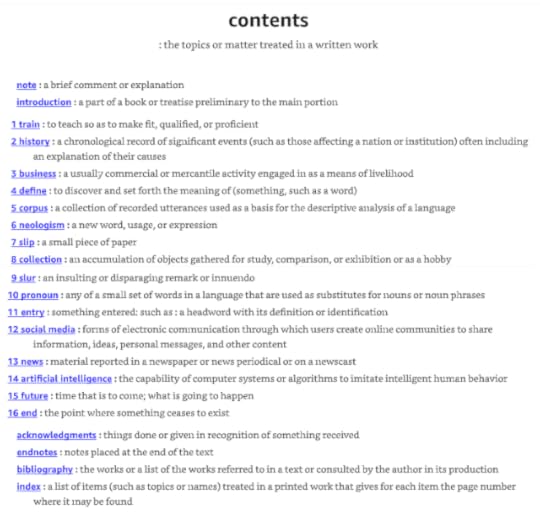
Unfortunately, the chapter headers didn't make their way into the actual Kindle or audio TOC (so I'd have to go check out the one "contents" page and line it up with the numerical chapter, as that's all that was listed for reference.
ProFanity x 62 ... and I normally note some words, which seemed a little overkill here ;) I missed many, and didn't write down any that were being discussed AS dictionary words, but noted some used as part of the author's general conversation: portmanteau, parse, quotidian, patina. At one point, he joked about a manly overhaul, a "br-overhaul" and that made me laugh (him too!)
You might think a book about dictionaries/words would be "clean" and noncontroversial ... but there was an entire chapter devoted to the f-word, and the n-word, and about pronouns (beyond he/she/they ... this one ran a little long for me. I consider myself open minded, but I just haven't come across this much to have it take up so much space here in this book). Covid gets some conversation (words being added more quickly than usual), some politics, and then a look at the impact of AI.
I thought the Table of Contents was cleverly set-up ...
Unfortunately, the chapter headers didn't make their way into the actual Kindle or audio TOC (so I'd have to go check out the one "contents" page and line it up with the numerical chapter, as that's all that was listed for reference.
ProFanity x 62 ... and I normally note some words, which seemed a little overkill here ;) I missed many, and didn't write down any that were being discussed AS dictionary words, but noted some used as part of the author's general conversation: portmanteau, parse, quotidian, patina. At one point, he joked about a manly overhaul, a "br-overhaul" and that made me laugh (him too!)
January 7, 2026
A good dictionary is indispensable to any serious reader. But now with ebooks, you can get definitions just by highlighting words. When reading on paper, a definition is a few clicks away on your cell phone. But I have always loved paper dictionaries. I used to have a dictionary so big that it needed a special stand like a lectern to hold it. It was also great for pressing flowers. I loved it. My sister had one of the two volume versions of the OED with near microscopic type that came with a magnifying glass for reading. Sadly, those days are gone. This book tells the tale of the demise of the paper dictionary and the near death of the profession of lexicographer. Now, of course, with AI, we are on the verge of eliminating even regular online dictionaries. A part of me yearns for the days of Dr. Johnson when definitions and samples of usage could shine with wit and style, even if they were also sometimes inaccurate or incomplete and included too many examples of questionable social principles that most of us today would abhor.
Then there is the other side of the coin. I'm a nerd, a reader, a lover of books and writing, but even for me there is something about the art and practice of lexicography that is a little too fussy. How precise does a definition need to be? Isn't the whole idea of a book of definitive definitions antithetical to the fundamental fluidity of language? Isn't it inherently classist in a way that cannot be saved by alternative dictionaries which only can exist in a world where there is a standard that the alternatives reference? Maybe we should be happy with building algorithms that can track the living flow of language. There is also beauty in the idea that you can never step into the same linguistic river twice.
Then there is the other side of the coin. I'm a nerd, a reader, a lover of books and writing, but even for me there is something about the art and practice of lexicography that is a little too fussy. How precise does a definition need to be? Isn't the whole idea of a book of definitive definitions antithetical to the fundamental fluidity of language? Isn't it inherently classist in a way that cannot be saved by alternative dictionaries which only can exist in a world where there is a standard that the alternatives reference? Maybe we should be happy with building algorithms that can track the living flow of language. There is also beauty in the idea that you can never step into the same linguistic river twice.
Displaying 1 - 30 of 125 reviews