A hilarious, mind-bending investigation into how much humans and aliens might have in common, scientifically speaking—from a best-selling cartoonist and acclaimed physicist.
When the long-awaited day dawns and the aliens finally arrive on Earth, they might eat us and destroy the planet—or, just maybe, they might share the secrets of the Universe with us. When that time comes, will we be able to cross the communication barrier to beg for our lives? If the aliens do hold out those precious jewels of knowledge, will we even be able to grasp them?
It’s long been assumed, in both science fiction and real scientific efforts to communicate with hypothetical aliens, that math and physics could serve as a universal language connecting us with extraterrestrial minds. But as humanity draws ever closer to the possibility of an interplanetary future and expands its agelong search for alien life and intelligence, beloved author and physicist Daniel Whiteson and best-selling cartoonist Andy Warner wonder if we should be so sure. In Do Aliens Speak Physics?, they take readers on a wild adventure to the edges of space-time, science, and the imagination to investigate whether an alien–human mind meld could ever be achieved.
Deploying cutting-edge physics, deep philosophical insight, and plenty of cartoons, Whiteson and Warner explode what we thought we knew about talking to our cosmic neighbors—and even science itself—by asking and answering questions both lighthearted and profound. Would aliens even need science to build the technology that brings them to Earth? Is it possible that they could experience the Universe very differently from us—tasting electrons and smelling photons? Would the extraterrestrials have to perceive “electrons” and “photons” at all, or are these particles only convenient concepts for our human minds? At bottom, does physics reveal fundamental truths about the Universe, as we so often believe, or might it in fact tell us more about ourselves?
As ultimately mind-altering as it is hilarious, Do Aliens Speak Physics? will leave you with a view of the Universe—and humanity—that’s stranger and more marvelous than before.
This is a mostly high-level, very accessible and light-hearted discussion of a very interesting and profound question — how universal is the science of physics? Would all intelligent, technological life develop a science of physics like ours? Does reality drive us to our science of physics, or might it be something peculiar to our biology and our history? All of this by way of the author’s title question about intelligent aliens.
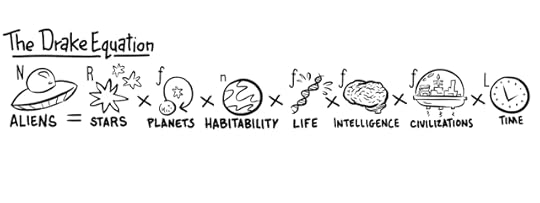
The authors take the famous Drake Equation, estimating the number of civilizations in our Milky Way galaxy that we might communicate with as a starting point. The final factors in the Drake Equation concern the likelihood of intelligence evolving on planets (or other bodies) where life evolves, the likelihood of intelligent civilizations developing the technology needed to send and receive signals detectable by other intelligent civilizations, and the lifetimes of those intelligent, technological civilizations.
All of the factors in the Drake Equation have their difficulties, but those last three have special problems. Like some of the other factors, our knowledge is limited to our one instance — our own planet, the evolution of life on our planet, the evolution of intelligence in our own biological history, our own development of technology, and our precarious, thus-far short by biological and astronomical standards, lifetime as an intelligent, technological species.
And, maybe even more limiting, we rely on a wealth of assumptions in even thinking about these factors. How likely is it that intelligent beings are curious about reality in the ways that we are, that they formulate theories as we do, that they formulate those theories mathematically, that they have the urge to manipulate their environment, augment their capabilities, and even exploit their resources to develop the kinds of technologies that afford exploration of the universe beyond their worlds. Would they even want to communicate with other civilizations?
Physicists and others in what we could call the traditional search for extraterrestrial intelligence (SETI) have been optimistic in answering these questions. Intelligence breeds curiosity, curiosity breeds theory (as opposed to serving only practical functions), and theory will converge on an account of reality that in some way coincides with our own. And their theories will be mathematical, as ours are.
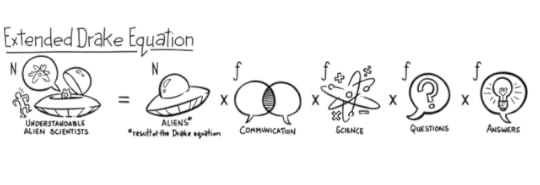
To address this mass of questions, and ultimately to challenge that optimism, Whiteson and Warner propose to extend the Drake Equation. They add four new factors, to be applied to the result of the Drake Equation, the whole thing aimed at approximating the likelihood of our being able to share scientific knowledge with whatever alien, intelligent civilizations may exist. These are their four new factors:
- Alien science: what is the likelihood that aliens in those civilizations do something akin to experiment-driven science (taking that characterization as valid of our own sciences)? - Alien language: can we actually communicate with those aliens, in some language, to allow us to share theoretical knowledge and questions? - Asking questions: do the aliens ask the kinds of questions that we ask? Are they motivated by the same curiosity about reality that motivates our theories? - Answering questions: are the answers they have arrived at, their own theories, answers to the questions that we want to find answers to?
Whiteson and Warner are less optimistic than earlier generations of physicists and astronomers have been about the answers to these questions. They recount the efforts and the thinking of optimists like Carl Sagan, who supposed that any intelligent, technological civilizations must not only pursue scientific questions, but answer them in mathematical terms that are reconcilable with our own. That generation was optimistic enough to even suppose that our representations of scientific facts like diagrams of our solar system or of basic mathematical values would be understood by aliens.
The authors question assumptions behind that optimism. In particular, they question the assumption that a technological civilization must be a scientific one. After all, craft technologies, such as those developed and practiced for centuries — taming fire, making pottery, fashioning spears and other weapons — did not depend on theoretical knowledge, only practical knowledge. Could the same be true of more advanced technologies, the kinds we are talking about when we talk about sending and receiving signals across space?
You might want to argue that making spears is one thing and building radio transmitters is another, and that the latter, although not the former, depends on theory, not just know-how. But that argument hasn’t been made, and the steps to get to the radio transmitter may well be achievable through know-how and without know-why.
The bigger, overarching point is that we do not understand and should not underestimate how alien aliens are likely to be. How their biology, their history, how their cognitive lives (if they have something we could recognize as cognitive lives) may differ in truly unimaginable ways from our own. To argue that they must, for example, conquer mathematics to design and build advanced technologies, or even that they must develop symbol-driven languages, only ecause we can’t imagine any other way for them to build a technological civilization is to argue from the limitations of our own imaginations. Our imaginations may shrink before the realities of a universe of life we know nothing about.
All of this is to say that Whiteson and Warner are doing a job that is late in arriving. “Alien” really does mean alien. The paths that alien intelligent life may take, if they take “paths” at all, are truly unknown and beyond our ability to imagine. It’s fun to try, and science fiction writers are fantastic at it. But their imaginings may pale before what we might actually find out there.
The premise of the novel, Roadside Picnic, by Arkady and Boris Strugatsky, should serve as a lesson. Aliens actually visit and land on our planet. They spend a little time (maybe having a “roadside picnic”), and they leave without apparent interest in us and leave what may be garbage to them behind. We are just a stop on the road. We imagine ourselves to be recognized as peers — of course they will want to talk to us? Look at us — we have telescopes, we build cities! Surely you’d recognize the builders of cities as intelligent peers!
Okay, that’s a bit sarcastic. Sorry. But the point is, building cities (or other marks of what we call “civilization”) may be insignificant, bizarre, or primitive in the eyes (or whatever) of aliens. Our cities may be akin to prairie dog towns in their eyes, so different from how they live and organize themselves, if those terms are even applicable, as to suggest no commonality, no membership in any galactic intelligence club, at all.
In some ways, the authors’ question about communicating with aliens is a maguffin. To answer it, they must take on the philosophical question, does our physics truly capture reality in a uniquely valid way, or is it only one of many possible ways of describing reality?
Informative, imaginative, and fun! The idea of meeting intelligent beings from other stars is truly exciting. We have so much to learn from each other, but how would we communicate? It is hard enough to communicate with people from other countries, much less our cats and dogs. How could we “talk” to aliens from other star systems? Cultures may vary, but principles of math and science do not, so a natural assumption is that this could be a basis on which to build communication and hopefully learn from each other. This book convinced me that this assumption is not as certain as it sounds. If you are the kind of thoughtful reader likely to be attracted to this book, do not expect the amount of time you spend on it to be predictable based on the number of pages. It is the kind of book that makes me stop and muse for a bit before I move on to the next chapter. A simple example is the statement that two honest, accurate observers can have different accounts of the order in which things happen in the universe if they are moving at different velocities or are far apart. Hmmm. If this sounds a bit deep and much too serious to include much humor, please rest assured that the universe is full of MANY different elements, and humor is one of them!! I did, indeed, laugh a lot in the course of my reading, although I must acknowledge that sometimes the humor seemed more relevant than at other times (I must say that sometimes the clever authors made what seemed irrelevant become relevant later, so hang on!) . In addition to interesting ideas for me to mull over, there is fascinating information that made the book worth my time on a more intellectual level, including unexpected tidbits like the abilities of bees to see in ultraviolet light and butterflies to taste with their feet (I wonder if they like chocolate?). The sources cited in the book, such as Carl Sagan, Noam Chomsky, and Frank Drake, made it clear that the authors were not just using their obviously active imaginations but were doing serious research. The fact that it had the recommendation of Daniel Dennett added to my conviction. The cartoons are a fun touch but have small details, so I recommend you read either in hard copy or on a screen where you can easily resize to switch between pictures and print. I also recommend that you not read this book in the company 0f family members who are trying to concentrate on something else, because your frequent laughs and occasional interruptions when you cannot resist sharing something especially enticing is NOT going to make their own experience easy. I received an advance review copy of this book from NetGalley and W. W. Norton and Company,
Informative, imaginative, and fun! The idea of meeting intelligent beings from other stars is truly exciting. We have so much to learn from each other, but how would we communicate? It is hard enough to communicate with people from other countries, much less our cats and dogs. How could we “talk” to aliens from other star systems? Cultures may vary, but principles of math and science do not, so a natural assumption is that this could be a basis on which to build communication and hopefully learn from each other. This book convinced me that this assumption is not as certain as it sounds. If you are the kind of thoughtful reader likely to be attracted to this book, do not expect the amount of time you spend on it to be predictable based on the number of pages. It is the kind of book that makes me stop and muse for a bit before I move on to the next chapter. A simple example is the statement that two honest, accurate observers can have different accounts of the order in which things happen in the universe if they are moving at different velocities or are far apart. Hmmm. If this sounds a bit deep and much too serious to include much humor, please rest assured that the universe is full of MANY different elements, and humor is one of them!! I did, indeed, laugh a lot in the course of my reading, although I must acknowledge that sometimes the humor seemed more relevant than at other times (I must say that sometimes the clever authors made what seemed irrelevant become relevant later, so hang on!) . In addition to interesting ideas for me to mull over, there is fascinating information that made the book worth my time on a more intellectual level, including unexpected tidbits like the abilities of bees to see in ultraviolet light and butterflies to taste with their feet (I wonder if they like chocolate?). The sources cited in the book, such as Carl Sagan, Noam Chomsky, and Frank Drake, made it clear that the authors were not just using their obviously active imaginations but were doing serious research. The fact that it had the recommendation of Daniel Dennett added to my conviction. The cartoons are a fun touch but have small details, so I recommend you read either in hard copy or on a screen where you can easily resize to switch between pictures and print. I also recommend that you not read this book in the company 0f family members who are trying to concentrate on something else,. because your frequent laughs and occasional interruptions when you cannot resist sharing something especially enticing is NOT going to make their own experience easy. I received an advance review copy of this book from NetGalley and W. W. Norton and Company,
This is a fun, thought-provoking book that explores whether our assumptions about alien intelligence actually hold up. We often take it for granted that if an alien civilization can achieve interstellar travel, it must also possess a deep, human-like scientific understanding of the universe—but is that really true? Whiteson challenges this idea in clever ways. After all, humans were forging iron swords long before we understood metallurgy. Sometimes technology comes first, and the underlying science catches up later.
A central question of the book is whether we would even share a common intellectual language with extraterrestrial intelligence. Would mathematics be universal, or is it partly a human construct? And even if math itself is universal, would aliens recognize our symbols—our “2,” our “+”—or would those be as alien to them as their symbols would be to us?
My favorite section is the discussion about whether mathematics is invented or discovered, and what numbers actually are. This is where the book really shines for me—when physics drifts into philosophy and asks foundational questions about reality, knowledge, and meaning.
Compared to Whiteson’s earlier works, which felt more like concise tours of classical physics and core concepts, Do Aliens Speak Physics? is far more philosophical. It’s less instructional and more reflective—more about questioning assumptions than teaching formulas. It’s a definite change of pace, and one I thoroughly enjoyed.
In this fun and informative book, particle physicist Daniel Whiteson and cartoonist Andy Warner speculate about aliens visiting Earth.
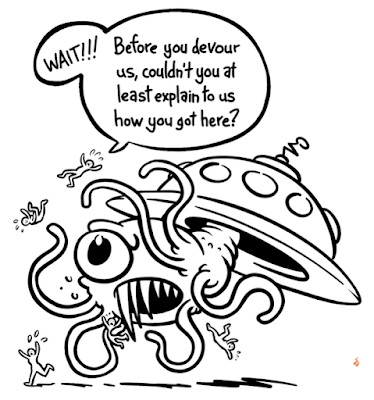
There are various scenarios for what might happen if an alien spacecraft touches down on Earth. On the one hand, snarling tentacled monsters might overrun Earth's measly defenses and fry us into human crisps by a planetwide death ray.
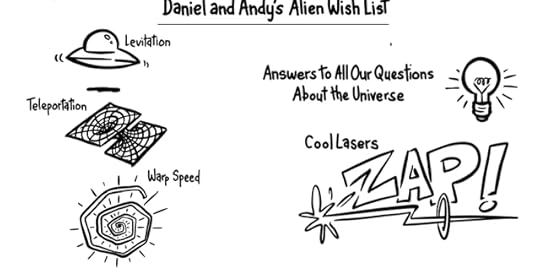
On the other hand, the aliens might come bearing gifts. They've traveled far to get here, using advanced technology, and might be willing to share. The authors speculate, "What if they could just tell us how everything works, so we don't have to blindly hack away for decades or centuries to gain this elusive knowledge?"
Many scientists, especially physicists, believe this could happen. They imagine that physics describes everything in the Universe, not just life on Earth, and so should form the foundation of alien science. Therefore, we should be able to use physics as a mental bridge between ourselves and the aliens.
Whiteson and Warner suggest this view may be too optimistic. They think it's possible alien minds, and ideas about physics and math, are "so different from ours that asking how they do math is like asking what color Tuesday is." The authors speculate that aliens might be so unlike us, there could never be useful communication. For instance, life on Earth is based on carbon and water, but aliens might be made of silicon and ammonia.
In any case, for humans to interact with aliens, many conditions must be fulfilled. Astronomer Frank Drake devised an equation to estimate the number of alien civilizations we might be able to communicate with by laying out the individual requirements piece by piece. Briefly, the Drake equation includes approximating the number of stars with habitable planets that could sustain intelligent life, and how long they've been broadcasting signals we might receive.
Whiteson and Warner devised an extended Drake equation that summarizes the concept of humans meeting - and learning from - aliens as follows:
The authors go on to discuss our hypothetical 'first contact' with aliens, whether or not they have knowledge to impart. I'll give a brief peek at the subjects covered, and encourage interested humans (or aliens) to read the book.
➤ Do aliens do science?
Though traveling through space would seem to require scientific knowledge, aliens might hit on the technology without knowing how it worked.
For instance, centuries ago, people learned to forge swords and bake bread without understanding the science. Humans WANTED to comprehend though, and they told stories, asked questions, and made observations until they figured it out.
Would aliens have the same desire to understand the universe as humanity? If so, they might have things to teach us.
➤ Could we communicate with aliens?
To learn the secrets of black holes from aliens, we'll have to figure out how to communicate in the first place.
The authors note, "Alien language might employ not only unfamiliar words and sounds, but also lights, gestures, or smells - not to mention that the thoughts an alien language expresses may themselves be unfathomable."
As it happens, scientists have already thought about communicating with aliens:
The 17th century Austrian astronomer Joseph von Littrow had a plan to write huge mathematical equations on the Earth's surface by digging trenches in the Sahara Desert, filling them with kerosene, and setting them on fire in hopes that Martian mathematicians would see them.
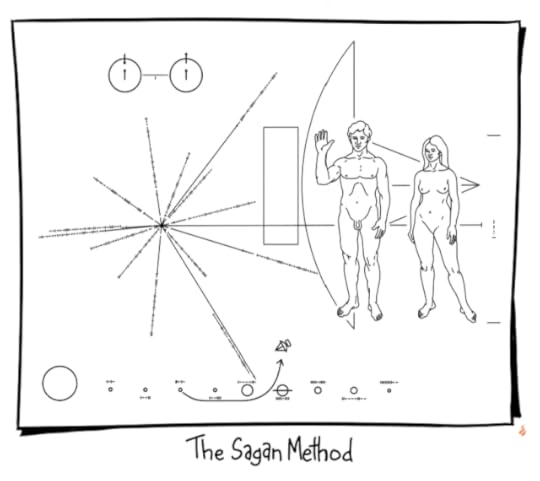
More recently, Carl Sagan designed a message that would be inscribed on plaques attached to the Pioneer 10 and Pioneer 11 spacecrafts, launched in the early 1970s. This is it:
Referring to the first part of the plaque, Whiteson and Warner joke about what an alien might make of it: "All tadpoles must enter the hot tub on the left and exit on the right."
Joking aside, Sagan hoped aliens would recognize it as a depiction of the hydrogen atom. In reality, even other HUMAN physics graduate students struggle with this picture, so it's hard to imagine aliens understanding it.
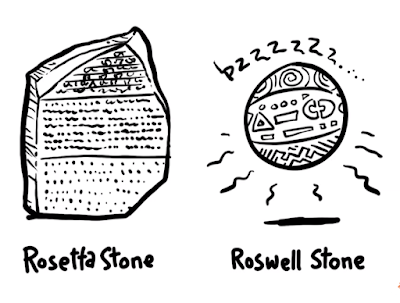
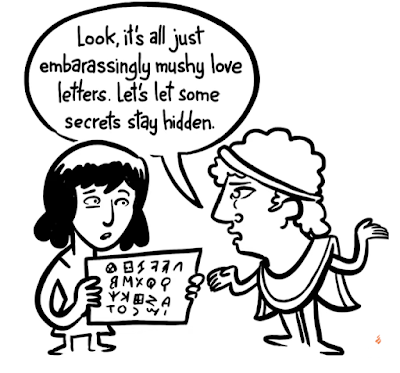
Conversely, humans would probably find it almost impossible to decipher something written in an alien language. It took about a thousand years for scholars to interpret Egyptian hieroglyphics, a HUMAN language, and they needed a cheat sheet, the Rosetta stone - a decree issued in hieroglyphics and ancient Greek - to do it.
The authors write, "If alien minds have very alien ideas, it may be impossible to decode their written language, requiring us to somehow translate a set of unknown words or symbols into a potentially unfamiliar set of concepts." However, if the aliens came here to Earth, then having human and alien brains together might advance communication.
➤ Do aliens do math?
Math is the language of physics on Earth, but can we count on math to be the foundation of alien science. If so, we have a good chance at being able to share information about the universe.
The authors present a long discourse on math, and point out that the most basic math is counting and adding. To illustrate how OUR math might not align with alien math, they present an example: If you put a piece of paper and a pencil on a table and ask an American, 'how many things are there?', they will say 'two.'
If you ask a Japanese person in Japanese, their answer will translate to 'one flat thing, one long cylinder.'
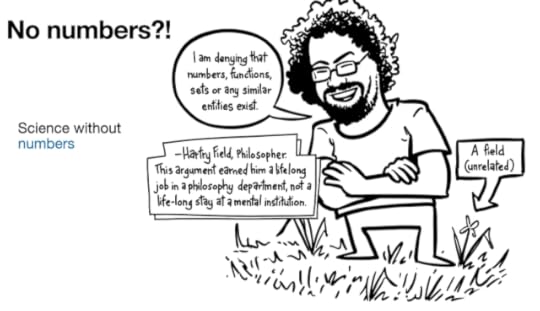
Whiteson and Warner observe that a difference between human and alien perception of math won't matter IF math is a deeply seated element of the Universe, something discovered rather than invented. Contrariwise, "many philosophers worry that math is just part of the way we think, a complex human game like checkers."
➤ What about alien perception?
Even if aliens are mathematical, scientific, and communicative, they may not be seeing the same Universe as us. Whiteson and Warner write, "If aliens have different senses, they will perceive different bits of the Universe - which will naturally lead them to ask different questions about it."
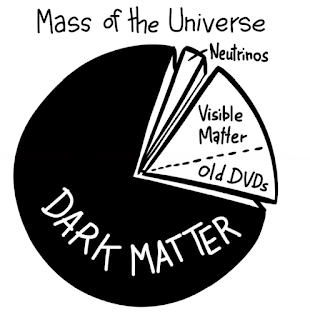
To give an example, aliens may 'see' the zillions of neutrinos passing through everything on Earth (including you) every second. Human eyes are constructed to absorb photons, not neutrinos. In fact, humans can't see most of what makes up the Universe - dark matter. Whatever this dark stuff is, "it isn't just out there in deep space; it's here with us. It's in your room with you right now."
Humans can't see, smell, touch, hear, or sense dark matter. If aliens can, they might have a vastly different picture of the universe than we do. Aliens may even have an alternate understanding of space and time.
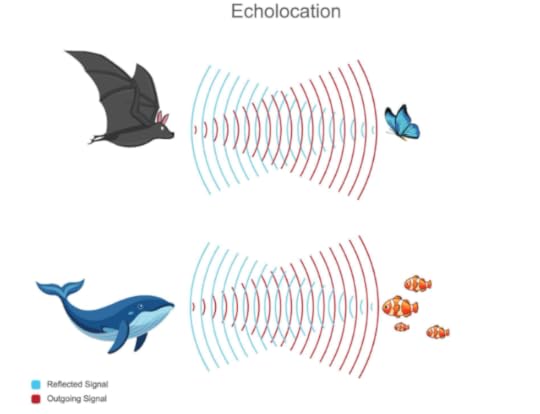
To illustrate the array of senses humans DON'T have, we need only look at other inhabitants of Earth. Some fish can sense electric fields; some birds can sense Earth's magnetic field; bats and dolphins use echolocation; and some cold-blooded animals have infrared vision.
The authors point out that human senses evolved in an Earth environment, and if aliens evolved in a completely different habitat, their senses may also be very different.
➤ What questions do aliens ask?
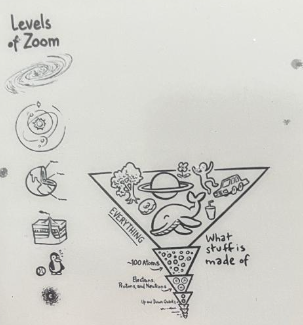
Humans are curious about everything, but (normally) only see the 'big picture.' At a tennis match, for instance, humans can observe the ball going back and forth, but not the atoms in the ball. This works for big things like planets and tennis balls because we can zoom out to determine how the objects move without referring to the atoms they're made of.
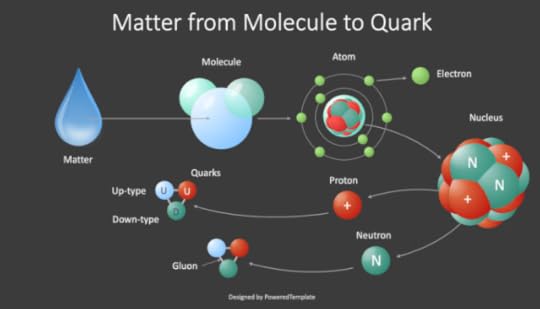
More than that, big pictures can bury details, so we zoom the other way to find the smallest objects. The world is made of tiny atoms, which in turn are composed of electrons, protons, and neutrons. Protons and neutrons, in turn, are made of quarks. Particle physicists on Earth study these miniscule entities, but would aliens also be curious about them?
Would aliens see the universe the same way? Would they notice the same things and ask the same questions? Humans live on the surface of a planet and look up into the sky, so astronomy was the gateway science for early humans. If aliens live underground, though, "they may think that focusing on orbits over what's inside is burying the lede. What's reasonable to us may be more cultural than universal."
The authors include an extensive discussion of how and why humans do science, and emphasize that our scientific knowledge didn't accrue by a 'straight path up the physics mountain', but rather by zigs and zags and branches and chance and luck. They ask, "Are aliens on the same route as us, probably further along, or are they climbing a completely different face?"
I guess we'll have to meet some aliens to know. 😊
In sci-fi movies and television shows, humans communicate with aliens rather easily, maybe using a 'universal translator.' Whiteson and Warner make it clear this is an unlikely notion. The book is fun, and the cartoons are hilarious, but it's real science, not a fluffy read (in case you need to know).
I enjoyed the book and highly recommend it.
Thanks to Netgalley, Daniel Whiteson and Andy Warner, and W. W. Norton & Company for an ARC of the book.
My thanks to NetGalley and W. W. Norton & Company for an advance copy of this book that seeks to answer questions many of us have thought about if and/or when aliens come to our planet, questions about what aliens might be like, how they communicate, what they eat, and if they find us even worth trying to talk too.
I have loved science fiction for almost all of my life. I have probably read more books about aliens, both fictional, nonfictional, science related or just conspiracy, than most other genres. Communication always seemed like the most difficult hurdle to overcome in dealing with visitors from another world. I thought this while down South when I was in college visiting a friend in Texas. Words for soda were different, actions were different, which made me smile. Same thing in Canada, accents were different, meanings were slightly different. I thought of this one the way home. On one continent we have different ways of talking. How are we supposed to talk to people from a different star. I think of a lot of weird things. Thankfully so do these authors, one to study and write about, the other one to make cartoons to illustrate these weird thoughts. Which makes for a fun book. Do Aliens Speak Physics? And Other Questions about Science and the Nature of Reality by physicist Daniel Whiteson and cartoonist Andy Warner is a book that answers many questions raised by people about a First Contact situation, including modern research, historical events and quite a bit of humor.
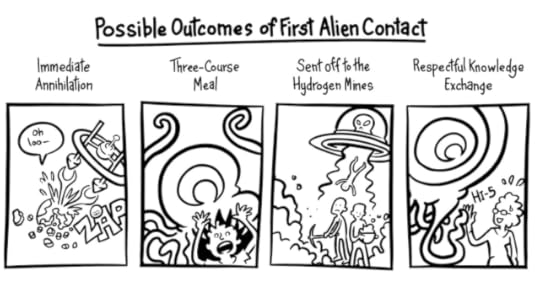
The book looks at what could happen if and when the human race makes contact with aliens from beyond the stars. The book is broken down into different chapters, dealing with language, how aliens and humans might perceive things, biology, technology and more. The book draws on a lot of current thoughts on things, while looking at the history of both science, scientific method and how hard it is in many ways to really think like an alien. What if they don't understand numbers the way we do, or their biology is based on something we have not thought of. What could they eat, and how do aliens taste? Taste their food I should say. The book looks at a lot of popular ideas over the century and point out whoops that was wrong, or that is outdated, all while coming up with solutions of their own. Interspaced between the chapters are first contact situations, and possible results, from a successful meeting, to a thanks for the food we have to go, to even a well we have talked enough, thanks goodbye. The book is illustrated also showing ships, crafts aliens, and the figures in science and history that are being discussed.
A book that was far more than I expected. I thought this was going to be more a linguistics book, but this is a whole lot more, and really made for an enjoyable read. The authors look at a lot of things, from Voyager to messages beamed into space, and point out a few to the things that were wrong, and how other beings might interpret them. A space rug for instance. The book has a good mix of science and humor, with the humor not overwhelming the book, as many books allow. I never felt lost even when the paragraph might discuss hieroglyphs, how eyes see, the interpretation of color in language and other bits of science. Whiteson does a very good job of keeping everything understandable, interesting and fun. I learned quite a bit while reading this, and can't help but wonder what would happen if humans and aliens ever met.
A book for science fiction fans, readers of science and those who like to learn things. Also this would be a good book for aspiring writers to use as research. There are a lot of good ideas for science fiction writers, as well as ideal for those who write historical fiction. This is the first book I have read by either author, I hope they team-up for more books like this.
Since we haven’t met any aliens (that we know of), the authors have fun speculating about how little green men would view the universe. They don’t just wildly guess, but base their theories in what we know, like ancient cultures on Earth. Some saw astronomy as godly, others were more practical. What type of viewpoint would aliens have? The science is mostly approachable, and is explained with fun examples (donuts and hot cocoa are used a lot). I’ve given up on Quantum Physics so that part went way over my head, but there is also history and philosophy, and cute funny illustrations were witty and made me laugh. They also include fictional scenarios of first contact and offer a final conclusion in which they explain what our perfect alien date would have to look like to learn from them. Interesting, well written and funny, recommended for readers of all ages. I chose to read this book and all opinions in this review are my own and completely unbiased. Thank you, NetGalley/W. W. Norton & Company.
This work contains plagiarized material from my original book, used without permission.
Beyond the theft of intellectual property, the author distorts the narrative by falsely claiming my cat was an alien.
That “alien” was a sentient being whose story was never authorized for this type of publication.
This is not only a violation of copyright and intellectual property—it’s an act of symbolic cruelty toward both animals and alien beings.
The portrayal is misleading, unethical, and scientifically baseless.
Additionally, the alien narrative appears to plagiarize elements from Ross Coulthart’s published work on UAPs and extraterrestrial phenomena, without proper attribution. This compounds the ethical violations and further undermines the credibility of the publication.
Parts of the book are interesting; it contains a number of cartoon drawings which add very little to the story and are borderline funny, but none of these makes the book an engaging reading. The book goes on tediously explaining that for one reason or another humans and aliens may not be able to understand each other.
The most interesting idea in the book, I found, is that the story stems out from Drake’s equation which tries to determine the number of alien civilizations out there in the universe. Everyone knows that most of the terms in the equation are very difficult to estimate or simply that there is no data to do so. The book after some brief lighthearted discussion gives only qualitative values, which is fine. It leaves open the likelihood that intelligent life might be found soon, otherwise the book would be unnecessary.
A meandering but entertaining exploration of the possibilities of aliens. The authors do not rest of the unlikely idea of bilaterally symmetrical humanoids but consider the "what-ifs" of the difficulties of communicating with creatures who evolved on so different a world that they might perceive science through the metaphor of eddies or have traversed the universe without really understanding how. For that alone, it is pop science worth the time of the general reader--and essential for any speculative fiction authors who want to have more worthwhile creatures populating their pages.
I enjoyed the subject matter of the book; how we would communicate science with aliens, given that it is not guaranteed that they will see the universe the same way we do. There is so much we take for granted about how science works, that it was refreshing to read how things could have happened differently. I enjoyed the scenarios and the cartoons. There was some humour in the book, especially in the footnotes, but at times the humour seemed forced. Overall this was an interesting read. Thank you to Netgalley and W. W. Norton & Company for the advance reader copy.
I received a digital review copy of this book from NetGalley.
This was a fun book. Probably a bit more philosophy than physics. The hypothetical situations and examples were excellent, and the cartoons were a good way to break up the text. However, sometimes the humor and snarkiness got in the way of the content... like the authors were more focused on making or setting up clever jokes than writing on the topic. It started getting annoying after awhile and was enough of a distraction that I almost didn't finish the book.
A very fun, but educational, read. It posed some questions I never considered when thinking about aliens (which, to be fair, I really don't think of *that* often). The little pictures and comics were cute but I don't know that it really added much to the book other than a small chuckle. I ended up kind of just skimming past them halfway through. But the text was full of enjoyable thought experiments!
An interesting book that points out that the traditional ideas of how to communicate with aliens (just start with prime numbers and work your way up!) may not work because aliens may think so differently than we do. I started the book not terribly convinced about this but by the end I was willing to concede that the authors had a point.
Having said that, I felt like the book was too long, and a lot of the jokes seemed pretty tacked on. (maybe I was just in a grumpy mood though!)
An interesting read! I was a little unsure of this book before I began, but found myself enjoying it. I’m not a huge alien fan, but I had lots of fun reading this. It was well written, entertaining, and informational. Thank you to NetGalley and W.W. Norton & Company for the advanced reader copy for review.
Such a highly anticipated book! We Have No Idea and Frequently Asked Questions About The Universe are possibly my most favorite nonfiction books! I hit pre-order on this one as soon as I could. You just gotta love the both playful and humble approach these books take. It is so refreshing! I am of the opinion that every scientific paper should tackle its subject matter like that. Reading them is such a mind-bending experience; I could almost feel new folds forming in my brain. What they do is call into question our own distorted understanding of the world and challenge the misguided beliefs that come with it. Thus breaking us out of our conceptual cages. This one isn’t as funny as the other two and the illustrations aren’t on par with the ones from the two previous ones, but it is still a perfect cocktail of science, philosophy and humour. I fervently hope that Daniel Whiteson will publish more books in the future.
Good book, I had higher expectations though. I enjoyed the conceptual challenges about how our science and physics has developed, including human biases etc. It's interesting to see how differently it could have been/could be developed. It is well framed with the topic of aliens to keep it interesting and not just philosophical.
Are We Alone? This book doesn't answer that. It explains if and how we might communicate with aliens if they arrive one day. Daniel Whiteson (a particle physicist and co-host of "Extraordinary Universe" Podcast) and Andy Warner (a cartoonist) ask: If an alien civilization came to us, could we communicate with them using physics? They challenge the common assumption that physics and mathematics are universal — that any intelligent species would “do physics” just like us. The book explores whether core scientific concepts — like “number,” “space,” “time,” and “laws of nature” — might be shaped by our human biology, culture, and perception, rather than being purely objective. Whiteson and Warner extend the Drake Equation (the formula estimating the number of communicating alien civilizations) by adding terms that ask: How many aliens even do science in a way we’d recognize? If they do science, can we understand their science? Would their “answers” to fundamental questions (about reality) even resemble ours? Through humorous, speculative scenarios (some even sci-fi-ish) and cartoons, the authors ask serious philosophical questions about the nature of science, knowledge, and communication. I really enjoyed this book and gave it five stars.
A good, snarky book that looks mostly at philosophy of science questions that uses the possibilities of alien life as a mirror to examine our senses, scientific methods and how we perceive the universe. A fun read!
The cartoons added humor and understanding to the content. Wish the font would have been larger. It is a good idea- but not absolutely necessary- to have some physics knowledge (ant interest in aliens) in order to better understand and appreciate this book.
This book was so interesting and well documented that I even read the whole references and highlighted some of them. I wish there were more popular science books like this.
You won’t finish this book as a physicist or a rocket scientist, but you may finish it as a more thoughtful citizen of a scientifically complex world.
If you’ve ever enjoyed a PBS-style science program that trusted you just a little more — one that values curiosity, humility, and collective understanding — this book is for you. And in a moment when our shared future increasingly depends on how well we understand and trust science, that feels like no small thing.