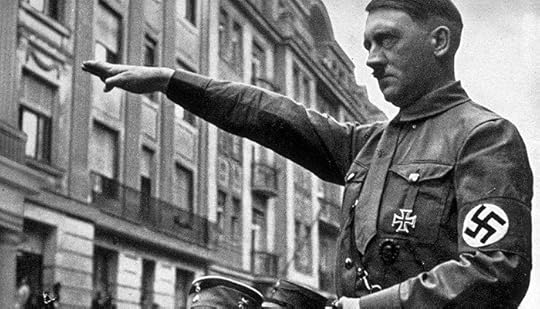
Edgar Feuchtwanger, in varsta de 5 ani, este unicul fiu al unui editor evreu. Are o copilarie fericita in orasul München. Este lipsit de griji, rasfatat de parinti si de bona, pana cand, in blocul de vizavi, se instaleaza Adolf Hitler, seful Partidului National-Socialist. In 1933, fericirea acestei vieti neumbrite de nimic dispare. Hitler este numit cancelar al Germaniei. Parintii lui Edgar, lipsiti de drepturile lor cetatenesti, incearca sa-si protejeze fiul de umilinte. La scoala, invatatoarea il pune sa deseneze svastici, iar colegii intra in randurile tinerilor hitleristi. De la fereastra casei lui, Edgar va asista la pregatirea unor evenimente tragice: Noaptea Cutitelor Lungi, Anschlussul, Noaptea de Cristal. Evreii sunt arestati, tatal lui este inchis la Dachau. Groaza, frigul si foamea de acolo il vor marca pentru totdeauna. In 1939, Edgar este trimis singur in Marea Britanie, unde isi va vedea mai departe de viata.
Edgar Feuchtwanger este istoric. Locuieste la Winchester, in Marea Britanie. A locuit vizavi de Adolf Hitler din 1929, cand avea cinci ani, pana in 1939. Bertil Scali este editor. Intre 1992 si 2004, a fost reporter la VSD, apoi la Paris Match. In 2013 a realizat un documentar, Hitler, mon voisin (Hitler, vecinul meu, 2013), pentru canalul de televiziune Planète.
Edgar Joseph Feuchtwanger is a German-British historian. born in Germany, as a boy Feuchtwanger escaped with his family to Britain prior to the outbreak of the Second World War. From 1944 to 1947, Edgar studied at Magdalene College in Cambridge, where he received his doctorate in 1958. From 1959, he taught history at University of Southampton, until he retired in 1989.
"He's right in front of us, outside his building...I can see he's cut himself shaving, as my father sometimes does. He has blue eyes. I didn't know that. You can't see that in photos. I thought his eyes were completely black. I've never seen him so close up. He has hairs in his nose, and a few in his ears. He's shorter than I thought."—Edgar Feuchtwanger, aged 6
Gah! What a memoir! It's just about perfectly written. Through sensory memories, Feuchtwanger takes us back to his quiet, upscale neighborhood in Munich circa 1929-1939. In 1929, when he's five years old, Hitler moves into an apartment across the street from him. He can look out his window and look directly into Hitler's bedroom and study. In the beginning, the new neighbor is the main topic at the dinner table of Edgar's family, who are authors and/or work in the publishing field. Also a great topic of interest is Hitler's Mein Kampf, which is a bestseller in Germany at the time.
However, as each year goes by and Edgar's neighbor works his way up the political ladder, the number of visitors to Prinzregentenplatz 16 become more numerous as well as notorious. Security is beefed up, and most nights he can see Hitler's shadow across drawn curtains. What's he cooking up tonight? What change in agenda or policy will be altered on this night?
"It's cold outside. You can't walk along the sidewalk outside Hitler's house now because there are barriers and, behind them, soldiers standing to attention, watching the Mercedes cars in the street. I recognize the guards because I pass them every day, but they don't notice me, an invisible little Jewish boy. I've been walking past this building all my life, and I watch them closely. I imagine what it must be like being Hitler. I wonder what he eats for breakfast. I see his shadow pass behind a window frame. He hates us. He hates me. Without even knowing I exist."
Then one morning, he wakes up to news of the Nuremberg laws, and his world is systematically turned upside down. Everything about his routine, school, friendships change on a dime. Now he's not just Edgar, but he's a Jew.
"Ralph has the whole uniform, and after school he and some of the other boys do their exercises [Hitler Youth]. On Saturdays they go hiking in the country, and they're planning to camp out one night. I sometimes wonder whether I could leave my family and stop being a Jew, be just a German like the others. I'd like to be free to decide who I am and be friends with Ralph again. Maybe we'll be friends again tomorrow."
So wonderfully told and structured. I love how this could have been a dense historical memoir, but it wasn't. It was elegantly sparse in keeping with the age of the narrator at the time. His knowledge of the world and politics is what he gathers from scraps of adult conversations he overhears. By this, we can see the foreshadowing of events to come, and we can understand why his parents and nanny are concerned about the way the tide is turning in the government. Later as he matures, you can see him working things out for himself, learning about his identity and embracing it...and then getting mad! Highly recommend!
I didn't really find the book as interesting as I thought it would be. It isn't particularily well-written, which also makes the book a little dull despite it being about a very serious topic. I didn't feel like I got any more insight into Hitler's life or how it was to live during WW2 either. I'm not trying to downplay WW2, I'm simply saying that this book as a literary text is not that good.
Romanian review: Am cumpărat cartea aceasta la un târg Gaudeamus prin 2014 sau 2015, fără să fi auzit de ea în prealabil— cu un asemenea titlu nu e de mirare. A zăcut mai bine de șase, poate chiar șapte ani, pe raft fără să o citesc. Între timp, am descoperit Goodreads și am citit sute de cărți și am început să privesc cu scepticism acest volumaș de sub 200 de pagini. Practic, când am cumpărat-o mă gândeam, ,,Un copil evreu a fost vecinul lui Hitler— sună al naibii de interesant". Pentru ca apoi să mă gândesc, ,,Și totuși, Edgar Feuchtwanger avea doar cinci ani când Hitler s-a mutat în blocul de vizavi și cincisprezece când a părăsit Germania, cât de remarcabile și de relevante pot fi observațiile unui puștan?" Scepticismul a fost accentuat și de citirea unei recenzii negative în care cineva remarca, pe bună dreptate, că părinții și rudele lui Edgar vorbesc constant despre ura lui Hitler față de evrei și despre intenția acestuia de a-i extermina pe toți încă de dinainte ca acesta să devină cancelarul Germaniei, iar, cu toate acestea, nu se grăbesc să fugă în altă țară. Prin urmare, este plauzibil ca autorul să ,,bage de la el" în aceste amintiri. După Al Doilea Război Mondial foarte mulți oameni pretindeau că știau ce urmează să facă Hitler și atunci te întrebi: dacă era așa evident, de ce nu l-a oprit nimeni? Răspunsul: pentru că majoritatea oamenilor nu aveau absolut nicio idee. Dar este ușor să faci pe profetul despre ceva ce s-a întâmplat deja. Pe scurt, am pornit sceptic, iar după ce am terminat cartea pot spune că nu am fost nici dezamăgit, nici impresionat. Motivul pentru care familia lui Edgar a părăsit atât de târziu Germania (pentru că au părăsit-o până la urmă în 1939) este explicat cu argumente destul de veridice. Era greu la acea vreme ca o familie întreagă de evrei să obțină vize, mai ales în perioada Marii Crize Economice când, așa cum spune și autorul, orice străin era privit cu ochi răi de cetățenii unei țări, care nu agreau ideea să vină cineva să le ,,fure" locurile de muncă. În plus, până la un punct, viața în Germania nazistă nu era chiar insuportabilă. Părinții lui Edgar, Ludwig și Erna, aveau atât prieteni, cât și un statut în comunitatea evreiască din München, pe care le-ar fi pierdut dacă plecau. Într-adevăr, este greu de crezut că majoritatea oamenilor înțelegeau amenințarea pe care o reprezenta nazismul, mai ales în 1929. Totuși, unchiul autorului, Lion Feuchtwanger, scria încă de la acea vreme cărți în care critica nazismul, pe Hitler și cartea acestuia, ,,Mein Kampf". Prin urmare, nu mi se pare incredibil ca, totuși, aceste memorii să fie sincere. Per ansamblu, observațiile micului Edgar au fost interesante. Nu au valoare documentară, însă dezvăluie amănunte intrigante despre viața din Germania interbelică— o viață departe de a fi obișnuită. Câți oameni pot spune că au locuit vizavi de Hitler și că unchiul lor a fost prieten cu THOMAS MANN? Plăcerea lecturii acestei cărți mi-a fost ajutată și de familiaritatea cu filmele și cărțile/autorii pe care îi menționează Edgar Feuchtwanger. Pe lângă sus-menționatul Thomas Mann, voi aminti filmul M(1931), regizat de Fritz Lang, și romanul Emil şi detectivii de Erich Kästner. Totuși, în ciuda lucrurilor menționate anterior, am spus că ,,Hitler, vecinul meu" nu m-a impresionat. Observațiile lui Edgar nu sunt atât de extraordinare încât să pună acea perioadă istorică într-o lumină nouă. Nu pot spune că acești primi ani ai vieții lui Edgar nu au fost marcați de prezența lui Hitler în blocul de vizavi. Nu pot pretinde că Edgar nu se gândea constant la această prezență, însă nu mă simt de parcă ea l-ar fi marcat atât de mult, încât această carte să aibă o valoare inestimabilă. Voi încheia recenzia menționând cea mai inedită parte din această carte: descrierea perspectivei unui copil evreu care învață într-o școală nazistă. Partea aceea chiar pune perioada respectivă într-o lumină nouă.
English review: I bought this book at a Gaudeamus fair in 2014 or 2015, without having heard of it beforehand—hardly surprising given its title. It sat on my shelf for more than six, maybe even seven years, unread. In the meantime, I discovered Goodreads, read hundreds of books, and started to look at this slim volume of under 200 pages with skepticism. When I first bought it, I thought, “A Jewish child was Hitler’s neighbor—sounds incredibly interesting.” Later, I began to think, “But Edgar Feuchtwanger was only five years old when Hitler moved into the building across the street and fifteen when he left Germany. How remarkable or relevant could the observations of a child really be?” My skepticism only grew after reading a negative review pointing out, quite reasonably, that Edgar’s parents and relatives frequently discussed Hitler’s hatred for Jews and his intent to exterminate them long before he became Chancellor of Germany. Yet, despite this, they didn’t rush to flee the country. This raises the plausible concern that the author might have embellished his memories. After all, many people claimed after World War II that they knew what Hitler was going to do, which makes one wonder: if it was so obvious, why didn’t anyone stop him? The answer: most people had no idea. It’s easy to play prophet about something that has already happened. In short, I started this book skeptical, and after finishing it, I can say I was neither disappointed nor impressed. The reason Edgar’s family left Germany so late (they ultimately emigrated in 1939) is explained with reasonably plausible arguments. It was difficult at the time for an entire Jewish family to obtain visas, especially during the Great Depression when, as the author notes, any foreigner was viewed with suspicion by citizens worried about job competition. Moreover, life in Nazi Germany wasn’t entirely unbearable at first. Edgar’s parents, Ludwig and Erna, had friends and social status within Munich’s Jewish community, which they would have lost by leaving. It’s true that it’s hard to believe most people understood the threat posed by Nazism, particularly in 1929. However, the author’s uncle, Lion Feuchtwanger, was already writing books at that time criticizing Nazism, Hitler, and his book "Mein Kampf". This makes it not entirely incredible that these memoirs could be sincere. Overall, young Edgar’s observations were interesting. While they lack significant documentary value, they reveal intriguing details about life in interwar Germany—far from ordinary. How many people can say they lived across the street from Hitler and that their uncle was friends with THOMAS MANN? My enjoyment of this book was also enhanced by my familiarity with the films and books/authors Edgar Feuchtwanger mentions. Besides the aforementioned Thomas Mann, he references Fritz Lang’s film M (1931) and Erich Kästner’s novel Emil and the Detectives. However, despite these points, I must reiterate that "Hitler, My Neighbor" didn’t impress me. Edgar’s observations are not extraordinary enough to cast that historical period in a new light. I don’t deny that these early years of Edgar’s life were shaped by Hitler’s presence across the street, nor that Edgar thought about it often. Yet I don’t feel as though this presence marked him so profoundly that this book holds inestimable value. I’ll conclude this review by mentioning the most unique part of the book: the perspective of a Jewish child attending a Nazi school. That section truly offers a fresh angle on that era.
As much anything else written in this small and powerful memoir, the quotes from Adolph Hitler's Mein Kampf, displayed at the beginning of each chapter and written almost 80 years ago, parallelled in a remarkable way to statements made by Donald Trump, not about Jews, but about immigrants and people from the countries he considers "shitholes." As most things not destroyed which then tend to move in cycles, it is unsurprising that someone like Trump makes an appearance on the leadership stage using words similar or identical to those used by the most malicious dictator and human being of the modern age. What is depressing is that the nation where that appearance is made would be America.
The author is an historian with a Cambridge degree. He actually lived across the street from Hitler during the time Hitler rose to power, and remembers the increases in security as Hitler became more determined to make Germany an Arayan nation by ridding it of Jews. He describes in sorrowful detail the destruction of the city's synagogues in Munich (Hitler apparently went to Berlin to conduct official Reich business). Each chapter begins with quotes from Mein Kampf showing Hitler's disdain for Jews as wells as Marxists, immigrants and Catholics and his perfidious belief that their acumen and religiosity had destroyed Germany.
As the years unfold (each chapter reflects the author's recollections during a given year beginning in 1929 and ending in 1939 when he was able to escape to London by crossing the border into Holland leaving his family behind), his parents hold onto the belief that Hitler could not possibly do to Jews what he claims to say he wants to do even as alarming events unfold before them. They held fast until the late 1930s that Germans were not a people who allowed such things to happen, but word of the camps and their observations of Jews being beaten, the businesses shut down, and personal property confiscated, were made first hand. One of Hitler's frequent arguments was that with the economy collapsed and the stock market moribund, immigrants were responsible for taking German's jobs.
Neither he nor his parents wanted to leave Germany for Palestine, either, seeing problems there for European Jews and rampant terrorism by proponents of an independent Jewish State. He says that he sometimes wondered if "I could stop being a Jew, just be German like the others." His long-term German friend Ralph had deserted him because he was Jewish and Hitler decreed that Aryans were not to associate with Jews
Over time and well before the beginning of 1939, the author's parents realized that their best alternative was to escape Germany. His uncle, Lion, a respected intellectual and author, had already left Germany along with Thomas Mann and others, and his father began obtaining visa applications from every country that would issue the applications to him.
There is much tragedy in this story. The parents never escaped and were sent to the camps where they died. But the author went to Cornwall, living with a Cornish family who treated him with love, encouraged his education, and made sure he got to Cambridge.
But this story really is about how people can ignore the obvious in evil people and that ultmately, they are at risk even though their position seems solid and they themselves are respectable.
Pretty soon, the despot comes for you, and by that time, you've had all the warnings necessary not to trust your good-hearted neighbors and friends who just follow the despot in his murderous ways, leading to self-destruction.
Truly a unique insight into Hitler’s Nazi Germany through the eyes of a child that lived across the street from Hitler. A Jewish Child that also recalls the changes made in textbooks, curriculum, and teachers as Hitler gained power and their family fell from societal grace. Very well written. Very much enjoyed it.
Even if the author has become an esteemed historian since the days portrayed here, there is no denying this is an awkward read. It is one part warm-hearted reportage of his childhood, full of lovely girl friends and mansions galore; one part a study of the literary bent of his family, including his uncle Lion who was about the only person to out-sell Hitler's Mein Kampf; and the major part a portrayal of life when the chief Nazi is living in a converted mansion over the road from you. That part should be the most interesting, but comes across here as the most clumsily written, which makes this book a bit of a mess, if I'm honest – the hindsight, the incredible riches of exposition and the impossibly well-remembered dialogue just dull the life out of the characters I had wanted to meet, and makes it all an implausible melange of faction. A shame, as the considerations about Hitler – that someone was his neighbour, someone else his dentist, etc – are incredibly valid.
An engaging, fluid, succinct, and illuminating narration of life in Germany during 1929-1939 period, pre and during the Third Reich. Hitler, My Neighbour, is a not a fictional story; obviously, memory fails sometimes, this is stated in the epilogue; and there are things that may need to be reconstructed; but the author was in fact, Hitler’s neighbour; Hitler lived across the street , and Edgar and Hitler crossed paths regularly.
ANOTHER perspective on the lead-up to WWII, from an observant, engaged boy from age 5 to 15. His life is filled with a close, loving family, girlfriends, mansions, summer vacations...everything for a well-to-do family. Edgar Feuchtwanger walks us through his feelings and experiences as his untroubled, happy life comes to an end. He is the only son of a respected Munich editor and the nephew of best selling author Lion Feuchtwangerthe who is the only person to out-sell Hitler's Mein Kampf. But Edgar is a Jew who lives across the street from Hitler's Munich apartment. In 1933, when Hitler is named Chancellor, his family starts the struggle about what to do.
The Hitler coming and going from his apartment are just a backdrop to what Edgar's family is experiencing. I appreciated another unique insight into what it was like for people to try to understand what was happening in Germany during the 1930s. The boy hears the adults discuss, so we get a firsthand account, and we and feel what it was like to have your life gradually, completely changed. I really enjoyed the perspective about what Edgar's family went thru to figure to leave, and then figure out how to get out - or know where to go - before it was too late.
As always, I loved the historical content and background...how did it happen??? There is excellent perspective on everyday Germans who were living the WWI reparations and their desire for hope and change. The author, now an aged historian, gives the Nazi buildup some explanation.
I won't forget what the author wrote about Hitler that added perspective to the monster: "He's superstitious, illiterate, and obsessed with dark forces that don't exist. He's like the barbarians who thought there were ogres in the woods and who loved warfare and sacking villages. He's less sophisticated than the Greeks three thousand years back."
Some of the pages seemed a little too long, too much detail about the boy's everyday life. But, it was all worth the story! It was also interesting, in the early 30s, Edgar the boy, in school, even got caught up in the "hope" of Germany . He drew "maps of Germany, not forgetting the regions stolen by other countries...our enemies behaved like cowards."
The main theme of this book sounds like something a Jewish comedienne in the 1960s could have created. ("Hey, did I tell you Hitler lived across the street from me when I was growing up in Germany during the 1930s? Seriously, it's true! Ask my mother! I can't tell you how many times she told me 'Do not trample on the flowers in Herr Hitler's yard'!") Of course, being a Jewish child living so close to Hitler was anything but funny during the 1930s, yet this is not a book of constant fear or terror.
Mr. Feuchtwanger begins the story when he was five and ends it when he was 15. Until the Jews started to be openly persecuted in Germany, he had a very happy childhood and much of the book is about that. Even when school assignments had him drawing swastikas, he still saw himself as fitting in with the other kids and having a future life in Germany.
His father also obviously had great difficulty picturing the family living elsewhere. He did go to Palestine to investigate the possibility of moving there, but working the land seemed too foreign to him, and he could not imagine his family living that way. Life got much worse, though, and the man across the street was too much a reminder about how dangerous Germany had become, so 15-year-old Edgar Feuchtwanger was sent to England.
By that time, he was more than happy to leave, and he would never forget seeing Hitler in and out of his residence, seeing those who came to visit him, and seeing those in the street trying to get Hitler's attention. While there is both a 5-page Epilogue and a 7-page What Became Of Them? chapter at the end of the book, much more about Mr. Feuchtwanger's new life in England can be found in his earlier 2015 memoir I Was Hitler's Neighbour.
(Note: I received a free ARC of this book from Amazon Vine.)
Hitler, My Neighbor Memories of a Jewish Childhood, 1929-1939 by Edgar Feuchtwanger, Bertil Scali
Other Press
Biographies & Memoirs
Pub Date 07 Nov 2017
I am reviewing a copy of Hitler, My Neighbor through Other Press and Netgalley:
In 1933 the joy of Edgar Feuchtwanger untroubled life comes to an end. He is the only son of a respected editor and the nephew of best selling author Lion Feuchtwanger, but he is a Jew and in 1933 when Hitler is named Chancellor his family looses all rights.
Edgar was only nine when Hitler came into power, destroying his life, his families life. At nine he was stripped of his childhood.
Edgar’s Father would spend several weeks in Dachau and would eventually go home, in 1939 Edgar would be approved to go to England and a few weeks later his parents would be approved.
I give Hitler, My Neighbor five out of five stars!
Excellent read. Fast paced, historical in content. Worth the read. Would recommend as reading material for middle school students. If you like WWII history you will enjoy this book.
Vi følger en liten gutt på 5år som bor tvers over gaten for verdens mest kjente Adolf i 10år, med alle de utfordringer dét bærer med seg i årene fra 1929 til 1939.
La première chose à savoir en commençant ce livre, c'est que c'est un témoignage réel. D'un enfant juif qui a réellement vécu en face d'Hitler pendant les années précédant la Grande Guerre. Il a assisté à l'ascension de cet homme, tout en pouvant observer le regard inquiet de ses parents.
Le père d'Edgar est un éditeur, son oncle est un écrivain plutôt connu à l'époque. Ils sont tous deux plus ou moins actifs dans l'opposition au moment de l'arrivée d'Hitler au pouvoir. Actifs par les mots, par le relai d'informations... Ils sont aux premières loges pour voir naître celui qui, plus tard, deviendra le pire ennemi de ce qu'ils "sont", des juifs. Ils ne pratiquent plus la religion depuis des décennies, mais ils le demeurent par le "sang"
A vrai dire, je ne savais pas que c'était un vrai témoignage. J'ai lu ce livre en imaginant lire un récit romancé. Du coup, certaines choses m'ont parues étranges et ont fait que je ne suis pas tout de suite rentrée dans l'histoire. Le récit d'Edgar, l'enfant, commence alors qu'il n'a 5 ans, et ses premiers souvenirs semblent bien naïfs. Mais finalement ce n'est pas plus mal car, à froid, ce que j'ai aimé, c'est que l'auteur qui a réuni les propos des années plus tard, Bertil Scali, a su rester neutre dans la retranscription des sentiments. On ne sent pas la peur de l'enfant au tout début du livre. On la ressent grandissante au fil des pages. Ca aurait pu être différent, et je pense que ça aurait moins bien interpelé le lecteur.
J'ai compris que l'histoire était vraie au moment de l'épilogue. Et c'est glaçant. Le livre s'achève avant le début de la Guerre et donc, parle d'une période dont on parle moins souvent : celle de l'arrivée d'Hitler au poste de Chancelier, l'abolissement des droits des juifs, la dérive, jusqu'à l'envahissement de la Pologne en Septembre 1939, date à laquelle la guerre mondiale a officiellement commencé.
Scali nous donne même des nouvelles de toutes les personnes qui gravitaient autour d'Edgar dans ces années là, et là encore, ça donne une toute autre dimension au livre.
TOut est vrai. Photos à l'appui, journaux à l'appui, photocopie du cahier d'école d'Edgar, et j'en passe.
Edgar recounts his life year by year from 1929 when Hitler moved next door to 1939 when Edgar and his family finally escaped, and every chapter is begun with a chilling quote from Hitler’s Mein Kampf. Edgar’s simple descriptions of a once ideal and later unimaginable childhood give a childlike feel and add to the authenticity of the read. Memoirs like these chronicling the atrocities brought about by this monster a man who because of his early failures created an atmosphere of hate that nearly ended the world as we know it are so important for many reasons, not only because there are so few people left who lived through this time and also because it’s imperative that this evil from beginning to bitter end is never forgotten. Fans of WWII non-fiction and memoirs will devour this and it should be required reading for high schoolers worldwide.
Edgar Feuchtwanger had an ideal early childhood, he and his parents were non-practicing Jews even celebrating Christmas, they lived in Munich Germany. Edgar’s father Ludwig was an editor, his uncle Lion an internationally acclaimed author and their friends included royals, actors, authors, and varied other celebrities. In 1929 when Edgar was five a new neighbor moved in across the street, a neighbor that would change the lives of not only his family and everyone they knew but the whole world. This new neighbor was a man who had only five years before been convicted of treason and sent to prison but who now found himself growing in favor because of Germany’s devastating debt and unprecedented unemployment and the Wiemar Republic was losing supporters. The changes started slowly but by 1939 this new neighbor had made it impossible for Edgar and his family to remain in Germany and they escaped only months before this neighbor had his troops invade Poland. His name was Adolf Hitler.
One thing (..amongst a lot of others) that has always baffled me regarding WW2 is.. why did so many jews not leave the Reich? this book, in many ways, discusses just that. I still got frustrated as in wanting to shake them into survival mode, but one of the best parts of this book is how it broadened my perspective as to why jews were desperate to stay in Germany despite bring told they were rats that should die. the father is sent to a concentration camp for a while, and even after that he hoped to influence his world using the pen Rather than leave and THEN fight using words. To me, it's imperative to know when to use both the pen _and_ the knife so to say... but I guess that fundamental faith in humanity that ressonates with the fathers arguments just never ressonated with me.
I do wish the cover was designed differently though, because when I was reading this all people around me noticed was HITLER in capital letters on the cover. Having blonde braids and blue eyes, it's safe to say I got some quite unpleasent stares.
Bien que ce livre soit écrit à la première personne, ce n'est pas Edgar Feuchtwanger qui l'a écrit, mais un journaliste d'ailleurs très talentueux, qui rend le récit de l'enfance d'Edgar, ce petit garçon qui observe Hitler de chez lui, très vivant et réel. Le ton évolue au fur et à mesure de la montée du nazisme et de la puissance d'Hitler. Edgar, enfant confiant et choyé par les siens se met peu à peu à avoir peur. Vingt fois, j'ai eu envie de secouer ses parents et de leur demander ce qu'ils attendaient pour partir, puisqu'ils le pouvaient. Le livre inclut des extraits des cahiers du petit Edgar à qui sa maîtresse faisait dessiner des croix gammées et autres dessins à la gloire d'Hitler. Ce récit m'a beaucoup intéressée et je ne sais pas vraiment ce qui m'empêche de lui attribuer 5 étoiles.
The author of this book grew up as a child of a wealthy German Jewish family, in an expensive apartment in Munich Germany, across the road from Adolf Hitler. He recalls his childhood and the times he saw his infamous neighbor.
It is quite the story to tell, but it felt a bit manufactured to me. I certainly can't remember discussions from when I was six years old in such detail. In such a scary time to be Jewish, the family were lucky to be able to survive intact when so many around them perished. I would have liked to have known more about the people that surrounded their family at the time.
Fascinating. I love memoirs, and the recollections of a Jewish boy who lived across the street from Hitler in 1930's Munich may well be unique in the literary world. Be aware though, much of the book involves his life after his immigration to England in '39, so the title alone doesn't give an accurate profile of the book's total content.
Because seen through a child's eyes, it really wasn't what I would have expected. He didn't seem much worse than any unfriendly neighbor. The atrocities we KNOW we're experienced by so many lead me to imagine that being a neighbor would have been like being in a torture chamber.
The book is a chilling look into how people were reacting to the rise of Hitler. And how a country slowly turned against the Jewish people. All through the eyes of a small boy whose innocence disappear over the course of ten years. It is an eerie sight into today’s world as well.
Quick, intimate recount of a young man who grew up in the same neighborhood as Adolph Hitler at the same time. It is a very personal insight into a time and place. The writing is well done.
L'autore, nato nel 1924 in un ricco casato, con questa narrazione autobiografica, quasi in forma di diario, racconta la sua vita di ragazzo ebreo negli anni dal 1928 al 1939. L'avvento del nazismo viene narrato in prima persona, dapprima attraverso quello che Edgar sente dai discorsi dei grandi, e per il bimbo sembra quasi un gioco, qualcosa che forse non è brutto, o che non verrtà, o che potrà toccare solo agli altri. Ma ben presto l'odio razziale si fa sentire anche su di lui attraverso cambiamenti della vita quotidiana: gli amici che voltano le spalle, le angherie piccole e grandi, l'arresto del padre. Edgar lasciò la Germania all'età di 14 anni, pochi mesi prima dell'inizio della guerra. Per 10 anni visse in un appartamento di fronte a quello di Hitler, proprio là dove vennero pensati e pianificati i più tremendi crimini mai commessi dal genere umano, "di fronte al personaggio più abominevole che la Terra abbia mai generato". Ebbe occasione di vederlo quasi tutti i giorni, dietro le tende o sul portone sempre sorvegliato dalle SS. Per fortuna, grazie alla disponibilità economica ed alle conoscenze, molti componenti della famiglia Feuchtwanger si salvarono emigrando. Un bel libro, scritto con una prosa senza fronzoli, con frasi brevi, e ben tradotto.
Da quando il sogno di partire per Londra è diventato una certezza non posso fare a meno di sorridere ogni volta che vedo la finestra del Führer illuminata. Lui non sa che lo sto guardando, non sa che sono qui, non sospetta neppure che nella casa di fronte alla sua, per dieci lunghi anni, è cresciuto un bambino ebreo che un giorno testimonierà contro di lui. Quando passo sotto le sue finestre il cuore mi batte all’impazzata, e tremo ancora quando un motore romba nella notte o qualcuno sale le scale nelle prime ore del mattino.
As the daughter of a survivor who lived and worked for members of the educated upper class Jewish community in Munich, of which the author was a member, I picked up this book wanting to learn more about life in that community at the time when the Nazis rose to power. The book was disappointing in that respect.
Despite being written by an eminent British historian, this book read more like a vanity piece than a work of history or autobiography. It basically consists of name dropping with a few stories inserted in between to describe the people and the incidents involving the author and those to whom he referred in the book. In fact, the author in some instances made it clear that he didn’t even engage in elementary fact-checking when he wrote this book as for instance he said he thought a certain person was defense minister at the time of a certain event instead of undertaking a few minutes of basic research to verify the information.
This is a book that should have been privately published and distributed to the author’s family and friends, and left among the author’s papers for perusal by future scholars to affirm information gleaned from other sources rather than being published for distribution to a general audience, or even to those interested in learning more about the Holocaust and events leading up to it.
A fascinating insight to how life was like in Germany from 1929 to 1939, from the perspective of a child. As it is stated, the author doesn't remember if he actually remembers a lot of it, or if they are false memories from what his mother told him. It is hard to think someone remembers so much from what their daily life was like at the age of 5. There also seems to be a lot of "you have to always remember this day" coming from peoples lips, like that is something people say.
I did enjoy the book, but nothing really happens in it. He lives his life, while gradually getting freedoms and rights taken from him. It feels like the transformation from him being part of the community, to him writing nazi symbols in his textbook at school was almost over night. That is probably not the case, but more of a gradual (but still quite rapid) turn of events. It does make one want to read more books about the war, especially about how Germany came to be in a state where Hitler could rise to power.
Recommended for everyone that wants to read a little different take on the rise of Hitler and how the second world war came to be.
Real history, stuffed with real observations and memories, seasoned with a child's point of view... It would have been an enjoyable read if the story wasn't about the rise of nazism in Germany. And this child's point of view could be so cute if it weren't for the fear... The fear that comes from realizing that the child is growing up in a Jewish family that lives across the street from Hitler's house.
A must read book. Must read and must remember. There is no other way to prevent history from repeating itself unless we learn and remember our lessons.
Less than a century ago, Hitler occupied Austria and part of the Czech Republic just on the fact that some people there spoke German. The world allowed this to happen and soon paid a terrible price. Less than 100 years ago, the nazis genocide people solely on religious and national grounds. The world watched how ultra-right slogans turned into terrible crimes, but did not react in time. Now we witness the senseless occupation of the Crimean peninsula, Donetsk and Luhansk regions by russia and a Chamberlain-like reaction of the world.
And yet it was enough to prefer books to propaganda and fake news. Yet is it enough?
--I received a copy of this book in exchange for an honest review. All thoughts are purely my own and not influenced in any way.-- This was a very interesting book about a young Jewish boy growing up right next to Hitler himself. Even though I've read books like this before, it is still always fascinating to see someone else's perspective, especially with Edgar's father being so actively resistant to the Nazi Party. There's really not much I can really say about it: you know what you're getting into with books like these, and you know certain details that will likely be touched on. I will say that this one is a lot "lighter" in comparison to books like Night or other books of its ilk, but that is never a bad thing: everyone has different experiences! I really loved how indoctrinated the school system was, as it's something that's always fascinated me but is never mentioned that much. Overall, great book about resilience and resistance that anyone can get something out of, but that could also easily be the first foray into the topic in schools. 3.5/5 stars.
Chilling book, particularly the intro to each chapter with an excerpt from Hitler's Main Kampf, progressing through his belief changes, so I would assume progressing through his book. Feuchtwanger is now 92. He was able to escape to Britain on a visa months before WW2 started, with his parents coming just months later. He has lived in England since, and became a historian and academic. The book is filled with poignant memories of a comfortable and social childhood growing up in Munich during the late 20's and early 30's, and the contrast as Hitler's power grew. A good portion of the book is presented as dialogue, which makes it more interesting, although I would doubt memories of many of the conversations included are as accurate as they are presented. However, both the general progress of events described, and his unique observation point from their front window across the street, where Hitler moved into an apartment when Feuchtwanger was five, offer some human context for a dark era of dictatorship and repression in the history of a great many countries between the two world wars.
This book was told over the ten years of Hitler's rise to power and the outbreak of World War II. It is the recollection of a man in his nineties, told about when he was five to fifteen.
The perspective of a child to the changing world of Germany, and the adults reactions from thinking Hitler was a fringe player to genuine loathing then fear as he became more powerful was heartbreaking to read and a powerful voice that is often lost when we look back on this point in history.
Even in the darkest times, we can learn so much from the viewpoint of a child. In this case, one who was quite proud to be German ND fond of Hitler way on, to eventually come to hate Hitler and the Nazi party.
I definitely recommend checking this book out. it's a quick but powerful read, and a story worth sharing.
This book was originally published in French h, and the English translation released in 2017.
I received an ARC of those book from the publisher and NetGalley in exchange for my honest review.