

What do you think?
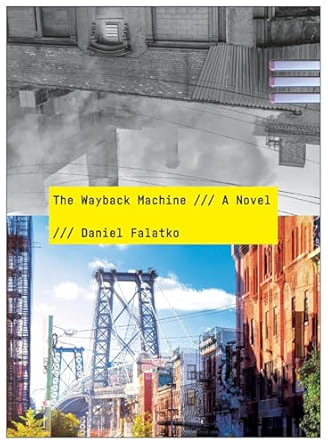
The Wayback Machine
Nathan thought he'd hit his lowest point when he landed in a federal penitentiary on drug trafficking charges. Back in NYC and living in his dead friend's apartment, he's at risk of descending even further. But as an aging former blogger and internet-famous music critic of the 2000s, Nathan has one thing going for a story to sell. And he's on the hunt for the highest bidder from a new media wasteland of podcasts and YouTube channels. It's a story that threatens to bring down his former employers, BAD HABITS Magazine, now risen from the ashes of pre-gentrified Brooklyn's hipster utopia to become a mainstream media titan.
What unfolds is a surreal cat-and-mouse game spiraling from the cold, dead heart of gentrified Williamsburg to the tent-colony-strewn streets of Westside LA. Zoomer podcast hosts, canceled media men, forgotten aughties indie artists, rockabilly Airbnb owners, and assassins in Jack White masks dot the landscape as Nathan races to promote his tale, while the media apparatus pulls out all the stops to kill the story-and perhaps Nathan himself.
"It was the last gasp of independent culture. It was all downhill from there, and it still has a long way to fall. It's bottomless, and we aren't even in the freefall yet. It's an era they're actively trying to erase, the last great time of possibility before it was all co-opted and turned back against the culture, relegated to the depths of the Wayback Machine."
What unfolds is a surreal cat-and-mouse game spiraling from the cold, dead heart of gentrified Williamsburg to the tent-colony-strewn streets of Westside LA. Zoomer podcast hosts, canceled media men, forgotten aughties indie artists, rockabilly Airbnb owners, and assassins in Jack White masks dot the landscape as Nathan races to promote his tale, while the media apparatus pulls out all the stops to kill the story-and perhaps Nathan himself.
"It was the last gasp of independent culture. It was all downhill from there, and it still has a long way to fall. It's bottomless, and we aren't even in the freefall yet. It's an era they're actively trying to erase, the last great time of possibility before it was all co-opted and turned back against the culture, relegated to the depths of the Wayback Machine."
214 pages, Paperback
Published February 20, 2025
About the author
Daniel Falatko
6 books44 followersThe Wayback Machine (2025, Neutral Zones Press) https://a.co/d/28qK0rG
On Neutral Zones (2020, Adelaide Books) https://bit.ly/3e0ny2v
Travels & Travails of Small Minds (2017, Ardent Press) https://amzn.to/3hsLUUH
Condominium (2014, CCLAP Press) https://amzn.to/3hp83TQ
On Neutral Zones (2020, Adelaide Books) https://bit.ly/3e0ny2v
Travels & Travails of Small Minds (2017, Ardent Press) https://amzn.to/3hsLUUH
Condominium (2014, CCLAP Press) https://amzn.to/3hp83TQ
Ratings & Reviews
Friends & Following
Create a free account to discover what your friends think of this book!
Community Reviews
Displaying 1 - 11 of 11 reviews
May 20, 2025
Fantastic modern satire about a man who returns to a city that is no longer his. So many things to like about the words on the page, from Shaolin-level dialogue to a wisely-paced narrative and format that incorporates podcast exchanges that both elevate and bring recency to the themes covered, The Wayback Machine brings the goods for those who consider themselves literary and readers who simply want to be entertained.
One of my favorite aspects of the book was how well it worked on me, having never lived in NYC, as urban commentary about what occurs in life, and when a city constantly changes, as they naturally do. The story pays tribute to that yearning for what used to be in a way that was equal parts laughable and heartfelt. I thought about how that desire for our own “wayback” can be found in all of us, even if for a college or small town. I also found myself chuckling at any sentiment it drummed up in me about places I now and once called home, which will be or are already different than how I remember them. When I read Bright Lights, Big City, it was many years after it was first published. And that book, as great as it is, very much felt like a product of its time. The Wayback Machine, by comparison, works for me as both of a product of the time it satirizes and ode to the recall, which can go on for as long as the reader desires. One does not have to be from or know NYC to appreciate what The Wayback Machine has to say.
Too quickly we forget, that which we knew can so easily be erased, for commerce, or gentrification or whatever the cultural motivation of the week happens to be.
Read The Wayback Machine to remember what matters in a way that’s real and includes some genuine laughs along the way.
One of my favorite aspects of the book was how well it worked on me, having never lived in NYC, as urban commentary about what occurs in life, and when a city constantly changes, as they naturally do. The story pays tribute to that yearning for what used to be in a way that was equal parts laughable and heartfelt. I thought about how that desire for our own “wayback” can be found in all of us, even if for a college or small town. I also found myself chuckling at any sentiment it drummed up in me about places I now and once called home, which will be or are already different than how I remember them. When I read Bright Lights, Big City, it was many years after it was first published. And that book, as great as it is, very much felt like a product of its time. The Wayback Machine, by comparison, works for me as both of a product of the time it satirizes and ode to the recall, which can go on for as long as the reader desires. One does not have to be from or know NYC to appreciate what The Wayback Machine has to say.
Too quickly we forget, that which we knew can so easily be erased, for commerce, or gentrification or whatever the cultural motivation of the week happens to be.
Read The Wayback Machine to remember what matters in a way that’s real and includes some genuine laughs along the way.
October 26, 2025
Everyone loves this book and they’re right to.

August 8, 2025
If you have any interest in a satirical paranoid thriller centering on an investigation into the collapse and erasure of online hipster culture from the ‘00s—arguably the last gasp of America’s ”true freedom” before everything got paved over with our current corporate, generic, prohibitively expensive, subscription-based, AI-generated hellscape—you should read The Wayback Machine by Daniel Falatko. It’s great.
I’m constantly impressed with Falatko’s ability to create emotional yet anthropologically insightful portraits of communities through times of transition. All of his work has a powerful sense of place, and The Wayback Machine is his magnum opus.
I’ll leave you with a brief list of the book’s vibes:
* Vats of burning acid satire poured like hot tar over the hipsters you once were and/or loved to hate!
* The limping, sweating, white-knuckled nostalgia of Falling Down!
* The paranoid intrigue of an early-‘70s urban thriller!
* Multigenerational debates over whose fault it is that everything sucks now!
* Sincerity. For a book about a millennial defending his generation on a zoomer podcast, there’s a lot of heart to be found here. Both sides of the argument have their protective shells, and Falatko does a beautiful job cracking them to reveal the stunned and sad human beings beneath.
* The TRUTH about why everything sucks now! Yes! The answers you seek are to be found within!
If that sounds good to you, read it!
I’m constantly impressed with Falatko’s ability to create emotional yet anthropologically insightful portraits of communities through times of transition. All of his work has a powerful sense of place, and The Wayback Machine is his magnum opus.
I’ll leave you with a brief list of the book’s vibes:
* Vats of burning acid satire poured like hot tar over the hipsters you once were and/or loved to hate!
* The limping, sweating, white-knuckled nostalgia of Falling Down!
* The paranoid intrigue of an early-‘70s urban thriller!
* Multigenerational debates over whose fault it is that everything sucks now!
* Sincerity. For a book about a millennial defending his generation on a zoomer podcast, there’s a lot of heart to be found here. Both sides of the argument have their protective shells, and Falatko does a beautiful job cracking them to reveal the stunned and sad human beings beneath.
* The TRUTH about why everything sucks now! Yes! The answers you seek are to be found within!
If that sounds good to you, read it!
October 8, 2025
All culture is fraud.
This entire review has been hidden because of spoilers.

January 13, 2026
The tone is almost perfect, but not quite. I can't tell if Falatko actually wants the reader to feel sympathy for his protagonist or not! This isn't about likability, it's about the view of the world that's all about how gentrification is a plot of the rich and powerful. I have some sympathy for this view, as I was gentrified right out of my hometown. But on the other hand...who cares?
Millennial culture, my culture, my indie rock bands, my copies of Vice Magazines sitting in the display windows of American Apparels, my mumblecore movies, my acquaintances starting assonantly named pizza joints in Bushwick: they failed, but they weren't THAT great. I think Falatko almost knows this, but c'mon: The National and Japanese Breakfast are actually middle class. They just had good timing. Now, St. Vincent and Mitski: sure, they're industry plants. That's fine.
Millennial culture, my culture, my indie rock bands, my copies of Vice Magazines sitting in the display windows of American Apparels, my mumblecore movies, my acquaintances starting assonantly named pizza joints in Bushwick: they failed, but they weren't THAT great. I think Falatko almost knows this, but c'mon: The National and Japanese Breakfast are actually middle class. They just had good timing. Now, St. Vincent and Mitski: sure, they're industry plants. That's fine.

June 18, 2025
4.5 rounded up.
Part dark satire and part cat-and-mouse psych-thriller, The Wayback Machine pokes fun at mid-Millennial indie-set nostalgia while also saving plenty of barbs for our current “culture” of ubiquitous podcasts, faux-activism, gentrification and identical coffeeshops. Wayback Machine asks what makes a culture authentic, what is its purpose, and is there any way to escape the Powers That Be?
Part dark satire and part cat-and-mouse psych-thriller, The Wayback Machine pokes fun at mid-Millennial indie-set nostalgia while also saving plenty of barbs for our current “culture” of ubiquitous podcasts, faux-activism, gentrification and identical coffeeshops. Wayback Machine asks what makes a culture authentic, what is its purpose, and is there any way to escape the Powers That Be?

December 3, 2025
This is Dan Falatko’s thesis statement. A life’s work. A PhD in Wild Ideas (That Might Be True), and, finally, he’s able to name names — Not *all* of the names, mind you. But hey, this book is on my shelf. There’s no erasing it now, you bastards!
Had me in a perpetual amused smirk from start to finish.
Had me in a perpetual amused smirk from start to finish.
July 12, 2026
This was okay, but the formatting (or lack of) was a little jarring for me. I would just about get engaged in the podcast transcript sections to be quickly jolted into either a flashback or the present. I liked the thriller aspects, and the nostalgia of hipster culture (especially within the music industry).
October 3, 2025
I inhaled this book and recommended it to everyone I know who grew up listening to the Strokes and rueing the future we wish we had.

August 6, 2026
Oh, how I loved it !
Truly, all the characters in this books make you snort, snigger, frown and hmmph.
And sometimes all at the same time.
Magnificently written and mighty entertaining.
Truly, all the characters in this books make you snort, snigger, frown and hmmph.
And sometimes all at the same time.
Magnificently written and mighty entertaining.
May 28, 2026
It's good! Unique premise and totally committed to it. I thought the protagonist was unlikeable in interesting and believable ways. The book is a bit flawed -- too much of the narrative is told via an extended podcast transcription, which doesn't totally work, and the "thriller" angle is underdeveloped. Yet, I liked it. It's definitely a book that, like the best books, clearly came from the author's very particular obsessions. Full review here: https://compostedbooksreview.substack...
Displaying 1 - 11 of 11 reviews