

What do you think?

Midnight's Furies: The Deadly Legacy of India's Partition
Nobody expected the liberation of India and birth of Pakistan to be so bloody — it was supposed to be an answer to the dreams of Muslims and Hindus who had been ruled by the British for centuries. Jawaharlal Nehru, Gandhi’s protégé and the political leader of India, believed Indians were an inherently nonviolent, peaceful people. Pakistan’s founder, Mohammad Ali Jinnah, was a secular lawyer, not a firebrand. But in August 1946, exactly a year before Independence, Calcutta erupted in riots. A cycle of street-fighting — targeting Hindus, then Muslims, then Sikhs — spun out of control. As the summer of 1947 approached, all three groups were heavily armed and on edge, and the British rushed to leave. Hell let loose. Trains carried Muslims west and Hindus east to their slaughter. Some of the most brutal and widespread ethnic cleansing in modern history erupted on both sides of the new border, searing a divide between India and Pakistan that remains a root cause of many evils. From jihadi terrorism to nuclear proliferation, the searing tale told in Midnight’s Furies explains all too many of the headlines we read today.
304 pages, ebook
First published January 1, 2015
Ratings & Reviews
Friends & Following
Create a free account to discover what your friends think of this book!
Community Reviews
Displaying 1 - 30 of 347 reviews

September 5, 2022
“[T]he violence seemed to subside. Shortly after dusk a heavy thundershower cleared the streets. It was the holy month of Ramadan, and many Muslims had gone home to break their fast. [Governor Frederick] Burrows imposed a strict curfew throughout Calcutta. He was confident the police would have the city under control before morning. After midnight, however, something new spread through the humid, mud-slicked lanes of Calcutta’s endless slums. Gangs of killers materialized in the gloom, wielding machetes and torches, even revolvers and shotguns. With ruthless efficiency they hunted down members of the opposite community. Where a lane of Muslim shanties crossed through a Hindu area, or a few threadbare hovels inhabited by Hindu families sat amid a sea of Muslim homes, the shrieking mobs woke the inhabitants, slaughtered them, and set their cramped, flimsy huts alight. Armored cars could not pursue the marauders into the warren-like slums, and on foot, small patrols would have been quickly overwhelmed. Police shouldered their batons uneasily and watched as flames licked the night sky. The scale of the slaughter only became apparent in the daylight. Hundreds of corpses littered the streets…tossed out like refuse overnight…”
- Nisid Hajari, Midnight’s Furies: The Deadly Legacy of India’s Partition
The end of the British Empire in India is a truly remarkable historical moment. When the hour hand reached twelve on August 15, 1947, two-hundred years of British rule ended, and two new countries – India and Pakistan – came into being. Shortly before this birth, India’s first prime minister, Jawaharlal Nehru, stood before parliament and famously spoke of a “tryst with destiny,” an awakening “to life and freedom.” It all seemed so hopeful: the peaceful overthrow of a longstanding colonial power.
Nehru’s soaring words aside, the reality was much darker.
A year before the momentous midnight hour, blood had already been shed, the road to partition having created feelings of passionate intensity that spilled over into violence. It was one thing for clever men to draw lines on a map, creating borders, apportioning cities, splitting resources. It was quite another thing for the people whose lives would soon be defined by that map, people who would wake up to find themselves strangers in their own country.
The death toll from India’s partition varies widely, but it is safe to say that tens of thousands were killed, while countless others were injured, sexually assaulted, or forced to flee their homes. Nisid Hajari tells this important, untidy story concisely in Midnight’s Furies.
***
The literature on the partition is pretty vast. There are all kinds of books, of all kinds of lengths, working all kinds of angles. The virtue of Midnight’s Furies is that it is a good place to start. At 261 pages of text, it is economical, clearly written, and fast-paced. There are no literary flourishes or truly memorable passages – it lacks the style of Alex von Tunzelmann’s Indian Summer – but it is by no means tedious.
For lack of a better word, Midnight’s Furies is sturdy. Hajari accomplishes his goals competently and professionally. If this sounds like faint praise, it’s not meant to. I’ve read plenty of books that take twice as long to say half as much.
***
Hajari starts Midnight’s Furies with a brief prologue that broadly outlines the book’s content and Hajari’s methodology. The story proper begins in 1946, with the deadly street fighting in Calcutta. It ends in 1949, with a cease fire in Kashmir. Between those two markers occurred a litany of horrors that led many journalists to compare the sights to those they’d witnessed at Nazi death camps.
Despite the steep death toll, the killings were – as Hajari notes – “relatively confined in time and space,” the worst of it occurring in the span of about six weeks, mostly in the Punjab, but also in the princely state of Hyderabad. Each of the three major religious groups – Muslims, Hindus, and Sikhs – were at various times both perpetrator and victim.
***
In telling this tale of woe, Hajari focuses on the major players, especially Mohammad Ali Jinnah, an uncompromising lawyer who dreamt Pakistan into being, and Jawaharlal Nehru, a protégé of Mohandas Gandhi whose life work was independence from Great Britain. We also spend a good deal of time with Nehru’s deputy, Vallabhbhai Patel; Louis Mountbatten, the last viceroy of India; and Sikh political leader Tara Singh.
Hajari intersperses the high-level diplomacy with on-the-ground anecdotes, visceral glimpses of the human cost. It is an effective approach, balancing the abstraction of boundary commissions with the real-world consequences.
***
At the outset, Hajari explains that he is seeking to understand the experience of partition, not to lay blame. To that end, he works to maintain his objectivity. Everyone involved made mistakes, but Hajari does a good job of showing those mistakes in context, providing some understanding of why they occurred.
Partition was so unprecedented, so impossible to accomplish with perfect fairness, that it seems absurd to condemn any one person for so large a tragedy. Of course, I say this from a remote geographical distance. For Indians and Pakistanis, partition is personal, and remains a source of contention and finger-pointing. It is quite possible that others will sense a personal bias in Hajari – an Indian writer raised in the United States – that I did not.
***
In the west, Hajari points out, the emphasis of this saga usually falls on the triumphant narrative of Gandhi, and the years of protest preceding actual independence. But it is the legacy of partition that lingers most powerfully, especially in the fraught corner of hotly-disputed Kashmir. Having written this in 2014, with the War on Terror still simmering, Hajari is especially interested in Pakistan’s risky double game, taking American money to track down terrorists, while simultaneously training and sheltering fighters for use against India.
With long national memories and nuclear weapons, the borderland between Pakistan and India remains a potential flashpoint. There is also the potential for great good, for improved transportation links, lowered tariffs, and increased trade. Such a mutually beneficial relationship would not only bring stability to the subcontinent, but would make the entire world a safer place. It is with that hope that Hajari makes a plea to look to the future, rather than dwelling on the ferocity of the past.
- Nisid Hajari, Midnight’s Furies: The Deadly Legacy of India’s Partition
The end of the British Empire in India is a truly remarkable historical moment. When the hour hand reached twelve on August 15, 1947, two-hundred years of British rule ended, and two new countries – India and Pakistan – came into being. Shortly before this birth, India’s first prime minister, Jawaharlal Nehru, stood before parliament and famously spoke of a “tryst with destiny,” an awakening “to life and freedom.” It all seemed so hopeful: the peaceful overthrow of a longstanding colonial power.
Nehru’s soaring words aside, the reality was much darker.
A year before the momentous midnight hour, blood had already been shed, the road to partition having created feelings of passionate intensity that spilled over into violence. It was one thing for clever men to draw lines on a map, creating borders, apportioning cities, splitting resources. It was quite another thing for the people whose lives would soon be defined by that map, people who would wake up to find themselves strangers in their own country.
The death toll from India’s partition varies widely, but it is safe to say that tens of thousands were killed, while countless others were injured, sexually assaulted, or forced to flee their homes. Nisid Hajari tells this important, untidy story concisely in Midnight’s Furies.
***
The literature on the partition is pretty vast. There are all kinds of books, of all kinds of lengths, working all kinds of angles. The virtue of Midnight’s Furies is that it is a good place to start. At 261 pages of text, it is economical, clearly written, and fast-paced. There are no literary flourishes or truly memorable passages – it lacks the style of Alex von Tunzelmann’s Indian Summer – but it is by no means tedious.
For lack of a better word, Midnight’s Furies is sturdy. Hajari accomplishes his goals competently and professionally. If this sounds like faint praise, it’s not meant to. I’ve read plenty of books that take twice as long to say half as much.
***
Hajari starts Midnight’s Furies with a brief prologue that broadly outlines the book’s content and Hajari’s methodology. The story proper begins in 1946, with the deadly street fighting in Calcutta. It ends in 1949, with a cease fire in Kashmir. Between those two markers occurred a litany of horrors that led many journalists to compare the sights to those they’d witnessed at Nazi death camps.
Despite the steep death toll, the killings were – as Hajari notes – “relatively confined in time and space,” the worst of it occurring in the span of about six weeks, mostly in the Punjab, but also in the princely state of Hyderabad. Each of the three major religious groups – Muslims, Hindus, and Sikhs – were at various times both perpetrator and victim.
***
In telling this tale of woe, Hajari focuses on the major players, especially Mohammad Ali Jinnah, an uncompromising lawyer who dreamt Pakistan into being, and Jawaharlal Nehru, a protégé of Mohandas Gandhi whose life work was independence from Great Britain. We also spend a good deal of time with Nehru’s deputy, Vallabhbhai Patel; Louis Mountbatten, the last viceroy of India; and Sikh political leader Tara Singh.
Hajari intersperses the high-level diplomacy with on-the-ground anecdotes, visceral glimpses of the human cost. It is an effective approach, balancing the abstraction of boundary commissions with the real-world consequences.
***
At the outset, Hajari explains that he is seeking to understand the experience of partition, not to lay blame. To that end, he works to maintain his objectivity. Everyone involved made mistakes, but Hajari does a good job of showing those mistakes in context, providing some understanding of why they occurred.
Partition was so unprecedented, so impossible to accomplish with perfect fairness, that it seems absurd to condemn any one person for so large a tragedy. Of course, I say this from a remote geographical distance. For Indians and Pakistanis, partition is personal, and remains a source of contention and finger-pointing. It is quite possible that others will sense a personal bias in Hajari – an Indian writer raised in the United States – that I did not.
***
In the west, Hajari points out, the emphasis of this saga usually falls on the triumphant narrative of Gandhi, and the years of protest preceding actual independence. But it is the legacy of partition that lingers most powerfully, especially in the fraught corner of hotly-disputed Kashmir. Having written this in 2014, with the War on Terror still simmering, Hajari is especially interested in Pakistan’s risky double game, taking American money to track down terrorists, while simultaneously training and sheltering fighters for use against India.
With long national memories and nuclear weapons, the borderland between Pakistan and India remains a potential flashpoint. There is also the potential for great good, for improved transportation links, lowered tariffs, and increased trade. Such a mutually beneficial relationship would not only bring stability to the subcontinent, but would make the entire world a safer place. It is with that hope that Hajari makes a plea to look to the future, rather than dwelling on the ferocity of the past.

June 6, 2019
What is the main reason for the continuing animosity between India and Pakistan? Why can't they just get along? Nisid presents the main reasons for the distrust between the two governments which sadly is still pretty much the same after 70 odd years since their creation. Both founding fathers, Nehru and Jinnah almost completely distrusted each other and did their utmost to destabilize their nemesis. India using their superior army while Pakistani resorted to proxy a tribal/mujahedin model to counter India's army. Unfortunately, the same formula is employed even today, why because it still works and I would argue that it has gotten worse with the rise of RSS/BJP government in its second term. So if Pakistanis started using Islam as the main ideology for Pakistan after the fall of Dhakka, the Indians seem to have followed them by ideology to Hinduvita, leaving little room for minorities on either side.
What can be a common ideology which unites both arch enemies from their far-right ideologies?
What can be a common ideology which unites both arch enemies from their far-right ideologies?

July 30, 2023
Lots to learn about the years building up to freedom of India and it's partition.

June 10, 2015
I had mixed feelings about this work. My biggest complaint is that it seemed based to large degree on secondary sources (more so than I'd hoped and the preface seemed to suggest), and as such it didn't seem to cover as much new ground as one would hope for an already thoroughly documented historical event. On the other hand the narrative itself is really gripping and well-written. The book is an absolute page-turner and I suppose that in itself makes it worth writing another book on Partition.
Content-wise, Jinnah unsurprisingly comes across poorly. Nehru fares much better, although by no means comes across unscathed. One thing that the author does very well is tracing the roots of Pakistan's current paranoia about India back to the initial attempts by India to devour the Pakistani state. The early roots of Pakistani support for non-state militias is also traced, with their predecessors being the impromptu militias who travelled to fight in the Punjab and Kashmir during the breakup of the country.
Nonetheless, Pakistan itself clearly seems to have been a half-baked idea concocted callously by Jinnah, and perhaps even supported by the British as a means to handicap a newly-independent India.
Reflecting in hindsight, its clear that a full India would be a potential superpower today, and maybe would have already been long ago. In this light, the support British Conservatives gave at the time Muslim nationalism makes sense in a sinister way as a parting kick to the subcontinent.
In Partition, India came apart in a manner from which it has never healed. A mosaic of cultures that existed for millennia was blasted apart by the mania of nationalism, something which feels more and more today like a mere fad. Above all, due to the inability of a few craven elites to get along, millions of ordinary people who would've in all likelihood continued to live peacefully ended up suffering in the most grievous manner possible.
My gripe on the sources aside, this is a compelling and fairly evenhanded look at one of the greatest calamities to occur in the 20th century (a high bar). For those unfamiliar with the history it offers a good primer.
Content-wise, Jinnah unsurprisingly comes across poorly. Nehru fares much better, although by no means comes across unscathed. One thing that the author does very well is tracing the roots of Pakistan's current paranoia about India back to the initial attempts by India to devour the Pakistani state. The early roots of Pakistani support for non-state militias is also traced, with their predecessors being the impromptu militias who travelled to fight in the Punjab and Kashmir during the breakup of the country.
Nonetheless, Pakistan itself clearly seems to have been a half-baked idea concocted callously by Jinnah, and perhaps even supported by the British as a means to handicap a newly-independent India.
Reflecting in hindsight, its clear that a full India would be a potential superpower today, and maybe would have already been long ago. In this light, the support British Conservatives gave at the time Muslim nationalism makes sense in a sinister way as a parting kick to the subcontinent.
In Partition, India came apart in a manner from which it has never healed. A mosaic of cultures that existed for millennia was blasted apart by the mania of nationalism, something which feels more and more today like a mere fad. Above all, due to the inability of a few craven elites to get along, millions of ordinary people who would've in all likelihood continued to live peacefully ended up suffering in the most grievous manner possible.
My gripe on the sources aside, this is a compelling and fairly evenhanded look at one of the greatest calamities to occur in the 20th century (a high bar). For those unfamiliar with the history it offers a good primer.

December 20, 2015
The book begins with up close and personal stories on the 3 leaders: Jawaharlal Nehru, Mohandas Ghandi and Mohammad Ali Jinnah. This warm and engaging part is followed by the politics and violence of the independence movement followed by the politics and violence of achieving independence. The book Indian Summer: The Secret History of the End of an Empire tells this story with emphasis on the British role, this book focuses on the role of the Indians.
It seems that more than half this book tells of the mobs, people hacked to pieces/death, arson, suicide (or forced conversions) in lieu of rape, rape, villages wiped out, trains arriving in Pakistan full of bodies, body parts and blood.
For the political parts a reader needs more background than I have. Without the threads that hold the story together a lot of the narrative seemed like a collection of episodes. You really need to know why the British (inclusive of Churchill) agreed to the creation of Pakistan and why British officers served in both the Indian and Pakistani armies. Why were the Sikh’s not at the bargaining table? The author frequently alludes to “both sides doing it” (“it” being violence or intransigence at the bargaining table) but you never see Nehru encouraging violence or giving it a wink and a nod and despite his hatred for Jinnah, he tried to work with him.
Nevertheless, there is a lot to learn. You see that the vibrant independence movement did not provide independence (Britain’s devastation from WWII did that) but produced the leaders for the new India and Pakistan. You can see Jinnah’s toxic leadership and the violence partition spawned. You see the meetings of the leaders and their helplessness to stop the violence. You see Jinnah’s denial that lives in Pakistan today in its role with the Taliban and housing Osama Bin Laden.
There are interesting narratives on personal lives of the key people, the dynamics of their meetings, how areas eligible to join a country did so and Jinnah's telling Bengali's that their language will be Urdu to name a few. There are sad turning points such as setting the date for partition and India's handing funds over to Pakistan. The numbers of casualties are staggering.
This story is ripe for alternative histories. If there were no Jinnah, would there be a Pakistan? If there were no Pakistan, would India suffer from a restive minority? Would violence have been avoided if the partition was given more time or if the ruler of Kashmir joined his area with India sooner? Should there have been a partition for the Sikhs?
The maps are helpful and the Index worked for the few times I used it. The research is well documented and the writing is readable. The B & W have good portraits of the key players.
It seems that more than half this book tells of the mobs, people hacked to pieces/death, arson, suicide (or forced conversions) in lieu of rape, rape, villages wiped out, trains arriving in Pakistan full of bodies, body parts and blood.
For the political parts a reader needs more background than I have. Without the threads that hold the story together a lot of the narrative seemed like a collection of episodes. You really need to know why the British (inclusive of Churchill) agreed to the creation of Pakistan and why British officers served in both the Indian and Pakistani armies. Why were the Sikh’s not at the bargaining table? The author frequently alludes to “both sides doing it” (“it” being violence or intransigence at the bargaining table) but you never see Nehru encouraging violence or giving it a wink and a nod and despite his hatred for Jinnah, he tried to work with him.
Nevertheless, there is a lot to learn. You see that the vibrant independence movement did not provide independence (Britain’s devastation from WWII did that) but produced the leaders for the new India and Pakistan. You can see Jinnah’s toxic leadership and the violence partition spawned. You see the meetings of the leaders and their helplessness to stop the violence. You see Jinnah’s denial that lives in Pakistan today in its role with the Taliban and housing Osama Bin Laden.
There are interesting narratives on personal lives of the key people, the dynamics of their meetings, how areas eligible to join a country did so and Jinnah's telling Bengali's that their language will be Urdu to name a few. There are sad turning points such as setting the date for partition and India's handing funds over to Pakistan. The numbers of casualties are staggering.
This story is ripe for alternative histories. If there were no Jinnah, would there be a Pakistan? If there were no Pakistan, would India suffer from a restive minority? Would violence have been avoided if the partition was given more time or if the ruler of Kashmir joined his area with India sooner? Should there have been a partition for the Sikhs?
The maps are helpful and the Index worked for the few times I used it. The research is well documented and the writing is readable. The B & W have good portraits of the key players.

February 18, 2019
BOOKS:
Midnight's Descendants, John Keay - 2014, 352 pg. text (Three Stars)
Midnight's Furies, Nisid Hijari - 2015, 262 pg. text (Four Stars)
While trying to choose a recent book on the history of the India-Pakistan partition these two came up frequently (along with Yasmin Khan's Great Partition written in 2007). It was difficult for me to determine the differences between them, so I decided to read and review both. I haven't had an opportunity to read the Khan book yet, which looks like a more scholarly alternative. Similarly, Indian historian Ramachandra Guha has written about "India after Gandhi". He is quoted extensively by Keay, and I wonder: why not just read Guha? I am unable to answer that at this time, and will have to find out later.
AUTHORS:
Keay-
- British journalist and long-time popular historian of India, not an academic
- Didn't grow up in India, but has spent time in the region as a reporter, researcher and radio presenter
Hajari-
- Indian-American journalist and foreign affairs analyst, not an academic
- Didn't grow up in India, but has spent time in the region, and has won an award as a first-time author
SOURCES:
Keay-
- All English language, by British as well as Indian/Pakistani authors
- Almost all sources are secondary; little original research seems to be done
Hajari-
- All English language, by British as well as Indian/Pakistani authors
- Secondary and some primary sources: letters, diaries, speeches and reports
CONTENTS:
Keay-
-Only the first hundred pages are about the Partition proper, the rest retells India's recent history to the present
-Covers events in Punjab, Kashmir and Bengal; afterwards India, Pakistan, Bangladesh, Nepal and Sri Lanka
Hajari-
-Includes history leading to and during the Partition only, with the exception of a brief chapter on the legacy
-Covers the Great Calcutta Killings, the riots in Bengal, and events in the Punjab, Kashmir and Hyderabad
VIEWS:
Keay-
- It was an oversimplified solution to divide Hindus and Muslims by area, arrived at by mutual distrust and in a rush to resolution
- There was no regional homogeneity of the various religious and ethnic groups; large minorities lived side by side with majorities
- Pakistan could have been organized as constituent states with Muslim majorities inside India; Calcutta-Bengal & Delhi-Punjab
- The Princely States were never fully integrated into the Raj and resisted ceding their hereditary rights to the new nation-states
- The responsibility for the Partition falls more or less equally to the founders Nehru and Jinnah who failed to foresee the results
- Gandhi was against it, and the main goal of Mountbatten was to leave as quickly as possible with the least trouble for Britain
Hajari-
- Aims to show how the violence that the Partition created defines the relationship between India and Pakistan until today
- Ongoing conflicts in Kashmir and elsewhere have renewed the relationship of antagonism between Muslims and Hindus
- Responsibility for events is placed on both Nehru and Jinnah for ineptitude, arrogance, prejudice and personal animosity
- Nehru is praised for his later performance as Prime Minister, while Jinnah's successors' after 1948 are criticized as weak leaders
- Internal conflicts and misadventures with India would lead to control of Pakistan by the military and the loss of Bengal in 1971
- The military junta would join with the mullahs to rally around religion, instead of to the secular society envisioned by Jinnah
SUMMARY:
Keay- If you want a general, mostly uncontroversial history of India from events leading into the Partition until recent years this book is a good choice. The writing may not have won any awards, but it is intelligent and entertaining. Keay takes a measured view without prescribing what should have been done in order to have averted the crisis of Partition. While his analysis of South Asia after the events of 1947 is somewhat superficial, it does show that the Partition should not be seen in a time capsule.
Hajari- If you are looking for an exciting account focused only on events shortly before and during the Partition you may prefer this book. It is written in an engaging way, and it almost reads like a dramatization at times. This can feel slightly sensational, depending on your personal tastes. Hajari argues that the fear of Indian aggression has lead Pakistan towards authoritarian regimes and covert support of terrorism, and an easing of tensions is needed to avoid future conflicts.
Midnight's Descendants, John Keay - 2014, 352 pg. text (Three Stars)
Midnight's Furies, Nisid Hijari - 2015, 262 pg. text (Four Stars)
While trying to choose a recent book on the history of the India-Pakistan partition these two came up frequently (along with Yasmin Khan's Great Partition written in 2007). It was difficult for me to determine the differences between them, so I decided to read and review both. I haven't had an opportunity to read the Khan book yet, which looks like a more scholarly alternative. Similarly, Indian historian Ramachandra Guha has written about "India after Gandhi". He is quoted extensively by Keay, and I wonder: why not just read Guha? I am unable to answer that at this time, and will have to find out later.
AUTHORS:
Keay-
- British journalist and long-time popular historian of India, not an academic
- Didn't grow up in India, but has spent time in the region as a reporter, researcher and radio presenter
Hajari-
- Indian-American journalist and foreign affairs analyst, not an academic
- Didn't grow up in India, but has spent time in the region, and has won an award as a first-time author
SOURCES:
Keay-
- All English language, by British as well as Indian/Pakistani authors
- Almost all sources are secondary; little original research seems to be done
Hajari-
- All English language, by British as well as Indian/Pakistani authors
- Secondary and some primary sources: letters, diaries, speeches and reports
CONTENTS:
Keay-
-Only the first hundred pages are about the Partition proper, the rest retells India's recent history to the present
-Covers events in Punjab, Kashmir and Bengal; afterwards India, Pakistan, Bangladesh, Nepal and Sri Lanka
Hajari-
-Includes history leading to and during the Partition only, with the exception of a brief chapter on the legacy
-Covers the Great Calcutta Killings, the riots in Bengal, and events in the Punjab, Kashmir and Hyderabad
VIEWS:
Keay-
- It was an oversimplified solution to divide Hindus and Muslims by area, arrived at by mutual distrust and in a rush to resolution
- There was no regional homogeneity of the various religious and ethnic groups; large minorities lived side by side with majorities
- Pakistan could have been organized as constituent states with Muslim majorities inside India; Calcutta-Bengal & Delhi-Punjab
- The Princely States were never fully integrated into the Raj and resisted ceding their hereditary rights to the new nation-states
- The responsibility for the Partition falls more or less equally to the founders Nehru and Jinnah who failed to foresee the results
- Gandhi was against it, and the main goal of Mountbatten was to leave as quickly as possible with the least trouble for Britain
Hajari-
- Aims to show how the violence that the Partition created defines the relationship between India and Pakistan until today
- Ongoing conflicts in Kashmir and elsewhere have renewed the relationship of antagonism between Muslims and Hindus
- Responsibility for events is placed on both Nehru and Jinnah for ineptitude, arrogance, prejudice and personal animosity
- Nehru is praised for his later performance as Prime Minister, while Jinnah's successors' after 1948 are criticized as weak leaders
- Internal conflicts and misadventures with India would lead to control of Pakistan by the military and the loss of Bengal in 1971
- The military junta would join with the mullahs to rally around religion, instead of to the secular society envisioned by Jinnah
SUMMARY:
Keay- If you want a general, mostly uncontroversial history of India from events leading into the Partition until recent years this book is a good choice. The writing may not have won any awards, but it is intelligent and entertaining. Keay takes a measured view without prescribing what should have been done in order to have averted the crisis of Partition. While his analysis of South Asia after the events of 1947 is somewhat superficial, it does show that the Partition should not be seen in a time capsule.
Hajari- If you are looking for an exciting account focused only on events shortly before and during the Partition you may prefer this book. It is written in an engaging way, and it almost reads like a dramatization at times. This can feel slightly sensational, depending on your personal tastes. Hajari argues that the fear of Indian aggression has lead Pakistan towards authoritarian regimes and covert support of terrorism, and an easing of tensions is needed to avoid future conflicts.

August 28, 2026
This is a book about the strife that occurred during the partition of British India between India and Pakistan. It focuses on wrangling between the future leader of Pakistan, Muhammed Ali Jinnah and the future leader of India, Jawaharlal Nehru and the modern nation of India. This led to one of the greatest forced population changes in history. Mahatma Ghandi and Lord Louis Mountbatton take a second seat. Other notable people featured in the book are Mir Oman Ali Khan, the last nizam of Hyderabad, Hari Singh, the last ruler of Jammu & Kashmir, Sikh leader Tara Singh, and Shah Nawaz Bhutto, the last Nawab of Junagadh.
The book describes how the partition became a religious war with horrid atrocities committed on both sides. Most of the scant history I have absorbed from general reading paints Pakistan and Jinnah as the bad guys and Nehru and Ghandi as good guys. This book does not have Nehru and Ghandi looking very good either. All three of these major leaders are portrayed as single minded and obsessed with their own ambitions and unwilling to compromise for a better future. Likewise, the machinations of the Sikhs prevented reconciliation as well.
The book describes the political climate leading up to the partition and the atrocities and counter-atrocities that were committed. It also describes how Hyderabad, the eastern Punjab, Junagadh, and Kashmir became parts of the modern states of India. The use of tribes from Waziristan to fight in Kashmir has an enduring impact on the region today. The role of the British is discussed but downplayed.
All in all, this was a very informative book. I knew little about the subject going in and know a lot more about it now. It has piqued my interest in the affairs of the region. If you are interested in why these two neighbors are ready to tear each other apart, this book is a good place to start. I recommend it to anyone interested in the region today or its post-WWII history.
The book describes how the partition became a religious war with horrid atrocities committed on both sides. Most of the scant history I have absorbed from general reading paints Pakistan and Jinnah as the bad guys and Nehru and Ghandi as good guys. This book does not have Nehru and Ghandi looking very good either. All three of these major leaders are portrayed as single minded and obsessed with their own ambitions and unwilling to compromise for a better future. Likewise, the machinations of the Sikhs prevented reconciliation as well.
The book describes the political climate leading up to the partition and the atrocities and counter-atrocities that were committed. It also describes how Hyderabad, the eastern Punjab, Junagadh, and Kashmir became parts of the modern states of India. The use of tribes from Waziristan to fight in Kashmir has an enduring impact on the region today. The role of the British is discussed but downplayed.
All in all, this was a very informative book. I knew little about the subject going in and know a lot more about it now. It has piqued my interest in the affairs of the region. If you are interested in why these two neighbors are ready to tear each other apart, this book is a good place to start. I recommend it to anyone interested in the region today or its post-WWII history.

June 7, 2015
June 2020:
Having just read through this book again, I find myself agreeing with what I said almost five years ago. This book is perhaps the definitive book on India’s partition, the murderous devastation it left in its wake, and how those wounds continue to fester. Yet, so much has changed in the last five years that I come to this book with new questions. While Kashmir is still one of the biggest potential flashpoints in the world, the main story out of India now is the rise Prime Minister Modi and Hindu nationalism. The NPR podcast “Throughline” did an excellent episode on the roots of Hindu nationalism not too long ago, which is tangential in a lot of ways to this book. However, this book only touches upon Hindu nationalism’s roots in hardline groups like the RSSS, which was responsible for so much violence and instability during the partition. Indeed, just as this book preserves a moment in history, so too does this book reflect that moment in the mid 2010s when this biggest regional concern was just another Kashmir conflict going nuclear. While this book still serves as a great guide to those bloody years before and after partition, more needs to be researched and written about the sad state of India’s internal politics and how it connects to its past.
July 2015:
One of the greatest tragedies to ever occur in the history of the 20th century was the partition of India following the end of British rule of the subcontinent not just because a once large country was split in two, but because of the communal slaughter of Muslims, Sikhs, and Hindus that occurred as each group, unsure of their future in either the new India or Pakistan, grouped together and began to see their neighbors as potential murderers-in-waiting. The massive slaughter of innocent people that occurred in 1947, which is the root cause of tensions and suspicions between India and Pakistan to this day, has never been fully told- until now. In this fine, short history of the partition of India, Mr. Hajari lays bare the suspicions and savagery that characterized this confusing time in Asia's history. At its heart is the personal and political animosity between the founding leaders of India and Pakistan: Jawaharlal Nehru and Muhammad Ali Jinnah. From their outright hatred of each other, Mr. Hajari traces how their inability to compromise led first to the calls for partition, then sporadic rioting, then communal genocide on an inconceivable level and then finally, war and assassinations. The hardest thing about this book is that with each succeeding chapter things seem to get worse. Mr. Hajari even quotes some British officials in India and Pakistan, who had recently fought in World War II, saying that the slaughter was worse than the Holocaust. It is not until Mahatma Gandhi is assassinated at the beginning of 1948 do things seem to calm down and even Gandhi doesn't come away as the Hindu saint some may think of him as. And while neither the Pakistani nor Indian governments were responsible for the targeted killing of Muslims, Sikhs, and Hindus, some officials may very well have winked at the violence. It will be a tough slog of a book, but by the end of it you will see where the deep suspicions India and Pakistan have for each other originated from and where Pakistan first began to useIslamic insurgents to counter Indian military power and why Kashmir has become the greatest flashpoint in international politics with any dispute between India and Pakistan over the disputed region that could quickly go nuclear. This is a true and depressing litany of woe and death and I would recommend it to anyone interested in learning more about India and Pakistan.
Having just read through this book again, I find myself agreeing with what I said almost five years ago. This book is perhaps the definitive book on India’s partition, the murderous devastation it left in its wake, and how those wounds continue to fester. Yet, so much has changed in the last five years that I come to this book with new questions. While Kashmir is still one of the biggest potential flashpoints in the world, the main story out of India now is the rise Prime Minister Modi and Hindu nationalism. The NPR podcast “Throughline” did an excellent episode on the roots of Hindu nationalism not too long ago, which is tangential in a lot of ways to this book. However, this book only touches upon Hindu nationalism’s roots in hardline groups like the RSSS, which was responsible for so much violence and instability during the partition. Indeed, just as this book preserves a moment in history, so too does this book reflect that moment in the mid 2010s when this biggest regional concern was just another Kashmir conflict going nuclear. While this book still serves as a great guide to those bloody years before and after partition, more needs to be researched and written about the sad state of India’s internal politics and how it connects to its past.
July 2015:
One of the greatest tragedies to ever occur in the history of the 20th century was the partition of India following the end of British rule of the subcontinent not just because a once large country was split in two, but because of the communal slaughter of Muslims, Sikhs, and Hindus that occurred as each group, unsure of their future in either the new India or Pakistan, grouped together and began to see their neighbors as potential murderers-in-waiting. The massive slaughter of innocent people that occurred in 1947, which is the root cause of tensions and suspicions between India and Pakistan to this day, has never been fully told- until now. In this fine, short history of the partition of India, Mr. Hajari lays bare the suspicions and savagery that characterized this confusing time in Asia's history. At its heart is the personal and political animosity between the founding leaders of India and Pakistan: Jawaharlal Nehru and Muhammad Ali Jinnah. From their outright hatred of each other, Mr. Hajari traces how their inability to compromise led first to the calls for partition, then sporadic rioting, then communal genocide on an inconceivable level and then finally, war and assassinations. The hardest thing about this book is that with each succeeding chapter things seem to get worse. Mr. Hajari even quotes some British officials in India and Pakistan, who had recently fought in World War II, saying that the slaughter was worse than the Holocaust. It is not until Mahatma Gandhi is assassinated at the beginning of 1948 do things seem to calm down and even Gandhi doesn't come away as the Hindu saint some may think of him as. And while neither the Pakistani nor Indian governments were responsible for the targeted killing of Muslims, Sikhs, and Hindus, some officials may very well have winked at the violence. It will be a tough slog of a book, but by the end of it you will see where the deep suspicions India and Pakistan have for each other originated from and where Pakistan first began to useIslamic insurgents to counter Indian military power and why Kashmir has become the greatest flashpoint in international politics with any dispute between India and Pakistan over the disputed region that could quickly go nuclear. This is a true and depressing litany of woe and death and I would recommend it to anyone interested in learning more about India and Pakistan.
February 20, 2019
The title is misleading - "The Deadly legacy of India's Partition" it should be history instead of legacy. From the description on goodreads - "From jihadi terrorism to nuclear proliferation, the searing tale told in Midnight’s Furies explains all too many of the headlines we read today." No it does not. It is not an analysis, it is not a book that explores causes of events, it is a chronicle, a narrative history.
Having said that it has been written very very well. This was my n-th book on India's independence movement / partition and yet came to know a no. of new facts/events. Also, it was largely unbiased ; or maybe there were biases but they were not forced opinions or distortions of facts as Indian "liberals" do. And the author has successfully built character portraits of Jinnah and Nehru in their full glory :) And Patel hasnt been spared too. As an Indian used to reading an evil portrait of Pakistan/Muslims during partition/riots, I was surprised.
Because of its unputdownable nature and short length, this is a perfect read for those who are new to the subject too. And I do wish other authors do read it to understand how history can be made more interesting without compromising on scholarship.
Having said that it has been written very very well. This was my n-th book on India's independence movement / partition and yet came to know a no. of new facts/events. Also, it was largely unbiased ; or maybe there were biases but they were not forced opinions or distortions of facts as Indian "liberals" do. And the author has successfully built character portraits of Jinnah and Nehru in their full glory :) And Patel hasnt been spared too. As an Indian used to reading an evil portrait of Pakistan/Muslims during partition/riots, I was surprised.
Because of its unputdownable nature and short length, this is a perfect read for those who are new to the subject too. And I do wish other authors do read it to understand how history can be made more interesting without compromising on scholarship.

June 29, 2015
It's not for beginners. Although I know a bit about India, Pakistan and the wider region due to reading up on the news, having Indian/Pakistani friends, etc. I thought this might be a great book to help me understand the history a bit better. I had read and seen a couple of interviews with the author where he talks a bit about both history and the current events and it sounded really fascinating.
Unfortunately, I felt this was a really tough read. While I certainly wouldn't expect a 101-level textbook to spoon-feed me, I found the text a real struggle. The focus is the conflict surrounding the eventual creation of modern India and Pakistan: from the politics to the violence in the streets. But unfortunately it's tough to grasp with the large cast of characters (there is no "Who's who" list and maybe it's just me who had trouble keeping who's who separate). I also found the text genuinely difficult to read. Some sections were fascinating and kept me going, but there were several places where my eyes dragged and I just felt it just wasn't compelling reading.
I'd also agree that it's not a great book to connect the then and with the now. Again, I don't think it's required for the author to hand hold (and he does have an epilogue at the end), but the book ends at the beginning of 1949 and then there's pretty much a time-skip in the epilogue. Although the partition is the focus, I would have loved to have a longer epilogue looking at the events since then to the present day.
I personally suspect the author's background as a journalist just doesn't help. As a longread article or as a series of articles this could have been great. But as a book I really disliked his writing (style, not content!).
And while this may be me, I felt that someone reading this is expected to have a greater knowledge of the history of Pakistan, India and the relations between the two countries. A reviewer on Amazon thought he/she would run it by relatives who actually lived in this time period to see what they thought. This might have been a better read for me if I knew more before picking this up. I might have gotten a lot more out of it, and will consider revisiting it someday.
Borrow from the library and try before you buy.
Unfortunately, I felt this was a really tough read. While I certainly wouldn't expect a 101-level textbook to spoon-feed me, I found the text a real struggle. The focus is the conflict surrounding the eventual creation of modern India and Pakistan: from the politics to the violence in the streets. But unfortunately it's tough to grasp with the large cast of characters (there is no "Who's who" list and maybe it's just me who had trouble keeping who's who separate). I also found the text genuinely difficult to read. Some sections were fascinating and kept me going, but there were several places where my eyes dragged and I just felt it just wasn't compelling reading.
I'd also agree that it's not a great book to connect the then and with the now. Again, I don't think it's required for the author to hand hold (and he does have an epilogue at the end), but the book ends at the beginning of 1949 and then there's pretty much a time-skip in the epilogue. Although the partition is the focus, I would have loved to have a longer epilogue looking at the events since then to the present day.
I personally suspect the author's background as a journalist just doesn't help. As a longread article or as a series of articles this could have been great. But as a book I really disliked his writing (style, not content!).
And while this may be me, I felt that someone reading this is expected to have a greater knowledge of the history of Pakistan, India and the relations between the two countries. A reviewer on Amazon thought he/she would run it by relatives who actually lived in this time period to see what they thought. This might have been a better read for me if I knew more before picking this up. I might have gotten a lot more out of it, and will consider revisiting it someday.
Borrow from the library and try before you buy.

April 7, 2017
Loved the book. Five-stars primarily because it's so hard to find even-handed historical summaries of events in modern India. I'd naturally read about the Partition before (most recently with Indian Summer, another fantastic book), but this book brought out many nuances I'd glossed over in the past. Three things I found interesting:
1 - It reinforced my belief that Partition could have gone down a *very* different path if it was anyone but Nehru, Jinnah and Mountbatten negotiating. Each man's biases, insecurities and ambitions are critical aspects to why the subcontinent looks the way it does today.
2 - Kashmir is particularly complex. This might just be me, but I've always found it hard to find facts around what the issue is. My gripe with Indian literature is that we don't have too many respected historians writing about recent events - leading to everyone getting their version of Reality. I like how Hajari goes through the entire story, and calls out specific points where the Indian and Pakistani versions vary. Exceptionally helpful to serve as a starting point to understand Kashmir better. Must read more.
3 - I love reading about Nehru. The man had his flaws - arguably too emotional, not as tough a negotiator as Patel would have been, idealistic to a fault etc. That said, Nehru was India's embodiment of Plato's Philosopher King. As I complain to friends, every time I read about Obama's view of history and America's place in it and the challenges America faces today, I feel sad that we don't have many politicians who don't (and in many cases, can't) similarly discuss with the idea of India. Being a student of history gives you the maturity and humility to understand the underpinnings of why people, society and countries behave in a certain way today. Nehru was a rare, idealistic visionary who saw the world this way. And cobbled together a nation in a complex, difficult time. It is perhaps too soon (it has only been 50 years since he died, after all) for those who disagree with Nehru to still respect his immense, unparalleled contribution to the founding of the country. I wonder when that day will come.
1 - It reinforced my belief that Partition could have gone down a *very* different path if it was anyone but Nehru, Jinnah and Mountbatten negotiating. Each man's biases, insecurities and ambitions are critical aspects to why the subcontinent looks the way it does today.
2 - Kashmir is particularly complex. This might just be me, but I've always found it hard to find facts around what the issue is. My gripe with Indian literature is that we don't have too many respected historians writing about recent events - leading to everyone getting their version of Reality. I like how Hajari goes through the entire story, and calls out specific points where the Indian and Pakistani versions vary. Exceptionally helpful to serve as a starting point to understand Kashmir better. Must read more.
3 - I love reading about Nehru. The man had his flaws - arguably too emotional, not as tough a negotiator as Patel would have been, idealistic to a fault etc. That said, Nehru was India's embodiment of Plato's Philosopher King. As I complain to friends, every time I read about Obama's view of history and America's place in it and the challenges America faces today, I feel sad that we don't have many politicians who don't (and in many cases, can't) similarly discuss with the idea of India. Being a student of history gives you the maturity and humility to understand the underpinnings of why people, society and countries behave in a certain way today. Nehru was a rare, idealistic visionary who saw the world this way. And cobbled together a nation in a complex, difficult time. It is perhaps too soon (it has only been 50 years since he died, after all) for those who disagree with Nehru to still respect his immense, unparalleled contribution to the founding of the country. I wonder when that day will come.

October 23, 2017
True Wonderer
3.5/5 Stars, Death Destruction Disaster
"If India wants her bloodbath, she shall have it!" Mahatma Gandhi to Archibald Wavell, 27th Aug, 1946
It is ironical that the one time, the messiah of peace & non-violence uttered words of carnage, they turned out to be prophetic beyond belief. 'Partition'... the word has become a synonym for 'meaningless disaster' to Indians, and probably for the Pakistani people as well. I have read and seen books, documentaries, featurettes about the 'Why', 'How', 'When' & 'Who' of that time, trying to make sense, to find justification for the enormous loss, that both nations suffered, and found none. No apt ideology, no holy war, no past, no explanation to it all, save one, 'Ambition & Arrogance'. That's what doomed us.
“History is written by the Victors” and so finding an impartial account of it is nigh impossible. The pages, if written with intent, can be colored any which way, So reading this book was a sobering experience like bathing in cold water. Mr.Nisid Hajari, has tried his utmost to remain neutral, to present the events ‘as is’ and be critical of them as impartially as he could. I am almost thankful that he didn’t use a lot of imaginative writing while describing the massacres. Reading about them in pure statistics was chilling enough, ten’s of thousand of women raped, many thousand children slaughtered, men cut down with indifference, like swatting flies. The Sikhs with their Jathas, The Muslims with their war cries, the Hindu RSSS with their fanaticism, trains dripping with blood and filled with body parts, utter bloodbath. Furies let loose indeed.
The book gets full marks on researching the ‘Indian follies’ for the partition, many a time, the only story told is the one critical of the British (Don’t get me wrong, the lion’s share of the blame does go to them, they were the prime mechanics of the hate that festers across the Indian subcontinent still, though Mr.Nisid Hajari has not delved into that, he has portrayed the Brits as someone who just wanted the job done.), in popular retelling the Indian leaders come across as helpless victims. Not so, though heavily influenced and burdened by the long standing policies and the departing chaos of the Raj, the Indian leaders and their vanity deserves a lot of the blame too. Nehru with his idealism, trying to be the white knight all the time. Patel with his stiffness, Gandhi with his meekness and of-course none more than the ‘Lucifer’ of the Indian ‘Eden’….Jinnah , the vainest of them all. Each of them with their necks stiff and noses in the air. A cause that they have fought for, for so long together, forgotten in an instant, replaced with the pursuit of deluded fame and personal glory.
A considerable portion of the book is focused on the partition of ‘Punjab’ , and the ensuing riots which happened. The key players behind it all, their attitude, how the insecurities of all the communities were stoked into a fearful frenzy, to the point that they forgot that they have been living with each other for centuries, in relative peace. And it became ‘them’ or ‘us’ that quickly. It also does a good job in explaining the other’s side attitude, the friction between the two regimes has its roots in the tussle of partition. Every little spat between the founding fathers has now bloomed into a full on policy of suspicion and distrust for the two nations. The insurgency in Kashmir and the tussle for territories in the early days of independence, has been covered in quite detail, something lacking in the standard histories.
An interesting read, for any history buff or politics enthusiast, though it does read for the most part as plain History, but I found that a welcome aspect. Something, this volatile should be treated with an analytical attitude, rather than an emotional one. The later, would happen on its own, despite our best tries.
3.5/5 Stars, Death Destruction Disaster
"If India wants her bloodbath, she shall have it!" Mahatma Gandhi to Archibald Wavell, 27th Aug, 1946
It is ironical that the one time, the messiah of peace & non-violence uttered words of carnage, they turned out to be prophetic beyond belief. 'Partition'... the word has become a synonym for 'meaningless disaster' to Indians, and probably for the Pakistani people as well. I have read and seen books, documentaries, featurettes about the 'Why', 'How', 'When' & 'Who' of that time, trying to make sense, to find justification for the enormous loss, that both nations suffered, and found none. No apt ideology, no holy war, no past, no explanation to it all, save one, 'Ambition & Arrogance'. That's what doomed us.
“History is written by the Victors” and so finding an impartial account of it is nigh impossible. The pages, if written with intent, can be colored any which way, So reading this book was a sobering experience like bathing in cold water. Mr.Nisid Hajari, has tried his utmost to remain neutral, to present the events ‘as is’ and be critical of them as impartially as he could. I am almost thankful that he didn’t use a lot of imaginative writing while describing the massacres. Reading about them in pure statistics was chilling enough, ten’s of thousand of women raped, many thousand children slaughtered, men cut down with indifference, like swatting flies. The Sikhs with their Jathas, The Muslims with their war cries, the Hindu RSSS with their fanaticism, trains dripping with blood and filled with body parts, utter bloodbath. Furies let loose indeed.
The book gets full marks on researching the ‘Indian follies’ for the partition, many a time, the only story told is the one critical of the British (Don’t get me wrong, the lion’s share of the blame does go to them, they were the prime mechanics of the hate that festers across the Indian subcontinent still, though Mr.Nisid Hajari has not delved into that, he has portrayed the Brits as someone who just wanted the job done.), in popular retelling the Indian leaders come across as helpless victims. Not so, though heavily influenced and burdened by the long standing policies and the departing chaos of the Raj, the Indian leaders and their vanity deserves a lot of the blame too. Nehru with his idealism, trying to be the white knight all the time. Patel with his stiffness, Gandhi with his meekness and of-course none more than the ‘Lucifer’ of the Indian ‘Eden’….Jinnah , the vainest of them all. Each of them with their necks stiff and noses in the air. A cause that they have fought for, for so long together, forgotten in an instant, replaced with the pursuit of deluded fame and personal glory.
A considerable portion of the book is focused on the partition of ‘Punjab’ , and the ensuing riots which happened. The key players behind it all, their attitude, how the insecurities of all the communities were stoked into a fearful frenzy, to the point that they forgot that they have been living with each other for centuries, in relative peace. And it became ‘them’ or ‘us’ that quickly. It also does a good job in explaining the other’s side attitude, the friction between the two regimes has its roots in the tussle of partition. Every little spat between the founding fathers has now bloomed into a full on policy of suspicion and distrust for the two nations. The insurgency in Kashmir and the tussle for territories in the early days of independence, has been covered in quite detail, something lacking in the standard histories.
An interesting read, for any history buff or politics enthusiast, though it does read for the most part as plain History, but I found that a welcome aspect. Something, this volatile should be treated with an analytical attitude, rather than an emotional one. The later, would happen on its own, despite our best tries.

June 9, 2015
I learned in high-school that British India was partitioned in 1947 between "India" and "Pakistan", and that this process went badly. I didn't know more than that. Thanks to this book, now I feel like I have much better understanding what happened and why. I also feel like I have a much better sense why Pakistan is screwed up in the ways that it is.
At least in this account, it's a Frankenstein or "Sorcerer's Apprentice" story -- Jinnah and Nehru were basically decent people who started a process they immediately lost control of. Overheated rhetoric led to violence, which lead to ill-feeling, hysterical (exaggerated) press coverage, reprisals, and atrocity. It's startling and a more than a little scary how fast things got totally out of control and the extreme levels of brutality that became normalized.
Nehru comes off well in this account. He was appalled by the violence, was trying sincerely to stop it, and exhibited great personal bravery in doing so. He would get in a small plane, order his pilot to land in front of a mob, and personally try to harangue them into going home instead of burning down Muslim villages. Jinnah comes off less well. As early as 1947, the Pakistani elite was indulging in the very dangerous habit of preaching Jihad in the hills in order to recruit tribal warriors to fight against India. This has of course gone very badly for the Pakistanis (and the world) in the decades since. And Jinnah personally at least acquiesced in this, though he was a very sick man and probably not closely involved in any of the details of anything. The people who come off worst are the Sikh leaders in the Punjab, who very deliberately organized a campaign of terror and atrocity to drive all the Muslims out of their territory in the hopes of establishing an independent Sikh state.
I feel like I have a better understanding now how ethnic conflict takes shape. It's not altogether a pleasant feeling.
At least in this account, it's a Frankenstein or "Sorcerer's Apprentice" story -- Jinnah and Nehru were basically decent people who started a process they immediately lost control of. Overheated rhetoric led to violence, which lead to ill-feeling, hysterical (exaggerated) press coverage, reprisals, and atrocity. It's startling and a more than a little scary how fast things got totally out of control and the extreme levels of brutality that became normalized.
Nehru comes off well in this account. He was appalled by the violence, was trying sincerely to stop it, and exhibited great personal bravery in doing so. He would get in a small plane, order his pilot to land in front of a mob, and personally try to harangue them into going home instead of burning down Muslim villages. Jinnah comes off less well. As early as 1947, the Pakistani elite was indulging in the very dangerous habit of preaching Jihad in the hills in order to recruit tribal warriors to fight against India. This has of course gone very badly for the Pakistanis (and the world) in the decades since. And Jinnah personally at least acquiesced in this, though he was a very sick man and probably not closely involved in any of the details of anything. The people who come off worst are the Sikh leaders in the Punjab, who very deliberately organized a campaign of terror and atrocity to drive all the Muslims out of their territory in the hopes of establishing an independent Sikh state.
I feel like I have a better understanding now how ethnic conflict takes shape. It's not altogether a pleasant feeling.

April 6, 2015
A History of the Violence at the Separation of India and Pakistan
After WWII, the British felt pressured to give India independence. However, the Muslim forces in the north of India, led by Jinnah, a lawyer, wanted to control their own destiny. Jinnah would settle for nothing less than an independent country, and Pakistan was born. However, creating two separate countries was not simple. Muslims, Hindus, and Sikhs lived on both sides of the proposed border. Each group feared the other would try to take away their freedoms, and thus began the ethnic cleansing.
Muslim toughs rampaged through the countryside killing hundreds of Hindus and Sikhs. Hindus and Sikhs retaliated by killing Muslims. Wholesale massacres occurred and the British were unable to stem the tide. Even Gandhi, who believe that the Indians as a whole were a peaceful people, was unable to keep the violence from escalating.
This is a very difficult book to read because of the descriptions of violence. However, it's important to the understanding of what happened and what is still happening today. Before reading the book, I knew little about the division of India, now I can see how stressful it was. The author points out that much of the violence in the Middle East today had it's roots in that time. Pakistan feared India and as a result gave asylum to the Taliban and other extremist groups.
Anyone interested in the problems of the Middle East should read this book. It is very well written and gives a warning about the origins of the stresses in that region that we would all do well to heed.
I reviewed this book for the Amazon Vine Program.
After WWII, the British felt pressured to give India independence. However, the Muslim forces in the north of India, led by Jinnah, a lawyer, wanted to control their own destiny. Jinnah would settle for nothing less than an independent country, and Pakistan was born. However, creating two separate countries was not simple. Muslims, Hindus, and Sikhs lived on both sides of the proposed border. Each group feared the other would try to take away their freedoms, and thus began the ethnic cleansing.
Muslim toughs rampaged through the countryside killing hundreds of Hindus and Sikhs. Hindus and Sikhs retaliated by killing Muslims. Wholesale massacres occurred and the British were unable to stem the tide. Even Gandhi, who believe that the Indians as a whole were a peaceful people, was unable to keep the violence from escalating.
This is a very difficult book to read because of the descriptions of violence. However, it's important to the understanding of what happened and what is still happening today. Before reading the book, I knew little about the division of India, now I can see how stressful it was. The author points out that much of the violence in the Middle East today had it's roots in that time. Pakistan feared India and as a result gave asylum to the Taliban and other extremist groups.
Anyone interested in the problems of the Middle East should read this book. It is very well written and gives a warning about the origins of the stresses in that region that we would all do well to heed.
I reviewed this book for the Amazon Vine Program.

July 12, 2015
This is by far the best and the most comprehensive account of one of the darkest periods of Indian history. The gruesomeness of the event and the helplessness of our leaders to mitigate the pogrom that ensued during Independence is honestly delineated with telling detail. All the players including the British grossly underestimated the impact of Partition. Must read for anyone interested in understanding the human psyche.

August 30, 2016
This book is pretty amazing. For all the distress and agony you go through while reading it, the insight you get is totally worth it. Well-framed, directed and revelatory. I will recommend this book to anyone who wants to understand Partition 1947.

September 20, 2015
Well, that was depressing, but it does shed light on things.
December 25, 2018
I take issue with narrative non-fiction, as its historicity is as much in question as any drama’s should be; as the adage goes, there are two sides to every story. Reality does not operate in clean narratives, and there are no omniscient authors who can cast judgement and narrate the entire tale. Here lies my biggest opposition to such works: they invest too much power in the author. Not only do you have to trust what they’re saying is true, you are unaware of what they’re leaving out. While my formal reading on South-Asian history was minimal prior to this book, I knew enough to find some flaws immediately. Looking more up about the book later, it turned out to be far worse.
The upside of course, is that narrative history is often far more readable, and the book performs on this front spectacularly. It reads like an action novel, and I could not put it down.
I was recommended this book as a pro-India take on Kashmir (I am looking to round out my knowledge of South Asia and thought I’d tackle this most contentious issue first). The book is not openly biased (which I hate reading), however, and I wouldn’t readily accuse it of bias per se. That being said, it has other serious flaws, which if corrected, would have gotten five stars from me:
1. The book presents itself as being taken from primary sources – yet this is not true. In fact the author often took narratives presented in other earlier works, and re-made them for his own work. Hearing the first-person account of someone is quite powerful if you think the author had interviewed them, or had rewritten a first-person account; it is quite misleading when you realize the author had re-imagined a story someone else had written about.
2. The book has egregious errors, where family relations, quotes and names are simply incorrect. Here are some from the NY Times, but there are more to be mentioned:
3. Jinnah is viewed very negatively, juxtaposed against the handsome and well-meaning Nehru. Jinnah’s flaws and mistakes are always seen as a fulfillment of his character, while Nehru’s flaws and mistakes are always an exception. At times, this becomes very noticeable. Jinnah’s actions are described as sinister though events that take place next clearly give him basis, while Nehru’s mistakes are always portrayed as honest ones, though events later imply he did have more serious shortcomings. I find it acceptable for an author to make comments that some might find biased (they’re human after all). But most all writing on Jinnah is accompanied by commentary on his looks, calling him ugly. The amount of time spent insulting his appearance is just unnecessary.
4. The author never really makes the case for Pakistan. Instead, the author essentially argues that Jinnah created Pakistan…because he was jealous of Nehru. Here the problems of narrative history became more prominent. Allamah Iqbal is never mentioned whatsoever. The author often makes passing references to extenuating factors impacting events, so the lack of Iqbal’s mention is a glaring hole. His life’s work clearly demonstrates that there was a movement and case for Pakistan that preceded Jinnah. That there was far more depth to it than simply Jinnah’s jealousy. A complaint I have seen on partition novels is that Jinnah's rebuked attempts at diplomacy are not appropriately highlighted (though I am not knowledgeable enough to judge this on my own)
5. Because this was so crazy, I thought I’d mention it as well: another instance of important history left out, was the relationship between Nehru and the British Viceroy of India’s Wife. While the author vaguely hints at it by mentioning Nehru’s letters to her had become more romantic and fanciful, I think it bears mentioning that the relationship was confirmed, and that the Viceroy (who was supposed to be impartial) readily accepted his wife’s extramarital partners into his “family”. Jinnah’s mention of this relationship in the book is used to further evidence of his “bitter paranoia”, but clearly he had a point.
6. To be clear, I find the author’s flaws to be epistemic in nature; he doesn’t see a case for Pakistan, he sees Jinnah negatively, his scholarship fails at times. But I do not think of him as some biased pundit. This is best proven in his discussion of partition violence. The author is certainly not sectarian: he goes to great pains to emphasize that the communal violence was not a phenomenon wherein blame could simply be placed, or wherein one side went unscathed. The literary device of a ‘fury’ which the author introduces very appropriately frames this from the beginning. While if one looks you could find something to raise an eyebrow at, I think the author did a solid job.
Though it may seem as if the flaws are overwhelming, I really enjoyed this book and would definitely recommend it. I was originally going to give it 4/5 or 4.5/5 stars, as it was still narrative history and suffered corresponding flaws. After considering some of the biases (‘epistemic flaws’ is a better phrase, as he again and again tries to give both sides) I thought of moving it to a 3, or 3.5. However, after finding out about the scholarly issues, I had to reduce it to a two, as this is an issue no reader can ignore. It’s quite disappointing as honestly this is a fantastic book. The author’s use of “fury” as mentioned in point 6 is a beneficial contribution to the discourse I will use in the future. His attempts to move away from sectarianism are also very admirable, and reflect well on his person. It’s a shame, but if you keep the above points in mind, then I think reading this book is still very much worth someone’s time.
The upside of course, is that narrative history is often far more readable, and the book performs on this front spectacularly. It reads like an action novel, and I could not put it down.
I was recommended this book as a pro-India take on Kashmir (I am looking to round out my knowledge of South Asia and thought I’d tackle this most contentious issue first). The book is not openly biased (which I hate reading), however, and I wouldn’t readily accuse it of bias per se. That being said, it has other serious flaws, which if corrected, would have gotten five stars from me:
1. The book presents itself as being taken from primary sources – yet this is not true. In fact the author often took narratives presented in other earlier works, and re-made them for his own work. Hearing the first-person account of someone is quite powerful if you think the author had interviewed them, or had rewritten a first-person account; it is quite misleading when you realize the author had re-imagined a story someone else had written about.
2. The book has egregious errors, where family relations, quotes and names are simply incorrect. Here are some from the NY Times, but there are more to be mentioned:
“Jarring, too, are the number of inaccuracies, visible even to the inexpert eye. It was not Clement Attlee whom Winston Churchill once “wickedly” called “a sheep in sheep’s clothing”; it was the Labor leader Ramsay MacDonald. Satyagraha is not “literally ‘soul force’ ”; it is literally the force — or insistence, rather — of truth. Muslims did not object to the Congress anthem “Vande Mataram” because it “included several verses” thought to be anti-Muslim; they objected to the novel from which the verses were taken, and the portrayal of India as the goddess Durga. Edwina Mountbatten was not the daughter of King Edward VII’s financier, Sir Ernest Cassel; she was his granddaughter. The standard initialism for the Hindu nationalist group the Rashtriya Swayamsevak Sangh is not, as Hajari has it throughout, R.S.S.S., but simply R.S.S. The errors give one the sense of being in unsafe hands.”
3. Jinnah is viewed very negatively, juxtaposed against the handsome and well-meaning Nehru. Jinnah’s flaws and mistakes are always seen as a fulfillment of his character, while Nehru’s flaws and mistakes are always an exception. At times, this becomes very noticeable. Jinnah’s actions are described as sinister though events that take place next clearly give him basis, while Nehru’s mistakes are always portrayed as honest ones, though events later imply he did have more serious shortcomings. I find it acceptable for an author to make comments that some might find biased (they’re human after all). But most all writing on Jinnah is accompanied by commentary on his looks, calling him ugly. The amount of time spent insulting his appearance is just unnecessary.
4. The author never really makes the case for Pakistan. Instead, the author essentially argues that Jinnah created Pakistan…because he was jealous of Nehru. Here the problems of narrative history became more prominent. Allamah Iqbal is never mentioned whatsoever. The author often makes passing references to extenuating factors impacting events, so the lack of Iqbal’s mention is a glaring hole. His life’s work clearly demonstrates that there was a movement and case for Pakistan that preceded Jinnah. That there was far more depth to it than simply Jinnah’s jealousy. A complaint I have seen on partition novels is that Jinnah's rebuked attempts at diplomacy are not appropriately highlighted (though I am not knowledgeable enough to judge this on my own)
5. Because this was so crazy, I thought I’d mention it as well: another instance of important history left out, was the relationship between Nehru and the British Viceroy of India’s Wife. While the author vaguely hints at it by mentioning Nehru’s letters to her had become more romantic and fanciful, I think it bears mentioning that the relationship was confirmed, and that the Viceroy (who was supposed to be impartial) readily accepted his wife’s extramarital partners into his “family”. Jinnah’s mention of this relationship in the book is used to further evidence of his “bitter paranoia”, but clearly he had a point.
6. To be clear, I find the author’s flaws to be epistemic in nature; he doesn’t see a case for Pakistan, he sees Jinnah negatively, his scholarship fails at times. But I do not think of him as some biased pundit. This is best proven in his discussion of partition violence. The author is certainly not sectarian: he goes to great pains to emphasize that the communal violence was not a phenomenon wherein blame could simply be placed, or wherein one side went unscathed. The literary device of a ‘fury’ which the author introduces very appropriately frames this from the beginning. While if one looks you could find something to raise an eyebrow at, I think the author did a solid job.
Though it may seem as if the flaws are overwhelming, I really enjoyed this book and would definitely recommend it. I was originally going to give it 4/5 or 4.5/5 stars, as it was still narrative history and suffered corresponding flaws. After considering some of the biases (‘epistemic flaws’ is a better phrase, as he again and again tries to give both sides) I thought of moving it to a 3, or 3.5. However, after finding out about the scholarly issues, I had to reduce it to a two, as this is an issue no reader can ignore. It’s quite disappointing as honestly this is a fantastic book. The author’s use of “fury” as mentioned in point 6 is a beneficial contribution to the discourse I will use in the future. His attempts to move away from sectarianism are also very admirable, and reflect well on his person. It’s a shame, but if you keep the above points in mind, then I think reading this book is still very much worth someone’s time.

August 6, 2020
I ordered this book almost a year ago when news broke that India had revoked the special status for the state of Kashmir and proceeded to suppress all protests there. I wanted to learn more about the area and its political history but, like much of the rest of the world, was quickly distracted by other news. At the one year anniversary of the Modi government’s decision, however, I finally got around to reading this and cannot recommend it enough. It’s incredible just how MUCH information Hajari packs into this book, and the language is fabulously descriptive. Excited to read many more.
July 25, 2019
Sort of like a real version of the Itchy and Sctratchy Show. It doesn’t seem that you have to dig too deep to find the absolute worst in humanity.
Blah, blah, kill, chop, murder, blah, rape, massacre, blah-blah, mass killing, mass rape, genocide, and more rape, blah, blah, kill, blah-blah-blah. What is wrong with people?
The final chapter has more history that the rest of the book. He seemed better at detailing the atrocities than telling the story of what was happening. Still, it’s a book that I would recommend, if you have the stomach for it.
Blah, blah, kill, chop, murder, blah, rape, massacre, blah-blah, mass killing, mass rape, genocide, and more rape, blah, blah, kill, blah-blah-blah. What is wrong with people?
The final chapter has more history that the rest of the book. He seemed better at detailing the atrocities than telling the story of what was happening. Still, it’s a book that I would recommend, if you have the stomach for it.

March 19, 2024
The blurb calls this "fast moving and highly readable" and that's pretty accurate. Despite the very grim subject matter and the reams of dates and details, it is a fast gripping read and acts as a good overview of the partition. I had a few problems with it overall, namely:
- the author seems to delight in sensationalist almost trauma-porn esque descriptions of the violence, giving it a kind of lurid true crime vibe, which I deeply dislike.
- an entire book about the partition with not one single mention of Ambedkar and the concerns of the bahujan parties and leaders is unconscionable.
- the way the author writes about women is intensely male gazey.
Padmaja Naidu was the cofounder of the INC in Hyderabad and would become the Governor of Bengal and a Parliamentarian. None of this is mentioned in the book, where her buxom sultriness and status as Nehru's lover is considered more relevant.
She is literally 16 years old. (Jinnah is nearly 40 at the time)
Get wrecked, Nisid.
As an aside, it is such a shame that Indian audiobooks are always voiced by diaspora (usually American) narrators. It was immensely grating to listen to 12 hours of Sunil Malhotra stumbling over 'Jawaharlal' every time. Bollywood is literally spilling over with hungry actors, singers, and voice artists, it shouldn't be this unheard of to hire Indian narrators.
- the author seems to delight in sensationalist almost trauma-porn esque descriptions of the violence, giving it a kind of lurid true crime vibe, which I deeply dislike.
- an entire book about the partition with not one single mention of Ambedkar and the concerns of the bahujan parties and leaders is unconscionable.
- the way the author writes about women is intensely male gazey.
Before the end of the year, Nehru appears to have plunged into a far steamier affair with none other than Ruttie’s young friend Padmaja Naidu, Sarojini’s buxom daughter.
Now Nehru openly admitted to the sultry Padmaja, -
Padmaja Naidu was the cofounder of the INC in Hyderabad and would become the Governor of Bengal and a Parliamentarian. None of this is mentioned in the book, where her buxom sultriness and status as Nehru's lover is considered more relevant.
More importantly, he had a sixteen-year-old daughter—a sinuous beauty named Rattanbai, or “Ruttie.” Jinnah would have been hard-pressed to ignore her presence. She wore gossamer-thin saris that clung to her body and had a ready, flirtatious laugh. One prim memsahib described her as “a complete minx.”
She is literally 16 years old. (Jinnah is nearly 40 at the time)
Since his wife died seventeen years earlier, Jinnah had lived in the echoing manse with only servants and his acid-tongued, spinster sister Fatima for company.
His pinched sister Fatima was his only real companion.
He dined with his shrewish sister Fatima, -
Get wrecked, Nisid.
As an aside, it is such a shame that Indian audiobooks are always voiced by diaspora (usually American) narrators. It was immensely grating to listen to 12 hours of Sunil Malhotra stumbling over 'Jawaharlal' every time. Bollywood is literally spilling over with hungry actors, singers, and voice artists, it shouldn't be this unheard of to hire Indian narrators.

August 19, 2026
This book absolutely brings the violence and desolation of the Partition struggle to life. What it doesn’t do, at least for me, is provide a coherent explanation of what caused and sustained that violence. Certainly there were religious & cultural tensions on the ground. And the book extensively details the inter-personal antipathy between Jinnah & Nehru. But for that elite-level conflict to have manifested at the level that it did, there must have been an important and interesting intermediate layer of political organization/leadership connecting these Great Men to the masses who actually bore the conflict. Unfortunately, Hajari does not spend much time in that space.
At the two levels where it does operate, though, it’s a strong book. At the popular level, you get a real sense of the nature and scale of the massacres and retaliations taking place. Hajari fully details the growth of intolerance, mistrust and fear among the subcontinent’s Hindu, Muslim, and Sikh populations. One valuable insight from the book—expressed clearly at one point by a British ambassador, of all people—is the way masses of people act on their own expectations of what the other side might do, at least as much as on verifiable evidence of what’s been done. This book’s depiction of the Partition conflict provides a prime example of how that particular kind of hostility lends itself to cycles of violence, pretty far beyond anyone’s control.
Then too, we’re given quite full portrayals of Jinnah and Nehru, undoubtedly the two most important individuals in this historical moment. From this book alone, one could certainly make a case that the nature of Partition was little more than a manifestation of their inter-personal conflict. Is that accurate? I’m not inclined to believe so, but I also don’t know nearly enough about the history of the area to say otherwise.
So I do feel much more aware of the nature and details of the Partition conflict, but at the same time I’m still left with some fundamental questions. Would this conflict have taken place without the influence of Nehru or Jinnah? Were there political and social structures in place that would inevitably have cleaved India’s Muslim populations away from the newly independent state? If not, would these same sorts of conflagrations have taken place within the nascent state? Would it have survived? I know these kinds of questions are never truly answerable, but to even begin to consider them, I think I would need a much fuller sense of how Jinnah & Nehru’s influence actually traveled from the top down through Indian society. This book doesn’t get me there.
At the two levels where it does operate, though, it’s a strong book. At the popular level, you get a real sense of the nature and scale of the massacres and retaliations taking place. Hajari fully details the growth of intolerance, mistrust and fear among the subcontinent’s Hindu, Muslim, and Sikh populations. One valuable insight from the book—expressed clearly at one point by a British ambassador, of all people—is the way masses of people act on their own expectations of what the other side might do, at least as much as on verifiable evidence of what’s been done. This book’s depiction of the Partition conflict provides a prime example of how that particular kind of hostility lends itself to cycles of violence, pretty far beyond anyone’s control.
Then too, we’re given quite full portrayals of Jinnah and Nehru, undoubtedly the two most important individuals in this historical moment. From this book alone, one could certainly make a case that the nature of Partition was little more than a manifestation of their inter-personal conflict. Is that accurate? I’m not inclined to believe so, but I also don’t know nearly enough about the history of the area to say otherwise.
So I do feel much more aware of the nature and details of the Partition conflict, but at the same time I’m still left with some fundamental questions. Would this conflict have taken place without the influence of Nehru or Jinnah? Were there political and social structures in place that would inevitably have cleaved India’s Muslim populations away from the newly independent state? If not, would these same sorts of conflagrations have taken place within the nascent state? Would it have survived? I know these kinds of questions are never truly answerable, but to even begin to consider them, I think I would need a much fuller sense of how Jinnah & Nehru’s influence actually traveled from the top down through Indian society. This book doesn’t get me there.

February 18, 2026
"If no one could say what it [Pakistan] was, everyone could see what they wanted in it. Landlords envisioned rich fields being added to their holdings. Farmers imagined a life free of Hindu moneylenders. Bureaucrats saw themselves ascending to senior posts. Mullahs pictured a society lived according to the Koran" - report from the Office of Strategic Services (OSS), USA, dated Feb 1943.
---
This book has considerable overlap with Freedom At Midnight (Review).
The positive is the narrative isn't dominated by Mountbatten and Gandhi, as in Freedom of Midnight. The negative is that it isn't as engaging to read as Freedom at Midnight.
The factual recounting of events do not differ much between the two books which is encouraging. The narrative interpretation however differs a fair bit.
Freedom at Midnight, I find, tries to insert some romanticism in what was indisputably a very bleak time for the subcontinent while Midnight Furies is willing to call a spade a spade and name and shame the worst offenders in the author's eyes.
This is no better representation than the title of the two books.
If I had to pick one book, I'd probably pick Freedom at Midnight. But I do not feel satisfied with either book and feel like this topic would be best served by a book by an academic historian.
---
This book has considerable overlap with Freedom At Midnight (Review).
The positive is the narrative isn't dominated by Mountbatten and Gandhi, as in Freedom of Midnight. The negative is that it isn't as engaging to read as Freedom at Midnight.
The factual recounting of events do not differ much between the two books which is encouraging. The narrative interpretation however differs a fair bit.
Freedom at Midnight, I find, tries to insert some romanticism in what was indisputably a very bleak time for the subcontinent while Midnight Furies is willing to call a spade a spade and name and shame the worst offenders in the author's eyes.
This is no better representation than the title of the two books.
If I had to pick one book, I'd probably pick Freedom at Midnight. But I do not feel satisfied with either book and feel like this topic would be best served by a book by an academic historian.
May 3, 2020
Making order of those chaotic, bloodstained years that followed the Indian Independence Act – the carnage of partition, the coercive accession of the 562 princely states, the First Kashmir War – was likely always doomed to be a procrustean assignment in some sense. Still, Nasid Hajari gives it a solid go in Midnight’s Furies. Lest its misleading subtitle fool potential readers, this book serves primarily as a play-by-play of the tumultuous events that transpired in 1947 and 1948, using the dynamic rivalry between Muhammed Ali Jinnah and Jawaharlal Nehru to frame the narrative.
The result is a fast-paced, visceral account of the paroxysmal violence that erupted on the subcontinent in the wake of partition. While Hajari takes great pains to present his book as an even-handed assessment, it’s clear that his sympathies lie (perhaps justifiably) with Nehru, who is depicted as a charismatic, reasonable leader seen leaping into violent mobs in an attempt to deescalate the genocidal fury of his compatriots. Conversely, Jinnah comes across as a haughty, bitter opportunist, once a rising star within the Indian National Congress who found his status reduced to that of a peripheral community leader with the rise of Gandhi. In this context, his Muslim League’s strident demands for an independent Pakistan almost begin to seem more like a manifestation of personal ambition than anything else. This feels a dash unfair, but I don’t know enough to contest the portraits with alternatives of my own.
To be sure, Hajari makes is clear that, in addition to these three towering figures, there is ample blame ripe for apportionment. He provides nuanced accounts of many other major players, weighing their actions with a largely balanced scale. Lord Mountbatten, the final viceroy of British India, feels his hand forced by the widespread sectarian violence that bleeds outwards following the 1946 Calcutta Killings and therefore speeds up the transfer of power, hastily drawing borders for the two new nations and leaving the institutions of neither much prepared to deal with mass migration that followed. Sardar Patel and V.P. Menon give a steely backbone to India’s forceful efforts to bring recalcitrant princely states into line, notably stoking partisan animosity in Hyderabad as a pretext for its annexation through Operation Polo. Sikh leaders like Tara Singh and Baldev Singh fight to carve out a space for their people within the new political order (sometimes at the expense of other communities). One of the most captivating sections has Hari Singh, the flamboyant maharaja of Jammu and Kashmir, attempting to retain the independence of his kingdom by playing Pakistan and India off each other, only to turn to India for military assistance (in exchange for accession) after Pakistan PM Liaquat Ali Khan’s decisions see Major Kurshid Anwar disastrously lead a ‘lashkar’ of tribesman into the region in an attempt to take it by force. In a strange quirk of history, due to the way the army of British Raj had been divided, the resulting war featured British commanding officers on both sides of the conflict.
There’s a great deal to be learned from this book, but its fixation on the tactical maneuvering of a few key figures allows little room for nuanced takes on the historical, cultural, or philosophical roots of the post-partition horrors. Central ideologues like Muhammed Iqbal (the animating intellectual behind the Pakistan Movement) and Vinayak Damodar Savarkar (the activist from whose ‘Hindutva’ ideology a virulent strain of Hindu nationalism most notably espoused by organizations like the RSS and the BJP would be spawned) are essentially invisible. Similarly, so blinkered is Hajari by a ‘great man’ study of history that he leaves little agency in the hands of the people of the subcontinent and affords the reader only the most opaque glimpse at what the situation must have been like on the ground. A richer, more textured examination of this painful period is still waiting to be written. I look forward to reading it.
The result is a fast-paced, visceral account of the paroxysmal violence that erupted on the subcontinent in the wake of partition. While Hajari takes great pains to present his book as an even-handed assessment, it’s clear that his sympathies lie (perhaps justifiably) with Nehru, who is depicted as a charismatic, reasonable leader seen leaping into violent mobs in an attempt to deescalate the genocidal fury of his compatriots. Conversely, Jinnah comes across as a haughty, bitter opportunist, once a rising star within the Indian National Congress who found his status reduced to that of a peripheral community leader with the rise of Gandhi. In this context, his Muslim League’s strident demands for an independent Pakistan almost begin to seem more like a manifestation of personal ambition than anything else. This feels a dash unfair, but I don’t know enough to contest the portraits with alternatives of my own.
To be sure, Hajari makes is clear that, in addition to these three towering figures, there is ample blame ripe for apportionment. He provides nuanced accounts of many other major players, weighing their actions with a largely balanced scale. Lord Mountbatten, the final viceroy of British India, feels his hand forced by the widespread sectarian violence that bleeds outwards following the 1946 Calcutta Killings and therefore speeds up the transfer of power, hastily drawing borders for the two new nations and leaving the institutions of neither much prepared to deal with mass migration that followed. Sardar Patel and V.P. Menon give a steely backbone to India’s forceful efforts to bring recalcitrant princely states into line, notably stoking partisan animosity in Hyderabad as a pretext for its annexation through Operation Polo. Sikh leaders like Tara Singh and Baldev Singh fight to carve out a space for their people within the new political order (sometimes at the expense of other communities). One of the most captivating sections has Hari Singh, the flamboyant maharaja of Jammu and Kashmir, attempting to retain the independence of his kingdom by playing Pakistan and India off each other, only to turn to India for military assistance (in exchange for accession) after Pakistan PM Liaquat Ali Khan’s decisions see Major Kurshid Anwar disastrously lead a ‘lashkar’ of tribesman into the region in an attempt to take it by force. In a strange quirk of history, due to the way the army of British Raj had been divided, the resulting war featured British commanding officers on both sides of the conflict.
There’s a great deal to be learned from this book, but its fixation on the tactical maneuvering of a few key figures allows little room for nuanced takes on the historical, cultural, or philosophical roots of the post-partition horrors. Central ideologues like Muhammed Iqbal (the animating intellectual behind the Pakistan Movement) and Vinayak Damodar Savarkar (the activist from whose ‘Hindutva’ ideology a virulent strain of Hindu nationalism most notably espoused by organizations like the RSS and the BJP would be spawned) are essentially invisible. Similarly, so blinkered is Hajari by a ‘great man’ study of history that he leaves little agency in the hands of the people of the subcontinent and affords the reader only the most opaque glimpse at what the situation must have been like on the ground. A richer, more textured examination of this painful period is still waiting to be written. I look forward to reading it.

July 20, 2017
Although greater India has rarely remained united in its long history, there was every reason to hope that it would emerge from the centuries of British dominion in one piece. Instead, the people of India erupted as two -- then three -- nations, with armed borders and bloodbaths between them. Midnight's Furies is a history of how the Partition happened, and a full account of the massacres on every side until the United Nations was able to meditate a cease-fire. Although its pages are bloodsoaked, no less than a history of the fighting and civilian slaughters between Hitler and Stalin's empires in WW2, it does deliver a sad understanding of why tensions between India and Pakistan continue to haunt the region and the world.
The two most prominent personalities of this tale are Jawaharlal Nehru, a key figure in both the independence movement and India's Congress Party, and Muhammad Ali Jinnah, also a leading voice in the movement but one who relied on Muslim support. Although both Nehru and Jinnah supported a future for India as a secular state, the long road to independence and personal quarreling made them feuding allies at best, and rivals at worse. Gandhi gave the Indian independence movement a strong populist flavor; his supporters were not middle-class Indians, but India's poor masses, and the Mahatma and his followers channeled their desires and energy through Hindu religion. This was exceptionally off-putting to Jinnah, who not only feared Hindu nationalism given his Muslim background, but had a marked distaste for the underclass, reluctant even to shake hands with his followers. As the movement grew larger and more populist, Jinnah was marginalized and found relevance only by doubling-down on his Muslim background and becoming an stubborn voice for a Muslim state that would protect its citizens' wishes against the Hindu majority.
Although Nehru comes off much better here (confronting the leaders of mass violence, dreaming of a united India) Hajari does delve into his culpability. As the day of withdrawal grew closer and Indian leadership became a fact, not a proposal, Nehru targeted his critical energies against Jinnah's partisanship with the same zeal he'd once thrown at the British. In treating Jinnah and his followers like the enemy, he aided the two countries' downward spiral of accusation, attack, and counterattack. The bloodbath that overtook the country when the Partition came into effect -- as majorities tried to push minorities out -- was not exactly their 'fault', but their inability to work with one another set the stage. (Jinnah's call for "Direct Action" to effect Pakistani independence from India kicked off the blood feud, however, so he seems more culpable than Nehru.) The violence was not a simply Hindu v Muslim feud; in the Punjab, where the new state line split the militant Sikh community in two, it involved Sikhs and Muslims. The ever-present spiral of violence is obvious here: one community attacks the other ,who attacks the first in self-defense, who attacks the other in reprisal, etc. The aggression and violence simply keep ratcheting up, until the streets are literally filled with broken bodies, including children, and air is filled with the smell of blood and the cry of wounded and raped victims.
This is not a book for the faint of heart, though it's not as gruesome as The Rape of Nanking. Although ending in 1947, the spasm of brutality documented here continues to effect Indian and Pakistani relations, and particularly Pakistan's foreign-policy worldview. For it, India remains the existential threat and the priority -- not cold wars or terrorism.
The two most prominent personalities of this tale are Jawaharlal Nehru, a key figure in both the independence movement and India's Congress Party, and Muhammad Ali Jinnah, also a leading voice in the movement but one who relied on Muslim support. Although both Nehru and Jinnah supported a future for India as a secular state, the long road to independence and personal quarreling made them feuding allies at best, and rivals at worse. Gandhi gave the Indian independence movement a strong populist flavor; his supporters were not middle-class Indians, but India's poor masses, and the Mahatma and his followers channeled their desires and energy through Hindu religion. This was exceptionally off-putting to Jinnah, who not only feared Hindu nationalism given his Muslim background, but had a marked distaste for the underclass, reluctant even to shake hands with his followers. As the movement grew larger and more populist, Jinnah was marginalized and found relevance only by doubling-down on his Muslim background and becoming an stubborn voice for a Muslim state that would protect its citizens' wishes against the Hindu majority.
Although Nehru comes off much better here (confronting the leaders of mass violence, dreaming of a united India) Hajari does delve into his culpability. As the day of withdrawal grew closer and Indian leadership became a fact, not a proposal, Nehru targeted his critical energies against Jinnah's partisanship with the same zeal he'd once thrown at the British. In treating Jinnah and his followers like the enemy, he aided the two countries' downward spiral of accusation, attack, and counterattack. The bloodbath that overtook the country when the Partition came into effect -- as majorities tried to push minorities out -- was not exactly their 'fault', but their inability to work with one another set the stage. (Jinnah's call for "Direct Action" to effect Pakistani independence from India kicked off the blood feud, however, so he seems more culpable than Nehru.) The violence was not a simply Hindu v Muslim feud; in the Punjab, where the new state line split the militant Sikh community in two, it involved Sikhs and Muslims. The ever-present spiral of violence is obvious here: one community attacks the other ,who attacks the first in self-defense, who attacks the other in reprisal, etc. The aggression and violence simply keep ratcheting up, until the streets are literally filled with broken bodies, including children, and air is filled with the smell of blood and the cry of wounded and raped victims.
This is not a book for the faint of heart, though it's not as gruesome as The Rape of Nanking. Although ending in 1947, the spasm of brutality documented here continues to effect Indian and Pakistani relations, and particularly Pakistan's foreign-policy worldview. For it, India remains the existential threat and the priority -- not cold wars or terrorism.

June 28, 2015
Growing up in the second generation of free India, most of my knowledge about the partition and the last days of British Raj is mired with sensational patriotism and holier-than-thou emotions. The concept of Unity in Diversity is ingrained in young minds as soon as children understand the concept of a nation. The blatant discrimination on the basis of religion, caste, skin color, etc., and the violence that comes along, is always swept under the rug as an exception rather than a significant part of our history. The sacrifices by the martyrs of the freedom struggle are woven in beautiful prose and poetry, and glorified to the limits of truth and beyond, in movies and songs. But the senseless crimes of murders, rapes, and arson are left to the likes of the barbaric British rulers and Pakistani militants. The virtues of the peace loving nature of Hindus, Sikhs, and other major Indian religions are extolled by raising a few quotes from the Mahatma, instead of being questioned with cynicism on the basis of facts from Kashmir, Punjab, Delhi, Hyderabad, Gujarat, etc.
This book of the week, on one of Fareed Zakaria's weekly broadcast, has shed some light on the facts of the civil war that engulfed the subcontinent during and after the last days of the British rule. The midnight furies that lit up parts of India and Pakistan (including now Bangladesh) played a devastating role in the sour relationship that exists in the sister nations, in spite of the passage of almost 7 decades. On the other hand, the wounds on some of the factions, such as Hyderabad and Punjab, have certainly healed much better. The differences between the Congress party and National League, might have widened due to personal desires and shortcomings of Jinnah and to some extent Nehru. Although both had no desires of separate nations during the early days (1930s), Jinnah's falling dominance, and Nehru's rise in national politics, incensed the Quaid (Jinnah). A whisky drinking, non religious, elite, turned to pandering to the Muslim League with tall promises and miscalculated assumptions, that will forever haunt the peace in the subcontinent.
This book of the week, on one of Fareed Zakaria's weekly broadcast, has shed some light on the facts of the civil war that engulfed the subcontinent during and after the last days of the British rule. The midnight furies that lit up parts of India and Pakistan (including now Bangladesh) played a devastating role in the sour relationship that exists in the sister nations, in spite of the passage of almost 7 decades. On the other hand, the wounds on some of the factions, such as Hyderabad and Punjab, have certainly healed much better. The differences between the Congress party and National League, might have widened due to personal desires and shortcomings of Jinnah and to some extent Nehru. Although both had no desires of separate nations during the early days (1930s), Jinnah's falling dominance, and Nehru's rise in national politics, incensed the Quaid (Jinnah). A whisky drinking, non religious, elite, turned to pandering to the Muslim League with tall promises and miscalculated assumptions, that will forever haunt the peace in the subcontinent.

July 16, 2020
This was a decent book. Author Nisid Hajari covers the story of the post WW2 partition of India.
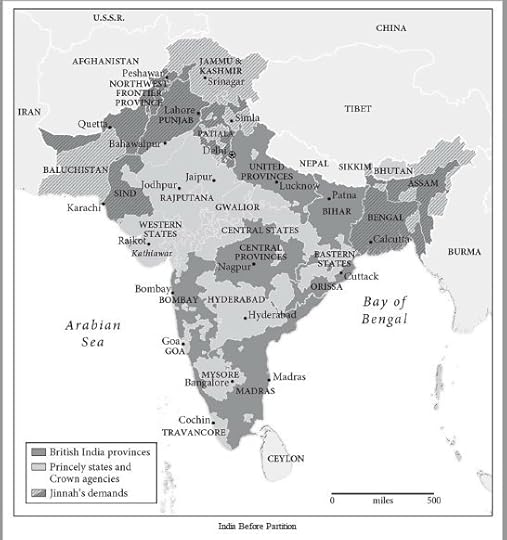
Jawaharlal Nehru and Muhammad Ali Jinnah are the central figures of this book, although Mahatma Gandhi plays a role in the story told here as well.
Midnight's Furies (it's namesake a description of the violence and horrors that took place during this partition) was written in a decent style. The furies described are almost unbelievable; babies killed, women raped and mutilated, men disemboweled and decapitated. The list goes on. And this all for a group of peoples with a shared ethnicity, divided only over religious ideology...
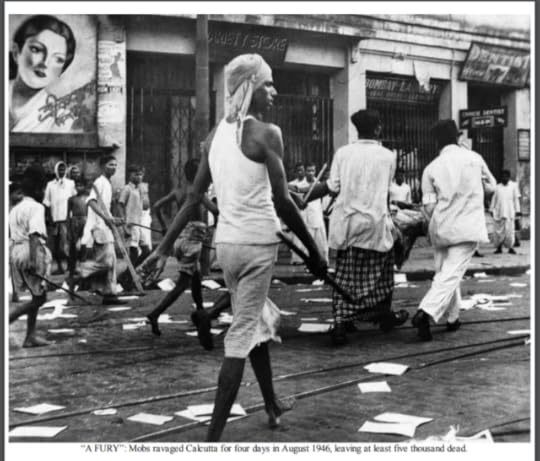
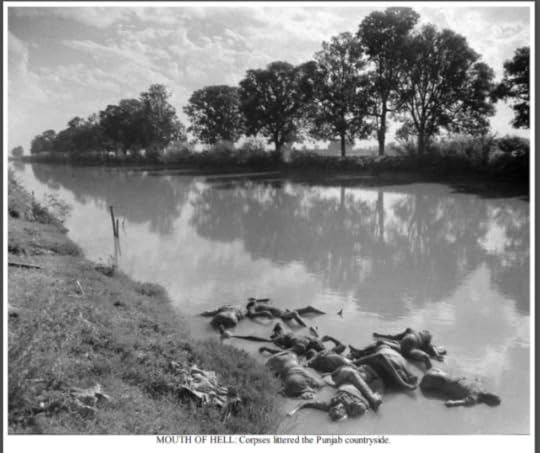
While I did enjoy this one, I found the writing to be a bit long-winded and dry.
3 stars.
Jawaharlal Nehru and Muhammad Ali Jinnah are the central figures of this book, although Mahatma Gandhi plays a role in the story told here as well.
Midnight's Furies (it's namesake a description of the violence and horrors that took place during this partition) was written in a decent style. The furies described are almost unbelievable; babies killed, women raped and mutilated, men disemboweled and decapitated. The list goes on. And this all for a group of peoples with a shared ethnicity, divided only over religious ideology...
While I did enjoy this one, I found the writing to be a bit long-winded and dry.
3 stars.
December 6, 2018
As I was reading this book, I noticed a bias. The author paints the Indian leaders Nehru and Gandhi in a positive light while portraying the Pakistani leader Jinnah negatively - even when both countries' leaders had done similar actions, Jinnah was seemingly criticized while Nehru was applauded by the author and the reaction of the public.
Furthermore, if you are going to discuss the creation of Pakistan, it is quite necessary to include Muhammad Iqbal (Allama Iqbal), as he was one of the greatest philosophical founders of Pakistan and is often quoted as the Spiritual Father of Pakistan.
This book mainly focuses on the leaders atop that were fighting the British politically, and fails to bring to account the individuals on the ground who felt the effects on a more direct level.
The book was nonetheless interesting but the more I read it, the more I saw a clear bias based upon the commentary and presentation of historical nuances.
Furthermore, if you are going to discuss the creation of Pakistan, it is quite necessary to include Muhammad Iqbal (Allama Iqbal), as he was one of the greatest philosophical founders of Pakistan and is often quoted as the Spiritual Father of Pakistan.
This book mainly focuses on the leaders atop that were fighting the British politically, and fails to bring to account the individuals on the ground who felt the effects on a more direct level.
The book was nonetheless interesting but the more I read it, the more I saw a clear bias based upon the commentary and presentation of historical nuances.

September 24, 2015
Meh. This was history in the form of a 60,000 word Wikipedia article--boring and unedifying.
I love history as a genre, but good history has got to either have (a) something human or personal going on or (b) incisive second-order analysis that gets into questions of "why" and "how". Repeating facts at excruciating length ("then Nehru did this, then some Sikhs went on a rampage") just does not cut it.
Probably the most damning thing I can say about this book is that by the end, despite spending paragraph after rote paragraph amid the author's prosaic descriptions of Nehru and Jinnah, I felt I knew neither main protagonist with any depth. Historians, do not be afraid to cast judgment! That's why we read you. Who should I like? Who should I dislike? Analyze, synthesize, suggest. I am an adult; I can handle it. Don't just give me the listing of events.
I love history as a genre, but good history has got to either have (a) something human or personal going on or (b) incisive second-order analysis that gets into questions of "why" and "how". Repeating facts at excruciating length ("then Nehru did this, then some Sikhs went on a rampage") just does not cut it.
Probably the most damning thing I can say about this book is that by the end, despite spending paragraph after rote paragraph amid the author's prosaic descriptions of Nehru and Jinnah, I felt I knew neither main protagonist with any depth. Historians, do not be afraid to cast judgment! That's why we read you. Who should I like? Who should I dislike? Analyze, synthesize, suggest. I am an adult; I can handle it. Don't just give me the listing of events.
March 21, 2018
A solid narrative history, which helped me understand partition, and the mess that it caused. The first half of the book is the more interesting, the second half mostly depressing, as mobs hack each other to pieces and the 'leaders' of the various parties and nations do... nothing. So it's a bit of a let-down; the build up to partition is fascinating; the actual process of partition is mostly mindless violence, which is hard to make interesting, I'm sure.
Special bonus star for learning that Winston Churchill, yet again, managed to stick his nose into a situation he did not understand, that did not involve him, and that he could do nothing but make worse, and, naturally, did precisely that. Churchill is the twentieth century: a thin, peeling veneer of heroism stuck to stupidity, rot, and fetor.
Special bonus star for learning that Winston Churchill, yet again, managed to stick his nose into a situation he did not understand, that did not involve him, and that he could do nothing but make worse, and, naturally, did precisely that. Churchill is the twentieth century: a thin, peeling veneer of heroism stuck to stupidity, rot, and fetor.
Displaying 1 - 30 of 347 reviews