Soon after finishing Helen Bain’s Daffodil Days came the realisation that Sylvia knew quite a few people in North Tawton. She lived next to a church, she knew the local midwife and her cleaner and the owner of the horse-riding establishment. I wondered what might have happened if she hadn’t gone to London. If she had stayed at her house, Court Green. A tantalising possibility came to mind. That one of these people, worried about Sylvia and the children, checked on her and saved her life.
Unfortunately reading these poems after more than twenty years, I have to admit, I believe there was no saving Sylvia. So much has been written about her late poetry, the searing brilliance of it but for me the reality is that she was mentally ill. Not taking away anything from her accomplishments but the vitriol in some of these poems, particularly Lesbos and the dark obsessions featured in others, is hard to face.
I won’t attempt to critically examine any of the poems. You can pretty much read an analysis online of most of them. Instead I will write about the few that touched me in a positive way.
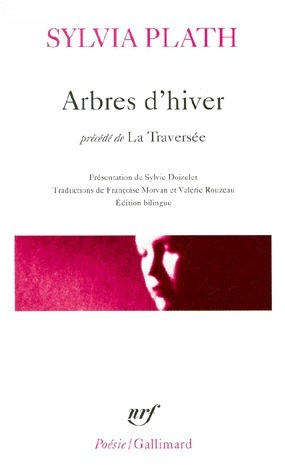
In the introduction Hughes explains that “the poems in this volume are all out of the batch from which the Ariel poems were more or less arbitrarily chosen”. Three poems: Lesbos, Mary's Song and The Swarm are in both collections. “Three Women, a Poem for Three Voices, was written slightly earlier and can be seen as a bridge between The Colossus and Ariel.” I will touch on that suite of poems soon.
The title poem, Winter Trees, starts beautifully:
“The wet dawn inks are doing their blue dissolve.
On their blotter of fog the trees
Seem a botanical drawing-
Memories growing, ring on ring,
A series of weddings.”
And then we are shocked awake by the first line of the next stanza:
“Knowing neither abortions nor butchery.”
The juxtaposition of the images are of course next level.
Maybe it is the mood I’m in but I was looking for something hopeful (a stupid thing to be doing in the poetry of Plath’s last nine months of life but there we are) and I found it in the poem Mystic which is a mediation on her life and her beliefs and her feelings about religion. She remembers a summer place in the second stanza:
“I remember
The dead smell of sun on wood cabins,
The stiffness of sails, the long salt winding sheets,
Once one has seen God, what is the remedy?
Once one has been seized up”
But oh, the last two stanzas and the very last line:
“Whose hopes are so low they are comfortable-
The humpback in her small, washed cottage
Under the spokes of the clematis.
Is there no great love, only tenderness?
Does the sea
Remember the walker upon it?
Meaning leaks from the molecules.
The chimneys of the city breathe, the window sweats,
The children leap in their cots.
The sun blooms, it is a geranium.
The heart has not stopped.”
To think that Sylvia wrote this only ten days before she died!
I’m going to jump ahead to the suite of poems, Three Women, which I had never come across before in all my reading of Plath. I don’t believe it has received enough attention. It was first broadcast in 1962. The first voice is a housewife and seems more experienced than the other two. The second voice is a secretary and it seems she has tried many times to have a child and the third a student. Each suffer in different ways the experience of giving birth. One woman gives birth to a healthy boy, another woman’s baby dies and the third baby is given up for adoption. As you read through the interweaving voices the effect of each woman’s experience builds and builds.
Here is the first woman:
“What is it that flings these innocent souls at us?
Look, they are exhausted, they are all flat out
In their canvas-sided cots, names tied to their wrists,
The little silver trophies they’ve come so far for.
There are some with thick black hair, there are some bald.
Their skin tints are pink or sallow, brown or red;
They are beginning to remember their differences.”
Here is the second woman, married who seems to have lost other babies, whether stillborn or miscarried is not clear:
“There is the moon in the high window. It is over.
How winter fills my soul! And that chalk light
Laying its scales on the windows, the windows of empty
offices,
Empty schoolrooms, empty churches. O so much emptiness!
There is this cessation. This terrible cessation of everything.
These bodies mounded around me now, these polar sleepers –
What blue, moony ray ices their dreams?”
And finally, the third woman, younger than the other two:
“She is a small island, asleep and peaceful,
And I am a white ship hooting: Goodbye, goodbye.
The day is blazing. It is very mournful.
The flowers in this room are real and tropical.
They have lived behind glass all their lives, they have been
cared for tenderly.
Now they face a winter of white sheets, white faces.
There is very little to go into my suitcase.”
Sylvia Plath: trailblazing and original but often distressing to read. Not for the faint-hearted. Four and a half stars.